
Brexit Kitty

Does anyone know who our “lead councillor for Brexit” is?
The government required every council to appoint someone to be responsible for Brexit preparations:
Searching under “Brexit” on the EDDC site brought up no information except generic government information non-specific to East Devon, instead the site kicks responsibility to our Local Enterprise Partnership, saying that:
“The Heart of the South West Growth Hub
Our LEP wide Growth Hub continue to update their Brexit page with useful links to trustworthy sources of information & advice, Brexit related events and other resources that could be of use to local businesses.
Find out more, see the HotSW Growth Hub Brexit Resources page.”
Unfortunately, the link to the resource page apoears to be dead!
This LEP page did again have some very general information:
So, how prepared is East Devon for Brexit and who is in charge?
It’s getting nearer …..
Backlog of dead bodies
Clean drinking water
Unrest
Illegal immigrants
Far right
Reduced house building
Fuel shortages
Rubbish piling up
https://www.mirror.co.uk/news/politics/no-deal-brexit-chaos-feared-20058935
Is this why Swire is jumping ship?
“Local authorities are bracing themselves for widespread food, fuel and medicine shortages, civil unrest and job losses in the event that the United Kingdom leaves the European Union without a deal at the end of October.
Well over half of 63 local authorities nationwide expect a shortage of basic necessities if the UK leaves the EU without a Brexit deal, according to Freedom of Information requests sent by the People’s Vote campaign.
According to the documents compiled by the campaign:
68% of councils said they expected food shortages.
59% of councils said they were preparing for fuel shortages.
52% expected medicine shortages.
65% are preparing for “civil unrest,” “increased tensions,” and “public disorder.”
https://www.insider.com/no-deal-brexit-documents-reveal-councils-expect-food-shortages-riots-2019-9
“Government departments have ploughed nearly £100m into “overly secretive” Brexit consultant contracts since the 2016 referendum, MPs have said.
Publicly available information on consultancy work to prepare for Brexit is lacking and in some cases has taken too long – up to 237 days – to materialise, according to a Public Accounts Committee report out today.
Government guidelines say details of contracts should be published within 90 days of being awarded.
“Departments have been overly secretive about what the consultants are doing,” the PAC said.
“When departments have published information on consultancy work, usually later than they should have, they have failed to meet the government’s own transparency standards.”
Even when documents are published they are often “over-zealously redacted, the committee added.
The MPs also accused the government of being “overly relaxed” that 96% of the £97m spent on consultancy contracts has gone on just six large companies, despite the governments supposed “aspirations for more government work to go to small and medium-sized enterprise”.
The committee report suggested the true cost of Brexit consultancy work was not known, due to differing definitions of ‘consultancy’.
It said: “There is a widening gap between the Cabinet Office’s analysis of data on overall spending on consultancy services, not just to support Brexit, and expenditure reported by the departments.
“It appears that different departments are choosing to categorise their spending on consultancy services in different ways.”
For 2017-18 the Cabinet Office said total spend on all consultancy – not just for Brexit – was £1.5bn whereas analysis of invoices from individual departments suggested only £0.3bn was spent.
The Cabinet Office has been approached for a response. …”
Source: CIPFA (pay wall)
Owl isn’t convinced!
“With the current unrest in Parliament – linked to indecision around Brexit – Honiton Nub News contacted local MP Neil Parish to find out his thoughts on what is going on.
He said: “I supported the PM in his call for a general election, so the country can decide who deals with Brexit.
“Parliament is not functioning properly.
“There is no majority for the executive, MPs are not respecting the referendum result – and are now refusing to face public opinion.
“It can’t go on. After Party conference, the impasse must be broken at the earliest opportunity.
“I want to get on with leaving the EU, recruiting 20,000 extra police officers, providing a £14 billion cash boost for schools, 20 new hospital upgrades and transformative infrastructure investment on transport and superfast fibre broadband.
“These are all things which are crucial for our area.”
The schism between East Devon and West Dorset MPs widens:

Photo: BBC
May be not such a bad idea …
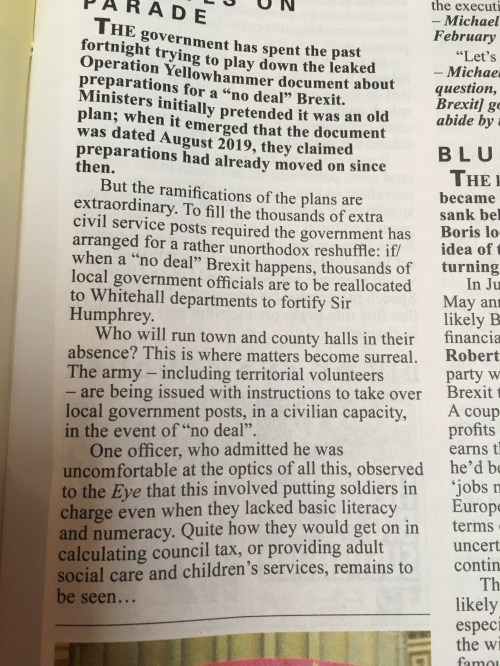
Source: Private Eye
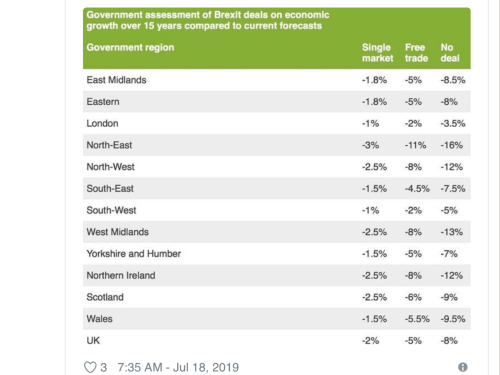
South-west growth 0.25% since referendum, slowest of all regions since the referendum in 2016. Hello, Local Enterprise Partnership – HELLO! Any response? Any new figures? Any new ideas?
“London’s financial services sector has been in recession since the third quarter of 2017, regional GDP figures from the Office for National Statistics have revealed.
In the 18 months to the end of last year the capital’s banking and asset management industry shrank 11 per cent. The ONS did not explain the slump but it is likely to be related to Brexit as banks and insurers downsized British operations and directed new investment overseas.
The regional GDP figures, which cover England and Wales, revealed that the South West, which voted to leave the EU, has been the slowest growing English region since the 2016 referendum. It grew 0.25 per cent between the second quarter of 2016 and the end of last year.
The figures, which start in the second quarter of 2012 and run to the final quarter of last year, show that London has grown the fastest, expanding 21 per cent, while the North East and South West have been slowest, at 5.5 per cent and 7 per cent respectively.
London’s success has been despite the downturn in the square mile. Financial services contributed £132 billion to GDP last year, 6.9 per cent of total output, with half of that from the capital. Of the industry’s 1.1 million jobs, 400,000 were in London last year, analysis by the House of Commons library showed. …”
So, what are MPs FOR?
This chap was selected by around 90,000 people out of a population of 66 million – whyy does HE get to decide?
“Legal school meal nutrition standards may need to be amended, or discarded, in the event of a no-deal Brexit, according to internal local council planning documents seen by the BBC.
The standards are designed to make sure school children are fed healthy food.
Many councils say school meal costs will rise and funding for free school meals increase if there is no-deal.
The government said the food industry was “well versed at dealing with scenarios that can affect food supply.”
“We have a highly-resilient food supply chain and consumers in the UK have access to a range of sources of food. This will continue to be the case when we leave the EU.”
Prime Minister Boris Johnson insisted earlier on Monday that no-deal Brexit preparations are on track.
Some councils are anticipating they will not meet nutrition standards because of a rise in food prices and restriction of choice anticipated after a no-deal Brexit, particularly on fresh imports from Europe.
For example, North Ayrshire Council says it “might need to amend school nutrition standards”, in its internal Brexit planning document.
Local councils are legally obliged to provide high standard food to vulnerable users of public services and to manage the food supply challenges of leaving the EU without a deal.
Other councils, such as North Tyneside, report that “special dietary requirements may be difficult to meet” and that “if fresh produce is difficult to come by” schools should “increase use of tins and frozen goods”.
Many councils say that prices for school meals will rise, and central government funding for free school meals will have to increase.
Some also mention the possible use of food banks. Slough has contacted food banks in its area to check contingency plans for food shortages, and some Scottish councils have already increased funding for extra provision from food banks.
Bedford Council’s planning document from its internal Brexit planning team says care homes are “advised to hold four to six weeks supply of non-perishable foodstuffs”.
Hastings Council’s internal Brexit risk document even goes as far as saying: “There might be the need for rationing. The severity would depend on what was available and particularly the duration of any shortages.”
Insiders suggest this is a reference to the prevention of stockpiling, more than a return to wartime ration books.
The documents seen by the BBC date from the end of last year – up until last month – but predate the appointment of Boris Johnson as prime minister.
Most take at face value the government’s national assessment for March that there will be no impact of a no-deal Brexit on overall food supply, but there could be an impact on price and choice.
An October no-deal Brexit would come, however, at a time when the UK is particularly dependent on European imports for its fresh food, and when there is little to no excess warehousing space, unlike in March.
One catering industry veteran, Andy Jones, the chair of the Public Sector 100 Group of caterers, backed the councils: “Given a no-deal Brexit, they’re being very sensible. They’re being very cautious, and rightly so, we’re going into something that we don’t know about, we’re going to the unknown.
“If a no-deal Brexit happens, I feel that the supply chain long term will absolutely be under pressure. And that will affect the most vulnerable in society. …”
Hello, Mr Parish, HELLO …
“The UK must accept US food standards as part of any future trade deal with Washington, the head of America’s farming lobby has said.
Zippy Duvall, head of the American Farm Bureau, said US farmers were keen to trade with their British “friends”.
But he said fears over practices such as washing chicken in chlorine and using genetically modified (GM) crops were not “science-based”.
The US has said the UK will be “first in line” for a trade deal after Brexit.
But some fear the UK will have to compromise on standards currently enshrined in EU law in order to secure a deal with Washington.
Mr Duvall, himself a poultry farmer in Georgia, said he wanted to have “a conversation” about US food standards given the concerns in the UK.
One of the most controversial practices is washing chicken with chlorine to kill germs, which is banned in the EU. This is not because the wash itself is harmful but over fears that treating meat with chlorine at the end allows poorer hygiene elsewhere in the production process.
“You know, here in America we treat our water with chlorine,” Mr Duvall told the BBC’s Today programme.
“So there is no scientific basis that says that washing poultry with a chlorine wash just to be safe of whatever pathogens might be on that chicken as it was prepared for the market, should be taken away.
“If there was something wrong with it our federal inspection systems would not be allowing us to use that,” he added.
Harmful competition?
In London this week, Donald Trump’s national security advisor John Bolton suggested that the US could strike trade deals with the UK after Brexit on a “sector-by -sector basis” to speed up the process.
But asked whether he could envisage a trade deal with the UK that did not include agriculture, Mr Duvall said it would be seen as a betrayal by US farmers.
“To have a trade treaty and not discuss agriculture would be turning your back on rural America and that’s where a big part of our population lives. …”
One wonders what attracted Swire to direct the push for him as PM … actually, on second thoughts, one doesn’t!
“What do we know about Dominic Raab, and what does it tell us about how he might approach his new job as Brexit secretary?
Prediction is a fool’s game in Brexit Britain, but as this hardcore leaver settles behind his desk, Raab’s controversial ideology may offer some clues.
Dominic Raab: bullish Brexiter with outspoken reputation.
Brexit poses a serious challenge to many of the rights we take for granted, including workers’ rights and our right to equality, which is not protected by a written constitution. Many of those rights that we enjoy today are in very substantial measure the product of our membership of the European Union, underpinned and developed over 40 years through laws passed and case law developed with British input. Once we leave the EU, any of those rights that originate with our EU membership, for example working time protections and the right to equal pay for work of equal value, are subject to potential removal or restriction by a future government so inclined.
And Dominic Raab arrives into his new job with the credentials of someone who may well be so inclined. Our new Brexit secretary is a man who believes the time has come for men to burn their briefs. He has called for an end to obnoxious “feminist bigotry”, and thinks we’ve already sorted equality – for women anyway – so the real cause of advancement should be men’s rights.
According to him, we shouldn’t be worried about the gender pay gap because “men work longer hours, die earlier but retire later than women.” In fact, it’s discrimination against men we should be getting exercised about: “from the cradle to the grave, men are getting a raw deal”.
Raab’s regressive views aren’t limited to gender. He has a long history of decrying the “excessive protections” of workers’ rights in favour of the rights of business. He has consistently made clear his contempt for regulation. Raab expressly compared Britain to the “rising” power of Singapore in a 2011 report called “Escaping the Straitjacket”. and argued that the “burden of employment regulation” was a “dragging anchor” on the British economy. He called for scrapping the requirement for small businesses to pay those aged under 21 the minimum wage, renegotiating the UK’s treaty obligations with the EU on workers’ rights, and securing a total opt out from European working time regulations. …. “
https://amp.theguardian.com/commentisfree/2018/jul/11/dominic-raab-ideologue-rights-eu-brexit
Brings backsome old memories:
https://eastdevonwatch.org/2014/09/22/ex-councillor-browns-facts-disputed-2/
Anyone see parallels?
“Boris Johnson’s controversial enforcer, Dominic Cummings, an architect of Brexit and a fierce critic of Brussels, is co-owner of a farm that has received €250,000 (£235,000) in EU farming subsidies, the Observer can reveal.
The revelation is a potential embarrassment for the mastermind behind Johnson’s push to leave the EU by 31 October. Since being appointed as Johnson’s chief adviser, Cummings has presented the battle to leave the EU as one between the people and the politicians. He positions himself as an outsider who wants to demolish elites, end the “absurd subsidies” paid out by the EU and liberate the UK from its arcane rules and regulations.
But his critics say the revelation that Cummings has benefited from the system he intends to smash underscores how many British farmers are reliant on EU money that would evaporate if the UK leaves.
An Observer analysis of Land Registry documents and EU subsidy databases reveals that a farm in Durham, which Cummings jointly owns with his parents and another person, has received roughly €20,000 a year for most of the last two decades.
The revelation opens Cummings up to charges of hypocrisy, as writing on his blog, he has attacked the use of agricultural subsidies “dreamed up in the 1950s and 1960s” because they “raise prices for the poor to subsidise rich farmers while damaging agriculture in Africa”. …”
“Schools may have to close, exams could be disrupted and fresh food for pupils’ meals could run short because of panic buying with prices soaring by up to 20%, according to a secret Department for Education analysis of the risks of a no-deal Brexit obtained by the Observer.
The five-page document – marked “Official Sensitive” and with the instruction “Do Not Circulate” – also raises the possibility of teacher absences caused by travel disruption, citing schools in Kent as particularly at risk.
On the dangers of food shortages to schools, it suggests that informing the public of the risks could make matters even worse.
In a section entitled School Food, it talks of the “risk that communications in this area could spark undue alarm or panic food buying among the general public”.
And it adds: “Warehousing and stockpiling capacity will be more limited in the pre-Xmas period. The department has limited levers to address these risks. We are heavily dependent on the actions of major suppliers and other government departments to ensure continued provision.”
Listing the actions the department would take in the event of food shortages affecting schools, the document says: “In light of any food shortages or price increases we will communicate how schools can interpret the food menu standards flexibly. DfE may make exceptional payments – or submit a prepared bid to HM Treasury for additional funding. Worst case scenario estimate of the increased costs – £40 to £85m a year for schools in relation to free school meal provision based on price increases of 10-20%,p. ….”
* If all councils given an equal share – except ports of entry will probably get more so other councils will get less.
“English councils have been told to designate a “Brexit lead” to work with central government to prepare for the possibility that the UK will leave the European Union with no deal at the end of October.
But a £20m funding pledge to help authorities step up preparations was immediately described as an “insult”, as the Ministry for Housing, Communities and Local Government (MHCLG) was forced to concede that the full amount had already been pledged in previous announcements.
In the new policy announced on Saturday, Robert Jenrick, the recently appointed communities secretary, instructed authorities to appoint staff in every community to plan intensively for Brexit with local stakeholders.
The funding was being made available for communications as well as for recruiting and training new staff, Jenrick said.
Officials were considering how best to allocate the cash to ensure that those areas facing more acute potential stresses, such as ports of entry, get the funding they need. Shared equally, it would amount to about £57,000 for each of England’s 353 councils and combined authorities, according to the Guardian’s calculation.
The Labour MP Jess Phillips said: “The idea that £20m across the 353 main councils of England is enough to prepare is an insult to our intelligence and to the hard work of public servants struggling with the consequences of the government’s decision to force a vicious Brexit on us.”
Criticism intensified after a MHCLG spokeswoman admitted half the pledged funding comes from the chancellor Sajid Javid’s £2.1bn announcement on Thursday. The other half comes from funding announced by the department in January, she added.
“This offers no new money and no new ideas for how to address the cliff-edge councils are facing,” Andrew Gwynne, the shadow communities secretary, said.
The Liberal Democrat MP Christine Jardine added: “This extra money is a drop in the ocean for cash-strapped councils desperately concerned about what no-deal Brexit will mean for crucial public services in their areas.”
Councils across the country welcomed the funding but highlighted the shortfall they are already facing.
Kevin Bentley, the chairman of the Brexit taskforce at the Local Government Association, said: “With councils already facing a funding gap of more than £3bn in 2019/20, it is more important now than ever that councils receive the resources they need for their ongoing Brexit preparations.
“There remains information and advice gaps that councils are facing while helping their communities prepare, which need to be met by the government.
“Councils also need certainty to plan for their communities over the longer term, such as on the domestic replacement for EU funding.”

“Weeks after paying £43m for the city-state’s most expensive penthouse, the inventor has reportedly lined up a £26.5m house …
Dyson, 72, a prominent supporter of Brexit, announced plans in January to move his company’s head office from Britain to Singapore to be closer to its fastest-growing markets. His firm plans to build its first electric car in the city-state.
Dyson has also purchased a three-storey “super penthouse” at the top of Singapore’s tallest building. He reportedly paid £43m for the five-bedroom property which comes complete with a 600-bottle wine cellar.
A spokeswoman for his company, Dyson Limited, said: “We do not comment on the private affairs of the Dyson family.”
When contacted about the previous penthouse purchase, a spokesman said: “Given the decision to locate the headquarters in Singapore and the growing focus of the company’s business in the region, of course James Dyson has bought a property there.”
By Peter Jukes:
The MARCH of LOOT
As the contest finally creaks
Into its last corrupted weeks,
So much is owed to the people who
Were robbed so often by so few.
Bombasts, blowhards, sound your horn,
Herald this disastrous dawn,
Moguls, oligarchs, raise a glass
As your chumps and champions pass.
In a bus, emblazoned in red,
Farage and Bannon at its head,
Inside he waits for Trump to tweet:
This is the triumph of deceit.
Piffle, kippers, dead cats, whey –
The land of Shakespeare blown away,
Famed for gravity and honour,
Led by a dunce to ruin and squalor.
*
Far away, in warmer water,
Kitts and Nevis, Cyprus, Malta
Lucre glitters, laughs and flies
Back to London where it buys…
Lawyers, bankers, spooks and hacks,
Shorting, leaking, legal attacks.
On the road to Downing Street,
All these frauds and chancers meet.
Stolen rubles, hedge fund debt
All double down on this last bet
To bribe, blackmail, and take power
In Britain’s most inglorious hour.
Churchill, Cromwell, pale with shame
Freeze with horror at his name.
Rooks are silent, lions mute,
At the vainglorious March of Loot.
*
Land of honour and fair play
Never saw a darker day.
As the doors of Number Ten
Close behind the hollow men
Who whistled up the dogs of race
And brought a nation to disgrace.
Weep Britannia, weep in grief.
Hope your neighbours bring relief.
Tell the truth – this cannot last.
Hold the faith, and hold it fast,
As clown, liar, cheat and fool,
Boris Johnson starts his rule.
 East Devon Watch