Glover Review of National Parks and AONBs – interim findings

Some quotes:

“… The message from all this work has been vigorous and clear. We should not be satisfied with what we have at the moment. It falls short of what can be achieved, what the people of our country want and what the government says it expects in the 25-year plan for the environment.

Some of this failure comes from the fact that our protected landscapes have
not been given the tools, the funding and the direction to do the job we should now expect of them. I want to praise the commitment of those who work to protect our landscapes today. Everywhere I’ve been I’ve seen energy,
enthusiasm and examples of success.

Supporting schools, youth ranger schemes, farm clusters, joint working with
all sorts of organisations, tourism, planning and design, backing local
businesses, coping with the complexities of local and central government –
things like this happen every day, not much thanks is given for them and yet
much of it is done well, for relatively small sums.

But all this impressive effort is not achieving anything like as much as it could.

We need to reignite the fire and vision which brought this system into being in 1949. We need our finest landscapes to be places of natural beauty which look up and outwards to the nation they serve.

In essence, our review will ask not ‘what do protected landscapes need?’, but “what does the nation need from them today?’….

We think that AONBs should be strengthened, with increased funding, new purposes and a greater voice on development. We have been impressed by what they often achieve now through partnership working.

We believe there is a very strong case for increasing funding to AONBs. We will make proposals in our final review.

– We have been asked to give our view on the potential for new designations. We will set this out in our final report.”

Click to access landscapes-review-interim-findings-july2019.pdf
“Rural domestic abusers being protected by countryside culture”

“Rural women enduring domestic abuse are half as likely as urban victims to report their suffering and are being failed by authorities with perpetrators shielded by countryside culture, a report says.

Abusers are protected by the isolation of the countryside and traditional patriarchal attitudes, says the report from the National Rural Crime Network. It is the first study of its kind and finds that close-knit rural communities can facilitate abuse which can last, on average, 25% longer than in urban areas.

Some abusers move their partners from urban areas, where detection is more likely, to rural areas.

The report, published on Wednesday, says: “Rurality and isolation are used as a weapon by abusers. Financial control, removal from friends, isolation from family are all well-understood tools of abuse.”

It continues: “We have revealed a traditional society where women (and it is mostly women) are subjugated, abused and controlled, not just by an individual abuser, but de facto by very the communities in which they live, too often left unsupported and unprotected. This is not at all unique to rural areas, but it is very significant, and change is slow.”

Abusers exploiting isolation is a common theme in the report. One woman said: “My partner used to deliberately drive off to work with the kids’ car seats in his car, which meant I could not go anywhere safely because I was stuck in the cottage with the kids … it was just another way he isolated me and kept me from interacting with anyone else.”

The National Rural Crime Network is funded largely by police forces and their police and crime commissioners, to improve public safety in rural areas.

The report says that traditional, patriarchal communities control and subjugate women. “Rural communities are still dominated by men and follow a set of age-old, protected and unwritten principles.

“Men tend to hold the rural positions of power – head of the household, landowner, landlord, policeman, farmer. This patriarchal society makes women more vulnerable to coercion and control, prevented from speaking out and accessing support.”

Some cases have led to murder, such as that of Lance Hart, 57, who shot dead his wife Claire, 50, and daughter Charlotte, 19, in Spalding, Lincolnshire, in 2016, before killing himself. Claire Hart suffered years of controlling behaviour without the authorities realising and was killed after leaving her abusive husband.

One caseworker in County Durham said of the people suffering: “Many of them are in such a stressful situation they have shut down from any kind of rational thinking. It’s like all their effort goes into survival mode or protection for the kids … The longer it goes on the less likely they are to see the dangers.”

Escape is harder than in urban Britain because of shrinking resources and cuts to public services, the report says. “The availability of public services in rural areas more generally is on the decline, limiting the support networks and escape routes available to victims.

“A recently evidenced reduction in rural GP practices and challenges of effective broadband are good examples. This equally extends to services like buses and trains, whereby it remains very difficult (and getting worse) to travel within rural areas without a private vehicle. Abusers use this to limit victims’ movements, rendering already inaccessible services all but impossible to contact. …”

https://www.theguardian.com/society/2019/jul/17/rural-domestic-abusers-being-protected-by-countryside-culture?CMP=Share_iOSApp_Other

Rural broadband still a dream for many – and will remain one

Shelve that dream of running an internet-based company in many parts of rural East Devon.

“The company awarded the publicly-subsidised contract to deliver superfast broadband to thousands of rural homes in Devon and Somerset has been given a deadline to come up with a rescue plan for the programme.

Last September, Gigaclear admitted the project was facing significant delays and was two years behind schedule.

Connecting Devon and Somerset, the organisation in charge of the whole project, stopped paying Gigaclear nine months ago.

It has told the firm it must come up with acceptable plans by the end of July to fulfill the contract.”

https://www.bbc.co.uk/news/live/uk-england-devon-48664146

Vouchers up to £350 available to upgrade poor broadband services in Devon

“If you currently experience broadband speeds of less than 2 Megabits per second (Mbps), the Better Broadband Voucher Scheme may be able to help you access a basic broadband service that will offer download speeds of at least 10 Mbps.

The Better Broadband Voucher Scheme, developed by the UK government, provides a voucher worth up to £350 for basic broadband installation to homes and businesses that will not benefit from superfast broadband within the next twelve months. …”

To see if you qualify, see here:

Home

Fat cat mobile phone companies want £600m from the government to cover country

Mobile phone companies make large profits. They do not want to spend their money on coverage, it goes to bonuses and dividends. They want all of us taxpayers to dig further into our pockets to provide them with bigger profits from wider coverage.

“Mobile operators want ministers to invest more than £600m to tackle poor phone signals in the countryside.

O2, Three UK, BT’s EE and Vodafone want backing for their plan to invest jointly in a single rural network that would give the four operators 95% coverage.

Only 66% of the country enjoys full coverage, so millions of people and thousands of businesses have to grapple with patchy signals or total black spots.

The mobile giants are willing to invest £533m to stamp out “partial not spots”, where one or more operators cannot provide a signal. That would bring national coverage up to 88% through a barter system, where they would share access to each other’s masts.

In return, they want the exchequer to foot the bill for 95% coverage. That includes spending about £620m over 20 years on areas with no signal, and £6m on opening up the Emergency Services Network used by police and ambulance workers.

Operators have told ministers those costs could fall by £90m if planning rules around issues such as mast heights were relaxed.”

Source: Sunday Times (pay wall)

“Rewild a quarter of UK to fight climate crisis, campaigners urge”

Rewilding would (according to the Environment Secretary) focus on:

Native woodlands
Salt marshes
Peat bogs
Ponds and lakes
Meadows and grasslands

all of which we have in abundance in East Devon.

Perhaps it is now time to revive the idea of a Jurassic Coast National Park (West Dorset would be an already-enthusiastic partner) which was squashed by the previous council because they feared losing their cosy relationship with housing developers …

And, as part of our climate emergency, make rewilding an integral part of all future neighbourhood, district and Greater Exeter development plans.

“More than 2,500 post offices are set to close in one year unless ministers intervene”

“MORE THAN 2,500 post offices will be wiped out within a year unless ministers intervene, a trade body is warning.

Business Secretary Greg Clark was last night told communities across the UK face “catastrophe” without Government action.

In a blistering report, the National Federation of SubPostmasters (NFSP) warns that the Post Office network is “beyond tipping point” and urgent support is required to keep almost one in four branches going.

The Federation says a “digital” first approach by ministers means that revenue from providing Government services such as DVLA forms has collapsed from £576 million in 2005 to just £99 million in 2018.

And it says Royal Mail appears more interested in dealing directly with the public over the web than supporting the network.

Some 98 per cent of Post Offices are run by franchisees or ‘SubPostmasters’, with many vital for smaller towns or villages. There are 9,300 branches employing approximately 40,000 people.

‘BEYOND TIPPING POINT’

Calum Greenhow, NFSP chief said: “The viability of sub post offices and the morale of sub postmasters has been eroded to the extent that the network’s resilience is extremely limited.

“We believe a tipping point has been passed and the consequences of this are now being realised.”

He added: “SubPostmasters are resigning in high numbers because it is increasingly difficult to make a decent living.

“The closure of 2,500 post offices in a year would be a catastrophic loss to communities across the UK.”

https://www.thesun.co.uk/news/9109911/post-offices-close-one-year-report-warns/

“Bus services should be designed for young people, says watchdog”

“Bus tickets need to be cheaper and easier to buy using contactless and smart phones to attract young people, according to the UK transport watchdog.

Despite being the biggest users of buses 16-18 year-olds are also the least satisfied, Transport Focus found.

The watchdog also recommended companies should install wi-fi and USB charging points on board, to encourage younger people to travel on buses.
Bus companies said they were investing in services young people expect.
Graham Vidler, chief executive of CPT UK, the trade association which represents bus and coach operators, said the industry recognised the importance of meeting the expectations of younger travellers. …

… Transport Focus gave the example of a flat fare of £2.20 for unlimited travel in and around Liverpool, which it said had led to a significant rise in the number of under 18-year-olds using buses. …”

https://www.bbc.co.uk/news/business-48303401

“Almost one in 10 cash machines vanishing from East Devon”

“… Figures show one in ten cash machines – or ATMS – have disappeared from East Devon’s high streets in the last two years, amid warnings the UK’s cash system is ‘falling apart’.

At the end of 2017, there were around 230 ATMs – according to data from the cash machine network Link – this has now fallen to 208, as of February this year.

The number of free-to-use cash points has also gone down from 179 in 2017 to 171 two years later.

An independent review published in March found that around eight million adults – 17 per cent of the population – were still reliant on cash and would struggle to cope in an entirely digital economy.

These included people in rural communities, those on a low income who may struggle to budget without cash, and older people or people with disabilities who rely on cash for their independence.

Natalie Ceeney, chair of the Access to Cash Review, said: “There are worrying signs that our cash system is falling apart.

“ATM and bank branch closures are just the tip of the iceberg – underneath there is a huge infrastructure which is becoming increasingly unviable as cash use declines.

“We need to guarantee people’s right to access cash, and ensure that they can still spend it.”

A recent report by consumer watchdog Which? found almost 1,700 previously-free cash machines had begun charging users between January and March of this year. …”

https://www.exmouthjournal.co.uk/news/east-devon-atms-disappeating-figures-show-1-6047802

“Rural communities being ignored and underrated, say peers”

“Rural communities have been “ignored” and had “inappropriate” policies forced upon them, a report says.

A group of peers said a new agenda for the countryside was needed similar to the government’s industrial strategy.

Priorities included improving mobile and broadband connections, replacing lost bank and bus services and tackling social isolation, the House of Lords Rural Economy Committee said.

The government said it was committed to “rural proofing” policies.
Ministers plan to spend £3.5bn on supporting economic development in the countryside by the end of 2020 through the Rural Development Programme.
The cross-party committee of peers said policies suitable for urban and suburban areas had too often been foisted upon the countryside.

As well as improving communications, it is calling for action to address the supply and cost of housing and a lack of training for people working in rural industries.

“Successive governments have underrated the contribution rural economies can make to the nation’s prosperity and wellbeing,” it said.

“They have applied policies which are often inappropriate for rural England. This must change. With rural England at a point of major transition, a different approach is needed.”

Lord Foster, the Lib Dem peer and former MP who chairs the committee, said the “clear inequalities” between urban and rural areas could not be allowed to continue.

He called for a policy blueprint of equal ambition to the government’s industrial strategy to realise the potential of struggling and under-performing areas. …

… Only 41% of rural premises received a mobile data link of 2Mbps or higher, it found, compared with 83% in urban areas. …”

https://www.bbc.co.uk/news/uk-politics-48065625

“Half of England is owned by less than 1% of the population”

“Half of England is owned by less than 1% of its population, according to new data shared with the Guardian which seeks to penetrate the secrecy that has traditionally surrounded land ownership.

The findings, described as “astonishingly unequal”, suggest that about 25,000 landowners – typically members of the aristocracy and corporations – have control of half of the country.

The figures show that if the land were distributed evenly across the entire population, each person would have almost an acre – an area roughly the size of Parliament Square in central London.

Major owners include the Duke of Buccleuch, the Queen, several large grouse moor estates, and the entrepreneur James Dyson.

While land has long been concentrated in the hands of a small number of owners, precise information about property ownership has been notoriously hard to access. But a combination of the development of digital maps and data as well as pressure from campaigners has made it possible to assemble the shocking statistics.

Jon Trickett, Labour MP and shadow minister for the Cabinet Office, hailed the significance of the findings and called for a full debate on the issue, adding: “The dramatic concentration of land ownership is an inescapable reminder that ours is a country for the few and not the many.”

“It’s simply not right that aristocrats, whose families have owned the same areas of land for centuries, and large corporations exercise more influence over local neighbourhoods – in both urban and rural areas – than the people who live there.”

“Land is a source of wealth, it impacts on house prices, it is a source of food and it can provide enjoyment for millions of people.”

Guy Shrubsole, author of the book in which the figures are revealed, Who Owns England?, argues that the findings show a picture that has not changed for centuries.

“Most people remain unaware of quite how much land is owned by so few,” he writes, adding: “A few thousand dukes, baronets and country squires own far more land than all of middle England put together.”

“Land ownership in England is astonishingly unequal, heavily concentrated in the hands of a tiny elite.” …”

https://www.theguardian.com/money/2019/apr/17/who-owns-england-thousand-secret-landowners-author

Stagecoach rail franchise in pensions row

Owl says: Stagecoach has a near monopoly on bus routes in the Exeter commuter and rural hinterland – hoping the bus franchise is healthier.

But just another privatisation cash grab.

“Stagecoach says it is “extremely concerned” after the Department for Transport (DfT) barred it from three UK rail franchise bids.

The DfT says the bids for the East Midlands, South Eastern and West Coast franchises were “non-compliant” because they did not meet pensions rules.
Martin Griffiths, chief executive of Scotland-based Stagecoach, has called for an “urgent meeting” with the DfT.

Stagecoach had “repeatedly ignored established rules”, the DfT said.
Mr Griffiths said in a statement: “We are extremely concerned at both the DfT’s decision and its timing. The department has had full knowledge of these bids for a lengthy period and we are seeking an urgent meeting to discuss our significant concerns.”

Bidders for the franchises have been asked to bear full long-term funding risk on relevant sections of the Railways Pension Scheme, Stagecoach said. The Pensions Regulator has estimated the UK rail industry needs an additional £5-6bn to plug the pensions shortfall, and the company said it was being asked to take on risks it “cannot control and manage”. …”

https://www.bbc.co.uk/news/business-47877858

Gigaclear rural broadband project – paused probably for many months

From the blog of DCC Independent Councillor Claire Wright:

“There has been a delay now for sometime in Devon on the implementation of fibre to the home broadband. This means individual connections from the fibre cables in the road to each house.

A huge operation that was started by BT and in the past two years or so, operated by Gigaclear under the management of Connecting Devon and Somerset (Devon and Somerset County Councils).

Unfortunately, the timetable has slipped last autumn, partly due to the collapse of Carillion (Gigaclear were partners with a Carillion subsidiary engineering company) and partly due to the enormity of the Devon operation and road layouts.

One of the problems has been traditional Devon banks which have apparently been a challenge as the company usually digs up grass verges to install cables. Devon banks are also (quite rightly) protected under planning policy.

Connecting Devon and Somerset have had to apply for a funding extension from the government to allow for the extension of this work. This has been agreed in principle but won’t be endorsed nor the money received until the next comprehensive spending review later this year.

So without the firm confirmation contract extension funding and other logistical issues, there is still a delay of an unknown number of months.

This is deeply disappointing indeed and incredibly frustrating for communities such as Aylesbeare which doesn’t even have superfast broadband so residents are putting up with speeds of less than one megabit. I’m also aware that there are people living on the edges of communities who also have poor broadband service.

For residents and communities frustrated at the lack of connectivity there are other options, such as a voucher scheme to offset the cost of roof aerials for individual properties. For a bigger scheme involving whole communities, telecommunications companies can quote for a village service.

There are no easy solutions at the moment unfortunately and this is deeply frustrating for me and for many people in my ward.

Please email me if you have any questions at claire@claire-wright.org

I will update you when I know more.”

http://www.claire-wright.org/index.php/post/fibre_to_home_broadband_delayed_for_an_unknown_number_of_months

“When Will Britain Acknowledge Our Countryside Poverty?”

“… If you live in a rural environment your chances of being successful in life are very much linked to your early years. I live in rural Worcestershire, and went to college from rural North Yorkshire. I remain the only degree educated person in my family and the reasons are clear – opportunities in rural areas are not as abundant for young people as they are in cities. As a result, our countryside has become a social mobility coldspot, with my local council of Wychavon rated 310th out of 324 councils in a recent government report. If your parents are plumbers or cleaners, bakers or builders, the chances are you will follow in their footsteps. For some, through choice, but for others, it is because options are limited.

It is easy to hide social mobility in the countryside. My town of Pershore is generally a well-off and affluent area. House prices and wages are above the national average, the town is a great place to raise children and the schools are generally good. But if you are from a working-class background and work in the service industry the average house prices of £300,000 quickly make the experience of living in the area unsustainable. And the recent revelation that house prices have been forced upwards by the government’s Help to Buy scheme, just adds to the issues people face. With housing unaffordable, people are struggling to help their children access opportunities to increase their chances in life.

Education is the key to success. Education opens doors to all, regardless of backgrounds. But in a rural area, education opportunities can be very limited. Schools have the added pressures of large catchment areas, with children travelling from a wide area. Class sizes can also be small and, in the current educational climate, unsustainable. So schools have to focus on traditional GCSE and A level subjects, limiting their students’ knowledge of other, potentially inspiring minority subjects. Similarly colleges focus on qualifications aimed at the local economy. In Pershore, our local college is an agricultural centre so, if a young person wants to study ancient history or geology, electrical engineering or photography, they must travel to neighbouring towns. This commute requires time and the money, and is also restricted further by the continued reduction of bus services in the area.

But it is an even bigger issue for the local economy if young people decide to go to university. As young men and women move into cities to study at university, they create a rural brain drain. This results in a drop in the 18-30 year old population, which further limits the opportunities of those who remain as it keeps job opportunities in traditional low paid professions. New industries rarely emerge and there are few incentives for young locals to return after graduation. With limited public transport and sluggish roll-out of high speed broadband graduates find no drive to return to their childhood homes. …

… Of course not everything is perfect in major cities, but it is clear that opportunities are more accessible and education is the driving force that helps students from more deprived environments succeed in life. Wychavon, however, is struggling to keep up with the pace, with education opportunities limited and access to transport becoming ever more a problem. Has social mobility stopped? Certainly not. But if you live in a rural area, your chances are being constrained, and maybe we need to seek alternative approaches to help our rural young people succeed.”

https://www.huffingtonpost.co.uk/entry/countryside-poverty_uk_5c7da47de4b060c5e078048c

“Official Brexit rural impact report includes phrase: ‘we are f*****’ “

“An official report on the impact Brexit will have on rural Scotland includes the quote: “We are f*****,” it has emerged.

A document published by Scottish Rural Action (SRA) featured a side banner on page four carrying the statement.

It was one of a number of banners attributed to participants in a workshop which asked them to imagine what newspaper headlines they might expect to see after the UK leaves the EU.

Amanda Burgauer, SRA chairwoman, said the exercise had been used as an “icebreaker” and that several of the participants used “earthy language” in describing their feelings towards Brexit.

The comments are only explained on the following page, saying they had been put forward by those taking part in the workshop event.

Ms Burgauer said she would flag up the “design and layout” issue with the SRA design team. …”

https://www.standard.co.uk/news/politics/official-report-brexits-impact-rural-scotland-phrase-we-are-f-a4095061.html

Older, wealthier rural elderly people being targeted by fraudsters

“Fraudsters are increasingly moving out of the city and targeting older homeowners in the countryside, according to Experian, the credit checker.

Experian’s data shows a 29.5pc rise in third-party fraud against well-off homeowners in the country in 2018, with thousands of people affected.

Third-party fraud is where criminals steal an unsuspecting victim’s identity and then commit crimes in their name.

A classic example is to gather information on a victim, then apply for a bank account or credit card under their name.

This can be done with relatively little information. If a fraudster knows your full name, date of birth, plus current and previous addresses, then they are in a good position to clone your identity.

If the fraudster then intercepts the card by stealing post directed to your house, they can use the credit or debit card as if they were you.

Fraudulent credit card applications rose 31pc in 2018, Experian said.

Fraudsters have traditionally committed this kind of fraud in towns and cities, where they can rely on flats with communal mailbox areas and residents who might not challenge strangers.

But last year saw fraudsters start to change their tactics.

Nick Mothershaw, of Experian, said: “Fraudsters are now moving out of cities and into the nearby countryside.

“They will go to areas where there are wealthy houses.”

The frauds that criminals can commit under the name of a wealthy clone will be larger.

Mr Mothershaw said: “If you’re going to steal someone’s identity, you might as well steal the identity of someone with high net wealth, as the credit limits you are going to be offered are higher.” … “

https://www.telegraph.co.uk/money/consumer-affairs/financial-fraudsters-go-hunting-new-marks-country/

Rural communities and elderly will be hard-hit by cashless society

As banks and cash machines are being closed in rural areas, and where broadband for internet banking may be poor, people will struggle:

https://www.theguardian.com/money/2019/mar/06/uk-cash-system-on-the-verge-of-collapse-report-finds?CMP=Share_iOSApp_Other

Ambulances not reaching rural areas quickly enough

The article includes a postcode checker to show the situation where you live.

“Critically injured patients in rural areas are at risk due to the time it takes the ambulance service to reach them, a BBC investigation has found.
Some rural communities wait more than 20 minutes on average for 999 crews or trained members of the community to reach life-threatening cases such as cardiac arrests and stab victims.

A response should come in six to eight minutes, depending on where you live.
Experts said delays could make the difference between life and death.
This was particularly the case for cardiac arrests where “every second counts”, the British Heart Foundation (BHF) said. …”

https://www.bbc.co.uk/news/health-47362797

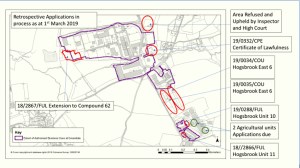
How many Retrospective Applications can one company do at once? Answer 9! Where? Greendale Business Park!

In 2017 FWS Carter and Sons, the owners of Greendale Business Park, appealed against an “Enforcement Notice” against the removal of various industrial compounds and buildings at their Business Park, which they had built prior to obtaining planning permission.

They lost their appeal with the Planning Inspector, who stated in his report that FWS Carter and Sons had misinterpreted the East Devon Local Plan and that their interpretation was “patently wrong”.

But undaunted the company challenged the Inspectors decision in the High Court. Early last year the company lost the appeal in the High Court. The Judge’s decision also restricted the owners any further opportunity to appeal and them to pay all costs arising from the case.

The Company was required to return the area back to agricultural use, but it transpires that they imported soil and laid this over the concrete yards and simply reseeded it.

It remains to be seen if the covering the concrete is enough to satisfy the Planning Inspectors requirement that the land must return to agricultural use.

Lessons learnt?

So once bitten, twice shy you would have thought with substantial losses, large court fees and professional fees involved!!

Unfortunately, it would seem not, for this family run business. Now there are 9 applications which are known to have been or are in the process of building work before the Planning Applications were submitted.

18/2866/FUL. A retrospective planning application for a rear roller shutter door and concrete pad on the rear of an industrial building onto agricultural land at Unit 11 Hogsbrook Farm. This application is before East Devon’s Planning Committee on Tuesday 4 March.

19/0034/COU. A Retrospective Application at Hogsbrook East 6. A retrospective change of use from agricultural use to industrial. An interesting history to this one! Originally built for a gas pipeline contractors’ compound that had to be returned to agricultural use when the pipeline was completed. However, FWS Carter and Sons applied for planning permission to retain the secure compound for fruit farming. Instead of fruit-growing, Woodbury Carbreakers as tenants stored scrapped vehicles there instead! After 3 years and a court case they were eventually evicted by the Environment Agency, but the owners then used it for commercial storage. Their application for industrial use failed 3 years ago, but just before an Enforcement Notice was served in late 2018 they submitted a further application. But they withdraw it and submitted this latest application.

19/0035/COU. A Retrospective Application next to Hogsbrook East 6. Very similar to the previous application which was used for the gas pipeline company. FWS Carter and Sons submitted, what is called a “Certificate of Lawfulness” which in planning terms means that after 10 years of illegal use they would not require planning permission, to allow to continue operations. However, their own documents clearly stated that gas pipeline contractors had been tenants until July 2009. As this was classified at permitted lawful use the submission was refused. Just as the previous application prior to an “Enforcement Notice” was served as the previous site in late 2018 they submitted a further planning application. They again withdraw it, a submitted this further application.

19/0332/CPE. This was a submission of a “Certificate of Lawfulness” at Greendale unit 33A. Following the publication of the East Devon Villages Plan it was realised that this unit was outside the permitted “Employment Zone” for Greendale Business Park. This was because in its 15 years of operations, planning permission had never been applied for! Therefore, the Local Authority asked the company to summit the paperwork to legalise the operation.

19/043/FUL. A Retrospective Application for 3 Freezer storage pods at Compound 31. The compound is used by DHL Logistics for parcel distribution, but early last year after winning a distribution contract with Kentucky Fried Chicken they started frozen food distribution as well. Several residents living close by the noisy freezer units and hearing the loading and unloading during the night reported the problem to Environmental Health at East Devon. They suggested to the Planning Department that a retrospective application should be submitted.

19/0288/FUL. A Retrospective Application for an extension to Unit 10 at Hogsbrook Farm to extend an Industrial Building which sits on the Employment Boundary of Greendale Business Park. This would mean that the extended building would straddle the boundary between Industrial/Agricultural use.

18/2867/FUL. A Retrospective Application to extend Compound 62 beyond the Employment Boundary into agricultural and landscaping area. The area has been built up over recent years with inert waste material under an Environment Agency permit but it would seem the Company has gone beyond the permitted landfill area.

There are 2 further Retrospective Planning Applications due for extensions to Agricultural units that have been reported to the Enforcement Officer at East Devon District Council.

That’s nine Retrospective Applications in a row. Is that a record!!

And the Government still insist that Planning Authorities treat Retrospective Applications the same as any other Application!

Newton Poppleford GP surgery: lost, never to be regained

This means that, should the NHS ever regain the funding and doctors it needs, and should the local surgery then be in a position to open a secondary surgery in Newton Poppleford, it can never happen.

Anyone buying a new Clinton Devon Estates house at Newton Poppleford (particularly if they have children, or a chronic health condition or are elderly) might want to think twice if this is a suitable location for them.

And EVERYONE should beware “promises” from developers.

A Devon development site once earmarked for a “much needed” GP surgery is being turned into housing instead – much to the disappointment of residents.

People living in Newton Poppleford have to travel miles for medical care.

It comes as a report from the government watchdog, the National Audit Office, has criticised how community infrastructure projects for healthcare, education, and transport are often abandoned once planning permission’s been granted.

In a statement, the developers Clinton Devon Estates said the withdrawal of the surgery plans was understandably very disappointing, but the decision was made by a local medical practice due to circumstances beyond their control with unexpected changes to NHS policy.

https://www.bbc.co.uk/news/live/uk-england-devon-47170553