People feel unsafe amid ‘staggering fall’ in police stations – Lib Dems

One police station has shut every two weeks under the “Law and Order” Party.

No wonder the Tories have made so much of reopening a station in the largest town in Devon, Exmouth, after seven years without.

What about smaller towns?

Remember for every £1 you spend in local taxes on services provided by EDDC you spend £1.6 on the Police. Value for money? – Owl

Amy Gibbons www.independent.co.uk 

The Government is being warned that people feel “unsafe on their own streets” as new analysis suggests more than 200 police stations and counters have closed in the past seven years.

The Liberal Democrats said the figures, which the party obtained under freedom of information laws, equate to the loss of more than one site every two weeks.

It said a total of 217 stations and counters in England and Wales were shut from 2015 to 2021, with an average of 31 closures a year.

London and the South East in particular have seen a “staggering fall” in numbers, the party said, with Thames Valley Police closing the most sites – 23 stations and 44 counters.

Ahead of the local elections in May, the Lib Dems are promoting a three-point plan to crack down on crime and anti-social behaviour.

This would involve restoring “proper community policing”, where officers are more visible, trusted and known personally to local people; and reversing cuts to youth services by investing an extra £500 million a year through a ring-fenced fund to local authorities, it said.

The party also wants to scrap police and crime commissioners and invest what it says will equate to £50 million in savings in frontline policing and solving crimes.

Lib Dem leader Sir Ed Davey said: “Shuttered police stations have become a symbol of the Conservatives’ failure on crime. Too many people feel unsafe on their own streets, and too many criminals are getting away with it.

“The Liberal Democrats are calling for a return to proper community policing, where officers are visible, trusted and focused on cutting crime.

“This May people will have a chance to send Boris Johnson’s Conservatives a message. A vote for the Liberal Democrats is a vote for more investment in our police and youth services to help make our communities safer.”

A Home Office spokesperson said: “The Government is already over halfway to recruiting an additional 20,000 additional police officers and the police are being given the powers, tools and funding they need to cut crime.

“It is the responsibility of locally elected police and crime commissioners and chief constables to take decisions around their resourcing and estates.

“However, police stations – which remain one of many methods where incidents can be reported – should be kept open where possible to ensure people feel safe in their communities.”

Exeter Hill Barton homes to be decided on Monday

The site forms part of a major housing expansion in the area, as part of the Monkerton and Hill Barton masterplan which is included in the city’s housing land supply.

This document, published in 2010, provides a framework to “guide the future development of a sustainable urban extension to the north east of the city.”

Ollie Heptinstall, local democracy reporter www.radioexe.co.uk

They could affect Met Office satellite info

New homes on the outskirts of Exeter could affect the Met Office’s ability to receive satellite information, unless planning conditions are put in place.

The weather forecaster has submitted a response to outline plans for up to 285 new homes at Hill Barton that city councillors will consider next week.

Devon developer Salter Property wants to built the properties just north of the Met Office, on land between it and Hollow Lane.

The site forms part of a major housing expansion in the area, as part of the Monkerton and Hill Barton masterplan which is included in the city’s housing land supply.

This document, published in 2010, provides a framework to “guide the future development of a sustainable urban extension to the north east of the city.”

In the last couple of years, approval has been given for housing on land adjoining the site , with construction well underway and many homes already built.

The wider development area received outline permission for 750 homes in 2013.

There is likely to be a mix of properties including houses and flats, however this does not need to be confirmed at the outline stage and will be subject to the final stage ‘reserved matters’ application.

The proposal will also provide open space with a multi-use games area (MUGA) and other equipped play areas.

Planning officers recommend approval, subject to a number of conditions and contributions towards local amenities. This includes £1 million towards new secondary school provision at South West Exeter, over £500,000 in transport contributions and £166,349 for GPs to be able to take on more patients.

The council wants 35 per cent of the homes set aside as affordable, in line with its policy for new developments, with 70 per cent of these for social rent.

Four objections have been received from members of the public, with worries about overdevelopment, a loss of open green space, and nearby schools and GP surgeries being “over capacity to cope.”

The Met Office’s concern is about the potential for the construction work to “obstruct the receipt of satellite data transmissions” but it has has no objection subject to the “inclusion of suitable worded planning conditions” to prevent such issues.

In conclusion, the planning officer’s report states: “The site is allocated with the core strategy for residential development and therefore the principle of development is considered to be acceptable.”

“Furthermore, the site has previously benefitted from an outline consent for residential development as part of a wider site, large parts of which have already been constructed.

“The development would provide a significant level of housing towards the council five-year housing supply which is to be welcomed.

“The application is for outline planning permission and therefore, while some concerns have been identified with the illustrative layout submitted, these have been drawn to the attention of the applicant. It is considered that there is no reason why these cannot be addressed as part of any ‘reserved matters’ application…”

Sidmouth Rockfish delayed

Sidmouth’s promised Rockfish restaurant is facing a delay.

Joe Ives, local democracy reporter www.radioexe.co.uk

No date is yet set for the conversion of the derelict Drill Hall in Sidmouth into the seafood eatery as “legal matters” continue to halt progress. 

East Devon District Council (EDDC) agreed to sell the historic building to the  restaurant chain in February 2020, but the pandemic intervened. Legal disagreements with the previous owners, reported in December last year, continue to hold the deal back.

According to the council, the former owners say they could be owed money if the land becomes significantly more valuable in future; for example if a block of flats were to be built there.

EDDC, which currently owns the property, says that’s not the case because Drill Hall is being refurbished and that these payments, known as overages, only have to be paid when a building is knocked down and the land redeveloped. 

EDDC says no agreement has been reached with the former owners: “despite the efforts of the council and its solicitors”, a situation it describes as “very unfortunate.”

The news came in a statement in response to a question submitted by Sidmouth councillor Cathy Gardner (Independent East Devon Alliance and Democratic Alliance Group) ahead of a full council meeting. In its reply, EDDC also reported it was looking at ways to give Rockfish “the comfort” to enter an agrrement to buy the building before the legal dispute is resolved.  

Rockfish, owned by award-winning chef and restaurateur Mitch Tonks, has an ‘option agreement’ to take over the Drill Hall which expires at the end of October. If the legal dispute is not settled before this date the council might have to re-market the building.

EDDC says it expects Rockfish to stick with its plans, which is said may bring £1million of investment and 30 to 40 jobs into the area. 

In her written question, Cllr Gardener said: “After many years of campaigning to save the Drill Hall at Port Royal, Sidmouth from demolition, I was delighted that Rockfish were willing to take on the lease and convert the building…[but] residents are now concerned about the future of this historic building.” 

Speaking in 2020 another Sidmouth representative, Councillor Denise Bickley (Independent East Devon Alliance and Democratic Alliance Group), said she hoped the regeneration of the derelict building would “transform the Port Royal area.”

Her views were widely shared. At the time councillors voted unanimously in favour of the plans. 

Torbay Council meetings to go online

Torbay playing catch-up – Owl

Joe Ives, local democracy reporter www.radioexe.co.uk 

Netflix beware!

Torbay residents will soon be able to watch council meetings online as the local authority finally takes more permanent steps to make use of streaming.

Torbay Council’s cabinet agreed to a ‘trial’ period for live streaming meetings that will start in May and last until the end of July next year. 

Councils were allowed to hold and make decisions in virtual meetings at the start of the pandemic. But since a High Court ruling in May last year, most local councils have had to meet in person.

However, this does not stop them from streaming meetings for the benefit of the public or councillors who may be unable to attend. 

Many councils, including most in Devon, have made use of this right and have kept live streaming their in-person meetings, allowing the public to watch online. 

Over the past year, the leadership of Torbay Council has insisted that this isn’t a good option for Torbay because of the cost and difficulty of setting up the technology in the council’s old buildings. 

Since late June 2021 the council hasn’t streamed any of its decision-making meetings, not even with a rudimentary webcam as has been used successfully by some councils.

Council leader Steve Darling (Lib Dems, Barton with Watcombe) said it was “a pity” that the government didn’t allow local authorities to decide if they wished to hold decision-making meetings over the internet or in person.

Commenting on the new streaming trial, Councillor Mike Morey (Independent, Furzeham with Summercombe), cabinet member for infrastructure, environment and culture, said: “Why should we expect people to come here [Torbay Council] to a central point to take part in and listen to meetings? 

“When we had Zooming, 12 months, two years ago, we had many more people taking part, whether that’s listening or participating. 

“They could dip in and out of meetings as and when they had something of interest, whereas if they travel here they’ve got to sit through a lot of interesting conversation until they get to their actual item.

“I do think live streaming and hybrid meetings do go some way to bring decision-making back to the people.”

Deputy leader of the council Darren Cowell (Independent Group, Shiphay) said the move was “long overdue” as many people are unable or unwilling to attend meetings. It’s also thought that more councillors attended meetings when they were streamed. 

There are no plans as yet to broadcast meetings of the council’s overview and scrutiny committee. Cllr Darling said: “This is a starter for ten and it is very costly as far as making this provision on a temporary basis and we need to get a longer-term solution for this.

If the pot will extend to overview and scrutiny then clearly we’ll do that. It’s about being realistic with what we have as far as the finances.” 

The council has not publicly revealed how much the trial will cost but it is known to be spending more than £50,000.

Local Eco-Warriors Fight Back Defending the Environment and their Homes!

From a Correspondent:

We hope that the images below do not ‘stick in the craw’ of Owl, local ornithologists, naturalists and other East Devon environmentalists?

[Owl’s don’t have craws/crops for anything to get stuck in. They either swallow their prey whole or, Owl’s preference, tear them into small pieces and swallow them bit by bit!]

They are published in reply to today’s EDW posting entitled:-

‘VETO PLANS FOR UGLY HOMES, COUNCIL URGED – Could this apply to Clyst St Mary and the Winslade proposals? – Owl’

. . . . and indeed many residents living beside the proposed 15-metre 40 x 4.5 storey flats on a Winslade Park car park, encroaching into a TPO protected woodland and towering above tree-lines and existing 7-metre tall two-storey homes, have submitted their objections to these incongruous proposals (Application No. 21/2217/MRES) sited opposite a Grade II* Listed Historic Manor House in the East Devon rural village of Clyst St Mary.

The phrase ‘ugly homes’ can always be defended and dismissed by Developers as being subjective and based on personal feelings, tastes and opinions – but many will agree on what isand was is not ‘ugly behaviour’ i.e. inappropriate, harmful and disgraceful practices.

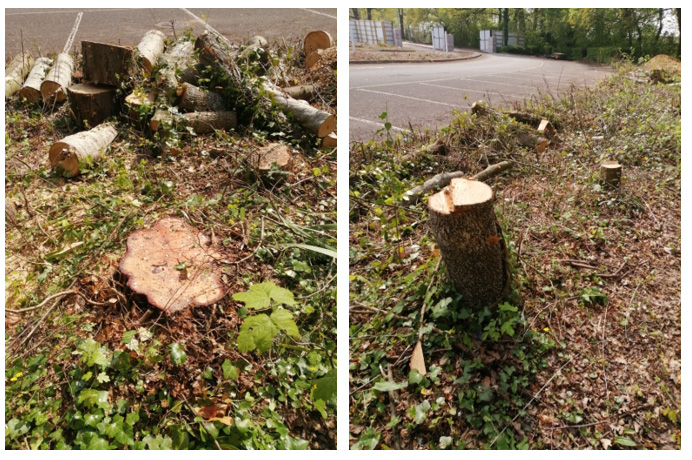
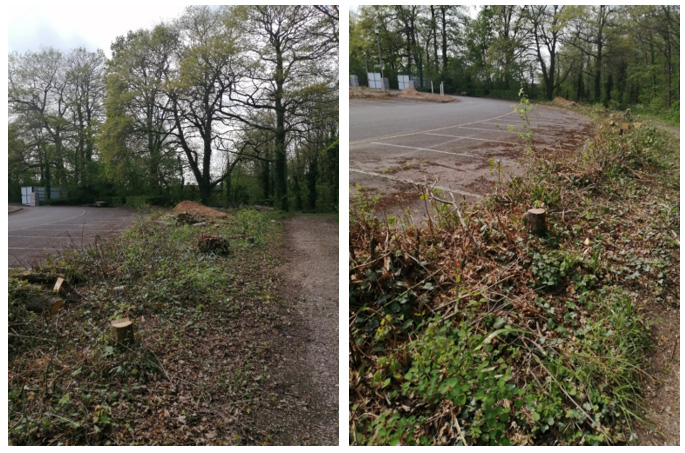
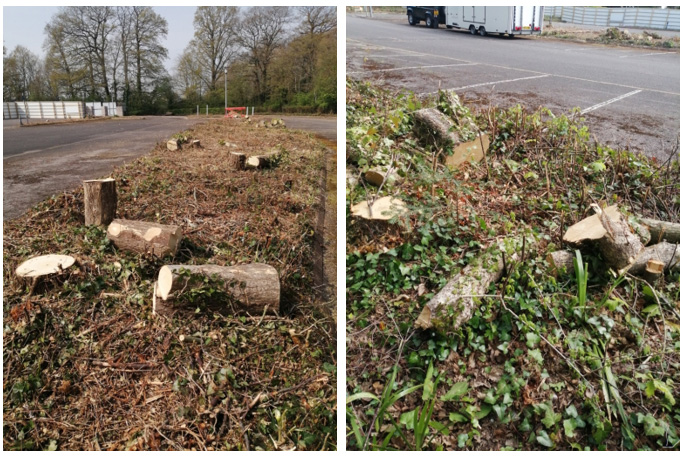
The following images show not only the ugly buildings that are proposed for Winslade Park in Clyst St Mary but also the ugly behaviour that has resulted in the recent decimation of large areas of mature trees and hedgerow within this car park area . . . . . and all this has happened before the Reserved Matters Planning Application has even been listed for an East Devon Planning Committee decision by elected planners!

The moment the chainsaws and mechanical chippers began annihilating this valued, natural environment, the residents informed various departments within EDDC – but to date there has been no official verification as to whether such extensive tree felling and hedge removal have authorisation or permission, either under the previous outline planning application or at all? Irrespective of this – these works have been undertaken and are still continuing during the prime bird nesting season, which, is surely, an offence under the Wildlife and Countryside Act 1981, (which appears to recommend a pre-work schedule being agreed by the local authority to ensure no bird nests, bats, wildlife are present within the trees and hedges being removed)? Obviously the Developers have submitted evidence that there are no nesting birds in these areas – although local people did report seeing bird boxes and nests thrown down by their boundaries during the chainsaw massacres – but all evidence has now been chipped into piles of sawdust – along with all the mature trees and hedges! Furthermore, the area that has been destroyed to date totals more than 5m3 of trees – so isn’t a felling licence required from the Forestry Commission, even if the trees do not have the benefit of TPOs (again does such evidence exist)?

Sadly, the birdsong from innumerable, diverse, indigenous bird species – some rare – some more common – have been replaced by the continuing, intrusive drone of the chainsaws!

The images below tell their own story:-

Local council by-election: Tories hit with big loss in Michael Gove’s constituency

True Blue Tory Heath Council by-election falls to Lib Dem 2:1 landslide (thanks to “George Dixon” for spotting this one) – Owl

Ninian Wilson  www.thenational.scot 

THE Tories have been hit with a big loss in a local council by-election where Michael Gove is the MP.

As the Tories suffer a relentless barrage of scandals following Boris Johnson’s partygate fine, voters in the traditionally Tory area of Bisley and West End (Surrey Heath) have turned away from the Conservative party.

The Liberal Democrats managed to win almost twice as many votes as the Tories in what Gove will be hoping is not a forecast of things to come for his party in the upcoming May elections.

One Twitter user wrote: “Having lived in this area for a number of years and knowing how true blue it was, take it from me, this is a colossal result”

While the turnout for the election was relatively low, Tories may fear that an election result like this -and those coming up in May – could be seen by voters as an opportunity to voice their anger over the partygate scandal and the controversial Rwanda asylum scheme.

Rishi Sunak to court City heavyweights at £10,000-a-table Tory fundraiser

Rishi Sunak will this week attempt to put his recent political troubles behind him when he courts City figures at a Conservative donors’ dinner designed to bolster party finances.

Mark Kleinman news.sky.com 

Sky News has learnt that the chancellor will speak at the event in central London on Tuesday evening, with guests being charged £10,000 for a 10-person table.

Sources said the dinner had been organised by Malik Karim, the investment banker who was appointed as a Tory treasurer last September.

He is said to be keen to broaden the party’s donor base in an industry that has historically provided a reliable source of funding, and wants this week’s inaugural City dinner to become an annual event.

Ironically, major Tory donors who are members of the House of Lords will be unable to attend Tuesday’s dinner because they have been told to be available to vote in the chamber.

Mr Sunak is understood to have been promoted as the event’s guest of honour, with tickets costing £1,000-a-head.

Buyers of individual tickets would not be required to disclose their purchase, although anyone buying an entire table would, because of the £7,500 threshold for declaring political donations to national parties.

The chancellor has endured the toughest month of his political career amid scrutiny of his family’s tax affairs and the fixed penalty notice he received, alongside the prime minister, for attending a Downing Street gathering during one of the pandemic lockdowns.

Mr Sunak has asked the government’s independent ministerial standards adviser to investigate whether he has adequately disclosed his financial interests since joining the front benches.

The Treasury declined to comment.

Planning applications validated by EDDC for week beginning 11 April

Protesters call out South West Water over sewage pollution

“South West Water needs Potty Training” read one placard held by a two year old. More “cut the crap” images on Cornwall Live

People have had enough of sewage pollution

Greg Martin www.cornwalllive.com

Campaigners were joined on Fistral Beach by everyone from local swimmers to national TV presenters, from toddlers to silver surfers

Around 150 people gathered in Newquay today, Saturday April 23, to demand an end to sewage pollution by South West Water. The protest was one of 12 taking place simultaneously around the country, targeting UK water companies on a ‘National Day of Action on Water Quality’.

Representatives from ocean conservation charity Surfers Against Sewage (SAS) who teamed up with clean water campaign groups to organise the protests were joined on Fistral Beach at 1pm by everyone from local swimmers to national TV presenters, from toddlers to silver surfers.

The protests come after data was released by the Environment Agency (EA) on 31 March, revealing that in 2021 water companies discharged raw sewage into UK rivers 372,533 times, for a combined total of more than 2.7m hours – prompting outcry from the public and campaigners.

Matt Hancock’s stay at mansion of Randox founder revealed by FoI request

The former health secretary Matt Hancock was given an overnight stay at a country estate owned by the head of Randox, the healthcare firm that had hired the MP Owen Paterson as a consultant.

Rob Evans www.theguardian.com 

During a two-day visit to Northern Ireland as health secretary in 2019, Hancock had a private dinner and stayed overnight at the Dundarave country estate in County Antrim, which is owned by Peter Fitzgerald, Randox’s founder.

The overnight stay was disclosed in documents released under the Freedom of Information Act. It was not included in the official register of hospitality received by ministers.

Through a spokesperson, Hancock said he did not need to declare the hospitality as he had not accepted it in a ministerial capacity. However, transparency campaigners disagreed and said there was a “clear expectation” that ministers should declare such hospitality and follow the spirit of the rules.

Questions have been raised about the relationship between Randox and the Conservative party after the firm was awarded almost £500m of public funds during the Covid pandemic for testing.

Randox also hired Paterson as a consultant, paying him £100,000 a year. Paterson resigned from parliament last year after he exploited his position as an MP to lobby for his clients, including Randox.

Randox donated £160,000 to the Conservative party between 2010 and 2018. Paterson directly lobbied Hancock on behalf of Randox during the pandemic. After Paterson’s lobbying, Hancock chased his officials, saying he was “very worried” about how his department was treating Randox and other firms.

During the Northern Ireland visit in 2019, Hancock met three firms, including Randox, that at that time were paying Paterson to be their consultant. Official documents obtained by Transparency International UK under the Freedom of Information Act suggest Paterson was partially involved in organising Hancock’s visit.

They also show how Hancock was invited by Randox to have dinner and stay overnight at Fitzgerald’s Dundarave estate during his visit.

The County Antrim estate is described as “magnificent … in a glorious setting” with “a fine Italianate mansion at its heart.”

On 21 March 2019, Hancock toured Randox’s laboratories in Belfast. An email sent to the health department, which appears to have been written by a Randox employee, said: “Understand SoS [secretary of state] will be with us, Randox Science Park … Then SoS goes to other visits before joining us for a private dinner and overnight that evening.”

On the same day, Hancock carried out a number of other official visits, including at Ulster hospital. He also attended a forum to discuss health and food. Two of the speakers were from Devenish, a firm that makes animal feed, and Lynn’s Country Foods, a firm that makes meat products.

The two firms were at that time paying Paterson a total of £61,000 a year to be their consultant.

The rules governing the conduct of ministers, known as the ministerial code, state that when politicians accept hospitality in a ministerial capacity, details should be made public through a register that is published regularly. Official guidance identifies dinners given by companies as the type of hospitality that should be declared if received in a ministerial capacity.

Hancock’s spokesperson, James Davies, said there had been no need to declare the private dinner and overnight stay at the Randox founder’s estate because it was political rather than departmental.

“Everything was declared properly and appropriately,” Davies said, adding that the relevant paragraphs of the ministerial code were “a departmental responsibility. If they judge an event political, then this doesn’t apply. Perhaps you should be speaking to [the Department of Health and Social Care], rather than Mr Hancock.”

He continued: “Staying overnight is absolutely fine. It was a political dinner, and Mr Hancock met many [Northern Ireland] politicians including Robin Swann, another relationship that became critical in responding to the pandemic. It’s absurd to say there was anything wrong with this.”

That interpretation of the rules was disputed by Rose Whiffen, a research officer at Transparency International UK, which obtained the documents. She said: “When ministers accept hospitality, especially from political donors, there is a clear expectation this should be declared and a matter of public record.

“When a secretary of state is uncertain over whether they have to report being wined and dined under the ministerial code, it is always better for them to err on the side of caution and follow the overriding spirit of the rules by doing so.”

Latest plans for Winslade Park, reposted in case you missed it over Easter.

Bank Holidays are traditional times for Developers to submit controversial plans. No exception this year as Burrington’s submitted further amendments to the 40 four-storey flats proposed on Winslade Park. These amendments are in the Documents file dated 11th April 2022 – see link below

21/2217/MRES | Reserved matters application pursuant to outline application 20/1001/MOUT seeking details of layout, appearance, scale and landscaping for a residential development of 40 apartments (Zone D) | Winslade Park Winslade Park Clyst St Mary (eastdevon.gov.uk)

Comment from Clyst St Mary Residents Association:

Burringtons have only slightly reduced the height of two blocks (by lowering their increased ground level plans) by 90cm for Block A and 45cm for Block B and moved Block B (1.8 metres)  and Block C (1.6 metres) further south away from some  tree roots, with a few other minimal differences that are also inconsequential for us all and so insignificant that they will make no difference to our previous objections. 

These amendments are so insignificant that they fail to address the concerns and objections on the detrimental issues of overlooking, privacy and intrusion on Clyst Valley Road residents’ existing 7-metre-high 2-storey homes by these proposed approx. 15-metre-high 4.5-storey apartment blocks.

The Parish Council considered the new application last Wednesday but there is still time for individuals to make their comments direct to EDDC.

Veto plans for ugly homes, councils urged

Could this apply to Clyst St Mary and the Winslade proposals? – Owl

Tom Wall www.theguardian.com 

Housebuilders are churning out substandard housing schemes with poor living conditions despite councils having the power to block them, according to new research.

The National Planning Policy Framework was amended in July to allow councils to refuse “development that is not well designed”. A study by University College London found that the Planning Inspectorate, which hears housebuilders’ appeals, is now three times as likely to back councils who reject developments on design grounds. But it also found that the vast majority of those blocked were in the south-east, suggesting that elsewhere councils were not using the new powers.

Professor Matthew Carmona, who carried out the research, said councils depleted by austerity often lacked the in-house design expertise to take on large, well-resourced developers.

“Local authorities in the south-east generally deal with more development and are more likely to have their own local design policies and employ urban designers. They are simply more geared up to challenge developers,” he said. “Councils in the south-west, Midlands and north tend to see fewer developments and are more reluctant, and perhaps a little nervous, to call out bad design.”

A survey revealed last year that 41% of councils do not employ any urban designers, and 76% lack access to any advice on architecture.

The change to the country’s planning rules was part of a package of measures that ministers claimed would ensure new housing was “beautiful and well-designed”. The government is setting up an “Office for Place” to help “communities encourage development they find beautiful, and refuse what they find ugly”.

The report, published by the UCL-based Place Alliance, highlights 12 schemes rejected on design grounds since last July. The inspectorate found proposals for an unattractive block of 15 flats on the site of a demolished car park in Crawley in West Sussex would offer “unsatisfactory living conditions”. Some flats had limited natural light and the outside spaces were close to roads and railway lines. Others lacked privacy as windows were next to people passing on a walkway and close to cars queueing on a traffic gyratory system.

The inspectorate also backed Braintree district council’s efforts to block two estates on the edges of villages in Essex, where developers were trying to squeeze in large numbers of houses, jarring with houses nearby. Officials also turned down an appeal relating to five tower blocks on the former Westferry newspaper printworks site in east London. It was ruled the scheme – which led to a row about media mogul Richard Desmond’s contact with ministers tasked with planning decisions – would harm appreciation of the Greenwich world heritage site.

Carmona said big developers had been getting their way for decades but the tables were starting to turn. “Volume housebuilders have been able to get a lot of poor-quality development past local authorities. But this research shows councils can now be far more confident in their exercise of quality control,” he said.

Profits for Britain’s biggest housebuilders have continued to rise despite routinely producing low-quality homes and failing to meet the UK’s estimated housing needs. The UCL researchers rated three-quarters of large developments in England as “mediocre” or “poor” in 2020.

They found bland architecture, with estates dominated by access roads and parking spaces at the expense of green areas and playgrounds. Other failings included few public transport links and a lack of amenities such as shops, pubs and cafes.

Carmona said it was possible to increase the number of houses built without compromising on the design factors that allow a new community to flourish.

“We are in desperate need of housing but it doesn’t mean we should build poorly designed, unsustainable places,” he said.

Disbanding of Dorset wildlife crime team puts birds of prey ‘at risk’

“Wildlife groups fear that influential landowners who have interests in removing police focus from wildlife crime could take inspiration from the situation in Dorset, and that this pattern could be repeated throughout the country.”

Helena Horton www.theguardian.com 

Birds of prey are being put at risk by the disbanding of one of the country’s leading wildlife crime teams, campaigners have warned, raising fears it could be part of a nationwide pattern.

Wildlife crime officers work to stop offences such as raptor persecution, where birds of prey are poisoned or shot by gamekeepers and landowners.

Earlier this year, a rare white-tailed sea eagle was found poisoned on an estate in Dorset. The local wildlife policing team opened an investigation led by PC Claire Dinsdale, a recipient of the Queen’s police medal for her work on wildlife crime. But weeks later, the case was abruptly closed, and a search on the estate where the eagle was found dead was cancelled. The RSPB described this decision as “baffling”.

Around the same time, the local wildlife crime team was rebranded – removing “wildlife” from its name. Dorset police rural wildlife and heritage crime was renamed as Dorset police rural crime team on its Twitter account, and police sources confirmed this rebrand took place to “reflect the broader work we are undertaking to ensure we provide exceptional local policing to our rural communities”. The wildlife crime section of the local policing website has also been removed.

Dinsdale then went on leave, and the Guardian understands that she has been told that on her return she will no longer be a wildlife crime lead.

Sources who were part of the white-tailed eagle death investigation told the Guardian that they were concerned about the hostility to wildlife crime investigations in the area, pointing out that the local MP, Chris Loder, said that police funding should be focused on other crimes.

Wildlife groups fear that influential landowners who have interests in removing police focus from wildlife crime could take inspiration from the situation in Dorset, and that this pattern could be repeated throughout the country.

Dr Ruth Tingay, a co-founder of wildlife campaign group Wild Justice and author of the Raptor Persecution blog, said: “If police wildlife crime teams are disbanding or rebranding to exclude wildlife crime, this flies in the face of government and police commitments to tackle wildlife crime, and particularly raptor persecution which is supposed to be a national wildlife crime priority but is on the rise according to the latest annual reports.

“There is absolutely no justification whatsoever for ignoring these crimes when there is a statutory duty for raptors to be protected.”

The RSPB, which is still conducting its own investigations into bird poisoning in Dorset, said it was concerned by the changes in Dorset police.

RSPB’s head of investigations, Mark Thomas, said: “RSPB Investigations enjoy a good working relationship with police wildlife and rural crime teams across the UK, especially in relation to fighting raptor persecution, the illegal killing of birds of prey, most often relating to land used for gamebird shooting.

“Dorset police … has been an exemplary force to work with. We obviously have concerns if the level of response from any force to wildlife crime incidents was diminished in any way, as there is clearly lots of work to be done, especially at a time when raptor persecution is at a modern day high and we have suspicious deaths of amazing birds like white-tailed eagles.”

A spokesperson for Dorset police said: “Dorset police is committed to keeping everyone in our county safe, including our wildlife, which brings so much to our beautiful countryside and our communities.

“As part of the police uplift programme and working together with the office of the police and crime commissioner we have reviewed our rural crime strategy for the county and allocated increased numbers of officers to the rural crime team to tackle the issues that matter. This includes all aspects of rural, wildlife and heritage-related crime.

“We will continue to work closely with many different partner agencies in relation to these issues. We want to make it clear that we take any and all potential wildlife offences seriously and will act to prevent and detect offences wherever possible.”

A Home Office spokesperson said: “We recognise the importance of tackling wildlife crime and those who hurt animals should be subject to the full force of the law. However, it is for operationally independent chief constables and elected police and crime commissioners to align their resources to tackle local priorities.”

Right to Roam shelved: ‘the countryside is a place of business’

Ninety-seven per cent of rivers are off limits to the public, and tens of thousands of acres of woodland have benefited from public subsidy yet remain publicly inaccessible.

Locally, the Exe Estuary and the East Devon Pebblebed Heaths provide an important recreational resource for the local community. However, they are sensitive environments which are important to international nature conservation.

The increased housing development and consequential footfall in East Devon has required mitigation strategies to be put in place. (I.e. trying to keep people out!). One of these is the  creation of the Clyst Valley Regional Park.

Another reason we need the protection of absorbing the East Devon and Dorset AONBs into a new national Park. – Owl

Minister defends shelving right to roam report: ‘the countryside is a place of business’

Helena Horton www.theguardian.com 

The English countryside is a “place of business” and already has “hundreds of thousands of miles of public footpaths”, a minister has said in response to questions about why the “right to roam” report has been shelved.

The comments by Mark Spencer, the leader of the house, came as campaign groups expressed their fury over the Treasury’s decision to shelve the review, which was commissioned to search out a “quantum shift in how our society supports people to access and engage with the outdoors”.

The review, headed by Lord Agnew, had included a potential expansion of the much-fought-over “right to roam”, which campaigners fear will not now go ahead. In response, activists are planning mass trespasses to raise awareness of how much of England’s land is out of bounds. The right to roam exists over only 8% of the country.

Spencer made the remarks after the Green MP Caroline Lucas asked why the responses to the Agnew report into making more of the countryside publicly accessible would not be published.

He said: “I think we are blessed in this country with hundreds of thousands of miles of public footpath to allow people to access the countryside. We have to recognise the countryside is not just a place of leisure, but it is also a place of business and food production.”

Lucas responded: “Utterly feeble ‘defence’ from leader of house on government quashing review into the right to roam. Working and leisure are not incompatible – is this really the government’s excuse?”

Ninety-two per cent of England’s land is privately owned and not available to access. The Countryside and Rights of Way (CRoW) Act 2000 gives a legal right of public access to mountains, moorland, heaths, some downland and commons, and the English coastal path. Campaigners have asked for this to be extended to cover rivers, woods and green belt land. Ninety-seven per cent of rivers are off limits to the public, and tens of thousands of acres of woodland have benefited from public subsidy yet remain publicly inaccessible.

This weekend, the Right to Roam campaign is celebrating the 90th anniversary of the 1932 Kinder Trespass, when hundreds of activists trespassed on Kinder Scout in the Peak District. They were there to highlight the fact that walkers in England and Wales were denied access to areas of open country.

A group of ramblers will be walking to Kinder Scout on Sunday for a Kinder in Colour event, which will be led by people of colour.

The organisers said: “Even with a small amount of rights of way available to ramblers, the countryside is still rife with barriers to access, especially for black people and people of colour. With this in mind, we want to celebrate the Kinder Scout legacy by creating a new culture for the countryside, one which is fully inclusive and embraces differences.”

The Right to Roam campaign is planning a series of mass trespasses planned between May and September, including in Totnes on 8 May and West Berkshire on 14 May, with more to follow.

James MacColl, the head of policy, advocacy and campaigns for the Ramblers, said the UK government was not doing anywhere near enough to improve access to the countryside.

He explained: “The government … isn’t making use of its own Environment Act powers to set public access targets. Its new farm payments scheme shows no sign of rewarding farmers for improving access on their land, despite repeated promises. Proposed changes to the planning system don’t prioritise access to nature.

“As the Ramblers continue to campaign for access rights, this weekend we’ll be celebrating the 90th anniversary the Kinder Scout trespass, a landmark protest on the route to improving access to the countryside for all.

“Access to these green open spaces is still currently very limited and unequal and the Ramblers wants to see government extend the freedom to roam across England and Wales so that it is more easily accessible, and better connected to our path network and our towns and cities.”

Nobody should be left behind during switch over to internet-based phones

Comment from a correspondent: “Fiddling while Rome burns.  I’ve been changed to an internet phone (Virgin) and offered an alternative phone if I am vulnerable.”

Simon Jupp www.exmouthjournal.co.uk

In our modern age, some increasingly old-fashioned things are still sticking around.

Cash and coins are thankfully still widely used despite never-ending efforts to make everyone go contactless.

Not everyone likes tapping a card and cash helps businesses manage small and informal payments like tips.

It seems traditional landline telephones will stick around a bit longer, too.

Regular readers may remember that I previously wrote about plans by telephone bosses to switch off the copper-wire technology which make calls on landlines by 2025. Everyone would have been moved to an internet-based connection. 

The good news is that BT Openreach – who manage the UK’s phone network – have now paused plans to disconnect traditional phone lines.

I raised my concerns with the Secretary of State a few months ago that half of older people over 75 are not online, areas with no mobile signal and without internet risk being cut off from essential services, and internet can go off in power cuts leaving no alternative to make emergency calls if you don’t have a mobile.

Storms Arwen and Eunice brought the last key concern into sharp focus and drove BT to announce that they’re pausing the programme for now. They will only transfer people who request it.

To give a quite tragic example reported in the news of where the digital switch-over could potentially go wrong, during Storm Arwen a man’s home burned down in a remote part of Scotland because he had no mobile signal and could not call 999 on his internet-based landline phone during the power cut.

BT admitted they need to sort out how to raise more awareness of the digital change, how to provide emergency solutions like battery-back up units or hybrid phones that can switch between the internet and mobile networks, and how to address so-called mobile ‘not-spots’. Regulator Ofcom has also warned that some devices such as panic alarms which use analogue phone lines would cease to function, potentially affecting 500,000 vulnerable people.

As your MP, I will continue to pressure BT, Ofcom, and the government to make sure nobody is left behind.

UK gave sanctioned Russians ‘golden visas’ after first Ukraine invasion

Seven Russians now under sanctions were awarded controversial “golden visas” by the UK after Vladimir Putin’s regime first invaded Ukraine in 2014, the government has admitted.

Jasper Jolly www.theguardian.com

The government closed the “tier 1 investor visa” scheme in February amid the build-up of Russian forces on Ukraine’s border as it prepared to broaden its occupation beyond Crimea, which it annexed in 2014.

Since the invasion, sanctions targeted at many of Russia’s richest businessmen have become a key part of the response by the UK and its allies.

The measures have also prompted awkward questions for the government, with critics accusing it of offering an open door to kleptocrats and oligarchs, who in some cases are thought to have expropriated wealth from the Russian state on a massive scale. Much of that wealth has been used to buy luxury property in London.

The golden visa scheme allowed people with at least £2m in investment funds and a UK bank account to apply for residency rights, along with their family. Before 2018 it is thought that minimal checks were carried out on investors or the source of their wealth.

The government revealed that 10 Russians who received golden visas are now subject to sanctions, an increase from the eight previously admitted, in a written answer to a question from Stephen Kinnock, Labour’s shadow immigration minister.

Kevin Foster, a junior Home Office minister said seven of those 10 Russian nationals “either obtained an initial grant of leave or obtained further leave via the route after 2014”.

The government declined to name the people who received the visas, despite demands from Labour and Spotlight on Corruption, a campaign group.

In 2014 David Cameron, then prime minister, said Russia must “choose the path of diplomacy and de-escalation, or face increasing isolation and tighter and tighter sanctions”. However, the latest data suggested that the government continued to wave through visas for Russian nationals now considered by officials to play key roles in supporting Putin’s regime.

“Putin’s invasion of Crimea should clearly have been a fork in the road for how the British government viewed Russian oligarch investors,” said Kinnock. “It therefore beggars belief that – even after the threat posed by Putin to western security and British interests had been exposed – the Conservative government continued to award grants of tier 1 (investor) leave to seven of Putin’s cronies who would later be sanctioned.”

Spotlight on Corruption said the latest revelation made it even more urgent that the government release a 2018 report on the golden visa scheme. A minister last month committed to publish it, but the government has not yet done so.

Susan Hawley, the group’s executive director, said: “This is compelling evidence of the frankly shocking complacency in the UK government about Russian money coming to the UK even after Russia started its aggression against Ukraine in 2014.

“The golden visa regime looks increasingly like a state-sponsored scheme to enable kleptocracy. The lessons must be learned for the UK visa regime across the board.”

A Home Office spokesperson said: “We have made it clear we will not tolerate abuse of our immigration system and we have closed the tier 1 (investor) route with immediate effect to ensure that those who have profited from dirty money cannot gain access to the UK.

“We want to make it clear that the UK is no safe haven for those who enable the Putin regime. By implementing the largest and strongest sanctions package in the UK’s history, we are continuing to crack down on these individuals and making sure they pay the price.”

Exmouth councillor claims someone knew John Humphreys was under investigation

Someone at East Devon District Council (EDDC) knew that former Conservative councillor John Humphreys was under investigation for sex crimes against children while still serving as a councillor, it has been alleged.

Joe Ives, Local Democracy Reporting Service www.exmouthjournal.co.uk

Labour councillor Paul Millar (Exmouth Halsdon) made the claim at a full council meeting this week.

Humphreys, 60, who also previously served as mayor of Exmouth, is now serving a 21-year prison sentence for sexually assaulting two teenage boys 10 years apart.

He was arrested in 2016 before being released on bail on suspicion of the crimes he would eventually be convicted of in August last year.

Cllr Millar’s claim could have serious implications for the council. The investigation into Mr Humphreys was not made public at the time and he continued to be a councillor until May 2019, eventually being awarded the honorary title of alderman by EDDC in December that year.

Despite being under investigation since 2016, no officers or councillors at EDDC have said that they had any knowledge of the allegations against Mr Humphreys during his time in office or when he was named as an alderman. Following his conviction in August last year, the council retracted the honour.

Addressing the council, Cllr Millar said: “I, unfortunately, have to share that I have been made aware by somebody I consider to be a very reliable source that a senior individual in East Devon District Council was officially made aware whilst Mr Humphreys was a councillor that Mr Humphreys was being formally investigated by police for sexual allegations.” 

In response to the claim, a spokesperson from EDDC said the questions raised by Cllr Millar would be something for the council’s cabinet ‘to consider in due course’.

At the meeting, councillors agreed to commission an external investigation looking into the circumstances around Mr Humphreys from 2016, when he was first arrested, until he received his alderman award in 2019.

Speaking ahead of the vote, Cllr Millar said: “There has to be a way that individuals in any way involved in the [alderman] nomination process are able to intervene to prevent nominating a potentially inappropriate individual. 

“The principle of innocent until proven guilty does not extend to individuals facing serious charges and receiving civic honours at the same time.

“No institution in its right mind should ever risk offering a civic honour if they had any knowledge within that institution of a serious criminal investigation that could be taking place.”

Cllr Jess Bailey (Independent, West Hill and Aylesbeare), who proposed the idea of an external report, said it should have one key thing in mind: ‘child protection and safeguarding of children’.

Protected areas, such as AONBs, can be the beating heart of nature recovery in the UK, but they must be more than lines on a map

“National Parks, Areas of Outstanding Natural Beauty and other protected areas currently make up 27% of UK land. However, the report finds that the proportion of land that is effectively protected for nature could be as low as 5%.”

British Ecological Society www.britishecologicalsociety.org 

A report by the British Ecological Society says that the UK government’s commitment to protect 30% of land and sea by 2030 offers the opportunity to revitalise the contribution of protected areas to nature recovery. But it also warns that this ambitious pledge will fail if we don’t make radical, transformative changes.

The UK government has committed to protecting 30% of the UK’s land and sea to support nature recovery by 2030. The report welcomes this target, as failure to achieve it could result in continued and irrecoverable declines in biodiversity.

The BES’s Protected Areas and Nature Recovery report looks at the role protected areas play in supporting nature and determines what is needed to meet the ‘30×30’ target.

Although the ‘30×30’ target seems close to being achieved, with 27% of UK land and 38% of UK seas under some level of protection, the report finds that many protected areas are not delivering for nature and are in poor ecological condition.

The report therefore urges caution over what should count towards the ‘30×30’ target and provides recommendations for what protected areas, and the surrounding environment, need in order to be effective in restoring nature.

Dr Joseph Bailey at York St John University and lead author of the report said: “Designating an area of land or sea does not automatically make it an effective protected area. Designation is simply the first step in a long process towards ensuring that long-term ecological benefits are delivered for nature and people. To be effective, a protected area needs adequate implementation, enforcement, monitoring, and long-term protection.”

Dr Bailey added: “The 30×30 target presents such a good opportunity that we can’t let it pass us by, especially in the face of a changing environment and a future in which we will need resilient ecosystems.”

Protecting the land

National Parks, Areas of Outstanding Natural Beauty and other protected areas currently make up 27% of UK land. However, the report finds that the proportion of land that is effectively protected for nature could be as low as 5%.

Many protected landscapes, such as National Parks, do not specifically prioritise biodiversity and were not established or funded to do so. The report recommends that these areas should not be included in the ‘30×30’ target in their current state.

Professor Jane Hill at the University of York and author of the report said: “The evidence is that most protected landscapes are not delivering for nature and only a low percentage are in good ecological condition. However, because there is existing governance in place managing these landscapes, they have great potential to be adapted to improve how they deliver for nature.

“With the right support and willingness, nature can recover and thrive in almost any landscape. If the objectives of protected landscapes like National Parks and Areas of Outstanding Natural Beauty can be reformed to ensure that they deliver for nature in the long-term, they could then count towards the ‘30×30’ target.”

Protecting the seas

On paper, marine environments seem better protected than UK landscapes with Marine Protected Areas (MPAs) already exceeding the government’s target and covering 38% of UK seas. However, many of these areas have no current management measures in place and most areas closed to fishing are in UK overseas territories.

While regulations to control fishing are in place in some MPAs, across the entire UK only three small MPAs ban all fishing activity. Damaging fishing activity from large bottom trawlers is still unregulated in many MPAs across the UK.

Rick Stafford of Bournemouth University and author of the report said: “The proposal to protect 30% of UK seas is very welcome, but we need effective management measure in place in Marine Protected Areas which will protect wildlife and benefit local coastal communities.

“The lack of comprehensive management or enforcement means that the majority are failing to deliver for nature and bring the full range of biodiversity benefits they otherwise could.”

What should count towards the ‘30×30’ target?

For protected areas to deliver for nature and be included in the ‘30×30’ target, the report recommends the following criteria:

  • Protected areas must be managed to deliver for nature in the long term, using evidence-based approaches.
  • Protected areas should have effective governance to address pressures such as climate change, pollution, and damaging fishing activities.
  • Have monitoring in place that informs the long-term management of protected areas so that they meet conservation goals. This will require substantial and sustained funding and resourcing.
  • Protected areas should be inclusive to benefit local people and ensure buy-in. The governance of protected areas should involve local communities in partnership with landowners, NGOs, researchers, government agencies, and other stakeholders.

Nobody should lose out to something benefiting nature

Dr Paul Sinnadurai of the Brecon Beacons National Park Authority and Cardiff University, and author of the report said: “Protected areas have suffered from not having enough resources and having to make too many compromises. This has left them in a position where they are not doing enough to support nature.

“To turn this around, money and resources need be made available for consistent monitoring. During the late 1990s and early noughties, there was a good advance in the use of the Common Standards for Monitoring in protected areas, but momentum wasn’t maintained in this essential practice because it is resource intensive.

“For effectively protected areas to be successful, they must also be inclusive. To do this we need to have conversations with landowners and local people and ensure nature recovery works for everyone. Nobody should lose out to something benefiting nature.”

Protected areas are not enough on their own

Despite the enormous potential of protected areas, they cannot protect nature on their own. Landscapes surrounding protected areas are also vitally important, particularly with species ranges shifting in response to climate change.

The report details how other effective area-based conservation measures (OECMs) – areas outside of designated protected areas that are managed in a way to support nature – can complement protected areas and provide an essential contribution to nature protection and recovery.

Dr Bailey said: “We need to make sure landscapes are suitable for species to move between highly protected areas. This could be done with wildlife corridors such as hedgerows. Protected areas simply won’t work if the spaces in between them are not working towards the same goals.”

Read the report

Share your experiences for a Parliamentary debate on the availability of affordable housing in Devon and Cornwall

A correspondent has drawn Owl’s attention to this Westminster Hall debate next week, to make an input you need to act quickly:

Share your experiences for a Westminster Hall debate ukparliament.shorthandstories.com

Wednesday 27 April, 2:30 pm – 4:00 pm

On Wednesday 27 April, Selaine Saxby MP is leading a Westminster Hall debate on the availability of affordable housing in Devon and Cornwall.

To inform her debate, she wants to hear from those living in, or near the region about their experiences:

Link to online survey here

Apart from giving your name, email and postcode, there are only three questions:

  1.   How have you, or those you know been affected by the availability of affordable housing in Devon and Cornwall?
  1.   What consequences do you think a lack of availability of affordable housing will have in the future if left unresolved?
  1.   Do you have any additional comments or suggestions on this topic?

The deadline for submissions is midday, Tuesday 26 April.

Introducing the debate, she gave the following statement:

“With summer fast approaching, the lack of affordable housing and the effect of short term holiday lets and second homes in tourist hotspots such as Devon and Cornwall is only likely to get worse.

“While tourism is essential to our economy, a balance is needed, and many people are cautious about the consequences of excessive holiday lets and second homes in our communities.

“Local people are the biggest victims when it comes to availability of affordable housing and private rentals, and action needs to be taken.

“I hope this debate can explore the impact the lack of affordable housing has on locals, and the potential solutions to this problem.

“Your experience of housing in Devon and Cornwall would provide an invaluable insight to the debate.”

The deadline for submissions is midday, Tuesday 26 April.

How it works

How to watch the debate:

Links to watch the debate and read the transcript will be added to this page (see link above) as soon as they are available from Wednesday 27 April.

What is a Westminster Hall Debate?

Westminster Hall debates take place in the Grand Committee Room in the House of Commons.

They give MPs an opportunity to raise local or national issues and receive a response from a government minister. 

Debates in Westminster Hall take place on ‘general debate’ motions expressed in neutral terms. These motions are worded ‘That this House has considered [a specific matter]’.  

How Parliament works: Westminster Hall debates.

How your contributions are shared

In these exercises, members of the public who may have experience or understanding of the debate topic are invited to contribute.

Their responses are passed on to the MP leading the debate, who may refer to them directly in their speeches.

You can see previous examples further down the page.

What happens next?

If you shared your email in the survey, we’ll send you an update after the debate with links to watch it, read the transcript, and information about the Government’s response.