
Housing development, sugar tax, booze tax, inheritance tex, smoking tax ….
“Child poverty cash handed back to Europe unspent”
“More than £3.5m intended to alleviate child poverty and homelessness is at risk of being wasted because the government has failed to spend it, says a House of Lords committee.
Peers have written to the Home Office saying it is “extraordinary” that the EU funding has not been used.
They warn that some of the cash has already been forfeited and are worried about the rest being handed back.
The government said there had been “barriers” over spending the money.
But peers have written to complain that after almost six years, the government has failed to deliver spending aimed at addressing “the worst forms of poverty”.
About £580,000 of unspent cash has so far been taken back – and a further similar amount is at risk of being deducted at the end of the year. …”
All our nuclear eggs in a broken basket (case)
… and, so, far, not a peep out of our Local Enterprise Partnership – who put pretty much all our local eggs in that same government basket …
Wonder what (if anything) Johnson thinks of that?
Today’s Times (pay wall)
Flamanville points to nuclear fiasco
“As French existential jokes go, little beats building a nuclear power plant at a place called Flammable. OK, it’s actually Flamanville. But who cares about that sort of nicety — not least when the project’s proving so incendiary?
It was due to be up and running in 2012 at a cost of €3.3 billion. Not only that. Flaming Ville was to be the showcase for the European Pressurised Reactor, the wizzy new tech developed by the state-backed EDF. True, it’s living up to the pressurised bit, at least for EDF boss Jean-Bernard Lévy. He’s just been forced to announce another delay: a howitzer, even by usual standards, of “more than three years”. The end of 2022 is now the earliest start date; a delay bound to jack up project costs that have already exploded to €10.9 billion
The reason? France’s spoilsport nuclear safety authority has ordered EDF to repair eight bits of dodgy welding: who’d have thought nukes had to be welded together properly? And, yes, the whole thing is turning into a nice French farce. Except for one thing, of course: the joke’s on us.”
AND (in more detail):
The latest delay at Flamanville comes after the French Nuclear Safety Authority ordered EDF to repair eight faulty welds at the plant.
Jean-Bernard Lévy, 64, EDF’s chief executive, said: “The time that we will need to prepare the repairs, carry out the repairs, test the repairs and get everything checked and then have the whole plant tested again and prepared to be launched, that will lead to delays of more than three years. So I don’t think it’s possible to commission it before the end of 2022.”
The European Pressurised Reactor at Flamanville was initially due to come on stream in 2012 at a cost of €3.3 billion. In its most recent estimate, EDF said that the costs had risen to €10.9 billion. The latest delay means that this will almost certainly have to be revised upwards.
Critics want EDF to take the reactor off the market, given the difficulties at Flamanville and elsewhere. Plans to build one in Finland are also running more than ten years behind schedule.
Engineers started working on the model in the early 1990s but only one — in China — has so far been switched on.
EDF reported first-half earnings before interest, taxes, depreciation and amortisation of €8.3 billion, up 3.5 per cent from a year earlier. Revenue rose by 4.3 per cent to €36.47 billion.
The French government plans to split EDF into two units under a state-owned parent company. EDF Bleu will hold the nuclear assets and be wholly owned by the state and EDF Vert will concentrate on renewable energy and services, with a minority stake in private hands.
The defective welds responsible for the latest setback at Flamanville were detected last year. EDF said that it would repair most of them but argued that those in the building enclosing the reactor could be left for now. Those are difficult to access and to repair.
EDF said that it was “highly improbable” that they would break and urged nuclear inspectors to allow the construction programme to go ahead without repairing them but the watchdog insisted that they should be fixed before the reactor was started up.
EDF said it would agree with the watchdog how to repair the welds.
“Further delay for Hinkley-style reactor raises pressure on EDF”
“The company building Britain’s new nuclear reactors has announced a further delay to its troubled high-profile project in France.
EDF, the French state-owned group, said that the launch of its nuclear reactor at Flamanville in Normandy had been put back three years until the end of 2022.
The group is leading the project to build two similar reactors at Hinkley Point in Somerset at a cost of £19.68 billion.
“The comma touch: Jacob Rees-Mogg sends language rules to staff”

“The new leader of the House of Commons, Jacob Rees-Mogg, has reportedly set out a list of rules banning his staff from using words such as “hopefully” and demanding that they use imperial measurements only and give all non-titled males the suffix Esq.
According to ITV News, Rees-Mogg sent out the list shortly after his appointment to the role by the new prime minister on Wednesday night.
Among the words and phrases considered unacceptable were: “very”, “due to” and “ongoing”, as well as “equal”, “yourself” and “unacceptable”. Rees-Mogg was also reported to have banned the use of “lot”, “got” and “I am pleased to learn”.
The guidance was drawn up by the North East Somerset MP’s constituency team years ago, but has now been shared with officials in his new office.
In a call for accuracy contained in his list, Rees-Mogg reportedly told staff: “CHECK your work.” Other directions include a call for a double space after full stops and no comma after the word “and”.
Staff should avoid “too many ‘Is’” in their writing, Rees-Mogg is reported to have ordered, and he will neither be “pleased to learn” anything, nor will he “note/understand your concerns”, nor “invest (in schools, etc)”. Moreover, the phrase “no longer fit for purpose” has been deemed no longer fit for purpose.
As chair of the European Research Group – an influential, hard-Brexit Tory backbench grouping – Rees-Mogg has increased his influence in Westminster in recent years.
The official transcript of parliamentary proceedings, Hansard, records more than 700 instances of Rees-Mogg using one or other of the banned words or phrases.
He is an Old Etonian, like the prime minister he serves, and, like the prime minister he serves, has cultivated a reputation for formality and upper-class eccentricity, gaining the nickname the “honourable member for the 18th century”. When standing for the Conservatives for the Central Fife seat in 1997, he took his nanny and his mother’s Mercedes to canvass a working-class area.
Rees-Mogg has also used his position of influence to argue against abortion, even in cases of rape, and same-sex marriage.
He has been one of the most prominent backers of a hard Brexit and, last year, it was revealed that a City firm he co-founded had set up an investment fund in Ireland and was warning prospective clients about the financial dangers of a hard Brexit.
Following his appointment by Johnson this week, he is responsible for organising government business in the Commons.
The Commons leader’s office would not comment on the leaked document.”
All councils must have more and better recycling by 2023 and packagers to bear more costs
“Local authorities in England will have to collect the main types of recyclable materials by 2023, the government has announced.
All authorities must put in place collections for glass, paper and card, plastic bottles and pots and aluminium within four years, due to legislation to be introduced by the Department for Environment, Food and Rural Affairs.
DEFRA has also said that packaging producers will pay the full net cost of disposing of packaging as part of a range of measures that make up the broader Environment Bill later this year.
The department said that the changes would “achieve greater constituency in household and business recycling”, but council leaders have urged the government to make sure it is fully funded. …”
Vocal Brexiteer James Dyson buys second mega-million Singapore home
“Weeks after paying £43m for the city-state’s most expensive penthouse, the inventor has reportedly lined up a £26.5m house …
Dyson, 72, a prominent supporter of Brexit, announced plans in January to move his company’s head office from Britain to Singapore to be closer to its fastest-growing markets. His firm plans to build its first electric car in the city-state.
Dyson has also purchased a three-storey “super penthouse” at the top of Singapore’s tallest building. He reportedly paid £43m for the five-bedroom property which comes complete with a 600-bottle wine cellar.
A spokeswoman for his company, Dyson Limited, said: “We do not comment on the private affairs of the Dyson family.”
When contacted about the previous penthouse purchase, a spokesman said: “Given the decision to locate the headquarters in Singapore and the growing focus of the company’s business in the region, of course James Dyson has bought a property there.”
Young people: register to vote!
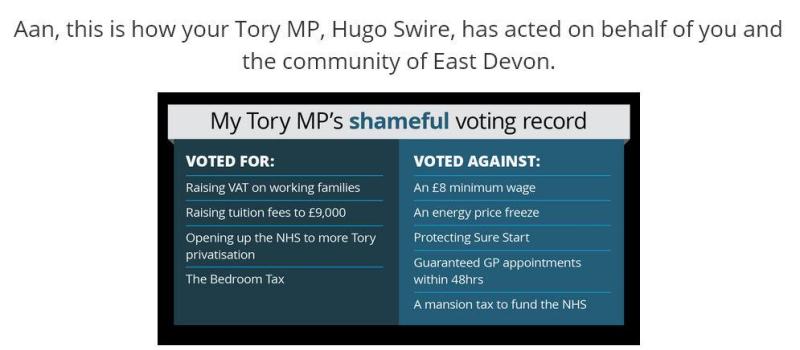
A general election on the horizon – now more important than ever that young people get their say in our collective future.
Easy, 5 minutes at most and could be the most important 5 minutes of your life:
Swire misses out on return to Foreign Office
Chris Pincher – foreign minister
Still, he can still do LOTS of travelling in his many other (non-constituency-related) well-paid jobs.
Nepotism, £1,000/hr consultancy …. yes, it’s a new Tory cabinet!
Johnson has appointed his previously Remain brother to his cabinet, and now …
“The new home secretary, Priti Patel, holds a £1,000-an hour contract with a global communications firm that supplies products and services to the UK government, the Guardian can reveal.
Patel, who was appointed on Wednesday by the new prime minister, Boris Johnson, as a part of a wholesale gutting of the cabinet, has been working for Viasat for the past three months as a strategic adviser earning £5,000 for five hours’ work a month.
She recorded the role on the MPs’ register of interests, and the contract is due to expire on 31 July.
Viasat, a Californian company with a UK base in Farnborough, supplies services and products to the Ministry of Defence (MoD). The MoD works in collaboration with the Home Office on numerous projects, including the Innovation and Research Insights (IRIS) Unit, which sets up technology-based contracts for both departments.
Patel, who was forced to resign from government two years ago for failing to disclose secret meetings with Israeli ministers, is understood to have been advising Viasat on a matter relating to India.”
“Amazon CONFIRMS it is moving Exeter operations to 100,000 sqft facility close to Cranbrook”
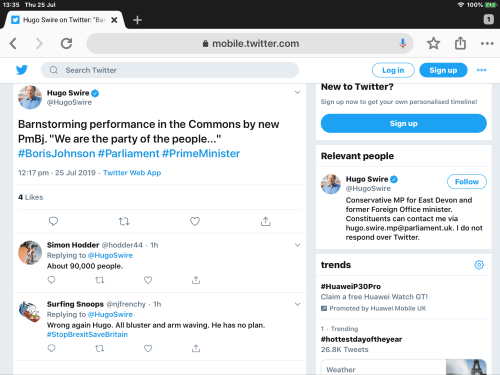
Swire nails his (blue) colours to Johnson mast
New housing minister has great credentials …. not!
In addition to having 3 expensive homes (but calling himself ‘an ordinary businessman’) Jenrick has other “qualities” to recommend him, not least ANOTHER auctioneer a la Swire -and also a residency in Moscow! Perhaps he got some housing ideas there ..

“Robert Jenrick has been appointed Secretary of State for Housing, Communities and Local Government in Boris Johnson’s first Cabinet.
Jenrick was elected Conservative MP for Newark in June 2014 and has served as Exchequer Secretary to the Treasury since January 2018.
His previous roles have included acting as Parliamentary Private Secretary to the Lord Chancellor and Secretary of State for Justice.
He replaces James Brokenshire who yesterday announced he was returning to the backbenches.
Jenrick studied History at St John’s College, Cambridge and was Thouron Fellow in Political Science at the University of Pennsylvania. He qualified as a solicitor in 2008 and practised corporate law at international law firms in London and Moscow. He then went on to have a career in business, notably at Christie’s, the art business. …”
EDDC Tories appear in Private Eye’s “Rotten Boroughs” column
From the blog of DCC EDA Independent Councillor Martin Shaw:
Private Eye goes to town on EDDC Tories’ handout to developers of the Knowle
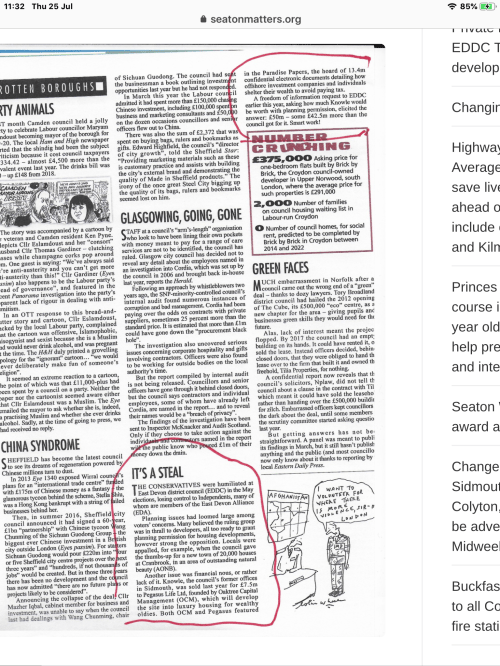
Oh dear – and now “The Independent Group” led by EDDC Leader Ben Ingham has chosen to cosy up to Tories, rather than East Devon Alliance independents, whom he has frozen out.
With current Councillor Ingham having the been a member of all 3 groups and Leader of 2 of them (former Tory, former Leader of East Devon Alliance and current leader of ‘The Independent Group’) he really has to decide which side of the fence and his cohort are on!
Or maybe he has already decided – given that he appointed a Tory as Chairman of the Development Management Committee, who then used his casting vote to push through a controversial planning applucation in Axminster, opposed by Axminster EDA councillors on safety and pollution grounds:
Reality check needed for some of his colleagues, perhaps?
CORRECTION: The Tory hopeful with 3 homes who says he’s ordinary bloke is NEW HOUSING MINISTER

Tory hopeful with 3 homes says he’s just an ordinary bloke …

Swire in with a chance of a job as his choice for PM becomes Johnson’s right-hand man
“Dominic Raab has been appointed foreign secretary and first secretary of state.
First secretary of state is a title sometimes given to a minister by the PM. Damian Green was the last person to hold the post. It means Dominic Raab, who was Brexit secretary until he resigned at the end of last year because he was opposed to the withdrawal agreement, is effectively deputy prime minister (unless Boris Johnson surprises us all and appoints an actual deputy prime minister). …”
New unitary authorities … the criteria restated for counties AND districts
“The Communities Secretary, James Brokenshire, has set out the circumstances in which he would be prepared to issue a formal invitation to councils under the Local Government and Public Involvement in Health Act 2007 to submit proposals for the establishment of new unitary councils.
In what could be one of his last acts as Secretary of State, with the prospect of Boris Johnson becoming Prime Minister and choosing a Cabinet, Brokenshire said in a written ministerial statement yesterday that he would also set out how he intended to assess any unitary proposals councils make in response; and the Government’s continued approach to any proposals two or more district councils may make to merge in order to form a new larger district council.
The Secretary of State said: “Locally-led changes to the structure of local government, whether in the form of unitarisation or district mergers, can – with local support – be an appropriate means of ensuring more sustainable local government and local service delivery, enhanced local accountability, and empowered local communities. This statement …. continues the Government’s commitment to supporting those councils that wish to combine, to serve their communities better and will consider unitarisation and mergers between councils when locally requested.
“However, I recognise that unitarisation may not be appropriate everywhere. I also recognise that it is essential that any local government restructuring should be on the basis of locally led proposals and should not involve top-down Whitehall solutions being imposed on areas. The Government does not support top-down unitary restructuring. This has been the Government’s consistent approach since 2010.”
The Secretary of State said he also wanted to provide further clarity for those councils who might consider the possibility of restructuring, by setting out the factors councils should consider and the processes to be followed – including with regard to local support.
For councils wishing to restructure to form unitary local government, the first step of the statutory process as set out under the 2007 Act is for the minister to issue an invitation to councils to submit proposals.
Brokenshire said there were two circumstances in which he would consider issuing such an invitation.
The first circumstance, he said, is where the following two conditions are met:
There is a local request for an invitation.
That he considers that the request “demonstrates local opinion is coalescing around a single option which is reasonably likely to meet the existing publicly announced criteria for unitarization”.
The Secretary of State said, in forming his view, he would carefully consider the request, including the groups making and supporting it and their reasons for so doing. “Where I issue an invitation, I would do so to all those councils that I consider to have regard to the area concerned, whether or not they were among those who had made the original request.”
The minister said the second circumstance was where he considered that doing so would be appropriate given the specific circumstances of the area, including in relation to the long-term sustainability of local services. This was the situation in which his predecessor, Sajid Javid, issued an invitation to the councils in Northamptonshire, he said.
“Following such an invitation, it would be for the councils concerned to decide whether to develop and submit proposals for unitarisation, either individually or jointly by two or more councils.”
In the statement Brokenshire confirmed that he would assess any locally-led unitary proposal that he received against the criteria for unitarisation announced to Parliament in 2017.
These criteria state that subject to Parliamentary approval a proposal can be implemented, with or without modification, if the Secretary of State has concluded that across the area as a whole the proposal was likely to:
improve the area’s local government;
command “a good deal of local support across the area”; and
cover an area that provides a credible geography for the proposed new structures, including that any new unitary council’s population would be expected to be in excess of 300,000.
On district council mergers, the Secretary of State confirmed that where two or more district councils submit a proposal to merge, he would assess this against the criteria for mergers announced to Parliament in November 2017 and which had been used since then.
“The statutory process for such mergers does not involve my inviting proposals, and I recognise that particularly small district councils may wish to propose merging as a natural next step following a number of years of successful joint working, sharing of services and senior management teams,” he said.
The criteria for district council mergers are that, subject to Parliamentary approval, a proposal to merge would be implemented if the minister had reached a judgement in the round that if so implemented it would be likely to:
improve the area’s local government;
command local support, “in particular that the merger is proposed by all councils which are to be merged and there is evidence of a good deal of local support”; and
the area is a credible geography, consisting of two or more existing local government areas that are adjacent, and which, if established, would not pose an obstacle to locally-led proposals for authorities to combine to serve their communities better and would facilitate joint working between local authorities.
Brokenshire said: “This statement is intended to provide clarity to councils and communities and help ensure that time and effort are not wasted on pursuing proposals which are unlikely to get the go ahead. It is important that those seeking to pursue locally led proposals are confident that there is a broad basis of common local support for the proposals to avoid unnecessary local conflict and distraction from the delivery of quality public services. The statement underlines the need for any proposals to be innovative, improve services, enhance accountability, have local support and deliver financial sustainability if they are to be taken forward.
“Moreover, restructuring is only one of the different ways that councils can move forward. Joint working with other councils and partners could also be an appropriate and sustainable way forward. Such joint working can take a variety of forms ranging from adopting joint plans, setting up joint committees, and sharing back office services, to establishing Combined Authorities, and may extend across county boundaries. Those in an area will know what is best – the very essence of localism to which the Government remains committed.”
“Make environmental damage a war crime, say scientists”
“International lawmakers should adopt a fifth Geneva convention that recognises damage to nature alongside other war crimes, according to an open letter by 24 prominent scientists.
The legal instrument should incorporate wildlife safeguards in conflict regions, including protections for nature reserves, controls on the spread of guns used for hunting and measures to hold military forces to account for damage to the environment, say the signatories to the letter, published in the journal Nature.
The UN international law commission is due to hold a meeting with the aim of building on the 28 principles it has already drawn up to protect the environment in war zones.
Prof Sarah Durant of the Zoological Society of London, one of the signatories to the letter, said the principles were a major step forward and should be expanded to make specific mention of biodiversity, and then adopted across the world.
“The brutal toll of war on the natural world is well documented, destroying the livelihoods of vulnerable communities and driving many species, already under intense pressure, towards extinction,” she said.
“We hope governments around the world will enshrine these protections into international law. This would not only help safeguard threatened species, but would also support rural communities, both during and post-conflict, whose livelihoods are long-term casualties of environmental destruction.” …”
“Businessman who lent Boris Johnson his £9.5 million flat given job as government adviser”
Here we go …
“LONDON — Boris Johnson has been accused by opponents of allowing friends to “buy influence” after a business executive who loaned the incoming prime minister his lavish £9.5 million home was offered a job in Johnson’s new administration.
Andrew Griffith has stepped down from his role as chief financial officer at broadcasting giant Sky to work as a “corporate adviser” to Johnson.
It came after Johnson and his campaign team were handed Griffith’s lavish Westminster property for the past few weeks as he fought Jeremy Hunt in the Conservative leadership contest, according to a Guardian report.
Labour’s Shadow Cabinet Office minister Jon Trickett said: “Before he is even appointed Prime Minister, one of Boris Johnson’s first acts is to dish out a powerful job in Number 10 to his super-rich pal who lent him his luxurious house in Westminster for the Tory leadership campaign.”
“The public would be forgiven for coming to the conclusion that Johnson’s friends can buy influence within the new administration.”
“It’s blindingly obvious — Boris Johnson and his government will act only in the interest of the wealthy elite.”
Johnson previously worked from the flat belonging to his partner Carrie Symonds located in Camberwell, south London. But the pair were forced to move out of the flat after police were called to the property following a row from the pair, which drew protests outside.
The couple have been living in Oxfordshire but Johnson’s sizeable campaign team reportedly needed a property near Westminster from which they could operate.
Griffith is a former Conservative election candidate who worked at Sky for twenty years, before standing down.
Chief executive Jeremy Darroch told Sky News: “Over the course of his twenty years at Sky and since 2008 as a member of the Board as CFO (chief financial officer) and then as chief operating officer, Andrew has played a fundamental role in many of our proudest collective achievements.”
“Whilst Andrew will be missed, he leaves behind a business that is performing well, has an ambitious set of growth plans and a strong team of colleagues,” he said. …”
“State schools choose ‘posh’ uniforms to exclude poor pupils, says MP”
“Some schools are deliberately pricing school uniforms beyond the means of poorer families so “only posh kids go there”, MPs have been told.
Emma Hardy, the Labour MP for Kingston upon Hull West and Hessle, has written to the education secretary, Damian Hinds, asking him to tell schools to stop forcing parents to buy branded school uniforms.
She said that academies in particular were “emulating grammar schools and private schools” in prescribing prohibitively expensive uniforms – including branded blazers and even socks.
She had also been told that some academies deliberately chose expensive suppliers in order to put off parents of lesser means, and that some schools received a cut from suppliers given the exclusive contract for their uniforms.
“People have told me confidentially that schools get money from suppliers,” said Hardy. …
A survey from the Children’s Society last year found families were shelling out more on school uniforms with an average of £340 per year for each child at secondary school – an increase of 7% or £24 since 2015. Parents of primary school children spent on average £255, an increase of 2% since 2015.
The research found nearly one in six families said school uniform costs were to blame for them having to cut back on food and other basic essentials compared to one in seven in 2015.
In England, local authorities and academy trusts may choose to provide school clothing grants or to help with the cost of school clothing in cases of financial hardship.
In Wales, a Pupil Development Grant can provide £125 to buy school uniform, equipment, sports kit and kit for activities outside of school. In Scotland, parents may be able to get financial help with their child’s school clothing and shoes through a school clothing grant, available from local councils.”

