Thames Water told by auditors it could run out of money by April

When the Conservative prime minister Margaret Thatcher sold off the water industry in 1989, the government wrote off all debts amounting to £5bn and granted the water companies a further £1.5bn of public money, known as a “green dowry”.

Miles Brignall www.theguardian.com 

The parent company of Thames Water has been warned by its auditors that it could run out of money by April if shareholders do not inject more cash into the debt-laden firm.

In accounts signed off in July and published on the Companies House website last week, PricewaterhouseCoopers said there was “material uncertainty” about whether the main company behind the water supplier can continue as a going concern.

The disclosure was made in the 2022-23 accounts of Kemble Water Holdings, the company at the top of Thames Water’s byzantine ownership structure.

PwC made its assertion after noting that there were no firm arrangements in place to refinance a £190m loan at one of its subsidiary companies.

Thames Water is expected to face further scrutiny over its debt levels when it issues its results on Tuesday, and a possible investigation into whether it misled MPs earlier this year.

In June, it emerged that contingency plans for the collapse of Thames Water were being drawn up by the UK government amid fears that Britain’s biggest water company would not survive because of its huge debt pile.

Sir Robert Goodwill, chair of the environment, food and rural affairs select committee, said it was considering a fresh investigation after the Financial Times reported that Thames Water had originally presented a loan from its shareholders to its parent as new equity funding.

Alastair Cochran, chief financial officer at Thames Water, told MPs in July that its “incredibly supportive” shareholders “have already provided £500m of equity this year, in March, which was fully drawn by the company”.

However, according to the Kemble accounts, the investment had come in the form of a £515m convertible loan reportedly charging 8% interest per year.

The accounts highlights the complicated web of companies behind the water supplier. In early 2023, Kemble Water Holdings issued £515m of convertible loan notes to its shareholders, translating into £500m after fees, and this money was then “cascaded” through various parts of the group before eventually ending up with Thames Water Utilities Limited – the regulated company that supplies water and sewerage services to about 15m households in London and across the Thames valley area.

Last week the Liberal Democrats called for a public inquiry into both Thames Water and Ofwat.

A spokesperson for Thames Water told the Guardian that the water supply business was ringfenced and that customers’ supplies would be unaffected by any behind-the-scenes changes to the business structure.

“We are in a robust financial position and are extremely fortunate to have such supportive shareholders,” said the spokesperson. “Our shareholders have already invested £500m of equity in 2023. In addition, they have agreed to provide a further £750m in new equity funding across AMP7 [the water industry asset management plan period running from 2020 to 2025].

“This further funding is subject to satisfaction of certain conditions, including the preparation of a business plan that underpins a more focused turnaround that delivers targeted performance improvements for customers, the environment and other stakeholders over the next three years and is supported by appropriate regulatory arrangements.”

Kemble Water Holdings declined to comment.

Conservative Minister is urged to correct the Commons record after saying people’s taxes are falling

Laura Trott didn’t provide proof of claim that taxes had gone down since 2010 

A treasury minister has been urged to correct the record in Parliament after claiming that people’s taxes are falling.

Anna Mikhailova www.dailymail.co.uk 

Laura Trott, the new Chief Secretary to the Treasury, recently told MPs that ‘taxes for the average worker have gone down by £1,000’ since 2010.

Questioned about her statement, she did not provide proof to back up her claim.

The House of Commons library has calculated that personal taxes will in fact have risen by about £1,200 between 2010 to 2024.

Labour has written to Ms Trott demanding she correct the Parliamentary record.

The letter by shadow Treasury minister James Murray says: ‘The tax burden in our country is set to increase by £4,300 per household between 2019/20 and 2028/29. 

‘Even limiting ourselves to personal taxes, the tax burden is still projected to rise by £1,200 per household.’

It repeats the request for Ms Trott to give an ‘urgent clarification’ of her comments, and, if she cannot do so, to ‘correct the record’ in the Commons.

Last month Chancellor Jeremy Hunt announced cuts to National Insurance, which will come in in January. 

The Prime Minister told the Mail on Sunday the cuts are just the ‘start of a journey’, fuelling speculation that the Spring Budget will see cuts to income tax.

The Treasury responded by saying that Ms Trott was referring to increases to tax allowances since 2010. 

The UK’s ‘best airport’ where average flights are delayed by only 14 minutes

Small is beautiful – Owl

One airport in the UK has been crowned its best – with its distinguishing feature being short delays.

Exeter airport’s delays average just 14 minutes when it has them, even as it handles over one million passengers every year. Staff were particularly praised in customer reviews, with one saying they “make the place”.

Charles Harrison www.express.co.uk

But at the other end of the scale, Manchester airport was labelled the “worst”, according to travel guide A-Z Animals’ analysis.

The northwest airport has far more passengers heading through its two runways, but struggled to impress with its quality of service and the severity of delays.

Exeter Airport doesn’t have a huge range of spots to eat and shop at, but what is there is of good quality. The Coastline Cafe offers various breakfast options and later more classic pub food, while Moorland Kitchen offers all-day brunch. There is also an Executive Lounge to relax in for just £20 a head, and of course a WHSmith.

Reviewers of the airport on SkyTrax were glowing about the staff, describing them as “on the ball, very polite and thorough”, with others saying there was a “relaxed atmosphere and very friendly staff”.

One wrote: “All four members of staff at security were great. Helpful, friendly and professional. Lovely atmosphere. At the café a lovely women served me. Smile on her face.

“The shop and café are small. I’m not here to shop or sit drinking. I’m here to have an ideally stress free start to my holiday. The staff make this place.”

However, reviewers were far less reasonable when it came to Manchester Airport. A-Z Animals said of Manchester Airport: “Security lines, poor design, construction, lack of staff, and overcrowding were the culprits in making it the worst airport in the UK. Hopefully, the construction will help ease the problems.”

Reviewers on SkyTrax, however, did not mince their words. “It’s a disgrace to the UK” complained one, and “Appallingly depressing” said another.

One wrote: “A shocking airport which I will not be using again. Car parks are miles away. Buses are irregular. I have never walked so far at an airport in my life.”

However, opinions seem to be divided as another ranking, by payingtoomuch.com, ranks Manchester as the best, scoring it particularly highly in its accessibility.

They scored the aiport a 10/10 for accessibility, as well as 6.8/10 for lounges and relaxation. More positive reviews on SkyTrax acclaimed its speed at dealing with high volumes of passengers, with one describing it as “quick and efficient”.

The airport flies more passengers than anyone outside of London to over 200 destinations.

A Manchester Airport spokesperson said: “As part of our commitment to delivering great customer service, we continually survey passengers. In July and August this year – our peak months, during which we served millions of people – 93 percent of those passengers rated their overall satisfaction with the service they received as good, very good or excellent.”

They added: “Since April this year, we have welcomed more than 10.4million people through Manchester Airport, who have travelled to more than 180 destinations with nearly 50 different airlines – and 95.65 percent of them have got through security in under 15 minutes. Almost three quarters got through security in under five minutes and 99.8 percent in under 30 minutes.”

Second wave of Covid killed more than the first. What if science had failed to find a vaccine?

It was the brilliant application of science that produced the first ever vaccines against coronaviruses to be fully developed, approved and deployed. (And Johnson can be credited with choosing Dame Kate Bingham to lead the roll out programme).

The Key Question for Boris Johnson to answer (and “Dr Death” who is credited with fuelling the second wave), however, is: what would have happened had science failed, as so easily could have been the case?

How would we have fared under their “Plan B”?

The graph above plots daily deaths in both the first and second waves.

We can now see that although the peak daily death rate is broadly the same, the second wave lasted longer and killed 60% more individuals than the first.

Vaccine roll out began in early Dec 2020 and the top four priority groups received a first dose by mid Feb 2021, that is care home residents and carers, frontline health and social care workers, those aged 75 years and over, and those clinically extremely vulnerable aged 70 and over. 

By April 2021 most of those aged 55 and over had also been given their first dose.

Bearing in mind the lag between vaccination and individuals gaining significant immunity, the main effect of the vaccination programme was to lower the impact of subsequent waves.

Political decisions had already “baked in” second wave fatalities.

Owl concludes that the government’s handling of the second wave was worse than the first.

Covid inquiry: Eight uncomfortable questions facing Boris Johnson

Boris Johnson appears before the Covid inquiry next week, and his government’s response during the first year of the pandemic will be in the spotlight.

By Nick Triggle www.bbc.co.uk

A range of experts, scientists and ministers have already given evidence, and some of them have cast doubt on Mr Johnson’s decision-making. Mr Johnson is expected to apologise but also argue his government got many of the big calls right.

So what challenging questions might the former prime minister face?

Did he take Covid seriously enough early on?

There was a lack of urgency as Covid started to spread in the early months of 2020, scientists have told the inquiry.

Both Prof Neil Ferguson and Prof Graham Medley, who sat on the government’s scientific advisory group, Sage, have told the inquiry that by February 2020 they were worried the NHS was going to be overwhelmed.

Despite this, it was not until 2 March that Mr Johnson chaired his first meeting of the Cobra emergency committee on Covid.

WhatsApp messages released by the inquiry show Dominic Cummings, who at the time was chief of staff to the PM, wrote a day after the meeting that he still didn’t think Mr Johnson was convinced of the severity of the situation. He “doesn’t think it’s a big deal”, he wrote.

This week the then Health Secretary Matt Hancock said that, in hindsight, lockdown should have happened three weeks earlier. But he said the data – how fast Covid was spreading the UK – was not available until mid-March.

Mr Johnson will surely be asked about his response in those early days. Should he have acted sooner?

Could a full lockdown have been avoided?

New data from scientists led to a frantic set of meetings on the weekend of the 14 and 15 March. Government scientists were worried the NHS was at “imminent” risk of being overwhelmed.

On the Monday, a set of voluntary measures were introduced, including asking the public to stay at home for 14 days if they – or anyone in their household – had Covid symptoms. They were also advised to stop non-essential contact, and all unnecessary travel.

Some at the inquiry have wondered whether those earlier, less restrictive measures were enough. It was thought reducing social interactions by 75% would be needed to stop the epidemic growing.

Sir Chris Whitty, England’s chief medical officer, told the inquiry last month that it initially looked like the public were firmly adhering to the measures. But with only a few days of data to study, the scientists were uncertain whether it would be enough, Sir Chris said in his testimony.

After what appears to be widespread agreement inside government that tougher measures were needed, the full lockdown was announced on 23 March.

But that lack of absolute certainty in the lead-up has come up repeatedly during the inquiry. We will never know for sure what would have happened if we had relied on the voluntary measures, as Sweden did. The former PM will no doubt be asked about it.

Did dysfunction in government cost lives?

WhatsApp messages and extracts from the diaries of Sir Patrick Vallance, who was the chief scientific adviser during the pandemic, have made it clear that there were bitter divisions within government during 2020. In an entry in the autumn he accused No 10 of being at war with itself.

And in one of the most memorable exchanges of the inquiry so far, Mr Cummings was read WhatsApp messages he sent, saying he wanted to “personally handcuff” senior government official Helen MacNamara “and escort her from the building”.

“We cannot keep dealing with this horrific meltdown of the British state while dodging stilettos from that [expletive],” Mr Cumming wrote in one message from August 2020.

In her evidence, Ms MacNamara said the “toxic” environment in government affected decision-making during the crisis.

In particular, she said the “macho, confident” nature of people in and around Mr Johnson’s No 10 team meant the government was “unbelievably bullish” early on, with people “laughing at the Italians” when they started to impose restrictions.

Did he undermine the scientists?

The Eat Out to Help Out scheme has attracted a lot of attention in the inquiry. It was designed by the Treasury to help boost the hospitality industry after the first lockdown, by giving diners discounted meals in August 2020.

And while its role in that autumn’s second wave can sometimes be overplayed, key government scientists have told the inquiry they were not consulted about the scheme.

Prof Jonathan Van-Tam, who was deputy chief medical officer in the pandemic, told the inquiry he only learnt about Eat Out to Help Out from a TV report, adding it “didn’t feel very sensible to me”.

Sir Patrick said it was “obvious it would cause an increase in transmission risk” and that ministers would have known that.

The architect of the scheme was Rishi Sunak, who was then Chancellor. He will face plenty of questions about this when he appears the week after Mr Johnson.

But as prime minister at the time, Mr Johnson will have to explain what happened. His witness statement – which has already been handed to the inquiry – suggests the scheme was run past the scientists.

Why was there no ‘circuit breaker’ lockdown?

By September 2020, government scientists were setting out the merits of a circuit breaker – a short lockdown to disrupt the spread of the virus when it was starting to spread more quickly.

On 20 September, Mr Johnson called a Zoom meeting of scientists to discuss the government’s response to sharply rising Covid infections.

Present were key government scientists, including Sir Chris and Sir Patrick, as well as Dr Anders Tegnell, who spearheaded Sweden’s pandemic response – with no lockdowns, school closures or mask mandates.

The Downing Street meeting had also involved scientists who were critics of several lockdown-related measures.

It is not entirely clear what advice was given. Dame Angela McLean, who is the current chief scientific adviser, told the inquiry that a single, one-off circuit breaker would not have been enough.

No circuit breaker was introduced. Restrictions were tightened in the coming weeks, including the sliding-scale system of regional restrictions – tiers, as they were known – which the former Cabinet Secretary Michael Gove described as “inherently flawed” in his testimony.

On 31 October, Mr Johnson announced another lockdown for England during November, but with schools allowed to stay fully open this time. He told the public it was needed to allow people to have as normal a Christmas as possible.

Was it a mistake to try to save Christmas?

Regardless of what happened in the autumn, the situation changed completely in December with the identification of the new, more transmissible Alpha variant. With England out of November’s lockdown and back in tiers, Covid began spreading rapidly.

Promising to save Christmas, Mr Johnson resisted calls to go back into lockdown until the new year.

This was despite the Covid vaccination programme having started, meaning the most vulnerable would soon have some protection against the worst effects of the virus.

It presented, some argue, the strongest case for a lockdown out of any of them, as it would have bought time for those people to get their vaccinations and build up immunity – and therefore would have had a tangible impact on the harm the virus could wreak.

In his testimony, Michael Gove, who was cabinet secretary during the pandemic and part of the core group of decision-making ministers, accepted that this lockdown happened too late.

More people are recorded as dying in this winter wave than were in the first wave. Did Mr Johnson’s desire to give people a festive period with limited restrictions cost lives?

Was decision-making ‘colour blind’?

Ethnic minority groups were disproportionately affected by both the virus and restrictions, said Prof James Nazroo, a sociologist at the University of Manchester, but Mr Johnson’s government was not tuned into this.

It took, he told the inquiry, a “colour-blind approach” and “disregarded existing economic, social and health vulnerabilities experienced by ethnic minority groups”.

One of the key problems was that, in the early months of the pandemic, there was no equality impact assessment, which governments use to consider the costs and benefits of policy for different groups.

Equalities Minister Kemi Badenoch agreed that Mr Johnson’s government was slow to fully grasp the problems it was facing, saying too often ethnic minorities were lumped together under the BAME grouping, an acronym standing for black, Asian and minority ethnic.

“Using the term BAME masked what was actually happening within different ethnicities. From a health perspective, or even just from any sort of analysis perspective, that’s not particularly helpful,” she told the inquiry.

Did he forget about children?

Mr Johnson’s government made a “terrible mistake” over schools, said Anne Longfield, who was children’s commissioner for England during Covid.

She told the inquiry that while the closure of schools for most children was probably necessary at the start of Covid, decision-making “lacked coherence”. Pubs and hairdressers, for example, were able to open after the first lockdown before schools, she said.

This was something that was repeated in Scotland later in the pandemic.

She said schools should be the “last to close and first to reopen”, and accused ministers of being indifferent to the policy decisions affecting children.

The most vulnerable children will be struggling with the impact of the pandemic for the next 10 or 20 years, she said.

Mr Gove conceded mistakes were made over children, saying there was not enough focus on the impact on them. Mr Johnson will be asked about them too.

Boris Johnson appears at the Covid inquiry from Wednesday at 10:00 GMT.

‘She sacrificed care home residents’: health chief Jenny Harries under fire after UK Covid inquiry revelations

The head of Britain’s health security agency is facing a growing backlash after it emerged she suggested that discharging Covid-infected hospital patients to care homes would be “clinically appropriate” to protect the NHS from collapse.

Michael Savage www.theguardian.com 

Care home providers and the families of those who died after contracting Covid while in residential care said the revelations confirmed their suspicions at the time, adding that it disproved the claim of ministers to have thrown a “protective ring” around the homes.

It comes after the disclosure of an email from Dame Jenny Harries, then the deputy chief medical officer, sent in March 2020 as Covid was unfolding. In a message to health officials, she said that discharging care home residents from hospital would have to happen if there was exponential growth of Covid – and acknowledged the move would be criticised by the families involved.

“Whilst the prospect is perhaps what none of us would wish to plan for, I believe the reality will be that we will need to discharge Covid-19 positive patients into residential care settings for the reason you have noted,” she wrote. “This will be entirely clinically appropriate because the NHS will triage those to retain in acute settings who can benefit from that sector’s care. The numbers of people with disease will rise sharply within a fairly short timeframe and I suspect make this fairly normal practice, and more acceptable, but I do recognise that families and care homes will not welcome this in the initial phase.”

Appearing at the inquiry last week, Harries – who has since been promoted to run the UK Health Security Agency (UKHSA) and given a damehood – conceded that the email “sounded awful”. However, she had been taking “a very, very high-level view” of what would need to happen if the NHS was overwhelmed with an “enormous explosion of cases”.

It has now provoked an angry response from families of those who died in care homes and from care providers who complained at the time that they had not been prioritised on a par with the NHS. “In the face of a virus that would go on to kill 230,000 people in this country, Jenny Harries was employed specifically to find a way to protect people and make the best of the situation,” said Deborah Doyle, spokesperson for Covid-19 Bereaved Families for Justice UK.

“It’s clear that instead she took the ‘easiest’ and cruellest option of sacrificing care home residents, some of the most vulnerable people in the country. It was families like ours that paid the awful price for her failure and it’s absolutely disgraceful that she has since been promoted, made a dame and is head of the UKHSA.”

Prof Vic Rayner, chief executive of the National Care Forum, said the evidence heard so far “confirms the distressing experiences of our not-for-profit members, their staff, the people they supported and their relatives”. “On 19 March 2020, DHSC issued guidance to discharge people, regardless of testing status, into social care settings without ensuring that the necessary PPE, infection prevention control and clinical support was in place to keep everyone safe. Among the devastating revelations was confirmation that PPE paid for by social care providers was requisitioned by the NHS. The inquiry has laid bare that there was no ring of protection around care homes – instead decisions seemingly taken in abstraction of the reality of social care or available evidence were implemented with unforgettable consequences.”

Ministers are also facing political pressure over the revelations, with opposition parties stating that it now contradicts claims of prioritising care home safety. “The government said they were putting a protective ring around care homes, when in reality they were infecting care homes,” said Wes Streeting, the shadow health secretary. Daisy Cooper, the Lib Dem health spokesperson, said it was “simply staggering that the government knowingly spread Covid into care homes by allowing the discharge of patients with the virus”.

The UKHSA did not comment. However, an ally of Harries reiterated that she had been commenting on what would happen “if and only if” hospitals were overflowing with patients and the system had no other option.

Scottish landowner who ‘obstructs public access’ made environment minister

Obvious choice! – Owl

No 10 has appointed a wealthy Scottish landowner accused by ramblers of restricting public access to his estate as a new environment minister by making him a peer.

Rowena Mason www.theguardian.com

The government made the surprise announcement on Friday afternoon that the king was giving the title of baron to Robbie Douglas-Miller, allowing him to enter the Department for Environment, Food and Rural Affairs as a minister.

It gave no biographical details about Douglas-Miller, but he is believed to be a Scottish businessman whose family owned the Edinburgh department store Jenners.

Douglas-Miller has long worked on conservation projects and was awarded an OBE for services to wildlife conservation in Scotland. He is managing director of Moorfoot Capital, according to his LinkedIn profile.

Douglas-Miller also chaired a charity called the Atlantic Salmon Trust, where Scottish secretary Alister Jack sat on the board and King Charles was the patron.

He has attracted criticism from Ramblers Scotland for apparently making it difficult for walkers to access a site at East Lothian’s Lammermuir Hills, which is part of his Hopes estate.

The area became increasingly popular with walkers during the pandemic, but the estate brought in a new car park and put up a gate, with access reportedly allowed only three or four days a week and requiring permits bought in advance.

In a statement last March, reported by the National, Ramblers Scotland said: “Our members reported that there were only 14 permits a month to be sold, despite the car park having space for 20 cars, and these had immediately sold out.

“We do not believe it is sustainable to continue to create a car park which is only available on certain days and on purchase of a permit.

“This is an indirect obstruction to public access given there is no public transport to this site and it is a long walk from Gifford or surrounding settlements.”

Jon Moses, from the Right to Roam campaign, criticised the appointment. “The government have put yet another unelected major landowner … in charge of our environment and rural affairs. Defra increasingly resembles a genteel medieval court.

“Meanwhile its long awaited access reforms appear to amount to little more than taxpayer handouts to landowners in exchange for permission to access a few woodlands.”

The apparent approach of the new minister towards access to nature is in contrast to comments from Steve Barclay, the new environment secretary, to journalists at the Country Land and Business Association conference in London on Thursday.

He said he wanted to open up “responsible access” to the countryside to allow people to enjoy the fresh air.

Barclay said he wanted to “support farmers and landowners with access schemes”, adding “we are looking at the detail but I think people want to be able to access nature, but to do it in a responsible way”.

Defra sources said at the time that Barclay was passionate about social prescribing and getting people outdoors to help their mental and physical health.

The Department for Environment, Food and Rural Affairs was approached for comment.

‘Forever chemical’ in English tap water samples carcinogenic, WHO rules

A substance found in hundreds of drinking water samples across England has been categorised as carcinogenic by the World Health Organization (WHO).

The move will increase pressure on the UK government to take action on “forever chemicals”.

Rachel Salvidge www.theguardian.com 

Perfluorooctanoic acid (PFOA) is one of 10,000 or so chemicals within the family of per- and polyfluoroalkyl substances (PFAS) that are used in a wide range of products, from cosmetics to clothing and food packaging, as well as in industrial processes and in firefighting foams. PFOA and another member of the family, perfluorooctanesulfonic acid (PFOS), have largely been banned, but remain in the environment because of their persistence. Studies have linked the PFAS family of chemicals to cancers, immunodeficiencies, reproductive harms and developmental effects in children. They are not easily metabolised by the body so build up in humans and animals over time.

PFOA has been linked to cancer for some time but a growing body of evidence means it has now been upgraded to “category one”, which means it is “carcinogenic to humans”, according to the WHO’s International Agency for Research on Cancer (IARC).

A recent report from the Drinking Water Inspectorate (DWI) shows that approximately 12,000 samples taken from drinking water sources contain at least one PFAS of some kind.

The highest concentration of PFOA detected in a drinking water source was 149 nanograms a litre (ng/l), 1.5 times the DWI’s maximum limit for tap water. PFOS, categorised by the IARC as a “possible carcinogen”, was found at levels as high as 1,869ng/l, although these levels will have been diluted before reaching a tap.

Analysis of Environment Agency and water company data by Watershed Investigations showed that PFOA was detected in almost 1,000 drinking water sources sampled between 2006 and 2022. And tap water sampling around England found PFOA in more than half of the 45 samples taken, albeit below 10ng/l, deemed “low risk” by the DWI.

Earlier this year, the Guardian and Watershed Investigations found that effluent from the site of a chemicals company flowing into a protected river in Lancashire contained “extremely high levels” of PFOA.

The government has been accused of dragging its feet over taking action on PFAS compared with the EU, which is considering stricter regulation across all 10,000 or so of the substances.

England is behind the EU on drinking water limits: the DWI allows up to 100ng/l for PFOA and PFOS, while the EU applies a limit of 100ng/l for the sum of 20 PFAS. Denmark has set a limit of just 2ng/l for four individual PFAS, and the US Environmental Protection Agency has proposed dropping limits on some to 4ng/l.

Dr Patrick Byrne from Liverpool John Moores University, said: “Recently the Royal Society of Chemistry called on the government to reduce the maximum allowable level of individual PFAS such as PFOA in drinking water from 100ng/l to 10ng/l. This is to bring the UK more in line with other countries such as the US, who are proposing a maximum allowable concentration for PFOA of 4ng/l.

“UK regulations and environmental standards must keep pace with the scientific and medical evidence to protect our drinking water and us.”

Hannah Evans from the chemicals NGO Fidra said the categorisations were “extremely alarming” and highlighted the urgent need for regulatory action on PFAS. “We must take this opportunity to learn from cases such as PFOS and PFOA, and transition towards a PFAS-free economy as quickly and as effectively as possible.”

Philippe Grandjean, professor and chair of environmental medicine at the University of Southern Denmark, said PFAS chemicals were “transferred from a pregnant mother through her placenta to her foetus, and they are excreted in her milk. Thus, a breastfed infant receives a relatively large dose … so we see abnormalities like elevated cholesterol and poor glucose metabolism in children with elevated PFAS exposures. In addition, the immune system is harmed. This has implications for infectious disease but may also be of importance for cancer development, where immune cells are supposed to remove abnormal cells.”

A Defra spokesperson said: “Drinking water quality in England is of an exceptionally high standard and among the best in the world. Water companies are required to carry out regular risk assessments and sampling for any substance – including PFAS – that they believe may cause the water supply to pose a risk to human health.

“Work is continuing across government to help us assess levels of PFAS occurring in the environment, their sources and potential risks to inform future policy and regulatory approaches.”

Net Zero Rollback: What Sunak claims about the UK’s climate record – and the reality

Rishi Sunak has made a series of claims about the UK’s climate record in defence of his net zero rollback. Speaking at a press conference during a short visit to the Cop28 climate conference in Dubai, the prime minister insisted he had not faced any criticism from other world leaders for watering down his climate pledges.

Helena Horton www.theguardian.com

Claim: the UK has decarbonised faster than any major economy

This is true to an extent: according to some models, since the 1990s the UK has decarbonised faster than other large economies. This is because it was once very dependent on coal and was fast to phase it out. However, look at more recent times and the picture changes. Recent data shows Germany has cut greenhouse gas emissions faster than the UK since the 2015 Paris agreement to limit global warming. The UK was good at moving past the age of coal but it is going to be difficult to keep up with countries that have less stringent planning rules on solar and wind, more nuclear power stations, and less leaky, better-insulated homes.

Claim: the UK is one of the largest climate donors

According to Seek development, the UK is the world’s 13th largest climate donor. As it is the sixth largest economy by GDP according to the World Bank, the UK could do better.

Claim: the UK will meet its climate targets even with rollback on net zero

Sunak claimed the UK would still be on track to meet its carbon targets despite the changes he announced. The government’s own climate change committee has worked out that the changes will make this more difficult.

Claim: rollback on heat pump and insulation pledges will save families thousands of pounds

This is debatable. While Sunak has brought forward some exemptions for the gas and oil boiler phase-out, there were always going to be exemptions for people who would find it difficult to heat their home any other way. No one was ever going to be forced to have a heat pump – they could heat their home by another method that did not involve a fossil-fuel boiler. And the insulation rules he scrapped were only for landlords, who were going to be made to ensure their tenants lived in a home they could heat affordably. So while this will save landlords thousands of pounds, it may end up costing renters more.

Claim: climate politics is broken and rhetoric is harming progress

This was a theme Sunak kept bringing up at Cop28. However, it is he who has been criticised by scientists for politicising the Climate Change Committee, and for accusing climate campaigners and other experts of being “zealots”.

Hancock accepts there was no ‘protective ring’ around care homes

Cathy Gardner’s case is referenced in the last paragraph. – Owl

Matt Hancock has accepted that his claim the government threw a “protective ring” around care homes “from the start” of the pandemic was misleading.

Ruby Lott-Lavigna www.opendemocracy.net

On 15 May 2020 at a Downing Street press conference, Hancock said: “Right from the start. It’s been clear that this horrible virus affects older people most. So right from the start, we’ve tried to throw a protective ring around our care homes.”

At the time, however, patients with Covid were discharged back into care homes without being tested, leading to the death of over 20,000 residents in the first wave of the pandemic.

“I entirely understand why people feel strongly about this,” Hancock told the Covid inquiry today. “I then went on to explain what I meant – that we put over £3bn into the care sector in March and April, that we’ve released free PPE, that we’ve put in place infection control guidance based on the scientific advice, etc.”

“In that press conference, I went on to list the different things that we were doing… I was trying to simply summarise that we had taken action,” he added.

But Hancock agreed this was misleading when the words of a top government scientist were put to him. Jonathan Van-Tam said in his written evidence statement a ring is a “circle without a break in it”.

“However you describe the protective processes you put in place around the care sector, they did not form an unbroken circle, did they?” lead counsel Hugo Keith asked Hancock.

“It is quite clear from the evidence that Professor Van-Tam is right,” he said.

Hancock’s own advisers were also concerned about some of his care home claims.

A message shown to the inquiry from Jamie Njoku-Goodwin, Hancock’s media adviser at the time, said: “We might have some issues with you telling the PM we ‘locked down’ care homes before the rest of the country.”

When challenged, Hancock said: “It depends on how you define lockdown.”

Care homes were not “locked down” before the country. Government guidance setting out restrictions on care home visits was published in April 2020.

A document revealed by openDemocracy shows the government knew, at least by the autumn of 2020, that it had prioritised the NHS “at the detriment” of care homes.

And in 2022, the discharge of Covid patients back into care homes without testing was ruled to have been illegal.

The inquiry continues. openDemocracy is fundraising to pay reporters to cover every day of the public hearings. Please support us by donating here.

Hancock’s Covid charge sheet: what he is accused of and how he replied

Matt Hancock, the former health secretary, has come in for huge criticism from other witnesses to the Covid inquiry, from scientists to civil servants and political advisers. These are their key allegations, and his responses:

Rowena Mason www.theguardian.com 

Dominic Cummings, a former senior adviser to Boris Johnson, said in a text message during the pandemic: “I also must stress I think leaving Hancock in post is a big mistake – he is a proven liar who nobody believes or shd believe on anything, and we face going into autumn crisis with the cunt in charge of NHS still.”

On Cummings, Hancock said: “Systems need to be in place so that if there is a malign actor inside No 10 … whose behaviour is unprofessional, the system needs to work despite that.”

Patrick Vallance, the chief scientific adviser during the pandemic, told the inquiry: “I think he had a habit of saying things which he didn’t have a basis for and he would say them too enthusiastically too early, without the evidence to back them up, and then have to backtrack from them days later. I don’t know to what extent that was sort of over-enthusiasm versus deliberate – I think a lot of it was over-enthusiasm.”

Helen MacNamara, a former senior civil servant, said: “What was said in a meeting as actually being under control or going to be delivered or something that was fine … then subsequently a matter of days sometimes, or sometimes weeks later, we’d discover that that wasn’t in fact the case.”

On whether he was a liar, Hancock said: “I was not. You will note that there’s no evidence from anybody who I worked with in the department or the health system who supported those false allegations.”

Simon Stevens, the former head of the NHS, said: “The secretary of state for health and social care took the position that in this situation he – rather than, say, the medical profession or the public – should ultimately decide who should live and who should die.”

Hancock responded: “The Nimbus minutes do show that the NHS asked the question of how to prioritise when there is insufficient NHS capacity and there was a debate around that, as you can see in the minutes, and then I concluded that it should be for clinicians, not for ministers, to make a decision on this basis, and that’s how we went on and proceeded.”

Mark Sedwill, the former cabinet secretary said there was a “clear lack of grip in DHSC [the Department of Health and Social Care]”.

Hancock responded: “It’s normal for the centre, the Cabinet Office, to be sceptical of departments … I think that the toxic culture that you’ve seen at the centre of government, that’s been the subject of much discussion, was unhelpful in assuming that when anything was difficult or a challenge, therefore there was somehow fault and blame.

“That’s a part of the toxic culture that we have seen and some of these exhibits that you’ve just shown demonstrate a lack of generosity or empathy and understanding the difficulty of rising to such a big challenge.”

Consultation on Sid Valley Multi – Use Trail

Local people and businesses in the Sidford/Sidbury area are being asked for their views on proposals for a new multi-use trail linking Sidford to Hillside,Sidbury.

www.stuarthughes.org

From November 22 to January 5 members of the public can view the draft scheme and provide feedback before formal planning permission is sought.

The proposals are for a multi-use trail, approximately half a mile in length, from the north side of the village of Sidford along the western side of the A375 (Two Bridges Road) connecting to Hillside, Sidbury.

Starting on land adjacent to the Waste Water Treatment Plant on the east of Two Bridges Road, the trail would cross the A375 via a new Toucan controlled signal controlled crossing and run along the western side of the A375 in a northerly direction.

It would cross Ottery Lane with a new cycle/walking pedestrian priority crossing and through the existing agricultural land, eventually connecting into Hillside.

This is Phase 1 of the route, with developers providing Phase 2 between Hillside and Sidbury as part of their development.

These proposals follow a previous planning application for a cycle scheme from Sidford to Sidbury which ran along the eastern side of the A375.

However, a decision was made to withdraw that planning application because of engineering challenges, expected higher costs and concerns that the distance from the main road might reduce the perception of personal safety, particularly when dark.

Additionally, the eastern route would have required agreements with multiple landowners, whereas the western route requires permission from one landowner.

Councillor Stuart Hughes, the local county councillor for Sidmouth and Cabinet Member for Highway Management, said: “These plans for a multi use trail at this location is very welcome news and is something that I have advocated for a number of years and would extend the current ‘Byes’ multi use trail between Sidmouth and Sidford.

“It will provide walkers and cyclists, who at present have to use the busy A375, with a safe alternative route while proposals for a new toucan crossing will provide people with a safe place to cross and will slow down vehicles approaching Sidford.

“Sidbury residents will have a safe route to Sidford, Sidmouth and the Community College, and it will also encourage more people to choose active travel for short local journeys which will benefit their health and the environment.”

“These proposals aren’t set in stone and we want to hear what local people think and any suggestions before we apply for planning permission.”

You can give your views by viewing the plans on the Have Your Say webpage and answering a short survey.

Sidbury to Sidford Cycle Route – Have Your Say

Alternatively, please send any responses to transportplanning@devon.gov.uk

All correspondence should quote the scheme name: Sidbury Walking and Cycling Scheme

An online consultation event will be held on Monday 4th December between 5.30 & 6.30pm. Please email transportplanning@devon.gov.uk to request an invite to the event.

It is anticipated that the formal planning application will be submitted in Spring 2024.

Update: Exeter Council votes against student housing land sale

Exeter City Council has voted against selling off two multimillion-pound sites for student housing.

BBC

A report for the council had recommended selling the old Clifton Hill leisure centre site and the Mary Arches multi-storey car park site with unrestricted use – going against council policy.

The report said the city council needed to make the maximum amount of money from the sales so it could pay off a debt of about £9m as a result of the failure of its housing development company, Exeter City Living.

On Tuesday, the council’s executive voted unanimously not to allow purpose-built student accommodation on either site.

Council leader Phil Bialyk, Labour and Cooperative, said: “We will continue to work to get the right homes built in the right place, for the right people.

“We will do this even when it is the option that doesn’t give the highest financial return.

“By choosing to invest in the future development of our city in this way we will ensure that our shared vision continues to be delivered.”

Mr Bialyk said figures for the valuation of the sites were confidential but he was confident the sales of both sites would “satisfy the situation of our outstanding debt”.

Diana Moore, Green Party leader on Exeter City Council, said the Labour-led council had “turned council assets into complete liabilities”.

She said: “They are now selling off important sites which should be decent homes, affordable homes for our communities.”

Exeter City Living was set up as an arms-length company by the council to provide social and affordable housing and bring in extra revenue.

Exeter City Council said the project failed due to a series of issues such as Brexit, Covid-19, the invasion of Ukraine, high inflation rates and repeated interest rate rises.

Michael Mitchell, Liberal Democrat group leader, said there was “about a £9m shortfall” that would need to be found from the sale of the two sites.

He said: “We don’t know what the market value of these two sites are, particularly with the restricted use on them.”

Mr Mitchell believed the council would still have to find more money to cover its debt.

Anne Jobson, Conservative group leader on Exeter City Council, said council debt was a growing problem.

She said: “There clearly will be a financial implication on a council who has already, I would say, by its own financial poor decision making, in approximately £163m worth of debt.”

The matter will now go to full council for a final decision.

Rishi Sunak pushed hard for lifting of Covid rules, inquiry hears

Rishi Sunak pushed “very hard” for a lifting of all lockdown restrictions during a meeting in July 2021 where Boris Johnson referred to people as “malingering” and “workshy”, the Covid inquiry has heard.

Ben Quinn www.theguardian.com 

The then chancellor and prime minister were pitted against the “more cautious” approach of Michael Gove and Sajid Javid during the meeting, which took place when Covid-19 cases and hospital admissions were rising, according to a diary entry by the then chief scientific adviser Sir Patrick Vallance.

“PM looks downbeat and talks of grim predictions,” the entry read. “[Javid] says ‘we are going to have to learn to live with it’, ‘and die with it’, PM says.”

Javid, who was the health secretary from June 2021 to July 2022, told the inquiry on Wednesday it was “possible” that Johnson had said the words attributed to him.

“The prime minister in these meetings often said things that were hard to determine what he actually thought versus a joke,” he said. “Even when you were discussing something as important as this.”

The same entry recorded: “[Sunak] pushes very hard for faster opening up and fuller opening up. Getting rid of all restrictions. Repeats his mantra ‘we either believe in the Vx [vaccine] or we don’t’. I pointed out we would be facing a lockdown now if it was not for the Vx.”

Referring to Johnson, it added: “He says he wants everyone back at work ‘we can’t have the bollocks of consulting with employees and trade unions. They need to come back to work. All the malingering workshy people.’”

Vallance concluded in the entry that the whole meeting was “political posturing” and that civil service officials were worried. He said he and the chief medical officer for England, Sir Chris Whitty, had made the risks “very clear”.

However, a claim by Javid that Johnson was not in charge of the government during the pandemic and that his chief adviser, Dominic Cummings, was “prime minister in all but name” was later contradicted when Dominic Raab gave evidence.

“I just don’t accept the characterisation that there was some sort of puppet regime,” the former foreign secretary told the inquiry.

Raab, who resigned this year after a report on alleged bullying behaviour towards civil servants, mounted a defence of Cummings, who has been accused of contributing to a toxic environment at No 10.

Cummings was there to “galvanise the direction of travel” and act as “some grit in the oyster”, Raab told the inquiry.

In tetchy exchanges, he accused the counsel for the inquiry Andrew O’Connor KC of being “dismissive” when O’Connor suggested Raab was resorting to “managing speak” as Raab told the inquiry about his theory of taking what he called a “perpetual beta” approach to decision-making in crises.

“In any crisis it’s not going to be a manicured response and there will certainly be people who feel bruised by the pressure. Sometimes that will be because someone has behaved inappropriately. I get it,” Raab said, adding that there was a broader problem of delivery in Whitehall.

Raab defended his going on a series of overseas government trips and on a family skiing holiday as the pandemic loomed and as initial cases were appearing in Britain, insisting he very rarely went on holiday in what was a “gruelling” role and that he would have been umbilically linked to chains of communication no matter what.

The former minister also told of how he was given “five minutes’ notice” in April 2020 that he was to deputise for the prime minister, who had been hospitalised with the virus. Planning before it had been “pretty sparse”, he said, but there had been an understanding when he was first appointed as deputy prime minister by Johnson, who he said had told him: “You’ve got my back.”

Raabs said one of his first acts was to “get the team together” and convene a cabinet meeting, and he insisted he was aware of how the moment was perceived.

He said: “I didn’t want anyone saying that Dom Raab’s enjoying this a bit too much, because I wasn’t, and I was there to do a job.”

Latest council to go bust – Nottingham

Nottingham city council has issued a section 114 notice, in effect declaring itself bankrupt, as experts warn an increasing number of councils are “reaching breaking point”.

Jessica Murray www.theguardian.com 

In an announcement on Wednesday, the local authority said it had a significant gap in its budget and the council’s chief financial officer had decided it was not able to produce a balanced budget for this year.

The Labour-run council attributed its financial problems to issues affecting councils across the country, including an increased demand for children and adults’ social care, rising homelessness presentations and the impact of inflation.

It also acknowledged previous issues relating to financial governance and an overspend in the past financial year had played a part but said it still had sufficient financial resources to meet all of its current obligations.

Robert Jenrick, the Conservative MP for Newark in Nottinghamshire, said the council had displayed “breathtaking waste and incompetence” and called for the secretary of state to appoint commissioners to “restore order”.

A section 114 notice means all spending, apart from on protecting vulnerable people and providing statutory services, will be suspended.

Birmingham city council issued a section 114 notice in September because of financial problems compounded by a £760m equal pay bill and failed IT implementation costing £100m.

Sir Stephen Houghton, the chair of the Special Interest Group of Municipal Authorities (Sigoma), said the government risked “seeing an epidemic of S114 notices” as Nottingham council’s crisis showed “the funding model is completely broken”.

“There are fundamental systemic issues with the local government finance system that have resulted in an increasing number of councils reaching breaking point,” he said.

“The chancellor in his recent autumn statement had the perfect opportunity to help address some of the well-publicised pressures in local government and the wider public sector but failed to do so.”

Accounts showed Nottingham city council was headed for a £23m overspend in the 2023-24 financial year, and government commissioners could be brought in to take charge.

The local authority has been beset by financial difficulties for years. The collapse of a council-run Robin Hood energy scheme in 2020 led to the loss of millions and a government-appointed board being brought in to monitor the council.

It was also revealed that more than £40m of ringfenced cash from the council’s housing revenue account was unlawfully spent as general funds, with the cost of repayment estimated to be £49m-£51m.

However, the council leader, David Mellen, has previously said the council’s financial “mistakes” were small in comparison with the year-on-year reduction of funding from central government, which was estimated to be a loss of £100m over the past decade.

Sigoma said Nottingham city council’s spending power was 28% lower in real terms compared with 2010-11, and the council was spending 31% of its budget on children’s services, up from 19% a decade ago.

Jonathan Carr-West, the chief executive of the Local Government Information Unit, said the news from Nottingham was unsurprising.

“Nottingham isn’t the first to issue a section 114 and certainly won’t be the last. More and more well-run and effective councils are saying that they could be next,” he added. “Government is quick to point the finger at ‘failing councils’ but the truth is we have a broken system.”

A spokesperson for the Department for Levelling Up, Housing and Communities said: “We used our statutory powers to intervene at Nottingham city council last year over serious governance and financial issues and have been clear that improvements must be made.

“We have expressed concern over the lack of urgency demonstrated by the council in addressing these challenges. We are assessing the situation and will consider whether further action is necessary.”

Sunak’s half-hearted attempt to halt the “destruction” of the British Countryside

Tory commitments to the British countryside are equivocal, particularly amongst local Tories.

History of broken promises 

In 2018 Michael Gove, then Secretary of State for Environment, Food and Rural Affairs, commissioned Julian Glover to undertake a review of National Parks (NPs) and Areas of Outstanding Natural Beauty (AONBs). Glover was given an extensive brief to review the areas’ statutory purposes and their alignment with the government’s 25 Year Environment Plan.

In July 2019 Glover published his interim findings, which included:

“… The message from all this work has been vigorous and clear. We should not be satisfied with what we have at the moment. It falls short of what can be achieved, what the people of our country want and what the government says it expects in the 25-year plan for the environment.

Some of this failure comes from the fact that our protected landscapes have
not been given the tools, the funding and the direction to do the job we should now expect of them.”

In November 2021 Owl reported that Natural England had been tasked by the government to assess the creation of a new National Park based on combining the East Devon and Dorset AONBs. This was in line with the “Ten Point” plan for a green revolution published a year earlier. [The proposal originally submitted to Natural England in 2013 covered the Dorset AONB and East Devon AONB]

Note East Devon “Build, build, build” Tories have consistently refused to countenance or engage with this proposal to combine the two AONBs into a National Park for fear of losing control over planning. As a result of this petty intransigence the proposal is generally described as “the Dorset National Park” and led from Dorset. For similar reasons East Devon lost the lead to Dorset on the Jurassic Coast with consequences for tourism.

In October 2023 Owl reported that the Government was blowing cold on the idea and were set to break their manifesto pledge to do so.

This was followed a few days ago by an email circulating introducing a “rebranding” of the East Devon AONB. 

Owl is always deeply suspicious of the opportunity this gives to water down commitments. 

“Today marks the start of a new chapter in the story of designated Areas of Outstanding Natural Beauty (AONBs) in England and Wales.”

It will now be called East Devon National Landscape.

“The new name reflects our national importance: the vital contribution we make to protect the nation from the threats of climate change, nature depletion and the wellbeing crisis, whilst also creating greater understanding and awareness for the work of the whole National Landscapes family.

This is a significant milestone for the UK and the next step in fully realising our vision to be leading examples of how thriving, diverse communities can work with and for nature in the UK: restoring ecosystems, providing food, storing carbon to mitigate the effects of climate change, safeguarding against drought and flooding, whilst also nurturing people’s health and wellbeing.”

Is this a fudge to blur the distinction between AONBs and National Parks reducing all to the lowest common denominator?

Last minute volte face?

Following the sacking of Thérèse Coffey we now hear the proposal to create more National Parks might all be on again, though the number has been reduced to just one.

There is no official shortlist of locations and the decision process could take some time. But three areas have emerged as early favourites after a government-commissioned landscape review called for three new national parks to be created, in the Chilterns, the Cotswolds and Dorset and East Devon.

Labour’s 2019 manifesto called for 10 new designations of “National Nature Parks”.

Search to begin for a new national park in England amid criticism of ‘true state’ of UK’s landscapes

Report by news.sky.com 

The search for a new national park for England has been announced as part of a plan for nature set out by Rishi Sunak.

Critics have said the environmental package – which includes woodlands and food production covering 200,000 hectares of land – will be unable to hide the “true state” of the UK’s natural landscapes.

The scheme has received a lukewarm response because government funding for nationals parks has fallen by 40% in real terms in just the last decade, reported the Campaign For National Parks.

Critics also pointed to the state of the UK’s waterways, rivers and coastlines with increasing levels of sewage dumping, which the government has admitted is “unacceptable”.

Earlier this year, England’s environmental watchdog, the Office For Environmental Protection, strongly condemned the government’s record on climate and nature – finding the Tories were not “demonstrably” on track to meet a single target.

As part of the new project, an allocation of £15m will be shared by England’s 10 existing national parks and 34 National Landscapes.

Natural England will assess a list of possible national park sites, while there are plans to create two community forests in Derbyshire and the Tees Valley.

Prime Minister Rishi Sunak unveiled the efforts “to protect these much-loved spaces” ahead of Thursday’s COP28 climate summit in Dubai.

But shadow environment secretary Steve Reed said the Tories had been overseeing the “destruction” of the British countryside.

He added: “Under their watch, the UK is one of the most nature-depleted countries in the world, and waterways face the highest levels of illegal sewage discharges in our history.”

Mike Clancy, the general secretary of the Prospect trade union, which represents a range of professions including engineers and scientists, also highlighted the conditions of the UK’s waterways – and Tory funding cuts to the Department For Environment, Food And Rural Affairs.

“Bold-sounding initiatives can’t hide the true state of our rivers, shorelines and natural landscapes,” he said.

“Without adequate funding for the guardians of our natural environment, there is little chance the government’s rhetoric will be able to meet its stated ambition.”

In August, environmentalist and author Guy Shrubsole, who lives near Dartmoor National Park, told Sky News “we need a balance of areas” to allow habitats to thrive.

He said: “Our national parks are in a pretty shocking state for nature… they’ve actually found that on average, they’re in a worse condition than nature is, outside our national parks.”

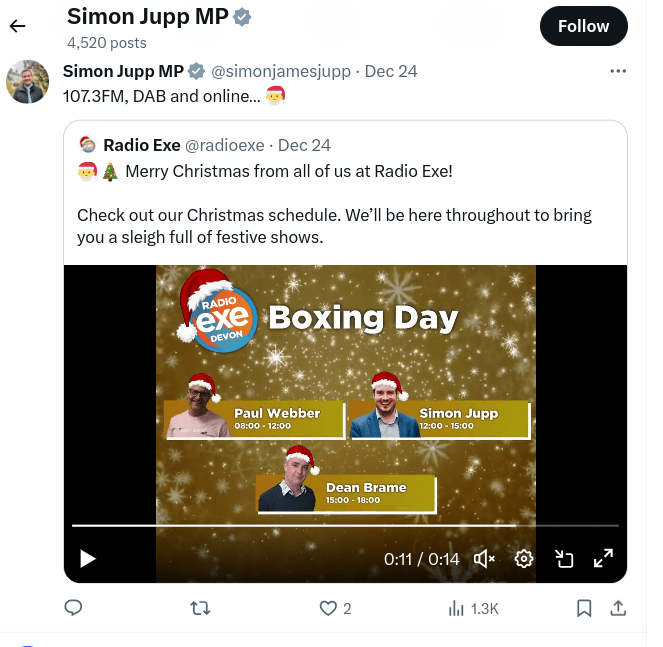
Did Simon Jupp advise the Transport Secretary on new “Hi Viz” livery?

We know that Simon Jupp, fearing a wipe out at the general election, puts a lot of thought and effort in upping his profile locally. 

So was it our Parliamentary Private Secretary who advised Mark Harper to introduce a new livery for “Team Transport”? 

Please alert Owl to any sightings of Simon sporting his PPS coat (or is it only for ministers?)

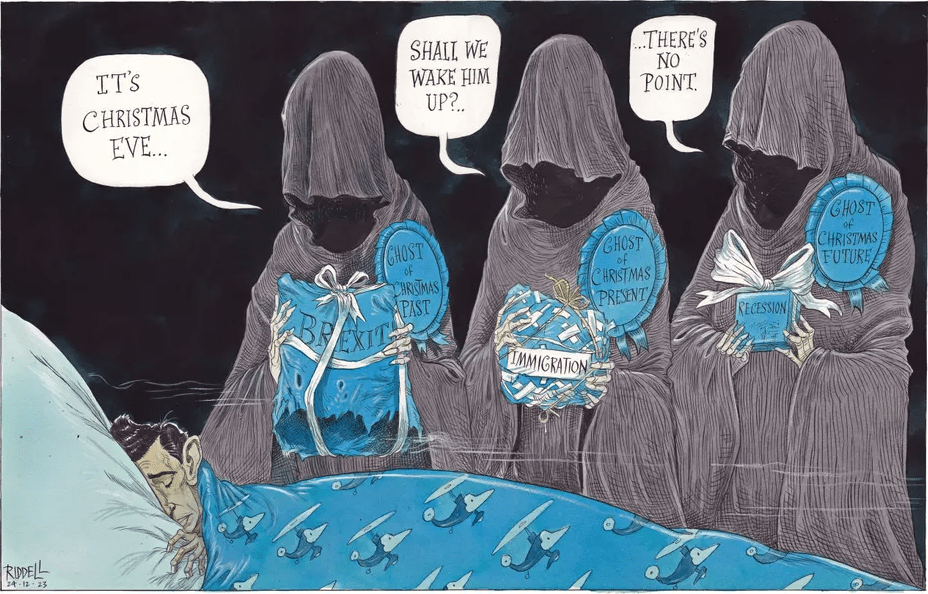
A year on and the Tories are flying by the seat of their pants again on the economy

“After March of 2025 the Government doesn’t have any spending plans.” [aka a scorched earth policy – Owl]

No 10 on collision course with Bank of England and OBR over economy

The Government is on a collision course with the Bank of England and Britain’s budget watchdog as they clash over whether or not the UK economy is on the up.

Hugo Gye, Callum Mason inews.co.uk

The Governor of the Bank warned that the UK was facing years of low growth while the Office for Budget Responsibility (OBR) said the Chancellor’s “vague” plans to cut spending put the public finances at risk.

But No 10 hit back at the warnings, pointing out that previous OBR forecasts have been too pessimistic and insisting that business views of the British economy are “very positive”.

Bank chief Andrew Bailey said this week: “If you look at what I call the potential growth rates of the economy, there’s no doubt it’s lower than it has been in much of my working life.” He suggested interest rates would stay high for an extended period of time to deal with stubborn inflation.

Speaking to MPs, the head of the OBR Richard Hughes said: “It is very difficult to assess the credibility of the Government’s spending plans, because after March of 2025 the Government doesn’t have any spending plans.” Jeremy Hunt has promised to limit growth in state spending after 2025 but has not explained how this will affect individual Whitehall departments.

Mr Hughes added: “In effect because he hasn’t provided any detail about the choices involved in delivering those numbers, we don’t know if they’re plausible or not… I think they are a very big fiscal risk, partly because they are so uncertain.”

In response to the warnings from the two institutions, a spokesman for Rishi Sunak said: “We’ve listened very carefully to the OBR and the Bank of England, but we are firmly of the view that the economy has turned the corner. We have halved inflation, and it is forecast to fall below 3 per cent next year.

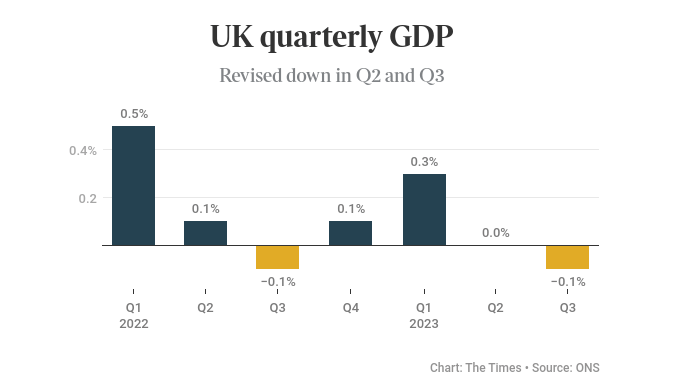
“You’ll remember the OBR said a year ago, in the first part of this year the economy would shrink by 1 per cent, and obviously it has grown.

“The revisions we’ve seen mean the UK is now growing faster than France, Germany, Italy and Japan. We’ve recovered faster from the pandemic than France, Germany and Japan. The IMF predicts UK will grow faster than Germany, France, Italy, Japan.”

A No 10 source pointed to the promise by companies to invest an extra £30bn in Britain made at a summit this week, saying: “The Global Investment Summit showed what investors think of UK – the mood music was very positive.”

City Minister Bim Afolami urged regulators to be more pro-growth, telling a gathering of bankers on Tuesday: “If you’re regulating a market, in any area, there’s no point having the safest graveyard. Animal spirits need to be there, we need to innovate, we need to drive growth and initiative.”

Transport Secretary Mark Harper added: “The forecast that we had last year said we were going to have a recession this year and actually the British economy turned out to be much stronger than that.”

A Treasury source insisted there was no split between the Government and the Bank of England on the need to tackle inflation despite the growing divide in rhetoric, saying: “We are more aligned in policy terms than we have been previously in the efforts to bring down inflation.”

Charles Goodhart, a former rate-setter at the Bank, said that Mr Bailey was right to warn markets of the risk that interest rates would have to stay at their current high level for at least another year.

He told i: “There is great uncertainty about events, particularly political events, in the next year. We do not know how the two major conflicts will develop. Moreover, the greater reliance on fixed mortgage deals means that the effect of tightening monetary policy now involves greater lags.

“So, there is considerable uncertainty about the likely rate of growth of demand and output. What Andrew Bailey is trying to prevent is markets coming to the conclusion now that rates will come down at some stage in 2024, because that would ease monetary policy unduly at this stage.”