Oh, oh, trouble: a mini Local Enterprise Partnership or a maxi East Devon Business Forum on its way?

Another unelected, unaccountable, non-transparent secret society on its way?

Another shady group of “private sector representatives and business community” Tories wetting their pants with the excitement of yet another trough for their snouts?

Cabinet Agenda for 14 December, 2015
Item 19
Page 147

The “Exeter Travel to Work Area (TTWA) area recommendations:

Click to access 141216combinedcabagendafinals.pdf

“It is presently proposed that the desired formal body for the Exeter TTWA will be a ‘Greater Exeter Growth and Development Board’ (GEGDB) including the local authorities covering the Greater Exeter functional economic area.

The Board would be a Joint Committee under s101 (5), 102 Local Government Act 1972 and s9EB Local Government Act 2000 and pursuant to the Local Authorities (Arrangement for the Discharge of Functions) (England) Regulations 2012.

It will comprise the 5 local authorities [Exeter, East Devon, Mid Devon, Teignbridge and DCC] as voting members

and a number of non-voting co-opted private sector /other representatives drawn from the wider business community.

This approach was agreed by Exeter City Council in principle on 8 November and is now being considered by the other potential partners.”

Well done those EDDC Tory councillors! But watch your backs now

Unconfirmed reports suggest that Tory councillors Grundy (Exe Valley) and Pepper (Broadclyst) were the two sensible councillors who voted against the PegasusLife Knowle planning application.

So, no-one can accuse anyone of a “Sidmouth stitch up”.

It seems unlikely that the two councillors will be getting any gifts from under the Tory Christmas tree from Santa Phil Twiss – the official EDDC Tory Whip – who denies ever having used it but who is said to be less than chuffed at the result.

Of course, not being whipped, no-one will expect them to be removed from the DMC for not following non-whipped orders ….

The 30 [plus] questions to be answered BEFORE care at home is authorised

Owl has been passed a copy of the “30 [plus] questions” that must be asked BEFORE care at home can be implemented:

Pre-implementation

The model of care:

• Does the new model of care align with our overriding ambition to promote independence?
• Is there clinical and operational consensus by place on the functions of the model and configuration of community health and care teams incorporating primary care, personal care providers and the voluntary care sector?
• Is there a short term offer that promotes independence and community resilience?
• Is there a method for identifying people at highest risk based on risk stratification tool?
• Are the needs of people requiring palliative and terminal care identified and planned for?
• Are the needs of people with dementia identified and planned for?
• Is support to care homes and personal care providers, built into the community services specification?
• Is support for carers enhanced through community sector development support in each community?
• Has the health and care role of each part of the system been described?
• Have key performance indicators been identified, and is performance being tracked now to support post implementation evaluation, including impact on primary care and social care?

Workforce:
• Is there a clear understanding of the capacity and gaps in the locality and a baseline agreed for current levels and required levels to meet the expected outputs of the changed model of care?
• Is there a clear understanding of and plan for any changes required in ways of working:
o thinking
o behaviours
o risk tolerance
o promotion of independence, personal goal orientation

• Have the training needs of people undertaking new roles been identified, including ensuring they are able to meet the needs of patients with dementia?
• Do we have detailed knowledge with regards to investment, WTE and skill mix across the locality and a plan for achieving this?
• Are system-wide staff recruitment and retention issues adequately addressed with a comprehensive plan, and where there are known or expected difficulties have innovative staffing models been explored?

Governance, communications and engagement:
• Is there a robust operational managerial model and leadership to support the implementation?
• Has Council member engagement and appropriate scrutiny taken place?
• Is there an oversight and steering group in place and the process for readiness assessment agreed?
• Have providers, commissioners and service users and carers or their representative groups such as Healthwatch agreed a set of key outcome measures and described how these will be recorded and monitored?
• Is there a shared dashboard which describes outcomes, activity and productivity measures and provides evaluation measures?
• Is there an agreed roll out plan for implementation, which has due regard to the operational issues of managing change?
• Is there a comprehensive & joint communications and engagement plan agreed?
• Is there a need for a further Quality or Equality Impact Assessment?

Implementation
• Is there a clinical and operational consensus on the roles of each sector during the implementation phase including acute care, community health and care teams, mental health, primary care, social care, the voluntary care sector and independent sector care providers?
• Is there an implementation plan at individual patient level describing their new pathway, mapping affected patients into new services?
• Are the operational conditions necessary for safe implementation met?
• Have the risks of not implementing the change at this point been described and balanced against any residual risk of doing so?

Post Implementation
• Is there a description of the outcomes for individuals, their carers and communities?
• Are the mechanisms for engagement with staff, users of services and carers in place and any findings being addressed appropriately?
• Is there a process in place for immediate post implementation tracking of service performance including financial impact to all organisations?
• Is longer term performance and impact being tracked for comparison against pre-implementation performance?
• Have we captured user experience as part of the process, and have findings been addressed and recorded to inform the planning of future changes?
• Are there unintended consequences or impacts (e.g. on primary care or social care) which need to be addressed before any further change occurs?
• Is there a clear communication plan for providers and the Public describing the new system and retaining their involvement in community development?

Source: http://www.newdevonccg.nhs.uk/about-us/your-future-care/publications-and-evidence-sources/102085
( point 14, page 94)

When and how will PegasusLife spring back to life?

Cynics amongst East Devon Watch’s readers (the majority one might suspect) are already considering aspects of yesterday’s refusal of planning permission for the Knowle site.

Of course, there is the prospect of an appeal. But there are also other scenarios being mentioned.

Some suggest that this refusal suits both PegasusLife and East Devon District Council – the former so that it can tweak its application in the light of the current economic climate and resubmit and the latter because a delay in building the new Honiton HQ might be in the council’s own interests, given the same current economic climate and the need to almost certainly raise more money due to increased costs. Also there have been some misgivings expressed by Tory councillors on the design of the new building (which does look rather like a people warehouse) and considered hardly befitting the status and importance of the people warehoused within it:

hq

Others suggest that, as “Greater Exeter” moves ever more quickly (and secretly) forward it might be better for EDDC to cut its losses on a new Honiton HQ which would only be a satellite amongst satellites and therefore not needed to be so large (or maybe not needed at all if the Exmouth premises are large enough). Not to mention the messy complications of devolution and its effect on all district councils in Devon.

Others have even suggested that EDDC has had a better offer from a hotel chain which shall be nameless!

Whatever the reason, we can be absolutely sure that, like the Terminator, it will be back!

Budleigh Salterton health hub – Swire proud to have pushed it forward

Delighted that the Budleigh Hub has been given the green light. Pleased to play my part in pushing this project forward.”

Hugo Swire, Twitter, 30 November 2016

Do remember this when, after doing your (private) art class, (private) yoga class and drinking your (private) juice you have your very public heart attack and wait for your overworked public ambulance crew to take you to your overcrowded public hospital, where you will wait for overworked staff to treat you.

http://www.midweekherald.co.uk/news/health_bosses_give_assurance_east_devon_hospital_beds_will_not_close_until_stringent_measures_in_place_1_4801160

and perhaps think about another post on his Twitter account:

@HugoSwire what are your thoughts on Budleigh LoF [League of Friends] needing to fundraise to cover not-for-profit rent of space. #NHSPS totally immoral.”

Labour and Lib Dems fined for election rule breaking – no news on Conservative investigation

“The Liberal Democrats have been hit with a maximum £20,000 fine by the Electoral Commission for failing to declare hundreds of items of campaign spending at the general election.

The watchdog has notified the police of a possible electoral offence after 307 payments totalling £184,676 were found to be missing from the Liberal Democrats’ spending return “without a reasonable excuse”.

In addition, invoices supporting 122 out of the 307 payments were
missing from the return. It found the declaration to the Electoral Commission may have been signed recklessly, as there was evidence indicating some people in the party knew it was incorrect. …

… It comes after Labour was hit with a £20,000 fine in October for similar missing election expenses, including more than £7,000 on the “Ed Stone”.

It found two payments totalling £7,614 missing from the party’s
election return that were spent on the stone tablet on which the then
Labour leader, Ed Miliband, had carved his six key election pledges, promising to display it in the Downing Street rose garden if he won the election. …

… Conservative spending at the election remains under intense scrutiny after a Channel 4 investigation alleged some local spending was allocated to the national account to avoid tight limits for each constituency. About nine police forces have been investigating the accusations of higher-than-permitted spending in a number of marginal seats, which could have helped the Tories gain a majority at the election.”

https://www.theguardian.com/politics/2016/dec/07/lib-dems-fined-20000-for-undeclared-election-spending

Hospital trolley waits enormously increased

And when, if you were to be in North Devon, after projected cuts, you might already have taken 1-3 hours to get to your nearest hospital:

“More than one in 10 patients in England face long delays for a hospital bed after emergency admission.

BBC analysis of NHS figures showed nearly 475,000 patients waited for more than four hours for a bed on a ward in 2015-16 – almost a five-fold increase since 2010-11. Hospitals reported using side rooms and corridors to cope with the growing number of “trolley waits”.

NHS bosses acknowledged problems, blaming “growing demand” on the system.
But doctors said hospitals were now dangerously overcrowded, with three quarters of hospitals reporting bed shortages as winter hits.

Bed occupancy is not meant to exceed 85% – to give staff time to clean beds, keep infections low and ensure patients who need beds can be found them quickly. But 130 out of 179 hospital trusts are reporting rates exceeding this for general hospital beds. Hospital managers said the problem was causing “deeply worrying” delays for these patients.

They are people who have already faced a wait to be seen in A&E but whose condition is deemed to be so serious they need to be admitted on to a ward.
About one in five people who come to A&E fall into this category and it includes the frail elderly and patients with chest pains, breathing problems and fractures.

The BBC analysed official NHS England figures and found 473,453 patients waited more than four hours for a bed between October 2015 and September 2016 – 11% of the 4.2 million patients admitted in total during the period. More than 1,400 of them faced delays of more than 12 hours.

It compares with 97,559 “trolley waits” in 2010-11 – although NHS England pointed out a small fraction of the rise could be attributed to a change in the way the waits were measured in December 2015. Directly comparable figures are not available for other parts of the UK, although data suggests there is an increasing strain on beds.

While the delays are known as “trolley waits” not all patients find themselves on one. Hospitals use all sorts of areas, including side rooms, seats in the A&E department and spare cubicles depending on what is available.

Rupert Nathan, 55, was rushed to hospital in an ambulance when he started suffering chest pains at home in June. He had previously had two angioplasties – one in 2000 and one in 2001 – because of angina and feared he was having a heart attack.

He was taken by ambulance to Barnet Hospital in north London and was given blood tests and an electrocardiogram. At that point, staff decided to admit him for further tests. But he spent more than five hours waiting for a bed.
“I was left in a waiting area with my girlfriend. I was in pain and really concerned. There was little contact with staff and it was after midnight when I was finally found a bed.”

He asked for morphine and was told he would undergo scans in the morning. But when morning came, he was in a much better state and was discharged.
“I was told the delays were because it was very busy. I could see that, but it’s still not acceptable.” Mr Nathan has made a complaint about his care. The hospital said it was looking into the case.

‘Too few beds’
Siva Anandaciva, of NHS Providers which represents hospitals, said: “These figures are deeply worrying. We are heading into winter in a more fragile state than I have seen in the past 10 years or so.

“Even the historically top-performing trusts are being challenged, which shows that this is an issue affecting all parts of health.

“No-one wants to see people waiting in corridors, side rooms and emergency bays when they should be admitted to a hospital bed. These patients are still under the care of doctors and nurses of course, but it is not ideal for them and we know overcrowding leads to worse outcomes.”
Dr Chris Moulton, of the Royal College of Emergency Medicine, echoed the concerns.

“Patients who are delayed like this are still being monitored by staff. But we know that the overcrowding we are seeing is dangerous. It leads to worse outcomes for patients – higher infection rates, patients ending up on the wrong wards and generally a negative experience.”

Dr Moulton believes there are too few beds. There are just over 100,000 general beds in England – a fall of 40,000 in the past 20 years. “We simply don’t have enough. If you compare us to other European countries we are really short and the demands being placed on the health service means we are now struggling to cope,” he added.

A spokesman for NHS England said “growing demand” was putting pressure on the system – the number of emergency admissions having risen by more than 500,000 in five years to 4.2 million.

But he added it was “a tribute to front-line staff” that the NHS was able to handle so many patients.

http://www.bbc.co.uk/news/health-38228411

“Save our Hospital Services” calls for abolitition of “Success Regime”

ON THE NATURE OF INDEPENDENCE AND IMPARTIALITY

The ‘Success Regime’/STP Team in Devon

Save Our Hospital Services Devon (SOHS) is today calling for the abolition of NHS England’s Sustainability and Transformation Plan (STP) for Wider Devon and the suspension of the so-called Success Regime for North, East and West Devon that is now an integral part.

“These two programmes are false, flawed and fraudulent,” says Dave Clinch, a spokesperson for SOHS in North Devon. “They are riddled with public-private, professional-personal conflicts of interest.”

SOHS Devon points out that the Case for Change document on which both the Success Regime and the STP are based was produced by a private-owned health service consultancy, Carnall Farrar. One of the consultancy’s founding partners, Dame Ruth Carnall, is now the ‘Independent’ Chair of the Success Regime pushing through the STP in Devon.

“SOHS Devon believes that there is a pre-determined agenda in Devon to cut services, limit access and reduce demand by redefining medical need to ensure that government cuts are carried out. How can Ms Carnall, who produced the blueprint for the STP, be considered remotely independent in assessing our needs or services to meet them?” asks Mr Clinch.

SOHS Devon points out that to push their agenda for cuts to NHS services and staff, the Success Regime/STP team will have been allocated £7.4 million between 2015 and 2017. Some of this funding has been used to recruit senior staff from those same services they plan to cut; for example, Andy Robinson, who left his role as Director of Finance at the Northern Devon Healthcare NHS Trust to join the Success Regime in Exeter. What is more, Mr Robinson happens to be the partner of the Chief Executive of the Trust, Alison Diamond.

“Professional or personal? How can this relationship avoid directly impacting on the life-and-death decisions now being made?” says Mr Clinch.

Meanwhile, the proposed relocation to Exeter of acute services based at North Devon District Hospital (NDDH) is being overseen by the Success Regime’s Lead Chief Executive Angela Pedder, the former CEO of the Royal Devon & Exeter Foundation Trust.

“How can she be considered unbiased given her former role?” says Mr Clinch. It’s no coincidence that RD&E needs to cover a much bigger deficit than NDDH in Barnstaple.”

On top of this, the two leads on the STP’s Acute Services Review programme are both from hospitals in South Devon, namely Derriford in Plymouth and Torbay in Torquay. SOHS Devon can find no evidence that they are talking to the clinicians working in acute services at NDDH. And the fact is, if the proposed acute services cuts go ahead, people here in North Devon will suffer and die.

ENDS

Church of England closes care home – cannot get staff

“… Over the past couple of years, we have found it increasingly difficult to recruit and retain nursing and care staff, and we are now reaching the point where we will be unable to staff the home in a way that meets the needs of our patients.”

The reliance on agency staff was “not sustainable in the longer term”, Spencer said.

According to a C of E source, as well as the considerable cost of using agency workers, there were concerns about turnover, consistency of care, and levels of safety and standards.

About 40 members of staff are expected to lose their jobs when the home closes. …

https://www.theguardian.com/world/2016/dec/06/church-of-england-closing-manormead-care-home-hindhead-surrey-lack-of-staff

GP slams secret health cuts

” … “The GP profession (alongside nurses, paramedics and so many others in the NHS) is struggling to recruit and retain its workforce – perhaps this has been the reason why we have not been asked to come to the table. We are imploding from workload and burnout. Shifting work into the community is already happening without an increased workforce and there’s no plan to increase dwindling GP numbers.

These plans are setting alarm bells ringing. Involving frontline staff or the public in any meaningful way is likely to pose delays for their implementation. And as NHS England states in its own guidance, due to financial challenges “we do not have the luxury of waiting until perfect plans are in place”. Certainly it could be argued that STP boards are trying to make the best out of the must-do mantras, rigid financial control and timescales stipulated by NHS England.

The greatest danger of STPs is that they become the focus not of improvement or innovation but of cost-cutting
Can there be any room for transformation at a time when many of the STP organisations are experiencing significant financial deficits? Can we moderate demand, promote self-care, roll out seven-day access, improve cancer and other health outcomes, reduce hospital and emergency nursing home occupancy and balance the books? The greatest danger of STPs is that they become the focus not of improvement or innovation but of cost-cutting: moving bottle-necks of demand from one setting to another and leading to poorer health.

Ultimately the level of NHS deficit will dictate how achievable these STPs become. In the end it seems that NHS England is asking local organisations to deliver a sugar-coated pill that may look ambitious and futuristic, but will nevertheless still be bitter to swallow.

https://www.theguardian.com/society/2016/dec/06/secret-plans-to-transform-nhs-zara-aziz

Today truly IS a day for miracles! Pegasus Knowle planning application REFUSED by DMC

????????????????????????????????????

Refused by 7 votes to 6. Express and Echo article here, more to follow:

Controversial plans to build 113 apartments for older people on the site of East Devon District Council’s offices at Knowle in Sidmouth have been dramatically rejected by the authority’s Development Management Committee.

The decision could throw into jeopardy the council’s planned relocation to new offices in Honiton and Exmouth Town Hall.

To finance the move, East Devon District Council had agreed to sell its Knowle headquarters to Pegasus Life Ltd, which specialises in providing living and care facilities for older people. The sale was subject to a successful planning application.

The council decided to relocate its headquarters in March last year.

It plans to move out of its current premises in Sidmouth to purpose built offices in Honiton and to Exmouth Town Hall, which will be refurbished.

The relocation to Exmouth is due to take place during the latter part of next year, with relocation to the new purpose built offices in Honiton to follow by spring 2018.

But it is not yet clear how the planning committee’s decision will affect these plans.

The planning application by PegasusLife for a 113-apartment assisted living community for older people was refused by the committee by seven votes to six at a meeting on Tuesday, December 6.

Local campaigners and Save Britain’s Heritage had objected to plans to demolish the 19th-century council offices and build on the Knowle Park.

Liz Fuller, buildings at risk officer for Save Britain’s Heritage, said: “The Knowle is an important local landmark building in Sidmouth standing in attractive landscaped grounds.

In our view, the loss of the Knowle and the additional development of the park’s upper lawns and car park as proposed represent a devastating blow to the history and character of Sidmouth, a remarkably well-preserved Regency town in a beautiful setting on the Jurassic coast.

“The long-term benefits of retaining this building should be properly considered as it would serve to secure an important local landmark.

She argued that the proposed development would result in “clear over-development of the site”.

Pegasus Life said its plans would help to meet Sidmouth’s housing need. The company had reduced the amount of proposed accommodation in response to comments from local residents.

The application was refused on the grounds that it was an overdevelopment of the site which would impact on neighbours and the character of the area; that the proposed development should be a C3 use and include affordable housing and not a C2 use, and that it impacts on the setting of an historic building.

PegasusLife now has the option to appeal.”

http://www.exeterexpressandecho.co.uk/retirement-village-plan-for-east-devon-council-s-knowle-hq-rejected/story-29961485-detail/story.html

NHH hospital and bed cuts public meeting Sidmouth Parish Church Friday 7.30 pm

Chris East via 38 Degrees:

“I hope that some of you managed to get to the amazing “see red” rally in Exeter Princess Hay last Saturday.

This message gives notice of a public meeting this coming Friday in Sidmouth Parish church at 7.30 pm.

The “Your Future Care” consultation ends on 6 January. Please come to this local meeting and learn how it is not just a matter of proposed Sidmouth hospital bed cuts, or even just bed cuts, but cuts to many different NHS services in Devon wide, hidden under different project names, aimed at confusing us.

You can download a meeting leaflet from out East Devon campaign web site:

http://www.one-name.name/protect-east-devon-hospitals-campaign.html
Please spread notice of this meeting among your friends and neighbours.

Thanks

Chris East

The great LEP scandal – part 3: Government says LEPs should investigate themselves!

“Officials should be banned from taking cash from any public bodies they run following a Daily Mail investigation, Dame Margaret Hodge declared last night.

The former chairman of the Public Accounts Committee said the law must be changed to stop board members benefiting from grants.

Her intervention came amid fury over the Daily Mail’s revelations that officials responsible for billions of pounds have been handing money to their colleagues’ firms.

The Commons Business Committee last night said it was investigating the ‘extremely serious issues’ – after the Public Accounts Committee also launched a major probe.

Officials oversaw the payments after getting places on boards called Local Enterprise Partnerships – or LEPs – which consist of business bosses and council chiefs and were put in charge of £7.3billion meant to kick-start economic growth.

Reporters found LEPs have made at least 276 payments to their own board members, their companies, or projects from which they stand to benefit. One received £1million for his call centre, while another got £13,000 of payments towards events at his family castle.

‘There is a quite clear and simple answer to all this – you outlaw it,’ Dame Margaret said last night. ‘Where you’ve got a conflict of interest, you have to choose – you either are a member of the board or you want to make money out of it.’

Last night the Government insisted LEPs should investigate any suspect payments themselves – and that this was not the Government’s job.

But MPs said this was ‘simply not good enough.’ Dame Margaret criticised the Government for failing to properly scrutinise LEP spending.

‘It is your money and my money that they are spending,’ she added.
‘When Government sets up these fragmented structures it always fails to put in place proper regulatory systems. It’s because the Government doesn’t care. What the Mail has uncovered doesn’t surprise me, what it does is depress me.’

Incredibly, there are currently no rules to prevent LEP officials from using the money they have received to award grants for their firms’ benefit, or to make decisions in secret.

LEPs have failed to account for at least £3.7billion of the cash they have been given by the Government, in their responses to Freedom of Information requests by the Mail.

The revelations are a major embarrassment for Chancellor Philip Hammond, who handed LEPs another £1.8billion in last month’s Autumn Statement. Meg Hillier, Public Accounts Committee chairman, has vowed a major probe into the payments and the ‘utterly unacceptable’ lack of transparency. She said the boards were acting like ‘a cosy little club’.

Iain Wright, chairman of the Business, Energy and Industrial Strategy committee, said last night: ‘These are extremely serious allegations. LEPs have been given stewardship of massive amounts of public money. There appears to have been some appalling failings in accountability at some LEPs. We will want to know how they are spending public money and who is checking that they are spending it responsibly.’

Tory MP Philip Hollobone represents Kettering in Northamptonshire, the county where a banker on the LEP board received nearly £13,000 for his family’s Norman castle. He added: ‘The Daily Mail has played a crucial role in bringing these issues to national attention and is providing much needed scrutiny about how this money is being spent.

‘But it shouldn’t have been up to the Daily Mail. It is clear when LEPs were set up proper systems for scrutiny were not established. I would welcome further investigations from organisations like the PAC.’

The TaxPayers’ Alliance accused Government of ‘frittering away taxpayers’ hard-earned money’. Chief executive John O’Connell added: ‘Many of these cases quite frankly do not pass the smell test.’

Downing Street insisted it was ‘for those councils and partnerships’ to investigate ‘individual allegations’. But every council contacted by the Mail over suspect LEP payments has refused to investigate them.

Many councils and LEPs share the same staff, and when contacted by the Mail many councils offered joint statements with the LEP – apparently failing to understand they were supposed to be carrying out independent scrutiny.
The Prime Minister’s official spokesman said: ‘We expect these partnerships to maintain the highest possible standards.’

She said that after the Mail contacted the Government with its concerns it had taken action.

‘We strengthened the rules to make sure there was greater transparency,’ she added. ‘We have been very clear that we won’t hesitate to act if any LEP fails to comply with the new tougher standards.’

MORE CASE STUDIES

BRISTOL

A former Mayor took £48,000 for his ‘beer factory’ – and another £14,000 for his brewing firm – from the LEP board he sat on.

The grants were handed to enterprises owned by George Ferguson while he sat on the board. He was Mayor of Bristol until earlier this year.
But no minutes exist on how the decisions were taken and no documents indicating his interest in the factory and brewing firm appear to have been published by the LEP.

The £48,000 grant for Mr Ferguson’s Bristol Beer Factory was supposed to be to support local jobs, but there is also no publicly available record of why his other beer firm – the Bristol Brewing Company – received two other payments totalling £14,499.

Neither the LEP nor Mr Ferguson would explain the payments.

While on the board, another company the Mayor was a director of – Destination Bristol – was also paid £10,000 in consultants’ fees by the West of England LEP.

Five other payments – worth just over £92,000 – were made to a company owned by one of Mr Ferguson’s political donors, Alasdair Sawday. The former Mayor said he had ‘properly declared all his known interests’ and ‘studiously avoided being involved in any decision relating to my own or family interests’.

West of England LEP said Mr Ferguson ‘played no part’ in the funding decisions but would not comment on why no registers of interest were available for former members or why minutes of key funding decisions before 2014 did not exist.

LEICESTERSHIRE
A zoo was given a £550,000 grant for ape enclosures after its chief executive joined the LEP board.

Sharon Redrobe said securing the funding had been her finest achievement. And after the grant was handed out, her pay went from £85,000 to £94,000, a rise linked to the zoo’s improved financial performance.

Dr Redrobe, 47, became CEO of Twycross Zoo in October 2013 and joined LEP board the following summer. Less than a year later, a panel on which two of her LEP colleagues sat approved a £558,000 grant to help the zoo refurbish animal enclosures.

Twycross Zoo denied Dr Redrobe’s pay rise was linked to the LEP grant. A spokesman said: ‘There is no conflict of interest. Dr Redrobe played no part in the grant decision.

Leicester and Leicestershire Enterprise Partnership also said Dr Redrobe had no role in the decision to grant the funds.

BRIGHTON
… fashion boss Susie Cave was handed a £53,000 taxpayer-funded grant from her Local Enterprise Partnership.

She was given the money after telling the LEP Coast to Capital she wanted to launch a designer collection but her business didn’t have enough cash.
By then, Mrs Cave’s designer clothes line – which she makes from the comfort of her home – had already been worn by celebrities such as Cate Blanchett and model Daisy Lowe.

But she told the board she needed more money to hire staff and launch a full collection for women ‘with money to spend on beautiful things’. It has now been launched, with dresses ranging from £575 to nearly £1,000.

Milliner to the stars Philip Treacy OBE and designer Bella Freud – Lucian Freud’s daughter – are among the company’s board members and advisers.
Mrs Cave, the business’s 50-year-old creative director, lives in a regency-era mansion worth around £3million with her husband Nick, the singer-songwriter, who is worth £4million.

Coast to Capital said: ‘This is a strong local business. It has already delivered the 5.5 jobs for local people it committed to at its premises on a Brighton Business Park. This grant, representing 25 per cent of the total investment, was awarded through a transparent process, with the proposal assessed against the published criteria by an independent panel.’ ”

http://www.dailymail.co.uk/news/article-4003918/Ban-fat-cats-secret-deals-says-MPs-demand-action-Mail-exposes-old-pals-club-doles-public-money.html

Daily Mail investigation into LEPs part 2 – prepare to be shocked to your core

“Officials in charge of billions of pounds of Whitehall business grants have overseen hundreds of payments to their colleagues’ firms, the Daily Mail reveals today.

They were put in charge of £7.3billion of taxpayers’ money to boost growth and help small businesses, under the Government’s flagship Growth Deal scheme.

But on at least 276 occasions, the cash has been used to make payments to the officials themselves, their own companies, or projects they stand to benefit from.

The officials sit on boards called Local Enterprise Partnerships or LEPs consisting of local business bosses and council chiefs. These bodies have not accounted for £3.7billion of the cash they have been given by the Government.

Astonishingly there are no rules to prevent the officials from using the cash to award grants to themselves, or from making their decisions in secret.

In the first comprehensive audit of the billions spent under the Growth Deal, the Mail’s investigation found conflicts of interest over hundreds of payments. In some of the most extraordinary cases:

■ A board boss saw his own call centre handed a £1million taxpayer-funded grant – a quarter of the funding available for his area;
■ A multi-millionaire banker oversaw payments of nearly £13,000 to his family’s Norman castle for board events;
■ A board member’s multi-millionaire business partner received a £40,000 payment – to renovate a luxury barn on his estate that they both used as their offices;
■ A £60,000 grant intended for local companies was given to a Saudi chemical giant after its UK boss joined an LEP board.

Last night a Government spokesman admitted the Mail’s findings were ‘extremely serious’. And the evidence was branded ‘completely unacceptable’ by the Commons public accounts committee chairman Meg Hillier, who accused the boards of acting like ‘a cosy little club of private businesses’.
She vowed that the committee would carry out a full investigation of the Mail’s evidence.

Under the Growth Deal, £7.3billion has been allocated to LEP boards to spend on projects that will supposedly boost growth all over England.

The revelations will embarrass Chancellor Philip Hammond, who just last week pledged to hand a further £1.8billion to LEPs in his Autumn Statement.
But no rules were ever laid down by the Government about whether the private sector bosses who sit on LEP boards and administer the funding can award the money to themselves.

Many of them seem unaware that taxpayers’ money must be accounted for.
In many cases, the bodies have simply refused to explain payments, or been unable to provide any records of how decisions involving tens of millions of pounds of public money were made.

Because most of the bodies do not publish accounts, it took months of Freedom of Information requests to establish where the £7.3billion had gone. And the Mail has found that barely half has been properly accounted for – with at least £3.7billion unaccounted for publicly. Hundreds of grants have also been handed out in secret – so it is impossible to tell whether officials have benefited financially. Nearly £500,000 worth of grants have been labelled ‘miscellaneous’ or ‘redacted’ in accounts provided to the Mail.

One LEP refused to provide an account of its spending, and told the Mail to look at board minutes online – where all details of all its funding decisions were redacted. Another said it had promised all the companies it gave money to that their names would be kept secret.

It was last night refusing to name the 182 businesses that had benefited – meaning it is impossible to know whether any of its board members were among them.

From the figures that have been provided nationally, the Mail found 276 payments – worth more than £100million – which involved obvious conflicts of interest.

In many cases there are no public records of how the decisions were made. Where they are available, we found some board members had declared their interests – but had been allowed to sit in and even vote on decisions anyway.

Others do not bother to declare their private interests in registers which are supposed to be published online.

Until our investigation, four in ten of the bodies failed to publish a register of interests – even when asked for one by the National Audit Office. In addition, some board members were found to have taken fees for ‘consultancy’ work or other services – while publicly claiming they were not remunerated. Some of the fees have been paid through private firms or personal service companies – a practice which allows the beneficiary to potentially avoid paying income tax.

The supposedly low-cost LEPs have also spent a fortune on their lavish expenses – for hotel stays, foreign jollies, chauffeured travel, meals out, curries and burgers.

Although they are supposed to spend only £500,000 a year on their running costs, one has spent £24million in just six years.

In a report published earlier this year, the National Audit Office raised serious concerns about the accountability of LEPs. It said it had been unable to find details of the remuneration of senior staff at 87 per cent of LEPs, and said registers of interest were missing at four in ten of the bodies. The report said the Government’s ‘light touch approach to assessing value for money’ was at risk of becoming ‘no touch’ and criticised it for having an incomplete picture of how the bodies were operating.

Last night MPs said the abuses were shocking – and accused the Government of allowing a ‘staggering’ lack of accountability over the billions of taxpayers’ money.

And they have demanded to know why billions were handed to boards chaired by representatives of private sector companies – without any safeguards to stop public funds being abused.

‘It’s not at all clear that the right safeguards have been put in place,’ Meg Hillier said. ‘To have more than £3.7billion that is not accounted for publicly is just completely unacceptable. These board members need to understand that if they go on an LEP board, it’s not just a cosy little club of private businesses. We have already raised concerns about the accountability of LEPs and the lack of basic systems in place to make sure interests are declared and where money is being spent. This whole issue is of deep concern to us.’

Charlotte Leslie, Tory MP for Bristol North West, said the Mail’s findings were ‘diabolical’ and suggested LEPs were at risk of becoming ‘cosy clubs for local vested interests.’ She added: ‘This must be investigated fully.’
A Government spokesman said: ‘We take the Daily Mail’s findings extremely seriously.’

Last week, after being contacted by the Mail about the story, the Government published new rules. The spokesman added: ‘We want to see greater transparency on how taxpayers’ money is spent. We won’t hesitate to act if any Local Enterprise Partnership fails to comply with these new tougher standards.

The Mail has found that more than £100million has been paid to LEP board members and officials’ own businesses or projects they have a stake in.

These are some of the most shocking examples…

1. ESTATE AGENT HAD OFFICES RENOVATED FOR £40K

A board member’s business partner was handed £40,000 to refurbish a luxury barn on his private family estate.

The barn belongs to Richard Burton, the business partner of LEP board member Bill Jackson. It also happens to be where Mr Burton and Mr Jackson run their estate agency – called Jackson Equestrian.

Mr Jackson’s girlfriend also runs an interior design business, Horton Interiors, from the building – and reports online suggest her firm may also have been a beneficiary of the grant because it was used to carry out some of the refurbishment work.

Her company boasts of having undertaken ‘all work in the planning and feasibility stages, as well as securing grant funding’.
A news release on her company’s website added that it had ‘created a fun yet practical scheme for the offices, including whimsical wallpaper in the communal kitchen’.

After being fitted out at taxpayers’ expense, the barn now appears to boast luxury interiors, a design studio and oak signs, while a sculpture of a rearing horse stands amid manicured gardens in its front drive. As well as being the multi-millionaire heir of the estate, Mr Burton has a share in Mr Jackson’s business.

Mr Jackson did not disclose the fact that Mr Burton is his business partner – and married to his girlfriend’s niece – in his register of interests. He only declared the fact that the grant was ‘on buildings used on offices for Jackson Equestrian and Horton Interiors’. He insisted he had no financial interest, because the firms only rented the building.

The LEP has refused to provide evidence of how the funding decisions were made but said Mr Jackson, 71, who is the current High Sheriff of Herefordshire, has no involvement in funding decisions related to the redundant buildings scheme, and that they were made by a steering group. A spokesman added: ‘Neither Mr Jackson, nor any of his companies, has applied for or been a recipient of funding. Mr Jackson has no involvement in the allocation of any funds.’

Mr Jackson, said: ‘The grant was made to Longner Farms to which I have no financial connection. Jackson Equestrian, a company I am director of, rents part of the converted barns at £10 per square foot, which is a commercial rent and there is a lease in place. At all times I have declared my interest to the board in writing and have made no financial gain.’ Neither Mr Burton or Horton Interiors responded to requests for comment.

2. BANKER’S OWN CASTLE GOT £13K

A multi-millionaire banker received nearly £13,000 for his family’s Norman castle from the LEP board of which he is a member.

Eton-educated James Saunders Watson runs his family’s 20-acre Rockingham Castle Estate, alongside a lucrative career at investment bank JP Morgan.
Before Mr Saunders Watson joined the Northamptonshire LEP board in 2011, it made no payments to the estate. But within months of him joining, the LEP started giving money to public events there. This included more than £12,000 to sponsor dressage, cross-country, and show jumping competitions.
More than £400 was also used to cover the cost of canapes, elderflower presse, orange juice, mulled wine and mince pies for an LEP event at the castle.

This event was to ‘promote Northamptonshire’ – although technically, the castle is in Leicestershire.

The payments for the events were made directly to Mr Saunders Watson, who operates as a sole trader rather than through an official company. Mr Saunders Watson, 55, lives in the castle with wife Elizabeth, 51, and their three children.

The castle, started in 1071 on the orders of William the Conqueror, has been the family seat of the Saunders Watson family for 450 years.
In an interview with the Financial Times in 2004, he said: ‘It’s wonderful to have so much space. The part we live in has 11 bedrooms, with a further five available if needed, and there are 20 acres of garden outside – the kids love it.

‘Of course there are drawbacks. It takes ages to unload the car after we’ve been to the supermarket because we have to walk through two courtyards carrying everything; and it’s also an awful long way to the loo.’
Mr Saunders Watson is estimated to be worth £22million. He is head of investment trust marketing at JP Morgan.

There are no public records showing how the decisions were made, but Northamptonshire Enterprise Partnership said Mr Saunders Watson had no role in the decision to pay money to his castle, which was made by officials and not at board level.

It said sponsoring the Rockingham International Horse Trials allowed it to promote Northamptonshire ‘as an investment and housing location to a national and international audience’.

A spokesman added: ‘The refreshments were best value as no charges were made for use of the venue. NEP has a key strategic objective to promote Northamptonshire as a great place to live, work and invest.’

Mr Saunders Watson said the horse trials sponsorship was ‘exceptionally good value’ and that refreshments ‘were charged at cost with the venue costs met by me, as part of my commitment to NEP and Northamptonshire’s economic growth’.

He said he had no role in choosing to pay the castle, adding: ‘Rockingham Castle is the oldest historic building and the only international equestrian event in the county so it is not surprising or inappropriate that an organisation responsible for promoting Northamptonshire would include Rockingham in its activities.’

3. SAUDI ROYALS’ FIRM GOT £60K

A £60,000 growth grant intended for ‘local companies’ wanting to ‘take on more business’ was given to a Saudi chemical giant represented on the board handing the cash out.

The multinational firm – which is one of the world’s largest makers of petrochemicals and makes profits of £5billion a year – was chosen for the growth grant after its UK director joined the LEP board handing out the money.LEP advertising stated that the grants would ‘support local companies looking to recruit more staff, enabling them to grow and take on new business.’

But astonishingly SABIC – which is based in Saudi Arabia and is 70 per cent owned by the Saudi royal family – was given £60,000 as a ‘wage subsidy’ for its British base in Teesside.

The global chairman of SABIC UK Petrochemicals Limited is Prince Saud bin Abdullah bin Thenayan Al Saud, a member of the Saudi royal family +7
The global chairman of SABIC UK Petrochemicals Limited is Prince Saud bin Abdullah bin Thenayan Al Saud, a member of the Saudi royal family
Paul Booth, chairman of SABIC UK Petrochemicals Limited, continued to sit on the Tees Valley LEP board when the payments were made. SABIC – which stands for Saudi Basic Industries Corporation – employs more than 40,000 people across more than 50 countries.

The global chairman is Prince Saud bin Abdullah bin Thenayan Al Saud, a member of the Saudi royal family. SABIC UK and Tees Valley LEP said Mr Booth had no involvement in the funding decisions, which were taken by an LEP panel he did not sit on. SABIC UK said the application was made without Mr Booth’s knowledge.

A spokesman added: ‘Mr Booth was not involved in the decision-making process for making these payments. He and SABIC UK Petrochemicals Limited did not operate under any conflict of interest or otherwise exert any inappropriate influence.’

The LEP said the grant had led to new jobs, adding: ‘There is no impropriety. Robust procedures are in place to ensure any potential conflicts of interest are identified and dealt with.’ ”

http://www.dailymail.co.uk/news/article-4000010/Exposed-Secretive-fat-cats-carving-7bn-cash-friends-family-including-40-000-renovate-barn-155-000-Jamie-Oliver-s-charity-restaurant.html

Daily Mail investigation into LEPs – part 1

LOCAL ENTERPRISE PARTNERSHIPS: QUESTIONS & ANSWERS

What are LEPs?

Local Enterprise Partnerships were set up by the coalition government in 2010. They control billions of pounds of public money, which they are supposed to use for investment that will help drive economic growth in their region. They replaced Regional Development Authorities. But unlike RDAs, LEPs were never set up in law and are ‘voluntary bodies’. This means that, despite making decisions over billions of pounds, many have no legal structure.

How many of them are there?
There are 39, one in every region in England.

Who sits on them?
LEPs are led by boards of local authority officials and private business bosses. According to the rules set out by the Government, the boards must be chaired by a businessperson and at least half the members must be from the private sector. But under the Government’s ‘light touch’ regulation of LEPs, the bodies are otherwise free to make their own decisions on how to appoint board members.

How powerful are they?
LEPs have been given £7.3billion of taxpayers’ money so far – and in last week’s Autumn Statement, Chancellor Philip Hammond promised them another £1.8billion. Although the money they control is kept in council accounts, LEP boards have free rein to decide where it goes.

Are they transparent about how they spend our money?
Despite being asked for details of all their expenditure via Freedom of Information requests, they were unable or unwilling to provide details of at least £3.7billion of the money they have been given.

Some LEPs refused to provide any information at all for more than five months – and many still refuse to answer key questions about payments they have made.

No firm rules were made about how transparent LEPs had to be about how they used public money, or how grants were made. And no rules were made which prevent the board members from benefiting from grants. In March, the National Audit Office found LEPs were ‘not as transparent to the public as we would expect’. It found no details of the pay and perks of senior staff available to the public at 87 per cent of LEPs. Four in ten did not publish a register of interests.

How are they scrutinised?

Incredibly no real scrutiny of LEPs appears to exist. The Government claims it is the job of councils to check on their decisions.

But no councils contacted by the Mail were willing to investigate the questionable payments we found. In fact, many did not appear to understand they were supposed to be carrying out independent scrutiny. The NAO said Ministers’ ‘light touch approach to assessing value for money’ was at risk of becoming ‘no touch’, relying on conversations with the LEP and ‘self-reporting’ to assess how well they are doing.

http://www.dailymail.co.uk/news/article-4000010/Exposed-Secretive-fat-cats-carving-7bn-cash-friends-family-including-40-000-renovate-barn-155-000-Jamie-Oliver-s-charity-restaurant.html

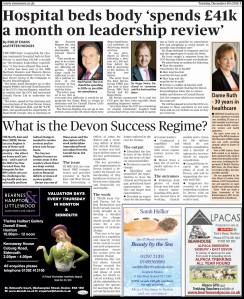
Local NHS – where our money goes – “leadership review” costs £41,000 per MONTH

80aa4a4d-c25c-4f2c-8fc5-7cb7f1be109b-2012-000001718f4e8194_tmp

THE NHS body responsible for closing community hospital beds in East Devon is spending £41,400 a month on “developing leadership capabilities,” it has been alleged this week.

A letter has been sent to the NHS Northern Eastern and Western Devon Clinical Commissioning Group by the East Devon Group of the Campaign to Protect Rural England.

The letter, dated December 1st, to Mrs Angela Pedder, the Lead Chief Executive of the CCG’s Success Regime, asked her to confirm that the CCG had instructed Carnall Farrar Ltd to undertake the work.

The letter, signed by the chairman and vice-chairman of the East Devon Group CPRE, Dr Margaret Hall, and Mr T.J.W. Hale, also questioned the impartiality of Dame Ruth Carnall, who is chairman of the Success Regime but also a director and shareholder of Carnall Farrar Ltd.

“This would appear to be a clear conflict of interest, affecting all parties, which alone could be sufficient to justify a judicial review of the outcome of this consultation,” said the letter.

The letter goes on to say that to overcome this difficulty it would be appropriate for Dame Ruth to resign as chairman and for Carnall Farrar Ltd’s contract to be terminated.

The Success Regime was set up as one of three areas in the UK where there were deep rooted financial problems in delivering health services.

It was introduced in Devon following a forecast of a £40 million deficit for 2014-15 increasing to £87 million in 2015-16 (see below).

The letter from the East Devon Group CPRE was also sent to East Devon MPs Neil Parish and Sir Hugo Swire.

Mr Parish commented: “It is vital the CCG gets the best value possible when spending taxpayers’ money.

“At a time when the CCG are consulting on closing community hospital beds across East Devon, they should be spending as little as possible on consultancy fees and ploughing as much money as possible into frontline care.”

Sir Hugo declined to comment until he had the opportunity to study the letter.

We have sought a response from the CCG but they failed to meet our deadline. We asked them to confirm the following:

  • That the monthly consultancy fee is £41,400?
  • How long has that monthly fee been paid?
  • How long will the monthly fee be paid?
  • Is there a conflict of interest with Dame Ruth Carnall chairing the Devon Success Regime when he is a shareholder and director of Carnall Farrar Ltd, the company which was awarded the contract?

We will be pleased to print the CCG’s responses to these questions in our next issue and on our website as soon as they are received.

Does anyone know what the CCG’s 30 questions are?

“…Speaking on behalf of the CCG, Budleigh Salterton-based GP Dr Rick Mejzner said: “Clinicians have developed a series of tests, building on a similar process used to support the implementation of changes in Northern Devon, which will underpin the introduction of the plan.

“This process comprises 30 key questions and scenarios which must be addressed, with supporting evidence, to measure the impact the new models of care will have across primary and secondary care settings.”

“Each of the 30 questions in this robust ‘gateway process’ must have a positive answer with evidence provided before any changes could happen. This will ensure that GPs and other clinicians have confidence in a safe implementation.”

http://www.midweekherald.co.uk/news/health_bosses_give_assurance_east_devon_hospital_beds_will_not_close_until_stringent_measures_in_place_1_4801160

Dorset: 9 councils to merge into 2 – public majority agrees

“THE public has shown clear support for merging Dorset’s nine main councils into two, local authority bosses have claimed.

They revealed the results of a consultation which showed majority support for turning Bournemouth, Poole and Christchurch into one authority, with another to cover the rest of the county.

The consultation saw 4,258 questionnaires returned out of the 20,000 sent to selected Dorset households. Another 12,542 were filled out online or in person by people responding to the call for views.”

http://www.bridportnews.co.uk/news/14946976.Public_shows_clear_support_for_merging_Dorset_s_nine_councils_into_two/

Post-truth spin by Conservative Gatecrashers

Owl refuses to publish the EDDC press release that triggered the comment below. Owl considers it a brazen example of “post truth” spin. Suffice to say he tries to twist the situation where he and two other councillors gatecrashed a “Save our Seafront” meeting.

Here is an organiser’s response:

Councillor Skinner’s press release of 05/12/16 is full of mistruths. In terms of clarification, the meeting Councillor Skinner [attended] was advertised as ‘all welcome’, however it was not advertised as a public meeting but as a Save Exmouth Seafront (SES) meeting in which we were welcoming along new supporters following the large numbers who attended our protest march. I don’t think that gives Cllr Skinner any legitimacy in his hijacking of the meeting – and hijack he did. If he wanted to attend a public meeting to genuinely engage, why did he arrive unannounced so no questions could be formulated ahead of the meeting? He attended and DISRUPTED what was a SES meeting, and judging by accounts of his behaviour – he had no intention to listen to those present anyway.

I have been trying since July to organise a public Q&A session with Cllr Skinner; the idea being for ALL members of the public to be able to attend and put questions to him, not only the supporters of SES. That he attended uninvited and unannounced and simply disrupted a SES meeting does NOT count as public engagement!

If Cllr Skinner was genuinely hoping to use this meeting as an opportunity to engage, the overriding question has to be, why did he not contact the organisers of the meeting, including myself, for I was emailing him in the preceding week asking him to clarify his intent ref the public Q&A? My emails of the preceding week would have been a perfect opportunity for him to tell me he intended to attend the SES meeting. Instead he utterly ambushed the meeting and acted rudely towards many who were in attendance, I therefore take serious issue with him now trying to paint this as a public engagement exercise.”

Now Unison adds its voice on health care crisis

“Health reform plans being put together across England should be halted in order to allow for greater consultation on the planned changes, according to the trade union Unison.

Ahead of the publication of all 44 NHS sustainability and transformation plans, the union also called for greater staff involvement in the plans to help ensure they can be implemented and a government funding boost.

The STP areas bring together health and care leaders, organisations and communities to develop local blueprints for improved health, care and finances in regional areas known as footprints. It takes forward part of the NHS’ Five Year Forward View.

Concerns have already been raised that some plans are unrealistic and Unison said both the government and NHS England have failed to consult properly with the public and staff on these reforms, which are being pushed through too rapidly.

The union’s head of health Christina McAnea said health and social care had been ignored in the Autumn Statement at a time when both services desperately need more money.

“These new NHS plans will fail if the government doesn’t give the health service extra funds and staff are not on board,” she stated.

“Health and care organisations have had to show how they will make services less fragmented. But better integration is just wishful thinking without more funding.

“Unless more is done to reassure staff and the public the government will find it has little support for these plans.”

http://www.publicfinance.co.uk/news/2016/12/unison-calls-pause-stp-planning