“Housing ministry returns cash to Treasury”

Affordable homes? Pah, who needs them!

“The Ministry of Housing, Communities and Local Government has returned £817m of unspent cash to the Treasury.

According to website Huffington Post, the money includes £329m for the government’s Starter Homes programme, £72m for affordable homes and £52m for estate regeneration.

Labour’s shadow housing secretary, John Healey, said: “If the secretary of state can’t defend his department’s budget from the Treasury he should give the job to someone who can.”

http://www.room151.co.uk/151-news/news-roundup-pwlb-borrowing-reaches-464m-mhclg-returns-unspent-817m-to-treasury-us-firm-enters-advice-market/

“John McDonnell: Spring Statement ‘must help ailing councils’ “

[Many of the councils ehich admit to severe problems are Conservative councils – some in affluent areas]

“John McDonnell has urged the government to ensure that the Spring Statement offers help to local councils that are struggling financially.

Mr McDonnell said: “Tories are bizarrely saying they will pass up an opportunity this month to act.”

He warned that councils in England are facing bankruptcy due to what he called the government’s “failed policy of austerity”.

Chancellor Philip Hammond will deliver the Spring Statement on 13 March.

A recent survey suggested that 80% of England councils feared for their finances.

In his speech in Southampton on Saturday, Mr McDonnell highlighted reported comments by Surrey County Council leader David Hodges – a Conservative – who said the authority faced “the most difficult financial crisis in our history”.

Mr Hodges also reportedly urged the government not to “stand idly by while Rome burns”.

Surrey County Council spans the chancellor’s constituency of Runnymede & Weybridge.

John McDonnell said: “If his own Tory council leader doesn’t trust his main economic policy, why should anyone else in the country?”

Mr McDonnell accused the government of trying to play down the Spring Statement by refusing to publish “any major documents” and moving the statement from its usual slot.

A Treasury spokesman outlined the plans to the Financial Times for the statement which, unlike most recent Budgets and Autumn statements, is being delivered on a Tuesday rather than taking the high profile slot straight after Prime Minister’s Questions on a Wednesday.”

http://www.bbc.co.uk/news/uk-politics-43273843

EDDC, the property consultant and Premier Inns – a worrying menage-a-trois?

From East Devon Alliance Facebook page:

“Look who’s coming to advise our Council: Item 7 on Overview agenda, March 13th.

http://eastdevon.gov.uk/…/130318-overview-agenda-combined.p…
Do we trust these people? Public can attend the meeting”

Anyone recall a few years ago, Tesco was flavour of the month? Now it seems to be Premier Inns.

Oh, and JLL was the company that chose Moirai as the lead developer for the first ill-fated stab at seafront development in Exmouth!

https://eastdevonwatch.org/2016/07/18/exmouth-eddc-backtracks-on-moirai-capital-investments-seafront-development-up-for-grabs-again/

The blurb that goes with this agenda item says:

“Matters for Debate 7 JLL presentation – Commercial Property Investment for Local Authorities JLL is a leading professional services firm that specializes in real estate and investment management. A Fortune 500 company, JLL helps real estate owners, occupiers and investors achieve their business ambitions.

Presenting Team John Kinsey, National Director John Kinsey joined the practice in November 2003 and has over 30 years of experience within the property markets throughout the South West. He has considerable experience in out-of-town leisure and retail developments along with High Street A3 developments. He is the representative for Whitbread Plc for their Premier Inn hotel chain throughout the South West. He has advised a number of local authorities on key project work and regeneration schemes. Simon Bennett, National Director Simon joined Jones Lang LaSalle in October 1995. He has 22 years’ experience within the Investment Department, specialising in the disposal and acquisition of a variety of properties across the whole of the South West. His clients are a wide range of institutional, local authority, property companies and private investors, together with a number of charity clients. Recent clients include CBRE Global Investors, AEW, IO Group, Standard Life and Mayfair Capital. David Roberts, Director A Director in JLL’s Planning and Development Team with a focus on the preparation and implementation of effective estate strategies for a range of public sector clients. David also currently works on a significant number of commercial and residential regeneration projects across the South West. His specialist skills include concept development, masterplanning, options appraisal, viability analysis, due diligence, business planning and estate strategy, implementation strategy, development partner procurement, agency and funding support.

Presentation JLL will be presenting and discussing with the council the recent drive by local authorities to enter into the commercial investment market and how this is being used for both income generation and regeneration projects.

They will present a number of case studies and also discuss case studies where local authorities have used their covenant to enable regeneration and investment opportunities.“

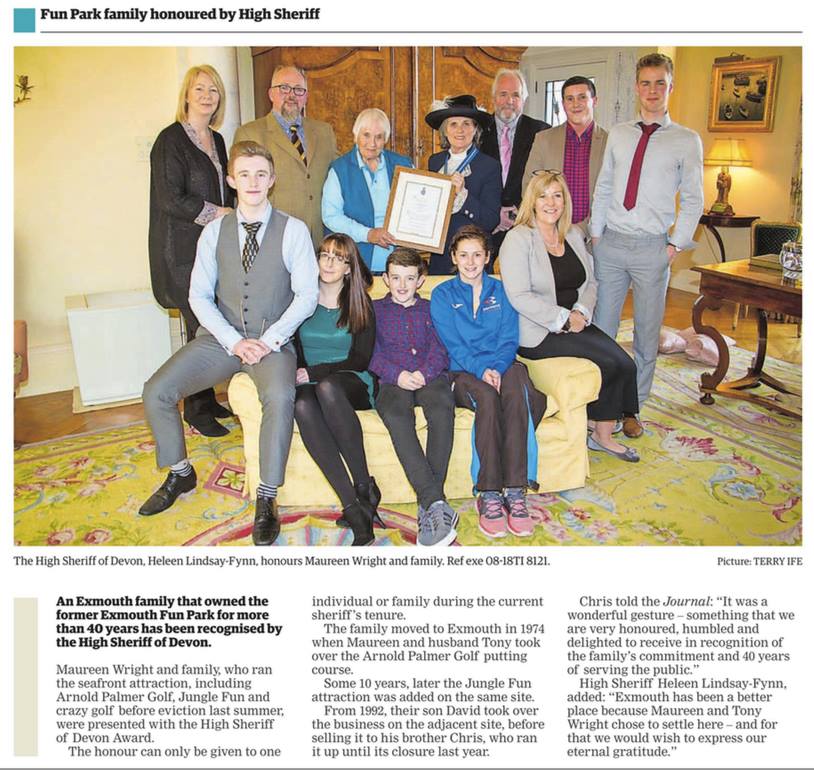
Exmouth’s Wright family receives much-deserved and unique award

From Exmouth’s Save our Seafront Facebook page and Exmouth Journal:

“The High Sheriff of Devon honours Maureen Wright and family, former owners of The Fun Park.

The award was presented to The Wright Family “in recognition of the great and valuable services to the community” and also recognises “the appreciation of the residents and people for activity and contribution in enhancing the life of the community”.

The High Sherriff, Heleen Lindsay-Fynn, can only honour one family or individual during her time in office and chose to present her award to The Wright Family on 21 February 2018.”

Majority of councils fear effect of Brexit

ALL councils, irrespective of who is in control – scary!

https://www.theguardian.com/politics/2018/mar/03/council-leaders-across-uk-believe-brexit-will-hurt-local-economy

Productivity, weather, climate change and – robots!

Our LEP says we can double productivity in Devon and Somerset by 2030. But can we do this given recent weather/climate activity that has apparently already cost Devon £200m?

https://www.devonlive.com/news/business/snow-storm-emma-cost-south-1289777

To recap: the only 2 main roads into and out of Devon (M5 and A303) were both impassable at the same time, the rail service collapsed in Dawlish and London, Exeter airport was closed and rural bus services were all cancelled. Devon came to a standstill. At a time when there were threats to cut gas supplies to larger, non-strategic businesses.

Good quality and quantity infrastructure is essential to get productivity growth, and now the cold weather has – yet again – shown how bad our infrastructure is, and that the current government has under invested – almost certainly because the south-west is generally a set of safe seats – so there is no need to invest – need as defined by political election need not citizen need.

So LEP claims to double productivity would be extremely optimistic / challenging in the best of circumstances, with great infrastructure, but with crumbling infrastructure, struggling under the weight of homes growth, and subject to the vagaries of the weather and lacking in desperately needed investment, there is not a hope of getting anywhere close. And indeed, we might ask, with the woeful infrastructure we currently have, and no investment, should we expect a decline in productivity rather than an increase?

And we have another problem. Productivity = output. so, with robotics does that mean more or less employment – and if less, and no one wants to move here, who are going to live in all these new homes and how will they afford to keep them?

Even Greggs the bakers are now using robots to make sausage rolls and pasties:

https://www.dailystar.co.uk/news/latest-news/685288/Greggs-to-cut-hundreds-of-jobs-sausage-roll-doughnut-robot-UK

Developers and loopholes – go together like a horse and carriage!

Owl says: as millions of pounds meant to be used for affordable homes was returned to the Treasury by the Department of Communities, Local Government and HOUSING, we can only assume this government doesn’t give a stuff about this.

“Property developers have used a legal loophole to halve the number of affordable homes that they are building in the countryside.

A study of more than 150 new housing developments found that confidential viability assessments had been used to cut the number of affordable houses by 48 per cent. The assessments let developers break promises made to get planning permission, if they can show those commitments will eat into profits.

The research, which was commissioned by Shelter, the charity for the homeless, and the Campaign to Protect Rural England (CPRE), found that eight rural councils lost 938 affordable homes after viability studies over the course of a year. “The viability loophole is slashing affordable housing supply in the countryside,” the report said. “The profits of volume housebuilders are rocketing, yet affordable housing provision by the same developers is being undercut on the grounds that it is not profitable enough.”

In one instance in Cornwall, the owners of a disused tin and copper mine promised that 40 per cent of the site’s 99 new homes would be affordable. They cut that commitment to zero with a viability study. The owners then advertised the plot for sale, boasting in the brochure that all of the plots had been approved for “open market housing” without any “liabilities”.

Central Bedfordshire, which was the worst affected of the eight councils in the study, lost 533 affordable homes in the 2015-2016 financial year.

Affordable housing includes homes for social rent, shared ownership and other intermediate tenures. “The term affordable in this context does not necessarily mean that these homes are in fact genuinely affordable to local people,” the report said.

The profits of Britain’s three biggest builders, Barratt Developments, Taylor Wimpey and Persimmon Homes, have quadrupled since 2012 to £2.2 billion a year. Yet they regularly cite financial constraints to reduce the percentage of affordable homes at new developments.

At Sowerby Gateway in North Yorkshire, Taylor Wimpey promised to build 256 affordable homes. A viability study cut that promise to zero. “Too much of our countryside is eaten up for developments that boost profits, but don’t meet local housing needs because of the viability loopholes,” said Crispin Truman, the chief executive of CPRE.

Councils can challenge viability studies but the government has guaranteed big builders at least a 20 per cent profit. If the builders can show that they stand to make less, the government will side with them.

“Developers are using this legal loophole to overpower local communities and are refusing to build the affordable homes they need,” said Polly Neate, the chief executive of Shelter.

Sajid Javid, the communities secretary, has promised to review how “viability is assessed” when he starts a consultation next week to overhaul the planning laws.

Separate research by the Institute for Public Policy Research, a think tank, found that the number of people sleeping rough in rural parts of England increased by 42 per cent from 397 in 2010 to 565 in 2016.

Houses are 26 per cent more expensive in the countryside because of pressure from wealthy retirees and buyers of second homes, but wages in rural areas are 26 per cent lower, which has created an exodus of young families.

Andrew Whitaker, from the Home Builders Federation, an industry body, said local authority targets were always negotiable. “There is a limit as to what can be extracted from development sites before they become unviable and you get no homes of any sort,” he said.”

Source: Times (paywall)