Role model independent talks about independents

“What kind of independents are these?

Given that these numbers record only district level and above, they won’t include many of the grassroots independents that have succeeded in record numbers at the community level: town councils and parishes. Notable exceptions will include Herefordshire County and East Devon District Council – the first fully independent council. The majority are more likely to be disillusioned and ashamed Tory and Labour councillors, unwilling to go down with their national party.

However, they are a broadening gateway to something else quite remarkable, and now moving into the space of people’s politics. A new wave of local people who are taking it upon themselves to be responsible for what happens in their local community, how the money is spent and how decisions are made.

Given that over the past three years turnout for local elections has fallen to 33%, leaving 67% technically open to persuasion, the margin for an upset is always large. In 2013 this was the entry point for UKIP. With only one MP and later 2 MPs in the UK Parliament to represent them, they used the power of narrative and social media to characterise this localism as a people’s vote in favour of leaving the EU.

Yet there was no new mechanisms on offer to give people any more agency in the political sphere – even locally – it was all coming from above. After the Brexit referendum they were more or less deserted by their leaders and are now heavily regarded as a spent force.

In hindsight, nevertheless, it is possible to see UKIP and the Leave vote as important moments in the revolution of UK democracy. Not only has there been a weakening of the long-standing duopoly in British politics but it has stirred ambition for a better expressed people’s politics – a genuine alternative to the current political system and culture. Amongst other things, even as a phenomenon to grapple with, it gave birth to The Alternative UK.

The degree to which such a democratic emergency dovetails with the environmental emergency cannot be underplayed. They depend upon each other to achieve the transformation of our society we need to survive. Our own deep dive into this arena for over two years has revealed a substantial movement – appearing in multiple guises – of a new socio-political sensibility that links people to power to planet (I, We, World).

Frome Frome! The Flatpack model picks up speed

Within this, the “values-based” independents inspired by Flatpack Democracy in Frome are causing a storm right now.

The readers of the Daily Alternative, know this political model of citizen-led and participatory politics. The Independents from Frome were also one of the first towns to declare a Climate Emergency. But unlike the UK government, this came with a report of how to get Frome to zero carbon by 2030 and a commitment to deliver locally.

With the added phenomenon of Extinction Rebellion, leading a national and international campaign, becoming independent suddenly takes on another dimension – that of citizens stepping up to save our future, in the face of national-level failure to do so.

How many of the wave of newly elected independents below the district level were Flatpack Democracy aligned candidates, we won’t know for another day or so. In Frome where Flatpack was birthed, former Mayor Peter Macfadyen stood back after two terms to see a resounding 17/17 seats retained for IfF.

In Devon where we have been closely watching and working to create the conditions for the rise of Flatpack politics, remarkable gains were made at District, Town and Parish levels, many of them taking control of their councils.

I spoke to Pam Barrett, former Mayor of Buckfastleigh who reported winning 10 out of 12 councillors; 11/16 in Dartmouth, 9/13 in Chudleigh, 7/14 in Bovey (taking control with 2 non-aligned independents), Portishead 15/16. East Devon has become the first ever independent District Council in the country.

Meantime, members of the Torridge Common Ground, co-founded by XR initiator Jamie Kelsey-Fry, won two further District Council seats alongside their 6 at town level.

Says Jamie: “I’m somewhat rocked in my soul today.. we have a foot in the door and can start to change the way local power operates. We have people’s assemblies, listening, radical inclusivity and the consciousness of acting with the next seven generations in mind, all at the heart of how we do things. It’s impossible not to have hope right now”.

Standing where we have been for the past two and a half years, steadily charting and helping to generate the rise of a new politics, this month feels like a Mexican wave. With first Greta, then the school strike, then Extinction Rebellion, then the Parliaments, then the local independents, all rising to take the headlines in turn. Together they’re generating the sense of something genuinely alternative in the making.

Link rising movements to better practice

But knowing how these waves are designed to start up and gradually fall away, how do we embed them more deeply in the rhythm of our daily lives? How can we maintain the excitement in ways that not only keep the connection between these movements going, but open the door to many more? …”
https://www.thealternative.org.uk/dailyalternative/2019/5/5/alternative-editorial-a-mexican-wave-of-change-as-local-elections-show-breakthrough-for-independents?

“Expenses watchdog hushed up revelation 377 MPs had credit cards suspended”

“The parliamentary expenses watchdog tried to cover up data showing 377 MPs, including nine cabinet ministers, have had their credit cards suspended for wrong, incomplete or late claims.

The Independent Parliamentary Standards Authority (Ipsa), set up in the wake of the expenses scandal 10 years ago, initially tried to claim the information should not be released because it could hinder the operation of the expenses system.

However, a former high court judge reversed the decision and released the information to the Daily Telegraph on appeal, saying that the risk of “embarrassing” MPs was no reason to keep the information secret.

It mirrors the initial reluctance of parliamentary authorities to release information on MPs’ expenses 10 years ago, when the scandal was uncovered only when it was leaked to the same newspaper.

The release of the credit card data showed MPs are regularly having their credit cards suspended for failing to provide receipts in a timely fashion or claiming for disallowed items, with 377 MPs sanctioned since 2015.

Claire Perry, the energy and climate change minister who attends cabinet, admitted wrongly using her parliamentary credit card to pay for her Amazon Prime subscription.

Since the 2015 election, 377 MPs have all had their credit cards suspended, documents released under the Freedom of Information Act show.

Repeat offenders include Amber Rudd, the work and pensions secretary, and nine MPs who have had their card suspended more than 10 times over the past three years. Damian Collins, the chair of the Commons media committee, and Chloe Smith, a Cabinet Office minister, have each both had their credit cards suspended 14 times.

Other cabinet ministers subject to suspensions include Stephen Barclay, Greg Clark, Chris Grayling, Robert Buckland, Rory Stewart, Jeremy Wright and David Mundell.

Jeremy Corbyn, the Labour leader, Tom Watson, the deputy leader, and Boris Johnson, the Tory leadership contender, were also among those to have had their cards suspended.

A spokesman for Rudd said: “Some payment deadlines were missed by the member of staff responsible for these matters. These issues were subsequently resolved.”

Collins said one case was to do with removal costs being challenged and otherwise “it was simply a case of being late in getting the reconciliation of the card payments back to Ipsa”.

A Labour spokesman said: “Our MPs’ offices rectify all such administrative issues as soon as they are identified.”

https://www.theguardian.com/politics/2019/may/08/expenses-watchdog-hushed-up-revelation-377-mps-had-credit-cards-suspended?

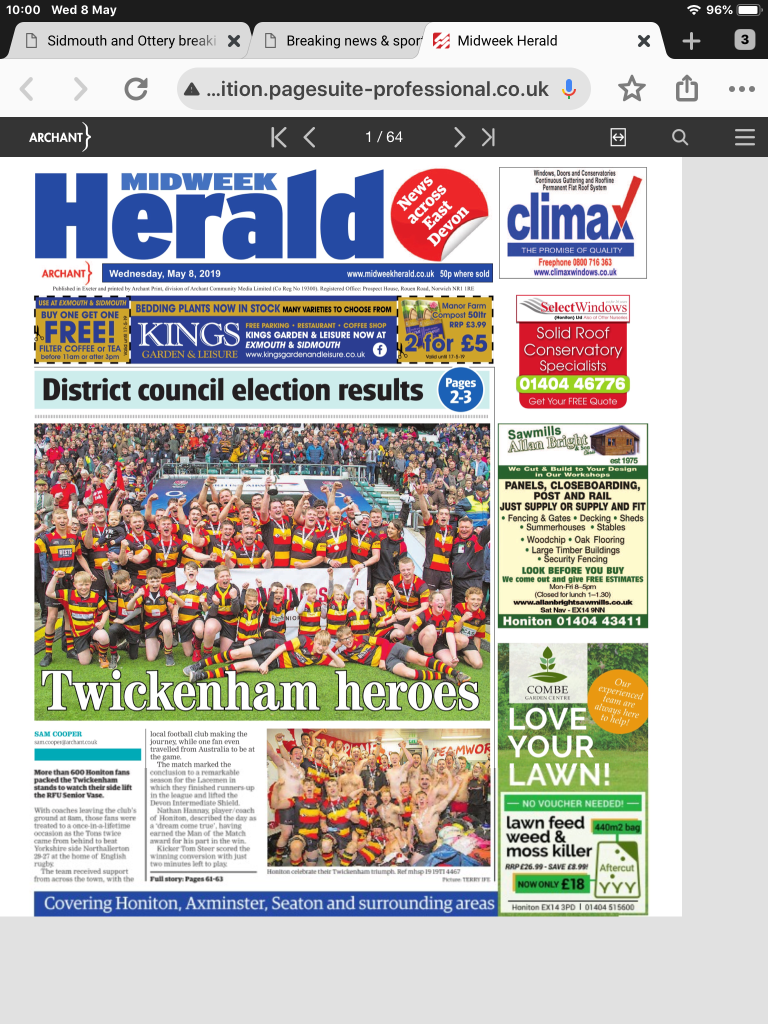
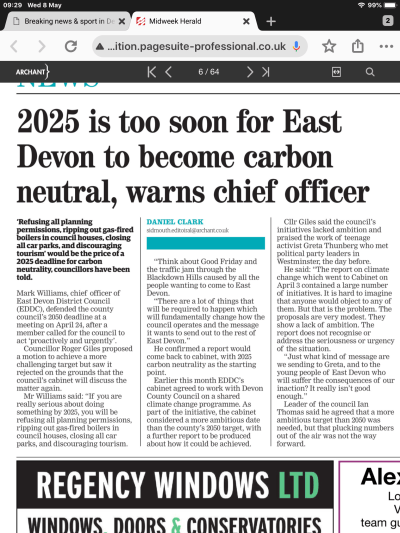
EDDC CEO puts new majority in their place about climate crisis – wants very slow change

Wasn’t aware Williams was in charge ….. print quality of the article is poor but you get the gist – I won’t be rushed …

   the

What is our Local Enterprise Partnership up to?

Well, if you strip out the projects that are actually “stand alone” and directly-funded by its members from its latest newsletter – not very much at all – and all funded by money that used to go directly to local authorities (and not a murmer about their biggest project – Hinkley C nuclear power station:

https://mailchi.mp/heartofswlep/hotsw-lep-march-newsletter?e=9367babecc

“Companies pocket millions from kid’s uneaten free school meals campaigners claim”

“Private companies are pocketing millions of pounds from children’s uneaten free school meals, campaigners reveal today.

Firms which have deals to provide school catering are benefiting from a loophole which allows them to pocket any unspent cash left on pre-loaded cards, according to Citizens UK.

It believes contractors are trousering millions from the arrangement – and called for a crackdown by education chiefs.

The group’s activists calculate some £70million a year lies dormant in youngsters’ free school meal accounts.

Some of the funds are recouped by cash-strapped schools and town halls, and pumped back into the system.

But where catering has been contracted out, the money helps to swell private firms’ coffers, the group claimed.

One year eight pupil said it was “wrong” for companies “to be taking our money without telling us”.

They added: “It’s practically stealing. Imagine all the other things you could afford to buy with all the money that’s being taken away from us.” …”

https://www.mirror.co.uk/news/politics/companies-pocket-millions-kids-uneaten-15011227

Indies … a diverse political background

Now the dust has settled on voting Owl has had chance to think what a rum lot the new Independents are …

A Tory councillor, who became EDA leader and then left to become an Independent Group councillor … Ben Ingham

A Tory who became an Independent but can’t say why … Ian Thomas

An Independent who was in the last Tory Cabinet and presumably still held in high regard by same Tories … Geoff Pook

An Independent married to a Tory … Kim Bloxham

An EDA councillor who became an Independent Group Councillor …Geoff Jung

Interesting times!

“Government issues new statutory guidance for authorities in England on scrutiny”

Bet MINORITY party Tories will be MUCH more keen on this than they were when in power!

“The Ministry for Housing, Communities and Local Government has issued new statutory guidance for local and combined authorities in England on scrutiny of their decision-making.

It said councils were being “encouraged to embrace scrutiny of their spending decisions to achieve value for money, improve services and address the public’s concerns”.

The guidance, which can be viewed here

https://www.gov.uk/government/publications/overview-and-scrutiny-statutory-guidance-for-councils-and-combined-authorities

stresses the role of scrutiny committees in holding authorities to account over local decision-making. It outlines what effective scrutiny looks like and the positives it can bring to local authorities.

Key points highlighted by the Ministry include:

councils should adopt a position of sharing any information asked for by their scrutiny committee, and if information cannot be shared in public they should consider sharing it in a closed session;

scrutiny committees should be constructive ‘critical friends’ with a vital role of amplifying the voices and concerns of the public when councils take important decisions;

local authorities should also consider whether contracts with companies delivering services should include a requirement to supply information to scrutiny committees.

Rishi Sunak, Minister for Local Government, said: “Scrutiny committees form an integral part of the work of councils in delivering services by acting on behalf of residents to hold councillors and staff to account for the important decisions they make.

“That is why I have set out new guidance to ensure authorities and residents can reap the benefits of effective scrutiny, by instilling a culture that welcomes challenge.”

The Centre for Public Scrutiny assisted the Ministry in developing the guidance. Its chief executive, Jacqui McKinlay, said: “We welcome government’s timely revision of its statutory guidance on scrutiny, and particularly its focus on leadership buy-in, culture and behaviours that are so central to ensuring that effective overview and scrutiny can operate, and make an impact, at local level.

“We look forward to working closely with our colleagues at the Local Government Association and individual councils to use the new guidance as an excellent opportunity to reflect and review their current approach to scrutiny.”

https://www.localgovernmentlawyer.co.uk/governance/396-governance-news/40497-government-issues-new-statutory-guidance-for-authorities-in-england-on-scrutiny

Diviani blames Tory “vendetta” for de-selection in Yarty …

This communication from ex-Leader and now also ex-councillor Paul Diviani really deserves a far wider audience than former Yarty voters:

“Dear All

As there is not a lot of substance to report other than repetition and the ghastly shenanigans afoot nationally, regionally and within the Conservative Party, I feel I should draw a line under my 20 years representing Yarty.

I have appreciated the many friendships I have made in that time and will always have your best interests in mind.

For the sake of clarity, I was deselected by the Conservative Executive as a result of a personal vendetta from standing in Yarty and had to find another ward away from Tiverton and Honiton with a disastrous personal result.

Wishing you all the best for the future and if I can help in any way (without interfering!) I am at the end of a call.”

No, Paul, everything really is fine in Yarty, the voters have spoken, so its time to hang up your Tory council boots … no-one appreciates old Grandpa insisting he’s the only one who knows how things should be done! And those disastrous results would almost certainly have been just as bad in Yarty.

Though, for the sake of even more clarity, Owl thinks you might name a few names before you hang them up!

And it certainly shows that there is definitely “something VERY nasty in the woodpile” if the current and ex-Leader complain about the party that served them so well until recently.

Owl is STILL waiting for Ian Thomas to explain exactly which of the national Tory policies he disagreed with (since he is on record as saying all was fine among East Devon Tories when it so obviously wasn’t).

“For England’s new councillors, the reality of life in our boroughs will hit hard”

“Optimism will be short-lived among the 1,560-plus new councillors – Liberal Democrats, independents, Greens – elected last week in the cities and shires of England, where countless councils changed hands.

These newcomers may have worthy ambitions to transform their councils. But reality kicked in on Tuesday. Entering town halls for briefings, one issue became clear: there’s barely any money left to fund even adult and children’s care, which swallows the majority of cash – let alone keep the rapidly shrinking library service running, the leisure and swimming pool afloat, parks and highways maintained.

Countless warnings from respected organisations, notably the government’s own spending watchdog, have gone unheeded by the government. Last year, the National Audit Office cautioned that council financing is unsustainable and that 10% of the larger councils could have exhausted their reserves – which prop up social care – within three years.

It gets worse. The Commons public accounts committee said recently that the government is in denial about a crisis in which councils are overspending alarmingly on social care, while some are courting “greater risks” through property speculation. …

How did we land in this mess? Look no further than George Osborne, the former chancellor, whose parting gift was a wheeze to make English councils almost self-sufficient by slashing central government grants while handing back control of most business rates. Until Osborne’s intervention, rates had been collected centrally, then redistributed relatively equitably, since 1993.

In 2016, the government initiated a “fair funding review” to work out how Osborne’s reforms might be implemented – and it’s turning out to be anything but fair. Why? Because ministers are taking little account of need and deprivation in poorer areas, with a £7.8bn funding gap emerging overall in council finances. Up to now, these areas have been compensated to take account of low tax bases because they have few expensive houses which deliver higher council tax receipts. Furthermore, business rates from run-down high streets generate a pittance in poorer areas compared with thriving city centres in London and elsewhere. No matter: for this lot, inequity is compounding denial.

Something has to give in a system where almost 60% of council spending now goes on adult and children’s social care – although, overall, social care spending is still falling. Everyone in Whitehall and town halls knows that the social care system is in freefall. A review of how it should be funded – locally, or nationally – is promised. So why introduce a new funding system for local government while its largest single service is awaiting a review?

True, some councils – sometimes smaller districts, with no social care responsibility – are plugging gaps in their finances by morphing into de facto property developers, borrowing heavily to buy shopping and office centres to deliver an annual income. In 2017-18 alone, councils spent £4bn on commercial property, in spite of NAO warnings that finances could be “strained” in the event of a downturn.

But radical action is needed. Rob Whiteman, head of the public sector accountants body Cipfa, argues that authorities should have the power to set council tax rates locally, based on up-to-date property values. His call should not go unheeded.”

https://www.theguardian.com/society/2019/may/07/england-councillors-cuts-funding-system-poorest-areas?

If party politics undid EDDC Tories what could undo Independents.

Self-interest and ego – title before right person for the job
Power games – valuing being top-dog over best person for job
Infighting – not sorting out best person for job, letting personalities rule
Really being a closet Tory – and ensuring they are your first oriority
Dishonesty to voters, unaccountability
Lack of transparency – scrutiny, scrutiny, scrutiny and then more scrutiny
Being developer or officer-led – letting Sir Humphrey sabotage policies

But it isn’t going to happen is it Independents?

“A303 and A358 plans to go ahead despite national press reports”

“Plans to dual two key routes through the West Country remain on course despite reports in the national press that they may be scrapped.

Highways England, which is responsible for England’s motorways and major A-roads, has put forward schemes for a new tunnel for the A303 at Stonehenge, the dualling of the A303 between Podimore and Sparkford, and the dualling of the A358 between Taunton and Ilminster.

National press reports on April 24 indicated that 11 schemes currently being considered by the body could be paused “indefinitely”, following concerns that they would not provide value for money. …”

https://www.chardandilminsternews.co.uk/news/17622233.a303-and-a358-plans-to-go-ahead-despite-national-press-reports/?

“Rising knife crime linked to council cuts, study suggests”

“Councils with large cuts to youth services were more likely to also have seen an increase in knife crime in the area’s police force, research suggests.

The All-Party Parliamentary Group on Knife Crime (APPG) studied budgets for youth services from 2014/15 to 2017/18. It also analysed knife crime data.
It said the four areas worst-hit by youth spending cuts also saw some of the biggest knife crime rises.

But comparison is not like for like as council and policing areas differ.
MP Sarah Jones, who chairs the APPG which is made up of MPs and peers, said youth services cannot just be “nice to have”.

She added: “We cannot hope to turn around the knife crime epidemic if we don’t invest in our young people. …”

https://www.bbc.co.uk/news/uk-48176397

An owlet reports …

“Owl may like to hear from other indigenous flocks of birds that have, over decades, chosen to settle in small, rural nesting places, free from predatory, vulture-like species, whose aim appears to have been the destruction of the East Devon natural environment, primarily to further their own self-sustenance.

Without suitable culling, these raptorial groups with such voracious, insatiable appetites would have caused the ruination of many distinct, valued habitats throughout East Devon. This species is commonly known as “The Feather Their Own Nests Birds” (Latin name – ‘torymemberus senioradmindominari’)!

However, it appears that when birds of a feather flock together, their collective birdsong is so momentous that it can effect change. Most can hear the birdsong but few actually pay attention, fully understand and LISTEN. The East Devon resident bird population remains territorial, watchful and perched in anticipation.

Data supplied by a Local Ornithologist who wishes to remain anonymous for fear of targeted, defensive bird attacks!

Hitch in town and parish council count while couple got hitched

The problem with two-site operations for EDDC HQ is that sometimes the south hand doesn’t know what the north hand is doing.

The count at Exmouth had to be halted for 45 minutes and the room cleared so that a double-booking – a wedding – could take place.

“The Local Elections Showed Banging On About Brexit And Nothing Else Is A Fast Track To Extinction”

“If voters wanted to reward parties committed to making Brexit happen, why would Ukip get wiped out at the polls? If a People’s Vote is such an anti-democratic proposal why did we not see losses to the Liberal Democrats and the Greens? …

… Voters who supported Brexit then or now share something in common with many pro-Remain voters: they want Westminster to pay greater attention to concerns on the doorstep and reconnect with the issues that matter most to them. Brexit was a way of giving the establishment a wake up call. If this was really about making Brexit happen, Liberal Democrats and Greens would be wiped out and swept away. But that did not happen either north or south.

The local election results indicate that bringing the country back together is achievable. It will require offering policies bringing tangible benefits, not playing it overly safe and support for a confirmatory People’s Vote. Those parties learning these lessons stand to weather the European elections best and will have the winning results when a general election is called. Banging on about a Brexit plan no one wants to the exclusion of everything else is a fast track to political extinction, as some parties may find out, unless a swift change in direction is made.”

Thom Brooks is Dean of Durham Law School and author of Becoming British

https://www.huffingtonpost.co.uk/entry/local-elections_uk_5ccc3103e4b0076cfb2a8a23?guccounter=1

“Don’t look to national politics for hope: you’ll find it thriving in local councils”

Something to cheer on our new councillors … “municipalism”

” … At the heart of the crisis in local politics is a deep contradiction. For 15 years at least, Westminster politicians have habitually talked up somehow reviving local government. But power has continued to be snatched from people on the ground. (Consider, for example, the story of how elected local politicians have been shoved out of any control or oversight of state education.) Meanwhile austerity has ensured that helpless local politicians are answerable for nonsensical policies authored by Westminster, just as our exit from the EU and the noise made by moronic opportunists has poisoned debate at every level.

Yet here is the fascinating thing. Despite cuts, crises and the sense that far too many councils are locked into decline, there is some cause for hope. The realisation that central government is too remote to solve a whole host of problems, and most things are best dealt with at the most local level, feels like it has become unanswerable: something highlighted not just by failures at the top (picture the transport secretary, Chris Grayling, and the point will instantly become clear), but by a host of trailblazing examples of how to do things differently.

The biggest recent news about childhood obesity came not from the Department of Health, but a programme created in Leeds. The new Labour party is setting great store by the so-called Preston model, whereby that city’s council is boosting the local economy by using its financial clout to help local business. If you want to know about the cutting edge of regeneration, it is best to talk to people who have either created local success stories or are trying to, in Manchester, Plymouth or Doncaster.

This continuing revolution, moreover, is not restricted to big places. Where I live, in the 25,000-population town of Frome, the coalition of independents in charge of the town council – who last week won all 17 of its seats, a feat they pulled off for the second time – have spent eight years encouraging sustainable transport, assisting local charities and helping to ease the realities of poverty and inequality. Among their achievements is the town’s “community fridge”, which encourages people to donate food that would otherwise be thrown away – and is now saving 90,000 items annually as well as enabling emissions savings equivalent to taking 43 cars off the road. This was not an idea authored in a central ministry: it is a classic example of an initiative that has proved successful and which now deserves to be adopted elsewhere: an opportunity for local politics to influence what happens nationally, rather than the other way round.

Across Europe and beyond, this kind of thinking is known as the new municipalism, and its lessons are obvious. If you want representatives who reflect the places they serve, we will have to pay them more. If councils are to attract and retain new people, they need not warm words but meaningful power. Many town, city and county halls are due a huge change in culture. Above all, if we are eventually going to push beyond the anger, silliness and polarisation of Brexit politics, it is obvious where we will have to start: not among grandstanding celebs and the white noise of social media, but in close proximity to the problems we need to solve, in the places where millions of us actually live.”

https://www.theguardian.com/commentisfree/2019/may/05/national-politics-hope-councils-councillors-local-elections?

Odd statistic on Lib Dems …

Over the whole of England Lib Dems gained 683 seats and lost only 7 – 43% of lost seats (2 of them) were losses in East Devon to East Devon Alliance – Peter Burrows (Seaton) and Douglas Hull (Axminster).