Brexit: Threat to exams and school meals (THAT wasn’t on the bus!)

“Schools may have to close, exams could be disrupted and fresh food for pupils’ meals could run short because of panic buying with prices soaring by up to 20%, according to a secret Department for Education analysis of the risks of a no-deal Brexit obtained by the Observer.

The five-page document – marked “Official Sensitive” and with the instruction “Do Not Circulate” – also raises the possibility of teacher absences caused by travel disruption, citing schools in Kent as particularly at risk.

On the dangers of food shortages to schools, it suggests that informing the public of the risks could make matters even worse.

In a section entitled School Food, it talks of the “risk that communications in this area could spark undue alarm or panic food buying among the general public”.

And it adds: “Warehousing and stockpiling capacity will be more limited in the pre-Xmas period. The department has limited levers to address these risks. We are heavily dependent on the actions of major suppliers and other government departments to ensure continued provision.”

Listing the actions the department would take in the event of food shortages affecting schools, the document says: “In light of any food shortages or price increases we will communicate how schools can interpret the food menu standards flexibly. DfE may make exceptional payments – or submit a prepared bid to HM Treasury for additional funding. Worst case scenario estimate of the increased costs – £40 to £85m a year for schools in relation to free school meal provision based on price increases of 10-20%,p. ….”

https://www.theguardian.com/politics/2019/aug/03/secret-education-report-no-deal-brexit-school-chaos?CMP=Share_iOSApp_Other

Johnson countrywide broadband fibre promise totally unachievable

Owl says: What planet is this man living on? Planet Trump?

“The UK’s telecoms industry has issued the prime minister a challenge of its own after Boris Johnson said he wanted full-fibre broadband “for all” by 2025.

An open letter says the target is possible, but only if the government tackles four problems causing delays.

It adds that all of the issues must be resolved “within the next 12 months” to achieve the high-speed internet goal.

But one expert said at least one of the measures was unachievable in that time frame.

Mr Johnson originally declared his desire to deliver the 100% rollout of fibre-optic broadband to properties across the UK “in five years at the outside” in an article for the Telegraph published before he won the leadership vote.

In it, he described the government’s former target of 2033 as being “laughably unambitious”.

The letter sent to 10 Downing Street lists four policies that the industry says require urgent attention:

Planning reform – at present telecom providers need to get a type of permission known as a “wayleave agreement” to get access to land and buildings to install cables. But in many cases property owners are unresponsive. The industry wants ministers to force landlords to provide access if a tenant has requested a full-fibre or other connection be installed

Fibre tax – the so-called tax refers to the fact that fibre infrastructure currently has business rates applied to it, just like other commercial property. The industry claims this discourages investment and should be rethought

New builds – the government has carried out a consultation into whether new-build home developments must incorporate gigabit-capable internet connections, but has yet to publish its response. In the meantime, the industry says too many new homes are still being developed without provision for fibre broadband

Skills – a large number of engineers will be required to carry out all the work involved. BT and Virgin Media have previously warned that Brexit could result in labour shortages. The industry says more money must be committed to training, and it must also be allowed to continue to “compete for global talent”

“Nationwide full fibre coverage is not a can that can be kicked down the road,” the letter concludes.

“Work needs to start now, and 100% fibre coverage requires a 100% commitment from government.”

The letter has been signed by the chair of the Internet Services Providers Association, the interim chief executive of the Federation of Communication Services and the chief executive of the Independent Networks Co-operative Association.

Their members include BT, Openreach, Sky, Gigaclear, CityFibre, Hyperoptic, Virgin Media, Google and Vodafone among many others.

Openreach, which maintains the UK’s digital network infrastructure, said it welcomed the government’s ambition but warned: “Upgrading the entire UK network is a major civil engineering challenge.”

It urged the government to “boost the build” by “creating an environment that encourages greater investment”.

Number 10 referred the BBC to the Department of Digital, Culture, Media and Sport for comment. …”

https://www.bbc.co.uk/news/technology-49209013

“All English councils told to appoint ‘Brexit lead’ ” [funding = £57,000 per council*]

* If all councils given an equal share – except ports of entry will probably get more so other councils will get less.

“English councils have been told to designate a “Brexit lead” to work with central government to prepare for the possibility that the UK will leave the European Union with no deal at the end of October.

But a £20m funding pledge to help authorities step up preparations was immediately described as an “insult”, as the Ministry for Housing, Communities and Local Government (MHCLG) was forced to concede that the full amount had already been pledged in previous announcements.

In the new policy announced on Saturday, Robert Jenrick, the recently appointed communities secretary, instructed authorities to appoint staff in every community to plan intensively for Brexit with local stakeholders.

The funding was being made available for communications as well as for recruiting and training new staff, Jenrick said.

Officials were considering how best to allocate the cash to ensure that those areas facing more acute potential stresses, such as ports of entry, get the funding they need. Shared equally, it would amount to about £57,000 for each of England’s 353 councils and combined authorities, according to the Guardian’s calculation.

The Labour MP Jess Phillips said: “The idea that £20m across the 353 main councils of England is enough to prepare is an insult to our intelligence and to the hard work of public servants struggling with the consequences of the government’s decision to force a vicious Brexit on us.”

Criticism intensified after a MHCLG spokeswoman admitted half the pledged funding comes from the chancellor Sajid Javid’s £2.1bn announcement on Thursday. The other half comes from funding announced by the department in January, she added.

“This offers no new money and no new ideas for how to address the cliff-edge councils are facing,” Andrew Gwynne, the shadow communities secretary, said.

The Liberal Democrat MP Christine Jardine added: “This extra money is a drop in the ocean for cash-strapped councils desperately concerned about what no-deal Brexit will mean for crucial public services in their areas.”

Councils across the country welcomed the funding but highlighted the shortfall they are already facing.

Kevin Bentley, the chairman of the Brexit taskforce at the Local Government Association, said: “With councils already facing a funding gap of more than £3bn in 2019/20, it is more important now than ever that councils receive the resources they need for their ongoing Brexit preparations.

“There remains information and advice gaps that councils are facing while helping their communities prepare, which need to be met by the government.

“Councils also need certainty to plan for their communities over the longer term, such as on the domestic replacement for EU funding.”

https://www.theguardian.com/politics/2019/aug/03/all-english-councils-told-to-appoint-brexit-lead?CMP=Share_iOSApp_Other

“Local elections: How voters in England were cheated by a broken voting system”

“Local democracy in England and Wales has long been under strain – with contests often seeing dismally low turnout, or indeed no contest taking place at all. But new research from the ERS adds fresh cause for concern.

There’s a ‘crisis of legitimacy’ for local elections in England, with the most detailed analysis of May’s elections in England yet revealing widespread disproportionality and absurd ‘wrong winner’ results.

In analysis published to mark this week’s 15 year anniversary of the introduction of proportional representation for Scottish local elections, we’ve highlighted a stark gap between the fairness of representation in Scotland and England.

In 115 English councils this May, a single party won over half the council seats up for election, despite getting fewer than half the votes in the area. This represents nearly half of all councils (46%) where local elections took place in England this year. In the most extreme case the Conservative Party took all of the seats up for election on Havant Council with just 43.9% of the vote.

Yet in the Scottish local elections in 2017 – conducted using the fairer Single Transferable Vote system – no council saw a party get more than half the seats with fewer than half the first preference votes. In other words, you only get a majority if you have majority support.

There are many other benefits to proportional representation. In many cases under First Past the Post, single-seat wards become ‘no go’ areas for other parties: the same person gets in every time, even in other parties have significant levels of support. That creates an incentive for parties to ignore areas all together and focus on ‘winnable’ seats. Voters lose out, denied a real choice.

In 2003, at the last Scottish local elections held under First Past the Post, 61 wards (5% of the total) were totally uncontested: there was only one candidate running.

In 2017 – having switched to proportional representation – there were just three uncontested wards in the whole of Scotland. Compare that with the broken winner-takes-all system in Wales where in 2017, 10.4% of Welsh council wards were uncontested.

In addition, in 17 English councils this May, the party with the largest number of votes did not secure the most seats creating ‘wrong winner’ results – a damning indictment of England’s woefully out-dated voting system.

As ERS Director of Research Dr Jess Garland noted, our analysis shows how our broken electoral system is distorting local election results. First Past the Post is delivering skewed results in over a hundred councils across the country meaning many voters’ voices are unheard.

England continues to rely on this undemocratic system for local elections, where only the votes for the top candidate to ‘get over the line’ secure representation – all others are ignored. Spread out over thousands of individual contests, this can lead to some parties being drastically over- or under-represented.

In Scotland and Northern Ireland, voters can rank candidates by preference, and ‘surplus’ votes (which would be ignored under FPTP) are redistributed according to voters’ other choices. Most advanced democracies use proportional systems where seats more closely reflect parties’ share of the vote.

It’s time we ended the broken First Past the Post system in England – a system that continues to warp our politics. A more proportional system would help open local democracy and make sure all voters’ voices are heard.

Local elections: How voters in England were cheated by a broken voting system

Lib Dems at Mid-Devon challenge developers on zero-carbon development, Tories whinge

“A motion was passed at Mid Devon District Council’s full council meeting on Wednesday, July 24, following on from the declaration of a climate emergency in June.

Developers will face a zero-carbon requirement on all future development taking place in Mid Devon.

A motion was passed at Mid Devon District Council’s full council meeting on Wednesday, July 24, following on from the declaration of a climate emergency in June.

Councillor John Downes (Boniface, Liberal Democrats) who put forward the following motion: “That this council instructs the Head of Planning, Economy and Regeneration to take the earliest available opportunity in planning policy terms to embed a zero-carbon requirement on all future development taking place in Mid Devon to respond to the climate emergency.”

Cllr Downes said he had wanted to word the motion so that planning which wasn’t zero-carbon would be refused as policy, and that it would be down to the planning inspector to agree to development or refuse. He added that the Chief Executive, Stephen Walford, had offered advice to defer to the head of planning to allow policy to change.

He said: “This is to make the point that we declared a zero-carbon target and any development we allow that is not zero-carbon is effectively carbon debt which is making the problem more difficult for us in the future.

“One developer, with the profit they made this year, could have made all their houses zero-carbon with the profit that they returned. The point is, if we do make the point and champion zero-carbon, technologies will need to change because that’s the way people are going to start making money and doing developments.

“It’s just about keeping it alive and making it current. I understand that policy will take time, but I think having declared a crisis, we need to show that we’re trying to do something, and planning and licensing are areas in which we can.”

However, Councillor Andrew Moore (Clare & Shuttern, Conservative) questioned whether the motion could be acted upon.

“Do we have any idea as to whether this can be done?” he said.

“An eco-home can operate carbon neutrally, and I’m advised that the likely uplifting cost to build is about 30 per cent, which of course is going to have a significant impact. That will come down in time naturally, but this is not necessarily a cheap thing to be imposing in policy.

“The thing that worries me though is what of the build cost in carbon terms? A study identified that on average, the carbon cost of simply constructing a home – forget the operational cost – is about 65 tonnes of CO2 on average. An average family car uses five tonnes per year, so that’s 13 year’s worth of car travel to build a house.

“Normally, one would amortise that over the life of the house, which is typically taken as 100 years, and how do you do that? Well a UK native tree would consume about one tonne in its whole life of 100 years, so build a house, plant 65 trees, and you know what, it equals out over time. But to be carbon neutral by 2030, that debt payoff model doesn’t work anymore because we’re saying it’s got to be neutralised at the point of the build.

“I have no idea, through my research, as to how on earth that is going to be accomplished. How at point of build, you’re going to get rid of 65 tonnes of CO2. I think it’s a great challenge and I am going to look forward to what actions and policies this motion will ultimately deliver.”

Councillor Richard Chesterton (Lower Culm, Conservative) applauded Cllr Downes for bringing the motion forward but warned that planning policy was a slow process.

He said the Council would also have to manage public expectations.

“I was at a parish council meeting recently in Uffculme where there was an assumption by members of the public that because we had made the decision we had made, that automatically a contentious planning application on the edge of the village wouldn’t happen because it wasn’t in keeping with that decision,” he said.

“I had to explain how the planning process works with policies set out at both national level and local level and that even the adopted local plan, while having some very good policies in them which will encourage the use of green technology and things like that, wouldn’t necessarily get to where you’re looking to get to, and wouldn’t necessarily be able to rely on that in their reason for why it should be turned down.

“The public expects that it will be different from the speed that we will meet, so we mustn’t get our hopes up too fast. It will also be complicated because any local plan and any planning policy that we bring forward has to be in line with national planning policies which don’t, at this moment in time, set out the same deadline and timescale that this Council has set out.

“That’s going be a stumbling block along the way. We need to be aware of that, and we need to know how the executive will push forward a planning policy that might be at odds with Government policy. It might not be of course by the time we get there.”

Cllr Chesterton quizzed the cabinet member for planning and economic generation, Councillor Graeme Barnell, (Newbrooke, Liberal Democrats) about a timescale, and whether or not the Council would have to introduce a revised Local Plan at the earliest opportunity.

He added: “Would it be through a revised local plan at the earliest available opportunity, or would it be just through maybe a revised development management policies? And what timescale do you see it being able to come forward?”

Cllr Barnell replied: “We haven’t been idle as a cabinet in responding to the green agenda. We have been very active in thinking through our policies, but as you quite rightly point out, there are a number of constraints including Government policies that are pre-existing and the plans we’ve inherited from the previous administration.

“We’re looking at a greener Devon policy which the biggest single thing we can do in making practical steps towards zero-carbon. We are looking to get people out of their cars, get people working locally, sustain the rural economy, plant trees and hedgerows. These are long term, not short term fixes. They are long term answers to a chronic problem.

“We have to take every practical step within our planning policies to be able to implement this, not just indulge in wishful thinking. We’re going ahead with careful thought about this and how it will impact on the Cullompton Garden Village, the Tiverton Eastern Urban Extension and making sure we have a mixed development with local jobs that aren’t reliant on commuting, that is reliant on high-quality local jobs that people don’t have to get in their cars to go to.

“Reducing car journeys, so people don’t have to take their children to school are really important issues, and they may sound small, but they’re an important contribution to implementing the climate change agenda, and they will be filtering through as soon as possible into local planning policy.

“The last thing we want to do is tinker with the Local Plan. The Local Plan has been subjected to repeated delays; we want to see it across the line. We will be bringing forward changes to local planning policies in line with our greener Devon agenda and moving towards sustainable local Devon communities and more details soon, you will be being asked to consider those.”

https://www.devonlive.com/news/devon-news/zero-carbon-requirement-imposed-future-3167887

We will all make Boris Johnson much richer, whatever happens …

Well, it makes a change from blaming immigrants and asylum-seekers for pocketing our cash.

“Taxpayers face handing millionaire Boris Johnson a huge annual fund for life – even if he’s forced out by Christmas.

The Mirror has confirmed he can claim a bumper public duties fund after he leaves office, no matter how little time he spends in No10.

That means we could start handing the Prime Minister the full Public Duty Cost Allowance even if he is dumped in a no confidence vote or a general election this Autumn.

The Old Etonian also stands to trouser a £18,860 severance payment for leaving as PM – on top of the £16,876 he pocketed for quitting as Foreign Secretary last year.

But he’d miss out on a special Prime Ministerial pension worth half his salary, as the bumper packages were scrapped in 2013….

The fund is currently worth £115,000 a year and every living ex-PM, plus Nick Clegg who qualifies specially, claimed more than £110,000 each last year.

Sir John Major, 76, claimed £114,935 despite leaving No10 22 years ago.

But all those men served for more than two years each, most of them much longer, while Boris Johnson has a fragile Commons majority of one.

The PM risks being ousted within months if his bids to ram though a Brexit deal – or a No Deal – end in failure.

Meanwhile Mr Johnson made around £750,000 in earnings outside his job as an MP in the 12 months before becoming PM. …

The Cabinet Office did not clarify whether the PDCA covers any security or safety measures for ex-PMs, but pointed us to public documents that say it pays for “necessary office costs and secretarial costs”.”

https://www.mirror.co.uk/news/politics/boris-johnson-set-huge-fund-18812778

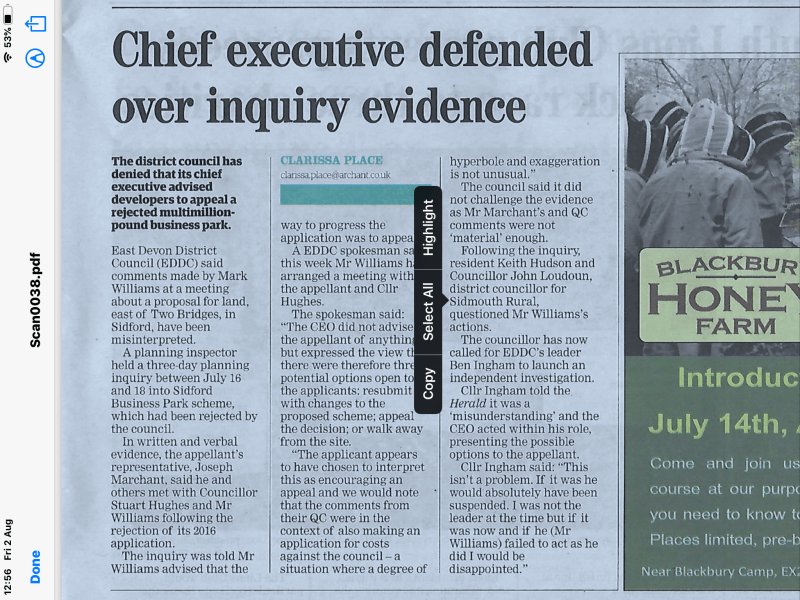
EDDC “Independent” Leader firmly nails his colours (blue?) to his CEOs mast


Owl sees no “misunderstanding”.

Another “TiggerTory” policy?

And what does Mr Marchant, the person accused of being “misunderstood” – and Ford’s QC who perpetuated the “misunderstanding” several times at the public inquiry – think about this?

And where’s Councillor Hughes’s explanation for not sharing information about the meeting with other councillors, particularly those on the Development Management Committee – or did he share it with only a select few of his colleagues?

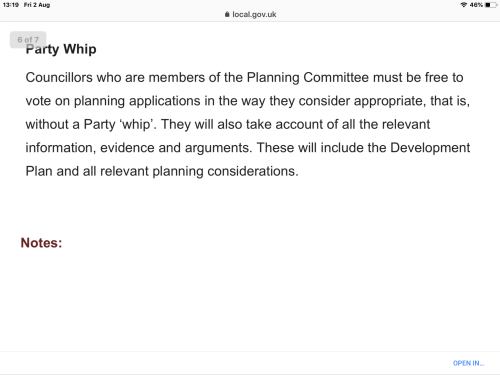
Remember, the Development Management Committee is a STATUTORY committee with rules and regulations … and it must NOT be subjected to party whipping or interference, nor must they “avoid undue contact with interested parties”.

Click to access planning-committee-manage-1cd.pdf

Wright v Swire – this must be a straight contest

In the light of the by-election last night, which saw the strongest pro-Remain candidate win against the incumbent Conservative, Lib Dems and Greens shoyld surely ensure that Claire Wright, who embodies all their policies, must be allowed a straight run against the risible Hugo Swire.

It would probably be too much to expect Labour to do the same, although they should, since their chances of gaining the seat are zero.

Let’s hope common sense prevails so that we can oust the barely seen multi-job London and Middle-East based Tory to the ever-present, ever fighting, ever-local Independent.

Officers advise councillors not to fight Clinton Devon Estates over withdrawal of Newton Poppleford doctors’ surgery in planning application

EDDC fight CDE – not on your life say officers …unless, of course, councillors instruct them to do so …

https://www.sidmouthherald.co.uk/news/newton-poppleford-home-appeal-meeting-1-6194658

“‘Questions hang in the air’ over council HQ relocation project”


Owl says: Leader Ingham seems to be thoroughly persuaded that the previous Tory majority council is whiter than white on the relocation project. Many disagree and had hoped that his new broom might be doing some sweeping – but not under the carpet as seems to be happening.

“A full report will be provided that will analyse in detail East Devon District Council’s relocation from Sidmouth to Honiton as ‘questions hang in the air’ over the project.

East Devon District Council’s moved into their new headquarters at Blackdown House in Honiton on February 11.

The new HQ, which replaced the council’s existing HQ at The Knowle in Sidmouth, cost the council £8.7m, while an additional £1.5m was spent on upgrading Exmouth town hall where one third of the council staff are to be based.

The controversial decision to relocate offices was taken back in March 2015 as it was decided the council needed to relocate into buildings that are affordable, cost efficient, and would significantly reduce the overheads of the council.

But the relocation project has faced criticism over the lack of transparency throughout the project, the procurement process, and the amount of cash the council received for the sale.

A freedom of information request asking how much the Knowle would be worth with planning permission said the answer was £50m, £42.5m higher than the council agreed to sell the land to Pegasus Life for, the latest edition of Private Eye states, naming the council as a ‘rotten borough’ because of it.

At Wednesday night’s full council meeting, Cllr Paul Arnott, leader of the East Devon Alliance, said that ‘questions hang in the air’ over the project.

He asked: “Both the disposal of the Knowle HQ and the procurement of the new Honiton HQ are matters of great concern to thousands of people in East Devon. Questions will hang in the air until they are fully addressed.

“Will the leader of the council support the immediate creation of a councillor-led working party, politically balanced, of up to 10 members, all of them newly elected in 2019, reporting to the scrutiny committee, to look into these matters in the public interest?”

In response, Cllr Ben Ingham, the council leader, said: “Relocation has been a key element of the council’s transformation agenda in terms of delivering against priorities of reducing council operational costs and introducing modern ways of working.

“Throughout its lifetime the relocation project has been subject to regular reporting to cabinet and council, dedicated project management, senior member and officer oversight through the Office Accommodation Executive Group, regular risk review and the scrutiny of South West Audit Partnership.

“Prior to the decision to move to Exmouth and Honiton and dispose of the Knowle site an independent audit was carried out to inform the decision to relocate and to test the financial projections for the project. These findings were included as part of the report to cabinet in March 2015 seeking approval of the move.

“Both Audit and Governance and Overview and Scrutiny committees met jointly to consider the relocation project programme and gave their endorsement. Cabinet and Council were provided with extensive detail, independent evaluation and wider committee endorsement as part of their approval.

“Relocation has been delivered successfully in terms of the physical moves and performance of the council. Furthermore this complex project has been delivered within budget.

“A project closure report will be provided to council at the one year anniversary of the project which will include a full project cost analysis and detail of operational costs for the first year of operation of Blackdown House and annual running costs of Exmouth Town Hall.

“If Scrutiny were so minded they could ask to consider the officer report or undertake a piece of work themselves and as Leader I would not want to restrict or pre-empt their independence to set their own forward plan. The Scrutiny Committee is politically balanced and already well placed to do this without the imposition of a working party which is constitutionally unsound in terms of its suggested membership.”

Cllr Arnott said that ahead of the May elections, the East Devon Alliance manifesto on their website saw their page on the relocation project have page views that were ‘streets ahead’ of anything else.”

He asked: “Can I be assured that if anyone on scrutiny wanted to commission a piece of work on sale off the Knowle and procurement of this, there would be nothing to stop them?”

Cllr Ingham confirmed if a member of scrutiny wanted to request that, then they could do so.

He added: “At the moment the project is coming in favourably to the target budget. The idea of waiting a year before the report was to establish more accurately exactly the savings that the council is making in the new building.”

https://www.devonlive.com/news/devon-news/questions-hang-air-over-council-3148843

Greater Exeter Strategic Plan – latest housing needs figures shows East Devon bearing greatest load

As at June 2019, ast Devon to bear the brunt of new housing:

Page 10:

Click to access Local-Housing-Need-Assessment-for-the-Greater-Exeter-Area-1st-Edition-June-2019-web.pdf

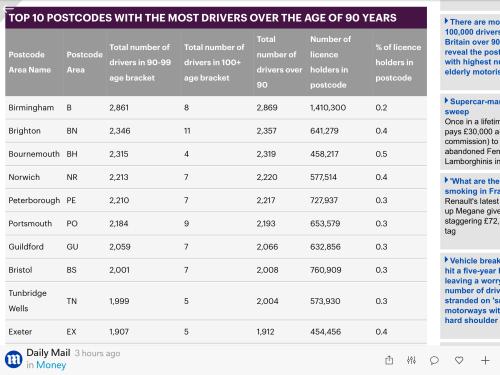
EX postcode in top 10 for drivers over 90

And is second highest (after Bournemouth) in percentage terms:

https://www.thisismoney.co.uk/money/cars/article-7290217/Which-UK-postcodes-drivers-90-Birmingham-tops-list.html

We paid our 4 ex-Prime Ministers (now 5, and one ex-Deputy) more than half a million pounds last year

Public money spent on supporting the offices of Britain’s five surviving former leaders has jumped by nearly 80 per cent in six years – despite the fact that many of them have gone on to become independently wealthy after leaving 10 Downing Street.

New figures show the costs of supporting the offices of ex-PMs Sir John Major, Tony Blair, Gordon Brown, David Cameron, as well as the former deputy PM Sir Nick Clegg, increased from £331,000 a year in 2013/14 – the first figures that are available – to £589,000 last year. …”

https://www.telegraph.co.uk/politics/2019/08/01/taxpayer-costs-paying-offices-four-former-pms-sir-nick-clegg/

Countryfile presenter works out what we’ve all known for years about modern rural life!

“Countryfile host John Craven has hit out over the loss of rural services, saying the problem has left residents “socially isolated”.

He laments the disappearance of many rural shops, schools, post offices, pubs and bus routes.

He said: “In particular this has hit the rising number of pensioners who live long distances from surgeries and hospitals and maybe don’t have anyone to keep an eye on them.”

The TV veteran feels the main visual change to the countryside in the past 30 years is the swathe of “new homes on the outskirts of villages.”

But he voiced his concern that there have not been “enough affordable ones to stop young country folk migrating to towns”.

The long-running series’ presenter also told BBC Countryfile Magazine: “No matter what happens over Brexit, I worry for the future of UK food production.”

With just 60% of Britain’s food currently home-grown, he warned: “It’s vital that we step up our level of self-sufficiency and improve our exports.

“Most farmers are middle-aged to elderly and over the years so many sons and daughters have told me they have no interest in taking over from their parents.

“So we’ll need more young recruits from non-farming backgrounds if future food demands are to be met.

“Politicians must face up to this or the UK will be forced to rely increasingly on imports.”

The ex-Newsround host, 78, also said “one joy of being at BBC Countryfile Live every August is to be regarded as a friend by folk I’ve never met before”.

https://www.mirror.co.uk/3am/celebrity-news/tvs-countryfile-host-john-craven-18808486