“Care homes fear closure over night shift back pay”

“Two thirds of charities caring for vulnerable adults risk going bust if they are required to pay backdated wages to staff for night shifts, a survey suggests.

The findings come after a tribunal ruled that carers had been historically underpaid for the shifts. …

Only half of local authorities or NHS care commissioning groups that buy care packages for disabled people had agreed to fund sleep-in shifts for care staff at a rate that paid them the national minimum wage per hour.

The survey also found that care providers had decided not to bid for 273 new contracts with councils or NHS bodies as they judged the fees offered would not cover higher staff costs. Fifty-six per cent were considering handing contracts back and 70 per cent wanted to renegotiate contracts. …”

Source: Times (pay wall)

“Tax on pensioners proposed to heal inter-generational divide”

A Robin Hood tax? Owl doubts pensioners in East Devon (quite a few of whom have probably given their kids and grandkids substantially more than £10,000) would agree!

“A £10,000 payment should be given to the young and pensioners taxed more, a new report into inter-generational fairness in the UK suggests.

The research and policy organisation, the Resolution Foundation, says these radical moves are needed to better fund the NHS and maintain social cohesion.

Its chairman, Lord Willetts, said the contract between young and old had “broken down”.

Without action, young people would become “increasingly angry”, he said.

The Resolution Foundation says its goal is to improve outcomes for people on low and modest incomes. ….”

http://www.bbc.co.uk/news/business-44029808

“UK parks save NHS more than £111m a year, study suggests”

And guess what? They are being sold off (as in land appropriated by EDDC for PegasusLife) or kept under the control of developers – as in Cranbrook.

https://www.theguardian.com/uk-news/2018/may/07/uk-parks-save-nhs-111m-year-study-suggests

Do you have a damp home? Do you need an affordable home? Contact Councillor Phil Twiss to get your problems sorted!

It seems councillor Twiss is a modern-day superhero – able to help you with just about any problem you might come across.

So, if you live in Honiton, do contact him:

Email: ptwiss@eastdevon.gov.uk
Telephone: 01404 891327
Address: Swallowcliff, Beacon, Honiton, EX14 4TT

http://eastdevon.gov.uk/council-and-democracy/councillors/honiton-st-michaels/phil-twiss/

or at DCC:
Email: phil.twiss@devon.gov.uk

True, he hasn’t so far sorted East Devon’s broadband not-spots, wasn’t able to halt the closure of Honiton Hospital’s community beds or stop Baker Estates from weaselling out of their affordable housing commitments and the ‘fillip’ to Honiton’s jobs and shops when the EDDC HQ moves to Honiton will be at the expense of Sidmouth … but these are just minor hiccoughs … aren’t they?

NHS discriminates against older people … says former old people’s tsar

“The NHS is discriminating against older people, Dame Joan Bakewell has claimed, as she said she had been denied access to a vaccination for shingles and mammograms because of her age.

Dame Joan, the former ‘older people’s tsar’ for the government said she was concerned that the health service was prioritising younger people for preventative treatment and screening.

The 85-year-old broadcaster and Labour peer, said older people would be left to ‘fend for themselves’ unless the NHS realised the value of keeping pensioners healthy.

Speaking on ITV’s Peston on Sunday, Dame Joan said: “Something is going wrong. I went to my local clinic I would like to have a mammogram again and I have been having them all my life, and I stay healthy, and I’ve resolved to stay healthy and they said, no you don’t automatically get called in now.

“Now that also happens to shingles. It’s a very horrible illness and there are now vaccines for people who are old because the risk of shingles increases with age especially if you had chickenpox as a child. And I applied for that. No you aren’t eligible for shingles.

“So what is happening? Is the health service saying, well the old they’ve had their lives we’ve got bigger priorities, it doesn’t matter.

“Given the problems of our finances, we’ll put the money with younger people rather than old, is that what’s happening? In which case the old are going to have to fend for themselves.”

Dame Joan said she was denied the shingles vaccine because she was too old
Dame Joan said she was raising the issue following the recent NHS breast cancer scandal in which 450,000 older women failed to receive screenings, which may have shortened the lives of 270 and led to thousands of missed cancer diagnosis.

Currently women are only offered screening up to the age of 70, because it was felt that by then the harms of over-diagnosis outweight the risk of cancer. However trials are currently underway to find out if it would be beneficial to extend screening to 73.

Older people are also only allowed the shingles vaccine up to the age of 79.

Dame Joan said prevention was extremely important to keep older people healthy and save the NHS money.

“There are more older people and they are very concerned about their health and it would save the health service money if they avoid illness

“Believe me, when you are over 70 (prevention) is very important. And I know that’s true of all my generation. We’re eager to stay fit, we want help in doing it, but we don’t want to fall off the radar. We need to be told about these things.”

Asked by Robert Peston whether it amount to a scandal, Dame Joan said: “Well I’m not sure that it is yet, but I am eager to find out what is happening here, to people who are over 70, over 80, people are living into their 90s.”

https://www.telegraph.co.uk/science/2018/05/06/nhs-discriminates-against-older-people-warns-dame-joan-bakewell/

Dear Local Enterprise Partnership: about that promise to double growth … again

“California has overtaken Britain to become the fifth biggest economy in the world in its own right. …”

as opposed to:

“In comparison, Britain’s growth has slowed to a virtual standstill in the first three months of 2018, hitting just 0.1 per cent in the first quarter.

Chancellor Philip Hammond blamed the sluggish performance on bad weather but the Office for National Statistics said that had been only a minor factor.

A contraction in construction, weak manufacturing growth and a squeeze on consumer spending led to the weakest economic activity in the country for five years.”

https://www.mirror.co.uk/news/uk-news/california-overtakes-britain-become-fifth-12483939

To paraphrase Dorothy in The Wizard of Oz:

“Devon and Somerset ain’t California, Toto”!

DON’T do as I say! Political hypocrisy at its very best!

“Theresa May’s 2004 Question Time Exchange

Question: “Has the government lost control of its immigration policy?”

Theresa May: “Yes I think the government has lost control of its immigration and asylum policy. Frankly I think we see a degree of chaos in what is happening and what is perfectly clear from what has taken place and been admitted by the Government and by Beverley Hughes in particular at the beginning of this week is that we have in this Government Ministers who simply don’t know what is going on in their Department, we have Departments that deny the truth and have to have it dragged out of them.”

David Dimbleby: “What’s the political remedy?”

Theresa May: “I think there are two things. I do think Beverley should resign as Minister on this particular issue. And I find it absolutely extraordinary that she has said in front of the Select Committee and in the House of Commons she blamed officials in her Department for this particular decision having been taken.

“I find it extraordinary that a Minister isn’t willing just to step up to the plate and take responsibility and it seems to me that you don’t have to take a Ministerial job, you don’t have to take the care and the extra pay and so forth. But when you do there is responsibility that has to be taken with it. And I’m actually sick and tired of Government Ministers in this Labour government who simply blame other people when something goes wrong and are not willing to take responsibility for what is happening under this government and their decisions.”

When Hughes said she couldn’t be expected to manage the civil servants in her department, May responded: “But Beverley, you are the minister who is responsible for what happens in your department.”

The Home Office has also been unable to say how many Windrush Britons have been wrongly deported, blaming a mix-up in paperwork.

May has also faced criticism for failing to act sooner after Jeremy Corbyn raised the issue with May at Prime Minister’s Questions a month ago. …”

https://www.huffingtonpost.co.uk/entry/theresa-may-branded-hypocrite-after-old-footage-of-pm-demanding-labour-ministers-resignation-emerges_uk_5ad8a401e4b0e4d0715defe8

“UK in last ditch new nuclear crunch talks as ageing power plants falter”

Remember, Hinkley C is where most of our Local Enterprise Partnership’s money (OUR money) is invested and a good proportion of LEP board members have nuclear or allied-closely-to-nuclear interests. AND renewable energy costs are getting lower and lower.

“Prime Minister Theresa May faces crunch talks over the future of a new nuclear power station on Thursday, as fresh faults reduce the amount of energy Britain’s ageing fleet of reactors can generate.

The Japanese conglomerate behind plans to build a new reactor at the Wylfa nuclear site in Wales is expected to call on the Government to take a direct stake in the new plant, or risk the £27bn project falling through.

The last-ditch talks between Hitachi chairman Hiroaki Nakanishi and the prime minister were scheduled for the same day that fresh cracks in one of the UK’s oldest [EDF-owned] nuclear plants underlined the need for new investment in low-carbon power.

A string of power plants, including the faltering Hunterston nuclear plant, are set to close by 2025.

Hitachi’s 2.9 gigawatt nuclear project could help to fill the gap created by the closures, but the group is not willing to take on the full risk burden without the backing of other private investors and government involvement.

The conglomerate is planning to back away from the project entirely unless the UK agrees to help finance it or take a stake in the plant alongside investments from the Japanese government, according to local media reports.”

https://www.telegraph.co.uk/business/2018/05/03/uk-last-ditch-new-nuclear-crunch-talks-ageing-power-plants-falter/

EDDC Independents lead call for action on local health provision

Owl can’t quite see why Tory Councillor Allen felt the need to table his amendment – perhaps he felt Independent councillors were rather too Independent and therefore needed a dash of Tory policy! Now we just have to hope that new Leader Thomas doesn’t go and do exactly the opposite of what was resolved when he attends to DCC health scrutiny meetings – as Diviani notoriously did last year.

“A motion calling for the community hospitals which have lost beds to be maintained as health hubs, that services and clinics should be moved out of Exeter to local community hospitals and that more outpatient services should be provided in each community hospital was discussed by East Devon District Council at their meeting last week.

Proposing the motion, Cllr Marianne Rixson [EDA, Independent] said that health hubs in local areas need to be supported by the Council.

She added that the need for less travelling and difficult local bus services needed to be taken into consideration and that if place-based care was to be effective then the level of out-patient services need to be increased overall or at least maintained in every town.

She was supported by Cllr Val Ranger [Independent] who added that those people discharged early from hospital, children and elderly living with long-term health conditions should be able to access out-patient services locally in every community.

Councillors voted for an amendment, proposed by Cllr Mike Allen [Conservative], that said that this Council resolves to welcome the proposal of the Devon CCG’s to develop placed-based health care where strong evidence suggested that it would deliver high-quality patient care and sustainable services.

It added: “However, due to lack of supporting clinical evidence and clear future planning, the Council has strongly opposed closure and removal of community hospital beds and hospital-based services throughout East Devon.

“All efforts are made, in consultation with local communities, to ensure the existing estate of community hospitals was retained for health care purposes, where appropriate, the potential development of ‘Health Hubs’ was investigated, and council members received from the Clinical Commissioning Group a review of service changes (bed-based to home/community based care) made during 2017/2018 in East Devon, to include clinical evidence highlighting levels of patient safety and outcomes achieved and an evidence-based forward plan of proposed changes to health services in East Devon, for initial discussion at a future Cabinet.

After the meeting, Cllr Martin Shaw [DCC East Devon Alliance], said that he has written to Cllr Ian Thomas, who is due to become the new leader of the council on May 16, asking for assurances that each of the hospitals which has lost its beds (Axminster, Honiton, Ottery and Seaton), as well as Exmouth and Sidmouth, to be kept open and that a formal public consultation in the affected town and surrounding area should a closure of any community hospital, involving substantial relocation of outpatient services, be proposed.”

https://www.devonlive.com/news/health/closure-removal-hospital-beds-should-1530794

“£250m spent but no starter homes yet built under flagship fund”

“The government has spent £250m to boost starter home construction without a single property being built so far, it has emerged.

Dominic Raab, the housing minister, made the admission in response to a question from John Healey, the shadow housing secretary, who described the situation as “a betrayal of young Brits looking for help to buy a first home”.

In March 2016 the government announced a £1.2bn fund to help deliver “200,000 quality starter homes by 2020 exclusively for first-time buyers at a 20% discount on market value”. The promise was originally made in the Conservatives’ 2015 election manifesto.

The aim was to use the cash to support the purchase and cleanup of sites to guarantee the construction of starter homes. The policy recognised that the cost of making brownfield sites useable could make some places unviable for development. Ministers believed that targeted interventions could help increase housebuilding at the bottom of the market where the affordability crisis had bitten most deeply and particularly affected millennials.

In January 2017, Gavin Barwell, then housing minister, said the first homes would be built that year after partnership agreements with 30 local authorities.

He said: “This first wave of partnerships shows the strong local interest to build thousands of starter homes on hundreds of brownfield sites in the coming years. One in three councils has expressed an interest to work with us so far.”

However, after Raab confirmed that “£250m of the starter homes land fund has been spent to date”, a spokesman for his department said, adding: “At the moment no specific starter homes have been built yet.”

The government has now placed the operation of the flagship fund under review.

A spokesperson for the Ministry of Housing, Communities and Local Governmen, said: “We have spent £250m buying land to build affordable properties, and work is underway getting them ready for development. It is important we get starter homes right and we aim to introduce regulations on them alongside our new planning policy before building gets underway.” …”

https://www.theguardian.com/society/2018/may/02/250m-spent-but-no-starter-homes-built-under-flagship-fund

Unitisation … today Somerset, tomorrow? Will the (very fat) turkeys vote for Christmas?

“Scrapping Somerset councils ‘may save £28m a year’ ”

“Abolishing all six local authorities in Somerset could save £18m to £28m each year, the county council leader says.

Conservative David Fothergill has asked for work to begin to look at how a unitary arrangement could work.

The plan would see several single-tier authorities – or one – replacing local councils including the county council.

The idea has been met with mixed responses with one councillor saying it would mean getting “turkeys to vote for Christmas”.

Mr Fothergill said: “At a time of unprecedented financial pressures on all councils we are all looking at different ways to be more efficient, make savings and protect the front-line services that our residents value so much.

“I believe that we owe it to our residents to look at this option too.

“I want start the ball rolling on work to establish the benefits and costs of such a change so that we can all make an informed decision as to whether a unitary model is the right way to go.”

News ‘a bombshell’

He said savings from introducing a single-authority would include £500,000 per year by moving from five chief executives to one, and about £1m per year by reducing the number of councillors covering the county by about half from the current 300.

Analysis: Ruth Bradley – BBC Somerset

While it’s relatively unusual for councillors to decide to get rid of their own authorities, it’s not unheard of.

In fact Somerset has been looking to the example of its near-neighbours to see just how it could work here – and how much money it could save.
Wiltshire became a unitary authority in 2007 – the same time as Cornwall – merging four districts and a county council into what is now the biggest local authority in the West of England.

But that was in a different political era, pre-austerity rather than as a reaction to government cuts.

And next year Dorset is due to scrap its nine councils and set up two new unitaries.

Interestingly it has managed to achieve this with near-consensus from all the councils involved – something which Somerset will be keen to emulate, given the fractured nature of the last attempt at this here in 2007.
Buckinghamshire was also signed off by the government earlier this year to go unitary at the same time as Dorset.

Somerset is hoping to have its model in place by the 2021 local elections.

Other savings would come through reducing the number of HR, customer services and finance teams, and reducing the number of IT and utilities contracts and transport costs.

The Conservative leaders of West Somerset and Taunton Deane said they were prepared to discuss the idea, while the Liberal Democrat leader of South Somerset described the news as “a bombshell” and said “none of us [district council leaders] want to go down this route but we have to put the people or Somerset first”.

Independent county councillor, Mike Rigby, said he was pleased with the plan and “had been calling for this for years”.

“It’s going to require some turkeys to vote for Christmas so it’s not in the bag yet, though I suspect the momentum will become irresistible,” he added.
There were protests outside parliament in London in 2007 when the Liberal Democrats made a similar proposal.”

http://www.bbc.co.uk/news/uk-england-somerset-43972967

Lies, damned lies – and election leaflets!

Should you get one of these, feel free to ask a few questions!

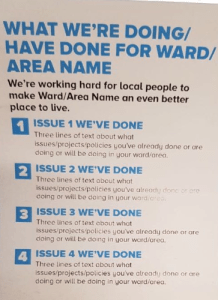
“Conservatives are standing for election in east London on their record of “ISSUES WE’VE DONE” for “AREA NAME”, according to their leaflet.

The leaflet, promoting the Tory candidate for Ilford Town, sets out in blue capitalised letters “WHAT WE’RE DOING/HAVE DONE FOR WARD/AREA NAME”.

Underneath, it lists issues one to four that “we’ve done” for Ilford. In what appears to be an embarrassing copy-and-paste error, the leaflet reads: “Three lines of text about what issues/projects/policies you’ve already done or are doing or will be doing in your ward/area name.”

The latest in a series of leaflet gaffes ahead of the local elections on Thursday, images of the leaflet quickly went viral on social media.”

https://www.huffingtonpost.co.uk/entry/election-leaflet-ilford-conservative_uk_5ae9983de4b022f71a038ce3

“Trying to maximise income purely from commercial revenues is NOT what the public want.”

CIPFA chief executive Rob Whiteman has told a conference this morning”

“… At some point in the next 15 – 20 years local government needs to be reorganised. We need to be aware reorganisation would be a good thing.”

But he predicted there was unlikely to be “any meaningful local government reform” for some time.

Local government must rebuild trust with the public, Whiteman told his audience. “In its present form, local government is not perfect.

“I do not think that trying to maximise income purely from commercial revenues is what the public want.”

Don Peebles, head of CIPFA UK policy and technical, echoed this, suggesting local government’s commercial investments should be more about keeping council finances afloat rather than maximising profit.

He said recent changes to the prudential code – the statutory guidance for local government on borrowing and investments – reflected that “the priority is not maximisation of return but the protection of capital”. …”

https://www.publicfinance.co.uk/news/2018/05/local-government-uncertain-place-10-years

MPs in power: “Reckless Opportunists”

Owl says: MPs as elites, out of touch and just in it for the glory – well, we know a lot about that in this part of the country!

(By the way, if your/our MPs have not been about much recently it is because they have been despatched to areas where the party in power might lose control in local elections tomorrow).

“[Amber] Rudd exemplifies a political class light on expertise and principle, yet heavy on careerism and happy to ruin lives. All the key traits are here. In a dizzying ascent, she went from rookie MP in 2010 to secretary of state for energy in 2015, before being put in charge of the Home Office the very next year. Lewis Hamilton would kill for such an accelerant, yet it leaves no time to master detail, such as your own department’s targets. Since 2014 Sajid Javid, Rudd’s replacement, has hopped from culture to business to local government, rarely staying in any post for more than a year. Margaret Thatcher kept her cabinet ministers at one department for most of a parliamentary term, but this stepping-stone culture turns urgent national problems – such as police funding and knife crime – into PR firefighting.

Another hallmark of Rudd exemplifies a political class light on expertise and principle, yet heavy on careerism and happy to ruin lives. All the key traits are here. In a dizzying ascent, she went from rookie MP in 2010 to secretary of state for energy in 2015, before being put in charge of the Home Office the very next year. Lewis Hamilton would kill for such an accelerant, yet it leaves no time to master detail, such as your own department’s targets. Since 2014 Sajid Javid, Rudd’s replacement, has hopped from culture to business to local government, rarely staying in any post for more than a year. Margaret Thatcher kept her cabinet ministers at one department for most of a parliamentary term, but this stepping-stone culture turns urgent national problems – such as police funding and knife crime – into PR firefighting.

Another hallmark of this set is the disposability of its values. Cameron hugs Arctic huskies, then orders aides to “get rid of all the green crap”. As for Rudd, the May cabinet’s big liberal vowed to force companies to reveal the numbers of their foreign staff, stoking the embers of racism in a tawdry bid to boost her standing with Tory activists. Praised by Osborne for her “human” touch, she was revealed this week privately moaning about “bed-blocking” in British detention centres.

And when things get sticky, you put your officials in the line of fire. During the Brexit referendum, Osborne revved up the Treasury to generate apocalyptic scenarios about the cost of leaving. While doomsday never came, his tactic caused incalculable damage both to the standing of economists and to the civil service’s reputation for impartiality. Rudd settled for trashing her own officials for their “appalling” treatment of Windrush-era migrants.

None of these traits are entirely new, nor are they the sole preserve of the blue team. At the fag end of Gordon Brown’s government, the sociologist Aeron Davis studied the 49 politicians on both frontbenches. They split readily into two types. An older lot had spent an average of 15 years in business or law or campaigning before going into parliament – then debated and amended and sat on select committees for another nine years before reaching the cabinet.

The younger bunch had pre-Westminster careers that typically came to little more than seven years, often spent at thinktanks or as ministerial advisers. They took a mere three years to vault into cabinet ranks. This isn’t “professionalisation”. It is nothing less than the creation of a new Westminster caste: a group of self-styled leaders with no proof of prowess and nothing in common with their voters. May’s team is stuffed full of them. …

Davis depicts a political and business elite that can’t be bothered about the collective good or even its own institutions – because it cannot see further than the next job opportunity. In this environment, you promise anything for poll ratings, even if it’s an impossible pledge to get net migration down to the tens of thousands.this set is the disposability of its values. Cameron hugs Arctic huskies, then orders aides to “get rid of all the green crap”. As for Rudd, the May cabinet’s big liberal vowed to force companies to reveal the numbers of their foreign staff, stoking the embers of racism in a tawdry bid to boost her standing with Tory activists. Praised by Osborne for her “human” touch, she was revealed this week privately moaning about “bed-blocking” in British detention centres.

And when things get sticky, you put your officials in the line of fire. During the Brexit referendum, Osborne revved up the Treasury to generate apocalyptic scenarios about the cost of leaving. While doomsday never came, his tactic caused incalculable damage both to the standing of economists and to the civil service’s reputation for impartiality. Rudd settled for trashing her own officials for their “appalling” treatment of Windrush-era migrants.

None of these traits are entirely new, nor are they the sole preserve of the blue team. At the fag end of Gordon Brown’s government, the sociologist Aeron Davis studied the 49 politicians on both frontbenches. They split readily into two types. An older lot had spent an average of 15 years in business or law or campaigning before going into parliament – then debated and amended and sat on select committees for another nine years before reaching the cabinet.

The younger bunch had pre-Westminster careers that typically came to little more than seven years, often spent at thinktanks or as ministerial advisers. They took a mere three years to vault into cabinet ranks. This isn’t “professionalisation”. It is nothing less than the creation of a new Westminster caste: a group of self-styled leaders with no proof of prowess and nothing in common with their voters. May’s team is stuffed full of them. After conducting more than 350 interviews with frontbench politicians, civil servants, FTSE chief executives and top financiers, Davis has collected his insights in a book. The argument is summed up in its title: Reckless Opportunists. …”

https://www.theguardian.com/commentisfree/2018/may/01/amber-rudd-career-elite-ordinary-people-contempt

“Food, clothes, a mattress and three funerals. What teachers buy for children”

“.. . In 2014 Gemma Morton, the headteacher of a large secondary school, told Education Guardian her school had helped to pay for the funeral of a student whose family couldn’t afford it, even after they had sold their car. Three years on, she has helped to pay for two more funerals. “When a child dies, nobody’s saved for it,” says Morton. “There is literally nowhere for families to go apart from the people they already know, and most of them are poverty-struck too.” 

… At Gill Williams’s primary school in the north-west of England, local supermarkets deliver bread and fresh vegetables three times a week, which are placed in the playground for parents to help themselves. There is rarely a crumb left. …

… Georgia Easton, a secondary teacher, always carries a few pounds in her pocket for children who have “forgotten” their dinner money. “It’s heartbreaking,” she says. “Kids saying ‘I had one slice of toast for tea.’” She estimates she spends about £10 a week of her own money on food and other shopping for needy pupils. That’s £380 per year. Gemma Kay, a food science teacher, spends much the same. “You hear kids talking about how in the holidays their parents are going to the food bank because they relied on free school meals in the week. It’s just very sad,” she says. “With changes to benefits, you’d know parents were on less money.” …

… Williams asked her leadership team to compile a list of the school’s recent expenditure on personal items for students and their families. It included school shoes, bus passes, uniform when the pupil welfare department said a child didn’t meet their criteria; a pregnancy test for a mother who arrived at school in turmoil; an entire food shop after a home visit when it was apparent there was nothing to eat in the house; a mattress for a child sleeping on a sofa; and a bedroom carpet when social services said bare floorboards were acceptable.

… Her school has put aside a sliver of budget, known as the social inclusion fund, for crisis situations, which has to be repaid. The fund has helped to guarantee a child’s physical safety during a criminal trial, when the family felt in danger: Williams paid for a week’s rental on a caravan out of the area.

… She also used the fund to install a safety gate in a family’s house after first trying and failing to fit it herself. “The children were unsafe without one and I couldn’t leave them another night in the space.”

… She observes pointedly that the local authority was unable to help. Thresholds of need for support by social services departments have increased and emergency grant and loan funds have been cut.

“There was mum with two teenage boys who’d been made homeless and put into one room,” says Easton. “I took them to Asda and got new shirts, trousers and shoes. It came out of staff pockets because much as school wanted to pay, it couldn’t.”

https://www.theguardian.com/education/2018/may/01/teachers-buy-children-food-clothes-mattress-funerals-child-poverty

East Devon Alliance Conference, 26 May 2018 – details and how to book a free place

Blog of Councillor Martin Shaw – East Devon Alliance, Devon County Council:

Time for a Change’ in East Devon

East Devon Alliance holding conference to bring together everyone fighting on health, environment, planning and other issues

Saturday 26th May, 10-1.30, Beehive, Honiton. A must-attend event for everyone who would like to see a change in local politics. If you’d like to come, please book your place via this link (there is no charge). I hope to see you there.

https://www.eventbrite.com/e/45482525458?aff=d43c421797

All across East Devon people are worried about their HEALTH, their HOMES and their JOBS. Never has it been more important to involve yourself with local democracy in your district.. YOU CAN MAKE THE DIFFERENCE.

The EAST DEVON ALLIANCE is trying to help with all of this, an umbrella group of Independent people, who since 2015 have won 7 district council seats and 1 county seat. The EDA is free from the negative influence of national parties who – at East Devon District Council – have acquired the arrogant habits of a Conservative one-party state.

This conference is for YOU. Speakers will include County Councillors CLAIRE WRIGHT and MARTIN SHAW, and PAM BARRETT, Chair of the Independent Buckfastleigh Town Council and regional expert on transforming democracy from the bottom up.

In two sessions you will be able to hear our experience and then CONTRIBUTE your own personal views:

a) how did the democratic deficit in East Devon happen? Or – the problem.

b) what can we do about it through democracy in our parishes, towns and district. Or – the solution.

Please come. We are all volunteers but if we band together now to fight for hospitals, homes and jobs we have a chance to change how our local area is run.

Parking: nearest is Lace Walk. 2 minute walk. If full, New Street, 5 mins.”

‘Time for a Change’ in East Devon – @EDevonAlliance holding conference to bring together everyone fighting on health, environment, planning and other issues

“Ex-Tory MP And His Floating Dog Inexplicably ‘Photoshopped In To Road Junction Protest’ “

Yet another “you couldn’t make it up” Tory fiasco!

“A row has broken out over an ex-Tory MP being photoshopped in to a picture of local people campaigning about a dangerous road junction in north London.

David Burrowes, who represented Enfield Southgate until he lost his seat to Labour in 2017, was last month pictured protesting with local Conservatives … or was he?

The Enfield Independent reported that the local conservative group first sent the picture of the campaigners to illustrate its efforts to lobby for traffic islands at the junction.

In the picture above, Burrowes is pictured on the left with his Labrador, Cholmeley. The group later sent the image without Burrowes or his dog. …”

The epidemic of community hospital closures shows no signs of slowing down …

We in East Devon feel your pain:

“Former MP slams plans to close Teignmouth Hospital – the first purpose build NHS Hospital in the UK”

The area’s former MP says:

“We need more hospital beds. The Germans have 8.13 beds per 1000 people but the UK only has 2.61 beds per 1,000, and this needs to improve as there is a local and a national need for beds.”

https://www.devonlive.com/news/devon-news/former-mp-slams-plans-close-1516807

https://www.devonlive.com/news/devon-news/former-mp-slams-plans-close-1516807

More news on EDDC’s new HQ builder

Owl says: EDDC getting a taste of the new build problems many house buyers are getting in East Devon, though this time it’s our taxes paying for them. Hope it is a fixed-price contract with penalty clauses and good insurance!

“… Signing up to a host of loss-making contracts and a disastrous foray into building energy-from-waste facilities have helped to send Interserve tumbling £244 million into the red.

Glyn Barker, chairman of the private sector provider of public services, said that the company had “suffered unprecedented levels of disruption and faced significant challenges” as it reported deep losses and warned that debts could more than double to £680 million this year….

The company’s shares, which have crashed by more than 80 per cent over the past five years, slumped a further 13¼p, or 12.3 per cent, to close at 93¾p yesterday.

The £244 million losses for 2017 included a 62 per cent slump in underlying operating profits to £52 million. Interserve was dragged into the red by writedowns of £98 million on the value of its assets, £67 million of restructuring and property costs and provisions of £86 million for lossmaking contracts.

About 125 of its contracts are in trouble. These are mainly in construction, but also include losses that Interserve is taking for looking after US military bases in Britain and a hit from the part-privatisation of the Probation Service. It took an extra £35 million of charges in the energy-from-waste fiasco that started the company’s crisis after it incurred £160 million of fines and penalties in 2016.

Interserve also reported £14 million of payments to consultants and advisers with a warning that the company would incur another £25 million this year.

Last week Interserve raised £196 million, taking its borrowing facilities to £834 million. Ms White said: “I would not say we are out of the woods. The debt refinancing has taken up a lot of our time.”

Source: Times (pay wall)

“For every home built 2014/5 £60,000 went to landowner”

Thomas Aubrey of the Centre for Progressive Policy:

“Our system favours landlords over communities. The PM must side with the many, not the few.

Theresa May is right. Britain’s housing market is broken and needs fixing. Homelessness and rough sleeping are rising and owner-occupation levels for the young have collapsed because homes have become unaffordable.

The average private rent in London accounts for more than a third of household income. The bill for housing benefit has risen eight-fold since the early 1980s after inflation is taken into account. House building has risen since the lows reached during the financial crisis of a decade ago but needs to almost double to hit the government’s target of 300,000 new homes a year by the middle of the next decade.

Yes, the housing market is broken all right and for the Conservatives, a party that sees itself as the party of the homeowner, it is a serious political headache.

A crisis has been brewing for decades – and left unattended the problem can only get worse. Britain has a rising population and the trend is for smaller households, both of which mean demand for housing will keep on rising. The weak growth figures for the first three months of 2018 will keep borrowing costs on hold for now but sooner or later the Bank of England will raise interest rates. That will make it still harder for people in their 20s to get a foot on the housing ladder.

Yet sketching out the problem is one thing. Coming up with solutions is trickier.

Replace a regressive council tax with a land value tax? Labour is thinking about a LVT but there is no chance the Conservatives will introduce what they have dubbed a “garden tax” that would hit millions.

How about giving some of the anonymous farmland in the green belt over to housing development? The thin end of a wedge that will result in the south-east being turned into one big urban sprawl.

Make prime residences eligible for capital gains tax? Are you kidding? Politicians know that Britain’s housing market is broken but mess with it at their peril.

The problem is so big, however, that changes have to come. London’s mayor, Sadiq Khan, wants to increase the supply of lower-cost homes in the capital, so under City Hall guidelines private development proposals where affordable units make up at least 35% of the total will be fast-tracked through the planning process. Under 35%, and developers can expect a much tougher time.
But as Daniel Bentley argues in a new pamphlet for the thinktank Civitas, the problem goes deeper than the planning system. Forcing councils to grant more planning permissions in high-demand areas doesn’t guarantee that the supply of new homes will markedly increase.

The reason for that, Bentley says, goes back to the 1961 Land Compensation Act passed by Harold Macmillan’s government. This enshrined in law the right of landowners, in the event of compulsory purchase, to be reimbursed not only for the value of their land as it stood but for its potential value if it were used for something else in the future.

A system so heavily weighted in favour of landowners had two consequences. First, it provided them with an incentive to wait, often for years, before selling their land for development because they would get a higher price. Second, house-builders had to recoup the costs of buying the land and did so by building more expensive properties that were drip-fed into the market to keep selling prices high.

If the aim is to build more affordable homes, this makes no sense. A site with planning permission for housing is worth more than a brownfield industrial site and 100 times more than agricultural land. Research by Thomas Aubrey of the Centre for Progressive Policy found that landowners made windfall profits of more than £9bn in 2014-15 on the sale of land. That meant for every home built that year, an average of £60,000 went to the landowner.

Bentley says the entitlement of landowners to this “hope value”, the prospect that it will be worth a lot more if used for something else, means public authorities are powerless to enforce development priorities that are in the interests of the community.

“This was not always the case. The new towns that were initiated before the 1961 act, and much of the local-authority output of the late 1940s and 1950s, was underpinned by a land values policy that meant landowners were compensated at values reflecting the existing use of the site,” he said.
“This meant land for new homes could be acquired at or close to its much lower agricultural or industrial use values. It also doused speculation and prevented the withholding of land.”

Reforming the 1961 act so that public-sector bodies can purchase land at less than its prospective residential use value makes sense because it would enable developers to get hold of land more cheaply and so build more affordable homes. Nor would it be an especially controversial move politically.

Judging by their 2017 manifestos, Labour and the Conservatives think the current system is weighted too heavily in favour of landowners, who see the value of their holdings increase not through their own efforts but through those of others.

Adam Smith and David Ricardo, darlings of the free-market right were critical of the “unearned increment” that landowners enjoyed. So was Henry George, who the left laud for coming up with the LVT.

May should seek bipartisan support for a rethink of the 1961 act. Sure, Conservative-supporting landowners would object but if the prime minister is to make good on her pledge to fix the housing market she has to side with the many not the few.”

https://www.theguardian.com/business/2018/apr/29/want-to-resolve-the-uks-housing-crisis-heres-how