“Struggling Tory council paid acting boss more than £1,000 a day”

“Tory-controlled Northamptonshire county council, which declared itself effectively bankrupt last month, paid its acting chief executive more than £1,000 a day, it has emerged.

Damon Lawrenson had been interim chief executive at the council since November, having previously acted as temporary finance director at the council since October 2016. Lawrenson left the council this week “by mutual consent”.

Northamptonshire was heavily criticised in a recent government inspector’s report, which identified deep-rooted management and governance failures over the past four years as the prime cause of its financial problems.

The report highlighted what it called the council’s “sloppy” approach to financial management and lack of realism in business planning. It called for a clear-out of the existing leadership in order to restore stability to the council.

A freedom of information (FOI) request by the GMB union revealed that the council paid out £371,000 to DDL Consultancy, owned by Lawrenson, during 2016-17 and 2017-18. His company had earlier been paid a further £540,000 between 2008 and 2011, when he had stints as assistant chief executive and commercial director.

The local government secretary, Sajid Javid, is considering the report’s recommendation that the county be run by a team of Whitehall-appointed commissioners until it can be scrapped, along with seven local district councils, and replaced by two new smaller unitary authorities.

The council, which recently warned that its overstretched adults social care services were “on the verge of being unsafe” issued a section 114 notice in February, signalling that its finances were unsustainable. It banned non-urgent spending, and pushed through £40m of cuts plans, including the closure of 21 out of 36 libraries.

A GMB official, Rachelle Wilkins, said: “For Northamptonshire county council to splurge almost £1m on consultancy while people are losing their jobs and services are being cut is a real kick in the teeth.”

A spokesman for Northamptonshire county council said: “Salaries reflect responsibilities associated with the posts, many of which require highly-qualified, professional staff, while being mindful of the necessity of providing value for money.

“It must be noted that about £560k was incurred in the three years between 2008/09 and 2010/11. Additionally, as a contractor Damon is not eligible for sick pay, holiday pay or pension contributions.” …

https://www.theguardian.com/society/2018/mar/23/struggling-northamptonshire-county-council-paid-acting-boss-more-than-1000-a-day

“Survey reveals another section 114 notice [council insolvency] expected within a year”

Some councils are taking on riskier investments with consequent higher returns to maximise income – risky indeed in the current uncertain financial climate. As with those councils that bought (non-local) shopping centres as investments … which will need very savvy auditors to monitor …

“Three quarters of senior finance officers expect at least one other council to issue a section 114 notice in the next 12 months, according to a Room151 survey.

Last month, Northamptonshire County Council’s director of finance issued a 114 notice imposing immediate spending controls on the authority.

Room151’s Local Government Finance & Treasury Current Affairs Survey, sponsored by investment manager CCLA, found that more than half of respondents expect one or two more notices in the next year.

Presenting the findings to Room151’s LATIF north conference in Manchester this week, John Kelly, client director at CCLA, said that a further 20% expect between three and five further section 114s, with 3.5% expecting between five and 10.

However, when asked about their own council, 56% of treasury officers said they were either confident, or very confident, of financial sustainability.

Kelly said this result “doesn’t suggest there is any panic or any need to get unduly worried at present”.
Elsewhere in the research, 36% of those surveyed said that they had begun to invest in higher yielding instruments, due to the current funding squeeze, compared to 30% who said there had been no impact. …”

http://www.room151.co.uk/treasury/survey-reveals-another-section-114-notice-expected-within-a-year/

Campaign group forces further consideration of “integrated care” in Devon

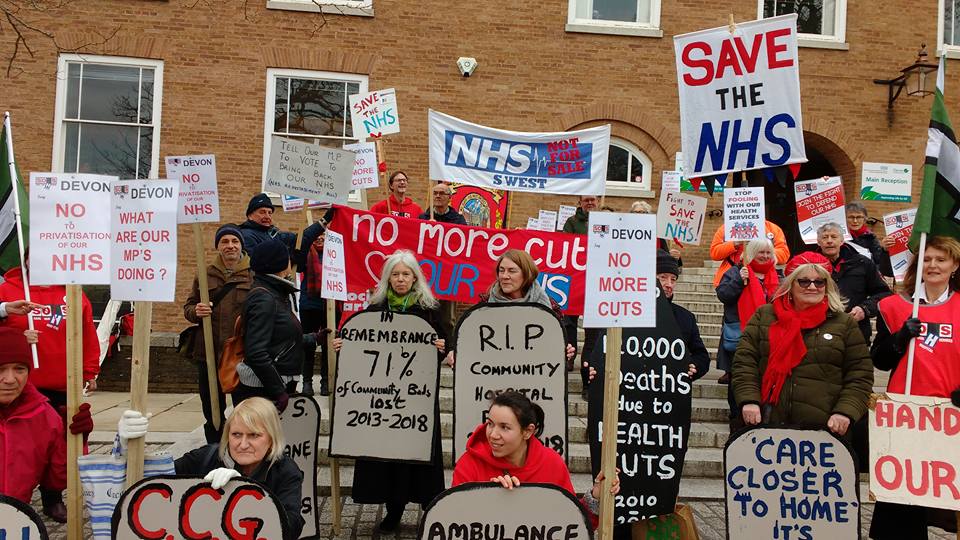
Save Our Hospital Services scored a major victory today when after its demonstrations (including another one today):

Emails, public speaking and media onslaught led to the DCC Health Scrutiny Committee refusing to agree to the commencement of the secretive and undemocratic imposition of an “Integrated Care System” (accelerating privatisation of health and social care) being forced on the county from 1 April 2018 (probably not coincidentally April Fool’s Day).

Well done SOHS!

BUT remember we are in the national local government election period and it may well be that, once this has passed, the Tory enthusiasts for this privatisation by the back door may well rediscover their taste for it!

Our LEP enthuses about one of its big achievements

Millions of pounds given to the LEP, and the best grant story they can come up with is:

https://www.heartofswgrowthhub.co.uk/devon-business-refurbishes-premises-thanks-growth-hub-11-support/

If that is the best they can do, their hugely ambitious growth targets are going to be even more difficult than we previously thought.

Swire: Maldives, Saudi Arabia, the Commonwealth – SO,SO busy!

Future of the Commonwealth – [Philip Davies in the Chair] (21 Mar 2018)
https://www.theyworkforyou.com/whall/?id=2018-03-21a.163.0&s=speaker%3A11265#g165.5

Hugo Swire: Does my hon. Friend agree that another reason to be optimistic is that the incoming President of South Africa was a major figure within the Commonwealth family? He believes in the Commonwealth, he gets it, he is coming to London and hopefully he will make South Africa a far bigger player in the Commonwealth family than has hitherto been the case.

Future of the Commonwealth – [Philip Davies in the Chair] (21 Mar 2018)
https://www.theyworkforyou.com/whall/?id=2018-03-21a.163.0&s=speaker%3A11265#g179.0

Hugo Swire: I draw attention to my entry in the Register of Members’
Financial Interests as deputy chairman of the Commonwealth Enterprise and Investment Council. I want to join in the congratulations to my hon.
Friend the Member for Gloucester (Richard Graham). My old friend is a stalwart proponent of all things Commonwealth. It is very good that we have Commonwealth debates from time to time….”

“Councils face ‘almost impossible struggle’ to fund social care””

“Revenue from council tax and business rates in England will not keep pace with a growing social care need – and the funding gap will significantly increase, the Institute for Fiscal Studies warned today.

Even if council tax revenues increased by 4.5% a year, adult social care spending is likely to amount to half of all revenue from local taxes by 2035, the IFS has predicted.

There is “no easy way to square the circle”, the think-tank recognised in its report Adult social care funding: a local or national responsibility?, “without backtracking on reforms to local government finance and reintroducing general grant funding”.

Grant funding from government is planned to end by 2020, and councils will be expected to rely on council tax and business rates for most of their revenue.

If councils meet their social care costs through local tax revenues “the amount left over for other services – including children’s services, housing, economic development, bin collection – would fall in real terms (by 0.3% a year, on average)”, the IFS warned in the report, funded by the Health Foundation charity.

One in 10 councils are to see their share of the population aged 75 and over increase by 6 percentage points or more over the next 20 years, the IFS noted.

Potential solutions all have drawbacks, the report suggested.

These include a ring-fenced top-up grant from government but this could lead to councils cutting back on how much of their own money is allocated to these services.

If government fully funded social care, this would “remove over one-third of what councils currently spend from local control, reducing residents’ say in local spending decisions”, the report stated.

Polly Simpson, research economist at the IFS, said: “The government has to decide whether it thinks adult social care is ultimately a local responsibility, where councils can offer different levels of service, or a national responsibility with common standards across England.

“If it opts for the latter, it cannot expect a consistent service to be funded by councils’ revenues, which are increasingly linked to local capacity to generate council tax and business rates revenues.”

David Phillips, associate director at IFS, suggested the government could “decide to keep and, over time, increase the general grant funding for councils that it currently plans to abolish in 2020”.

He added: “More radically, it could devolve revenues from other more buoyant taxes, such as income tax, to councils to help fund local services.” …
http://www.publicfinance.co.uk/news/2018/03/councils-face-almost-impossible-struggle-fund-social-care

Hunt fires warning shots about social care

“Jeremy Hunt has promised an upcoming green paper will “jump start” a debate with the public about how social care should be funded in the future.

Speaking to an audience of social care workers on Tuesday, the health secretary recognised the “economics of the publicly funded social care market are highly fragile” and said care models needed to “transform and evolve”.

He said: “We will therefore look at how the government can prime innovation in the market, develop the evidence for new models and services, and encourage new models of care provision to expand at scale.”

Hunt outlined seven key principles the government is considering as it draws up its social care green paper, due to be released before the summer.

He added: “We must make sure there is a long-term financially sustainable approach to funding the whole system.”

He added that this would “take time” but “must not be an excuse to put off necessary reforms”.

“Nor must it delay the debate we need to have with the public about where the funding for social care in the future should come from – so the green paper will jump-start that debate,” Hunt promised.

He also said he would look at making paying for social care fairer and less dependent on the “lottery of which illness” a person gets.

He explained the green paper would look at giving people greater control over the care they received, announcing he would consult on personal health budgets. …”

http://www.publicfinance.co.uk/news/2018/03/hunt-vows-social-care-green-paper-will-spark-funding-debate

“Manchester council to publish files used to bypass affordable housing quotas”

“Manchester city council has voted to make public the secret documents used by developers to bypass affordable housing quotas.

Analysis by the Guardian earlier this month showed that developers behind almost 15,000 new homes given the green light by the council’s planning committee in the past two years all managed to avoid including any affordable housing in their developments.

In many cases, developers submitted confidential viability assessments to successfully argue that their projects would not go ahead if they were to offer even one flat for affordable rent or sale. Just 65 of the 14,667 units analysed by the Guardian made any concessions to affordability, being pitched as shared ownership properties.

Over the past year councillors on Manchester city council’s planning committee have become increasingly frustrated that they are being asked to approve huge new developments – some containing 1,500 market-rate, luxury apartments – without being able to scrutinise the viability assessments.

‘We said it wasn’t acceptable’: how Bristol is standing up to developers
On Wednesday councillors voted to require viability assessments for developments of more than 15 units where less than 20% of the development is affordable housing as part of the planning process and for these to be public.

After the unanimous vote, all information submitted for the documents (including commercially sensitive information) will also now be made available to members of the planning committee and other relevant members of the council in advance of determination of the planning decision.

The motion read: “This council notes that developers have often used viability assessments to avoid their obligations to provide affordable housing and where this happens, it can damage public confidence in the planning process. Labour councils in Greenwich, Bristol and Lambeth have improved transparency by making their viability assessments public. “This council believes that the developers who make money from building in our city have an obligation to make a fair contribution to providing affordable housing.”

Last November Bristol became the latest city to force developers to be transparent by publishing viability assessments. Bristol’s mayor, Marvin Rees, believes that it sends a signal to developers: “We’re a great city to do business in – but we want the right kind of money.”

https://www.theguardian.com/cities/2018/mar/21/manchester-council-to-publish-files-used-to-bypass-affordable-housing-quotas

DEFRA not fit for purpose on countryside policies and issues

“The UK government is failing rural communities and the natural environment, a report says.

The Lords Select Committee document says there should be radical change in how the countryside is looked after.

It recommends stripping the environment department Defra of its power to regulate on rural affairs, and reforming the Countryside Code.
The Lords said Defra had focused too much on farming and agriculture, rather than other aspects of rural life.

The report describes a “consistent failure, over a number of years, to prioritise the ‘rural affairs’ element” of the remit of the Department for Environment, Food and Rural Affairs (Defra).

All this, it says, has had a “profound negative impact … to the cost of us all”.

The Select Committee on the Natural Environment and Rural Communities (NERC) Act 2006 recommends that responsibility for rural affairs should transfer to the Ministry of Housing, Communities, and Local Government.

According to the report, the body responsible for conserving the natural environment and promoting public access to the land, Natural England (NE), has been “hollowed out” and is now largely ineffective.

The report’s chairman, Lord Cameron of Dillington, said: “The last major research was done by the Commission for Social Mobility last year, and it said some of the worst spots for deprivation and intergenerational poverty exists in rural England.

“That it’s as bad as if not worse than our inner cities. We feel they have been neglected by government, that Defra is not doing a good job and that changes need to be made.”

Budgets slashed

Severe budget cuts and the abolition of the Rural Communities Policy Unit means that NE no longer has the budget or power to effectively and independently regulate government policy. It also means that not enough is being done to promote responsible access to the countryside.
Taking advice from the National Farmers Union, it says that the Countryside Code should be re-launched, so more people are aware of how to properly enjoy rural areas. …”

http://www.bbc.co.uk/news/science-environment-43475030

So, what difference has our Police and Crime Commissioner made to policing in Devon?

“Devon and Cornwall Police needs to improve at keeping people safe and reducing crime, an official watchdog has ruled.

The force was given the rating of ‘requires improvement’ in its annual report from HM Inspectorate of Constabulary and Fire and Rescue Services (HMICFRS).

In particular, it received poor grades in two key areas – investigating crime and preventing reoffending and protecting vulnerable people.

The findings come with inspectors raising “major concerns” over the stress police forces across the country are under, with “cracks beginning to show” due to budget cuts.

For 2017, Devon and Cornwall Police received a ‘good’ grade for tackling serious and organised crime, and for preventing crime and tackling anti-social behaviour.

But it received a ‘requires improvement’ grade for both investigating crime and protecting vulnerable people.

That meant the force received an overall grade of ‘requires improvement’ this year.

The report showed that recorded crime in Devon and Cornwall was up 17 per cent for the 12 months to June 2017 compared with the 12 months to June 2016.

This is compared to a national rise of 14 per cent.

Although Devon and Cornwall Police was seen to have made progress in some areas since 2016, its performance in other areas has deteriorated.

Inspectors found that the force needs to provide better support to officers and staff investigating crimes with vulnerable victims.

It also needs to improve its understanding of the way it protects some victims of domestic abuse.

Similarly, the force requires improvement in some aspects of investigating crime and reducing re-offending, as while victims generally receive a good service, rising demand has undermined the quality of some subsequent investigations. …

In total, 12 of the 43 police forces are considered to require improvement overall – including Devon and Cornwall – although none were seen to be inadequate. …

Performance is still below standard in nearly half of all forces. …”

https://www.devonlive.com/news/devon-news/devons-police-told-require-improvement-1369188

Campaigners in Huddersfield win right to judicial review of hospital closure

Campaigners against a hospital closure in Huddersfield have been granted a judicial review hearing of the decision.

Hands Off Huddersfield Royal Infirmary said plans from Calderdale and Huddersfield NHS Foundation Trust would see the town’s hospital demolished but not replaced.

Its chair Mike Forster said the grounds for judicial review would be flaws in the consultation, inadequate travel and transport provision to alternative hospitals, lack of community care provision and potential breach of the law on equalities.

The campaign group originally applied to the High Court in November.
Forster said: “We would like to thank the people of Huddersfield who have made this legal breakthrough possible through your long standing support.
“To those who told us this was a done deal, you were wrong. If you stand and fight, you can win. This is a huge hurdle we’ve passed but the fight goes on.”

The trust did not respond to a request for comment, but its chair Andrew Haigh told the BBC: “We note the judge’s findings today and we will continue to work with our healthcare partners, local communities, scrutiny and campaign groups.”

http://localgovernmentlawyer.co.uk/index.php?option=com_content&view=article&id=34637%3Acampaigners-secure-permission-for-legal-challenge-to-hospital-closure&catid=174&Itemid=99

“WHY WE CANNOT ACCEPT THE INTEGRATED CARE SYSTEM, by the Councillor who first exposed the CCGs’ plans”

PRESS RELEASE

“I am the County Councillor who first put the ICS (Integrated Care System) on the Council’s agenda, at the last Health Scrutiny in late January. This is what has led to the item at today’s meeting. Then, the CCGs and the Council’s leadership had failed to bring the proposals to Council ​- ​although they had been agreed since September. ​They did not want debate on the proposals in the Council – still less for the public to know what is planned.​

I shall be telling Health Scrutiny [Committee, meeting today] that even now, despite having 6 months to produce proper information, they still haven’t revealed some of the most ​worrying aspects of the ICS:

funding of services in the new system, how contracts will work, and whether these will lead to privatisation

details of the proposed Local Care Partnerships for N, S, E & W Devon and for Mental Health which are key to the system, and how they will be funded/contracted

the governance of the system – as things stand, Devon County Council could be handing over control of its social care services to unelected quangos (the CCGs)​​

plans for public engagement – the Cabinet paper says this is necessary but there are no proposals.

However, we do know there will be equalisation of funding between Eastern and Western Devon. Because the CCGs say Western Devon is relatively underfunded, this means deeper cuts in Eastern Devon – probably including closures of community hospitals. Scrutiny should reject this ‘equality of misery’.

On governance, I support the proposals of Cllr Hilary Ackland that if integrated commissioning in the ICS is to go ahead, a reformed Health and Wellbeing Board with proper all-party representation should become the integrated commissioning board. Democratic control is not an optional extra.

Devon County Council cannot support these proposals as they stand. Without full answers to our questions, Health Scrutiny should call in the plans.

I should be happy to talk to (journalists) today​. I shall be with the Save Our Hospital protestors ​outside County Hall ​between 12.30 and 1​ or you can phone me on ​07972 760254.

Martin Shaw
Independent East Devon Alliance County Councillor for Seaton & Colyton”

“Tory donors among investors in Cambridge Analytica parent firm”

“Conservative party donors are among the investors in the company that spawned the election consultancy at the centre of a storm about use of data from Facebook.

Filings for SCL Group, which is at the top of a web of companies linked to Cambridge Analytica, show that since its conception in 2005 its shareholders and officers have included a wine millionaire who has given more than £700,000 to the party, a former Conservative MP, and a peer who was a business minister under David Cameron. …

From its outset as a UK-registered company, SCL Group had investors from the upper echelons of British life. Lord Marland, a successful businessman who became a minister in 2010, held shares personally and through two related investment vehicles, Herriot Limited and a family trust. …

Sir Geoffrey Pattie, a former Conservative defence and industry minister, took a key role in the company for its first three years. In a Guardian article from 2005 he is described fronting the company’s stand – which is “more Orwell than 007” – at a defence show in London. Pattie is shown to have resigned as a director in 2008.

One of Marland’s fellow investors, and the person now registered as having “significant control” over SCL Group, is a Conservative party donor called Roger Gabb.

Gabb, who introduced the Volvic water brand to the UK then went on to make millions selling wines including the Kumala label, now owns more than 25% of the company. At its formation he was named as a shareholder, as was the Glendower Settlement Trust which is linked to him and his wife.

Gabb has given £707,000 to the Tories since 2004, making contributions to the main party and his local Ludlow branch. In 2006 he gave £500,000 to the party, making him one of its largest donors at the time.

He was also a campaigner for Brexit, signing letters on behalf of the campaign as a director of Bibendum Wine, and placing an advert in local newspapers. In October 2016 he was fined £1,000 by the Electoral Commission for failing to include his name and address in the advert.

The property tycoon Vincent Tchenguiz was also a shareholder via his company Consensus Business Group. Tchenguiz donated £21,500 to the Conservatives between 2009 and 2010.

For eight years from 2005 Consensus Business Group held just under a quarter of the shares in SCL, which was valued at around £4m at the time of the investment.

The firm said it had no role in the running of the company, and had sold off its stake in 2013. It appears that it received around £150,000 for the shares.

Julian Wheatland, a close associate of Tchenguiz, was involved with SCL Group from the beginning, and is still a director at the company.

The other main players at SCL Group are Nigel Oakes, an old Etonian from a military family – his father is Maj John Waddington Oakes – and a former boyfriend of Lady Helen Windsor. Oakes had previously set up a company called Behavioural Dynamics which made many similar claims to SCL about its ability to influence voters. In 2000, it worked for the Indonesian president, reportedly without great success.

Nix, a fellow old Etonian, is reported to have joined Oakes at an earlier incarnation of SCL in 2003. Companies House data shows he is linked to 10 firms, which all appear to be linked in some way.

On Wednesday, the Scottish National party’s leader in Westminster, Ian Blackford, asked May about her party’s links with SCL, which he said “go on and on”.

“Its founding chairman was a former Conservative MP. A director appears to have donated over £700,000 to the Tory party. A former Conservative party treasurer is a shareholder,” he said. …”

https://www.theguardian.com/politics/2018/mar/21/tory-donors-among-investors-in-cambridge-analytica-parent-firm-scl-group

“Barn conversion developments `could heap more pressure on rural infrastructure´ “

“A potential surge in barn conversion homes could heap more pressure on rural schools and roads in England, the Local Government Association (LGA) claims.

The LGA fears that changes to permitted development regulations, which come into force on April 6, may trigger a dramatic increase in the number of conversions.

It said currently, landowners can convert agricultural buildings into three new homes without the need for planning permission, but changes will soon allow conversions of individual agricultural buildings into five new homes.

The LGA said this means an increasing number of larger agricultural to residential conversions could take place without having to get planning permission or contributing towards local services, infrastructure and affordable housing.

It said there has already been a 46% jump in residential conversions from agricultural buildings in England in recent years.

In 2015/16 226 homes were created from agricultural buildings and in 2016/17 this figure was 330, it said.

Councillor Martin Tett, the LGA’s housing spokesman, said: “Councils want to see more affordable homes built quickly and the conversion of offices, barns and storage facilities into residential flats is one way to deliver much-needed homes.

“However, it is vital that councils and local communities have a voice in the planning process.

“At present, permitted development rules allow developers to bypass local influence and convert existing buildings to flats, and to do so without providing affordable housing and local services and infrastructure such as roads and schools.”

He continued: “Relaxations to ‘agri to resi’ permitted developments risk sparking significant increases in the number of new homes escaping planning scrutiny in rural areas.”

Housing Minister Dominic Raab said: “Through strengthening planning rules and targeted investment, we are ensuring we are building the homes the country needs as well as the local services needed by communities.

“In rural communities our changes will mean more flexibility on how best to use existing buildings to deliver much-needed properties.

“This is part of our ambitious plans to get Britain building homes again and ensure they are affordable for local communities.”

http://www.dailymail.co.uk/wires/pa/article-5525143/Barn-conversion-developments-heap-pressure-rural-infrastructure.html

Effect of “viability loophole” on rural communities

House builders are exploiting a legal loophole so they don’t have to build as many affordable homes in the countryside, claim campaigners.
Homeless charity Shelter and the Campaign to Protect Rural England (CPRE) analysed data they say shows that housing developers are shirking their responsibilities.

The two charities released their findings ahead of a speech by communities secretary Sajid Javid who is expected to outline government reforms to national planning rules.

Looking at eight rural councils over one year, the analysis shows that half the affordable homes that councils were required to build were lost when viability assessments were used.

Shelter and CPRE said their findings demonstrated that the housing crisis was not just confined to cities – but was having a serious impact in the countryside as well.

They said developers were using ‘viability assessments’ to argue that building affordable homes could reduce their profits to below around 20%.
This gave them the right to cut their affordable housing quota.
It meant developers were over-paying for land and recouping the costs by squeezing affordable housing commitments – a tactic often used by developers building big housing schemes.

Shelter and CPRE are calling on the government to use planning rules to stop developers from using this loophole to wriggle out of providing the affordable homes that communities need.

Similar research carried out by Shelter on housing lost to viability assessments in urban area paints a national picture of the affordable housing drought right across the country.

Shelter chief executive Polly Neate said: “We can see for the first time the true scale of our housing crisis – it’s not just blighting cities but our towns and villages too.

“Developers are using this legal loophole to overpower local communities and are refusing to build the affordable homes they need.”
Both charities said the government should use their current review of planning laws to close the loophole and give local communities the homes they required.

CPRE chief executive Crispin Truman said: “A lack of affordable housing is often seen as an urban problem, with issues of affordability in rural areas overlooked.

“It cannot be ignored any longer.

“Too much of our countryside is eaten up for developments that boost profits, but don’t meet local housing needs because of the “viability” loophole.”

Without adequate affordable housing, rural communities risked losing the young families and workers they needed to be sustainable, said Mr Truman.
The full report is available here.”

http://rsnonline.org.uk/community/loophole-means-fewer-affordabler-homes

£2 million unspent on broadband cannot be reallocated

“Councillors in Devon have been told that they cannot use £2m of unspent funds from a major broadband project.

External funding has been used to finish the first phase of the Connecting Devon and Somerset scheme, the largest government-funded superfast broadband programme in the UK.

However, councillors who wanted to use the extra £2m to accelerate the project have been told that it is not within the county council’s power to reallocate funds.

“Councillor Stuart Barker, Devon County Council cabinet member for economy and skills, said: “The money isn’t for us to redistribute.

“We are not the accountable authority or the contract holder, so it is not for us to redistribute that money.”

The first phase of the Connecting Devon and Somerset project has been used to install superfast broadband in homes on Exmoor and Dartmoor with other difficult areas due to be completed by next year.

http://www.bbc.co.uk/news/live/uk-england-devon-43377890

“Thousands of miles of UK roads in poor condition”

“Some 10% of the road network maintained by local authorities in Great Britain is in poor condition, or has been flagged for further inspection.
About 37,000 kilometres (22,990 miles) across England, Wales and Scotland fell below top standard in surveys carried out on behalf of the Department for Transport.

The RAC said the road network had suffered from years of underinvestment
The government said it was investing £6bn in improving local roads.
The analysis by the BBC shared data unit comes as a separate investigation by the Asphalt Industry Alliance found more than 39,300 kilometres (24,400 miles) of road had been identified as needing essential maintenance in the next year.

Simon Williams, a spokesman for the RAC, said: “Before the cold snap the condition of many local roads was on a knife edge with many councils struggling to fix our roads properly.

“But now, as a result of the ‘Beast from the East’ some local roads will have deteriorated even further, possibly to the point that they represent a serious risk to the safety of users.” …

http://www.bbc.co.uk/news/uk-england-43407167

Taylor Wimpey bonus “slashed” from £1.08 million to £827,757 after leasehold scandal

“Housebuilder Taylor Wimpey has slashed 23pc from its directors’ bonuses in response to the scandal over punitive leasehold terms.

The company’s annual report shows that chief executive Pete Redfern received £827,757 through Taylor Wimpey’s executive incentive scheme (EIS), rather than almost £1.08m as originally planned.

Ryan Mangold, finance director, and James Jordan, legal director and company secretary, also received a 23pc cut in their bonuses for 2017.

Taylor Wimpey has come under fire for selling homes with leasehold terms which mean the ground rent payable by the homeowners doubles every 10 years. In some cases, this has made the houses unsellable.

The homebuilder said the scaling back of bonuses was a “meaningful and proportionate approach to take”, even though the leasehold issue had not directly inflated the bonuses last year.

Meanwhile, housebuilder Persimmon has confirmed that chief executive Jeff Fairburn will receive a total pay packet of £47m this year thanks to a generous long term incentive plan agreed in 2012 which came to maturity last year. His total bonus award was due to be around £100m over two years, although it was later reduced to £75m.

Mr Fairburn has said he will give some of the money to charity.”

https://www.telegraph.co.uk/business/2018/03/19/taylor-wimpey-slashes-bonuses-leasehold-scandal/

How can you be trusted with the economy if you can’t get your election expenses right!

“Details of enforcement action relating to political parties

The Conservative Party, Green Party and the Labour Party are under investigation for submitting spending returns that were missing invoices and for submitting potentially inaccurate statements of payments made.

The Conservative Party and Liberal Democrats are under investigation for making multiple payments to suppliers where either the claim for payment was received past the 30 day deadline or it was paid after the 60 day deadline following the election. These deadlines are specified in law.

The Women’s Equality Party is under investigation for submitting a spending return that was inconsistent with its donation reports covering the same period.

Details of enforcement action relating to non-party campaigners:

Best for Britain is under investigation for submitting a spending return that was missing invoices. The campaigner is also under investigation for not returning a £25,000 donation from an impermissible donor within 30 days as required by PPERA.

The National Union for Teachers is under investigation for submitting a spending return that was missing an invoice.”

https://www.markpack.org.uk/154324/2017-general-election-expense-returns/

“RED FACES IN TRUE BLUE NORTHAMPTONSHIRE: PRO-AUSTERITY MPS SHIFT BLAME”

With Northamptonshire County Council (NCC) becoming the first local authority to see its finances effectively collapse, former council leader Heather Smith told the BBC:

“We have been warning government from about 2013-14 that, with our financial position, we couldn’t cope with the levels of cuts we were facing.”

But this isn’t merely a Conservative-run county council … every single MP in the East Midlands county just happens to be a Tory.

Unsurprisingly, all seven of them have been doing their utmost to distance themselves from the fiasco – releasing joint statements saying the government should take over NCC finances and later that the council should be abolished.

So it would be pretty embarrassing if it turned out that these MPs had – in fact – repeatedly trumpeted their support for the austerity policies that gave rise to this situation.

Errrr … here’s a taster.

Wellingborough MP Peter Bone in the Commons last February:

“Does the Secretary of State agree that our long-term economic plan has worked and that the Opposition Members who opposed it should now be contrite?”

Kettering’s Philip Hollobone to Andrew Lansley:

“will he arrange a full day’s debate … on Britain’s long-term economic plan, so that Members from across the House can describe how their constituencies are benefiting from Britain’s strengthening economic recovery?”

Corby MP Tom Pursglove said of a Northamptonshire retail development:

“This is local evidence that the Prime Minister’s Long Term Economic Plan is working.”

Chris Heaton-Harris, Daventry, reckons:

“This Budget is part of our long-term economic plan to give economic security to the families of Britain. The single biggest risk would be to abandon the plan and listen to Labour’s calls to borrow more, spend more and put up taxes.”

Michael Ellis, Northampton North, told PMQs:

“It is thanks to our long-term economic plan that £200 million has been allocated to fighting potholes, including £3.3 million for Northamptonshire”
And as economic secretary to the treasury under Cameron, South Northamptonshire MP Andrea Leadsom has her hands dipped dipped directly in austerity blood.

Soon-to-be-redundant council staff may take more convincing on this ‘long-term economic plan’ thing.

https://politicalscrapbook.net/2018/03/northamptonshire-council-collapse-pro-austerity-local-mps/