The East Devon electoral roll – is it up-to-date and fit for purpose this time round?

Householders are currently receiving a form from EDDC about checking that the household occupants are registered to vote.

It comes with a prepaid envelope and an alternative option to complete online. If you choose the latter, one can end up being told the information has already been supplied. The wording implies the visit to the website may have been unnecessary.

If it WAS unnecessary then itis a waste of time and money – or perhaps the wording could be more appropriate if it WAS necessary?

One wonders about the scale of this and whether it really is necessary to ensure inclusion on the electoral roll? Perhaps CEO Mark Williams’ (Election Officer, for an extra fee and staff budget) ought perhaps to be better targeting – making extra sure he doesn’t “lose” another 6,000 or more voters like he did in the next-to-last general election.

Home visits to addresses in ever-spreading Cranbrook might be a good idea along with some of the other large new estates that have sprung up all over East Devon since the last election (there must be hundreds of new households). How many of those, in the current political climate, might prefer a candidate other than incumbent Tory Swire and where a few hundred votes mught be crucial?

And he doesn’t have the excuse of it being too dark at night for his canvassers to go out … like he said when he tried to explain to Parliament why telephone contact (sometimes to people newly arrived in the area where their telephone numbers would not usually be known, or these days where they are likely to have only mobile phones) was more preferablethan canvassing

Which you can read about here:

https://eastdevonwatch.org/2014/10/13/highlights-of-mr-williams-audio-transcript-of-evidence-to-the-parliamentary-select-committee-on-voter-engagement/

Scrutiny definitely needed this time around … where the stakes are so very high.

Brexit: Threat to exams and school meals (THAT wasn’t on the bus!)

“Schools may have to close, exams could be disrupted and fresh food for pupils’ meals could run short because of panic buying with prices soaring by up to 20%, according to a secret Department for Education analysis of the risks of a no-deal Brexit obtained by the Observer.

The five-page document – marked “Official Sensitive” and with the instruction “Do Not Circulate” – also raises the possibility of teacher absences caused by travel disruption, citing schools in Kent as particularly at risk.

On the dangers of food shortages to schools, it suggests that informing the public of the risks could make matters even worse.

In a section entitled School Food, it talks of the “risk that communications in this area could spark undue alarm or panic food buying among the general public”.

And it adds: “Warehousing and stockpiling capacity will be more limited in the pre-Xmas period. The department has limited levers to address these risks. We are heavily dependent on the actions of major suppliers and other government departments to ensure continued provision.”

Listing the actions the department would take in the event of food shortages affecting schools, the document says: “In light of any food shortages or price increases we will communicate how schools can interpret the food menu standards flexibly. DfE may make exceptional payments – or submit a prepared bid to HM Treasury for additional funding. Worst case scenario estimate of the increased costs – £40 to £85m a year for schools in relation to free school meal provision based on price increases of 10-20%,p. ….”

https://www.theguardian.com/politics/2019/aug/03/secret-education-report-no-deal-brexit-school-chaos?CMP=Share_iOSApp_Other

“All English councils told to appoint ‘Brexit lead’ ” [funding = £57,000 per council*]

* If all councils given an equal share – except ports of entry will probably get more so other councils will get less.

“English councils have been told to designate a “Brexit lead” to work with central government to prepare for the possibility that the UK will leave the European Union with no deal at the end of October.

But a £20m funding pledge to help authorities step up preparations was immediately described as an “insult”, as the Ministry for Housing, Communities and Local Government (MHCLG) was forced to concede that the full amount had already been pledged in previous announcements.

In the new policy announced on Saturday, Robert Jenrick, the recently appointed communities secretary, instructed authorities to appoint staff in every community to plan intensively for Brexit with local stakeholders.

The funding was being made available for communications as well as for recruiting and training new staff, Jenrick said.

Officials were considering how best to allocate the cash to ensure that those areas facing more acute potential stresses, such as ports of entry, get the funding they need. Shared equally, it would amount to about £57,000 for each of England’s 353 councils and combined authorities, according to the Guardian’s calculation.

The Labour MP Jess Phillips said: “The idea that £20m across the 353 main councils of England is enough to prepare is an insult to our intelligence and to the hard work of public servants struggling with the consequences of the government’s decision to force a vicious Brexit on us.”

Criticism intensified after a MHCLG spokeswoman admitted half the pledged funding comes from the chancellor Sajid Javid’s £2.1bn announcement on Thursday. The other half comes from funding announced by the department in January, she added.

“This offers no new money and no new ideas for how to address the cliff-edge councils are facing,” Andrew Gwynne, the shadow communities secretary, said.

The Liberal Democrat MP Christine Jardine added: “This extra money is a drop in the ocean for cash-strapped councils desperately concerned about what no-deal Brexit will mean for crucial public services in their areas.”

Councils across the country welcomed the funding but highlighted the shortfall they are already facing.

Kevin Bentley, the chairman of the Brexit taskforce at the Local Government Association, said: “With councils already facing a funding gap of more than £3bn in 2019/20, it is more important now than ever that councils receive the resources they need for their ongoing Brexit preparations.

“There remains information and advice gaps that councils are facing while helping their communities prepare, which need to be met by the government.

“Councils also need certainty to plan for their communities over the longer term, such as on the domestic replacement for EU funding.”

https://www.theguardian.com/politics/2019/aug/03/all-english-councils-told-to-appoint-brexit-lead?CMP=Share_iOSApp_Other

“Local elections: How voters in England were cheated by a broken voting system”

“Local democracy in England and Wales has long been under strain – with contests often seeing dismally low turnout, or indeed no contest taking place at all. But new research from the ERS adds fresh cause for concern.

There’s a ‘crisis of legitimacy’ for local elections in England, with the most detailed analysis of May’s elections in England yet revealing widespread disproportionality and absurd ‘wrong winner’ results.

In analysis published to mark this week’s 15 year anniversary of the introduction of proportional representation for Scottish local elections, we’ve highlighted a stark gap between the fairness of representation in Scotland and England.

In 115 English councils this May, a single party won over half the council seats up for election, despite getting fewer than half the votes in the area. This represents nearly half of all councils (46%) where local elections took place in England this year. In the most extreme case the Conservative Party took all of the seats up for election on Havant Council with just 43.9% of the vote.

Yet in the Scottish local elections in 2017 – conducted using the fairer Single Transferable Vote system – no council saw a party get more than half the seats with fewer than half the first preference votes. In other words, you only get a majority if you have majority support.

There are many other benefits to proportional representation. In many cases under First Past the Post, single-seat wards become ‘no go’ areas for other parties: the same person gets in every time, even in other parties have significant levels of support. That creates an incentive for parties to ignore areas all together and focus on ‘winnable’ seats. Voters lose out, denied a real choice.

In 2003, at the last Scottish local elections held under First Past the Post, 61 wards (5% of the total) were totally uncontested: there was only one candidate running.

In 2017 – having switched to proportional representation – there were just three uncontested wards in the whole of Scotland. Compare that with the broken winner-takes-all system in Wales where in 2017, 10.4% of Welsh council wards were uncontested.

In addition, in 17 English councils this May, the party with the largest number of votes did not secure the most seats creating ‘wrong winner’ results – a damning indictment of England’s woefully out-dated voting system.

As ERS Director of Research Dr Jess Garland noted, our analysis shows how our broken electoral system is distorting local election results. First Past the Post is delivering skewed results in over a hundred councils across the country meaning many voters’ voices are unheard.

England continues to rely on this undemocratic system for local elections, where only the votes for the top candidate to ‘get over the line’ secure representation – all others are ignored. Spread out over thousands of individual contests, this can lead to some parties being drastically over- or under-represented.

In Scotland and Northern Ireland, voters can rank candidates by preference, and ‘surplus’ votes (which would be ignored under FPTP) are redistributed according to voters’ other choices. Most advanced democracies use proportional systems where seats more closely reflect parties’ share of the vote.

It’s time we ended the broken First Past the Post system in England – a system that continues to warp our politics. A more proportional system would help open local democracy and make sure all voters’ voices are heard.

Local elections: How voters in England were cheated by a broken voting system

Lib Dems at Mid-Devon challenge developers on zero-carbon development, Tories whinge

“A motion was passed at Mid Devon District Council’s full council meeting on Wednesday, July 24, following on from the declaration of a climate emergency in June.

Developers will face a zero-carbon requirement on all future development taking place in Mid Devon.

A motion was passed at Mid Devon District Council’s full council meeting on Wednesday, July 24, following on from the declaration of a climate emergency in June.

Councillor John Downes (Boniface, Liberal Democrats) who put forward the following motion: “That this council instructs the Head of Planning, Economy and Regeneration to take the earliest available opportunity in planning policy terms to embed a zero-carbon requirement on all future development taking place in Mid Devon to respond to the climate emergency.”

Cllr Downes said he had wanted to word the motion so that planning which wasn’t zero-carbon would be refused as policy, and that it would be down to the planning inspector to agree to development or refuse. He added that the Chief Executive, Stephen Walford, had offered advice to defer to the head of planning to allow policy to change.

He said: “This is to make the point that we declared a zero-carbon target and any development we allow that is not zero-carbon is effectively carbon debt which is making the problem more difficult for us in the future.

“One developer, with the profit they made this year, could have made all their houses zero-carbon with the profit that they returned. The point is, if we do make the point and champion zero-carbon, technologies will need to change because that’s the way people are going to start making money and doing developments.

“It’s just about keeping it alive and making it current. I understand that policy will take time, but I think having declared a crisis, we need to show that we’re trying to do something, and planning and licensing are areas in which we can.”

However, Councillor Andrew Moore (Clare & Shuttern, Conservative) questioned whether the motion could be acted upon.

“Do we have any idea as to whether this can be done?” he said.

“An eco-home can operate carbon neutrally, and I’m advised that the likely uplifting cost to build is about 30 per cent, which of course is going to have a significant impact. That will come down in time naturally, but this is not necessarily a cheap thing to be imposing in policy.

“The thing that worries me though is what of the build cost in carbon terms? A study identified that on average, the carbon cost of simply constructing a home – forget the operational cost – is about 65 tonnes of CO2 on average. An average family car uses five tonnes per year, so that’s 13 year’s worth of car travel to build a house.

“Normally, one would amortise that over the life of the house, which is typically taken as 100 years, and how do you do that? Well a UK native tree would consume about one tonne in its whole life of 100 years, so build a house, plant 65 trees, and you know what, it equals out over time. But to be carbon neutral by 2030, that debt payoff model doesn’t work anymore because we’re saying it’s got to be neutralised at the point of the build.

“I have no idea, through my research, as to how on earth that is going to be accomplished. How at point of build, you’re going to get rid of 65 tonnes of CO2. I think it’s a great challenge and I am going to look forward to what actions and policies this motion will ultimately deliver.”

Councillor Richard Chesterton (Lower Culm, Conservative) applauded Cllr Downes for bringing the motion forward but warned that planning policy was a slow process.

He said the Council would also have to manage public expectations.

“I was at a parish council meeting recently in Uffculme where there was an assumption by members of the public that because we had made the decision we had made, that automatically a contentious planning application on the edge of the village wouldn’t happen because it wasn’t in keeping with that decision,” he said.

“I had to explain how the planning process works with policies set out at both national level and local level and that even the adopted local plan, while having some very good policies in them which will encourage the use of green technology and things like that, wouldn’t necessarily get to where you’re looking to get to, and wouldn’t necessarily be able to rely on that in their reason for why it should be turned down.

“The public expects that it will be different from the speed that we will meet, so we mustn’t get our hopes up too fast. It will also be complicated because any local plan and any planning policy that we bring forward has to be in line with national planning policies which don’t, at this moment in time, set out the same deadline and timescale that this Council has set out.

“That’s going be a stumbling block along the way. We need to be aware of that, and we need to know how the executive will push forward a planning policy that might be at odds with Government policy. It might not be of course by the time we get there.”

Cllr Chesterton quizzed the cabinet member for planning and economic generation, Councillor Graeme Barnell, (Newbrooke, Liberal Democrats) about a timescale, and whether or not the Council would have to introduce a revised Local Plan at the earliest opportunity.

He added: “Would it be through a revised local plan at the earliest available opportunity, or would it be just through maybe a revised development management policies? And what timescale do you see it being able to come forward?”

Cllr Barnell replied: “We haven’t been idle as a cabinet in responding to the green agenda. We have been very active in thinking through our policies, but as you quite rightly point out, there are a number of constraints including Government policies that are pre-existing and the plans we’ve inherited from the previous administration.

“We’re looking at a greener Devon policy which the biggest single thing we can do in making practical steps towards zero-carbon. We are looking to get people out of their cars, get people working locally, sustain the rural economy, plant trees and hedgerows. These are long term, not short term fixes. They are long term answers to a chronic problem.

“We have to take every practical step within our planning policies to be able to implement this, not just indulge in wishful thinking. We’re going ahead with careful thought about this and how it will impact on the Cullompton Garden Village, the Tiverton Eastern Urban Extension and making sure we have a mixed development with local jobs that aren’t reliant on commuting, that is reliant on high-quality local jobs that people don’t have to get in their cars to go to.

“Reducing car journeys, so people don’t have to take their children to school are really important issues, and they may sound small, but they’re an important contribution to implementing the climate change agenda, and they will be filtering through as soon as possible into local planning policy.

“The last thing we want to do is tinker with the Local Plan. The Local Plan has been subjected to repeated delays; we want to see it across the line. We will be bringing forward changes to local planning policies in line with our greener Devon agenda and moving towards sustainable local Devon communities and more details soon, you will be being asked to consider those.”

https://www.devonlive.com/news/devon-news/zero-carbon-requirement-imposed-future-3167887

We will all make Boris Johnson much richer, whatever happens …

Well, it makes a change from blaming immigrants and asylum-seekers for pocketing our cash.

“Taxpayers face handing millionaire Boris Johnson a huge annual fund for life – even if he’s forced out by Christmas.

The Mirror has confirmed he can claim a bumper public duties fund after he leaves office, no matter how little time he spends in No10.

That means we could start handing the Prime Minister the full Public Duty Cost Allowance even if he is dumped in a no confidence vote or a general election this Autumn.

The Old Etonian also stands to trouser a £18,860 severance payment for leaving as PM – on top of the £16,876 he pocketed for quitting as Foreign Secretary last year.

But he’d miss out on a special Prime Ministerial pension worth half his salary, as the bumper packages were scrapped in 2013….

The fund is currently worth £115,000 a year and every living ex-PM, plus Nick Clegg who qualifies specially, claimed more than £110,000 each last year.

Sir John Major, 76, claimed £114,935 despite leaving No10 22 years ago.

But all those men served for more than two years each, most of them much longer, while Boris Johnson has a fragile Commons majority of one.

The PM risks being ousted within months if his bids to ram though a Brexit deal – or a No Deal – end in failure.

Meanwhile Mr Johnson made around £750,000 in earnings outside his job as an MP in the 12 months before becoming PM. …

The Cabinet Office did not clarify whether the PDCA covers any security or safety measures for ex-PMs, but pointed us to public documents that say it pays for “necessary office costs and secretarial costs”.”

https://www.mirror.co.uk/news/politics/boris-johnson-set-huge-fund-18812778

EDDC “Independent” Leader firmly nails his colours (blue?) to his CEOs mast


Owl sees no “misunderstanding”.

Another “TiggerTory” policy?

And what does Mr Marchant, the person accused of being “misunderstood” – and Ford’s QC who perpetuated the “misunderstanding” several times at the public inquiry – think about this?

And where’s Councillor Hughes’s explanation for not sharing information about the meeting with other councillors, particularly those on the Development Management Committee – or did he share it with only a select few of his colleagues?

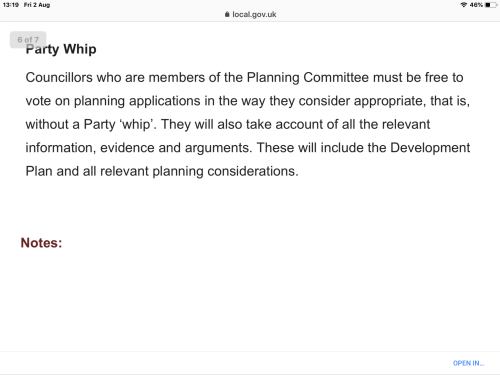
Remember, the Development Management Committee is a STATUTORY committee with rules and regulations … and it must NOT be subjected to party whipping or interference, nor must they “avoid undue contact with interested parties”.

Click to access planning-committee-manage-1cd.pdf

Wright v Swire – this must be a straight contest

In the light of the by-election last night, which saw the strongest pro-Remain candidate win against the incumbent Conservative, Lib Dems and Greens shoyld surely ensure that Claire Wright, who embodies all their policies, must be allowed a straight run against the risible Hugo Swire.

It would probably be too much to expect Labour to do the same, although they should, since their chances of gaining the seat are zero.

Let’s hope common sense prevails so that we can oust the barely seen multi-job London and Middle-East based Tory to the ever-present, ever fighting, ever-local Independent.

Officers advise councillors not to fight Clinton Devon Estates over withdrawal of Newton Poppleford doctors’ surgery in planning application

EDDC fight CDE – not on your life say officers …unless, of course, councillors instruct them to do so …

https://www.sidmouthherald.co.uk/news/newton-poppleford-home-appeal-meeting-1-6194658

“‘Questions hang in the air’ over council HQ relocation project”


Owl says: Leader Ingham seems to be thoroughly persuaded that the previous Tory majority council is whiter than white on the relocation project. Many disagree and had hoped that his new broom might be doing some sweeping – but not under the carpet as seems to be happening.

“A full report will be provided that will analyse in detail East Devon District Council’s relocation from Sidmouth to Honiton as ‘questions hang in the air’ over the project.

East Devon District Council’s moved into their new headquarters at Blackdown House in Honiton on February 11.

The new HQ, which replaced the council’s existing HQ at The Knowle in Sidmouth, cost the council £8.7m, while an additional £1.5m was spent on upgrading Exmouth town hall where one third of the council staff are to be based.

The controversial decision to relocate offices was taken back in March 2015 as it was decided the council needed to relocate into buildings that are affordable, cost efficient, and would significantly reduce the overheads of the council.

But the relocation project has faced criticism over the lack of transparency throughout the project, the procurement process, and the amount of cash the council received for the sale.

A freedom of information request asking how much the Knowle would be worth with planning permission said the answer was £50m, £42.5m higher than the council agreed to sell the land to Pegasus Life for, the latest edition of Private Eye states, naming the council as a ‘rotten borough’ because of it.

At Wednesday night’s full council meeting, Cllr Paul Arnott, leader of the East Devon Alliance, said that ‘questions hang in the air’ over the project.

He asked: “Both the disposal of the Knowle HQ and the procurement of the new Honiton HQ are matters of great concern to thousands of people in East Devon. Questions will hang in the air until they are fully addressed.

“Will the leader of the council support the immediate creation of a councillor-led working party, politically balanced, of up to 10 members, all of them newly elected in 2019, reporting to the scrutiny committee, to look into these matters in the public interest?”

In response, Cllr Ben Ingham, the council leader, said: “Relocation has been a key element of the council’s transformation agenda in terms of delivering against priorities of reducing council operational costs and introducing modern ways of working.

“Throughout its lifetime the relocation project has been subject to regular reporting to cabinet and council, dedicated project management, senior member and officer oversight through the Office Accommodation Executive Group, regular risk review and the scrutiny of South West Audit Partnership.

“Prior to the decision to move to Exmouth and Honiton and dispose of the Knowle site an independent audit was carried out to inform the decision to relocate and to test the financial projections for the project. These findings were included as part of the report to cabinet in March 2015 seeking approval of the move.

“Both Audit and Governance and Overview and Scrutiny committees met jointly to consider the relocation project programme and gave their endorsement. Cabinet and Council were provided with extensive detail, independent evaluation and wider committee endorsement as part of their approval.

“Relocation has been delivered successfully in terms of the physical moves and performance of the council. Furthermore this complex project has been delivered within budget.

“A project closure report will be provided to council at the one year anniversary of the project which will include a full project cost analysis and detail of operational costs for the first year of operation of Blackdown House and annual running costs of Exmouth Town Hall.

“If Scrutiny were so minded they could ask to consider the officer report or undertake a piece of work themselves and as Leader I would not want to restrict or pre-empt their independence to set their own forward plan. The Scrutiny Committee is politically balanced and already well placed to do this without the imposition of a working party which is constitutionally unsound in terms of its suggested membership.”

Cllr Arnott said that ahead of the May elections, the East Devon Alliance manifesto on their website saw their page on the relocation project have page views that were ‘streets ahead’ of anything else.”

He asked: “Can I be assured that if anyone on scrutiny wanted to commission a piece of work on sale off the Knowle and procurement of this, there would be nothing to stop them?”

Cllr Ingham confirmed if a member of scrutiny wanted to request that, then they could do so.

He added: “At the moment the project is coming in favourably to the target budget. The idea of waiting a year before the report was to establish more accurately exactly the savings that the council is making in the new building.”

https://www.devonlive.com/news/devon-news/questions-hang-air-over-council-3148843

We paid our 4 ex-Prime Ministers (now 5, and one ex-Deputy) more than half a million pounds last year

Public money spent on supporting the offices of Britain’s five surviving former leaders has jumped by nearly 80 per cent in six years – despite the fact that many of them have gone on to become independently wealthy after leaving 10 Downing Street.

New figures show the costs of supporting the offices of ex-PMs Sir John Major, Tony Blair, Gordon Brown, David Cameron, as well as the former deputy PM Sir Nick Clegg, increased from £331,000 a year in 2013/14 – the first figures that are available – to £589,000 last year. …”

https://www.telegraph.co.uk/politics/2019/08/01/taxpayer-costs-paying-offices-four-former-pms-sir-nick-clegg/

Big developer CEOs offloading large blocks of their shares …

“Barratt Developments’ boss follows Berkeley founder’s lead and sells more than a third of his shares for £3.3m.

Barratt Developments’ boss has sold more than a third of his shares for £3.3 million.

David Thomas sold 500,000 shares for 660p each. He still has 823,000 Barratt shares worth £5.3 million.

The move came just weeks after Berkeley founder Tony Pidgley cut his stake in his company by a fifth – cashing in £37.2 million of shares.

The sales raise concerns that housing bosses believe the market has peaked.

And Taylor Wimpey warned rising costs and ‘flat’ house prices were putting pressure on its profits.

It reported first half sales of £1.7 billion, almost unchanged from the previous year, and said profits fell from £301 million to £299.8 million. The firm has proposed a 2019 dividend of 18.34p per share.”

https://www.dailymail.co.uk/money/markets/article-7306879/Barratt-Developments-boss-sells-shares-3-3m.html

EDDC CEO tries to slither out of responsibility (NOT successfully!) for his planning advice to developer in private meeting

Owl has SO many questions!

First, Mr Williams’ ‘explanation’ defies belief, he basically accuses the developer of lying about the meeting. Then, he issues his denial of the circumstances of the event to the press, rather than to the councillor who asked him for an explanation. THEN, there appears to have been a totally undocumented meeting between him, Stuart Hughes and the developer – something that is extremely worrying – how many other such meetings with developers and hand-picked councillors have occurred? How do they happen?

But judge for yourself from the full text of the DevonLive article.

Owl thinks the very least EDDC majority councillors should do is suspend him until this is satisfactorily sorted.

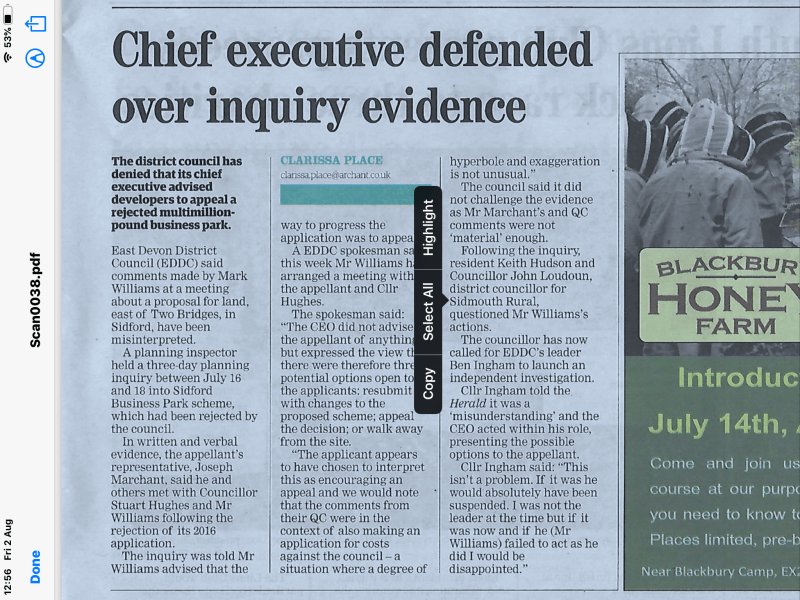
“Calls have been made for an independent investigation after East Devon District Council’s chief executive allegedly told developers to appeal his own council’s refusal of planning permission for the Sidford Business Park.

East Devon District Council in 2018, on the grounds of harm to highway safety, relating to increased heavy goods vehicle usage of the area’s narrow roads, refused the plans for land, currently used for agriculture, the east of Two Bridges Road in Sidford.

A larger scheme submitted by the applicants was rejected previously by the council in 2016.

Applicants Tim and Mike Ford challenged the 2018 refusal of the council and three days of arguments for and against the development took place in July.

At the planning inquiry though, Richard Kimblin QC, on behalf of the applicants OG Holdings Retirement Benefit Scheme, and Joseph Marchant, their planning agent, said that following the refusal of the 2016 scheme, Mark Williams, the council’s chief executive, advised them they should appeal.

The claims, made both in writing and verbally, were unchallenged by East Devon District Council during the inquiry.

Paragraphs 13 and 14 of the Mr Kimblin QC’s final closing arguments at the Inquiry said: “After the 2016 application was refused, there was a meeting with Councillor Stuart Hughes and the CEO of the Council. The CEO advised that the way to progress was to appeal. That is an extraordinary state of affairs.”

Following a request for comment from the Local Democracy Reporting Service on the remarks allegedly made by Mr Williams, an East Devon District Council spokesman said that the he did not advise the appellant of anything, the applicant chose to interpret the comments he did make as encouraging an appeal, and the comments were made in a ‘situation where a degree of hyperbole and exaggeration is not unusual’.

Cllr John Loudoun, who represents the Sidmouth Rural ward, though has called for an independent inquiry into the meeting and the comments, saying that the while the council says there was a ‘misinterpretation of events’, “misinterpretation is a nice way of calling someone a liar.”

The claim that was made by Mr Marchant was set out in his written evidence to the inquiry, which said: “Subsequent to the refusal of the 2016 application, an approach was made to Members, including Councillor Stuart Hughes and the CEO (Chief Executive) of EDDC, Mark Williams.”

The following paragraph added: “We were advised by Mark Williams….that in his opinion, the applicant (Fords) may make more advance in progress towards delivery through appealing the Council’s decision to refuse the 2016 planning application rather than resubmission.

Paragraphs 13 and 14 of Mr Kimblin’s final closing arguments at the Inquiry added: “After the 2016 application was refused, there was a meeting with Councillor Hughes and the CEO of the Council. The CEO advised that the way to progress was to appeal. That is an extraordinary state of affairs.”

Asked to comment on the claims made at the inquiry, an East Devon District Council spokesman said: “The council officers and legal representative, acting on behalf of the local planning authority, did not consider the comments made by Mr Marchant or the appellant’s QC as material in specifically defending the reason for refusal, which is of course their role in the inquiry.

“The simple point is that the circumstances described have no bearing or relevance to the local planning authority’s decision and nor therefore to the focussing of all of their efforts in seeking to persuade the Inspector that the proposed development was unacceptable.

“As for the meeting itself, as was made clear at the inquiry the CEO was asked by the applicant/appellant to facilitate a meeting between them and Cllr Hughes to ascertain what options there might be available to them in the light of the refusal of planning permission.

“At the meeting, as reflected in Mr Marchant’s proof of evidence, Cllr Hughes expressed his opinion that he could not foresee any circumstances under which planning permission would be acceptable, notwithstanding the Local Plan allocation.

“The CEO did not advise the appellant of anything, but expressed the view that there were therefore three potential options open to the applicants: resubmit with changes to the proposed scheme; appeal the decision; or walk away from the site.

“The applicant appears to have chosen to interpret this as encouraging an appeal and we would note that the comments from their QC were in the context of also making an application for costs against the council – a situation where a degree of hyperbole and exaggeration is not unusual.”

However Cllr Loudoun said that having read the council’s response, he was even more convinced of the need for what he originally asked for, a genuinely independent inquiry in these issues, and he was appalled that the response to his concerns was sent to the press and not him.

He added: “Evidence provided at the Inquiry was fully tested by both the Council and the applicants’ representatives because this is the way in which facts are established or challenged. The statements made verbally and in writing by Mr Marchant for the appellants are, according to the District Council statement, misinterpretations of the events and comments at the meeting involving the Chief Executive.

“This is an extraordinary state of affairs as we now have a challenge to Mr Marchant’s evidence at a point where he cannot defend himself and after the point when the Council allowed the statements to be accepted as fact. It would appear that the Council is now saying that Mr Marchant spoke untruths and that these were untruths were in turn repeated by the applicants’ QC.

“They are essentially accusing them of lying. When it was raised in the inquiry, no-one complained about it and or questioned it. To me, saying it was a misinterpretation is a nice way of calling them a liar.”

He added: “The Council’s statement is disingenuous in that it tries to down play the quotes of what the Chief Executive said as put forward by the applicants’ QC as “hyperbole and exaggeration” whilst pursuing a costs order. This ignores the fact that Mr Marchant made the claims whilst giving evidence and that the appellants’ QC repeated them not only in his arguments for costs but also, and more importantly, in his broader closing submissions in support of the applicants’ case.

“It was not a throwaway comment as it was in the both written and verbal statements and made by two people.

“I am even more concerned having read the Council’s public response to these matters and I am now even more convinced of the need for what I originally asked for, a genuinely independent inquiry in these issues.

“If he did say that they should appeal then he has it then he was undermined the officers, the council and his role on a very serious issues, and if not, then why wasn’t it challenged at the inquiry?

“I am bemused at the response from the council to this matter which seems to be now turning into as much a focal point as the planning application and subsequent Inquiry.”

A decision on whether to allow the appeal to allow the plans for 8,445sqm of employment space built on the outskirts of the village is set to be made by the Autumn. If the appeal was allowed, then a further planning application would need to be submitted for the details of the scheme.”

https://www.devonlive.com/news/devon-news/independent-inquiry-calls-after-claims-3158474

“One in 10 [South West Water] pollution incidents in 2018 happened in East Devon, figures reveal”

“An Environment Agency (EA) report on the performance of water companies at managing pollution levels said South West Water (SWW) had a total of 98 incidents in 2018 per 10,000km of sewer.

An FOI request made by the Journal has revealed that 14 of those happened in East Devon.

Four of these incidents happened in Honiton – three of them over a 20 day spell in January 2018.

Axminster had four relating to the River Axe and the River Yarty.

Exmouth and Ottery St Mary had two each while Sidmouth and Woodbury had one.

SWW, which had the most pollution incidents in 2018 of nine companies across the UK, said it achieved the best wastewater performance last year but recognised there is still more work to do. …”

https://www.exmouthjournal.co.uk/news/locations-of-2018-pollution-incidents-revealed-1-6191933

“The [privatised] market” in higher education crumbles, 3,500 students and 247 staff lose out

“GSM London, one of the biggest private higher education providers in England, has gone into administration – and will stop teaching students in September.

The college says it has not been able to “recruit and retain sufficient numbers of students to generate enough revenue to be sustainable”.

It teaches about 3,500 students – with degree courses validated by the University of Plymouth.

The college, based in Greenwich and Greenford, says 247 jobs are at risk. …

It was not a university – and not regulated by the higher education watchdog, the Office for Students (OFS).

But a spokesman for the OFS said its “overarching priority is to ensure that students are able to complete their studies”.

“We understand that some students who are nearing the end of their studies will be able to stay at GSM but it is likely that most will need to transfer to another higher education provider.”

The OFS says in 2017-18 the college had 5,440 students, with the latest figures showing 3,500.

A statement from GSM London says that “discussions are under way with other higher education providers to identify alternative courses for our students and we will be supporting them in the application process”.

The college, owned by a private equity firm, says it could not remain financially viable and had been unable to find a buyer to ensure its “longer-term future”.

It says it will teach until September – which for some courses will be the end of term – ahead of an “orderly wind-down and closure of the college”.

A Department for Education spokeswoman said: “We want a broad, sustainable market in higher education, which offers students flexibility and a wide range of high-quality choices for where and what they study.

“Whilst the vast majority of institutions are in good financial health, the Department for Education and the Office for Students have been clear that neither will bail out failing providers.”

https://www.bbc.co.uk/news/education-49181654

“Accountancy fines double to record £32m as regulator gets tough”

“Fines against accountants more than doubled to a record £32m last year as the regulator cracked down on auditors in an attempt to repair its reputation in the wake of Carillion’s controversial collapse.

The penalties imposed mark a significant rise from the £13m in fines handed out by the Financial Reporting Council over the 2017-18 financial year.

The total would have reached £42.9m in the year to March 2019 if the FRC hadn’t offered discounts to firms that volunteered to settle cases early.

The rise in fines follows a series of accounting scandals at companies, such as Patisserie Valerie, which has put the work of auditors under heightened scrutiny and attracted criticism from politicians and regulators.

The accounting watchdog said the rise in penalties last year was partly due to more cases coming to a close over the period, as well as a rise in serious misconduct by accountants and the size of the auditing firms involved. The “big four” accounting firms – KPMG, Deloitte, PwC and EY – accounted for six of the nine fines imposed.

The big four have attracted heavy criticism over the quality of their audit work, particularly following the Carillion collapse.

Critics said KPMG should have spotted the construction firm’s problems sooner, and claimed auditors were prioritising profits over proper company scrutiny.

The FRC itself has been criticised for failing to keep close enough tabs on the industry, and is now set to be replaced with a new regulator.

The FRC’s executive counsel, Elizabeth Barrett, said: “The clarity and accuracy of financial reporting is of critical importance to us all. The significant increase in the number, range and severity of sanctions sends a clear message that where behaviour falls short of what is required, we will hold those responsible to account.”

https://www.theguardian.com/business/2019/jul/31/accountancy-fines-double-to-record-32m-as-regulator-gets-tough?CMP=Share_iOSApp_Other

“UK reclaims place as world’s second largest arms exporter”

Swire will be pleased – he’s spent many happy hours in Saudi Arabia with representatives of BAE Systems.

“British defence exports rose to a record £14bn in 2018, with sales to Saudi Arabia, the UAE, Qatar and other countries in the Middle East accounting for nearly 80% of that figure, official figures reveal.

Campaigners said the statistics, released on Tuesday, showed that Britain was “arming and supporting repressive regimes”, while the Department for International Trade (DIT) said they demonstrated that the UK had returned to its position as the world’s second largest arms exporter after the US.

Defence orders rose by £5bn to £14bn, making it the biggest year since records began in 1983. That increase was helped by a £5bn order for Typhoon fighters made by BAE Systems, plus Paveway missiles from Raytheon that are partly made in the UK.

Campaign Against Arms Trade said the figures “exposed the rank hypocrisy at the heart of UK foreign policy. The government claims to stand for human rights and democracy, but it is arming and supporting repressive regimes and dictatorships around the world.”

Britain’s sales to Saudi Arabia – believed to be the largest arms buyer – are the subject of an ongoing legal battle. Ministers have asked the supreme court to overturn a lower court’s judgment that some of the arms sales to Riyadh were conducted illegally.

In June, the court of appeal concluded the sales of arms that could have been used by Saudi Arabia’s air force in Yemen were unlawful because ministers had failed to examine whether, in targeting civilians, the country was in breach of international humanitarian law.

The DIT estimates the UK’s share of the defence export industry to be about 19%, placing it second for the first time since 2014, pushing Russia into third place and sitting comfortably ahead of fourth-ranked France.

The world leader is the US, which has a share of about 40%, according to the British estimates in the annual statistics published by the DIT, which is the licensing authority for arms exports.”

https://www.theguardian.com/world/2019/jul/30/uk-reclaims-place-as-worlds-second-largest-arms-exporter?CMP=Share_iOSApp_Other

“Rip Off Britain” asks for information from Cranbrook residents on district heating problems

“Hello Cranbrook. Can you help? My Name’s Ian Griffiths and I work for the BBC on the consumer programme Rip Off Britain. We have been contacted by some people regarding their experiences with the District Heating Scheme in Cranbrook. We are looking to hear from others about what they think about the DHS. If interested please drop us a line at ripoffbritain@bbc.co.uk with your story and contact details or leave us note under this message and we’ll contact you back via Facebook Messenger. Bst wishes and thanks again Ian”

Bovis can’t build footpath on Axminster estate “because there are tree roots in the way”

Owl says: so who designed this then, knowing the problem? Amd which planner didn’t spot it?

“Residents on a new Axminster housing estate say the lack of a pavement outside their homes is putting lives at risk.

They say mums with pushchairs and wheelchair users are being forced to cross a busy road used not only by residents but also heavy construction traffic.

Brian and Barbara White claim plans for the Cloakham Lawns estate, off Chard Road, showed a pavement outside their home at Cloakham Drive.

But council officials say what they deemed to be a footpath was, in fact, only a ‘service margin’.

And they say building a permanent pavement there would harm the roots of a tree on the adjoining open green space.

Mrs White said the situation was ‘an absolute nightmare’, with pram and wheelchair users having to cross the road to the pavement on the other side and then cross back again further down the estate to return to the right side.

“Our road is busy with normal traffic plus heavy lorries, diggers, bulldozers and forklifts. Bovis Homes will be building here for years. There is plenty of room to continue the pavement all the way on this side of the road.”

Mr White added: “There is going to be an accident before long. People are putting their lives at risk.”

Bovis Homes has recently put down a temporary footpath outside the houses but says it cannot build a permanent pavement because of the nearby tree.

A spokesman told the Herald: “The tree is a hybrid lime, which is a category-A tree and is protected by a tree protection order (TPO) and also by a root protection area (RPA).

“RPAs are designed to protect the trees’ root systems and provide sufficient rooting environment to allow the trees to continue to thrive.

“The RPAs prohibit groundwork, construction, development or storage activity within the designated area. The highway proposals obviously had to take that into account.

“The temporary footpath is in place while there is construction work going on, and this hasn’t required the more robust foundation work that a permanent footpath would, which would adversely impact the RPA.”

https://www.midweekherald.co.uk/news/axminster-residents-say-mums-with-pushchairs-are-forced-to-cross-a-busy-road-1-6188464