
“Today, a report was released in which researchers at Sheffield Hallam University found that one third of landlords were cutting back on renting to under-35s. Because young people are more likely to be in insecure employment and, thanks to the last coalition government, are entitled to significantly lower levels of housing benefits, property owners are increasingly deciding it’s not worth the risk to take them on as tenants. …”
Category Archives: Affordable and Social Housing
Public land unlocking fund
We could have bought Knowle off ourselves and built affordable housing!
“Councils can bid to a new £45m land release fund for site remediation and small-scale infrastructure projects that will help bring sites forward for housing that could not otherwise be developed.
The fund has been launched by the Department for Communities & Local Government in partnership with the One Public Estate programme run by the Cabinet Office and the Local Government Association (LGA), which is separately offering £9m to councils to deliver programmes to make better use of publicly owned land and buildings.
Ministers hope to unlock enough council-owned land for at least 160,000 homes to be built by 2020.
Minister for government resilience and efficiency Caroline Nokes said: “One Public Estate is enabling local authorities to make better use of their land and property and deliver tangible benefits to their communities.” …
http://www.publicfinance.co.uk/news/2017/08/government-launches-ps45m-land-release-fund
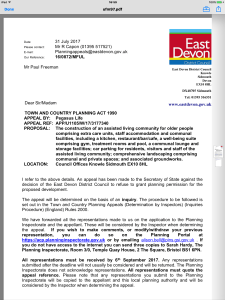
Knowle planning appeal inquiry – objections to Planning Inspector by 6 September
 i
i
Prince Charles gets his own (beautiful?) way with his new south-west town
Owl says: bet this wouldn’t happen in the Republic of East Devon! And wonders if a “zombie town” of which they speak might be on our own doorstep!
Jerome Starkey
http://www.thetimes.co.uk
“Three of Britain’s biggest housebuilders have lost an attempt to change the plans for a garden town designed by Prince Charles’s architects, amid claims that the builders’ proposals would have created a “zombie town”.
The Sherford Valley, on the outskirts of Plymouth, had been earmarked for 5,500 new homes and was designed by the Prince’s Foundation to create an eco-friendly pedestrian community like Poundbury in Dorset.
Bovis Homes, Linden Homes and Taylor Wimpey, which bought the site in 2014, had applied to Plymouth council to water down the design rules and change Prince Charles’s plan so that they could build cheaper homes more quickly.
Councillors said that the move would have created a “zombie town” with “years of planning thrown out of the window” and rejected their application.
The builders had built fewer than 300 of the homes when they applied to amend the town code and master plan.
“Instead of having the highest standard of new homes, we will instead have a rather large housing estate,” Vivien Pengelly, a councillor, said.
The housebuilders said that they were asking for minor changes that would not have affected the quality of homes. However, Ben Bolgar, a director of the Prince’s Foundation, said that they were trying to strip out commitments to quality.
He said that Sherford was designed to prove that Prince Charles’s model village of Poundbury, near Dorchester, could work on a larger scale but that the builders were determined to “build their normal boxes”.
The design code meant that the builders had to produce a range of houses, built from local materials, which were not more than 500m from the shops. Cars had to be parked in hidden courtyards rather than on the street to encourage people to walk.
Mr Bolgar said that the builders’ plans would have transformed Sherford into a “rubbish housing estate”.
Jonny Morris, a councillor, said that he did not want Sherford to end up like the sort of place you would see “in the aftermath of a zombie apocalypse”.
Housing companies applied to ditch a town code drawn up 13 years ago and replace it with a set of “fundamental principles” which they said allowed them greater flexibility over materials and construction methods.
“This is simply far too premature to take such a radical act, disregarding all those measures that allowed permission to be granted in the first place,” Nick Kelly, the deputy lord mayor, said. “We want development but everybody thinks, ‘This is what we’re going to get’, and at the stroke of a pen years of planning and assurances go out of the window.”
Lord Taylor of Goss Moor, who wrote a report in 2015 calling for dozens of new garden villages, said that Sherford had an excellent town plan and was “overwhelmingly supported by the local community” because of its commitment to quality. “The housebuilders knew what they were signing up to. There should really be no question about what will be delivered,” he said.”
Times (paywall)
Housing crisis still – 10 years after original crash it’s still shaping “the market”
“Britain’s housing market remains distorted 10 years on from the global financial crisis, with first-time buyers struggling to scrape together the much bigger deposits they need today, existing owners unable to “climb the ladder” and a gaping price divide between London and regional cities, according to a report out today.
The average house price has grown to £478,142 in London compared with the national average of £209,971. A decade on from the 2007 crash, prices have only just started gaining ground in Wales, Yorkshire and Humberside and the north-west, while values in the north-east are down 9%, according to analysis by the real estate company Savills.
Nationally the typical deposit has doubled to £26,224 while in the capital it has quadrupled to nearly £100,000. In the year to the end of March, about £4bn out of £10.2bn in first-time buyer deposit money came from either the “bank of mum and dad” or government help-to-buy schemes. Interest-only mortgages – which were key to going up the housing ladder – have become a thing of the past, and owners are staying put rather than selling.
The market has slowed overall with a “dramatic slump” in transactions. The HomeOwners Alliance says little more than a third of houses put on the market in London are selling. Those that do sell are taking longer, and owners are having to accept a bigger cut to their asking price. Overall the 2007 crash is “still shaping the UK housing market” and will for years to come, Savills predicts.”
One in three earns less than two-thirds average wage in south-west
Affordable Housing (80% average price of houses being built at the time) – in your dreams. Inequality- the price paid for rampant “growth”.
“The wage gap is growing in the South West – with almost a third of people now earning less than two-thirds of the UK average.
New figures show 31.2% of full-time employees in our region earned less than two thirds of the national average during the last quarter of 2016.
That compares to just 29.3% as recently as the first quarter of 2015.
The increase is the fifth biggest for any region in the UK after the South East, the North East and Northern Ireland (with the same increase) and Wales. …”
Corruption, absolute corruption, developers and councils
BUT THIS BLOG AND OTHERS HAVE BEEN SAYING THIS FOR YEARS AND YEARS AND YEARS AND YEARS!
HEAD … BRICK WALL … HEAD … BRICK WALL
Here are just a few recent East Devon Watch articles:
Section 106 scandal: New controls and a surprising revelation from CEO Mark Williams
The Great EDDC Section 106 Scandal of 2016 – and probably earlier years
and the BBC has only just discovered it!
“The council that ran the Grenfell Tower block struck deals worth nearly £50m last year to allow developers to avoid having to build affordable homes, research for BBC News shows.
Kensington and Chelsea’s own analysis shows it has built a fraction of the social housing the borough needs.
Developers can pay a fee if they can convince the council that affordable homes would make their plans unviable.
The council said it struggled to build affordable homes in a crowded area.
Kensington and Chelsea has been severely criticised for its failures over Grenfell Tower, including allegations that the regeneration of the tower was done on the cheap and that survivors of the blaze were not properly cared for.
At least 80 people died in the fire.
The disaster, in one of the richest areas in the country, has also thrown a spotlight on the council’s attitude towards its poorest residents.
Huge shortfall
The council’s policy is for half of homes in large housing schemes to be available for rent or sale at below market rates.
The official target is to build 200 affordable units – flats or houses – each year between 2011 and 2021.
But the council’s own figures show that since 2011-12, just 336 units have been built; in 2012-13, just four were completed.
At the same time, Kensington and Chelsea struck deals with developers to pay it nearly £60m.
Since 2011, the council has agreed payments worth £59.7m, in what are known as Section 106 agreements.
The council is allowed to charge developers a fee if their scheme would ordinarily be liable to include social housing but its backers can convince officials that to do so would make the proposal unviable.
That headline figure includes £47.3m in 2016 alone.
The figures have been calculated for BBC News by EG, a property consultancy firm, whose work includes researching planning committee reports for Section 106 payments.
Senior analyst Graham Shone said payment to the council had undergone a “step change” on previous years.
“Maybe the council is a bit more receptive to those kinds of agreements going through as a way to encourage development across the borough,” he said.
The council will gain £12.1m instead of affordable housing at Knightsbridge station
K1 development, Knightsbridge
Developers Chelsfield plan to “reinvigorate, restore and celebrate” the block above Knightsbridge Tube station.
The design includes retail outlets at street level, new offices, 35 residential apartments, an underground car park and a rooftop garden and restaurant.
Given the size of the development, to comply with the council’s own policy, the scheme should include affordable housing.
However, in their planning application, the architects say: “The size of units [flats] are larger than what would normally be associated with affordable housing based on the London Housing Design Guide.”
They also argue the service charge on the flats “would far exceed what would be a sustainable level for affordable housing”.
And while they had considered creating another lift to accommodate affordable housing, this would “compromise” the retail units on the ground floor.
A mix of private and affordable homes, they say, is therefore “not viable”.
The council accepted the arguments, passed the scheme, and will receive £12.1m in lieu of affordable housing at the development.
The payments are meant to help the council provide affordable housing in other parts of the borough or to renovate existing stock.
A paper prepared for the council’s cabinet last year shows that of the nearly £21m the council has received since 2009-10 for affordable homes, £9.2m remains unspent.
Developers can also pay fees to off-set other impacts of their schemes. And the same paper shows that of the total £57.3m that Kensington and Chelsea has received since 2009-10, £36.7m has still not been spent.
None of the developers’ contributions has been used to improve air quality, libraries, sports facilities or healthcare, and very little has been spent on employment initiatives or children’s playgrounds.
The leader of Kensington’s Labour group says he is shocked by the lack of new affordable homes
Robert Atkinson, head of the Labour group at Kensington and Chelsea, said he was shocked by the amount of money the council was receiving and how few affordable homes were being built.
“One of the beauties of living in London is you have a balanced population, and I do think we have a duty not to produce the prettiest ghost town in Western Europe.
“Our first loyalty should be to maintaining and strengthening our communities, and we have fallen down on that job terribly.”
The need for affordable housing in Kensington and Chelsea is acute.
A Freedom of Information request submitted by the BBC last year showed the council had spent £28m providing temporary accommodation to homeless residents in 2015-16, a figure that has doubled in five years.
Almost three-quarters of those people are being housed outside the borough – the highest proportion in London.
The council said that “as the smallest London borough”, with the second highest population density in England and Wales and 4,000 listed buildings, “the borough only has a limited capacity to deliver housing”.
A spokesman said its policy of allowing developers to negotiate on affordable housing “stems from government policy”.
“The council scrutinises any viability information provided by the applicants in detail and in some cases is able to secure higher proportions than those proposed by applicants,” he added.”
“Property values in desirable areas could go down in a radical bid to spark new building”
Oh dear! In East Devon we are getting LOTS and LOTS of houses being built but prices are still going UP and UP – not DOWN as Javid tries to suggest should happen! How will Javid deal with THAT? Or is it exactly what he wants, and the suggestion that prices should fall is just a smokescreen for even more rampant development in high-cost areas?
“Communities Secretary Sajid Javid is preparing to unveil a striking new rule that will make NIMBY councils take local affordability into account.
Under it, every authority will have to calculate how easy it is for young workers to get on the housing ladder by working out their local salary-to-house price ratio.
The average house in Britian now costs 7.8 times the average salary – an all-time record.
And in some areas of the south east, the figure rockets to above 12 times people’s wages.
Mr Javid wants to slap a new automatic legal requirement on councils with ratios that are too high to make them green light thousands more homes, so that a significant increase in housing supply reduces prices over time.
Mr Javid’s test has been debated intensely in No10 for six months over fears it will spark a rebellion from some Tory MPs, The Sun can also reveal.
It could also ignite a dangerous backlash in solid Tory areas as home owners panic about their own houses losing value.
But a senior government source said last night: “Sajid has come up with what he insists is an objective and transparent test to increase supply.
“For once, councils won’t be able to fudge it, and that is key.
“There was nervousness in Downing Street before the election about upsetting the horses, but he has persuaded a lot of us round.”
Mr Javid’s plan could be unveiled as early as tomorrow.
In a preview of his plan, Mr Javid mounted a withering attack on councils three weeks ago for failing to build enough.
The Cabinet minister branded them refusal “not good enough” and declared that “the era of tolerating such poor, patchy performance is over”.
“Countryside in crisis”
“In a pointed letter to the Times, the [Rural] coalition declared that: “More than nine million people live and work in rural England, yet their concerns are in danger of being squeezed out if Brexit discussions focus only on agriculture and the environment.”
The effects of austerity and corporate cost-cutting had already decimated vital rural services, it argued, “risking rural communities becoming enclaves only for the wealthy”.
Talking to various members of that group, you get a feel for the range of different perspectives, but also of the shared insistence that Brexit will not just affect the countryside in terms of a withdrawal from the Common Agricultural Policy and related regulation and subsidy, but is also likely to bring to a head issues concerning the fabric of rural life that have long been unravelling.
…“Do we want the countryside just to be a national park and import our food from elsewhere or do we want it to be full of thriving communities that can be a productive part of the economy?”
… The Rural Coalition wants at least 7,500 affordable houses for young families to be built per year to reverse this trend. Paul Miner of Campaign to Protect Rural England argues that, with concerted policy action, “a commonplace sight in the countryside could be thriving communities boosted by new affordable homes”.
… There is a very big if there, of course, to go alongside the multiple other ifs on the horizon. At the heart of this one is the question of what we collectively understand rural Britain to be about. Whether it is a green and pleasant backdrop to insistently urban priorities, or whether it can re-establish a community that works for all generations and income groups. Hudswell suggests perhaps part of that solution can be created by the communities themselves.
“The story really is,” Lightfoot says, “if you sit back, nothing happens.”
“Or,” Cullen says, “you look around one day and think, hey, Christ, we have lost everything.”
https://www.theguardian.com/uk-news/2017/jul/15/countryside-crisis-rural-britain-north-yorkshire
A solution to the housing crisis? The flatpack house
Inventor David Martyn, 58, of Wallingford, Oxfordshire, said the building’s partitions and storage space allow it to be used as a home, classrooms, business spaces, operating theatres and shelters for refugees.
Well, that could put developers out of business, so you can bet they are looking for ways of sabotaging it!
Councillors and developers – a (happy for them) marriage made in hell
Journalist Anna Minton wrote a damning report in 2013 (“Scaring the Living Daylights out of People”) heavily featuring the chilling antics of the East Devon Business Forum and its disgraced Chairman, former EDDC councillor Graham Brown and mentions this in today’s article in The Guardian:
Click to access e87dab_fd0c8efb6c0f4c4b8a9304e7ed16bc34.pdf
This article on the politicisation of planning is reproduced in its entirety as there was not one sentence that Owl could cut. Although the article concentrates on cities it applies equally to areas such as East Devon.
“The politicisation of planning has come with the growth of the regeneration industry. While once planning officers in local government made recommendations that elected members of planning committees generally followed, today lobbyists are able to exert far greater influence.
It’s not easy to see into this world, but there are traces in the public domain. Registers of hospitality, for example, detail some of the interactions between councillors and the commercial property business. Take a week in the life of Nick Paget-Brown, the Kensington and Chelsea leader who resigned in the aftermath of the Grenfell fire. In October last year he had lunch at the five-star riverside Royal Horseguards Hotel courtesy of the property giant Willmott Dixon. The previous evening he had been at a reception put on by the business lobby group London First, whose membership is dominated by property and housing firms. He had breakfast with the Grosvenor Estate, the global property empire worth £6.5bn, and lunch at Knightsbridge’s Carlton Tower Hotel. This was paid for by the Cadogan Estate, the second largest of the aristocratic estates (after Grosvenor), which owns 93 acres in Kensington, including Sloane Square and the King’s Road.
Rock Feilding-Mellen, the councillor in charge of the Grenfell Tower refurbishment, who has stepped down as the council’s deputy leader, had his own list of engagements. As the Grenfell Action Group noted earlier this year, he was a dinner guest of Terrapin, the firm founded by Peter Bingle, a property lobbyist renowned for lavish hospitality.
Bingle is also a player in the other big regeneration story of recent weeks: Haringey council’s approval of plans for its HDV – Haringey development vehicle. This is a “partnership” with the Australian property developer Lendlease, a lobbying client of Terrapin’s. The HDV promises to create a £2bn fund to build a new town centre and thousands of new homes, but local residents on the Northumberland Park housing estate, whose homes will be demolished, are vehemently opposed. The Haringey leader, Claire Kober, has lunched or dined six times at Terrapin’s expense.
In Southwark, just as in Haringey and Kensington, there is a revolving door between politicians and lobbyists. The former leader of Southwark council, Jeremy Fraser, went on to found the lobbying firm Four Communications, where he was joined by Southwark’s former cabinet member for regeneration Steve Lancashire. Derek Myers, who until 2013 jointly ran Kensington and Chelsea and Hammersmith and Fulham councils, is now a director of the London Communications Agency, a lobbying agency with property developers on its client list. Merrick Cockell, the leader of Kensington and Chelsea until 2013, now chairs the lobbying firm Cratus Communications, which also specialises in property lobbying. In Westminster, the hospitality register for the last three years of its deputy leader, Robert Davis – chair of the council’s planning committee for 17 years – runs to 19 pages.
Cities other than London and rural areas also provide examples of worrying relationships. In East Devon a serving councillor was found in 2013 to be offering his services as a consultant to help developers get the planning decisions they wanted. In Newcastle a councillor who worked for a lobbying company boasted of “tricks of the trade” that included making sure planning committees included friendly faces.
Meanwhile the culture of regular meetings and socialising does not stop with councils. The diary of David Lunts, head of housing and land at the Greater London Authority for the first three months of 2017, reveals a lunch in Mayfair with Bingle, a VIP dinner laid on by a London developer, another meal paid for by a housing giant, and dinner on Valentine’s Day with a regeneration firm. Consultants and a developer furnished him with more meals before he headed off to Cannes for Mipim, the world’s biggest property fair. He also had dinner with Rydon, the firm that refurbished Grenfell Tower.
Further up the food chain, it was only because of Bingle’s boasts that we heard of a dinner he gave the then local government secretary, Eric Pickles. Held in the Savoy’s Gondoliers Room, it was also attended by business chiefs, including one who was waiting for a planning decision from Pickles’s department. The dinner was never declared on any register of hospitality because Pickles said he was attending in a private capacity.
Lunt’s former colleague Richard Blakeway, who was London’s deputy mayor for housing until last year, and David Cameron’s adviser on housing policy, became a paid adviser to Willmott Dixon. He is also on the board of the Homes and Communities Agency, the government body that regulates and invests in social housing. Its chair is Blakeway’s old boss, the former London deputy mayor for policy and planning Ed Lister, who is also a non-executive director of the developer Stanhope.
The MP Mark Prisk, housing minister until 2013, advocated “removing unnecessary housing, construction and planning regulations” as part of the government’s red tape challenge. He became an adviser to the property developer Essential Living, eight months after leaving office. Prisk advises the firm on legislation, providing support for developments and “brand” building. Essential Living’s former development manager Nick Cuff was also a Conservative councillor and chair of Wandsworth’s planning committee. A colleague of Cuff’s, who spent 30 years in the south London borough’s planning department, now works for Bingle’s lobbying firm, Terrapin.
This is the world that Kensington’s Paget-Brown and Feilding-Mellen, Haringey’s Kober and countless other council leaders inhabit. Socialising between these property men – and they are mostly men – is used to cement ties, and the lines between politician, official, developer and lobbyist are barely drawn. This culture, and the questions of accountability it raises, must be part of the public inquiry into Grenfell. It is perhaps no surprise that the government doesn’t want it to be.
• Tamasin Cave, a director of the lobbying transparency organisation Spinwatch, contributed to this article”
Estate agent boss slams government housing policy
“… Paul Smith, chief executive of Haart estate agents, said: “Affordability is clearly reaching a critical juncture as the average loan size increases whilst the average income decreases. Although rising first-time buyer borrowing demonstrates the appetite for home ownership in the UK, young people should not be left to stretch beyond their means, and government should intervene with a tax break as a quick and straight-forward way to help them get onto the ladder.
“Theresa May’s legacy on home ownership has so far been a disaster. The ‘just about managing’ are further away from owning their own home than they ever have been, and the government’s feeble housing white paper did not go anywhere near enough to get housebuilders building and the market moving.”
http://www.cityam.com/268307/theresa-may-slammed-disastrous-action-home-ownership-estate
Barratt: 12% rise in profits yet only 76 more homes sold!
“Britain’s largest builder Barratt posted a better-than-expected 12 percent rise in 2016/17 profit as selling prices rose but it only built 76 more homes than its previous financial year, despite government efforts to tackle a chronic shortage.
Britain needs to deliver up to double the roughly 200,000 new properties arriving on the market each year just to keep up with demand, which has pushed up prices and rent, stopping many younger people from getting onto the property ladder.
Barratt, which built 17,395 homes in the 12 months to the end of June and posted pretax profit of 765 million pounds ($982 million), has previously said it wanted to focus on quality, with rivals such Bovis being criticised for poor workmanship.”
http://uk.reuters.com/article/uk-britain-boe-broadbent-idUKKBN19X0IG
Er, “quality” – don’t they mean “eye-wateringly expensive”?
“Inspector to decide if developer should pay more Sidmouth community cash”
Recall that PegasusLife is calling it’s plans for the Knowle “assisted living accommodation”. Why? Because it doesn’t then have to contribute to affordable housing.
Does anyone recall EDDC making a fuss about that? No – they left it to local objectors to point it out!
“A government planning inspector will decide whether a developer will have to pay a share of its profits from 36 proposed sheltered apartments to the public coffers.
The matter was the subject of an inquiry this week after Churchill Retirement Living and East Devon District Council (EDDC) could not agree terms for an ‘overage’ clause.
Churchill hopes to demolish the former Green Close care home in Drakes Avenue to make way for the development. The firm launched an appeal due to non-determination of its application.
The delay in EDDC deciding the fate of the scheme was due to officers trying to apply an ‘overage’ clause that would require Churchill to pay up if its profits exceed current expectations.
EDDC documents argue plans to create the apartments for the elderly should be worth nearly £1million to the Sidmouth community – but the developer has shown it is ‘unviable’ to pay more than £41,000.
Churchill’s five-figure offer towards off-site ‘affordable’ housing was last year slammed as an ‘insult to Sidmouth’ by town councillors, who suggested the developer should pay at least £360,000.
Papers submitted to the appeal process from EDDC say there is a policy expectation that half of the site should be provided as ‘affordable’ housing and that there is a ‘substantial’ need for one- and two-bedroom units in Sidmouth.
If 18 ‘affordable’ homes cannot be provided on-site, a payment of £935,201 would be expected so the properties can be built elsewhere.
Churchill said a viability assessment showed building ‘affordable’ homes on the site was ‘impractical’ and ‘unrealistic’.
It added: “It has been demonstrated that the application development is not sufficiently viable to permit the imposition of any affordable housing or planning gain contributions above £41,208.”
An EDDC spokeswoman said: “Unfortunately, the development is not sufficiently viable to pay this [£935,201] sum and, following an independent assessment of the viability of the scheme, it was reluctantly accepted that the scheme could only afford to pay £41,208 towards affordable housing.
“Under government guidance, we are required to reduce our requirements where a development is unviable and so we have no real choice but to accept this position.”
EDDC also expected Churchill to pay £22,536 for habitat mitigation, plus an £18,400 public open space contribution. The total is nearly £1million.
At the hearing on Wednesday, a representative for the developer said a viability report showed it could not offer more than £41,208 if it wanted a competitive return of 20 per cent.
He argued such developments, both locally and nationally, did not have an ‘overage’ clause like the one proposed and added that it was not in line with national guidelines.
“We need to ensure there are competitive returns for the developer and the landowner,” said the representative.
“If the developer, through his own skill or from fortuitous circumstances, makes a larger profit than intended, then the council wants to have a proportion of it and, if they are not so fortunate and make less than 20 per cent, the entire downside is to be borne by the developer.”
Town councillor Ian Barlow argued that the £41,208 contribution was only agreed to because councillors were told it was subject to an ‘overage’ clause. He added: “If they make an obscene amount of money from our community, then they should put it back into the community. They are now saying it is not plausible.
“We only deal with common sense.
“Theoretically, if someone builds a £5million-ish place and they are only giving around £41,000 back, at the end of the day, that does not seem right.”
Cllr Barlow argued that he found it hard to believe such a successful company would make an investment which was not financially viable.”
Investigation into government links with developers, Channel 4, 8 pm
Dispatches, 8 pm tonight, Channel 4
“How property companies have failed to deliver new, affordable homes and asks questions about the link between government and the property industry.”
Rural homelessness : government says LEPs should help (pull the other one)
“The “hidden crisis” of rural homelessness requires urgent attention from the government, a leading thinktank has said after research revealed a dramatic rise in the number of rough sleepers in countryside areas in the last five years.
The Institute for Public Policy Research warned that it is particularly hard to prevent or relieve because of the difficulties in covering larger areas and the lack of specialist resources compared to cities.
The report, Right to home? Rethinking homelessness in rural communities, finds the promotion of the countryside as a “rural idyll” where people go to escape the city and have a better life could “mask” the presence of households at risk of becoming homeless or already without a roof over their heads.
The research – which was commissioned by Hastoe, a leading rural specialist housing association – found that 6,270 households were accepted as homeless in 91 mainly or largely rural local authorities in England in 2015-16, an average of 1.3 in every 1,000 households.
A fifth of all homeless cases occurred outside of England’s most urban areas. From 2010 to 2016, “mainly rural” local authorities recorded a 32% rise in cases of homelessness. In areas that are “largely rural” there has been a leap of 52%, and an almost doubling in “urban areas with significant rural” (97%).
… Preventing and relieving homelessness can be especially difficult in rural areas, Snelling said, because of a relative absence of emergency hostels and temporary accommodation, large travel distances with limited public transport, isolated and dispersed communities, and constrained resourcing for specialist services.
Snelling said: “Rural homelessness often goes undetected but that doesn’t mean it isn’t happening and unless you tackle the difficulties in delivering services in rural areas and finding affordable homes, it will continue to be a problem.”
Jacob Quagliozzi, director for Housing Justice England, a Christian housing charity, said there has been a rise in churches and community groups contacting them for advice on setting up night shelters in their buildings.
The demand for emergency accommodation provision has seen “substantial growth” outside of the big cities, Quagliozzi said.
… The report also recommends that local authorities should enter into two-way negotiations with the government to develop devolution deals on housing and planning in which ambitious commitments to increasing affordable supply should be met with a transferral of power to do so.
Exmouth “assisted living” development next to Tesco
Why “assisted living”?
Surely not because, like Pegasus at Knowle, you won’t have to offer affordable housing as part of the deal?
“Warning issued on rural services and housing”
“A 12-strong coalition of organisations concerned with rural areas has warned these face becoming “enclaves of the affluent” unless the government acts on the lack of affordable housing and high costs of local service delivery.
The Rural Coalition, which includes the National Housing Federation, the National Association of Local Councils, and the Town and Country Planning Association, said policy makers should not regard rural England issues as only those of farming and the environment.
It called for a planning system and funding regime that would deliver “a meaningful increase in the number of affordable homes outside of towns and cities, fair distribution of funding between urban and rural areas for all services including healthcare and transport, and an industrial strategy that realises the potential of rural areas”.
Service delivery in rural areas incurs extra costs compared with those of towns because of population sparsity and the coalition said these must be properly reflected in funding formulae, such as those for local government, education and the NHS.
Rural areas would also be vitally affected by Brexit negotiations on issues raging from trade regulations to migrant labour to the future of EU funding programmes, the coalition said, urging ministers to ‘rural proof’ the results of Brexit talks.
Coalition chair Margaret Clark said: “For too long, rural people and businesses have been left behind and sidelined in the national political debate.
“From now on, all policies and their implementation must be properly assessed to ensure they meet the needs of the millions of people who call the countryside home.”
http://www.publicfinance.co.uk/news/2017/07/warning-issued-rural-services-and-housing
Better-off buyers are the ones who benefit from help-to-buy
“Government schemes designed to help more people get on the UK housing ladder have little impact on improving social mobility as better-off buyers are most likely to benefit from the support, a report has found.
Research by the Social Mobility Commission reveals that many low-cost home ownership schemes are beyond the reach of almost all families on average earnings, prompting warnings that the UK housing market is “exacerbating inequality and impeding social mobility”.
Those benefiting from low-cost home ownership schemes, such as Help to Buy, earn more than one and a half times the national working age median income, according to the findings. …”
Cranbrook expansion plans including travellers site
For plans and pictures see quoted article.
“Plans for the southern expansion of Cranbrook have been revealed – and it includes 1,200 new homes, a new primary school, a sports hub, a petrol station, and a site for travellers.
Two new applications for the southern expansion of Cranbrook have been submitted to East Devon District Council for the outline planning permission for 27.2 hectares of residential development, 9.2 hectares of employment development, a new primary school, a local community centre, and sport pitches and tennis courts as part of a sports hub.
Since the build of the new town in East Devon began in 2010, 3,500 homes, a railway station, St Martin’s Primary School, play facilities, the neighbourhood centre, local shops, the education campus, the Cranbrook Farm pub, while construction of buildings in the town centre and the sports pitches are underway, while plans for the ecology park in the town have also been submitted.
Now, as part of the southern expansion for Cranbrook, the town is set to get an additional 1,200 homes, but also a petrol station, a residential care home, employment land, a new primary school, and an all-weather sports facility.
The long-running problem of travellers pitching-up in Cranbrook is also set to be solved as an area has been identified within the employment area site as a potential travellers site, but discussions will need to be held with the district council about the exact location.
WHAT THE APPLICATION INCLUDES
Residential
The parameters plan proposes 27.2 hectares of residential development of up to 1,200 homes.
Employment
Employment provision forms part of the mix of uses within the southern expansion area. It proposes 9.2 hectares of employment land, comprising of up to 35,000 sq m of employment uses and a petrol station with associated convenience retail and facilities. An area is identified within the employment area as a potential travellers site. Provision is also made within the employment area for a future expansion of the energy centre if required.
Education
A two form entry primary school is proposed within the southern expansion area.
Local Centre
A local centre is proposed in the heart of the southern expansion area to serve all the residents and the employment area. It will comprise of financial services, restaurants, pubs, takeaway and business uses.
Open space
Around 35 hectares of green infrastructure will be provides. The sports pitches are proposed in one central location on the southern edge of the development. The outline application sports hub land can accommodate an all-weather playing pitch with floodlighting, senior and youth football pitches, changing facilities, and a youth and children’s play area. Two adult rugby pitches and four tennis courts can be delivered.
The application says: “The adopted East Devon Local Plan identifies the future growth of the town of Cranbrook as part of the strategic growth of the area referred to as East Devon’s West End. Land is allocated within the local plan to meet the demand for the town to grow to 6,300 dwellings.
“The three outline planning applications for the expansion of Cranbrook to the west, east and south were submitted in December 2014 which sought planning permission for up to an additional 4,120 dwellings. The three 2014 expansion area outline planning applications are awaiting a decision.”
The latest application comes following public consultation on the plans over the past two years.
The application says: “The southern expansion of Cranbrook establishes an attractive and sustainable development that will become a place where people will to and enjoy living.
“The vision for the town is that Cranbrook will be a dynamic town, of a size to support a broad range of facilities, infrastructure and opportunities in a vibrant town centre and local centres sustained by its population. Cranbrook will be independent from, yet serving, existing communities, with the identity of surrounding villages always protected by a strong green buffer.
“The expansion of Cranbrook, including the southern expansion area, is able to realise that vision.”
http://www.devonlive.com/major-cranbrook-expansion-plans-revealed/story-30420895-detail/story.html
 East Devon Watch