“Ain’t too proud to beg”

Hot on the heels of this article:

“A donation box installed on Sidmouth seafront that has been removed for maintenance will not be reinstated as the repairs are ‘too costly’.

A Freedom of Information Request submitted to the council had revealed that so far the council has received less money in donations than the cost of installing the box itself. …

… The cost of the sign and its legs were £276, and the cost of the box was £125, and the amount collected to date is £165.75, the Freedom of Information Request reveals. …”

https://www.devonlive.com/news/devon-news/sidmouth-donation-box-cliff-fall-1416667

comes this cartoon from the current Private Eye:

Council borrowing so high, government intervention may be needed

EDDC is borrowing to fund the building of its new HQ and to fund its “Growth Point” and is also considering going into the housing construction market.

“Local authorities could face further intervention by central government if new changes to investment and treasury codes fail to dampen council borrowing levels, according to a senior Whitehall official. …

[A conference speaker said] … “said: “When last year local authorities borrowed an additional £3.8bn, that was a £3.8bn increase in net debt. “That was £3.8bn less that the chancellor had available to distribute as funding across the board at the last budget. “So, local authority borrowing does have a real world impact in the overall quantum of funding that is available to government.”

In addition, he said that concerns have been raised that councils investing in particular asset classes can drive prices up, creating a bubble.

New principles on proportionality included in the code were triggered by some smaller authorities taking on huge sums of debt relative to their size, Caller [the speaker] added.

“We had concerns that those authorities who were doing that were effectively assuming that government stood behind their risk. “That is not the statutory position, and it is not a position we want to encourage. “What the legislation says is that effectively it is council tax payers that have to make good any deficit in those assumptions, not central government. We want people to remember that.” …

Councils could face ‘additional’ intervention if borrowing rates continue

“Survey reveals another section 114 notice [council insolvency] expected within a year”

Some councils are taking on riskier investments with consequent higher returns to maximise income – risky indeed in the current uncertain financial climate. As with those councils that bought (non-local) shopping centres as investments … which will need very savvy auditors to monitor …

“Three quarters of senior finance officers expect at least one other council to issue a section 114 notice in the next 12 months, according to a Room151 survey.

Last month, Northamptonshire County Council’s director of finance issued a 114 notice imposing immediate spending controls on the authority.

Room151’s Local Government Finance & Treasury Current Affairs Survey, sponsored by investment manager CCLA, found that more than half of respondents expect one or two more notices in the next year.

Presenting the findings to Room151’s LATIF north conference in Manchester this week, John Kelly, client director at CCLA, said that a further 20% expect between three and five further section 114s, with 3.5% expecting between five and 10.

However, when asked about their own council, 56% of treasury officers said they were either confident, or very confident, of financial sustainability.

Kelly said this result “doesn’t suggest there is any panic or any need to get unduly worried at present”.
Elsewhere in the research, 36% of those surveyed said that they had begun to invest in higher yielding instruments, due to the current funding squeeze, compared to 30% who said there had been no impact. …”

http://www.room151.co.uk/treasury/survey-reveals-another-section-114-notice-expected-within-a-year/

“Financial Peer Review Northamptonshire County Council”

Northamptonshire County Council is effectively bankrupt. This is a peer review report if their financial situation last year. Some worrying similarities!

Some lessons for officers and councillors.

For example:

“4.3.8 There is a lack of sufficient challenge among officers and from members. There is a considerable amount of trust in plans that are presented without evidence that those plans have been challenged. Some Portfolio holders readily accept the information they are given without systematic and robust challenge. There is a tendency for cabinet members to trust that the relevant individual portfolio holder has challenged proposals.

4.3.9 Decisions taken by the Cabinet need greater transparency. Council members and scrutiny chairs need access to more information. There was a desire expressed from some cabinet members for greater discussion and challenge across portfolios. However, where challenge has been provided, for example from the Audit Committee, that has not been welcomed.”

Northamptonshire CC – FINAL Feedback Report

Do our council officers have enough to do?

Owl says: And if EDDC pitches for these services and does not get them , who foots the bill and what work will the officers NOT have done that we are paying for? And what about that dang conflict of interest?

“We will explore the potential benefits that might arise from working with other local authorities including Exeter City Council, Teignbridge District Council and Mid Devon District Council to deliver advice, support, training and auditing services to businesses across the region.”

Click to access 170118-joint-overview-scrutiny-agenda-combined.pdf

“Nurses priced out of housing developments on former NHS sites”

“Four out of five homes on NHS land sold by government too expensive for nursing staff and only one in 10 offered at social rent”.

https://www.theguardian.com/society/2018/jan/09/nurses-priced-out-of-housing-developments-on-former-nhs-sites

East Devon – pay to pee?

http://www.sidmouthherald.co.uk/news/pay-to-pee-eddc-considering-charge-for-using-public-toilets-1-5347035

Sidmouth Port Royal: an independent view

“In July, ‘Three Rs’ campaigners unveiled their alternative vision to ‘retain, refurbish, re-use’ the site’s existing buildings.

They wanted to challenge suggestions that the ‘only apparent option’ for the development of eastern town was to construct a multi-use building with 30 homes that could stand up to five storeys high.

Campaigners argue the existing buildings should be retained, the whole area should be refurbished as needed and sites such as the Drill Hall and the old boat park should be re-used.

In a bid to keep the public informed, they have created four information sheets ahead of the publication of a final report on Port Royal.

Councillor Cathy Gardner, [Independent East Devon Alliance] who is one of those leading the Three Rs campaign, said: “We think it is important people have more background information for the proposals for the Port Royal area, particularly while we are waiting for the final report from the scoping study – we are expecting that in January.

“We have tried to be as factual as we can. People ask a lot of questions and sometimes there are misunderstandings, and we just want to help clarify it for everybody.”

The information sheets explain the challenges East Devon District Council (EDDC) faces in redeveloping the site and the importance of the authority deciding on what happens, and argue it is essential to retain the Drill Hall.

The guides also look at what the Ham is and its conveyance, the role played by Sidmouth Town Council, what the Local Plan has to do with Port Royal, and where Devon County Council comes in.

As well as this, the information sheets will address how the car parks could be refurbished.

Cllr Gardner said the campaigners could also cover other topics so asked residents who were unsure on anything or think something should be clarified to let them know.

The information sheets have also been pinned up on a notice boards around Sidmouth and are available online at http://www.retain-refurbish-reuse.uk.

Alternatively, email cathy.gardner@eastdevonalliance.org.uk for an electronic copy.”

http://www.sidmouthherald.co.uk/news/info-sheets-released-to-help-all-understand-potential-port-royal-development-in-sidmouth-1-5322440

What you can get away with in business in a greedy, unregulated system

“Palmer & Harvey paid out £70m since 2008 despite ongoing losses.

UK’s biggest tobacco distributor called in administrators and ceased deliveries on Tuesday, making 2,500 people redundant.

Palmer & Harvey directors, former directors and other shareholders extracted about £70m in cash from the grocery wholesaler over the past nine years despite ongoing losses.

The company, where 2,500 people were made redundant earlier this week and a further 900 jobs are at risk, had been owned by dozens of private individuals via a complex web of equity and loans. The company supplied 90,000 stores including 50,000 independents that are now struggling to secure stocks of tobacco and groceries at one of the busiest times of the year.

The UK’s biggest tobacco distributor called in administrators and ceased deliveries on Tuesday after hitting “challenging trading conditions” while efforts to restructure the heavily indebted business were unsuccessful.

P&H was bought by its management team in 2008 in a deal that valued the company at £345m. The deal was largely funded by debt.

P&H (2008), the wholesaler’s parent company, has paid out more than £8m a year in dividends since 2009 to its shareholders despite making losses of about £10m a year or more in all but one year, 2014.

The company’s net debt hit £48.6m in April 2016 and has been above £29m every year since 2011.

Some former managers, including the former chairmen Christopher Adams and Christopher Etherington, hold special preference shares, according to the latest list of shareholders filed at Companies House. These “B preference” shares pay out a fixed dividend twice a year.

Etherington, who stepped down as chairman earlier this year, and his wife were entitled to an estimated £300,000 in dividends last year and Adams £941,000. Half of this payment was deferred under an agreement with shareholders which pledged that it could be repaid if and when the B preference shares were ultimately redeemed.

Etherington and his wife have together held the same number of these B shares since the takeover, entitling them to about £2.5m in dividends since 2009.

In 2009, Etherington also held another form of preference share, the “A preference”, that entitled him to an annual dividend. The latest annual report indicates he no longer owns those shares. He was able to redeem them for £1 each or £500,000, before dividends owed.

Accounts for Palmer & Harvey McLane (Holdings), another parent company of P&H, also show that Etherington received a £3.44m interest-free loan from the company’s employee benefit trust with which to fund his stake in the company. This was repayable on the sale of any shares held by him.

Only a handful of shareholders in P&H (2008), most of whom are former and current staff, retained their A preference shares at the time of the last Companies House filing. But their rights to redeem the shares were protected at the time of the 2008 buyout with ring-fenced cash of £42m held in a separate company, Buildtrue, in April 2016. That company is not part of the administration process and it is understood that the majority of A preference shareholders have cashed out in the past year, receiving funds from Buildtrue.

Administrators at PricewaterhouseCoopers declined to comment.”

https://www.theguardian.com/business/2017/dec/01/palmer-harvey-paid-out-70m-since-2008-despite-ongoing-loses

Public spending jeopardised by Brexit uncertainty

“Philip Hammond, the chancellor, has been warned by Whitehall’s spending watchdog that continuing uncertainty over Brexit could jeopardise the public finances.

In a report released on Tuesday, the National Audit Office (NAO) says high levels of government borrowing since the financial crash meant there are already significant risks to the UK’s finances.

Sir Amyas Morse, the head of the NAO, said these risks could be exacerbated by “unexpected developments”, including any unforeseen consequences of leaving the European Union.

Auditors said that borrowing had increased since 2009-10 by 61%, while interest payments on the UK’s debts had cost the government £222bn. Over the same period, managing the public finances had become more difficult since the global financial crash of 2008.

The NAO pointed to an increase in the use of index-linked gilts to finance the government’s debts which meant a rise of just 1% in retail price inflation could add £26bn in interest costs between 2016-17 and 2020-21.

The latest warning comes after the trusted Institute for Fiscal Studies warned last week that Hammond could be forced to abandon his target of eliminating the deficit by the mid 2020s when he delivers the budget on 22 November.

Morse said uncertainty over Brexit, as well as the eventual unwinding of the Bank of England’s programme of “quantitative easing”, meant it was essential the Treasury kept the risks under constant review.

“Put simply, public and private borrowing are high, kept affordable by record low interest rates, and quantitative easing continues 10 years after the crisis it responded to,” Morse said.

“There are significant risks to the public finances and any unexpected developments, potentially including consequences of leaving the EU could exacerbate them. In these circumstances, the Treasury needs to constantly monitor these risks and be ready to react quickly and flexibly. It has taken steps to increase its capacity to respond. …”

https://www.theguardian.com/politics/2017/nov/07/brexit-uncertainty-is-jeopardising-public-finances-watchdog-warns

“Councils embracing commercialisation, says survey”

Do you agree that your council tax should fund EDDC as a “commercial enterprise”?

Bear in mind as you think about this and read below, its HQ move has gone up from “cost neutral” to the most recent estimate of around £10 million.

And ask yourself: how many of our councillors (town, district and county) would you trust to run your local sweet shop? And is this all academic anyway when increasingly the purse strings are being controlled by our Local Enterprise Partnership?

“Commercialisation has become the most talked about topic in councils this year, with some seeing turnover equivalent to a FTSE 250 company, according to research gathered by Zurich Municipal.

The insurer conducted in-depth interviews with 22 council chiefs across England and Scotland gathering findings into the Why are we here? The 2017 Senior Managers’ Risk Report (link below).

This revealed that many councils are embracing the opportunity to become commercial entities with one council chief interviewed by Zurich admitted to turnover of £1.5bn.

“Commercial income generating projects are the new norm for local government, with some competing against one another to buy and build hotels, harbours, piers, cinemas, university campuses, and science and research parks,” the report – released at the Solace Summit in Manchester yesterday – stated.

Many see the potential for commercially generated revenue to be re-invested in local communities, however, some spoke of the need not to stray to much into private sector disciplines, while others said it should not be pursued at any cost.

However, austerity is still seen as an ongoing challenge, with some councils saying that services cannot be cut any further.

Funding issues are also harming relations with central government, the research revealed.

One council chief executive said: “We need a frank discussion with government. We can’t carry on doing everything we do.”

Rod Penman, head of public services at Zurich Municipal said: “Councils are facing challenges from all sides, and many are employing commercial ventures to mitigate some of the lasting effects of austerity.

“This approach is not without its challenges, however. There is the growing potential for moral and commercial dilemmas at almost every turn, and it is clear that council chiefs are concerned about the long-term relationship between national and local government.”

Another theme to emerge from the study is the perception of councils following the Grenfell fire.

Council chiefs said they felt the tragedy marked a watershed in how local government’s purpose and remit is viewed.

One commented: “The Grenfell Tower disaster means we will take more consideration of community discussions.”

Penman added that councils needed to “improve the narrative” about the choices they take, especially in a more commercial environment.

“Framing decisions in a purely commercial light simply isn’t an option when the social value of public bodies and services has to be factored in,” he said.”

The full report is here:
http://newsandviews.zurich.co.uk/expert-lab/balancing-priorities-are-councils-facing-an-identity-crisis/

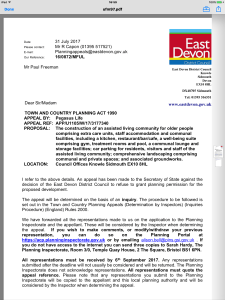
Knowle Pegasus inquiry details

The Inquiry will commence at

10.00am on
Tuesday 28 November 2017
in the Council Chamber, Council Offices,
Knowle, Sidmouth EX10 8HL

The Inquiry is expected to be heard for the duration of five days.

How much do PFI contracts cost DCC?

“A Labour pledge to bring “wasteful” PFI contracts back in the public sector would cost a massive £671m in Devon, it has been revealed.

Shadow chancellor John McDonnell told the annual party conference last month the contracts were set to cost the taxpayer £200bn over coming decades and private companies were making “huge profits”.

The cost to the county for all the buildings, such as schools, hospitals armed forces’ accommodation, funded by private finance initiatives was estimated to be around £2.4bn just four years ago.

Newly released figures by the county council show that Exeter Schools would cost £210m to buy out with £322m for an energy for waste (EFW) plant and £139m for a Devonport EFW scheme. …

… Private companies carry out the construction work and maintenance, in exchange for regular payments from the taxpayer.

It has proved controversial with criticisms that it is overly generous to the private contractors.

Some schools, including in Exeter, have said the quality of parts of their new buildings have been poor.

Other public bodies, such as hospitals, have complained that large debt repayments, over long periods of time, make it difficult for them to balance their books.

However, defenders of PFI said it provided new infrastructure which would otherwise be unaffordable.

The biggest margin on a project in Devon came with a deal for new accommodation for services’ personnel at Devonport Naval Base in Plymouth.

Its estimated cost of £554m, which will also include service and maintenance charges, is more than 12 times the initial building price. …

… Devon County Council said it could not “accurately” estimate the cost of terminating contracts without going into negotiations.

Cabinet member for finance John Clatworthy said the schools PFI contract in 2005/6 was £348m.

He wrote: “Set against this was a grant of £248m that would be received from central government – of the balance, £75m would be met from the delegated schools budget and the remainder (£75m) would be met by the council.”

http://www.devonlive.com/news/devon-news/cost-labour-pledge-cancel-pfi-583063

EDDC’s strategy for dealing with budget deficit: bleed residents dry?

“There is a significant shortfall projected in 2020/21 (£1.412m) which is as a result of an assumed rebasing of business rate income thereby reducing our income by £1.2m. It is proposed in the Finance Plan that work is started now in bridging this gap and driving self- sufficiency of the Council. Members have indicated that the strategic theme within the Transformation Strategy “Maximise the value of our assets through commercial thinking with a focus on income generation, sustainability and developing local economies” is one they believe has significant potential. The Financial Plan considers how this might be progressed with the use of a Member Group (possibly the Budget Working Party) to consider business cases and suggests that a fund is created to unlock barriers to the Council progressing this aim. Detailed recommendations will be presented within the 2018/19 Budget approval process.”

Click to access 041017-cabinet-agenda-combined.pdf

page 60

EDDC has other ways of raising cash … but not votes

Owl says: shame they couldn’t put the same amount of effort into getting voters to register. CEO Williams said it was much too dangerous to go around the dark, rural roads in East Devon seeking them out.

Owl hopes the officers tasked with weeding out these miscreants have had good martial arts training for dealing with those elderly widows, widowers and single mums!

And just as well officer time is never costec when accounting for how such an exercise!

Council Tax paying resis who wrongly claim they live alone and get a council tax discount are being targeted in East Devon. Checks are beginning this month to ensure that the 21,000 East Devon householders who currently claim a 25% discount for living alone are still entitled to it.

Councillor Ian Thomas, portfolio holder for finance, said “anyone genuinely claiming a reduction should not be concerned. However, if you are found to be deliberately misleading the council, you could face a penalty of £70, as well as having to repay the discount,” he added.”

[Source: BBC Devon]

A VERY extraordinary council meeting on Exmouth seafront businesses!

Owl predicts it will indeed be extraordinary – if it happens!

“East Devon District Council says it is to hold an extraordinary meeting to discuss the future of two Exmouth seafront businesses which are set to close imminently.

The council confirmed its chief executive was considering a request for a meeting to discuss the future of Exmouth Fun Park, set to close next week, and the Harbour View Café, set to close at the end of September.

A spokesperson said: “We will announce shortly when that meeting will be held.”

The sites of those businesses are needed for phase three of EDDC’s proposed three-phase seafront redevelopment plans, but there is currently no developer in place for this phase, and it was revealed last week that the site has not yet been remarketed to developers.

EDDC said last week that sites would be boarded up ‘for a time’, but that temporary attractions could be provided.”

http://www.exmouthjournal.co.uk/news/council-set-to-hold-extraordinary-meeting-on-exmouth-seafront-businesses-1-5160421

Alternative vision for Sidmouth’s Port Royal

To see drawings link to the original link at the end of this post.

Sidmouth Town Council and East Devon District Council (EDDC) have released a preliminary idea that shows the lifeboat station, sailing club and other facilities incorporated into a single building that could stand five storeys high.

Graham Cooper’s alternative vision – created in a personal capacity – is to build on what is there, rather than ‘destroy’ Sidmouth’s heritage as a fishing town and block views of the sea.

Mr Cooper, who entered an architecture competition last year to ‘re-imagine’ Port Royal, said: “In everybody’s mind, five storeys is too large. EDDC might say that it’s just an idea, but that’s what it’s put into the public domain as a ‘proposal’. It’s not ‘scaremongering’ to suggest it’s almost like a Trojan horse.

“The consultants are only proposing to include community assets that are already there. It doesn’t add anything, except holiday apartments.

“We want other options. An alternative would be to make incremental changes – to refurbish and repurpose what’s there.

“A lot of people have said there should be a performance area, but we already have the Drill Hall.

“The fishing area is a piece of history. That fishing compound is what eastern town used to be like.

“A big building is a form of cultural cleansing – it’s clearing out the heritage that is there. You shouldn’t destroy things unless you have a better solution.”

Mr Cooper proposed adding a further floor and balcony to the sailing club, with canopies extending over the boat yard and to the east of the Drill Hall linking it to the toilets.

The maximum height would be below that of Trinity Court, the four-storey block adjacent.

Mr Cooper added: “I think the Drill Hall would make a great flexible event space, café and bar, with a gallery in the basement shooting range.

“The top floor added to the sailing club would make a fabulous fish restaurant!”

In response, Sidmouth Town Council and EDDC said in a joint statement: “We are currently consulting on the findings of the independent consultants and we must stress that there are no proposals, no plans and no schemes currently being put forward.

“We are delighted to have so far received 159 responses to the consultation and responses are welcome from the public up to the closing date of Monday, July 31.”

http://www.sidmouthherald.co.uk/news/graham-shares-alternative-vision-for-port-royal-1-5129254

Knowle planning appeal inquiry – objections to Planning Inspector by 6 September

i

“38 degrees” petition started on plans for Sidmouth’s Port Royal

“To: East Devon District Council c/o P Diviani and Sidmouth Town Council

Alternative plan for Sidmouth’s Port Royal – the 3R’s

Include our alternative plan for Port Royal: Retain, Refurbish, Reuse in your regeneration proposal in place of the current ‘multi-use development’.

Why is this important?

In October this year EDDC will decide on future development for the Port Royal area of our seafront. This follows a scoping study done in conjunction with Sidmouth Town Council. The large-scale development put forward in the consultation (and as proposed in the Local Plan) will have a huge impact on the views, use of the area and change its unique character. People in Sidmouth have been asking why the area can’t remain as it is, with subtle improvements and changes. We now call on EDDC to reconsider their plan for a large new building and adopt our proposal to Retain, Refurbish and Reuse. Retain existing buildings, allow careful refurbishment of the whole area and open up discussions on potential uses for the Drill Hall.

How it will be delivered

Delivery in person, to the Leader and Chair of EDDC and the Chair of STC”

https://you.38degrees.org.uk/petitions/alternative-plan-for-sidmouth-s-port-royal-the-3r-s?source=facebook-share-button&time=1500191579

“Transformation plans” – a mortal danger to the public?

Our council talks a lot about its so-called “transformation plans” which are supposed to make it leaner and meaner – doing more with less. Except, of course, for its relocation plans, which get more and more bloated with every passing week (“doing the same with more”?).

It trumpets its plans – nay strategy, here:

Click to access transformation-strategy.pdf

There are objectives in it such as “WorkSmart”, “centred”, “clear”, “simple”, “fast”, “organised” and “rational”. As if our council was currently WorkDumb, off-centre, opaque, complex, slow, disorganised and irrational was the alternative. Hhhmm – let’s not go there!

But one word is missing – SAFE.

In the light of the Grenfell Tower disaster, we have seen that ALL of the above can impact directly on council tax payers to make them less safe – as cost-cutting (the REAL meaning of transformation plans) is the major driver.

The London Borough of Newham is so concerned that it has paused its transformation plans on hold saying:

“… Inevitably…in a programme of this scale there are certain areas which have associated risks to delivery both in timing and quantum. Due to the sheer complexity and scale of what the transformation programme is trying to achieve, there are risks attached with the programme being able to deliver fully against its target. Therefore, an adjustment of c£2m has been made to recognise potential non-delivery of savings/income shortfall for 2018/19.”

http://www.room151.co.uk/151-news/news-roundup-borrowing-to-increase-cash-needs-newhams-transformation-savings-residents-audit-lambeth-cipfas-ethics-update/

So, we (and EDDC) must ask: how far is too far?

And is the council’s relocation being done at great expense, when that money ought to be ploughed back into services that have been cut to the bone and may be much less safe for us all? In its race to be bottom of council tax bills has it also been a race to the bottom for our safety?

This is, of course, a national problem – driven by austerity cuts. But have our councils (DCC and EDDC) and other institutions such as the NHS been too passive or even too welcoming of these cuts and too conveniently blind to see their consequences?