“Judge agrees costs capping in action over NHS accountable care organisations”

“Campaigners including scientist Professor Stephen Hawking have secured a costs order for their judicial review of the government’s planned creation of accountable care organisations (ACO) in the NHS.

In January the claimants gained permission to bring the case against Health and Social Care Secretary Jeremy Hunt and the National Health Service Commissioning Board.

Cheema-Grubb J held that the crowd funded campaign met the statutory test for a costs capping order, being a group of responsible individuals acting in the public interest without a personal interest in the outcome.

The campaigners will challenge the lawfulness of accountable care organisations, which they argue Parliament has not given the Department of Health the power to create.

During the January hearing the court declined to cap costs and the campaigners feared they could face a £450,000 bill were they to lose.

Cheema-Grubb J said it was highly likely that some of the concerns raised in the judicial review had a high degree of public interest and accepted evidence that the case would be dropped in the absence of a cost order.

The claimants could not be criticised for being unreasonable in not proceeding in a case with open-ended potential liabilities, the judge said.

She also noted that Mr Hunt and the NHS were publicly funded through taxpayers’ money in defending the case.

Under the order, if the campaigners lose their liability for Mr Hunt’s and the NHS’s costs would be capped at £80,000 each.

If they won, the two defendants’ liability to pay their costs would be capped at £115,000.”

http://localgovernmentlawyer.co.uk/index.php

“Tory ministers decide not to spend £72 million set aside for affordable homes despite housing crisis The money will now be spent on building houses for sale worth up to £600,000”

“Tory ministers decided not to spend £72 million set aside to build affordable homes because it was “no longer required”, despite the housing crisis gripping Britain.

Communities Secretary Sajid Javid was forced to “surrender” the cash and send it back to the treasury, as part of £817 million his department failed to spend last year.

Some 115 million people are on council waiting lists in England, almost a quarter of whom are in London.

But a government memo, explaining the department’s underspend to the Treasury, states: “Part of the funding allocation for the Affordable Housing programme has not been required in 2017/18.”

The document also notes that the £817 million figure – much of which would have been intended for social or affordable homes – will now be spent on funding the Help to Buy programme.

In 2016-17, just 41,530 affordable homes were built, the second lowest figure for a decade.

The majority of affordable homes are so-called ‘affordable rent’, where the monthly rent is set at up to 80% of private market rent.

The number of cheaper, “social rent” houses built each year has plummeted from 39,560 in 2010-11 – the year the new “affordable rent” definition was introduced – to just 5,380 last year.

Labour’s Shadow Housing Secretary, John Healey said: “Feeble ministers are selling families short by surrendering much-needed cash for new homes.

“If the Secretary of State can’t defend his Department’s Budget from the Treasury he should give the job to someone who can.”

A DCLG spokesperson said: “We are delivering the homes our country needs and since 2010 we have built over 357,000 new affordable properties.

“But we are determined to do more and we are investing a further £9bn, including £2bn to help councils and housing associations build social rent homes where they are most needed.”

https://www.mirror.co.uk/news/politics/tory-ministers-decide-not-spend-12098770

Two unitary councils for Dorset: whither Devon?

With permission now granted for Dorset to move from nine regional authorities to two unitaries, politicians across Dorset are hailing it as the way forward to cope with continued austerity and income losses.

Which begs the question: if unitisation is so good, why are we stuck with a myriad of district and city councils in Devon?

Is Dorset right or wrong? Should we be following their lead? Are we following their lead in secret?

Or is our Local Enterprise Partnership Joint Committee our de-facto unelected, unaccountable, unscrutinised unitary authority already – with heavily-weighted Somerset taking the majority of its funds?

http://www.midweekherald.co.uk/news/go-ahead-for-two-unitary-councils-for-dorset-1-5410515

“South West ‘could suffer more than other regions’ after Brexit”

Good luck with that doubling of productivity, Local Enterprise Partnership! (see post below)

“The South West could be hit harder than other parts of England when the UK leaves the EU, according to panel members at a one-off Brexit discussion convened by CIPFA in Bristol.

High numbers of EU workers could be lost from industries in the region, which must get better at ‘fighting its own corner’, attendees at the event on Friday last week heard.

Kate Kennally, chief executive of Cornwall Council, pointed out the South West had a growing number of tech start-ups but it was not good at promoting its own industries.

“We have a big part of the UK that doesn’t have a big voice,” she said.

She added Cornwall voted leave because of “a sense of profound insecurities about public services” and that “this could be a moment where there needs to be a good deal of bravery”.

Kennally also pointed out: “Exeter, Bristol, Plymouth are the cities most reliant on exporting to the EU.”

Nigel Costley, regional secretary of the trade union federation the TUC, said: “I don’t think we are well equipped to respond to [Brexit].

“I fear we are going to be the losers in the South West. I do not see us fighting our corner very well. …”

http://www.publicfinance.co.uk/news/2018/02/south-west-could-suffer-more-other-regions-after-brexit

Our LEP expects our productivity to double – something never done anywhere else in the UK!

“… The Productivity Strategy aims to double productivity in the area over 20 years, focussing on themes including leadership, housing, connectivity, infrastructure, skills and training. It looks at growth, capitalising on the area’s distinctive assets and maximising the potential of digital technology.

Cllr Fothergill said: “We can do some of this ourselves but some aspects will need the support from Government which is why the Joint Committee is so important. …”

https://www.devonlive.com/news/devon-news/south-west-aims-double-productivity-1265805

Right! So, that’s ok then – the government will achieve something here they can’t achieve anywhere else!!!

Last legs for Thelma Hulbert gallery?

Owl says: The gallery, in Honiton, has swallowed up around £500,000 of our council tax money over the last few years. Could The Beehive (also a gobbler of funds in the past) perhaps house the gallery’s art and activities?

Or, here’s a thought: display it in the new £10 million HQ currently under construction in Honiton!

“Unprecedented increases in council tax starting in April will not offset cuts to services including children’s centres and libraries, local authorities have warned.

The Local Government Association (LGA) said councils in England would raise an estimated £1.1bn through higher council taxes in 2017-18, but this would not cover the £1.4bn lost through cuts to central government funding plus the higher wage bill of £1bn.

Nearly half of English councils with responsibility for providing social care for adults and children will increase council tax by the maximum 5.99% allowed – 2.99% for general council tax plus a further levy of up to 3% to pay for the care of older and disabled adults – but this will not prevent further cuts to services, according to the LGA.

Councils will continue to reduce or close services such as children’s centres, libraries, leisure centres, parks, museums and road repairs to plug growing gaps in adult and children’s social care and homelessness services, it says.

The widespread emergence of what some councillors have dubbed “pay more, get less” budget settlements comes as town halls struggle to balance the books after years of cuts in core government funding.

Northamptonshire county council effectively declared itself bankrupt earlier this month after admitting that rising costs and shrinking income made it unable to set a legal budget.

The council must set out revised plans for cuts at a meeting this week after an auditors report warned that its existing proposed budget plans were “not credibly achievable”.

Northamptonshire’s predicament highlights how councils are increasingly reliant on one-off measures such as dipping into reserves, or selling buildings and land, to meet the spiralling cost of social care. Those pressures are being compounded in some cases by the failure to deliver savings with existing cuts.

The LGA said 147 of the 152 English authorities that provide social care services would levy a 3% council tax precept from April to raise extra cash for the care of older and disabled adults. Although this will raise an extra £548m, it will be wiped out by the cost of meeting the national minimum wage.

These councils face additional costs estimated to be at least £400m over the next 12 months as result of a legal judgement that requires care employers to pay the minimum wage to carers working sleep-in shifts, backdated for six years.

Out of the 152 “social care” authorities, 108 also plan to increase general council tax by between 2.95% and the maximum 2.99% allowed. This will raise an estimated £548m. Five councils have said they will freeze council tax for 2018-19. …

… A spokesman for the Department of Housing, Communities and Local Government said: “As part of our finance settlement, we are delivering a real-terms increase in resources to councils over the next two years, more freedom and fairness, and greater certainty to plan and secure value for money.

“We want to work with local government to develop a new funding system for the future and encourage councils to submit responses to the review currently under way.”

England’s councils have experienced a 40% cut in central government funding since the start of the decade and face a £5bn funding gap by 2020.

The Local Government Information Unit thinktank warned this month that many English local authorities were teetering on the edge of financial crisis.”

https://www.theguardian.com/society/2018/feb/26/council-tax-hikes-will-not-stop-cuts-to-local-services-authorities-warn

“Labour says land value tax would boost local government budgets”

“Labour is considering a tax on land values as a way of boosting local government budgets, shadow chancellor John McDonnell has said.

In a sign of the party’s confidence about growing public interest in a fresh approach to managing the economy, McDonnell said cuts to council spending were so severe that it might now be possible “to have a rational debate”.

At the last election the Tories called the proposal, which was included in Labour’s manifesto as part of a review of council funding, a “garden tax” that could force home owners to sell up. The Greens and the Liberal Democrats are also interested in the idea.

A land tax, where a percentage of the value of the land is levied annually is popular with some economists, who say it is a logical approach to taxing individual wealth. But many politicians across the political spectrum are alarmed at the thought of introducing a new tax. A new tax on wealth that creates losers as well as winners would inevitably be a hard sell.

But McDonnell told the audience at the event organised by the Resolution Foundation, where he set out Labour’s plans to boost household incomes, that the crisis in the funding of local services may have opened a window of opportunity.

“I think we are at a stage where the decline in terms of funding to local government and the consequential effect on local services – many of them are in crisis – means, I think, that people are now willing to consider more radical solutions than they have in the past.”

Councils are hamstrung by government rules and cannot raise council tax significantly without a local referendum, which would be costly to run and would have an uncertain result. But the tax – introduced nearly 30 years ago to replace the unpopular poll tax – has not been uprated since then. It leaves many councils struggling, with too small a tax base to meet all their obligations.

Other councils are on the brink of catastrophe. Northamptonshire county council announced earlier this month that it could only afford to meet its statutory obligations. On Thursday the accountants KPMG, who audit the council’s budget, said it did not balance and was therefore illegal.

The local government association has said that by 2020 many councils would struggle to provide some public services, partly because of botched central government reforms. By 2020, central government funding will have been cut by more than 50% since 2010.

Council tax is regressive because it is levied on a notional value that has no relation to household income or to the market value of the property. However, unless it is regularly updated, a land value tax would share some of those weaknesses. But it would be directly related to the wealth of the homeowner and it would capture the rapid growth in house values that have been a financial boost to those who own property.

One council, Westminster, one of the richest in the country, is now proposing that wealthy residents pay a voluntary additional contribution, ringfenced to help offer improved services to rough sleepers and young people.

There is increasing support in policymaking circles for a land-value tax. Tony Blair’s thinktank, the Tony Blair Institute for Global Change, backed the idea in a policy paper published at the end of last year. ”

https://www.theguardian.com/politics/2018/feb/22/labour-says-land-value-tax-would-boost-local-government-budgets

“The greatest evil …”

“I like bats much better than bureaucrats. I live in the Managerial Age, in a world of ‘Admin.’ The greatest evil is not now done in those sordid ‘dens of crime’ that Dickens loved to paint.

It is not done even in concentration camps and labour camps. In those we see its final result.

But it is conceived and ordered (moved, seconded, carried, and minuted) in clean, carpeted, warmed, and well-lighted offices, by quiet men with white collars and cut fingernails and smooth-shaven cheeks who do not need to raise their voice.

Hence, naturally enough, my symbol for Hell is something like the bureaucracy of a police state or the offices of a thoroughly nasty business con­cern.”

–C.S. Lewis, “Preface to the 1961 Edition,” in The Screwtape Letters: Annotated Edition (New York: HarperCollins, 1942/1996), xxxvii.

DCC vote more cuts to keep reserves

Claire Wright and other independent councillors tried to persuade DCC to fund services rather than add to reserves – Tories voted to keep reserves.

From Claire Wright’s blig:

“… Over £155m worth of cuts have now been made to Devon County Council by central government, since austerity began in 2010. That’s around 80 per cent of the council’s core funding… gone…. …

It emerged in the past week that an extra £5m will be squirrelled away in Devon’s reserves, in case of financial difficulty.
But vital services are being relentlessly cut – for the EIGHTH year running – council tax is rocketing and the county’s people are suffering.

With council tax rising by 20 per cent in just seven years. That’s £250 for an average band D property, while wages stagnate – Devon’s residents (and people all over the country) are being ripped off by a Conservative government that claims to be a government of low taxation.

– 30 health visitor posts are to be cut which will hit families that most need support, especially those with babies and young children. The Independent Group is proposing that part of the £5m is used to prevent those losses

– Foster carers who look after the most damaged and challenging children could lose around £100 a week to foster carers who look after less damaged less challenging children.

This income cut is in addition to earlier cuts in allowances over recent years. The result of these cuts could see experienced dedicated foster carers struggle to make ends meet and be forced to leave. It is causing much anxiety … and ultimately it will be the children who suffer. The Independent Group is proposing that part of the £5m is used to shore up the income of foster carers

– The schools counselling service is set to be lost at a time when anxiety and depression among young people is soaring and when many are now being forced to PAY for their own counselling sessions. The Independent Group is proposing that part of the £5m is used to ensure this essential service continues

– People in Devon’s towns and villages are falling over dangerous paving stones every day. The Independent Group is proposing that part of the £5m is spent on making far more pavements safer, especially for elderly people who are most likely to hurt themselves and end up in hospital

And what of Devon’s MPs, especially the Conservative MPs, who ALWAYS toe the party line on cuts to our council budgets, despite requests each year from the leader of this council to stand up for the people of Devon?

Well this year, guess what? It’s no different. All Conservative MPs who were present in the chamber last week voted in favour of yet more suffering. …”

http://www.claire-wright.org/index.php/post/20m_of_devon_service_cuts_voted_through_as_council_tax_rises_by_around_five

“Poverty is now so visible that even the richest can see it”

Owl wonders how many will cough up for a guilt tax – most of these people didn’t get rich by helping the poor!

“Officially, it’s not a guilt tax. Westminster council prefers the term “community contribution” to describe the idea that its millionaire residents might like to make a voluntary donation on top of council tax. It is, they say, merely a chance for the wealthiest to “invest in their neighbourhood”. Perish the thought that they may have anything to feel guilty about.

But whatever you call it, attempting to appeal to the social consciences of the super-rich is surely a sign of changing times. That a flagship Tory council should be dabbling in new forms of redistribution is interesting in itself. That it began considering the idea a few months after the Grenfell Tower fire, which had some of Kensington’s more liberal-minded millionaires asking why their council hadn’t charged them more and housed their neighbours decently, is more interesting still, given that Westminster’s guilt money is earmarked partly for tackling homelessness….

The significance of the guilt tax is that, according to the council leader, Nickie Aiken, the idea came from wealthy residents themselves, who began asking last year if they could pay more. Most tellingly of all, she says it is most popular among those living in “the most expensive homes”, reversing the normal finding that tax rises are wildly popular only with people who won’t actually be paying them. This is starting to feel less like a conventional tax, and more like the biblical concept of guilt offerings: pay up, cleanse yourself of the perceived sin of unwittingly perpetuating gross wealth inequality, and perhaps you might avoid a plague of locusts.

… Relying on charitable donations, which could dry up overnight, to fund essential public services feels precarious and wrong. But the pragmatic attraction of a guilt tax is that, like the decision by the Manchester mayor, Andy Burnham, to donate part of his salary to a homelessness fund, it is quick and achievable, and it beats wringing hands.”

https://www.theguardian.com/commentisfree/2018/feb/17/poverty-visible-richest-grenfell-homelessness

Buzzfeed says Tory Housing Minister in private Facebook group that wants to sell off all council housing, privatise all health care and bring back workhouses for debtors

“The Conservatives’ new housing minister, Dominic Raab, belonged to a private Facebook group that argues for council housing to be sold off at market value, healthcare to be privatised, and the return of workhouses for the poor.

Raab was, until Thursday morning, one of 14 members of a closed group called the “British Ultra Liberal Youth — The Ultras”, which was set up about seven years ago. He withdrew from the group after being approached for comment.

Raab told BuzzFeed News: “I wasn’t aware of this group, let alone that I had inadvertently and mistakenly been linked on Facebook. I have corrected it, and needless to say I do not support its aims.”

Because the group is closed, BuzzFeed News is unable to see activity within the group — just the description and membership. There had been no new posts or new members in the last 30 days.

According to the group’s “About” page, it believes that “Britain is a nation that has been shooting at it’s [sic] own feet for too long” and that “too much tolerance of socialism has cost us a trillion pounds”.

“If this were a football field,” the description continues, “we would be racing down the right wing so close to the touchline, we would be doing so very carefully making sure we don’t put our feet outside the field of play.”

It is the duty of members, it adds, to pressure mainstream Conservatives into realising that selling off council housing, ending free healthcare, and bringing back workhouses for debtors are policies that “have found their time to enter Britain”.

At the time of publishing, the 13 other members appeared to include another current Tory MP, Henry Smith; a former Tory MP; and others who have stood unsuccessfully for parliament for the Conservatives or UKIP.

Smith was unavailable to comment because he is travelling, but an aide said he wouldn’t have voluntarily joined the group, and that he hasn’t used that Facebook account for more than a year. “Certainly someone may have added him to the group and he clearly didn’t notice but he definitely does not join any such groups himself,” the staffer said.

According to Facebook, you can be added to a closed group if you’re friends with someone in that group, and you’ll receive a notification that you’ve been added.

Raab joined Facebook in 2010 and uses his account to publicise his work as an MP and minister. In one recent post, he promoted an opinion piece he wrote for the Daily Telegraph about the government’s £866 million investment in local housing projects. Housing is “one of the great social challenges of our generation”, Raab wrote.

Raab, 43, was appointed housing minister in Theresa May’s new year reshuffle, putting him in charge of one of the Conservatives’ top policy priorities. Addressing the housing crisis has been one of the party’s main concerns after it polled significantly worse than Jeremy Corbyn’s Labour among voters under 40 at the last election, and the prime minister has said she will make it her personal mission to get more people into homeownership.

Raab was a City lawyer and Foreign Office official before becoming a parliamentary aide to David Davis. He was elected MP for Esher and Walton in 2010 and was a minister in the Justice Department before moving to housing last month.

Having been tipped as one of the rising stars on the Tory right, Raab was seen as unlucky not to be given a cabinet position during the reshuffle last month.

He was criticised during last year’s general election campaign for saying on the BBC’s Victoria Derbyshire show that food bank users typically aren’t poor but have a “cashflow problem episodically”.

https://www.buzzfeed.com/alexspence/the-tory-housing-minister-was-in-a-private-facebook-group

Police numbers plummet as crime rises

“The number of police officers in England and Wales has fallen by 1,213 in six months and is now 16% below its 2009 peak, official figures have shown. The latest Home Office statistics put the number of officers in the 43 police forces in England and Wales on 30 September last year at 121,929, down from 123,142 on 31 March last year and from 144,353 in 2009.

In evidence submitted to the police remuneration review body last week, the Home Office made clear that no more central funding would be available for the pay settlement, describing the recruitment and retention of officers as “stable”. But Labour said that was out of touch with reality, given the figures.

The shadow policing minister, Louise Haigh, said: “Once again we see how out of touch the Conservatives are with the lives of people across this country. Over 1,200 officers lost in just six months, more than 21,000 in total under this Tory government, against a backdrop of the highest rises in recorded crime in a decade.

“And yet ministers apparently think everything’s fine. Labour in government will add 10,000 police officers and provide the resources they need.” …

https://www.theguardian.com/uk-news/2018/feb/13/police-numbers-drop-by-1200-in-six-months-as-wage-bill-frozen

“Government spent £108m in failed attempts to stop people’s disability benefits” (to which they were entitled)

And how are they going to fix this? By employing 190 more officers!!!

“The Government has spent £108million in two years trying to prevent disabled people claiming benefits they are entitled to, it has emerged.

Freedom of Information requests have revealed how much taxpayers’ cash has been spent on unsuccessful legal battles to prevent vulnerable people receiving help.

The Department for Work and Pensions spent £108.1million on appeals against disability benefits in just two years, new figures reveal, reports The Mirror.

Neil Heslop, chief executive of disability charity Leonard Cheshire, said: “To spend this amount on admin fighting to uphold flawed decisions that shouldn’t have been made in the first place is staggering. “Thousands of disabled individuals have had to fight to receive support to which they are legally entitled.” …

The monthly cost has been steadily rising and in December the DWP spent £5.3million on mandatory reconsiderations and appeals for PIP and ESA.

The equivalent figure for October 2015 was £2million.

Since October 2015, 87,500 PIP claimants had their decision changed at mandatory reconsideration, while 91,587 claimants won their appeals at tribunal.

In the first six months of 2017/18 some 66% of 42,741 PIP appeals went in the claimant’s favour. …

A DWP spokeswoman said it was working to improve the process, including recruiting around 190 officers who will attend PIP and ESA appeals to provide feedback on decisions.

“Financial Peer Review Northamptonshire County Council”

Northamptonshire County Council is effectively bankrupt. This is a peer review report if their financial situation last year. Some worrying similarities!

Some lessons for officers and councillors.

For example:

“4.3.8 There is a lack of sufficient challenge among officers and from members. There is a considerable amount of trust in plans that are presented without evidence that those plans have been challenged. Some Portfolio holders readily accept the information they are given without systematic and robust challenge. There is a tendency for cabinet members to trust that the relevant individual portfolio holder has challenged proposals.

4.3.9 Decisions taken by the Cabinet need greater transparency. Council members and scrutiny chairs need access to more information. There was a desire expressed from some cabinet members for greater discussion and challenge across portfolios. However, where challenge has been provided, for example from the Audit Committee, that has not been welcomed.”

Northamptonshire CC – FINAL Feedback Report

How does a council become effectively bankrupt?

“… Earlier this month, Northamptonshire went effectively bankrupt, becoming the first local authority in two decades to issue a section 114 notice. This signalled that its finances were so precarious it would be unlikely to balance the books this year and was at risk of being unable to set a legal budget for 2018-19.

As a result, One Angel Square [its new HQ] is likely to be put up for sale, three months after it was formally opened by the communities secretary, Sajid Javid. A fire sale of assets is the only way to keep the council afloat, say officials, though even this temporary fix may not be enough to save it.

… The council’s predicament has triggered bitter recrimination among local Tories. Northamptonshire’s seven MPs, all Conservatives, accused the council of mismanagement. Heather Smith, the council leader, said the government had starved it of funds. Eighteen backbench Conservative councillors called on Smith to resign.

The irony is not lost on some observers that the first local authority to go bust under austerity is not the profligate Labour municipality of media caricature, but a Tory-run council in the heart of middle England.

Penny Smith, the council’s Unison branch secretary, said: “Can you just imagine if this was a Labour authority? They’d be saying ‘Typical Labour, can’t run anything’.”

Furthermore, it has crashed after rigid adherence to the Tory ideological rulebook for local government. Northamptonshire embarked on a “next generation” reform plan in 2014. Services would be outsourced or turned into profit-making companies. The council would drastically shrink in size and be run like a business. “The old model of local government no longer works,” it declared.

The grand plan failed at a cost, say critics, of more than £50m on consultants and rebranding. Expected efficiency savings did not materialise, some privatised services have since been hauled back in-house, and the scheme’s political architects, including the then council leader Jim Harker and the then chief executive Paul Blantern, have departed. After years of freezing council tax bills on principle, the authority has raised them by 6% from April.

… Northamptonshire’s future remains precarious. A government inspection into alleged financial and governance failures will report back in March. Staff morale is at rock bottom, said Smith. There is speculation that the county could be abolished and merged along with its five constituent district councils into two new unitary authorities.

There are fears that a handful of councils could follow Northamptonshire into bankruptcy. Conservative-run Surrey county council has a deficit of more than £100m. A survey by the Local Government Information Unit thinktank found eight out of 10 councils were concerned about their finances.

McLaughlin has warned Northamptonshire’s councillors that they should not assume the government will ride to the rescue. Ministers have promised a review of council funding, but this “is more likely to be concerned with the distribution of an ever-shrinking quantum of support than a major injection of spending power”.

https://www.theguardian.com/uk-news/2018/feb/11/northamptonshire-county-council-effective-bankruptcy-tories-cuts

Unitary authorities – the austerity measure that can’t be stopped?

Wonder what that new £10m EDDC HQ will be used for?

“Simon Heffer writes in the Sunday Telegraph to call on the Government to simplify and streamline the UK’s councils, replacing the system of county and district councils with county-level unitary authorities.

The need for “wholesale reform”, he says, has been made urgent by the problem of “social care that will break local government” and former chancellor George Osborne’s “disastrously flawed business rate system, which has had a profound effect on revenue-raising”.

He says that a system of unitary authorities would reduce payroll, offer the chance to sell off assets, and improve the handling of planning decisions, while the Government should remove “huge strategic questions such as social care from council control altogether”.

The Sunday Telegraph, Page: 21

“NHS chiefs pocket £166 MILLION in bonuses – while nurses suffer 1% pay cut”

“Nurses, midwives and other carers battered by David Cameron’s assault on NHS wages are night furious at revelations their bosses’ pay packets have risen by 36%.

Senior managers pocketed £166million in bonuses and other extras last year – as the Tory-led Coalition slashes £20billion in costs from the beleaguered service.

That is up 36% from £122million the year before.

The rise, on top of their annual salaries, could have paid for an extra 4,000 nurses, who have suffered a 1% cut. …”

https://www.mirror.co.uk/news/uk-news/nhs-bonuses-chiefs-pocket-116-3553527

Privatised profit, public loss – a masterclass

Virgin – running vast parts of our NHS; Stagecoach – a virtual monopoly on bus services in East Devon and Greater Exeter.

“For the third time in a decade, an East coast rail franchise operator has shown little of the financial prudence once associated with the great cities linked by its trains from London to Yorkshire and Scotland. Following the failures of GNER in 2007 and National Express in 2009, Virgin Trains East Coast has run out of steam, with the government declaring a financial covenant breached and the contract set to fail in months.

The latest incumbent has, like its predecessors, bid too much to run a lucrative line whose potential revenues have fallen short, at a time when economic uncertainty has gnawed away at ticket sales.

But exactly why Stagecoach, the 90% lead partner to Virgin’s 10% stake in the current franchise, promised £3.3bn to run the line, and how that contract is now resolved, remain key questions – amplified by East Coast’s unique place in the blazing political row over how the UK rail network is run.

In 2013, when bidding started, East Coast was nationalised, run by Directly Operated Railways (DOR), a government-owned firm returning around £200m a year in premium payments to the Treasury.

The previous year, the parallel line north, the West Coast intercity service from London to Glasgow run by Virgin with Stagecoach since privatisation, had been the subject of a bidding competition gone bad. The award of the franchise to First Group was overturned on legal challenge after Virgin argued that its rivals had won with a colossal but unsustainable bid.

Pointing at the lessons of the past, failed East Coast franchises, the Virgin founder Sir Richard Branson railed: “Insanity is doing the same thing over and over again and expecting different results. When will the Department for Transport learn?”

Not soon enough. A government-commissioned inquest concluded that franchising remained the best model. A queue of rail contracts were almost up, not least the Virgin-run West Coast. But the reletting of East Coast to the private sector was prioritised ahead of a 2015 election that was expected to see a hung parliament, potentially keeping the line in public hands.

The dust had hardly settled when the DfT invited bids with a vision that would lead to Branson and Stagecoach promising undeliverable riches of their own.

Investment was coming to the East Coast line, including track and power upgrades, critically bringing a new fleet of InterCity Express IEP trains, with more than half of a £5.7bn government order earmarked for the line. What was promised, pledged or inferred – and how relevant it is to the collapse of VTEC’s contract – is contested.

Stagecoach claim upgrades were promised and not delivered that materially impacted its franchise; a review by Peter Hendy axed or deferred engineering works around the country after the infrastructure body Network Rail blew its budget on the electrification of the Great Western mainline.

However, Network Rail is clear it has already done the work necessary to bring in new trains and a timetable that would have turbocharged passenger numbers – and Stagecoach’s premium payments – after 2019. Chris Grayling, the transport secretary, has also said that no cancelled upgrades have affected the franchise to date.

What was wrong, it appears, was Branson’s conviction that a new livery and “people hungrily trying to make a real difference” could propel passenger numbers upwards from when Virgin took over. Instead, fares went up and the outlook went down.

They got their forecasts wrong, Stagecoach’s chief executive, Martin Griffiths, admitted this week. But, he added, the DfT “decided we offered a high quality and realistic bid … indeed, I was personally told at the time that it was the highest quality bid they had ever seen”.

In March 2016, a year after taking over, Branson and Stagecoach’s chair, Brian Souter, rode into King’s Cross on one of the first government-bought IEP trains, now in Virgin livery and rechristened Azumas by the private operators, a name with echoes of the Japanese rising sun. “Like a new day dawning on the railway,” said Souter.

But City analysts were flagging concerns. And by the time Grayling came to the Commons in November 2017 to announce a “rail strategy” that slipped in news that VTEC’s contract would be replaced in 2020 by an East Coast Partnership, investors had already factored in heavy losses.

Stagecoach’s share price bounced back on Grayling’s plan, widely described as a £2bn bailout – the value of the remaining payments to the government due from VTEC’s owners had the contract continued from 2020 until 2023. Condemnation was largely led by Lord Adonis, the former Labour transport secretary who nationalised the line when National Express failed to meet payments in 2009.

It is not clear why Grayling then waited until this week to announce the franchise’s imminent collapse – stoking fury by simultaneously confirming a direct award to extend Virgin’s West Coast deal, a contract now held, without competition, from 2012 to 2020.

Officially, Stagecoach had “breached a financial covenant”, although the company has not acknowledged this, and the financials have not altered significantly. The mooted East Coast Partnership was met with some bemusement – one well-placed rail industry figure said there was “no chance of it being up and running, and absolutely the last place you’d do something like that”. A Stagecoach statement spoke of “a hardening of the DfT’s negotiating position, coinciding with increased media and political scrutiny”.

Adonis himself sees it differently – that once the ink was dry on the West Coast extension, the rules had changed and Grayling had lost his bargaining chips. He said: “I’ve sat around a table from Brian Souter. He knows when he’s got his man. Stagecoach are playing Grayling.”

DfT officials are now assessing the relative cost of returning the East Coast franchise to public sector control or allowing VTEC to continue on a “not-for-profit” basis – which would nonetheless relieve them of paying hundreds of millions due to be paid to the government in the original deal. Other train companies will be watching intently as they too grapple with franchises whose ambitious promised payments to the government rely on passenger growth that has not materialised, or even gone into reverse.

Had Stagecoach continued to deliver its payments, which in the second and third year were roughly 30% higher than East Coast under its previous operator DOR, and improved the service, it would have been compelling vindication for those who urged its restoration to the private sector. Instead, Virgin joins the ranks of those who bet high on East Coast and saw it all go south.

https://www.theguardian.com/uk-news/2018/feb/10/east-coast-line-bailout-rail-privatisation-spotlight

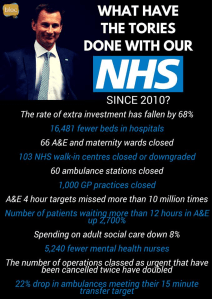
Our NHS but not “OUR” NHS

Another post from the Save Our Hospital Services Facebook page, which has nearly 11,000 (yes, ELEVEN THOUSAND) members

“The STPs have driven a huge wedge between hospitals and areas within the “footprints” people have been horrified to find that their services have been down-graded and moved to other hospitals some distance away.

In Devon there were threats made to move maternity and acute services from North Devon to Exeter some 55 miles away and even further away from some of the outlying villages.

The various committees and groups set up to implement the STPs have wasted vast sums of money on wages, premises, expenses and admin staff. There have been endless ridiculous consultations with all sorts of groups where the public’s views were dismissed—the public have watched on while these people have wasted money.

The STPs have been successful in taking huge sums of money from the system and putting it in the hands of people who should actually have been working in hospital. Management consultants and makers of pretty information books have had a great time too.

Meanwhile back in the hospitals beds have been closed to save money and then we find that there are not enough beds. The boards of hospitals ( NDDH – North Devon District Hospital) have been taking pay rises in some cases already earning a quarter of a million pounds per year- this individual has now had a vote of no confidence made against him by the consultants – yet still he cashes in.

The CCGs across the country have been following orders and cutting community hospitals and beds relentlessly rather that protesting and thinking about patient safety in their areas. They have all done great jobs at implementing STPs – well done but you should have been advocating for your patients.!!!!!

The public are furious across the country about this government’s shameful treatment of the NHS and its front line staff. They see the staff run off their feet, suffering stress and leaving. The hospitals which are under threat of closing or losing services have staffs that have no confidence in the system and no job security. How has this come about? The STPs have demoralised everyone, put hospitals against hospitals, made the public feel that because they live in certain areas that their lives are not as important as the lives of people in neighbouring areas.

The STPs are now morphing into ACOs and ACSs and goodness knows how many quangos and private companies (yet again) will be raking in their pounds of flesh before patients are considered. The whole nation is up in arms about the effects of cost cutting.

Deficits in hospitals do not represent overspending- they represent the needs of the people in that area.

No area is the same – we do not all fit into a formula – some populations have more elderly people, some have more babies, some have more people drinking and smoking, some are more polluted, some are deprived, some are wealthy. The STPs do not address these considerations.

ACOs are very suspicious- a move to the American (rubbish for the people) insurance based system. They break up the system even more and are not accountable to anyone. Private companies such as Virgin bully and sue if they do not get their own way over contracts already. What will happen when even more is thrown open to the sharks waiting to take a profit out of people’s ill health?

The demise of Carillion should send a warning shot across the bows of anyone who feels that public services are safe in the hands of profiteers.
People are angry- STPs started this – put a stop to it now and reinstate the NHS.”

Our local health services: our last line of defence

From the Save Our Hospital Services Facebook site:

:… these guys are our last line of defence. They need to work harder at not being manipulated.

Health and Adult Care Scrutiny Committee, County Hall, 25 January 2018

“I take my Scrutiny duty very seriously,” declared Cllr Brian Greenslade (Barnstaple North) at the Devon County Council Health and Adult Care Scrutiny Committee meeting at County Hall on 25 January. Save our Hospital Services (SOHS) members from North Devon who attended this and many other such meetings know this to be only too true.

Indeed, were it not for Cllr Greenslade and his meticulous colleague, Cllr Claire Wright (Otter Valley) it is doubtful how much scrutiny by the Scrutiny Committee there would be at all. One thing is certain: given the scale, speed and scope of the changes now being pushed through in health and social care services in Devon, real information, real questions and real answers have never been so vital. It is literally a matter of life and death.

At a previous Scrutiny meeting, the Chair, Cllr Sara Randall Johnson, in clear cahoots with Cllr Rufus Gilbert, manipulated proceedings. The two managed to prevent Cllr Wright putting a motion she had already tabled, thus shutting down a debate that may have saved in-patient services at some community hospitals.

This so outraged some councillors and members of the public that their chorus of complaints and the consequent internal investigation prompted the county’s lawyers to lecture councillors as to their legal obligations to scrutinise. The investigation and warning came too late for the community hospitals, but could better behaviour be expected from now on?

Indeed, it could. But then, on 25 January, the Chair of the Standards Committee was sitting in. This time Cllr Wright was allowed to say quite a lot, pose many more questions, and state much more of the obvious in defence of our health and social care services.

However, far too many of our County Councillors still appear unwilling to spend time and effort educating themselves as to the issues, facts and figures, whilst being only too willing to swallow propaganda and projections put out by overpaid health bosses bent on making severe cuts to our NHS services.

No one, even councillors who have barely raised a whisper in opposition, is in any doubt as to the real motive for all these health service changes: cuts and cutbacks designed to save £557 million over the next five years. The aim is to ration, restrict and remove elements of care and treatment for however many people it takes to save that amount of money. Cost comes first, clinical need a poor second.

Dr Sonja Manton was again allowed to speak at great length. She is NHS Devon’s lead cost-cutter, qualified by means of a doctorate in Systems Dynamics, not qualified in Medicine or any form of clinical care. Which sort of gives the game away –as does her most obvious skill, talking for a very long time without saying anything at all.

When questioned by Councillor Wright, she appeared, as ever, not to have the required data or evidence to hand. Cue the now customary promise to look it up and pass it on. The pattern that follows has been obvious for more than 15 months now. The Scrutiny Committee ends up waiting a long time for what they have asked for – if they get it at all — making real scrutiny in public for the public impossible. The lack of real information, the failure to meet requests, the failure to resolve contradictions in presentations cause real difficulties for our County Councillors meeting after meeting – not least again on 25 January.

It has been reported that Devon’s Clinical Commissioning Groups are bent on steamrollering ‘Accountable Care Organisations’ into position from 1 April. To prove that the joke is on us for what is, after all, April Fool’s Day, they have given the Scrutiny Committee no information about them at all. This is particularly scandalous and frightening. As Brian Greenslade stated: “I want to know where we are…..we need to understand where we’ve got to and what this may mean.”

One faint beacon of light is the announcement, on the same day as the Scrutiny meeting was held, that NHS England will hold 12 week consultations on the implementation of ACOs https://www.england.nhs.uk/…/consultation-aco-contracts/ which puts a very slight delay in place. But the website does not elaborate on how much time after closure of consultation implementation could happen. The Consultation could well be the outcome of an exchange between Sarah Wollaston, Chair of the Health Select Committee, and Jeremy Hunt, Secretary of State for Health and Social Care, as well as an attempt to water down the possible impact of a Judicial Review, which is being filed by a group of Health Care professionals, to challenge the government’s attempt to circumvent Parliament and democratic scrutiny and allow ACOs to operate

ACOs are financially constrained, business-based American-style systems of healthcare purchasing and provision, which will pave the way for further privatisation and still more rationing and restriction of provision. Councillor Martin Shaw from Seaton had done a lot of research on ACOs and put his findings online. But, incredibly, he had to force the whole issue onto the Committee’s Agenda just to secure the very limited discussion that took place.

Until this announcement it was the case that ACOs (unless the Judicial Review has effect) were to be imposed without any debate, discussion or statute. So an ACO could be and, in many cases, will be, a private business, primarily accountable to shareholders and managers rather than patients and the public. And even now we don’t know how ‘public’ the consultation will be. As Jan Goffey, Mayor of Okehampton, declared, “Sick people should never be regarded as a profit-making opportunity.”

Eventually even the Chair, Sara Randall Johnson said, “We need more information.” We have heard her, and others, say this before. Is this a way of avoiding doing anything? Or is it something more cynical: a way of helping to destroy our NHS, but giving themselves the excuse that they just did not know?

If so, it will only be because they failed to find out – or scrutinise.”