Swire and Parish vote (of course) not to lift pay cap on fire and police

http://www.independent.co.uk/news/uk/politics/public-sector-pay-cap-all-mps-vote-against-list-austerity-freeze-labour-jeremy-corbyn-conservatives-a7813706.html

No surprises there then.

But this is going to be interesting – for every such vote in future every Tory and DUP MP is going to have to physically be at the Houses of Parliament.

No “fact-finding” missions to the Maldives, no jaunts to Dubai, no popping over to the French château … Owl sees trouble ahead.

Grenfell Tower let down by local newspapers – leaving only tenants’ blog to report the problems

“Decline of advertising revenue and changing perceptions of ‘quality journalism’ have left no room for much needed local reporting

A day after the Grenfell Tower fire in West London, a Sky News camera crew is talking to writer, film-maker and local resident Ishmahil Blagrove as he delivers a polished exposition on the failings of the media as playing a part in the disaster.

“This is not just a story – this situation has been brewing for years … You the media, you are the mouthpiece of this government and you make it possible.” Later Blagrove describes the mainstream media as “a bunch of motherfuckers” to a small crowd surrounding him who break into polite applause. Channel 4’s Jon Snow faced an angry group outside Grenfell the same day, asking him where the press was when the fire safety concerns were first raised.

Among the many elements of failure which lead to the unacceptable and avoidable, the failure of accountability reporting on local communities is obvious to anyone who cares to scour the archives. The Grenfell Action Group blog carefully documented their repeated complaints to the council. Other reporting is scarce, and where it exists, hard to find.

Grenfell Action Group blogposts form the most reliable archive of concerns about the area’s social housing, and yet they were unable to make the council act on their behalf. Even in the aftermath of what the group describes as “social murder”, it continues to publish posts on other housing tenants and issues in the area. Inside Housing, the trade publication, has been full of good reporting on safety issues but it has a different constituency and no leverage over local officials.

The causes of the failure of local journalism are well known: commercialism, consolidation, the internet, poor management. The fixes for that, though, cannot be found in an environment which is commercially hostile to small scale accountability journalism, and for that we are all to blame.

The decline of in-depth reporting about London’s richest borough is a microcosm of what has happened to local journalism in the UK and beyond – the pattern is the same from Kensington to Kentucky.

A few minutes on Google will give you a snapshot of how local media has become a hollowed-out, commercial shell for an important civic function. In 2010 the Fulham and Hammersmith Chronicle launched a Proper Papers Not Propaganda campaign against H&F News, the Hammersmith and Fulham freesheet published by the local council at a cost of £175,000 of taxpayers’ money. Councils using advances in printing technology to cheaply produce professional-looking papers was the second part of a pincer movement on the local press, the first being the loss of advertising to Google’s search advertising.

In 2014, Trinity Mirror closed seven local papers and consolidated three West London titles, including the Fulham and Hammersmith Chronicle, and relaunched one Gazette to cover the territory of three defunct papers.

In truth the detailed coverage of local stories was already difficult for news organisations to maintain, and in some cases the idea of high-quality local reporting had always been a myth. But the evisceration of any sustainable professional journalism at the local level creates both an accountability vacuum and a distance between media and the communities it reports on.

As well as council-owned outlets, a plethora of glossy lifestyle and housing media mop up the advertising revenue not ingested by Facebook or Google. The local publication Kensington, Chelsea & Westminster Today – listed as the only free newspaper in the borough – has no local reporting at all.

The “news” site contains no information about its ownership or staff. However, in company filings its editor is listed as Kate Hawthorne, who is also the director of public relations company Hatricks.

The revolution in ground-level local media has never taken off in the way it was meant to. The local blogs run by tenants, activists and other citizens, find themselves isolated and crowded out in clogged social streams, short on attention, funding and traction. Often they rely on the tenacity and unpaid labour of their founders for survival.

As scale has become the sine qua non, choosing between the world and the local street has become the bargain for editors. The Guardian closed its own local city reporting experiment in 2011. The Daily Mail and General Trust sold its local newspapers to expand its global news and entertainment website. New players like Huffington Post and BuzzFeed are globalists not localists. The New York Times is putting more reporters into Europe than onto the local beat. The Washington Post was freed from a local remit and has soared since.

Senior editors are much more likely to be spending time in a departure lounge than a council chamber. Many have never held a reporting job that required them to sit in local courts or civic meetings.

Covering local housing meetings is an unglamorous beat for any journalist; hardly anyone reads your work, almost nobody cares what happens in the meetings, and the pay is extremely low. Yet it is hard to argue there are more civically important jobs for journalism than reporting the daily machinations of local power.

Local reporting serves another function which is seldom discussed. Local journalism should be a pipeline which takes young people from very different backgrounds into the profession of reporting; it ought to provide an access point for people to get to know and understand the importance of accountability coverage by participating in it.

The shallow wisdom of digital editors is often that when nobody reads your story, you are doing it wrong. But the stories worth covering that nobody reads are the fabric of the public record.

The immediate reach of a single story is only half the story. The record of what happens for instance at Kensington and Chelsea committee meetings is for the most part available in PDFs on the council’s website. There is no corresponding public record kept by independent reporters and without the Grenfell Action Group we would know almost nothing of the warning signs that were repeatedly pushed in front of the council.

The rise of vast advertising platforms has sucked money from the market, and the efficiencies have been good for business and bad for journalism. National and international media, who were numerous on the ground after the Grenfell fire, have conspired in creating an attention economy which leaves no room for the unread story.

Coverage of the “quality” of a media outlet often starts with a “how many….” metric about views and shares. There is decreasing correlation between high numbers and quality journalism; when it is set in a social environment, where gimmicks and outrage cause social “sharing”, the opposite is often true.

John Ness, who has been editor in chief of two US-based ventures to make hyperlocal journalism work on the web, Patch and DNAInfo, sees the difficulty of establishing and maintaining independent journalism at local level as feeding into issues of trust and transparency which blight all media.

I think people increasingly understand that our news ecosystem is broken, to the point where we can’t agree with our neighbours about what news events actually happened the day before. And I think people increasingly understand that the base of that ecosystem, local news, has to be fixed if we’re going to get back to a place where we share the same reality with our neighbours.,” he says.

There is decreasing correlation between high numbers and quality journalism
Ness thinks the route to sustainability resides primarily with people paying more for local media. In the US, communities with high-density populations and engaged citizens have had some success at creating not-for-profit local outlets, like the investigative outlet The Lens in New Orleans, and the veteran Voice of San Diego, or the much larger Texas Tribune in Austin. These remain the exceptions rather than the rule.

The BBC is increasingly the best hope of a route to building sustainable local reporting, but the costs of broadcasting are even less compatible with the scale issues of local stories, and the political penalties for rooting out corruption at council level mitigate the appetite for the mission.

As national and global news outlets in all their many forms continue to flood into the Grenfell story, they will I am sure, unearth and report on the root causes. But the stories which expose the causes of the fire, however they emerge, will not make up for the lack of the stories that might have stopped it in the first place.

The bitter irony of course is that a story read by a thousand people might have had more impact than one seen by 10 million. It is with deep regret and shame that we will never know if that could have been the case. Like Blagrove says, it is not just a story, it has been coming for a long time.”

https://www.theguardian.com/media/media-blog/2017/jun/25/grenfell-reflects-the-accountability-vacuum-left-by-crumbling-local-press

Tory MPs ordered not to take holidays abroad – poor old Swire

… in case the loss of a vote bringing down the government.

Oh dear, that’s Swire’s stranded!

(Source: Sunday Times – paywall)

“Be prepared to defend hospital closures in court”

“NHS leaders looking to deliver change and transformation in their local health economy should be prepared to defend their plans in court, rather than pretending that the likelihood of legal action will never happen, Rob Webster, CEO at South West Yorkshire Partnership NHS FT, has warned.

Chairing a session entitled ‘Saving Our Services – Why are local campaigns fighting to save the NHS from transformation?’, at last week’s NHS Confed17, Webster, who is also the lead for West Yorkshire and Harrogate STP, said that even if the health service does “harness the power of communities, you can bet we will still have a fight with some people about change”.

“One of the lessons I’ve learnt,” said the former NHS Confed boss, “is so long as you have engaged with people throughout the process and have done it in the right way, and so long as you have some clinical and public voices behind the changes you want to make, and as long as you’re prepared to go to court, if and when you have to, and win, then the change will happen.

“Somebody will refer you either to the secretary of state or to a judicial review. Get ready for it, and work through it, rather than pretending it’ll never happen or thinking that if it happens it is the worst thing in the world. Get yourself ready and it will work.”

During the session, Webster asked panel members what they thought should be the priorities with regards to the STP and change agenda for the new government.

David Lock QC, former MP and legal advisor to the NHS, said: “STPs were an object lesson in how not to do public engagement.”

The idea that the NHS needed space to have honest conversations with itself before going out to the public created a huge deficit in public trust, he argued.

“The process and the constraints put on those running the process, and not to be public about what they were doing, was enormously damaging,” stated Lock. “If the ministers want to keep the STP process going on, they are going to have to do an awful lot more emphasis on bringing the public with them. In the end, you cannot deliver public services in the face of public opposition.”

Cllr Robert Smart, an advisor to the ‘Save the DGH campaign’ in Eastbourne, stated that the health secretary needs to slow down the process of the STPs “and make them into a proper 10-year strategic view”.

“And if that takes a couple of years to produce, then it takes a couple of years to produce,” he told the audience of delegates. “It isn’t a question of suddenly saying, ‘in three months’ time, we’re going to convert 40% of acute spending into community spending’.”

The following day, Jeremy Hunt admitted that, given the result of the latest general election and with the negotiations around Brexit starting just a couple of days ago, it is now unlikely that the government will be able to introduce legislation for STPs in the next few years – if at all.

Imelda Redmond, national director of Healthwatch England, also called on Hunt to “reward, and encourage, engagement with the public” on the STPs.
“It is number one on people’s agenda of what they love about the country, and what they care about,” she said. “Why would you not harness that, and get the best care we can?”

And Jeremy Taylor, CEO of National Voices, stated that the government must give the health and care system the resources it needs, and give it the time it needs to make change.

“There may be legal requirements on consultation, but there are also psychological requirements: you need time to build trust and relationships,” he reflected. “If you are doing this at breakneck speed it is just not possible to do it.”

However, NHS Improvement boss Jim Mackey also told the conference that it is possible to get “90% of the way there” with accountable care systems and accountable care organisations within the current legislative framework – “but we need to prove it”.

NHS England’s Simon Stevens later confirmed the nine areas that will officially form part of the first wave of ACSs.

Webster concluded by agreeing that time and resources are really important. “It sounds like you need to plan in the medium term and understand the money you have to do that. You could call it a sustainability and transformation partnership trying to bring everyone together,” he joked.

“I think it’s good that we have an audience that thinks it is not right to be dishonest or patronising. What we need to do is be honest and get alongside people and harness the power of communities.”

http://www.nationalhealthexecutive.com/Health-Care-News/webster-be-prepared-to-defend-transformational-change-in-court?utm_source=National+Health+Executive&utm_medium=email&utm_campaign=8412033_Newsletter+Jun+17+Week+3&dm_i=IJV%2C50ARL%2COIIF3N%2CJ36W7%2C1

Another Tory dirty trick during the general election campaign?

“The Conservative party allegedly operated a secret call centre during the election campaign that may have broken data protection and election laws, according to an investigation by Channel 4 News.

An undercover investigation by the programme has found that the party used a market research firm to make thousands of cold calls to voters in marginal seats in the weeks before the election.

Call centre employees working on behalf of the party used a script that appeared to canvass for support rather conduct market research. On the day of the election, call centre employees contacted voters to promote individual candidates, which may be a breach of electoral law, the investigation claimed.

At the start of the election campaign, the information commissioner, Elizabeth Denham, wrote to all the major political parties reminding them of the law around telephone calls and data protection. She said that calling voters to promote a political party was “direct marketing” and was regulated by law.

The government also announced during the campaign that it wanted to tighten up the laws on nuisance calls and a bill on the issue was included in the Queen’s speech.

The Channel 4 News investigation, which ran over several weeks, found that a team employed by the Conservatives rang voters from a call centre in Neath, south Wales.

Operating from a script, the staff carried out calls for “market research” and “polling”. Identifying likely Tory voters in marginal seats could be important for the get-out-the-vote operation on election day, and also enable a political party to better direct its canvassing operation.

On election day, undecided voters were told that “the election result in your marginal constituency is going to be very close between Theresa May’s Conservatives and Jeremy Corbyn’s Labour party”.

They were then asked:

“So does knowing that you live in a marginal constituency that will determine who is prime minister for the Brexit negotiations, does that make you a lot more likely to vote for Theresa May’s Conservative candidate or a little more likely to vote for Theresa May’s Conservative candidate, or are you still unsure, or does it not make a difference?”

At an earlier stage of the campaign, the call centre staff said they were calling from a company called Axe Research, which does not appear to exist. Under the Data Protection Act, callers must disclose who they are and how the data will be used.

Asked what Axe Research was, one supervisor told Channel 4 News: “It’s just the name we do these surveys under, basically. I did a Google search, nothing comes up. But as far as anyone’s concerned, yeah, we’re a legit independent market research company.”

A week before the election, the same call centre staff started saying they were calling on behalf of Theresa May’s Conservatives.

The Conservative party said the call centre was conducting market research on its behalf, and was not canvassing for votes. The call centre confirmed it was employed by the party, but denied canvassing on its behalf.

A Conservative spokesman said: “Political parties of all colours pay for market research and direct marketing calls. All the scripts supplied by the party for these calls are compliant with data protection and information law.”

Evidence obtained by Channel 4 News suggests that on the day of the election, staff called voters in 10 marginal seats, including Bridgend, Gower, Clwyd South and Wrexham.

According to the Representation of the People Act, it is illegal to employ someone “for payment or promise of payment as a canvasser for the purpose of promoting or procuring a candidate’s election”. …”

https://www.theguardian.com/politics/2017/jun/22/conservative-party-call-centre-may-have-broken-election-law

Demonisation of the poor – Trump shows how to do it bigly

“Donald Trump has said he doesn’t want “a poor person” to hold economic roles in his administration as he used an Iowa rally to defend his decision to appoint the wealthy to his cabinet.

The US president told a crowd on Wednesday night: “Somebody said why did you appoint a rich person to be in charge of the economy? No it’s true. And Wilbur’s [commerce secretary Wilbur Ross] a very rich person in charge of commerce. I said: ‘Because that’s the kind of thinking we want.’”

Congressional Black Caucus refuses to meet with Donald Trump
The president explained that Ross and his economic adviser Gary Cohn “had to give up a lot to take these jobs” and that Cohn in particular, a former president of Goldman Sachs, “went from massive pay days to peanuts”.

Trump added: “And I love all people, rich or poor, but in those particular positions I just don’t want a poor person. Does that make sense?”

https://www.theguardian.com/us-news/2017/jun/22/donald-trump-says-he-doesnt-want-a-poor-person-in-cabinet-roles

The DUP, corruption, transparency

“The government needs to get its business through parliament – that’s what governments do. So it’s no surprise that the prime minister is looking to bolster her reduced number of MPs with the support of others, specifically the Democratic Unionist Party (DUP). But at what cost to the government’s reputation for fighting corruption?

Northern Ireland doesn’t currently have an elected government. Four months ago the devolved administration collapsed in acrimony following controversy about the ‘Cash for Ash’ scandal over the Renewable Heat Incentive (RHI) scheme. The assembly election which followed didn’t change the fact that politicians from both nationalist and unionist traditions needed to agree to work together to restore devolved government. This hinged on demands for the DUP’s leader Arlene Foster to stand aside for the duration of the independent public inquiry into RHI scheme, which she has refused to do.

To re-cap: the UK’s prime minister is seeking support for her government in negotiations with a party leader who lost her hold on government over serious questions about the use of public funds.

There have been several recent corruption concerns in Northern Ireland. The National Crime Agency has opened an investigation, at the request of the local police, into the sale of Northern Ireland assets owned by the Republic of Ireland’s National Assets Management Agency (NAMA). Other issues relate to the management of public contracts for housing maintenance. Meanwhile, the funding of most of Northern Ireland’s political parties remains unusually opaque. All of this is hard to assess, but we have a responsibility not to just shrug and accept such things as a normal part of modern politics.

A possible deal to support the new UK government in parliament is not the only reason why transparency over who funds Northern Ireland’s political parties now matters to British politics. The DUP was used as a channel for hundreds of thousands of pounds to support the Leave campaign during last year’s EU referendum.

In the past five years, the UK has established itself with a reputation for global leadership in the fields of tackling corruption and its counterpart, promoting open government. The UK has risen to be in the top ten of Transparency International’s annual Corruption Perceptions Index, the Serious Fraud Office has acquired one of the better anti-bribery enforcement records around the world, and this country has been a leader in the Open Government Partnership.

As the curtain fell of the last parliament, the previous government passed the Criminal Finances Act, with its ground-breaking provision for Unexplained Wealth Orders to freeze the assets of kleptocrats using the UK as a safe haven. Much remains to be done but worryingly, some of the gains of recent years could now be at risk. The long road to the arrival of the Bribery Act reminds us that there are those who will seize any opportunity to lobby to weaken it, and others who in difficult times for the economy will argue we should seek to attract foreign cash irrespective of its origin. …”

https://t.co/xarFNV5EDn

Queen’s speech: a masterclass in Toryspeak!

… those made homeless by the fire should be rehoused “as close as practically possible” to where they lived before (HOW CLOSE?)

… will continue to work to ensure that every child has the opportunity to attend a good school (Owl lives this one – “continue to work to ensure”! Priceless! NOT “WE WILL ENSURE”!)

… will work to ensure people have the skills they need for the high-skilled, high-wage jobs of the future, including through a major reform of technical education ( more working to ensure)!

… work to improve social care” and “bring forward proposals for consultation” on social care (NOT WE WILL IMPROVE)!

… bring forward measures to help tackle unfair practices in the energy market NOT TO TACKLE, JUST TO “HELP” TACKLE!

… examine “markets which are not working fairly for consumers”
EXAMINE not REGULATE!

Summary: we are stuffed, but I’m damned if we will admit it!

Bets on October election?

Claire Wright tells her side of the General Election story

AND she doesn’t whinge!

I originally intended to draft this blog in response to Hugo Swire’s repeated and tiresome accusations levelled at my supporters supposed abuse on Twitter and his insinuation that someone connected with me damaged his election posters.

I am not suggesting that Mr Swire didn’t get a hard time on Twitter, but his reaction to the challenging remarks, has been completely over the top.

For the record, once again, I have never ever asked anyone to, nor do I know of anyone, who damaged his posters.

And to respond only to these false allegations cheapens my campaign and the spectacular level of support my team and I received from a huge range of people right across the political spectrum during those six magnificent weeks.

It undermines the energy, the passion, the clear sightedness, and the unswerving determination that gripped so many of us during that frenetic time.

There were times that I felt (and I think many of us experienced) real joy at being involved in something that meant so much to so many people.

So you can see I see things very differently from our MP.

Here’s my story.

I was campaigning for the Devon County Council elections in Otterton which has a patchy mobile reception, when I reached the top of a hill and my phone suddenly started pinging with messages. I quickly learnt there was to be to be a general election on 8 June (eight weeks from that point).

Having previously hoped to run for a second time, my initial reaction was a deep groan.

I had no team, no funding and no structure. I didn’t even have a parliamentary bank account.

The only thing I had was the result from the 2015 general election, where I finished in second place with over 13,100 votes. It was a great first time result, but a successful new campaign in such a short timeframe seemed impossible….

…. Within an hour I was mentally planning a campaign.

There were two immediate priorities. First, I needed to know whether I had public support to run. Without this, I would not even contemplate running.

Secondly, if there was public support, I urgently needed a core campaign team.

I knew that I also needed significant funding for any campaign but I was confident that this would be resolved with crowdfunding, should I decided to stand.

By the time I had returned home, I had received dozens of messages urging me to run. For two days I kept my counsel before putting out a press release saying I was considering standing in the general election but if so, I would need an army of helpers if I had a chance of winning.

After this, I was deluged with offers of help. Hundreds of people offered their time, their expertise and their energy. I had thought a few might come forward but this was an amazing and inspiring reaction.

So it was settled. I would mount my second campaign for the East Devon Parliamentary seat.

While my gut instinct was powerfully present, I knew I was taking a risk. There was a possibility I could receive fewer votes than I had in 2015 due to the short timeframe and rumours of a LibDem resurgence. Fewer votes would have been humiliating, but the urge to run was very strong. I decided to take the risk.

I scanned the offers of help carefully, searching for potential core campaign team members. I also contacted a few people who had previously expressed an interest in helping me and who had excellent skills.

A meeting at Ottery St Mary Football Club was booked for on Monday 24 April. About 20 people with key skills attended.”

By the end of the meeting we had agreed all the key posts. The core team of 12 and the skeleton of a campaign was created.

I had been advised by the County Solicitor that I could not publicly declare as a General Election candidate until the Devon County Council elections were over, so to ensure we were fully ready for the launch on Monday 8 May, my team and I quietly beavered away on our preparations, including:

– setting up systems for volunteers, maps and canvassing
– drafting a campaign plan and writing campaign literature
– ordering publicity materials
– setting up the crowdfunding arrangements and a bank account
– reading the Electoral Commission guidelines to ensure we met them on all aspects of the campaign

There were also things like insurance and data protection issues to consider and comply with. It isn’t easy to get insurance as an Independent!

It was a hugely busy time. And many of us were getting to bed well after midnight and getting up again at around 5am to stay ahead of the work.

My caffeine drought ended immediately. Without copious cups of tea and coffee every day I couldn’t function.

My manifesto, which had been put together in 2015 based on a survey and conversations with thousands of people, was updated to include my position on Brexit (a proper parliamentary vote on the final deal) the NHS latest atrocities meted out by the Conservative government and the appalling slashing of school funding, which is causing massive problems for teachers and pupils across Devon and the country.

With years of obfuscation and lies drip fed to this country by the Conservative government often about ministers own record on our NHS and public services, I was determined I would tell people the truth about what was happening.

My manifesto addressed this in the space that was available. I enlarged on these remarks at my public meetings and at hustings.

Austerity has done terrible things to this country. Those of us who always believed that there was another way are now angry yet vindicated following the Prime Minister’s declaration that there will be no more austerity.

Because of course, she knows she cannot force more cuts through with a hung parliament.

This is good news, but the NHS is already on the verge of being sold off wholesale to developers. That’s what The Naylor Review and NHS Property Services have already started doing across the country.

Some of us have campaigned against this in our local communities. I have held two public demonstrations at Ottery St Mary Hospital and held the slippery managers of NHS Property Services (which now owns 12 community hospitals in Eastern Devon) to account as a member of Devon County Council’s health scrutiny committee.

One would have thought the local MP might be concerned about the risk the ownership of NHS Property Services posed to 12 local community hospitals, but instead Hugo Swire gatecrashed a demonstration I held in May last year. He asked me if he could address the 200-strong crowd which I agreed to. But rather than expressing his concern, he used this time to accuse me of scaremongering and being politically motivated.

In his follow-up blog post he disrespectfully dismissed the Ottery residents who were present at the protest as a “pack.”

There are many other examples I could give of Hugo Swire’s desultory record of fighting for local people but that one pretty much sums it up for me.

Although I might just give his dreadful record in parliament a quick mention. He has never, by his own admission, voted against the party whip.

In 16 years.

Back to my manifesto, I was confident that the 2015 pledges were still valid after knocking on hundreds of doors in the recent Devon County Council elections.

On Thursday 4 May the Devon County Council elections took place. I learnt that I had achieved 75 per cent of the vote with 3,638 votes, which is the biggest majority in Devon, once again.

I was over the moon with the result. But there was no time for a break or to celebrate. We had an announcement launch to prepare for on the Monday (8 May)!

I gave a speech and we Facebook live-streamed this event, which was held at Exmouth Rugby Club. I found the ability to stream straight to the internet and interact with residents at my events enormously exciting.

It prompted at least two members of the public to turn up speculatively at the Rugby Club and ask for my A1 boards!

We launched my manifesto at Sidmouth the following week to an audience of around 80 people. Once again it was live-streamed on Facebook and as with all my events I took questions from the floor without knowing what they would be in advance.

The campaign funds soon came flooding in and by the end of the campaign we had secured almost £13,000, in over 200 separate donations – nearly as much as we raised in a whole year during 2014/15.

With hundreds more volunteers, we were determined that every house (within a village and town at least) would receive a copy of my manifesto. This includes around 5,000 in Exeter and Topsham, so it was a tall order. Around 60,000 copies were printed so we had some spares.

And before the postal vote deadline, our 600 (by the end of the campaign we had 700) volunteers had managed to deliver to most houses in the constituency.

Aided by our teams of volunteers we then embarked on an enthusiastic four weeks of leafleting and door knocking.

The best way I can describe the way my campaign felt to me was as though I was caught up in a maelstrom of energy. It was a whirlwind of positivity. A force of nature, caused by a desire by many people to elect someone they believed would stand up for them in parliament, someone they already knew would work hard for them and who they could trust to put THEM first.

I simply had to keep up with the amazing momentum.

It was clear at the first hustings and from the tweets from the LibDem parliamentary team that their strategy appeared to be to target me, in the hope they could claw back some of the votes they lost to me in 2015.

Their claims that I could never win, nor have any influence in parliament were political slurs and were levelled at me so often on Twitter that I was forced to block one of their team – a first for me.

I should add here that I have worked alongside the LibDems on the district and county council for years, just as I have the other parties. I have always worked with them productively and in a friendly manner. It was quite a shock to be the target of such hostility, albeit limited to their team of three.

My campaign brought people together from across the country. A friend visited from Nottingham and someone I had never even met before travelled from Kent and assisted us in Exmouth for a few hours.

It motivated a bright young man from Sidmouth to record a touching video outlining why he was working so hard to get me elected.

And it prompted a reconnection with a friend I haven’t been properly in touch with for two years.

There were countless emails from younger men and women who expressed a belief in me that I found extraordinarily moving and motivational.

I heard from disenchanted lifelong Conservative voters and people who had never voted before in their lives.

All were saying that they intended to vote for me and that I had offered them hope. It was so uplifting.

There were countless emails from residents with views across the political spectrum who said they would vote for me because I was already a hard-working councillor and they had confidence that I would be a hard-working assiduous MP.

If there were times when I felt exhausted and under pressure, it only took an email or Facebook comment along these lines to reinvigorate me. The big picture was endlessly present.

And I have made new friends. People that I hope to stay in touch with forever. My campaign team shared a rollercoaster experience that we will never forget. It wasn’t all plain sailing and at times the pressures were overwhelming. But we all gave 150 per cent to a cause we believed in passionately. And I will never forget their generosity of spirit and belief in me.

Although disappointed not to be East Devon’s MP, I was absolutely thrilled with the result of 21,270 votes – a 35 per cent share, up from 24 per cent in 2015.

Apparently the result is the best of any non Conservative candidate in East Devon ever!

Before signing off I must talk briefly about the Conservative national campaign, in which the behaviour of the Prime Minister allowed Hugo Swire to wriggle out of any hustings. Mrs May apparently could not even cope with the idea of a live interview on Woman’s Hour, which is a level of control freakery not seen in any prime minister that I can remember.

The Prime Minister’s inability to answer a straight question, instead sticking to a rehearsed script earned her the deserved label “The Maybot.”

But what I found most distasteful was the campaign of fear and negativity which the Conservative Party perpetuated against the opposition. There was no hope, no inspiration and no positive policy announcements.

Instead, the slurs against the opposition were nothing more than a stream of spiteful vitriol. I was quite shocked at how low the Conservative Party stooped in its vain attempt to retain seats.

The election result was 100 per cent deserved and my own view is that although the country is in unchartered waters right now, already we have seen that the worst excesses of the Conservative Party’s determination to shrink the state and force more people into abject poverty, somewhat thwarted.

What Mrs May isn’t confident of getting through parliament will be dropped. Despite the involvement of the dubious DUP, this new more consensual approach can only be a good thing for every single person living in the UK.

After six months of election campaigning I am relieved not to be knocking on doors any more, replying to thousands of messages and feeling as though my life consists of rushing at breakneck speed from one place to the next.

I am very happy to be reconnecting with my Devon County Council work, enjoying the sunshine, the stunning East Devon countryside and our local beaches in the company of my daughter or my lovely friends.

As for another election…. whether it is this year, next, or in five years, Hugo Swire can be assured that I will be ready.

Pic. A photo that symbolises the energy of the campaign. A group of us canvassing in monsoon like weather at Westclyst. The camaraderie made it surprisingly huge fun!”

http://www.claire-wright.org/index.php/post/general_election_2017_my_story

Is EDDC Cabinet guilty of “groupthink”?

The theory of ‘groupthink’…

First formulated by the psychologist Irving Janis, it specifically applies to tightly knit executive teams composed of a dominating leader and ultra-loyal assistants with a drive to maximise in-group solidarity.

Suppose that in a first stage the team accomplished something extremely difficult, as May did in scheming her way to bid for the Conservative leadership. Especially important here was the intra-party arm-twisting of all the other candidates after the Brexit vote, so that she could ascend by coronation instead of having to fight an internal party election.

Janis argued that succeeding in this first stage struggle, against the odds, and with a centralising and controlling leader, then induces in the leadership team a distorted view of their own insights and capabilities.

Buoyed up by high morale, contemptuous of ‘outsiders’, and completely discounting any critical feedback received, the leadership team then goes on to make genuinely monumental second stage mistakes – as Blair did in committing to the Iraq war, and later sending troops to Afghanistan; or as Cameron did in his 2013 commitment to hold a Brexit referendum, and then his mismanagement of the doomy Remain campaign in 2016.”

http://www.democraticaudit.com/2017/06/10/how-groupthink-in-theresa-mays-no-10-led-to-another-round-of-political-chaos/

Monumental second-stage mistakes? Such EDDC and its £10 million relocation plan – that replaces one HQ with an expensive new HQ and two expensive but smaller satellites in Exmouth and Sidmouth perhaps?

“Experts unimpressed by East Devon MP Hugo Swire’s claims he was victim of Twitter bullies”

Politics experts quizzed by DevonLive had little sympathy for East Devon MP Hugo Swire’s complaints that he had been bullied on Twitter, with one accusing him of being a “sore winner”. As reported yesterday, Mr Swire said supporters of Independent rival Claire Wright had “lied to and libelled” him on the social media network.

Ms Wright lost her battle to claim the East Devon seat against the Tory incumbent, but was by far the most successful independent candidate in the country in Thursday’s poll.

In a panel interview the Exeter University politics expert Professor Jason Reifler said that robust discourse was part of the British political system.

“Politics is not for the faint-hearted, and if you are going to get into it, particularly in the national system, you have to weather some attacks,” he said.

“It’s never good to go after someone’s family or say something about a candidate but those things do happen. Far more distressing are attacks on the democratic process. People don’t like sore losers, they also don’t like sore winners, this would be a good opportunity to show the stereotypical British stiff upper lip.”

Former Lib Dem Devon County Councillor Des Hannon said: “I think attacks on people’s families are absolutely out whichever way they go, that’s just not acceptable but anything that’s at Hugo, frankly he pretty much incited himself by his attacks on Claire Wright and also as part of an absolutely entrenched establishment in East Devon which has assumed it has a right to rule permanently there with no flexibility and Claire is feeding off that – the more he protests this the better it will be for her.”

http://www.devonlive.com/east-devon-mp-hugo-swire/story-30382446-detail/story.html

PLEASE GO OUT AND VOTE!!!!!!!!!

In this election it REALLY DOES matter. No more posts from Owl till tomorrow – so anyone who doesn’t vote can’t blame Owl.

Don’t get it wrong, vote Wright in East Devon.

In Honiton and Tiverton, if you value your NHS, vote tactically or specifically for Kolek.

Swamp watch: “Crime czar set to appoint old Tory council colleague as deputy commissioner”

Owl says: Owl says nothing – it’s speechless!!!!!

“Crime czar Alison Hernandez looks set to name a Conservative colleague from her local council days as her second-in-command.

The Devon and Cornwall Police and Crime Commissioner admitted in April this year that she was considering appointing a deputy commissioner to share the workload, including increased scrutiny.

She had toyed with the idea of campaigning for office alongside a running mate last year but eventually stood alone on the Tory ticket and was elected in her own right.

Now fellow Conservative and Torbay councillor Mark Kingscote has emerged as the strong favourite and is likely to be announced later this month, Devon Live understands.

Ms Hernandez has declined to confirm the appointment of the 55-year-old NHS support worker, who specialises in mental health – one of the areas she has identified she needs extra help.

Cllr Kingscote, chairman of Torbay’s planning committee and a councillor since 2000, joined the commissioner at two public reassurance events in Exeter and Plymouth last week.

He told Devon Live on Tuesday that he had not “had a conversation about” nor been offered the post, which carries an estimated salary level of £50,000 a year though it is expected to be part-time and cost the taxpayer closer to £30,000 annually.

However, he said he believed he had the experience to take on the role.

“I am more than capable of doing the job so I don’t see why not,” he added.

“I am chairman of the planning committee, have been on the scrutiny panel for more than four years and am perfectly capable of putting my hand to lots of different things.

“I have known Alison for a long time and we have worked together on lots of community projects in the past.

“I went down to help her last week – she said “do you want to come along?” and I said “yes”. It was quite casual, just supporting her really.

“I have been doing community engagement for a long time so it’s not unusual that I would get involved in a thing like that.

“I have been involved in diversity and supporting the police in wards I represent.”

Ms Hernandez is free to appoint a deputy, as other commissioners have, without approval from the Police and Crime Panel, which is set to convene early next month.

However, the appointment would be subject to a confirmation hearing within 21 days of any announcement, the Office of the Police and Crime Commissioner (OPCC) has said.

The commissioner’s predecessor, fellow Conservative Tony Hogg, also took on paid help in the role.

He recruited Jan Stanhope for strategic support after he was elected, paying her around £20,000 a year for a two-day post, although she was not officially designated as his deputy.

Phillipa Davey, a Labour city councillor in Plymouth and a member of the panel which oversees the work of the commissioner, said she had not been informed that an announcement ahead of next month’s meeting.

However, she said that if the appointment of Kingscote was confirmed, it smacked of nepotism.

Kingscote, who was born in Torquay and has been in the NHS for 25 years, is the elected member for Shiphay with the Willows, a ward Ms Hernandez used to jointly represent alongside him.

“I have to be careful what I say as at the moment I don’t know anything at all about the appointment or his credentials, she told Devon Live.

“It does seem a bit odd – jobs for people’s friends.

“I would be interested to know what experience he has and how qualified he is to do the job especially as this is a new post which we will all be paying for.

“We are going to have to wait and see what is announced.”

The plans for a deputy come after the £100,000 a year chief executive of the Office of the Police and Crime Commissioner left last week.

Andrew White, who was recruited by Mr Hogg, has been hired by Lincolnshire Police to work as second-in-command to chief constable Bill Skelley.

Chief cons Skelly, who left his previous job as assistant chief constable in Devon and Cornwall last year, has hired White to become the force’s most senior civilian officer.

Ms Hernandez declined to comment on Cllr Kingscote’s potential recruitment, but she defended her plans for the appointment of a deputy in April.

She said: “Half of all police and crime commissioners, of all political colours, have appointed deputies – some also have assistant PCCs as well.

“Our strategic alliance partners in Dorset already have a deputy PCC.”

She also said a deputy could carry additional formal responsibilities on scrutiny and could play a greater role with elected members.

“This is the largest policing area in England, with a population of 1.7 million, 18 MP constituencies, three unitary authorities, one two tier authority, numerous districts and offshore islands.

“There are eight community safety partnerships, two fire services and a number of clinical commissioning groups. I plan to play an even greater part alongside all these partners.

“HMIC has identified a number of areas for improvement recently, including the critical area of crime recording in which the public must have confidence.

“Both these areas require considerable scrutiny.

“Therefore I am considering having a deputy to provide specialist support and advice in these areas and also to enhance our understanding of mental health issues.

“I have not made a final decision about appointing a deputy. It is something I am considering.

“Should I decide to make an appointment I will need to provide the Police and Crime Panel with terms and conditions for their confirmation hearing and that will be publicly available at that time.”

The Association of Police and Crime Commissioners has said the law allowed commissioners to appoint a deputy.

“It is a matter for the local PCC to decide if he or she wishes to do this,” it said.

“In the event that a PCC is incapacitated or unable to fulfil their duties for any length of time, it is the role of the Police and Crime Panel to appoint an acting PCC.

“If the absence continues for longer than six months, then a PCC election must take place.”

http://www.devonlive.com/crime-czar-accused-of-jobs-for-the-boys-after-appointing-party-colleague-as-deputy-commissioner/story-30374165-detail/story.html

“Perception of rubber-stamping holds scrutiny back, research suggests”

“The top three reasons that local government scrutiny is felt to lack impact are a perception that it exists to rubber-stamp cabinet decisions, fails to address pressing issues and ignores the public.

Those findings have come from the Centre for Public Scrutiny (CfPS)’s 2017 perceptions survey.

This also found that overall confidence in scrutiny’s ability to make an impact was down by 8.5% on the 2016 survey.

The greatest constraints on successful scrutiny were under resourcing, cited by 53% of respondents, internal culture, mentioned by 41%, and lack of skills (15%).

Responses showed that 74% of people thought party politics affected scrutiny, though 76% thought scrutiny’s role was understood.
Two factors found to be common in successful scrutiny operations were focusing on priorities and fostering a culture where challenge is valued.
The more positive this culture the more scrutiny was valued although 39% of respondents felt cabinet members were broadly negative about the role of scrutinisers.

Scrutiny was imposed on all but the smallest councils as part of the reforms of the Local Government Act 2000, which introduced the cabinet system.
The Communities and Local Government select committee had, before the general election was called, launched an inquiry into the effectiveness of scrutiny in councils.

CfPS is an independent charity that seeks to promote the use of scrutiny in public services.”

http://localgovernmentlawyer.co.uk/index.php?option=com_content&view=article&id=31422%3Aperception-of-rubber-stamping-holds-scrutiny-back-research-suggests&catid=59&Itemid=27

“East Devon Alliance hit out at ‘unforgivable mistake’ over postal voting ‘cock-up’ “

Calls have been made for East Devon District Council’s returning officer to resign from his post after a total of 9,000 postal votes were sent out without the correct security mark.

The Acting Returning Officer for the East Devon Constituency, Mark Williams, issued a statement earlier this week to reassure postal voters who have not yet returned their postal votes after the postal votes after packs that were issued on May 25 contained voting slips that did not have an official security mark visible on the front of the ballot paper.

A total of 9,000 postal voters were affected by the mistake, which has been put down to ‘human error’ and people are being reassured that little damage has been done.

But the chairman of the East Devon Alliance has said they are appalled that Mark Williams is even in his post to be able to commit this unforgivable mistake after the ‘disaster’ of the 2015 elections, in which Parliamentary, District and Town council elections were all held on the same day.

The Electoral Commission have been informed of the postal voting error.

A statement issued by Mr Williams said: “It has come to my attention that the postal vote packs we issued on 25th May contained voting slips that did not have an official security mark visible on the front of the ballot paper. This has affected a total of 9,000 postal voters.

“I want to reassure those postal voters affected that if they have not yet returned their postal votes they should still do so. We have taken all the necessary steps to ensure the postal votes are valid and will be counted. I apologise for the error but want to reassure postal voters that they should still complete their postal voting statements and return their postal voting envelopes back to me for validating as part of the normal postal voting process.

“To be valid, a postal vote has to be accompanied by a valid postal voting statement containing the voters date of birth and signature. After these are checked, the envelope containing the postal voting slip is opened and the slip is put into a sealed ballot box where it is kept safe until the formal count. My postal vote opening teams will ensure that all validly completed postal votes are double checked so that they will go forward to the count along with all the other votes that will be cast on polling day itself.”

But the ‘cock-up’ has left Paul Arnott, chairman of the East Devon Alliance, furious, and said that he would have more confidence in a village raffle than in Mr Williams running the forthcoming election.

Mr Arnott said: “The East Devon Alliance is appalled that Mark Williams is even in his post to be able to commit this unforgivable mistake. In 2015, after the debacle of the elections for town, district and Parliament, we wrote a measured report, in which our concerns included his prematurely calling results at his chaotic count for district elections with no reference to candidates or agents even when majorities were easily within the need for a recount.

“As a result we are not confident that two current serving councillors were duly elected. He had no control over who was at the count itself, and we know about the 2015 disaster with the postal vote. All our concerns in 2015 were mirrored by a report from the Electoral Commission.

“As a result, I was successful this year in demanding that the County Solicitor’s office and the Electoral Commission observed the County election last month. Under this level of scrutiny the conduct of the 2017 county election was unrecognisable from the disgrace of 2015.

“Now we are witnessing the final tragedy for democracy in East Devon because Mr Williams remains in position to make what must be his final mistake.

“How is the electorate meant to trust that he forgot to check before sending out no fewer than 9,000 postal votes that they did not bear any proper markings? It’s his job to check them and to have a commissioning relationship with the printers.

“How did these ballot papers, which frankly any of us could have run off from a home printer, ever get to be created? This must be the last election he ever runs and we will be issuing a report on this and take it to the highest level. The dog has eaten his homework for the last time.

“Meanwhile the only honourable act for Mr Williams himself is to resign from all future electoral activities, including voter registration, his laxity in which was condemned by a committee in Parliament. I never thought I would live to be a 55-year-old citizen of one of the most beautiful parts of the world and be unable to assure my children that they are able to trust the electoral processes here anymore than in some underfunded and unfortunate part of the developing world.”

A spokesman for East Devon District Council said that the mistake was ‘simply the result of human error for which we apologise’.

They added: “A total of 9,000 postal votes were involved but as we have outlined in our statement the issue has been remedied. We want to reassure those postal voters affected that if they have not yet returned their postal votes they should still do so as we have taken all the necessary steps to ensure the postal votes are valid and will be counted.”

A spokesman for the Electoral Commission said: “The Electoral Commission is aware of the issue surrounding postal ballot papers in East Devon which were issued without an official mark. We were contacted by the Acting Returning Officer and provided advice, and steps have been taken to ensure that these ballot papers will still be counted and nobody will be disenfranchised in the UK Parliamentary General Election.”

Following the 2015 elections, the East Devon Alliance raised concerns with Mark Williams about some aspects of the election that required immediate corrective action as part of their response to the East Devon District Council request for comments on the 2015 elections.

THE FULL RESPONSE THEY PROVIDED WAS

Comment 1 about issues during voting: Mark Williams (as the District RO) would not take responsibility for ensuring that EDA candidates and agents across the District could have access to apply seals to boxes and packages as they were taken from Polling Places and, after verification and separation of the national election papers, were transported to the Knowle for final counting. For all District election concerns about issues outside the East Devon constituency, MW referred the EDA to the RO’s for the other constituencies within East Devon District.

This led to a number of unsatisfactory standards in the District elections, specifically:

1.The ballot boxes used in that part of the East Devon District in the Tiverton and Honiton Constituency were not rigid boxes (flexible cloth), so an elector could reach to touch previously cast ballot papers. At least one of these ballot boxes was damaged so that previously cast ballot papers were in full view.
2.None of the flexible cloth boxes could be sealed with the EDA seals, which were purchased following MW’s email illustrating what was a suitable seal. This caused great confusion and distress to candidates and polling officers alike.
3.The EDDC District election unused ballot papers and other information from the Central Devon Constituency RO were returned in an unsealed clear plastic bag.
4.When the ballot first opened at 7am Colyton Polling Place did not allow for privacy in voting. At first, only open tables were provided.
5.Conservative election advertisements for the District were placed within the premises of Polling Places in Otterhead. There was disagreement and delay between the East Devon RO (MW) and the Tiverton & Honiton RO as to who should take action to deal with this.
6.The Presiding Officer in Feniton illegally prevented a number of voters from casting their District vote. MW blamed the illegal behaviour of this PO on poor training by the Tiverton & Honiton RO.
7.Polling Places in Seaton had hour-long queues of voters. Who was responsible for predicting the popularity of voting in this town?
8.A Liberal Democrat candidate was allowed to hand out an electioneering leaflet (it said “Vote Liberal” and had the candidate’s imprint on it) inside the Polling Place at Axminster. This was reported by EDA to the Presiding Officer but no action was taken to prevent it happening.
We believe that the RO for the District elections should have responsibility for ensuring the safe and secret transport of information from the casting of electors’ District votes to their receipt at the final count location (Knowle). We also believe that the RO for District elections should have overall responsibility for the satisfactory conduct of the whole District ballot.

Comment 2 about Candidates’ and Agents’ experiences at the District election count.

Whilst we acknowledge the difficulty of running three elections on the same day, we believe that there was sufficient notice and central government funding so that the organisation could have been much more effective. At our meeting on March 4th we signalled our concern about this, and were concerned that MW refused to consider providing separate ballot boxes for the district and parish elections. This mechanism would have done much to ensure the visible integrity of the counting process

“Bearing in mind that most of the EDA candidates had no previous experience as a candidate, we believe that more help should have been forthcoming from MW to ensure that their legal rights as candidates were not inhibited.

“Specifically:

1.There was no general briefing for candidates and their agents about the procedure that would be followed at the count
2.There was no check of who was allowed into the count. As a result, the room was very overcrowded and observers were inhibited from carrying out their function of observing the counting agents.
3.It is a requirement for the RO to provide facilities for Party agents to check that their seals on ballot boxes are unbroken. The arrangements for this were inadequate because the EDA agent was kept out of the area where the boxes were brought prior to opening them.
4.It is a requirement for the RO to share the verification results with candidates and/or their agents prior to proceeding to the count. This is the relevant statement in the EC instructions for ROs: “Any agent may make a copy of this, and indeed you should make available copies of this for the agents present once verification has been completed”. This was not done with EDA candidates/agents.
5.It is a requirement that the RO should share with candidates and agents the reasons why he has decided to reject various ballot papers. This is the relevant instruction from the EC booklet on dealing with doubtful ballot papers: “When undertaking the adjudication of ballot papers it is important to ensure that the process is carried out in full view of all candidates and agents present at the count”. This was not done with EDA candidates/agents.
6.The multi-member Ward ballot papers were sorted in different ways by different counting agents. There was no standard way of doing it. Observers watched as some agents were trying to sort ballot papers into piles based on all the possible permutations of voting. At this point the agents were very tired, so this was an enormous task for them and led to many challenges from observers. We recommend that a simpler standardised approach be taken to pre-sorting the ballot papers that requires decisions between at most three or four different piles on each sort.
7.The multi-member Wards were counted using the “grass skirt” method.

[For an explanation of the “grass skirt method” see here

Only one person was involved in preparing and counting the grass skirt, which is the most complex of the vote permutations, whereas other, simpler counts were always checked by at least one other person. The grass skirt was used extensively in the counts for some of the closest Ward results in the District.
8.It is a requirement for the RO to share the count results with candidates and/or their agents prior to announcing the result for their Ward. This is so that candidates can request a recount if the result is close. This is the relevant instruction in the EC instructions for ROs: “7.34 Once satisfied, you must advise candidates and election agents of the provisional result and you should seek their agreement on the announcement of the result. You should make clear that the candidates and agents are entitled to request a recount”. This was not done with EDA candidates/agents.
9.Many of the declared results for the District Council do not have a complete statement about the reasons for rejection of ballot papers as required by law. Given that candidates and agents were not made privy to the reasons for rejecting individual ballot papers during the count, this gives some cause for concern.
We understand that previous East Devon District elections have not been hugely competitive and this may have led to some casual practices in verification and counting of votes. However, publicity and debate prior to the 2015 elections should have led the RO to expect a high turnout and close results. Because of this we believe that the RO should have taken particular care to ensure that election law and the spirit of election law were more carefully followed.

A report from Elizabeth Gorst, the Electoral Commission representative for the 2015 elections, said:

Feedback for the attention of Mark Williams, Returning Officer:

1)You explained to me that postal vote identifiers were not checked for postal votes delivered to the count. You should ensure that you make provision to check 100% of postal vote identifiers, even for postal ballot papers being delivered last-minute to the count. A 100% check is now a legal requirement.
2)Some less experienced candidates and agents were not clear on the processes being followed to count the multi member wards – separation of block votes, grass skirts etc. At one point this resulted in a heated exchange between an observer and a non-supervisory member of count staff as to whether there was a better way to count the votes! We would recommend that you provide a written guide to attendees in advance of the event of the processes that will take place.
3)Some count staff themselves did not appear to be clear about the processes they had to follow and particularly in respect of the multi member count. For example I noted staff at the start of the count who were not familiar with extraction of block votes or the use of grass skirts and were initially looking puzzled/confused about the processes they were being asked to undertake. This in turn impacts on the confidence of observers. Additionally, as I raised with you, during verification there was a mixture of face up and face down verification being carried out. We would recommend that you review your provision of training to count staff. Also that written instructions are provided in advance of the event to all count staff.
4)You announced the start of each local government ward count (no PA system in place). It is also helpful if the ward name on the empty ballot box is positioned in such a way as to be visible to observers throughout the count. The same advice applies to verification.
5)When the ballot papers have been removed from a ballot box at verification or count stage, the empty box should be shown to agents and observers so that they can be satisfied that it is indeed empty.
6)A PA system should be in operation to ensure that all attendees at the count can clearly hear announcements
7)We recommend that you review your processes for stacking and signposting ballot papers on the individual counting tables. As an observer it was difficult to see what the various piles of ballot tables on the paper related to. Staff were also confused by moments about what ballot paper should go where. Sorting trays with labels would improve transparency and auditability.
8)We recommend that you develop a suite of paperwork for count staff and supervisors for recording counted votes. I noticed staff on count tables relying on A4 pads of paper to add up the total number of votes for each candidate.
9)Count staff seemed to be missing other stationery items – personal mobiles phones were being used as calculators and I noted staff working on grass skirts having to share pencils.
10) Because of space constraints there was at times insufficient room on the tables for ballot papers. Completed grass skirts and other items were having to be stored on the floor beneath the tables. Wider tables would have alleviated this to some degree, but we would recommend that the detail of the count processes you will undertake are considered at an early stage as part of the selection and layout of your venue.
11) I was not clear that candidates and agents were being consulted on provisional results before proceeding to a declaration. Our advice to Returning Officers is that ‘you should advise candidates and election agents of the provisional result and seek their agreement on the announcement of the result…… This process should be undertaken within the framework of maximum openness and transparency….. so that all candidates and agents can have confidence in the processes and the provisional result provided.
12) I was also not clear on the process for adjudication of doubtful ballot papers. Because there was no distinct tray on the counting tables for doubtful papers (see point 6), it wasn’t easy to see the audit trail of those papers and how they were being adjudicated on and who was carrying this out. I also couldn’t see that agents were being given the opportunity to review rejected ballot papers.
13) It may be that the points I mention in 11 and 12 were being undertaken, but because there was no PA system, I was unaware that candidates and agents were called by the Returning Officer to hear the provisional result and review the rejected ballot papers. Usually the candidates and agents are called over a PA system to receive the provisional results. This ensures that all those entitled to hear the provisional result are aware that the Returning Officer is ready with this information.
14) You mentioned to me the space constraints of the venue and your consideration of other venues. Certainly for the local government count, the number of observers present meant that it was impossible to move freely around the count tables and clearly observe the processes taking place. We would recommend that you consider venues other than the council offices for future counts – not only in terms of the number of observers, but also the number of count staff you require to conduct the count to your planned timescale.
15) Your actual count timings varied from the estimates you had announced. High turnout, three-way verification, the complexity of the multi-member local government counts, available staffing resource (determined by venue size) and the lesser ability of some count staff all impacted on this. You will have gathered some valuable experience on timing and we would recommend that for future elections you review the experience of 2015 and factors influencing the timing of the count in establishing your resource requirements. For future events, it could be worth making calculations of likely numbers of ballot papers to be processed and then producing a sample of mock ballot papers on which you carry out tests of your timings and processes
16) At the local government count on Friday morning, there was no control of admission to the count. Given that only certain individuals are permitted by law to attend the count, such controls need to be in place.

The news comes after it was revealed East Devon was chosen as one of eight UK constituencies to be monitored as part of an international mission to ensure elections are fair.

The Commonwealth Parliamentary Association (CPA) has announced that the constituency will be one of its target seats for the general election.

An Election Assessment Mission (EAM) will be conducted in the area from June 4 to 9 by Phillip Paulwell, an MP from Jamaica who will lead a team of Observers from the Commonwealth.

The Mission, which is being arranged by the Commonwealth Parliamentary Association UK Branch (CPA UK) as it did in the 2015 and 2010 general elections, will also observe elections in seven other UK constituencies to oversee:

polling
counting
post-election complaints or appeals

The team will compromise of three parliamentarians and one election official from Tonga who will monitor Election Day procedures at polling stations, meet with candidates, returning officers, local officials, community groups and other relevant stakeholders in order to assess the conduct of the election.

http://www.devonlive.com/fury-of-east-devon-alliance-at-postal-vote-error/story-30368193-detail/story.html

Those “missing” 6,000 voters – electors jump from 96,000 to 113,000-plus!

Owl broke the original story in July 2014 that EDDC was in the worst 6% of councils for voter registration and had “lost” 6,000 voters from the previous years – 102,000 down to 96,000. Owl was shocked and so a was Parliamentary Committee which summoned Electoral Officer Mark Williams to (not very satisfactorily) explain himself;

The missing 6,000 voters – EDDC is in the worst 6% of councils in the country for voter registration!

and

Highlights of Mr Williams audio transcript of evidence to the Parliamentary Select Committee on Voter Engagement

As of March 2017, the number of electors in East Devon stood at 113,079 – an increase of more than 20,000. And this doesn’t include a recent surge for the upcoming general election who registered after that date. An increase of more than 22%! In THREE years! That’s only registered voters – imagine the total population increase!

http://eastdevon.gov.uk/grants-and-funding/parishes-together-fund/numbers-of-electors-in-your-parish/

Our Election omnishambles – and the Returning Officer’s pay

In addition to the omnishambles about postal vote mistakes (twice) we should not forget this, too:

East Devon’s returning officer has defended the delays at the count for the General Election in Sidmouth.

In a statement given to the press Mark Williams said: “This the first time since 1979 that we have had three elections in one night. The reasons why the government stopped this was that in rural areas like East Devon means the sheer volume of ballot papers that are prepared for counting causes a huge volume of work.”

Earlier Mr Williams said his team was ready and said the count would conclude at 2.30am. …

http://www.devonlive.com/election-2015-east-devon-returning-officer/story-26463810-detail/story.html

Question: How come other rural areas didn’t have this problem?

AND remember Mr Williams is paid EXTRA for his election duties. Wonder how much extra and whether cock-ups mean a pay cut? We will never know, because the job is not covered by the Freedom off Information Act and EDDC refuses to tell us. AND the Returning Officer has a big budget but because of that Freedom of Information block, we are not allowed to know what it is and, crucially, what happens to any underspend.

However, we do know that the Sheffield returning officer refused his fee of £20,000 in 2015 and here is a list of what other election staff are paid:

“Fees

Election officials’ fees vary widely from constituency to constituency but might typically be:
Presiding officer: £250-£300;
Poll clerk: £115-£190;
Postal vote issuer: £8 per hour;
Postal vote opener: £9 per hour;
Count supervisor: £150 night shift;
Counting assistant: £12.50 per hour (plus £10 training fee).”

http://www.independent.co.uk/news/uk/politics/generalelection/general-election-2015-explained-who-registers-the-parties-who-counts-your-vote-and-how-much-do-they-10171387.html

Essex council switches to ‘more democratic’ committee system

“Councillors at Basildon last week (25 May) voted to switch to a committee system to run the council in place of the Leader and Cabinet.

Following a vote at the council’s annual general meeting, councillors were appointed to various committees and other positions.

The committees include: policy and resources; housing and community; regeneration and environment; infrastructure, growth and development; planning; licensing; and audit and risk.

Cllr Gavin Callaghan, Policy and Resources Committee Chairman, said: “We have taken a very important step to change the way that decisions are made because we believe it will make the council more democratic and more effective. It is now down to us to prove it.

“All of us need to commit ourselves to listening to what our constituents and our communities are saying and to making sound decisions based on good evidence and careful consideration. We will need to work together and listen to each other too.”

The council has resolved that no one should use the title of Leader of the Council but that the chairman of the Policy and Resources Committee shall assume the responsibilities of a Leader of the Council in a committee system.

Basildon councillors had resolved on 15 December 2016 to cease operating the Leader and Cabinet form of governance and start operating a committee system from the earliest permitted time, which was the AGM in 2017.

The authority cannot resolve to make another change to its governance arrangements, including a return to the Leader and Cabinet form of governance, for five years, except if approved in a referendum.”

http://localgovernmentlawyer.co.uk/index.php?option=com_content&view=article&id=31324%3Aessex-council-confirms-switch-to-committees-in-bid-to-be-more-democratic&catid=59&Itemid=27

MPs and their tenuous links to their constituencies

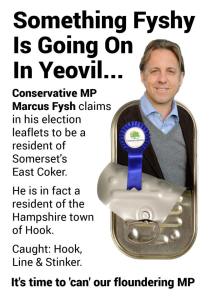
Well, we know that Hugo Swire lives in Mid Devon, now here’s another who prefers not to live in his constituency:

Source: Facebook Unseat Marcus Fysh

At least Hampshire is in England – our MP spends lots of time travelling the world as Chairman of the Conservative Middle East Council:

“A January 2016 Middle East Monitor investigation revealed that nearly all of the CMEC’s financial backers have strong business interests in Saudi Arabia and its smaller Gulf allies, ranging from defence to manufacturing to energy resources”

Time to pack him off on his camel?

(Claire Wright – Independent – was born, raised, educated and has family in East Devon and continues to live here; the Lib Dem candidate is a Teignmouth Councillor; the Labour Party’s candidate may or may not live in East Devon (says so but candidate documents say Central Devon).