Tory expenses scandal MPs in precarious position

“Conservative MPs accused of breaking election spending rules at the last election face the possibility of being prosecuted by the Crown while they are in the middle of fighting their re-election campaigns at this year’s general election.

14 police forces have sent files to the Crown Prosecution Service relating to the Tory 2015 ‘battle bus’ scheme, which it has been alleged led to Tory candidates breaking strict spending limits on elections.

The CPS is currently reviewing the evidence and considering whether to charge the MPs with breaking the election spending limits, which are put in place to prevent those with wealthy backers from gaining an unfair advantage during general elections.

A spokesperson for the CPS confirmed to The Independent on Tuesday evening that any charges would have to be made before the date of the general election, which Theresa May wants to hold on 8 June subject to a vote in Parliament tomorrow.

This means the CPS’s announcement must by law fall while the MPs are campaigning for re-election, before 8 June.

No charges have yet been made against any MP. All 14 police forces who sent files to the CPS last year applied for a 12 month extension to the prosecution deadline, which would have otherwise elapsed last summer.

Channel 4 News reported on Tuesday evening that the CPS is considering prosecution against over 30 individuals with regards to 2015 election expenses.

As a result, a decision has to be made by the CPS by late May or early June, meaning that any charges will land during at least the long election campaign period, and possibly even the short campaign.

Police forces who have sent files to the CPS relating to the spending allegations include Avon & Somerset, Cumbria, Derbyshire, Devon & Cornwall, Gloucestershire, Greater Manchester, Lincolnshire, the Metropolitan, Northamptonshire, Nottinghamshire and West Yorkshire.

Two dozen Conservatives are understood to be under investigation over claims that they did not include battle bus spending in their local campaign returns. The Electoral Commission is also investigating the allegations in parallel to the police.

The allegations centre on whether spending on hotels for visiting activists and certain campaign material was incorrectly registered as national spending rather than locally – potentially illegitimately taking advantage of a higher spending ceiling.

A Conservative spokesman said: “We are cooperating with the ongoing investigations.”

There have been suggestions that other parties may have failed to register similar spending in their local areas too.

In theory election results in individual seats could be declared invalid if laws are found to have been broken, though this is not an automatic process.

In recent weeks some Conservative MPs have hit out at party officials who they say have dodged blame for the fiasco at the expense of MPs’ reputation.

http://www.independent.co.uk/news/uk/politics/tory-election-fraud-prosecutions-cps-election-campaign-result-overturn-battle-bus-a7689801.html

“There’s going to be a general election, so let’s talk about the Tory MPs still under investigation for election fraud”

“Theresa May has announced a snap election on 8 June 2017. But as the country prepares for another election campaign, it’s important to remember that MPs in her party are being investigated for election fraud for the 2015 general election. And given the mainstream media’s reluctance to report the issue, we need to ensure it is kept firmly on the agenda.

Allegations of fraud

12 police forces have submitted files to the Crown Prosecution Service (CPS) over allegations that up to 20 MPs and/or their agents broke election spending limits in the 2015 election. The CPS is deciding whether charges should be brought. And a decision is expected soon – and is likely to come during the election campaign.

The allegations centre around the ‘battle bus’ campaign, and associated expenses such as hotel rooms. Many argue that the campaign promoted prospective local MPs in key seats. Under election law, any expenditure which promotes a local candidate should be covered locally. But the ‘battle bus’ and associated costs were declared nationally. Each constituency has a fixed amount of money it can spend locally. And including the ‘battle bus’ expenditure would have meant many candidates overspent.

Additionally, the Election Commission fined the Conservatives £70,000 for multiple breaches in connection to election spending during the 2015 campaign.

And there’s more

But it isn’t just the “battle bus” campaigns where the Conservatives have been accused of fraud. As The Canary previously reported, there are questions over how the party used social media and, particularly, Facebook, to target voters.

And a report by the London School of Economics has also warned [pdf] that Facebook targeting opens the door to electoral fraud:

The ability to target specific people within a particular geographic area gives parties the opportunity to focus their attention on marginal voters within marginal constituencies. This means, in practice, that parties can direct significant effort – and therefore spending – at a small number of crucial seats. Yet, though the social media spending may be targeted directly at those constituencies, and at particular voters within those constituencies, the spending can currently be defined as national, for which limits are set far higher than for constituency spending.
Implications

Theresa May might think she is avoiding difficult byelections if charges are brought in any of the constituencies. But she is equally taking a huge risk. There is a possibility that she will be running an election campaign while MPs are facing fraud charges. And then there’s the question of whether those MPs and their agents will run in this election.

Either way, the British public get to choose whether they want to vote for a party being investigated for fraud; and a party that’s already been fined £70,000 for election expenses breaches. But in order to do so, it is essential we do not allow the issue to be swept under the table.”

Source: https://www.thecanary.co/2017/04/18/theres-going-general-election-lets-talk-20-tory-mps-still-investigation-election-fraud/

Devon Tory MP admits election expenses errors

Well done to him for admitting it – but his election agent shares the blame. Wonder if our Police and Crime Commissioner and ex-election agent Ms Alison Hernandez will be forthcoming? Owl’s guess – no. Will our Police and Crime Panel (Tory majority) do anything – no. Will we see any criminal proceedings – no. Would we see them if it was any other party or independent – you bet!

“A Conservative MP admitted in a police interview that some of his election expenses were wrong but excused the errors on the grounds that he had no previous political experience, according to a report on how police handled the inquiry.

Johnny Mercer, Tory MP for Plymouth Moor View, was investigated by police after the general election in 2015 and a file was handed to the Crown Prosecution Service (CPS). It was decided, however, that there was insufficient evidence to charge him with any offence.

A Devon and Cornwall police report from the time states that Mercer had acknowledged during an interview that “some of his claims had been wrong” but had argued that they were minor, did not take him over election spending limits and that this was understandable given his lack of political experience.

The admission calls into question the Conservative party’s claim that “the local agents of Conservative candidates correctly declared all local spending in the 2015 general election”. …”

https://www.theguardian.com/politics/2017/apr/10/tory-election-spending-johnny-mercer-mp-police-some-claims-were-wrong

Dirty money in UK elections – Electoral Commission has no teeth to prevent it

An urgent review of “weak and helpless” electoral laws is being demanded by a group of leading academics who say that uncontrolled “dark money” poses a threat to the fundamental principles of British democracy.

A working group set up by the London School of Economics warns that new technology has disrupted British politics to such an extent that current laws are unable to ensure a free and fair election or control the influence of money in politics.

Damian Tambini, director of the media policy project at the LSE, who heads the group made up of leading experts in the field, said that new forms of online campaigning had not only changed the ways that political parties target voters, but crucially had also altered the ability of big money interests to manipulate political debate. “There is a real danger we are heading down the US route where whoever spends the most money is most likely to win. That’s why we’ve always controlled spending in this country. But these controls are no longer working.”

Its policy brief published on Saturday concludes that current laws can no longer ensure the fundamental principle of a “level playing field”, or guard against foreign influence, and that parliament urgently needs to review UK electoral law.

It comes as questions continue to be asked about spending during the referendum campaign. In an interview published in Sunday’s Observer New Review, Arron Banks, the founder of the Leave.eu campaign, says: “We were just cleverer than the regulators and the politicians. Of course we were.”

The Electoral Commission is investigating whether work that the data analytics firm Cambridge Analytica may have done for Leave.eu constitutes an undeclared donation from an impermissible foreign donor. Cambridge Analytica is majority owned by the hedge fund billionaire Robert Mercer, who bankrolled Donald Trump. Filings from the White House disclosed on Friday that Steve Bannon, Donald Trump’s strategy chief, was paid $125,333 by the firm last year.

Asked whether he was worried about the Electoral Commission’s investigation into Leave.eu, Banks said: “I don’t give a monkey’s about the Electoral Commission.”

Banks also claimed that Vote Leave “cheated” to get around campaign financing rules by donating money to third party campaigns. “They cheated! They gave 650 grand to a student. Come on! They absolutely, 100% cheated.”

A spokesman for Vote Leave responded: “The Electoral Commission gave us a clean bill of health.”

Privately, the commission admitted that the only penalties it was allowed to impose by law offered no deterrent to political parties, particularly in a one-off referendum. In addition, the LSE found that loopholes in electoral law mean that spending by political parties during the referendum was almost entirely unregulated or even recorded. The real cost of the campaign – building databases to target voters via social media – occurred almost entirely outside the period regulated by law.

Tambini said: “We don’t have a system that is working any more. In this country, we have had laws to control spending by political campaigns but online campaigning has changed everything and none of the existing laws cover it. The ability to throw around large amounts of cash is almost completely uncontrolled. The key costs in campaigning – building the databases – is happening during the period when campaign spending is not regulated at all.

“There is a real danger that public trust in the democratic process will be lost. There is real potential for foreign influence. We have now the ability to manipulate public opinion on a level we have never seen before. And the current framework is weak and helpless.”

The Electoral Commission has not yet made any public statement but privately it said: “We did have this environment that guaranteed a level playing field. But with the shift online that has all changed. We won’t be able to limit the power of money in elections, that’s what we’re very concerned about.”

Tambini said: “It is urgent. There could be a wholesale loss of trust in the process as the result of a scandal or swinging of an election. Though some would argue that has already happened. There has to be a principle of transparency. The public needs to know where the money is coming from. And we don’t.”

Martin Moore, director of the Centre for the Study of Media, Communication and Power, at King’s College London, said the machinery of campaigning had changed so rapidly, the law has had no chance to catch up. “The first election where digital made a difference was in 2008. And now it’s where pretty much all the spending is. It has been a shift that has happened in less than 10 years. What we’re seeing is exactly the same sort of disruption that we’ve seen in news and music and other industries.

“That is exactly what is happening in politics. The problem is that if you disrupt politics, you are also disrupting the democratic process and you are creating a very dangerous or volatile situation.”

In addition, the Electoral Commission said privately that it did not have the resources to monitor campaigns in real time. “It’s just not practical. There is some proactive stuff that we can do but we simply don’t have the resources.” The only action it can take is once the campaign is over and then the only penalties are fines which “campaigns can simply cost into their spends”.

https://www.theguardian.com/politics/2017/apr/01/dark-money-threat-to-uk-elections-integrity

First UKIP MP charged with election fraud

“Former Conservative MP Bob Spink, who defected to Ukip and became its first MP, has been charged with electoral fraud.

The 68-year-old has been charged alongside a second man, 38-year-old James Parkin, over allegations that they submitted false signatures on Ukip nomination papers.

The accusations relate to the local election for Castle Point Borough Council in south Essex, England in 2016. [Irish Times]”

http://www.markpack.org.uk/148910/bob-spink-ukip-electoral-fraud/

Wonder what Swire and his Conservative Middle East Council think of this?

“Britain is now the second biggest arms dealer in the world, official government figures show – with most of the weapons fuelling deadly conflicts in the Middle East.

Since 2010 Britain has also sold arms to 39 of the 51 countries ranked “not free” on the Freedom House “Freedom in the world” report, and 22 of the 30 countries on the UK Government’s own human rights watch list.

A full two-thirds of UK weapons over this period were sold to Middle Eastern countries, where instability has fed into increased risk of terror threats to Britain and across the West. …

… Ministers, who must sign-off all arms export licences, say the current system is robust and that they have revoked permission to export defence equipment in the past – for example in Russia and Ukraine.

But the Government has also ignored calls to stop selling weapons to repressive regimes, including Saudi Arabia, which has been accused by UN bodies of potentially committing war crimes in its military operation in Yemen against Houthi rebels.

Both the European Parliament and the House of Commons International Development Committee have called for exports to the autocracy to stop, but the Government says it has not seen evidence of Saudi war crimes. …

… Andrew Smith of Campaign Against Arms Trade warned that the dependence of British exporters on unsavory regimes could make the UK less likely to intervene against human rights violators.

“These terrible figures expose the hypocrisy at the heart of UK foreign policy. The government is always telling us that it acts to promote human rights and democracy, but it is arming and supporting some of the most repressive regimes in the world. The impact of UK arms sales is clear in Yemen, where British fighter jets and bombs have been central to the Saudi-led destruction,” he told The Independent.

“These regimes aren’t just buying weapons, they’re also buying political support and legitimacy. How likely is the UK to act against human rights violations in these countries when it is also profiting from them?

“There is no such thing as arms control in a war zone and there is no way of knowing how these weapons will be used. The fact that so many weapons were sold to Russia and Libya is a reminder that the shelf-life of weapons is often longer than the governments and situations they were sold to.”

http://www.independent.co.uk/news/uk/home-news/britain-is-now-the-second-biggest-arms-dealer-in-the-world-a7225351.html

Neil Parish worries about Equitable Life, expanding Colyton Grammar School and grammar schools in general

Neil Parish (Tiverton and Honiton) (Con)

I thank my hon. Friend for bringing this issue to the House yet again because policyholders with Equitable Life have been very badly treated. The finances of this country are now much improved, and it is time that we looked yet again at the situation of these policyholders, because their policies were oversold and actuaries hyped up their value well beyond anything that could be delivered, even at the time. Many people have never been held to account, but the policyholders have had millions of pounds taken from them through their insurance policies and pensions.

Neil Parish

Colyton Grammar School in my constituency has a great headteacher, wonderful staff and pupils with huge levels of attainment. The school would very much like to expand. How can the Secretary of State help it to expand more than it can at the moment?

Neil Parish (Tiverton and Honiton) (Con)

15. What steps her Department is taking to support the expansion of grammar schools. [909334]

And nurseries, primary schools and secondary schools in our area being deprived of funding – what about those, Mr Parish?

Swire worried about laptop ban for our allies” in the Middle East, particularly Egypt and Sharm el Sheikh

“Following the announcement by the British Government of a flight ban on Laptops affecting six Middle Eastern countries the Conservative Middle East Council would like to urge the Government to ensure that all measures are taken to mitigate the diplomatic damage that the ban may cause.

CMEC is not in a position to make a judgement on the security basis of the ban and has every confidence that the relevant agencies have acted to prevent lives being put at risk. CMEC thinks it vital that real efforts are made – at ministerial level – to assuage the concerns and possible offence taken by our allies in Egypt, Saudi Arabia, Jordan, Lebanon, Tunisia and Turkey.

Our allies must be reassured that this measure is taken with the protection of all passengers – not just British Citizens – in mind. This is particularly the case in Egypt, where due to the fact that the ban on direct flights from the UK to Sharm El Sheikh is now in its 18th month there is a rising feeling among many Egyptians that it is in some way politically motivated.

All efforts must be made to reassure our allies that this is a not a political issue but one of security and that the laptop ban is an inconvenient but very necessary mutual security measure, implemented in the interest of travellers from all of the countries affected.”

[Signed]

The Rt Hon Sir Hugo Swire KCMG MP, Chairman, Conservative Middle East Council

Charlotte Leslie MP, Vice Chairman, Conservative Middle East Council

Remember, Owl reported that he asked a question in the House of Commons about when flights to the diving resort might restart, shortly after his visit to Egypt a few days ago:

https://eastdevonwatch.org/2017/03/23/swire-makes-commons-plea-to-resume-flight-to-sharm-el-sheikh/

“The cost of perverting elections will have to be raised to such a level that parties do not think it is a price worth paying to win”

“In poor democracies, votes are bought directly. In rich ones, money is spent to secure votes. Instead of being bribed, voters are subjected to a deluge of advertising, rounds of door-knocking and incessant social media messaging. Laws in richer democracies are meant to be tightly enforced. A check on UK election spending is that contributions have to be declared correctly. That is why the decision to fine the Conservative party a record £70,000 for “numerous failures” in accurately reporting campaign spend at the 2015 general election and three by elections in 2014 is so important. It is a wrong compounded by cover-up. The Tories “unreasonably” failed to cooperate with the Electoral Commission, which acted after a Channel 4 News report.

Foolishly, David Cameron displayed not a hint of contrition, claiming he had won “fairly and squarely”. He ran a shambolic operation. It’s too early to say whether a criminal offence has been committed. Any prosecution must prove beyond reasonable doubt that this is dishonesty not just non-compliance. The cost of perverting elections will have to be raised so that parties do not think it is a price worth paying to win. Money buys access to shape policies. Without strict rules and harsh penalties, politicians will be tempted to win office by mortgaging the future to an investing elite.”

https://www.theguardian.com/commentisfree/2017/mar/19/the-guardian-view-on-tory-election-spending-its-a-scandal?CMP=Share_iOSApp_Other

Election purdah: expect LOTS of good news and promises next week!

Purdah for the local county council elections (and possibly a General Election if rumours are to be believed) will begin on Monday 27 March 2017. Be aware NO council (not just the county council) can ignore purdah.

You can find a useful guide here:

http://www.local.gov.uk/documents/10180/6869714/L15-91+Unpacking+Purdah_04.pdf/c80978b9-dc0b-4eee-9f81-49bd47afeb2d

From this guide:

“This means that:

• In general you (this means councils and councillors) should not issue any publicity which seeks to influence voters (an exception being situations covered by legislation or regulations directing publication of information for explanatory purposes).
• Particular care should be taken during the pre-election period to abide by the Act.
• Consider suspending the hosting of third party material or closing public forums if these are likely to breach the codes of practice.
• Do not publish any publicity on controversial issues or report views on proposals in a way which identifies them with individual councillors or groups of councillors.
• Publicity relating to individuals involved directly in the election should not be published unless expressly authorised by statute.
• You are allowed to publish factual information which identifies the names, wards and parties of candidates at elections.

Although this new code supersedes the previous versions and may seem less specific, in practice your conduct should be similar to previous elections.
What this means in practice:

Publicity is deemed as “any communication, in whatever form, addressed to the public at large or to a section of the public.”

The first question to ask is ‘could a reasonable person conclude that you were spending public money to influence the outcome of the election?’ In other words it must pass the ‘is it reasonable’ test. When making your decision, you should consider the following:

You should not:
• produce publicity on matters which are politically controversial
• make references to individual politicians or groups in press releases
arrange proactive media or events involving candidates
• issue photographs which include candidates
• supply council photographs or other materials to councillors or political group staff unless you have verified that they will not be used for campaigning purposes
• continue hosting third party blogs or e-communications
• help with national political visits (as this would involve using public money to support a particular candidate or party). These should be organised by political parties with no cost or resource implications for the council.

You should also think carefully before you:
• Continue to run campaign material to support your own local campaigns. If the campaign is already running and is non-controversial (for example, on issues like recycling or foster care) and would be a waste of public money to cancel or postpone them, then continue. However, you should always think carefully if a campaign could be deemed likely to influence the outcome of the election and you should not use councillors in press releases and events in pre-election periods. In such cases you should stop or defer them. An example might be a campaign on an issue which has been subject of local political debate and/or disagreement.
• Launch any new consultations. Unless it is a statutory duty, don’t start any new consultations or publish report Findings from consultation exercises, which could be politically sensitive.

and

Council Notice Boards:

Councils are required to publicise details of the election and how to register to vote. Material relating to wider political issues should not be posted on of official notice boards which may be seen by members of the public. This includes publicity issued by, or on behalf of, a trade union.”

Election spending (2) … just to make it crystal clear where the buck stops

“Managing campaign spending

Authorising and paying campaign spending

Only the ‘responsible person’ registered with us and people authorised in writing by the responsible person can incur campaign spending.

For example, someone may be authorised to spend money on particular items, or up to a particular amount.

These rules are in place to make sure that spending can be controlled and accurately recorded and reported.

You should make sure that your volunteers and campaigners know who can and cannot incur costs.”

Click to access to-campaign-spend-rp.pdf

Elections: Campaign spending rules for dummies

Presumably, Ms Hernandez read this:

“The types of election spending

There are two types of spending by or on behalf of parties at elections. These are:

Party campaign spending on campaigning to promote the party and its policies generally.

For example, national newspaper adverts for the party, or leaflets explaining party policy.

It also includes spending on promoting candidates at elections where the party nominates a list of candidates for a region, instead of individual candidates for local areas.

Candidate spending on campaigning to promote a particular candidate or candidates in their local area.

For example, leaflets or websites that focus on one or more candidates and their views.

Different rules apply to the two types of spending.

This guidance covers party campaign spending only.

Allocating spending between the party and the candidate

If you are not immediately sure whether something is promoting the party or the candidate, you must make a fair and honest assessment of the facts.

This will help you decide how to allocate the item’s costs against the right spending limit.

Spending will usually fall into one category or the other.

You should only divide the costs of an item between different spending limits if you are sure that it is reasonable to do so.

You should not split costs if an item is produced mainly to promote a candidate, and uses the party’s name or refers to the party’s policies purely in support of that aim.

For example, if a leaflet focuses on a candidate but includes some of the party’s key policy pledges as a way of telling voters what the candidate stands for.

If you are still not sure how you should allocate an item of spending, please call or email us for advice.

Click to access to-campaign-spend-rp.pdf

Comments on record fine for Conservative expenses scandal

“… Four aspects of this record fine are worth noting, especially in terms of what it means for forthcoming decisions on legal action against more Conservative MPs than makes up Theresa May’s majority in the House of Commons.

In short – it’s bad news for the Conservatives as the Electoral Commission has found repeated evidence of spending missing from constituency expense returns. That’s with the police, who have started interviewing MPs under caution, and the Crown Prosecution Service, which has received files from a dozen police forces now.

1. Conservative Party repeatedly hindered the Electoral Commission

The Conservative Party repeatedly refused to cooperate fully with the Electoral Commission investigation, requiring the Commission to go to court to get access to relevant evidence. Even after that, two further legal notices were issued in response to the party failing to provide information requested. The Electoral Commission also had to issue a legal order against a Conservative Party campaigner who “had chosen not to provide information voluntarily”.

“The Party hindered and caused delay to the investigation”, the Electoral Commission’s report concludes. This is notable different from its conclusions on other parties it has investigated recently, where cooperation was forthcoming and sustained.

2. When parties split costs, they must keep good evidence

It is a normal and legal part of election expenditure to split some costs between different legal areas. For example, a leaflet might both promote a local election candidate and a general election candidate and as a result its costs are split between the two candidate’s different expense limits.

One area where the Electoral Commission found against the Conservative Party was over its splitting of staff costs where staff were located in a constituency at the time of a by-election but were also continuing with their normal party roles as well as helping on the by-election.

“The Party could provide no record of how those proportions were determined for any of the by-elections. It did not have any written record of the formula at all, either generally or in relation to any of the three by-elections,” the Electoral Commission reports.

3. Police investigations into Conservative MPs are continuing

As the Electoral Commission’s report says, “The Commission does not have specific powers to investigate and enforce incomplete candidate returns”. The fines and police referral by the Electoral Commission are all about national record keeping and expense limit compliance, not what MPs and their agents got up to.

4. Electoral Commission’s conclusions worsen the legal risk faced by Conservative MPs

All the accommodation costs for national staff relocated to constituencies during three Parliamentary by-elections which the Electoral Commission investigated should have been included in local constituency returns even if the staff were spending some of their time on non-constituency campaigning.

That’s because otherwise they would have been based in their normal offices without accommodation being paid: “There is no reason the Commission can see as to why only an unspecified proportion of the accommodation costs for staff was included in the invoices to candidates. The Commission is satisfied that the entire accommodation costs, for staff and volunteers, were incurred for the purpose of basing individuals in Newark, Clacton and Rochester and Strood, to facilitate those individuals’ work on the respective by-election campaigns. This money would not have been spent otherwise.”

Moreover, when it comes to the Thanet South general election contest, the Electoral Commission has concluded that some of the expenses put on the party’s national expense return should have been included in the constituency return instead as they were for constituency campaigning: “The Commission is satisfied that a proportion of the costs included in the Party’s campaign spending return associated with the team based in South Thanet did not relate to Party campaign spending and should not have been included in the Party’s spending return. In particular, a proportion of the £15,641 included in the Party’s 2015 UKPGE spending return in relation to the Royal Harbour Hotel constituted candidate campaign expenses and should not have been included in the return.”

Likewise on the Conservative battlebus tour, the Electoral Commission has found that the Conservative Party wrongly claimed that all its costs were national election expenditure because in reality the battlebus operation often promoted constituency candidates and so a proportion of its costs should have counted against their limits.

Because the Electoral Commission doesn’t have direct jurisdiction over constituency returns, the question therefore of under-declaring costs on constituency returns has not been followed up by them in this report. That, however, is a matter for the ongoing police investigations. For example, on the question of the Conservative battlebus, the Electoral Commission concludes: “The Commission has not sought to identify the extent to which any affected candidates may have underreported their campaign spending, which is an RPA [Representation of the People Act] matter and therefore a matter for the police.”

In other words, the Electoral Commission has found a number of issues which directly mean that constituency expense returns were wrong. They haven’t issued fines or taken other action over them as those matters are with the police.”

http://www.markpack.org.uk/148784/conserative-party-electoral-commission-fine/

Devon and Cornwall Chief Constable AND Crime Commissioner both under investigation in election expenses scandal

The chief constable of Devon and Cornwall has been placed under police investigation over his conduct, the BBC has learnt.

It is in relation to comments Shaun Sawyer (pictured) made about the inquiry into the declaration of general election expenses by his Police and Crime Commissioner, Alison Hernandez. Gloucestershire Police have been brought in to carry out the investigation into Mr Sawyer.

Both he and Ms Hernandez both deny any wrongdoing.”

http://www.bbc.co.uk/news/live/uk-england-devon-37697575
(BBC Devon live-news 09.00 am)

Buying votes by political donation

Published in full because Owl found it impossible to decide which paragraph to cut.

“We may be told donors do not influence policy, but anywhere else our setup would be seen as corruption
Is this a democracy or is it a plutocracy? Between people and power is a filter through which decisions are made, a filter made of money. In the European referendum, remain won 46% of the money given and lent to the two sides (£20.4m) and 48% of the vote; leave won 54% of the money and 52% of the vote. This fearful symmetry should worry anyone who values democracy. Did the vote follow the money? Had the spending been the other way round, would the result have reflected that? These should not be questions you need to ask in a democracy.

If spending has no impact, no one told the people running the campaigns: both sides worked furiously at raising funds, sometimes from gruesome people. The top donor was the stockbroker Peter Hargreaves, who gave £3.2m to Leave.eu. He explained his enthusiasm for leaving the EU thus: “It would be the biggest stimulus to get our butts in gear that we have ever had … We will get out there and we will be become incredibly successful because we will be insecure again. And insecurity is fantastic.”

No one voted for such people, yet they are granted power over our lives. It is partly because the political system is widely perceived to be on sale that people have become so alienated. Paradoxically, political alienation appears to have boosted the leave vote. The leave campaign thrived on the public disgust generated by the system that helped it to win.

If politics in Britain no longer serves the people, our funding system has a lot to do with it. While in most other European nations, political parties and campaigns are largely financed by the state, in Britain they are largely funded by millionaires, corporations and trade unions. Most people are not fools, and they rightly perceive that meaningful choices are being made in private, without democratic consent. Where there is meaning, there is no choice; where there is choice, there is no meaning.

Politicians insist that donors have no influence on policy, but you would have to be daft to believe it. The fear of losing money is a constant anxiety, and consciously or subconsciously people with an instinct for self-preservation will adapt their policies to suit those most likely to fund them. Nor does it matter whether policies follow the money or money follows the policies: those whose proposals appeal to the purse-holders will find it easier to raise funds.

Sometimes the relationship appears to be immediate. Before the last general election, 27 of the 59 richest hedge fund managers in Britain sponsored the Conservatives. Perhaps these donations had nothing to do with the special exemption from stamp duty on stock market transactions the chancellor granted to hedge funds, depriving the public sector of about £145m a year. But that doesn’t seem likely.

At the Conservatives’ annual Black and White Ball, you get the access you pay for: £5,000 buys you the company of a junior minister; £15,000, a cabinet minister. Politicians insist that there’s no relationship between donations and appointments to the House of Lords, but a study at Oxford University found that the probability of this being true is “approximately equivalent to entering the national lottery and winning the jackpot five times in a row”.

We might not have had a say in the choice of the new prime minister, but I bet there was a lively conversation between Conservative MPs and their major funders.

Among the many reasons for the crisis in the Labour party is the desertion of its large private donors. One of them, the corporate lawyer Ian Rosenblatt, complains: “I don’t think Jeremy Corbyn or anyone around him is remotely interested in whether people like me support the party or not.” Why should the leader of the Labour party have to worry about the support of one person ahead of the votes of millions?

The former Labour adviser Ayesha Hazarika urged Corbyn to overcome his scruples: “Meeting rich people and asking for money is not exactly part of the brand that has been so successful among his party faithful. But … sometimes you just have to suck it up and do things you don’t like.”

Under our current system she might be right, not least because the Conservatives have cut Labour’s other sources of funding: trade union fees and public money. But what an indictment of the system that is. During the five years before the last election, 41% of the private donations made to political parties came from just 76 people. This is what plutocracy looks like.

Stand back from this system and marvel at what we have come to accept. If we saw it anywhere else, we would immediately recognise it as corruption. Why should parties have to grovel to oligarchs to win elections? Or, for that matter, trade unions?

The political system should be owned by everyone, not by a subset. But the corruption at its heart has become so normalised that we can scarcely see it.

Two-fifths of British political donations made by just 76 people
Here is one way in which we could reform our politics. Each party would be allowed to charge the same fee for membership – a modest amount, perhaps £20. The state would then match this money, at a fixed ratio. And that would be it. There would be no other funding for political parties. The system would be simple, transparent and entirely dependent on the enthusiasm politicians could generate. They would have a powerful incentive to burst their bubbles and promote people’s re-engagement with politics. The funding of referendums would be even simpler: the state would provide an equal amount for each side.

The commonest argument against such arrangements is that we can’t afford them. Really? We can’t afford, say, £50m for a general election, but we can afford the crises caused by the corruption of politics? We could afford the financial crisis, which arose from politicians’ unwillingness to regulate their paymasters. We can afford the costs of Brexit, which might have been bought by a handful of millionaires.

Those who urged us to leave the EU promised that we would take back control. Well, this is where it should begin.”

A fully linked version of this article can be found at Monbiot.com

http://www.theguardian.com/commentisfree/2016/jul/13/billionaires-bought-brexit-controlling-britains-political-system?CMP=Share_iOSApp_Other

MPs election expenses – not forgotten by Democratic Audit

Probably not good news for Police and Crime Commissioner Hernandez!

With all the constitutional chaos following the EU referendum result,
it’s easy to forget that up to 30 MPs are still being investigated for
breaking election spending limits by twenty police forces across the
country. But we’re still on the case!

Last week we hosted a meeting of politicians and campaigners to talk
about two things:

How can we bring MPs who have broken the rules to justice?
How can we fix the broken election expenses system?

Our friendly legal experts had some good news – there are legal options
to pursue MPs who have broken election spending limits even if the
police aren’t already investigating them! The allegations that the
police are already investigating could just be the tip of the iceberg in
this election expenses scandal.

It shouldn’t take a crack team of investigative journalists to keep our
elections fair and protect democracy. One big obstacle in the way of
holding MPs to account is that election expenses aren’t publicly
available. The only way you can access them is by going down to your
local council offices. We are working behind the scenes to change this
in time for the next general election (whenever that may be!) We will be
talking to the Electoral Commission to put pressure on local councils to
make this vital information available online.

With Brexit and Chilcot dominating the news, the election expenses
scandal could drop off the radar. We won’t let that happen.

Best wishes,

Alexandra Runswick
Director, Unlock Democracy

Claire Wright: even more important that MPs represent their constituency

“Brexit: It is now more important than ever that this country has MPs who will represent the people

Tuesday, 28 June 2016 1 Comment by Claire

Since Friday events have moved so fast I haven’t even written a blog as each time I think of an angle it gets superseded by another major news story!

The only clear thing among all the chaos and confusion, is that this country has probably never been more divided – politically and socially – and in my view, more in peril than at any other time in living memory.

The party system seems to have totally fractured. Not only has the Conservative parliamentary party become bitterly broken, the Labour party is also at war.

Last Friday morning I felt shellshocked and upset that we had left an institution I believed worked for the greater good, despite its many faults. Since then I have watched fascinated as the subsequent dramatic events unfolded.

The economic fallout came swiftly and is very worrying. The value of the pound has plummeted to a 31 year low, we are told that the UK’s credit rating has been downgraded from a triple A to a double A rating, we have dropped from being the fifth largest economy in the world to the fourth and the Bank of England is on standby to pump £250bn of public money into the markets to reduce the jitters currently reverberating across the globe from our EU exit.

More than £200bn has been wiped from the value of the UK stock market – equivalent to 24 years worth of EU contributions.

A general election is now looking possible in October, to tie in with the selection of a new prime minister.

Lies and exaggeration were undoubtedly the order of the day for both the Leave and Remain campaigns, but what is really galling to me is that the Leave movement won people over on false pretences. On the NHS and immigration in particular – two major planks of their operation, their claims have been found to be resoundingly untrue.

The Remain campaign focused too much on scaremongering and too little on how the EU helps us, which only riled people and forced them into entrenched positions , setting family member and friend against one another.

The conservative IN bandwagon, seemed to be blinkered on issues mainly linked to the economy and immigration, discounting all the positive things that the EU does for us, for example on employment, the environment and human rights for example. I believe that this was because these are the issues that are not valued by the right wing political elite that we currently have governing this country.

David Cameron’s supposedly one nation conservative cabinet, which campaigned WITH big business against a ban on bee killing pesticides, has already scrapped or weakened as many environmental protections as it can get away with. Planning regulations are now as relaxed and in favour of developers as they have been since the introduction of the Town and Country Planning Act in 1947.

With a future hardline right wing government on the cards, possibly led by the current favourite Boris Johnson, the likelihood of the current protections remaining for our seas, clean air, recycling, waste and for rare species, landscapes and plants – the Habitats Regulations – is remote.

Over the past few years the Conservative government has lobbied to scrap the EU Habitats Regulations – tough laws which protect some of our most precious landscapes here in East Devon, such as Woodbury Common, Aylesbeare Common, the Exe Estuary, as well as large swathes of Dartmoor.

However, despite the Habitats Regulations protecting our most rare and precious species such as the dartford warbler and the nightjar, our government announced the laws were “gold plated,” and lobbied the EU hard to get them scrapped.

The EU has so far held firm to these regulations, which also mean strong planning rules in these areas , as well as the surrounding countryside.

But I now can see on the horizon an inevitable and horrible ‘bonfire of red tape’ as a new right wing conservative leadership sets about dismantling anything that it views as in the way of “growth.”

So what is the future of East Devon now most of the country has voted to leave?

In my own council ward of Ottery, there must now be question marks for a controversial quarry proposed at Straitgate Farm, which was quietly looking less likely, due in part to the strict Habitats Regulations Protecting Woodbury Common, where Blackhill Quarry is based and where stone and gravel processing currently takes place. It was due to cease as of the end of this year because of these laws.

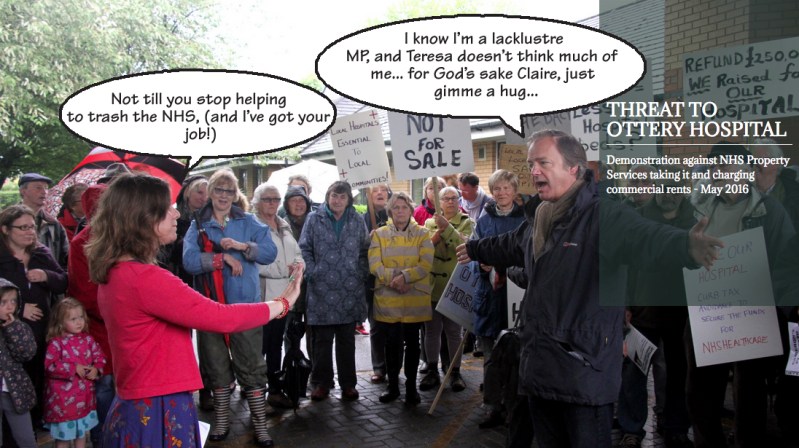
What will Brexit mean for East Devon’s two biggest industries? Agriculture and tourism? And what will it mean for education? What does it mean for our cash strapped NHS and our local very much at risk
community hospitals?

What will it mean for the most vulnerable people in the constituency and those on low incomes?

Certainly, both agriculture and education are forced to rely on EU subsidies and grants.

Prolonged economic hardship will surely mean even deeper public spending cuts, yet deeper cuts to public services, which as always, will have the biggest effect on those people who have the least.

If a general election does take place in October, the future of our district – and the rest of the country – rests with those politicians examining thousands of pages of EU law and policy with a view to changing, scrapping or tightening it.

The future of our vulnerable residents also rests with MPs who have a duty to stand up for people who need help and support.

East Devon’s MP needs speak and vote in favour or against new laws and policies based on how they affect local people. That’s voting FOR the people of East Devon, not his party.

Each MP has a duty, in my view, to be a diligent scrutineer of this process.

What laws or policies do we want in East Devon that will benefit us, our communities, our wildlife and our businesses? Now is the time to consider this very carefully.

If democracy is working effectively people in East Devon should have the opportunity to influence such discussions through our MP.

And our MP has a responsibility to stand up for the people of East Devon and what they see as their priorities, especially at this very turbulent time.

The question has to be as ever. Is Mr Swire up to the job?”

http://www.claire-wright.org/index.php/post/brexit_it_is_now_more_important_than_ever_that_this_country_has_mps_who_wil

Former editor of “The Independent” thinks party politics is dead and democracy is broken

“So here is the checklist: Conservative Party: split; Labour Party: in disarray; Liberal Democrats: severe losses.

That isn’t the end of it. There is another serious development running in parallel: the decline in people’s trust in their political leaders. Which is cause, and which is consequence, it is impossible to say.

What is certain, however, is that the systematic, shameless spinning and fear-mongering of the Remain and Leave campaigns has further reduced the respect in which our aged political system is held.

The truth is that the party system – a part of our everyday lives since Labour formed its first government in 1924 – is tottering and will soon collapse. …

… I hope myself that the ‘new’ would have three characteristics. First, the political process would be more consultative than it is at present. To this end I would favour a further expansion of the work of the parliamentary select committees. These are the bodies that have recently held Mike Ashley of Sports Direct and Philip Green, the former owner of BHS, to account. They should hold hearings in regional centres as well as in the Palace of Westminster.

Second, MPs should be subject to term limits, which would mean that they could not stand for re-election to the House of Commons more than, say, twice. This would prevent the creation of a political class. Politics would no longer be a lifetime career but a public duty.

And third, citizens who have done something with their lives other than politics should be willing to stand for Parliament knowing that with term limits, it would not be a job for life.”

http://www.independent.co.uk/news/uk/politics/the-founding-editor-of-the-independent-thinks-democracy-is-broken-and-he-wants-to-know-what-you-a7096311.html