NHS and Social Care Privatisation on all our doorsteps – Devon 111 service outsourced to company with BIG ideas

“The Company is engaged in delivering its ‘buy and build’ expansion strategy, adding to the range of services provided by the Group through working with organisations that share its vision.

Focused on out of hospital healthcare worth in excess of £20bn per year – the NHS is moving non-acute care components out of hospitals and closer to home

Buy and build consolidation strategy fitting with NHS trend towards outsourcing and outcome based commissioning

Targeting attractive companies in the UK health sector that share Totally’s vision for integrated and cohesive out of hospital healthcare
Build and develop a high-quality diversified group through organic and acquisition based growth

Become one of the leading out of hospital healthcare providers in the UK
This strategy is supported by ambitious management who have identified public-market outsourced health services as an attractive prospect and have developed a plan to fully develop this opportunity.”

http://www.totallyplc.com/about-us/our-strategy/

Swire sees the light on hospital beds (because it could be a big vote loser?)

Owl is concerned that local MP Hugo Swire is very, very slow in the uptake. After resting on his laurels by seeing community beds in his constituency staying while those in Neil Parish’s patch of EDDC have all gone (except for Tiverton – not part of East Devon which can’t be closed because it is a PFZi hospital), he finally wakes up and realises that it has left a black hole that will stop many people voting for either of them next time! AND result in people switching their votes to Claire Wright (Independent, East Devon) and maybe Caroline Kolek (Labour, Tiverton and Honiton)!

Sir Hugo Swire said the area’s demographics are 20 years ahead of the national average and it was ‘absolutely ridiculous’ the two services should have separate funding.

This comes after Dr Mike Slot raised concerns to Devon’s health watchdog that carers are not available to implement ‘care at home’ – the model the NEW Devon Clinical Commissioning Group’s (CCG) moved to after it closed 140 community hospital beds across the county.

Dr Slot said: “The loss of community hospital beds was intended to be offset by increasing the capacity of community care so that patients could be cared for in their own homes.

“This may or may not have been realistic since many of the patients in the hospital system cannot be managed in the community, even with excellent community services.

“However, with or without community hospital beds, it is an excellent idea to expand community services so that all those patients who can be cared for out of hospital can remain at home.

“Unfortunately, there is not sufficient capacity in the home care services to do this job.

“When GPs ring the single point of access number asking for rapid response or night sitting, the carers are not available.”

In a joint statement, the CCG and provider trust the Royal Devon and Exeter Hospital acknowledged that recruitment had been ‘challenging’ in a few places, but the bodies were working hard alongside other agencies to address the issues.

A spokeswoman said more than £2.5million had been redirected into growing and strengthening their community teams so more people can be cared for at home.

They added: “A large part of the reinvestment has been to increase the number of nurses, therapists and support workers and in most areas we have successfully recruited the additional staff.”

Social care was brought under the remit of health secretary Jeremy Hunt in the last cabinet reshuffle – a move welcomed by Sir Hugo, who said: “I think in future there will be far greater use of hubs.

“We must look to do the same with social care. It requires brave, strategic thinking. We have to get it right.

“The East Devon demographic is where the country is going to be in 20 years’ time. Sidmouth is even ahead of that. East Devon should be a template – use us as a guinea pig for integration of health and social care.”

http://www.sidmouthherald.co.uk/news/concerns-over-recruitment-for-new-care-at-home-model-after-east-devon-hospital-bed-closures-1-5395962

Important health meeting in Seaton on 23 March

From the blog of DCC East Devon Alliance councillor Martin Shaw:

“Seaton and Area Health Matters – Going Forward Together

Friday 23rd March 2018 – Seaton Town Hall

9.00 for 9.30 am start – 1.00pm

Book here: https://goo.gl/forms/7laMUjhByt8F0w053 (right click on link to open booking form)

You are invited to participate in this community led event with key stakeholders around the future health and wellbeing of all the people in our communities, in response to the new landscape affecting Seaton and surrounding area as a result of NHS and Government policies advocating Place-Based Care in health provision and cross-sector collaborative working with community groups

The aim: To discuss what we know, where there are gaps/challenges and how, as a community we will address these to ensure collaborative approaches to co-design and co-produce local health services/activities that meet the needs of all the people in our communities.

Invitees: Management and senior level employees and volunteers / trustees from community, voluntary and social enterprise sector as well as public and private organisations.

Area to include: Seaton, Colyford & Colyton, Beer, Axmouth, Branscombe

PROGRAMME:

Welcome: Mayor of Seaton – Cllr Jack Rowland

Community Context:

Dr Mark Welland – Chairman of Seaton & District Hospital League of Friends
Roger Trapani – Community Representative, Devon Health and Care Forum
Charlotte Hanson – Chief Officer, Action East Devon
Strategic and Services Overview – Place Based Care:

Laura Waterton – Royal Devon and Exeter NHS Foundation Trust
Richard Anderson – Health and Social Care Community Services Manager
Dr Jennie Button – Social Prescribing Lead – Ways 2 Wellbeing project in Seaton
Workshop, Networking and Discussion will form the main part of this event:

Workshop 1 – What is working well and what are the challenges for Seaton and surrounding area?
Workshop 2 – Working together to improve health and wellbeing outcomes? What support do we need?”

Important community conversation on health and wellbeing in Seaton and area to begin on 23rd March

Has Clinton Devon Estates completely lost its moral compass (if it ever had one)?

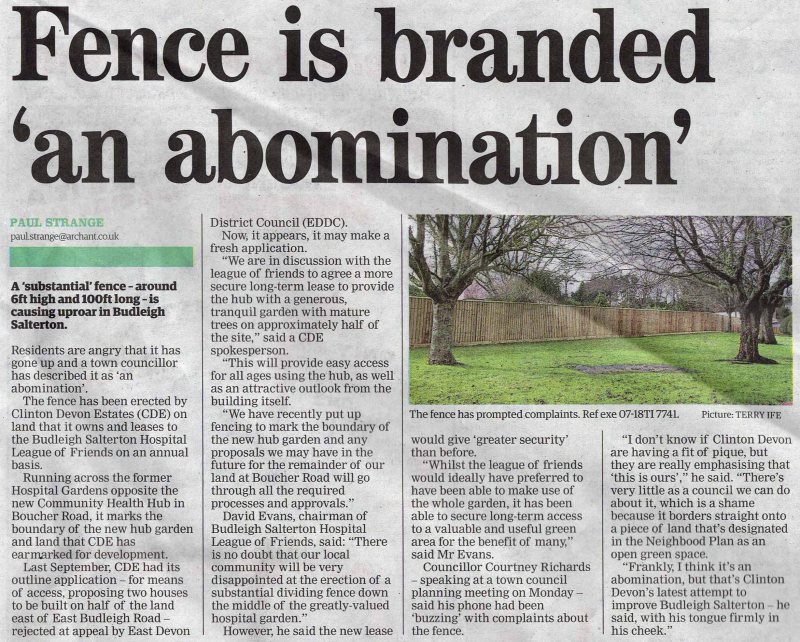
Background: Background: in 1887 to mark Queen Victoria’s Golden Jubilee the philanthropist and benefactor Hon. Mark Rolle “leased” the Budleigh Salterton hospital site and garden to the people of the Town. After his death in 1907, the Rolle Estate passed to the 21st. Baron Clinton and was absorbed into the Clinton Devon Estates. 131 years later CDE have fenced off two-thirds of the garden from use by the newly formed Hospital Wellbeing Hub just as the children attending a nursery there were beginning to use it for recreational purposes and Spring arrives.

Article in Journal:

“A ‘substantial’ fence – around 6ft high and 100ft long – is causing uproar in Budleigh Salterton.

Residents are angry that it has gone up and a town councillor has described it as ‘an abomination’.

The fence has been erected by Clinton Devon Estates (CDE) on land that it owns and leases to the Budleigh Salterton Hospital League of Friends on an annual basis.

Running across the former Hospital Gardens opposite the new Community Health Hub in Boucher Road, it marks the boundary of the new hub garden and land that CDE has earmarked for development.

Last September, CDE had its outline application – for means of access, proposing two houses to be built on half of the land east of East Budleigh Road rejected at appeal by East Devon District Council (EDDC).

Now, it appears, it may make a fresh application.

“We are in discussion with the league of friends to agree a more secure long-term lease to provide the hub with a generous, tranquil garden with mature trees on approximately half of the site,” said a CDE spokesperson.
“This will provide easy access for all ages using the hub, as well as an attractive outlook from the building itself.

“We have recently put up fencing to mark the boundary of the new hub garden and any proposals we may have in the future for the remainder of our land at Boucher Road will go through all the required processes and approvals.”

David Evans, chairman of Budleigh Salterton Hospital League of Friends, said: “There is no doubt that our local community will be very disappointed at the erection of a substantial dividing fence down the middle of the greatly-valued hospital garden.”

However, he said the new lease would give ‘greater security’ than before.
“Whilst the league of friends would ideally have preferred to have been able to make use of the whole garden, it has been able to secure long-term access to a valuable and useful green area for the benefit of many,” said Mr Evans.
Councillor Courtney Richards – speaking at a town council planning meeting on Monday said his phone had been `buzzing’ with complaints about the fence.

“I don’t know if Clinton Devon are having a fit of pique, but they are really emphasising that `this is ours’,” he said. “There’s very little as a council we can do about it, which is a shame because it borders straight onto a piece of land that’s designated in the Neighbood Plan as an open green space.

“Frankly, I think it’s an abomination, but that’s Cl in ion Devon’s latest attempt to improve -Budleigh Salterton in, said, with his tongue firmly in his cheek.”

“Government spent £108m in failed attempts to stop people’s disability benefits” (to which they were entitled)

And how are they going to fix this? By employing 190 more officers!!!

“The Government has spent £108million in two years trying to prevent disabled people claiming benefits they are entitled to, it has emerged.

Freedom of Information requests have revealed how much taxpayers’ cash has been spent on unsuccessful legal battles to prevent vulnerable people receiving help.

The Department for Work and Pensions spent £108.1million on appeals against disability benefits in just two years, new figures reveal, reports The Mirror.

Neil Heslop, chief executive of disability charity Leonard Cheshire, said: “To spend this amount on admin fighting to uphold flawed decisions that shouldn’t have been made in the first place is staggering. “Thousands of disabled individuals have had to fight to receive support to which they are legally entitled.” …

The monthly cost has been steadily rising and in December the DWP spent £5.3million on mandatory reconsiderations and appeals for PIP and ESA.

The equivalent figure for October 2015 was £2million.

Since October 2015, 87,500 PIP claimants had their decision changed at mandatory reconsideration, while 91,587 claimants won their appeals at tribunal.

In the first six months of 2017/18 some 66% of 42,741 PIP appeals went in the claimant’s favour. …

A DWP spokeswoman said it was working to improve the process, including recruiting around 190 officers who will attend PIP and ESA appeals to provide feedback on decisions.

Unitary authorities – the austerity measure that can’t be stopped?

Wonder what that new £10m EDDC HQ will be used for?

“Simon Heffer writes in the Sunday Telegraph to call on the Government to simplify and streamline the UK’s councils, replacing the system of county and district councils with county-level unitary authorities.

The need for “wholesale reform”, he says, has been made urgent by the problem of “social care that will break local government” and former chancellor George Osborne’s “disastrously flawed business rate system, which has had a profound effect on revenue-raising”.

He says that a system of unitary authorities would reduce payroll, offer the chance to sell off assets, and improve the handling of planning decisions, while the Government should remove “huge strategic questions such as social care from council control altogether”.

The Sunday Telegraph, Page: 21

“NHS chiefs pocket £166 MILLION in bonuses – while nurses suffer 1% pay cut”

“Nurses, midwives and other carers battered by David Cameron’s assault on NHS wages are night furious at revelations their bosses’ pay packets have risen by 36%.

Senior managers pocketed £166million in bonuses and other extras last year – as the Tory-led Coalition slashes £20billion in costs from the beleaguered service.

That is up 36% from £122million the year before.

The rise, on top of their annual salaries, could have paid for an extra 4,000 nurses, who have suffered a 1% cut. …”

https://www.mirror.co.uk/news/uk-news/nhs-bonuses-chiefs-pocket-116-3553527

“Things are going to get worse, nurse …” a poem

Northern poet John Cooper Clark on his 60th birthday in 2008 – a prophet!
Warning: some mildly bad language, understandable given the topic!

“What me worry? I should care,
Shit for brains, wire for hair,
I’ve seen the future and I ain’t there,
Things are gonna get worse.

Velcro slippers and a spandex wasteband,
Washed up on Planet Wasteland,
Zipped up like a nylon spaceman,
Things are gonna get worse.

Things are gonna get worse, nurse,
Things are gonna get rotten.
Make that hearse reverse, nurse,
I’m trying to remember everything that I’ve forgotten.

Things are gonna get worse nurse,
things are gonna get crappy,
colour me perverse nurse,
bad news always makes me happy.

Things are gonna get worse nurse,
things are gonna get dismal,
smite me with a curse nurse,
make it something real abysmal

Things are gonna get worse nurse
I ain’t optimistic
I’ve got a mouth like a purse nurse
and a bungalow smelling of piss and biscuits

things are gonna get worse nurse,
murder by statistics,
take me back to the first verse,
the last ones just too pessimistic

Euthanasia – that sounds good,
An Alpine neutral neighbourhood,
Then back to Britain, all dressed in wood,
Things are gonna get worse.”

https://www.clc.sllf.qmul.ac.uk/?p=387

Our NHS but not “OUR” NHS

Another post from the Save Our Hospital Services Facebook page, which has nearly 11,000 (yes, ELEVEN THOUSAND) members

“The STPs have driven a huge wedge between hospitals and areas within the “footprints” people have been horrified to find that their services have been down-graded and moved to other hospitals some distance away.

In Devon there were threats made to move maternity and acute services from North Devon to Exeter some 55 miles away and even further away from some of the outlying villages.

The various committees and groups set up to implement the STPs have wasted vast sums of money on wages, premises, expenses and admin staff. There have been endless ridiculous consultations with all sorts of groups where the public’s views were dismissed—the public have watched on while these people have wasted money.

The STPs have been successful in taking huge sums of money from the system and putting it in the hands of people who should actually have been working in hospital. Management consultants and makers of pretty information books have had a great time too.

Meanwhile back in the hospitals beds have been closed to save money and then we find that there are not enough beds. The boards of hospitals ( NDDH – North Devon District Hospital) have been taking pay rises in some cases already earning a quarter of a million pounds per year- this individual has now had a vote of no confidence made against him by the consultants – yet still he cashes in.

The CCGs across the country have been following orders and cutting community hospitals and beds relentlessly rather that protesting and thinking about patient safety in their areas. They have all done great jobs at implementing STPs – well done but you should have been advocating for your patients.!!!!!

The public are furious across the country about this government’s shameful treatment of the NHS and its front line staff. They see the staff run off their feet, suffering stress and leaving. The hospitals which are under threat of closing or losing services have staffs that have no confidence in the system and no job security. How has this come about? The STPs have demoralised everyone, put hospitals against hospitals, made the public feel that because they live in certain areas that their lives are not as important as the lives of people in neighbouring areas.

The STPs are now morphing into ACOs and ACSs and goodness knows how many quangos and private companies (yet again) will be raking in their pounds of flesh before patients are considered. The whole nation is up in arms about the effects of cost cutting.

Deficits in hospitals do not represent overspending- they represent the needs of the people in that area.

No area is the same – we do not all fit into a formula – some populations have more elderly people, some have more babies, some have more people drinking and smoking, some are more polluted, some are deprived, some are wealthy. The STPs do not address these considerations.

ACOs are very suspicious- a move to the American (rubbish for the people) insurance based system. They break up the system even more and are not accountable to anyone. Private companies such as Virgin bully and sue if they do not get their own way over contracts already. What will happen when even more is thrown open to the sharks waiting to take a profit out of people’s ill health?

The demise of Carillion should send a warning shot across the bows of anyone who feels that public services are safe in the hands of profiteers.
People are angry- STPs started this – put a stop to it now and reinstate the NHS.”

Our local health services: our last line of defence

From the Save Our Hospital Services Facebook site:

:… these guys are our last line of defence. They need to work harder at not being manipulated.

Health and Adult Care Scrutiny Committee, County Hall, 25 January 2018

“I take my Scrutiny duty very seriously,” declared Cllr Brian Greenslade (Barnstaple North) at the Devon County Council Health and Adult Care Scrutiny Committee meeting at County Hall on 25 January. Save our Hospital Services (SOHS) members from North Devon who attended this and many other such meetings know this to be only too true.

Indeed, were it not for Cllr Greenslade and his meticulous colleague, Cllr Claire Wright (Otter Valley) it is doubtful how much scrutiny by the Scrutiny Committee there would be at all. One thing is certain: given the scale, speed and scope of the changes now being pushed through in health and social care services in Devon, real information, real questions and real answers have never been so vital. It is literally a matter of life and death.

At a previous Scrutiny meeting, the Chair, Cllr Sara Randall Johnson, in clear cahoots with Cllr Rufus Gilbert, manipulated proceedings. The two managed to prevent Cllr Wright putting a motion she had already tabled, thus shutting down a debate that may have saved in-patient services at some community hospitals.

This so outraged some councillors and members of the public that their chorus of complaints and the consequent internal investigation prompted the county’s lawyers to lecture councillors as to their legal obligations to scrutinise. The investigation and warning came too late for the community hospitals, but could better behaviour be expected from now on?

Indeed, it could. But then, on 25 January, the Chair of the Standards Committee was sitting in. This time Cllr Wright was allowed to say quite a lot, pose many more questions, and state much more of the obvious in defence of our health and social care services.

However, far too many of our County Councillors still appear unwilling to spend time and effort educating themselves as to the issues, facts and figures, whilst being only too willing to swallow propaganda and projections put out by overpaid health bosses bent on making severe cuts to our NHS services.

No one, even councillors who have barely raised a whisper in opposition, is in any doubt as to the real motive for all these health service changes: cuts and cutbacks designed to save £557 million over the next five years. The aim is to ration, restrict and remove elements of care and treatment for however many people it takes to save that amount of money. Cost comes first, clinical need a poor second.

Dr Sonja Manton was again allowed to speak at great length. She is NHS Devon’s lead cost-cutter, qualified by means of a doctorate in Systems Dynamics, not qualified in Medicine or any form of clinical care. Which sort of gives the game away –as does her most obvious skill, talking for a very long time without saying anything at all.

When questioned by Councillor Wright, she appeared, as ever, not to have the required data or evidence to hand. Cue the now customary promise to look it up and pass it on. The pattern that follows has been obvious for more than 15 months now. The Scrutiny Committee ends up waiting a long time for what they have asked for – if they get it at all — making real scrutiny in public for the public impossible. The lack of real information, the failure to meet requests, the failure to resolve contradictions in presentations cause real difficulties for our County Councillors meeting after meeting – not least again on 25 January.

It has been reported that Devon’s Clinical Commissioning Groups are bent on steamrollering ‘Accountable Care Organisations’ into position from 1 April. To prove that the joke is on us for what is, after all, April Fool’s Day, they have given the Scrutiny Committee no information about them at all. This is particularly scandalous and frightening. As Brian Greenslade stated: “I want to know where we are…..we need to understand where we’ve got to and what this may mean.”

One faint beacon of light is the announcement, on the same day as the Scrutiny meeting was held, that NHS England will hold 12 week consultations on the implementation of ACOs https://www.england.nhs.uk/…/consultation-aco-contracts/ which puts a very slight delay in place. But the website does not elaborate on how much time after closure of consultation implementation could happen. The Consultation could well be the outcome of an exchange between Sarah Wollaston, Chair of the Health Select Committee, and Jeremy Hunt, Secretary of State for Health and Social Care, as well as an attempt to water down the possible impact of a Judicial Review, which is being filed by a group of Health Care professionals, to challenge the government’s attempt to circumvent Parliament and democratic scrutiny and allow ACOs to operate

ACOs are financially constrained, business-based American-style systems of healthcare purchasing and provision, which will pave the way for further privatisation and still more rationing and restriction of provision. Councillor Martin Shaw from Seaton had done a lot of research on ACOs and put his findings online. But, incredibly, he had to force the whole issue onto the Committee’s Agenda just to secure the very limited discussion that took place.

Until this announcement it was the case that ACOs (unless the Judicial Review has effect) were to be imposed without any debate, discussion or statute. So an ACO could be and, in many cases, will be, a private business, primarily accountable to shareholders and managers rather than patients and the public. And even now we don’t know how ‘public’ the consultation will be. As Jan Goffey, Mayor of Okehampton, declared, “Sick people should never be regarded as a profit-making opportunity.”

Eventually even the Chair, Sara Randall Johnson said, “We need more information.” We have heard her, and others, say this before. Is this a way of avoiding doing anything? Or is it something more cynical: a way of helping to destroy our NHS, but giving themselves the excuse that they just did not know?

If so, it will only be because they failed to find out – or scrutinise.”

“A third of carers quit each year”

“More than a third of care workers give up their job within a year because of low pay, lack of prestige and limited options to advance, a report says.

About half of care workers are paid £14,625 a year or less, equivalent to £7.50 an hour, and many have to work unsocial hours, travel long distances and lift or support people they care for.

The study, by the National Audit Office (NOA), found that about 6.6 per cent of posts among the 1.3 million jobs in the adult social care sector were vacant, and there were vacancy rates of 11.3 per cent for managers and 16 per cent for registered nurses. …”

Source: The Times (pay wall)

A retired East Devon staff nurse writes …

Save Our Hospital Services East Devon Facebook page:

“I worked as a staff nurse in the East Devon community hospitals. From 1986 -2005 gradually the number of beds were eroded and reduced, staff restructuring reapplying for their own jobs, management reorganisation after reorganisation, closure of elderly confused units at Seaton and Sidmouth areas, the gradual care in the community increased, far less respite care for stressed and fatigued careers often elderly themselves. The patients were on the whole admitted for medical surgical social and rehabilitation were thus releasing beds in the acute sector ie RD& E, Bristol and other areas in the Uk.

I doubt that the passage of time has seen a huge increase in Care in the Community just a huge reduction of service to save vital funding and line manager‘s pockets – let’s just think about the impact about the closure of the said beds and the amount of money raised by the League of Friends who paid for buildings, staff equipments and legacies from patients used to advance staff s professional development.

A really talented experienced Ward Sister/Manager tried to implement the setting up of a chemotherapy unit at Seaton hospital – it never happed but would have benefitted extremely ill patients, keeping them close to their communities and lessens the workload at RD&E.

It saddens me greatly that these very vital hospitals providing the core of what nursing stands for are no longer available to those greatest in need.

We have seen what privatisation has done to other Goverment departments – the simple solution is to raise tax by a relevant amount to accommodate the rapid advances in medicine, surgery and social care when those needs will never go away!

The cost of privately funded healthcare is hardly within the reach of the majority, these days it’s often a very last resort, people do prefer to stay in their own homes with the support and assistance they require, a huge expense to themselves.

I came across a lot of poverty amongst the elderly despite the fact of working hard, saving for their futures and being home owners, the Goverment is far too out of touch with the real world of the public sector.”

Our independent councillors: constantly standing up for our local NHS

ITV West Country News, with interviews with:

Claire Wright – DCC Independent Councillor (Ottery St Mary)
Martin Shaw – DCC independent East Devon Alliance Councillor (Seaton and Colyton)
Cathy Gardner – EDDC East Devon Alliance Councillor (Sidmouth)

continually fighting for our local NHS:

Not a single EDDC or East Devon DCC councillor attended the protest, nor did either of our MPs.

Parish questions community bed closure figures – too little and far too late

Owl says: how come WE knew all this and FOUGHT it whereas Parish, seeing votes lee h away from him, only sees it when it is FAR too late?

Where was he last Saturday when hundreds of people protested bed cuts and underfunding?

THE PHRASES THAT HAVE COME FAR TOO LATE AND ARE FAR TOO LATE:

“situation reasonably good”
‘big concerns”
“figures not necessarily correct”
“overstretched”
“strong representation”
“being looked at”
“necessary resources”
“not convinced”
“a little bit worried”
“watching very carefully”

WHAT HE SAID:

“Devon MP has raised fears over the closure of beds in community hospitals across the county.

Speaking to Mid Devon District Council, Tiverton & Honiton MP Neil Parish said that although the situation in Tiverton was reasonably good, he had a “big concern” over the closure of beds in both Honiton and Seaton.

“I’m not happy with it because I don’t necessarily think they’ve got the correct figures,” he said.

“I also think that the acute hospital in Exeter the RD&E is also overstretched. The community hospitals have enough ability to be able to take that strain, and so I have been making very strong representations.”

Mr Parish said that decisions had been made by the Clinical Commissioning Groups (CCGs), but that strong representation had been made.

He added: “Of course, the social care services and health are being looked at by the Government at the moment to be combined more than ever to be able to look after people longer in their own homes. I think it’s a really good idea, but you do need the necessary resources to be able to do it, and certainly, that’s what’s been happening in many areas.

“So far from what I’ve heard in Seaton, Axminster and Honiton areas are that it’s worked reasonably well and I think we need to keep a watching brief on that. I think whenever possible people want to stay in their own homes, but of course, there will be those who need hospital treatment and care. That’s where community hospitals come into the equation.”

The MP considered that care packages in his constituency were currently providing services well and he had been assured that there would be an improvement. He asked that incidents of care packages not being put in place satisfactorily in his constituency be reported to him so that he could make specific enquiries. He added that although he considered being cared for at home was the right thing for some patients; he was not convinced it would save money and that enough people were needed to undertake the work. With an ageing population it was essential to ensure that the resource was in place.

“My representations I’ve had in Honiton, Axminster and Seaton where hospital beds have gone so far seem to be getting those care packages in place reasonably quickly. What I’m a little bit worried about is that they’ve put a lot of resource in now to get it right and they don’t take it away later. Therefore I’m watching that very carefully.”

https://www.devonlive.com/news/devon-news/questions-asked-over-figures-led-1175794

Virgin – propped up by British Government

“As Britain’s best-known businessman, seen by millions as a buccaneering role model, Sir Richard Branson has produced bookshelves of advice about “relying on yourself”, creating a “nation of go-getters” and “standing on your own feet”.

As he wrote in his self-help manual, Screw It, Let’s Do It: “If you want milk, don’t sit in the middle of the field in the hope that the cow will back up to you.” This year, however, is likely to be one where Branson gets most of his British milk from the taxpayer teat.

Using recently published company accounts and regulatory disclosures, The Sunday Times has established that Branson’s Virgin Group is on course to join what critics call the “corporate welfare state” — with the majority of its UK revenues coming from work subsidised, or wholly funded, by the public purse.

More than 80% of revenues at Virgin UK Holdings, Branson’s main holding company in Britain, already come from operations dependent on public funding, mainly rail and the NHS, the accounts show.

Branson’s companies received £320m from taxpayers in 2016 for running public services. Some £262m of this was from the health service or local councils for medical and social care through his Virgin Care business. Then there was a net government subsidy of £58m for Virgin’s share of the East and West Coast rail franchises, a joint ventures with Stagecoach.

Virgin UK Holdings does not own all Branson’s British businesses, such as his stakes in Virgin Money and Virgin Atlantic, his biggest cash cow in 2016. And the tycoon — who lives mostly in his tax haven personal island of Necker in the Caribbean — now has substantial international interests, not least his space venture.

Nonetheless, in the UK, the balance of his income is shifting more towards public services. In a deal likely to be completed this year, Branson will slash his interest in Virgin Atlantic, from 51% to 20%. He has already cut his stake in Virgin Money to 35%.

Even in 2016, with the airline still on board, healthcare and rail accounted for about 40% of Virgin’s total UK revenues. By comparison, the now-collapsed Carillion earned about 45% of its UK income from the government that year.

Virgin Care has more or less doubled its NHS work in the past two years. If that growth were to continue, it is easy to imagine that more than half of Virgin’s UK revenues could be derived from public sector work — particularly in light of the likely reduction of Branson’s airline holding.

“Branson poses as a champion of competition, but has always been reliant on getting government-granted contracts and monopolies.” said Branson’s biographer, Tom Bower. “But as that sort of work grows, so does the risk that political controversy over it contaminates the brand loyalty, which is Virgin’s only real asset.”

Branson’s recent deal to escape up to £200m in future payments to the Treasury for his 10% share of the East Coast rail franchise drew that sort of political flak. Lord (Andrew) Adonis, a former transport secretary and chairman of the National Infrastructure Commission, called it “scandalous” — though Virgin points out that it has lost money on East Coast, and paid a £2m premium to the government last year.

On the far more lucrative West Coast line, Virgin’s 51% share generated revenues of £1.1bn, profits of £34m and it paid £7.5m in tax in 2016-17. The franchise also netted Branson £60m in state subsidy that year — and almost £1bn since 2008, according to the Office of Rail and Road (ORR) regulator.

Virgin says most of this money was paid to Network Rail to maintain the tracks its trains use. The ORR, however, defines it as a subsidy to Virgin, since the operator would otherwise have to pay Network Rail itself.

West Coast is much improved under Virgin — though Branson cannot claim all the credit, as he often does. The £9bn upgrade, allowing today’s faster, more frequent trains, was funded by further Treasury cash.

Despite all the subsidies, Virgin now charges £338 for a standard peak return from London to Manchester, up 50% since 2008. The morning peak period, during which such fares apply, finishes as late as 10.40am, while the evening peak for most English destinations starts at 3.01pm.

However, it is the NHS that has the potential to cause Branson the greatest political grief. Tellingly, in the 400 NHS and social care contracts now run by Virgin, its branding is extremely low-key. The Care Quality Commission, the health regulator, strongly praises many of its services. Yet middle England may not always agree. In Somerset and Yorkshire, where Virgin runs NHS contracts, there have been controversies about care standards. In Surrey, Virgin was criticised for suing the NHS, winning a multimillion-pound settlement. There is also controversy about tax. Branson’s core health and social care company, Virgin Care, made more than £8m profit in the year to March 2017. Its accounts, published on December 28, show a liability for corporation tax of £1.6m.

Across the web of companies that make up the Virgin Care group, however, “administrative expenses” of £31m were set against profits, reducing tax liabilities to nil. Virgin Care claims on its website that “we have always paid our UK taxes in full and will continue to do so”. In fact, it has never paid any UK tax — because, it says, it has never made a profit.

Virgin declined to respond to detailed questions about what the administrative expenses were, though it said they were less than in the public NHS.

Branson says Virgin Care has “saved the NHS and local authorities millions” and insists he does “not want or intend to profit personally from the NHS”. If and when a dividend was taken from the work, a spokesman said, all the money would be invested back into NHS services.

Virgin said last night that it had “many successful businesses across the world”, and continued to “start and invest in new ventures”. It said the publicly funded businesses accounted for a smaller share of profits than of revenues, and pointed out that it might no longer run West Coast after 2019, when its current deal ends, though it is bidding for a 30% share in the new franchise.

Branson’s trajectory in Britain seems clear, however. While Virgin’s name still adorns many UK businesses, it no longer owns most of them, including Virgin Mobile, Virgin Media and Virgin Radio, instead licensing other companies to use the Virgin brand. “Virgin is increasingly living off the state,” said Bower.

Yet even as it does so, new questions are being asked over the model, and even the very principle, of private involvement in public services. With the collapse of Carillion, the rise of the hard left, and a scathing National Audit Office verdict on the Private Finance Initiative, could Branson, for once, have misjudged a trend?”

Source: Sunday Times (paywall)

Who fights for the NHS in East Devon? Your Independent councillors!

At today’s Save Our Hospital Services demo in Exeter today. East Devon Alliance and Claire Wright make their mark but not an East Devon Tory (including our two East Devon MPs) to be seen!

East Devon Alliance DCC Councillor Martin Shaw

East Devon Alliance EDDC Councillor Cathy Gardner

DCC Independent Councillor Claire Wright

East Devon Alliance Councillors Marianne Rixson with East Devon Alliance Councillor Cathy Gardner

One of the many interviews the independent councillors did on the day.

“Hundreds protest NHS crisis in Exeter as councillor warns: ‘Only Derriford and RD&E will be left’ “

Brilliant coverage of today’s NHS demo in Exeter including interviews with EDDC East Devon Alliance councillor Cathy Gardner, DCC East Devon Alliance councillor Martin Shaw and DCC Independent Councillor Claire Wright making excellent points about the destruction of our NHS.

https://www.devonlive.com/news/devon-news/hundreds-protest-nhs-crisis-exeter-1162119

“Autocratic top-down management” fails NHS and leads to mediocrity

“Autocratic management is a leading cause of poor NHS care, according to the compiler of a European health service league table that ranks Britain 15th.

The UK trails Slovakia and Portugal while the best performers such as the Netherlands and Switzerland pull away, according to the Euro Health Consumer Index. Treatment is Britain is mediocre and there is an “absence of real excellence” in the NHS, the report concludes. Only Ireland does worse on accessibility measures such as availability of same-day GP appointments, access to specialists and waits for routine surgery.

The findings come after a global study this week found cancer survival in Britain still lagged well behind the best in the world.

Arne Björnberg, who compiles the Euro Health Consumer Index, said: “Cancer survival rates are one of the prime examples of NHS mediocrity.”

More money is needed to improve care, according to a study that finds a strong correlation between treatment results and how much countries spend on health.

However, Professor Björnberg said that the most urgent lesson the NHS could learn from other countries was about the corrosive effects of an “autocratic top-down management culture”. He said: “As a Scandinavian what strikes you when you visit the UK is British management is extremely autocratic. Managing 1.5 million using a top-down method doesn’t work very well. If you go and ask a secretary or a receptionist anything out of the routine in Scandinavia, the most negative response would be: ‘I’ll see what I can do’. But in the UK they will say: ‘I’ll have to talk to my manager’. Subordinate staff are not allowed to use their brains in the UK and managing a professional organisation like healthcare like that is not a good idea.”

The Netherlands has consistently topped the rankings, which some have attributed to a system of competing insurance companies. However, Professor Björnberg said that the main lesson to be learnt from the Dutch was not about market forces but the need to put doctors in charge and force them to take account of patients’ views.

“If you have intelligent people and make them talk to customers frequently, that is a good idea,” he said.

“You have 1.5 million intelligent and dedicated people working for [the NHS]. Liberate the medical profession and put politicians and amateurs at arm’s length.”

[Autocratic top-down] NHS bosses dismissed the findings, preferring an index compiled by the US-based Commonwealth Fund, which ranks Britain top of 11 global health systems. The NHS scores well on measures such as equal access, but ranks tenth at keeping people alive.”

Source Times (paywall)

Virgin: rewarded for failure

Virgin already run children’s services, many GO’s surgeries and other former public services in Devon. They will no doubt bid as aggressively as usual for more Devon health care services when Devon gets its (Un)Accountable (Non)Care (Non-scrutable) System which will allow wholesale privatisation of our NHS.

“Virgin Trains will be handed a lucrative new contract to run services on the west coast main line despite serious criticism of its owners’ handling of the east coast franchise.

The Department for Transport is expected on Monday to award the company a new deal to operate the line between London and Scotland for another two years. The contract will take the form of a “direct award”, when the incumbent is handed a short-term deal without other train operators being able to bid.

The announcement could prove awkward for Chris Grayling, the transport secretary, who has been criticised for his handling of Virgin’s east coast franchise. It is being scrapped in 2020, three years early, after the company overestimated passenger numbers and suffered a revenue shortfall. It is feared that the franchise could collapse even sooner, forcing the government to rewrite the contract or even renationalise the line.

The confirmation of the west coast deal could be seen as a “reward for failure” by critics of Britain’s privatised railway. The west coast is the country’s most profitable rail line, making £51 million for Virgin — a joint venture between Sir Richard Branson’s Virgin Group and Stagecoach — in 2016-17.

It will also fuel concerns over the franchising system, which has suffered a shortage of bidders in recent years. A third of rail franchises are let on a direct award basis. However, the DfT is preparing to mount a staunch defence of the deal, insisting that it merely represents confirmation of a contract announced more than a year ago, before the east coast fiasco.

Sources said that the west coast was well run, with the franchise delivering more than £200 million a year in premium payments to the government, reversing a previous position when it made a £75 million net loss.

It was also claimed that comparisons with the east coast were unfair. The east coast is 90 per cent run by Stagecoach. However, the west is 51 per cent owned by Sir Richard’s company, with Stagecoach holding a 49 per cent stake.

Stephen Joseph, executive director of the Campaign for Better Transport, said: “There is a need for a fundamental review of franchising. We can’t keep the railway running on direct awards. We need long-term thinking.”

The existing west coast franchise had been due to end in April. The government announced more than a year ago that a direct award would be made, allowing Virgin to run the line up to April next year. At that point, a new franchise was expected to be created — “the west coast partnership” — to run both west coast trains and HS2 services when the high-speed line is built in 2026.

However, it is believed that Virgin will now continue to run the line for a further year — up to April 2020 — delaying the start of the long-term west coast partnership by 12 months.

The direct award is expected to require Virgin to improve its passenger satisfaction ratings, extend free wifi in carriages, introduce passenger compensation for trains that are at least 15 minutes late and accommodate work needed to prepare for HS2.

A DfT spokesman said: “As set out in November 2016, we intend to award a short-term contract to operate services on the west coast main line until the start of the new west coast partnership, which will run services on the west coast line and shape the future of HS2.”

Source: Times (paywall)

And another wobbly privatisation domino: Virgin Care

“IF Carillion was a financial wreck that had to be fed ever more contracts to keep going until it was too late, something similar can be seen in the UK’s outsourced health services.

The company now winning the most NHS contracts is Virgin Care, which provides everything from children’s services in Devon to urgent care in Croydon and adult social care in Somerset. Yet it has a balance sheet that makes Carillion’s look like a picture of health.

On a total turnover of £252m up to March 2017, Virgin Care companies recorded losses of £15.9m last year. Set against this, income from several joint venture partnerships with local GPs totalling £4.2m still left the group with an eight-figure loss. Having been in the business several years now, the fact that Virgin can’t make a profit on its healthcare contracts raises the awkward question of whether it, like Carillion, has been bidding too low for them – and in the process elbowing out the NHS organisations with which it often competes. (When it loses, recent legal action against health commissioners in Surrey showed, those elbows are pretty sharp – see Eyes 1439 & 1440).

Liabilities exceeding assets

The years of loss-making have left the Virgin Care companies, mainly Virgin Care Ltd and Virgin Care Services Ltd, with liabilities exceeding assets by around £28m, and most of what assets the companies do have are in the “intangible” form of technology Virgin Care has developed. The losses are replenished by loans from unknown sources within the wider Virgin group. Since its accounts also show that it doesn’t expect profits for the “foreseeable future” – which again questions the wisdom of low-balling bids – these will have to keep rolling in for some time yet.

The business is spared from insolvency by ultimate owner Sir Richard Branson promising from his bolt-hole in the British Virgin Islands to continue to provide support, allowing Virgin Care’s directors and its auditor KPMG (which checked the Carillion numbers!) to declare that the companies are “going concerns”.

So long as Beardie continues to plough cash into the healthcare companies, the contracts carry on rolling in (a record £1bn worth last year), and other parts of the business such as his rail group secure large taxpayer bailouts, all remains well. But relying on the kindness of strangers, ie taxpayers, and a proprietor with who-knows-what long-term plans to provide stable public services looks about as sensible as it was to rely on Carillion.”

http://www.private-eye.co.uk/issue-1462/news