 i
i


i
Sidmouth resident Mike Temple has the lead letter in today’s Guardian on social housing. Our council is MUCH more interested in moving into its very expensive new offices (£10 million and counting) than building, or encouraging the building of, social and truly affordable housing. As shown when it agreed to sell its Knowle site to PegasusLife for super-luxury housing for only rich, elderly people, with PegasusLife attempting to exploit a loophole via a planning appeal to avoid any on-site or off-site affordable properties.
“The fire at Grenfell Tower has highlighted a number of issues relating to government housing policy in recent years, not only the failure to apply proper safety measures but also its whole approach to social housing.
The 2012 national planning policy framework, often described as a “developers’ charter”, has given precedence to expensive private development while discouraging social housing. The result is that through land-banking, slow build-out rates and using the housing market as an investment, house prices have risen way beyond the reach of most average-wage earners. At the same time, an increasing proportion of the incomes of the lower paid is spent on rented accommodation, which is often of poor quality.
Among the 72 Conservative MP landlords who voted against the 2016 housing bill to make “rented properties fit for human habitation” were the communities secretary, Sajid Javid, housing minister Brandon Lewis (who has also said installing fire-sprinklers could discourage house-building), fire minister Nick Hurd, and David Cameron.
Official Statistics on social housing show that since 2010 the number of government-funded houses for social rent has plummeted by 97%.
Gavin Barwell, until recently housing minister and author of a white paper that offered proposals to ease development while doing little to promote social housing, has – like the government he serves – failed to act on the recommendations in the report on the fire at Lakanal House in 2009. Like previous Conservative minsters he preferred light-touch regulation so that warnings have been ignored at national and local government level.
The result is a system that has failed to protect our citizens – cost-cutting and reckless decisions were made with little fear of anyone being held responsible.
Mike Temple
Sidmouth, Devon”
“Public service leaders have expressed dismay over the Queen’s Speech failure to address public sector issues including pay, social care and local government funding.
Today’s address laid out prime minster Theresa May’s legislative agenda for the next parliament but is far removed from the Conservative manifesto pledges she hoped to introduce.
She has been unable to push through all of her policy plans after she failed to win a majority in the bruising general election vote. The government’s weakness has been hampered further by the inability to finalise a confidence and supply arrangement with the Democratic Unionist Party.
There was no mention of May’s proposal to change the way social care was funded, pledges on grammar schools, retention of businesses rates for local councils or removal of the triple lock on state pensions.
CIPFA chief executive Rob Whiteman said “pressing issues” were missing from the speech, highlighting social care, devolution and the NHS.
He added: “Without urgent action, both health and social care budgets will be stretched to breaking point. More realistic medium and long term financial planning, and investment in prevention, is needed to stabilise the financial position of the NHS.”
This view was shared by Jo Miller, chief executive of the Society of Local Authority Chief Executives, who said: “I am disappointed that key legislation – absolutely fundamental to ensuring the future sustainability of local government – has now been dropped.
“Local government urgently needs clarity around our future funding – at present we simply face a cliff edge from 2020. This must urgently be resolved.”
Claire Kober, chair of London Councils, also expressed disappointment at the lack of detail on council funding, adding she was “deeply concerned” by the absence of discussion regarding 100% business rates retention.
Garry Graham, deputy general secretary of the civil service Prospect union, said this “was a missed opportunity” for the government to listen to the public over the election result.
“This was an ideal time for ministers to acknowledge that the 1% pay cap is no longer working and that public servants deserve a pay rise,” he said, adding that hard-pressed public servants would struggle to deliver a good Brexit because of bad pay and increasing world loads.
Alison Michalska, president of the Association of Directors of Children’s Services, welcomed the measures on mental health and domestic abuse but criticised the government for not tackling funding concerns for schools and local authorities.
She said: “The government must recognise that there is not enough money in the education system rather than focusing on the way in which existing funding is distributed to schools.”
She said it was “a matter of urgency” that great clarity was provided on local government funding as children’s services face funding shortages.
Dave Prentis, Unison general secretary, claimed the government was ignoring the nation’s concerns while “ministers are living in a parallel universe”.
He said: “People have had enough of austerity, and want proper investment in schools, hospitals, police forces and local services. Yet there was none of this in the Queen’s Speech.
“Nor was there anything about pay. Nurses, teaching assistants, council workers, police support staff and other public sector employees should be rewarded for their hard work with a long overdue wage rise.”
“PegasusLife submitted its challenge to East Devon District Council’s (EDDC) ruling to the Planning Inspectorate on Wednesday before today’s deadline.
Councillors defied officer advice to refuse the scheme in December – arguing it would overdevelop Knowle and represent a departure from the site’s 50-home allocation in the Local Plan. They also had concerns about the lack of ‘affordable’ housing provision.
An EDDC spokeswoman confirmed that PegasusLife has lodged an appeal with the Planning Inspectorate, but said it can take weeks for the process to begin.
The developer has agreed to pay EDDC £7.505million for the site of its current HQ if the application is approved. The proceeds would go towards the authority’s £10million relocation to Exmouth and Honiton, but councillors have since voted to press ahead with the project before a buyer is guaranteed.
This means construction work, funded by a loan, will begin at Heathpark in Honiton before Knowle is sold. Work on Exmouth Town Hall is already under way.”
http://www.sidmouthherald.co.uk/news/developer-submits-appeal-to-7-5m-knowle-plan-refusals-1-5055742
“… Baby boomers are not moving to the country or coast, but staying close to their network of family and friends, shops and the theatre. The urban model is very important and fast-growing …”
Sunday Telegraph Business News (firewall)
“Desperate councils risk being plunged into an Icelandic-style financial crisis after investing £1.5bn in the commercial property market, according to Sir Vince Cable, former business secretary.
Heavy cuts in central government funding have left the authorities having to consider increasingly exotic solutions to ease their financial constraints.
Between 2010 and 2015, there was a 37% cut in real terms in central government funding to local authorities. One option – popular in the last couple of years – has been to borrow from the Treasury-run Public Works Loan Board (PWLB) at very low rates of interest and then use the money to invest in commercial property ventures that offer returns of as much as 8%.
But there are fears that the strategy is creating a bubble that could bankrupt some local authorities. “This is not a wise and sensible thing to do,” said Cable, who was business secretary in the Tory-Lib Dem coalition and is standing as Lib Dem candidate in his former seat in Twickenham, south-west London.
“Local authorities have a long and inglorious history of gambling in financial and property markets,” he said. In the 1980s, Hammersmith and Fulham council was one of several local authorities that got into financial difficulties after becoming involved in complex bets on interest rates.
Cable said he could understand why councils were considering such strategies. “When they are massively constrained in what they can do around council tax – and indeed commercial rates – they are trying to prevent even deeper and more damaging cuts by taking these unorthodox measures. In some cases they may succeed, but there is a very high risk of bankrupting their local authorities. It does suggest a certain degree of desperation.”
Local government sources have defended the councils, saying that much of the money is invested in helping regenerate their local areas. But not in all cases. “What is so bizarre, so shocking, is that they are investing in property in other parts of the country,” Cable said. “It makes no sense whatsoever.”
Matthew Oakeshott, an investment manager at Olim Property, said councils were “playing a gigantic game of Monopoly with taxpayers’ cash”.
But authorities badly need returns at a time when interest rates remain low and demands on councils are rising. It is estimated that, by 2020, England’s councils will face a near £6bn funding gap between what they need to spend and what they receive. Most of this shortfall is due to rising costs linked to social care.
Two years ago, the Local Government Association warned that a dozen councils were on the brink of financial failure. Since then, the councils have had to be inventive in seeking to balance their books. Several – such as Eastleigh, Kettering and Maidstone – have successfully exploited loans from the PWLB to invest in commercial property. This, in turn, has attracted interest from other councils.
But such copycat behaviour is a concern, according to Cable, who drew comparisons with 2008, when many councils were left exposed after depositing millions of pounds in high-interest rate accounts offered by Icelandic banks, which then went bust.
“It did very serious damage to some councils,” Cable said. “It should have been a warning to all corporate treasurers in local government to not go anywhere near this.”
The extent to which councils are exposed to a downturn in the commercial property sector is unclear.
Last month, Lord Myners tabled a parliamentary question asking the government to confirm how much money the PWLB had lent to local authorities to invest in commercial real estate between 2011 and 2016, and what it was doing to monitor the risk from such investments.
Responding for the government, Baroness Neville-Rolfe said it was up to the councils to assess risk. She said: “The Public Works Loan Board is not required to collect information on the specific reasons that local authorities borrow from it, and so it does not hold information about the amount of lending that has been used for acquisition of commercial real estate.”
However, estate agent Savills told the Financial Times that councils had invested £1.2bn in commercial property last year and a further £221m so far this year.
An economic downturn could see commercial property yields drop, leaving councils exposed, say analysts. This fear has led some councils to resist investing, but others have developed considerable appetites. The Financial Times reported that Spelthorne borough council – which has assets of just £88m – bought a business park in Sunbury-on-Thames for £360m, having taken out 50 separate loans from the PWLB.
Local government sources played down fears of a bubble, pointing out that every council investment was made on a case-by-case basis and had to meet strict borrowing criteria.
Under the Prudential Code, councils must show that their investment plans are affordable, prudent and sustainable.
A Treasury spokesman said: “Responsibility for local authority spending and borrowing decisions lies with locally elected councillors, who are democratically accountable to their electorates.”
And still our council wants £10 million from us for a new HQ …
” … Nothing can disguise the real crisis in local government. With councils facing a £5.8bn funding gap by 2020 – when, ominously, they are all supposed to move towards self-financing, without direct government grants – the Local Government Association has warned that even if councils abandoned road repairs, stopped maintaining parks and open spaces, closed all libraries, museums and children’s centres, and stopped funding bus services, they might still not plug the hole.
Recently, the National Audit Office warned that the government was not on track to make councils self-sufficient, with the “financial sustainability” of English local government at risk through poor (central) planning. With councils due to retain income generated from all business rates – currently raised locally and redistributed nationally – there’s little forthcoming from ministers on how the councils with low tax bases can be expected to survive. …”
https://www.theguardian.com/society/2017/apr/25/metro-mayors-local-government-cuts
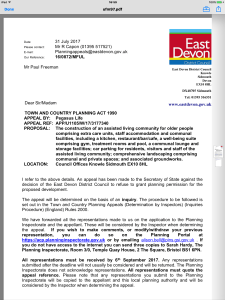
The big question is ‘what is the chance of Pegasus winning an appeal?’
Probably not that great:
The application is for more than a hundred units when the Local Plan allocation is for fifty.
The application does not include any affordable.
The application is opposed by Sidmouth Town Council and a large and vociferous group of local residents.
Most importantly, the Planning Consultants at the time of the provisional sale to Pegasus foresaw that the application would be refused. So did the Planning Team, who miraculously changed their minds when the application came forward. Both EDDC and Pegasus were warned in advance that the Development Management Committee could not approve the application. Remember: this information came into the public domain as a result of the successful Freedom of Information request.
If the application goes to inquiry, as seems likely, then we, and EDDC, will have to wait for 24 months with little confidence that the appeal will be successful.
Then comes the situation of ‘what happens next?’ Well, we know the answer because Grant Thornton have helpfully predicted four scenarios, all of which will lead to receipts well below the price currently agreed with Pegasus.
The whole process would have to begin again, against a backdrop of a planning appeal refusal. New tender, new negotiation, new design, new application, and perhaps even another refusal.
Eventually an application will succeed, and a sale result, but we could easily be four years down the road, and at a substantially reduced price in possibly a very different property market.
It is interesting that all scenarios put to the Scrutiny, Audit and Governance and Overview Committee take no account of depreciation on the Honiton HQ.
The committees might want to request the attendance of internal and current external auditors KPMG at their joint meeting, as the relocation finance paper was, for some reason, compiled by former external auditors Grant Thornton.
Click to access 180417-a-and-g-and-s-and-overview-agenda-combined.pdf
page 10
“Most coverage of local government finances falls into two categories of story. The first concerns the egregious rewards paid to “town hall fat cats” for often mediocre performance. The other concerns “savage cuts” being made to this or that service due to a reduction in central government grants.
There is truth in both of these. What has not gone reported so much is that a genuine revolution in local government finance is under way.
The traditional model of financing, in which grants are doled out by central government, is gradually being replaced by a system in which councils, collectively, are self-funding and individual councils bear more risk as a result of their own spending and revenue-raising decisions.
Some of these reforms have already attracted attention, chiefly the changes to business rates, over which individual councils will have greater, but still limited, autonomy in future.
Another big change coming has attracted surprisingly little attention. The UK Municipal Bonds Agency (UKMBA) was launched in 2014 with the aim of helping councils to finance their spending. The agency, a public limited company owned by 57 local authorities and the Local Government Association, aims to issue bonds with maturities of between ten and twenty years. Because it is backed by a number of councils who have pooled their borrowing requirements, the theory is that it should be able to create “benchmark” size issues for which there should be greater demand from institutional investors. And because more than one party is responsible for repayment of the bond and servicing the interest payable on it, a “joint and several guarantee” in the jargon, in theory the bonds should be less risky to investors. That should also, in theory, lower borrowing costs for councils.
The idea is common elsewhere. Kommune Kredit has been operating in Denmark for more than a century, while BNG in the Netherlands has been going since 1914. Kommunalbanken has been funding local authorities in Norway for 90 years; other such funding agencies exist in Canada, New Zealand and Switzerland, among others.
One of the key aims of UKMBA is to allow local authorities to borrow more cheaply than the existing lender of choice, the Public Works Loan Board (PWLB), a 224-year-old body that currently accounts for about three quarters of local authority borrowing. Traditionally, the board has charged 20 basis points above the prevailing gilt rate but in October 2010, in an attempt to discourage borrowing by local authorities, the coalition government raised this to a 100 basis points premium.
The board now, in most cases, lends to local authorities at 80 basis points over the gilt rate. It was when the cost of borrowing from the board was increased that leading figures in the local government world began to talk about an alternative finance provider.
Aidan Brady, the former Deutsche Bank chief operating officer who is chief executive of the UKMBA, is on record as saying: “Clearly, we have to beat the Public Works Loan Board [in terms of offering a cheaper rate], that’s as simple as it gets.”
The irony is that just as the new agency is about to offer some proper competition to the board disquiet is growing about the extent to which local authorities have been borrowing from the latter.
The Sunday Times reported last weekend that a number of local authorities had gone on a “£1.3 billion binge” of buying commercial property with the aim of using rental incomes from those assets to supplement spending or reduce the extent of budget cuts they would otherwise be making. The danger is that these authorities have exposed themselves and future generations of council tax payers to swings in the commercial property market. Traditional property market buyers have been astonished at the prices paid for assets such as some sub-prime shopping centres, grumbling that local authorities are distorting the market.
This has been made possible over recent years because by linking the PWLB loan rate to the gilt rate and allowing the latter to be depressed by the Bank of England’s asset purchase scheme the government has created a “carry trade” opportunity for local authorities in which they can borrow at about 2 per cent and invest the proceeds in an asset yielding between 6 per cent and 8 per cent.
None of this has made the job of the fledgling UKMBA any easier. The agency was reported as long ago as June last year to have signed up nine local authorities to participate in the first debt issue, which was expected by the end of 2016, with a panel of eight banks, including three to act as “lead runners”, in place to run it. But no issues have yet taken place. Market sources suggest that this is because the agency is still waiting on one more council to sign off on its participation.
This ramp-up in local authority activity could be because the PWLB, which is currently an arm of the Debt Management Office — the Treasury agency that issues gilts and manages the national debt, is about to be absorbed into the Treasury, which may lead to more control being exerted on its future lending. That was certainly suggested in a government statement last year noting that transferring the PWLB back into the Treasury would “secure greater accountability to ministers and enhance the efficiency and effectiveness of central government lending to local authorities”.
In other words, local authorities are borrowing now, while they can. The sooner they are subjected to either greater Treasury scrutiny on the one hand or the superior credit checks being promised by the UKMBA on the other, the better.“
The Times Comment (paywall)
So Mark Williams says that ‘We have an asset that will appreciate in value’.
First of all, it may not, but more importantly, the increasing value of the Knowle as an asset has always been excluded from EDDC’s calculations.
Finally, after seven or eight years, EDDC have recognised that the Knowle is a capital asset that is likely to increase in value.
Even when the figures were manipulated to show the move as ‘cost neutral’, that façade was only maintained because the value of the Knowle (at least £7.5 million) was equated to the value of the new HQ at Honiton (valued by JLL at £2-3 million). Since then, of course, ‘cost neutral’ has gone out of the window.
So we now have the proceeds of sale = £7.5 million – possibly, assuming in these trying times a sale is even possible.
Cost of replacement buildings = £10 million (Honiton) + Exmouth £1.7 million + Manstone £1 million = £12.7 million.
Net loss £5.2 million.
Plus new road at Honiton = £225,000.
Plus admin costs to date = £2 million.
Plus costs of moving = say £3 million. (New equipment, staff compensation, etc.
Plus loss of asset value = £7.5 million – £2.5 million = £5 million.
Total loss is now in this scenario about £15.5 million.
This is all to achieve gains in running costs. However, estimates for Manstone were never included. The cost of running three HQs rather than one will be higher because of increased travelling, and commuting between sites.
Were Option 3 to be pursued, and the modern buildings improved at a cost of £1 million to £1.5 million, then the ‘new’ Knowle would be a very cheaply run building.
The £2 million already spent on admin cannot be recovered, so that is a sunk cost.
So pursuing Option 3 would cost £12 million less, and almost certainly reduce running costs. And leave EDDC with a far nicer building than a cheap and uninspiring shed of offices on an industrial estate at Honiton.
The above assumes that EDDC’s numbers are correct, but we all know that the cost of relocating will rise as the scheme is pursued, and we no longer have the guarantee of Pegasus money coming through. Plus, of course, EDDC may feel the need to employ even more consultants!
So, we will not see any change out of £20 million. And there will be no savings as to running costs compared to Option 3.
All this at a time of local government reorganisation.
Real numbers: not EDDC’s strongest point …
DANGEROUS! DANGEROUS! DANGEROUS!
If/when it all goes pear-shaped, WE the council tax payers will not only foot the bill but see services cut – as interest payments on a loan will take precedence over services.
AND what happens when (as seems almost certain) “Greater Exeter” or Devon becomes a unitary authority? There will be no need for vanity project buildings which will be expensive white elephants as a glut of un-needed council properties hit the market.
Basically, EDDC is squandering OUR money. Disgraceful.
AND WHERE ARE THE INTERNAL AND EXTERNAL AUDITORS REPORTS ON THIS HIGH-RISK STRATEGY? Is EDDC ploughing ahead yet again with incomplete legal and financial information?
“Sidmouth representatives slammed the ‘cavalier’ decision to borrow money to fund the move to Honiton and Exmouth – but East Devon District Council’s (EDDC) top officers said there is greater risk in standing still.
Cabinet members were given the options of borrowing cash to ‘go now’, waiting for the outcome of developer PegasusLife’s planning appeal after it offered £7.5million for Knowle, or staying put and modernising the former hotel or its offices, together with a refurbished Exmouth Town Hall.
Speaking at Wednesday’s meeting, Sidmouth councillor Cathy Gardner said: “If you commit to borrowing a large amount of money at taxpayers’ expense, you aren’t in control. You are in more control when you know the outcome of the planning appeal.
“These figures aren’t certain. These are just estimates based on assumptions.”
She questioned if the officers had costed staying at Knowle, selling off part of the site and marketing its Heathpark plot in Honiton to another developer.
Councillor Marianne Rixson, who also represents Sidmouth, said EDDC was taking a ‘cavalier approach’ to spending taxpayers’ money, adding: “Any future developer will know you are desperate and will not match the price offered by PegasusLife.”
EDDC originally promised the relocation would be ‘cost neutral’, it would not borrow money and the project would not progress before Knowle was sold.
But chief executive Mark Williams disagreed, saying the ‘go now’ option ‘derisks planning’, while delaying ‘increases risk’. He added “We have an asset [Knowle] that will appreciate in value.”
Officers said pressing ahead with the relocation to Honiton’s Heathpark and Exmouth Town Hall is the most cost-effective option and could make EDDC £1.4million better off over 20 years.
If it chooses to delay the project so planning permission for Knowle can be secured, it could be £400,000 better off than it is now.
In contrast, members were told if they chose the ‘go minimum’ option – giving up on the new-build Honiton HQ, completing the refurbishment of Exmouth Town Hall and modernising a section of Knowle for £11.3million or £5.9million – they would be £4.5million worse off. There is no capital receipt to fund the modernisation.
Cllr Tom Wright said: “There has been a lot of talk about uncertainty. This building is unfit for purpose. Moving is not a vanity project. It’s to improve what we can do. If we stay here, it’s money down the drain. This building is useless for the 21st Century. This land isn’t going to lose value.”
The ‘go now’ option won the support of cabinet members but is now set to be considered by a joint meeting of the overview, scrutiny and audit and governance committees on April 18.
It will then go before the full council.”
“After a career as an investment manager at HBOS, the bank that had to be bailed out by Lloyds during the financial crisis, Donna Jones became leader of Portsmouth city council in 2014. It was a time of belt-tightening, with the prospect of government funding for local authorities drying up altogether by 2020.
“It was clear to me we had to start running councils like businesses,” said the 39-year-old Conservative councillor. “To survive during the austerity programme, the only way to protect high-quality public services was to go out and generate income. We’re not moving to fortnightly bin collections or closing any libraries, swimming pools or museums.”
She has been true to her word. The council is now selling back-office facilities, such as human resources and IT support, to charities and smaller councils. It has leased the naming rights to the Spinnaker Tower, the city’s 560ft-high landmark, to Emirates airline.
Portsmouth’s local authority has also amassed a commercial property portfolio — most of it many miles away from Fratton Park football stadium, HMS Victory and Southsea Castle.
Using £110m of debt, Portsmouth has so far bought properties including a DHL distribution centre near Birmingham, a Waitrose store in Somerset and a Matalan warehouse in Swindon. In December, it sold a long lease on the Wightlink ferry terminal to the insurer Canada Life for £73m. The proceeds will be used to raise the portfolio’s size to more than £180m.
Jones said the deals were already producing £4.9m of annual income after interest. Combined with other measures, that means only £900,000 of the £9m budget cuts that Portsmouth must implement in the coming year will have to be passed on to residents through service reductions, she said.
Across England, other councils are doing the same. Empowered by the 2011 Localism Act and funded by cheap loans from an obscure subsidiary of the Treasury, 49 local authorities went on a £1.3bn property buying spree last year — spending far more than the £142m recorded in 2015.
However, there are growing concerns in the private sector and parts of Westminster that government grant cuts, coupled with generous lending by the Public Works Loan Board (PWLB), are encouraging councils to take risks they do not properly understand — in an asset class that is more volatile than many realise. Most of the property deals have been 100% funded with debt, leaving both councils and the Treasury exposed to immediate losses if values fall.
William Hill, the former head of property at the fund manager Schroders, warned in January that councils were “behaving like hedge funds exploiting a financial arbitrage”. He questioned why the government was lending to local authorities “to buy real estate on terms that make bank lending to the property sector before the [great financial crisis] look positively conservative”.
Sam Resouly, a partner at the investment firm Trinova Real Estate, said the trend had caused “distortion” in the market, with the PWLB giving councils an advantage over other bidders. He added: “If they buy 10 years’ income, they have to accept that as 10 years goes to zero, they’re going to get a rapid deterioration in the value of that asset. At some point they’re going to have to spend money to get it up to standard, and what happens to councils’ accounts then?”
One management consultant, who did not want to be named, said: “It’s hard to see why councils aren’t just the dumb money in the property market.”
The borough council of Spelthorne, a patch of the Surrey commuter belt that is home to 95,000 people, had the dubious honour of doing Britain’s biggest local authority property deal last year. It boasted of outbidding “national and international” investors to buy BP’s Sunbury office campus for £360m. The complex has been leased back to the oil major for 20 years, yet Spelthorne financed its purchase with a 50-year fixed-rate loan from the PWLB.
Although the council is paying down the loan year-by-year — unlike most other PWLB borrowers, which pay interest only — the mismatch raises the possibility that Spelthorne will be on the hook for repayments on an empty building in 20 years, when BP’s lease runs out.
Terry Collier, deputy chief executive of the authority, said it had taken out a 50-year loan because “it was just the way the financing worked best for us”.
He said BP had been on the site for 100 years, and was an important local employer, but added: “We wanted to secure a key site within the borough which was 3½ miles from [Heathrow] Terminal 5. Regardless of what BP do long term, that’s a valuable site, and we obviously did our options analysis around various scenarios.”
Spelthorne took confidence from the fact it was advised by Cushman & Wakefield, a well-known property agent. Cushman, however, is likely to have received a seven-figure fee, based on typical industry contracts, meaning it was hardly incentivised to advise against the deal.
Of the 76 council property transactions last year, 58 involved authorities buying within their own geographic area, according to a report by the consultancy CBRE. Spelthorne’s purchase added £3m a year to its annual £13m income after interest costs, but also gave the council control of what it called a “strategic” local site. Similarly, Canterbury council in Kent spent £79m on 50% of the city’s Whitefriars shopping centre, with the dual aim of generating income and improving the mall, and Surrey Heath bought up a chunk of Camberley town centre for regeneration.
There were 18 instances of councils venturing beyond their boundaries for deals, apparently driven entirely by the hunt for investment yield. Tony Martin, a director at CBRE, played down the significance of this, saying there was “only a very small number who will do it”, but the trend among the likes of Portsmouth seems to be accelerating. Some are even considering going overseas.
East Hampshire is one. It was the only authority in England to announce a council tax cut this month. The council leader, Ferris Cowper, a former director of the confectionery giant Mars, believes the authority could scrap the tax altogether within five years despite the loss of central government grants.
As well as making money selling services such as planning and regeneration advice, Cowper has built a £24m property portfolio that produces more than £2m a year after costs.
He is in the process of negotiating £200m of new loans, at least half of them from the PWLB, to ramp up East Hampshire’s activities. Those borrowings would amount to eight times East Hampshire’s annual budget of £25m. “That will be for opportunities nationally and, depending on the yield and risk profile, internationally too,” said Cowper, who plans to remain a cabinet member to oversee the strategy.
At the heart of this property boom is the PWLB, a body set up in 1793 to lend councils money for sanitation works. It now gives them access to cash from the National Loans Fund for “capital projects” — in theory, building and infrastructure — and has a balance sheet of more than £65bn.
The PWLB allows authorities to raise finance at sovereign prices: according to its website last week, £100m from the PWLB over 20 years would cost a council just 2.2% annually. The equivalent private sector rate would be 4% to 5%.
The process is surprisingly simple. Since Sir Eric Pickles, the former communities secretary, abolished the Audit Commission, councils have set their own borrowing levels based on the Chartered Institute of Public Finance’s prudential code for capital finance without close supervision by the government.
Provided a council can assure the PWLB it is operating within its limit, which is agreed every year by the cabinet and signed off by its finance director, it can borrow as much as it likes without telling the PWLB the purpose of the loan. The PWLB lends to the council without taking security over the asset.
Councils’ interest payments must be paid ahead of their other commitments, such as spending on services, although the current spread between the PWLB’s rates and property yields means they can service the debt and keep a profit.
A parliamentary report last year noted that changes to the PWLB’s early repayment charges meant that fewer councils were paying off loans early.
Henry Stannard, an associate partner at the strategy consultancy OC&C, said councils were exploiting a loophole. He suggested they were using a legal but circuitous route to “launder” money ring-fenced for capital projects into the separate part of their budgets set aside for spending on services such as adult care.
“This is not what the PWLB was set up for, and it’s not what it’s been funding for the past 200 years,” he said. “There has to be a better way of funding local government than these sorts of cheats.”
The Treasury is absorbing the PWLB and taking over its functions, although it said local authorities would “continue to be able to access loans as before”, and that interest rates would “continue to be the responsibility of the Treasury”.
For now, the multibillion- pound property gamble is set to roll on. In the words of Tony Travers, local government expert at the London School of Economics, councils’ attempts to make profits are an “intended consequence” of Downing Street’s plan to cut local authority grants by 2020 while protecting spending on defence, the NHS and pensions.
The next property market crash will test the wisdom of that policy.
Are you being served?
Councils spent £1.3bn on commercial property last year as they sought ways of generating income to make up for central government grant cuts. They are doing this with cheap loans from an arcane branch of the Treasury that is supposed to help pay for infrastructure investment.
MPs raised the alarm over the trend in November. The public accounts committee, chaired by Labour’s Meg Hillier, said the Department for Communities and Local Government appeared complacent about the risks from councils “increasingly acting as property developers and commercial landlords with the primary aim of generating income”.
The report noted that:
• councils’ spending power on services, based on government grants and council tax, fell by more than a quarter from 2010-11 to 2015-16, and is set to drop another 7.8% by 2019-20;
• councils’ spending on capital projects — building and infrastructure, but also property investment — rose by 13.6% from 2010-11 to 2015-16; and
• a “significant” number were already having to use more than 10% of the money meant for services to meet interest payments on debts.
The MPs said the department did “not have good enough information” on the pattern of property investment. They pointed out that three-quarters of councils’ capital spending was grouped under one category — hiding the shift from building libraries and museums to investing in office blocks and supermarkets for yield.
The Tory MP Richard Bacon questioned councils’ ability to build portfolios. “We all know plenty of examples of local authorities that could not run a bath or organise their way out of a paper bag,” he said, referring to the early 1990s interest-rate swaps fiasco in Hammersmith & Fulham, west London. The council amassed £6.2bn of risky derivatives bets and was saved only when the House of Lords ruled them void.
Last week, Moira Gibson, leader of Surrey Heath council, accused critics of “underestimating councils”. She said her authority used outside advisers, including Montagu Evans, to help run its £130m portfolio.”
Times Newspapers (paywall)
Full page article in today’s Sunday Times main section, page 5.
The article relates to borrowing from the Public Works Loan Board (PWLB – a Treasury outpost) from which East Devon District Council expects to borrow to pay for its new Honiton HQ, and which the article warns:
“… there are growing concerns in the private sector and parts of Westminster that government grant cuts, coupled with generous lending by the
PWLB are encouraging councils to take risks they do not properly understand- in an asset class that is more volatile than many realise. Most of the property deals have been 100% funded with debt, leaving both the councils and the Treasury exposed to immediate losses if values fall. …
… Sam Resouly, a partner in an investment firm … said the trend had caused a distortion in the market … If they buy 10 years’ income, they have to accept that as 10 years goes to zero, they’re going to get a rapid deterioration in the value of that asset. At some point they’re going to have to spend money to get it up to standard, and what happens to council’s accounts then? …
… Councils’ interest payments must be paid ahead of their other commitments, such as spending on services …
… an associate partner of a strategy consultancy said” … councils were exploiting a loophole. He suggested they were using a legal but circuitous route to “launder” money ringfenced for capital projects into the separate part of their budget set aside for spending on services such as adult care. …“
Owl says: are these audited costs or still on
“District chiefs are being advised to press ahead with their £10million relocation from Sidmouth – despite having no guaranteed buyer for their ‘not fit-for-purpose’ Knowle HQ.
East Devon District Council’s (EDDC) cabinet is being asked to sign off nearly £8.7million to press ahead with building work at Honiton’s Heathpark, on top of the approved £1,7million pot to refurbish Exmouth Town Hall.
If approved, the relocation project’s total budget will stand at £10.36million, up from £9.2million in March 2015.
Members will also be asked if they support a further £225,000 cost for an improved access road to the Honiton base when they meet next week.
EDDC originally promised that the relocation would be ‘cost neutral’, that it would not borrow money and the project would not progress before Knowle was sold.
But after refusing PegasusLife’s £7.5million bid to redevelop Knowle into a 113-home retirement community, the authority now has to decide how to proceed with the relocation.
According to cabinet agenda papers, members have three options to choose from:
• ‘Go now’ – press ahead with building in Honiton in anticipation of an acceptable combination of cash for Knowle and prudential borrowing. Work could be completed as soon as December 2018.
• Delay relocation for one to two years, or more, so planning permission for Knowle can be secured to fund the project. EDDC understands PegasusLife is preparing an appeal, which would have to be lodged before June 9.
• A ‘do minimum’ option of giving up on the new-build Honiton HQ, completing the refurbishment of Exmouth Town Hall and modernising a section of Knowle. Essential repairs to Knowle would cost £1.9million, but there is no capital receipt for this expenditure.
Councillors have been recommended to pursue the ‘go now’ option. EDDC maintains that the move will save money in the long-run.
Its development management committee refused PegasusLife’s application because it represented a departure from Knowle’s 50-home allocation in the authority’s Local Plan and due to the lack of ‘affordable’ housing.
EDDC has considered various re-marketing options for Knowle – if a PegasusLife appeal is unsuccessful – that could fetch between £3.22million and £6.8million. One scheme proposes 50 homes, half of which would be ‘affordable’, and could bring in £4.2million.
Critics have long said EDDC could remain at Knowle rather than relocate. The cabinet papers say modernising the former hotel would cost nearly £11.3million, or, for the newer offices, the bill is expected to be more than £5.9million.
The relocation project has cost £1,784,884 to date.
Cabinet members will meet to discuss the options at Knowle at 5.30pm on Wednesday (April 5).”
http://www.sidmouthherald.co.uk/news/budget_for_eddc_s_relocation_tops_10_3million_1_4955207
Owl says: no austerity cuts for our councillors – and, no, this is NOT an April Fool joke – unfortunately.
“The Deputy Chief Executive – Development, Regeneration and Partnerships is delegated authority, in consultation with the Office Accommodation Executive Group, to commence works and deliver the new HQ building.
A budget is agreed of £8,692,000 to provide a new HQ building at Honiton Heathpark, which when added to the approved Exmouth Town Hall refurbishment budget of £1,669,000 gives a total gross budget of £10,361,000.
If Cabinet agrees that it wishes to relocate to a new HQ in Honiton then Cabinet is asked whether it wishes to recommend approval of a further sum of £225,000 to fund the addition of a direct access road to the new HQ building past the East Devon Business Centre This is a more direct approach to the building rather than bringing traffic through the Heathpark business park south of the building and does not affect the conclusions in this report in relation to viability and ranking of options for the sale of the Knowle site.”
Freedom of Information Question:
“Could you provide me with the full and exact costings for this planning application; the building costs of the new offices; and where the finance for this project is coming from
Answer:
Full and exact costings are not yet known. We have a working estimate which indicates that the cost of this element of the project is likely to be between £71,750 and £106,750 but, as we will soon be securing bids for this work, we are not prepared to disclose our budget estimate breakdown as this will seriously weaken our contract negotiating position and our ability to achieve best value for the work needed. We are withholding this information under Reg 12(5)(e) of the Environmental Information Regulations. We believe that the overall budgetary cost being in the public domain allows for the public interest in this matter to be adequately served.
This is an existing costed element of the relocation project and £100,000 is included within the overall re-location budget for this project and was in the budget when considered by the Council back in March 2015.”
It seems EDDC is VERY reluctant to answer any FoI requests relating to relocating its HQ:
https://www.whatdotheyknow.com/body/east_devon_district_council
What’s the problem? It can’t be the old chestnut “commercial confidentiality” as the project has not been tendered so there is no outside commercial involvement.
Requests now cover not only Knowle but also the massive cost overrun at Exmouth and the added costs of relocating the Estates Department to Manstone Depot.
From one HQ to an HQ and two satellites. All against a background of massively increasing costs, decreasing availability of skilled labour and no plan for how it will be financed after PegasusLife failed to get its planning permission.
Hundreds of thousands of pounds already spent (excluding officer costs which are never added in), expensive days in court losing to the Information Commissioner.
What is being concealed?
Owl says: Vanity projects – imagine how much we could spend on necessities if they were all abandoned! Hinkley C, HS2, the Big Society, EDDC relocation, Exmouth “regeneration”, Devon and Somerset devolution …!
“A publicly funded £1bn “big society” project set up by former prime minister David Cameron to restore values of responsibility and discipline among young people has been criticised by MPs for lax spending controls and poor management.
The Commons public accounts committee (PAC) said the National Citizen Service (NCS) trust lacked appropriate governance arrangements, could not justify its high costs, and was unable to prove whether its courses had any long-term impact on youngsters.
Meg Hillier MP, chair of the PAC, said: “We urge the trust and central government to review fundamentally the way NCS is delivered and its benefits measured before more public money is committed in the programme’s next commissioning round.”
MPs said that the scheme – which has received £600m in government funding since 2011 and stands to get another £900m investment over the next two years – should be “fundamentally reviewed” by ministers.
Hillier said although there was some evidence the scheme had a short-term positive impact on participants this did not in itself justify the high level of public spending on the programme, nor demonstrate that it would deliver the proposed benefits.
The PAC report criticised the trust for refusing to disclose directors’ salaries, and accused it of a “lack of discipline” after failing to recover £10m paid to providers for unfilled places. It concluded that it was unclear whether the trust management had the necessary skills and experience to run the scheme. …”
This case has direct ramifications for Exmouth regeneration and Knowle relocation.
“… The lengthy hearing, held independently of the government at Exeter Magistrates’ Court from 10am, was attended by members of the public, city councillor’s and members of the council. It continued into the afternoon with closed sessions which discussed the information in question.
The Information Tribunal was adjourned pending further information to an, as yet, unspecified date after the Judge heard in-part from both sides.
The appellant, Exeter City Council, is battling against the Information Commissioner’s decision that it should publish the details for the business case for the £27 million leisure complex development on the site of the current Bus and Coach Station.
Joined Party, Exeter resident Peter Cleasby, had submitted a Freedom of Information Act request for the details last year, so it could be open to wider scrutiny before contracts were signed. The Council refused on grounds of commercial confidentiality, and Mr Cleasby complained about its refusal to the Information Commissioner.
The Commissioner ordered key information in the business case to be made public, but the council appealed against the Commissioner’s decision. Peter Cleasby added: “Wider scrutiny and challenge of the business case assumptions is vital.”
Before the hearing, a city council spokesman said: “The Council will make its case before the Tribunal. It would be inappropriate to comment further ahead of the hearing.” The council say they are unlikely to comment until a decision is made in the coming weeks.
The development of St Sidwell’s Point has been put on hold because the council has not appointed a contractor. An Extraordinary Meeting of the Council, to direct questions about the delay, will be held at Exeter Guildhall at 6pm on Tuesday. March 21 – after being called in by political opposition.”
 East Devon Watch