BREAKING: Court Order shows Boris Johnson misled Parliament over Covid contracts – Good Law Project

3 days after the High Court ruled Government had acted unlawfully by failing to publish Covid contracts, Boris Johnson stood up in the House of Commons and reassured MPs and the public that all Covid-related contracts were “on the record”. However, the final Order handed down by the Judge today shows that what the Prime Minister told the House was not true. 

goodlawproject.org

The Judge confirmed:

“The Defendant has published 608 out of 708 relevant contracts for supplies and services relating to COVID-19 awarded on or before 7 October 2020. In some or all of these cases, the Defendant acted unlawfully by failing to publish the contracts within the period set out in the Crown Commercial Service’s Publication of Central Government Tenders and Contracts: Central Government Transparency Guidance Note (November 2017).”

Remarkably, the Judge’s Order is based on Government’s own figures – so at the same time as Johnson was falsely reassuring MPs, Government lawyers were preparing a statement contradicting him – revealing 100 contracts and dozens of Contract Award Notices were missing from the public record. You can read the final Court Order here and consequential judgment in full here. 

Over the course of our judicial review, Government made no less than four attempts to provide an accurate witness statement setting out the number of contracts and Contract Award Notices that had been published late – and they kept getting it wrong. As late as the hearing itself, they said they had published 28% of Contract Award Notices within the 30 day legal limit. 

But when asked by the Judge to follow up with evidence of the figures so he could make his final Order, it transpired that Government had actually only published 3% of CANs in the legal timeframe. 

Government has not only misled Parliament and placed inaccurate information before the Court, it has misled the country. 

Unless contract details are published they cannot be properly scrutinised – there’s no way of knowing where taxpayers’ money is going and why. Billions have been spent with those linked to the Conservative Party and vast sums wasted on PPE that isn’t fit for purpose. 

We have a Government, and a Prime Minister, contemptuous of transparency and apparently allergic to accountability. The very least that the public deserves now is the truth. 


It is only with your support that we can continue to hold Government to account. If you would like to make a donation, you can do so here.

Vandal damages public toilet in Budleigh

This is totally shocking.

East Devon, over the past year, has spent an exorbitant sum of Council Tax money on rubbish collection and toilet cleaning, up to three times a day, during the pandemic, with little benefit coming to the tourist industry.

This is an affront to us all.

Sam Sterrett www.radioexe.co.uk 

Photo: East Devon District Council

The facility in Budleigh has been closed

A public toilet at Limekiln, in Budligh, was criminally damaged last week. The photo above shows the full extend of damage, with pieces of the toilet shattered across the floor.

East Devon District Council, who shared the post via Facebook, were forced to close the toilet. The said they currently have no date for repair – but they’ll update the public once they do.

If you have any information regarding the vandalism, please report to Devon and Cornwall police via 101.

Devon areas where more than half of all adults have had vaccine

More than half of all adults in East Devon, Torbay and West Devon have now had their first Covid-19 vaccine.

Daniel Clark www.devonlive.com 

The statistics, which provide the position as of February 28, show that there have been 461,165 vaccines delivered in Devon, with 445,074 of them being the first dose. Just under 50,000 vaccinations were carried out in the last week.

Across the whole of Devon, which will have risen in the most recent days, are by far the highest number of vaccinations for any of the regions within the South West and they show that 44.5 per cent of the adult population had received their first jab. This is up on the 39.1 per cent as of February 21.

In Cornwall, 216,072 people have had their first dose of a Covid-19 vaccine, 46.8 per cent of the adult population, up from 39.3 per cent as of last week.

The statistics show that as of Sunday, in Devon, 99.6 per cent of over 80s, 100 per cent of 75-79s, 95.6 per cent of 70-74s, and 79.4 per cent of 65-69s had received one dose, based on the 2019 ONS population estimates.

In Cornwall, 98.4 per cent of over 80s, 100 per cent of 75-79s, 94.7 per cent of 70-74s and 83.9 per cent of 65-69s had their first vaccine.

Of the total population of Devon, 16,091 people, 1.6 per cent of adults, have also had their second dose, with 11,325 in Cornwall, 2.4 per cent of adults.

And figures also show the number of vaccines that have been delivered in each local authority, as well as in the MSOA area.

In every single local authority in Devon and Cornwall, more than a third of all adults have had at least one dose, and in East Devon, Torbay and West Devon, it is more than half.

Of the adult population, 46.8 per cent in Cornwall, 52.6 per cent in East Devon, 35 per cent in Exeter, 46.8 per cent in the Isles of Scilly, 43.8 per cent in Mid Devon, 48.4 per cent in North Devon, 38.9 per cent in Plymouth, 48.6 per cent in South Hams, 48.5 per cent in Teignbridge, 50.2 per cent in Torbay, 48.9 per cent in Torridge, and 53.4 per cent in West Devon, have had one dose. These figures are as of February 28 and so will have risen in recent days.

Nurses’ union anger over ‘pitiful’ 1% NHS pay rise

The government can expect a “backlash” if it goes ahead with a proposed 1% pay rise for NHS staff in England next year, a nursing union has warned.

Is the Government Tone Deaf? – Owl

www.bbc.co.uk 

The health department has made the recommendation in a submission to the independent panel that advises on NHS salaries.

The Royal College of Nursing called the suggested rise “pitiful” and said nurses should be getting 12.5% more.

NHS staff have been excluded from a pay freeze for most public sector workers.

The NHS Pay Review Body is due to recommend salary levels for health service staff before early May, before ministers then make a final decision.

In its submission, the health department said awarding NHS staff a “headline” pay increase of more than 1% “would require re-prioritisation”.

Health department officials said the Covid pandemic had placed a “huge strain” on NHS finances, whilst the economic outlook “remains uncertain”.

They added that this increase was still above the CPI rate of inflation, whilst some staff would see a higher rise under a previously agreed three-year deal.

Some 1.3 million public sector workers will see a pay freeze next year, while those earning less than £24,000 guaranteed a pay rise of at least £250.

image captionThe PM and his fiancee Carrie Symonds outside 10 Downing Street joining in clap for carers in May

Speaking on BBC’s Question Time, Business Secretary Kwasi Kwarteng said he was sure the pay round “has been discussed and established at the right level”.

“No one is doubting that the NHS hasn’t been absolutely first class in this pandemic. What I am suggesting is that the whole economy has been under pressure,” he added.

But Labour said a 1% increase for NHS staff was “the ultimate kick in teeth to our NHS heroes who have done so much to keep us safe over the past year”.

The party’s shadow health secretary Jonathan Ashworth said staff “deserve a fair pay rise,” adding the proposal was “an absolute insult”.

2px presentational grey line
Analysis box by Hugh Pym, health editor

NHS pay in England has been out of the news since 2018 when a three year deal was agreed and welcomed by unions.

But the issue is firmly back on the agenda with a new deal needed for the upcoming financial year.

This is just the start of the process.

The government has made its submission to the NHS Pay Review Body. But the fact that ministers think a 1% pay rise is reasonable has angered health unions.

They see it as scant reward for the huge efforts of staff during the pandemic.

Government sources say that inflation is so low that 1% still represents a real terms increase and that public finances are constrained.

This is shaping up to be a tense few months with pay added to the many difficult issues facing the NHS.

2px presentational grey line

RCN Chief Executive Dame Donna Kinnair said the government was “dangerously out of touch with nursing staff, NHS workers and the public”.

“Nursing staff would feel they are being punished and made to pay for the cost of the pandemic. It is a political decision to underfund and undervalue nursing staff.

“With the time remaining before the Pay Review Body recommendation, the government can expect a backlash from a million NHS workers. Taxpayers are supportive of a significant and fair pay rise for NHS workers – this year of all years.”

One nurse, Carmel O’Boyle, said she was “disgusted”.

“We just want something that reflects the work that we do. We want a fair wage and I don’t think the government understands at all what the nursing workforce does,” she said.

“I understand it is a very difficult year for the whole world… but this is a political decision,” she added.

The British Medical Association (BMA) said the recommendation was “a kick in the teeth”.

Its chair of council, Dr Chaand Nagpaul, accused the government of a “total dereliction” of its “moral duty and obligation to a workforce that is keeping the NHS on its feet and patients alive”.

He said: “Throughout the pandemic, doctors have cared for more critically ill patients than was ever thought possible and worked round the clock despite suffering from extreme stress and exhaustion.

“The government should demonstrate that it recognises the contribution of a workforce that has literally kept this country alive for the past 10 months.”

A government spokesperson said they would “consider carefully” the recommendations made by the NHS Pay Review Body when it reports in the spring.

The government “will continue to provide pay rises for NHS workers”, despite the wider freeze on pay in the rest of the public sector, the spokesperson said.

They added multi-year pay deals had delivered a pay rise of over 12% for newly qualified nurses, and will increase junior doctors’ pay scales by 8.2%.

Tell the government to extend FOI to contractors

The Freedom of Information (FOI) Act is essential to holding the government accountable. But it’s being undermined by a major loophole: it doesn’t apply to government contractors.

go.cfoi.org.uk

Will you help get FOI extended to government contractors?

The Freedom of Information (FOI) Act is essential to holding the government accountable. But it’s being undermined by a major loophole: it doesn’t apply to government contractors.

Since the Act was passed, outsourcing has vastly expanded. Government now spends £292bn a year buying goods and services – more than a third of all public expenditure. Private companies like Serco, G4S and Capita receive millions of pounds of taxpayers’ money, but because they’re not subject to FOI we can’t properly hold them to account.

During the pandemic £10.5bn of government contracts were awarded without competitive tender and hundreds of millions was spent on “potentially unsuitable” PPE according to the National Audit Office, the spending watchdog. It also found that suppliers with political connections were 10 times more likely to receive government contracts.

Access to contractor-held information depends on the public authority and contractor agreeing to clauses in the contract which permit it – a totally unacceptable situation that allows vital information to be withheld from the public.

We think the FOI Act should be extended to cover all contractor-held information via an FOI request to the public authority. Major contractors should be required to answer requests directly.

Support for bringing contractors under FOI has come from:

  • The Information Commissioner, who enforces the FOI Act. 
  • The House of Commons Public Administration & Constitutional Affairs Committee 
  • The House of Commons Public Accounts Committee 
  • The Committee on Standards in Public Life 
  • The government appointed Independent Commission on Freedom of Information 
  • The UK Anti-Corruption Coalition, which brings together 18 of the UK’s leading anti-corruption organisations 
  • The Open Government Network of civil society organisations

But we need to show there is huge public support for it too. This is where you can help:

Thank you!

Katherine Gundersen

Campaign for Freedom of Information

Tories accused of levelling up ‘stitch-up’ over regional deprivation fund

A fund intended to boost the UK’s most deprived places appears overwhelmingly skewed towards Tory-held areas, with dozens of Conservative regions in the top tier for assistance despite being relatively affluent, a Guardian analysis has found.

Peter Walker www.theguardian.com

Among 93 English regions placed in the priority group of three tiers to receive money from the £4.8bn levelling up fund, 31 are included while not being ranked as in the top third most deprived places by average deprivation score.

Of these 31, 26 are entirely represented by Conservative MPs, with the others having at least one Tory MP.

Among the remaining five is Canterbury, is a highly marginal Labour-Conservative seat.

Labour described the way the fund was allocated as “divide and rule”, and called on ministers to publish the criteria for the tiers. One MP whose area was excluded from the top tier called the decision “a stitch-up”.

Four places are in the uppermost level for funding despite being ranked in the bottom third of English regions by deprivation score, the analysis found. All those areas have Conservative MPs.

One area is Richmondshire in North Yorkshire, where the local MP is Rishi Sunak, the chancellor, whose own department is leading work on the fund. This is among the top fifth of most prosperous places in England by the average deprivation score.

The analysis will add weight to complaints about “pork barrel politics” within Sunak’s budget on Wednesday. It included money for two other funds, both of which appear also to lean towards Conservative-held areas.

The chancellor announced £1bn in extra money for an existing towns fund, intended to help struggling areas. Of the 45 new grants unveiled this week, 39 will go to towns with a Conservative MP.

Finally, a community renewal fund, with a total spend of £220m, will also benefit Sunak’s Richmondshire region. In all, seven areas represented by cabinet ministers are among the 100 areas targeted for help.

Dan Jarvis, mayor of the Sheffield city region and the Labour MP for Barnsley Central, said the government’s treatment of the levelling up fund was “symbolic of their divide and rule approach”, noting that while Richmondshire was in the top level, Sheffield and Barnsley – both of which have notably higher deprivation levels – were in tier 2.

Jarvis called for the funding metric to be published: “It’s yet again proof that this government’s actions are levelling South Yorkshire down, pushing our region and some of the poorest places in the north to the back of the queue for investment.”

Paul Dennett, the Labour mayor of Salford, said he could not understand why his city was tier 2 for the fund: “Salford is the 18th most deprived area in the country according to government’s own index of multiple deprivation. We would have fully expected Salford to have been included in category 1.”

While the levelling up fund also covers Scotland and Wales, deprivation statistics between the nations are not directly comparable, meaning the Guardian analysis only covers England.

However, Plaid Cymru’s Westminster leader, Liz Saville Roberts, said she could not understand why Gwynedd, in north-west Wales, which includes her Dwyfor Meirionnydd constituency, was put in the lowest tier for help, saying that earlier EU funds prioritised it as among the least developed areas in Europe.

She said: “Our public money is being snatched for the budget of Tory bungs. This is not levelling up but a stitch-up.”

Boris Johnson was asked on Thursday about the allocation of the towns fund towards Conservative seats, arguing that his party’s win in the 2019 election meant “there are a lot of Conservative-represented towns”.

Speaking to reporters on a visit to Teesport in north-east England, he said: “I’ve asked about this and I’m told that the criteria was entirely objective – it takes in data on poverty, employment and so on.”

The row has been exacerbated by apparent confusion in government over how the decision to allocate spending had been made.

While Sunak had told a post-budget press conference that the metric was “based on an index of economic need, which is transparently published”, an apparent reference to the levelling-up fund, the fund’s official prospectus, says this information is coming “shortly”. Treasury sources were unable to say how long this might be.

A Treasury spokesman said: “The bandings do not represent eligibility criteria – and money will be allocated to the areas most in need. Further technical details will be published by the government in due course.”

The metrics for the towns fund also appear somewhat open to interpretation. While a wider pool of 541 eligible towns was selected based on official deprivation levels, further selection was down to factors including what was called “strategic alignment with government priorities”, investment opportunities, and other indicators of need.

Similarly, the formula for deciding who received money from the community renewal fund was also somewhat qualitative, based on an assessment by the housing ministry of seven “strategic fit considerations”.

Towns Fund recipients March 2021 – but don’t bother looking for anything local

(Unless your’e “three homes” Robert Jenrick MP for Newark)

Ministry of Housing, Communities & Local Government www.gov.uk

This list consists of 45 of the 101 Towns Fund areas who have had their funding confirmed at part of Budget, announced by the Chancellor on Wednesday 3 March 2021. Funding equates to £1.02 billion in total.

[A National Audit Office report released in July revealed 61 of the 101 towns in the original list were chosen by ministers led by Communities Secretary Robert Jenrick – and all but one of these were either Tory-held seats or targets, including his own of Newark. Meg Hillier, chair of the powerful Commons Public Accounts Committee, accused the Government of “cherry-picking” which areas received funds. So the “cherry-picking” has become even more selective. – Owl]

TownOffer
Bolton£22.9m
Boston£21.9m
Bournemouth£21.7m
Burton-upon-Trent£22.8m
Carlisle£19.7m
Castleford£23.9m
Cheadle£13.9m
Clay Cross£24.1m
Colchester£18.2m
Crawley£21.1m
Goldthorpe£23.1m
Great Yarmouth£20.1m
Grimsby£20.9m
Ipswich£25m
Kidsgrove£16.9m
Leyland£25m
Lincoln£19m
Lowestoft£24.9m
Mablethorpe£23.9m
Mansfield£12.3m
Margate£22.2m
Middlesbrough£21.9m
Milton Keynes£22.7m
Morley£24.3m
Newark£25m
Northampton£25m
Nuneaton£23.2m
Preston£19.9m
Rochdale£23.6m
Rowley Regis£19m
Scarborough£20.2m
Scunthorpe£20.9m
Skegness£24.5m
Smethwick£23.5m
Southport£37.5m
Staveley (Derbyshire)£25.2m
Stevenage£37.5m
Stocksbridge£24.1m
Swindon£19.5m
Thornaby-on-Tees£23.9m
Wakefield£24.9m
West Bromwich£25m
Whitby£17.1m
Wolverhampton£25m
Workington£23.1m

The yawning Gap – Social Care: What the Budget is missing

Boris Johnson 2019: “And so I am announcing now on the steps of Downing Street that we will fix the crisis in social care once and for all with a clear plan we have prepared. To give every older person the dignity and security they deserve…”

Just another of “those” Tory promises – Owl

www.spectator.co.uk

If Daniel Defoe had been writing about modern budgets, he would have adapted his famous saying to include the certainty of death, taxes and an absence of a long-term plan for adult social care. Once again, the statement from the Chancellor had a yawning gap where the settlement for funding the beleaguered sector should be. There was no mention of social care in Rishi Sunak’s speech or in the Budget Red Book, either. The government’s answer to complaints about this is that ministers will publish a white paper on social care reform — but we’ve been hearing this line for years now.

Indeed, we might be hearing this line for longer than we’re being led to believe currently. The Whitehall machine at least seems to be gearing up for yet another delay to social care reforms. Ministers have been saying they will announce them later this year, but two official government documents have recently said we should instead expect them next year. 

There’s this official government response to a House of Lords Public Services Committee report, which reads: ‘In the longer term, the government is committed to sustainable improvement of the adult social care system and will bring forward proposals next year.’ Then there’s this letter from Treasury minister Steve Barclay to the Future Social Care Coalition, which says exactly the same thing.

When I spoke to No. 10 about this, sources pointed me to Boris Johnson’s words to the Liaison Committee in January that reform would be announced ‘later this year’. There’s always a chance, of course, that this sentence is being cut and pasted around Whitehall by civil servants who haven’t noticed that it was originally written in 2020 with a view to reforms being published in 2021 and we are in fact now in ‘next year’. But then again, they could turn out to be a Freudian slip.

If Daniel Defoe had been writing about modern budgets, he would have adapted his famous saying to include the certainty of death, taxes and an absence of a long-term plan for adult social care. Once again, the statement from the Chancellor had a yawning gap where the settlement for funding the beleaguered sector should be. There was no mention of social care in Rishi Sunak’s speech or in the Budget Red Book, either. The government’s answer to complaints about this is that ministers will publish a white paper on social care reform — but we’ve been hearing this line for years now.

Indeed, we might be hearing this line for longer than we’re being led to believe currently. The Whitehall machine at least seems to be gearing up for yet another delay to social care reforms. Ministers have been saying they will announce them later this year, but two official government documents have recently said we should instead expect them next year. 

Budget 2021: From “Santa” to “Scrooge” IFS analysis

Rishi Sunak “isn’t really levelling with people” about painful cuts that will be needed to repair the public finances, according to budget analysis by a respected economic think-tank.

John-Paul Ford Rojas news.sky.com 

Institute for Fiscal Studies (IFS) director Paul Johnson said “Santa Sunak… looks more like Scrooge Sunak” under plans for a squeeze totalling more than £50bn compared to the pre-pandemic outlook.

That is the scale of spending cuts and tax rises over coming years compared to what the chancellor outlined in his first budget a year ago – implying a spending outlook that seems “implausibly low”, Mr Johnson said.

“The chancellor isn’t really levelling with people about the choices the government is making to repair the public finances,” he added.

Mr Johnson characterised the plans outlined by Mr Sunak as a “tale of two budgets” with £65bn more coronavirus-related spending and a “super-deduction” tax break for investment followed by fiscal belt-tightening of £30bn, adding further to a squeeze outlined in November.

Spending heavily on policies such as furlough and business rates support this year will mean borrowing at historically high levels in the current fiscal year and the next.

But the chancellor’s plans, if delivered, put him on course to balance the books by 2025/26 – partly thanks to an income tax threshold freeze set to drag more than a million more people into paying it, as well as a hike in corporation tax to 25% in 2023.

“The sad truth is that that would be a balance built on the highest sustained tax burden in UK history and yet further cuts in unprotected public service spending,” said Mr Johnson.

The IFS director described the freezing of tax thresholds as “screeching U-turns” and the corporation tax hike a gamble that it “won’t have too terrible an effect on investment”.

He also pondered the likely impact of a plan to trim public service spending trimmed by £4bn a year, adding to a £12bn reduction outlined last November.

“If delivered, this additional £4bn cut in cash spending will cause additional pain,” Mr Johnson said.

One part of the plan to bring public finances back under control is to end the £20 a week temporary uplift in Universal Credit – though it has been extended for six months for now.

Unlike the gradual phase-out of furlough and other business support measures, this will be a “cliff edge” that sees some of the poorest families see their income drop by £80 from one month to the next, Mr Johnson pointed out.

The scale of the planned cuts is also likely to mean pain for services such as justice and local government – whose budgets, unlike the NHS, schools and defence, are not protected, he added.

Mr Johnson also called into question the assumption that the NHS would next year revert to its pre-COVID spending outlook.

“In reality, there will be pressures from all sorts of directions,” he said.

“The NHS is perhaps the most obvious. Further top-ups seem near-inevitable.

“Catching up on lost learning in schools, dealing with the backlogs in our courts system, supporting public transport providers, and fixing our system for social care funding would all require additional spending.

“The chancellor’s medium-term spending plans look implausibly low.”

Mr Johnson also pointed to “perennial absurdities” on pensions – with the lifetime allowance for savers frozen again – and climate change.

“This is the 11th year in a row that a government supposedly committed to net zero greenhouse gas emissions has cut the tax on burning petrol and diesel,” he said

Camper van site could replace seaside lorry park

Exmouth’s former lorry park which overlooks the Exe Estuary could become a dedicated location for motorhomes and camper van pitches.

Daniel Clark www.devonlive.com

The site off The Royal Avenue, near to the train station, has been put forward as a possible location in East Devon where ‘appropriate facilities’ would be provided by the council to allow longer stays, and for which a premium overnight rate comparable with commercial campsites could be charged.

The East Devon Car Parking TAFF, when they met on Wednesday morning, backed officer proposals to explore the possibility of creating dedicated motorhome / camper van pitches at the site.

Subject to approval by cabinet at a later date, the council would begin a formal consultation process Natural England this winter to consider the impact of the first such development on the site of Exmouth’s former lorry park adjacent to the Estuary, although Andrew Ennis, East Devon’s service lead for car parks, said that this could be a ‘significant hurdle’ to overcome.

The TAFF also recommended that the existing ‘absolute bargain’ charge for £11 for 24 hours be increased to between £15-20 a night, with overnight stays in car parks allowed in any of the pay and display car parks that are “deemed suitable”.

Mr Ennis, in his report, said that East Devon is seeing an increasing number of motorhomes in the beauty spots and the car parks, and the revised policy he had put forward was not about encouraging visitors but to alleviate some of the issues that may arise or offer services that could benefit the community and generate some useful revenue for the council in the process.

He said that increasing the charges to £15-20 a night would cover the extra cost of providing fresh water and additional refuge at the site where we are allowing stopovers.

On the proposals for the former lorry park, he said that it would need Natural England consent and planning consent, and that while consent from Natural England could be a significant hurdle, he would begin to make the enquiries if councillors supported the proposals.

DAY VISITORS

The TAFF backed keeping the policy unchanged and that visitors and residents may use any public car parks, but if their vehicle is unable to park wholly within one of the standard parking bays (2.4m x 4.8m) then they must parking with care

STOPOVERS/SHORT OVERNIGHT STAYS

The TAFF backed the proposals that overnight stays in car parks can be allowed, subject to strict terms and conditions of use, in any of the pay and display car parks that are “deemed suitable” in consultation with Ward Members and the relevant Town or Parish Council. It may be appropriate to allow overnight stays of three consecutive nights in suitable locations.

FIRE SAFETY

The Council can allow overnight stays in circumstances that are compliant with relevant fire safety legislation and therefore car parks must be managed in accordance with the appropriate guidance on the safe separation of vans staying overnight.

The TAFF agreed to the suggestion made by Cllr Eleanor Rylance that bays in different colours be marked out for people parking overnight so they can manage spacing to stop people parking wherever they like

The view across the Exe Estuary from the Exmouth lorry park (Image Google Maps)

The view across the Exe Estuary from the Exmouth lorry park (Image Google Maps)

TARIFFS

The current tariff of £11 per night is set to be increased to between £15-20 a night, with the TAFF allowing the cabinet to decide upon the final figure. Mr Ennis, in his report, said: “An appropriate tariff to reflect the value of these “casual” overnight stays in approved car parks for one, two or three consecutive nights only needs careful consideration.

”In my view, our current tariff of £11 per night in the Exmouth pilot is deliberately inexpensive (bearing in mind that it also includes 24 hours parking in a prime location). It was based on the previously charged on-street tariff so that the pilot did not act as a deterrent and sought to encourage existing visitors to relocate from the desirable seafront highway parking spaces into a less intrusive location within an off-street car park.

“If we were to up the charge to £15-20 a night, it would cover the extra cost of providing fresh water and additional refuge at the site where we are allowing stopovers

Cllr Maddy Chapman said that £20 a night wasn’t a great deal, while Cllr Olly Davey said that £18 was a better figure as it was just low enough to overcome the physiological barrier of a £20 fee and would ensure it wasn’t too high and driving visitors out from using the car parks

ARRANGEMENTS FOR LOCAL RESIDENTS

Residents will still be unable to purchase a parking permit to use our public car parks for long-term storage of motorhomes and campervans when they are not in use, but it has to be a vehicle that fits into a standard bay.

One safeguard to be introduced is to make it a condition that the exemption will only apply in areas where the resident lives in close proximity to the car park in question and where the vehicle is registered and insured in their name at that home address.

DEDICATED SITES

The TAFF backed the proposals from officers to explore the possibility of creating dedicated motorhome / camper van pitches within sites with appropriate facilities to allow longer stays and for which a premium overnight rate comparable with commercial campsites could be charged.

Mr Ennis said that they would propose beginning a formal consultation process with local members and Natural England this winter to consider the impact of the first such development on the site of Exmouth’s former lorry park adjacent to the Estuary.

He added: “The implementation of this would be subject to further consideration by members in due course in terms of financial investment decisions and might also need to be the subject of a planning application depending on the exact details of the change from Lorry Park to camp site.”

Cllr Rylance said that the Lorry Park site was perfect for overnight camping, with Cllr Davey adding that it would be a very attractive site and an exciting opportunity, while Cllr Joe Whibley said that camper vans and motorhomes won’t stop coming so the council needs to encourage them to a certain extent but to manage them in some way.

LOCAL PLAN

The TAFF agreed to proposals from Cllr Val Ranger that a formal planning policy for motorhomes and campervans should be tied into the Local Plan review to address the issue across the whole of East Devon.

The recommendations of the TAFF will now go to the scrutiny committee for consideration, before finally being sent to the cabinet for a final decision as to whether to move forward with the suggestions made as part of the revised motorhomes policy for East Devon.

Budget small print hides an awkward list of surprises – from ‘NHS cut’ to Brexit

Extract from Dan Bloom www.mirror.co.uk

Rishi Sunak today presented yet another £65billion of Covid support in his annual Budget.

The Chancellor extended most schemes until September and gave businesses another shot in the arm as they wait for a vaccine.

But all that help comes at a cost, and we’re not just talking about a hike in Corporation Tax.

A stealth tax hike on working Brits will raise £8bn a year and schemes could run out in September while 2million are still furloughed.

The Budget speech is always a triumphant affair, burying the awkward details to a few lines or none at all. To get a real feel for what’s going on, you must read the hundreds of pages of documents slipped out when the Chancellor sits down.

We’re still trawling through the mammoth pile of Budget documents, including analysis from the Office for Budget Responsibility watchdog (OBR). But here are the biggest surprises in the small print that have leaped out at us so far.

1. NHS spending overall looks set to be cut

2. Public spending could be ‘cut by £4bn a year’

3. 2million people ‘will still be on furlough’ just before it ends

4. Brexit will leave us worse off – it’s official

5. The self-employed face a hit earlier than expected

6. Massive firms could escape the Corporation Tax hike

7. New Stamp Duty cut won’t actually help first-time buyers

8. Stealth tax raid on working Brits will rake in £8bn a year

9. Eye-watering cost of the fuel duty freeze

10. We have no idea how much 95% mortgages will cost the nation

11. The Green Homes Grant looks to have been buried

Our Local Enterprise Partnership gets it wrong (again) or Government isn’t listening

Our LEP has been spending its effort in backing a “Freeport” bid centred on Bridgewater, did we know?

“Freeport aims to bring innovation and jobs to Somerset – Heart of the south west LEP”

But yesterday the Government chose Plymouth instead. 

From heartofswlep.co.uk

“Somerset has a key role to play in the bid to develop a new Great Western Freeport – a project which could create thousands of jobs and boost the region’s reputation as a leader in high-value design and innovation…….

…..Karl Tucker, Chairman of Heart of the South West LEP, said: “We are delighted to have worked in partnership with public and private sector partners to submit this bid to government for a Great Western Freeport, which will deliver thousands of jobs and support businesses and their supply chains both within and well beyond its boundaries across the region.

“It would create significant potential for the Gravity site near Bridgwater and the Freeport would become a national hub for green manufacturing and trade, building on the wider South West’s key strengths and helping to deliver clean and inclusive economic growth for our region.“

The submitted bid has been put together by the combined authority working with public and private sector partners, including large-scale businesses across the aerospace and nuclear sector, the region’s universities and colleges, innovation centres, local authorities and business networks.”

Free ports – or sleaze ports? Opinion divided.

From www.theguardian.com 

Proponents say free ports can attract investment to areas that have been left woefully short, bringing jobs and prosperity to deprived regions as part of the “levelling up” agenda, helping prioritise greener industry, and breathing new life into, say, the former Redcar steelworks site, or the Grimsby docks.

But others fear the move signals the creation of “mini-tax havens” and a race to the bottom on regulation, keeping revenues from councils and the Treasury to line the pockets of business and landowners, with profits sent offshore rather than reinvested in the UK.

Support is found predominantly among those who voted – and campaigned – to leave the EU; backers call it a Brexit dividend enabled by the final deal. The EU has started to clamp down on the 80-odd free zones within its jurisdiction, over tax evasion, corruption and crime concerns.

Sunak’s £1bn of ‘town deals’ will nearly all go to Tory constituencies (but not Exmouth)

Labour accused the government of using public money “to serve their own party’s needs” after Sunak’s own constituency of Richmond in Yorkshire, and those of other cabinet ministers, were put in the top tier to receive money from a new fund.

Peter Walker www.theguardian.com

Rishi Sunak has denied that funds intended to boost struggling towns are biased towards Conservative-held areas after it emerged that 40 of the 45 places to receive a share of the first £1bn in funding are represented by Tory MPs.

Labour accused the government of using public money “to serve their own party’s needs” after Sunak’s own constituency of Richmond in Yorkshire, and those of other cabinet ministers, were put in the top tier to receive money from a new fund.

The allocations from what are officially called the towns fund and the levelling up fund, unveiled as part of the budget, highlight the government’s intention to focus spending on areas outside major cities, particularly in northern England and the Midlands.

Separately, Sunak used the budget to announce that two new economic hubs will open in the north, in Darlington and Leeds, in another apparent attempt to strengthen the Conservatives’ support outside their traditional heartlands.

But in his post-budget press conference, Sunak was accused of “pork barrel politics” given that 40 of the 45 towns in the first tranche of towns fund spending were represented by Conservative MPs, while his constituency is in tier 1 of the levelling up fund, while less prosperous neighbouring areas are not.

The chancellor rejected this, saying: “The formula for the grant payment for the new fund is based on an index of economic need, which is transparently published by MHCLG [the Ministry of Housing, Communities and Local Government], and based on a bunch of objective measures.”

He said that the tier 1 areas were only receiving extra capacity funding to bid for support as they “might need a bit of extra help” and that this did not mean other places would lose out. Sunak added: “If you look at things we’re doing, they’re benefiting people in every corner of the country.”

Neither the Treasury or MHCLG said where the formula was published. Labour has tabled a parliamentary question to seek the information.

Labour said the levelling up fund not only now had Sunak’s local authority in tier 1, but also areas represented by the communities secretary, Robert Jenrick, the Welsh secretary, Simon Hart, the Scottish secretary, Alister Jack, and the Northern Ireland secretary, Brandon Lewis.

Labour said ministers needed to be more open about the metrics used. Steve Reed, the shadow communities secretary, said: “This research raises big questions marks over the fairness of the government’s regeneration funding schemes.

“This government should be investing to rebuild the foundations of our economy, but they’re pulling the country further apart by pitting regions and nations against each other for crucial funding, then diverting the money to serve their own party’s needs.”

Announcing the new northern hubs in his speech, Sunak said a Treasury campus will be set up in Darlington and a national infrastructure bank will be situated in Leeds.

Sunak announced plans for a regional Treasury site in last year’s budget and, after an extensive scoping exercise, revealed on Wednesday that Darlington in Tees Valley would be the location.

Sunak promised that the infrastructure bank in Leeds would be up and running “in an interim form” by the spring. Its role will be to dole out £13bn of equity and debt capital, and to issue up to £10bn of guarantees, as well as offering loans to local authorities from the summer. “Redrawing our economic map means rebalancing our economic investment,” said Sunak.

Details about how many civil servants could be relocated to Darlington and how many jobs could be created in the region have yet to be clarified, but the government plans to move 22,000 civil servants out of London by 2030. The policy mirrors a pledge in Labour’s 2019 manifesto when the then shadow chancellor, John McDonnell, pledged to “break up No 11” and move it “to the north”.

Axminster business recovery hopes

This needs to be read in conjunction with Simon Jupp’s public support for Exmouth.

Tim Dixon www.midweekherald.co.uk

Hard-hit traders in Axminster have their attention fixed on Chancellor Rishi Sunak’s Budget today as he announces his financial route out of lockdown.

A survey of businesses by the Totally Locally Axminster traders’ group shows that optimism over the town’s future is being tempered by concerns whether crucial support will be available to help them get through the recovery stages. 

As chief executive of one of the town’s most high profile businesses, River Cottage managaing director Stewart Dodd said that businesses would be unlikely to return to pre-Covid revenue levels until 2022. He spoke for most with his assessment of the critical factors for local businesses, including a furlough scheme extension until July 31 to support a phased return to work. He believed both the reduced VAT rate of five per cent and businesses rates relief should be further extended to the end of March 2022, and urged pressure be put on banks and lenders to allow further capital repayment breaks, plus encouragement to landlords to allow rent breaks.

He added: “Its highly likely that the UK economy will be buoyant throughout the summer months whilst people remain cautious booking international vacations but it’s important that the government continues support through the winter months, as the economy slows. Hopefully, in the spring of 2022 the economy will bounce back to pre-Covid levels.”

The longer term need for business rates reform is regarded as a key issue by Ian Styles, who has invested heavily in Axminster during lockdown through the restoration of the Trinity House anchor store as a haven for small independent businesses.

“The promised review of the business rates system is long overdue,” he said. “For those that have to pay it locally it can be a crippling burden – there is a real need to level the playing field between large and small businesses.”

At Collate Interiors, owner Naomi Eden highlighted the need for further grant support to cover the true cost of being closed for three months and funding for small towns to help with post Covid regeneration plans. Archway Bookshop’s Simon Holmes was cautious about an online tax designed to help small shops, fearing it could rebound on businesses like his own that have greatly increased their website trading through lockdown.

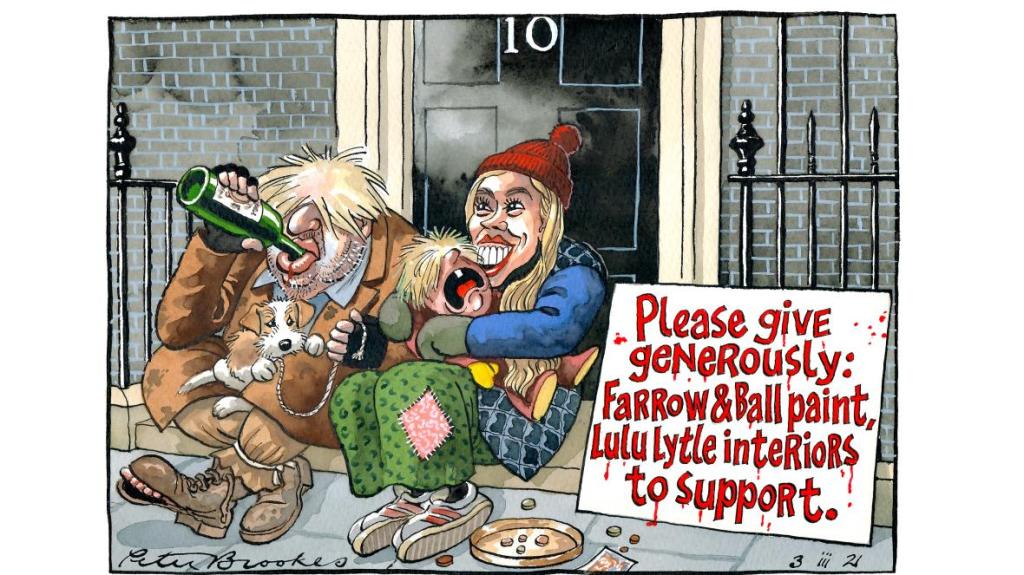
Boris Johnson sets up charity to fund Downing St renovation

An in-depth article in Tatler reveals that Symonds, 32, has been overhauling the flat to remove all vestiges of Theresa May’s “John Lewis furniture nightmare”. 

Owl believes that ardent Tory, Philip Skinner, has a grand mahogany dining table that is definitely not John Lewis; perhaps he could donate it to a cash strapped PM?

Extract from Oliver Wright, Policy Editor www.thetimes.co.uk

Boris Johnson’s plan to set up a charity to help pay for improvements to Downing Street is “inappropriate” and “monstrous”, a former standards chief has said.

The prime minister reportedly wants the new body to be based on one used by the White House to raise millions of dollars for interior design, antiques and art. He is said to be struggling to fund the makeover of his official flat by his fiancée, Carrie Symonds.

Johnson is said to have asked Lord Brownlow of Shurlock Row, a Tory peer and multimillionaire financier with close links to the royal family, to run the charity. An application to register it with the Charity Commission is said to be under way.

The charity could be funded by private donors, which would risk claims of a conflict of interest if it were seen as a backdoor way of providing benefit to the prime minister.

While its official purpose would be to raise funds to preserve No 10 and No 11 on heritage grounds, insiders say that the plans stemmed from the costs of Symonds’s makeover.

Sir Alistair Graham, a former chairman of the Committee on Standards in Public Life, told The Times that the charity idea was “quite inappropriate”.

Graham said: “It looks like he is seeking to set up the charity for personal benefit rather than for the benefit of a wider group in need. I would quite like to set a charity up to refurbish my flat in York, but I don’t think it’s a practical proposition. That’s not what charities are for: to provide enhanced living standards for the prime minister and his wife.”

Graham said that the idea of the charity being funded by party donors was “monstrous”. He said: “If you’re making a donation, you’re making it to a political party for the purposes of ensuring that party stays in power, you don’t do it for the personal benefit of the leader of the party. It would seem to me an abuse of his position as prime minister. I cannot believe how it crossed his mind. If there is a need to do certain things in terms of maintenance, that should be paid out of government funds.”

An in-depth article in Tatler reveals that Symonds, 32, has been overhauling the flat to remove all vestiges of Theresa May’s “John Lewis furniture nightmare”. The flat, above No 11 Downing Street, is larger than the one over No 10 and has been used by every prime minister since Tony Blair took it over.

In a separate piece the Daily Mail said that Johnson, 56, had complained that the cost of the project was “totally out of control”. The decor is said to have been inspired by Lulu Lytle, a celebrated eco-interior designer, who makes furniture “based on traditional crafts, including blacksmiths”.

Johnson is said to have first expressed concern last year after being informed by the Cabinet Office that the maximum taxpayer contribution would be about £30,000……

Simon is backing Exmouth, which town are you backing Neil?

From yesterday’s posts (see here and here) we learn that Simon Jupp continues to back Exmouth as a candidate to receive funding from either: the levelling-up fund, or the UK shared prosperity fund; and  only last week lobbied his election campaign pal, the Secretary of State for Housing, Communities and Local Government, Robert Jenrick. (Eat your hearts out Cranbrook, Ottery, Sidmouth and Budleigh).

So, Neil Parish, which East Devon Town are you backing? Honiton, Axminster or Seaton? Perhaps you favour Mid-Devon and are rooting for Tiverton instead? 

As we come up to the County Council elections do drop Owl an email with your choice.

Oi, government, where’s Exmouth’s dosh?

Some councillors think MP pulled a fast one

Daniel Clark, local democracy reporter www.radioexe.co.uk

East Devon District Council will seek answers about why Exmouth has not yet been given the promised £150,000 of Future High Streets funding.

Councillors have agreed to write to East Devon’s MP and a cabinet minister to ask why the town has yet to benefit from the cash.

Three days before the 2019 general eection, Simon Jupp, the Conservative candidate who subsequently became East Devon’s MP, announced that Exmouth will receive new funding from the fund.

His statement said that the secretary of state for housing, communities and local government, Robert Jenrick, had confirmed that Exmouth will receive funding of up to £150,000 to help secure up to £20 million pounds from the government’s Future High Streets Fund.

The news surprised East Devon District Council as they had submitted what turned out to be an unsuccessful bid for Axminster as part of the fund and during the debate about which town to submit, Exmouth was not mentioned.

When the announcement of the towns to receive funding was made on Boxing Day 2020, Exmouth was not on the list.

East Devon District Council has now voted to establish what actually happened, and to write to Mr Jupp and Mr Jenrick to express disappointment that Exmouth was not, as promised, given the opportunity to engage with the bidding process for the Future High Streets Fund.

When contacted by the Local Democracy Reporting Service, Mr Jupp,  said that he spoke up for Exmouth last week in parliament and that the secretary of state confirmed that new funding and the process to apply will be revealed very soon and that he was looking forward to seeing Exmouth’s application, and added he hoped that the council would work with him on any application.

Putting forward his motion, Cllr Joe Whibley (Democratic Alliance), who represents the Exmouth Town ward, said: “Just three days before the election, Exmouth was given a free pass to the next round of the Future High Streets Funding. According to details at the time from Mr Jupp, Exmouth would get £150,000 to put together a bid for substantial funds.

“But why was Exmouth in the running for a bid it hadn’t applied for, as the council had chosen Axminster to be its representative and in July 2019 received notice it had been unsuccessful. The money to put a bid together never arrived, there was no contact, and attempts to illicit contact yielded no response.”

Cllr Whibley said: “The promise of money was for one thing only – to win the East Devon seat as it was looking as though Mr Jupp wouldn’t be as secure as they had hoped. The offer of money was a complete fabrication and a carrot on a non-existing stick for East Devon.

“The deal struck in 2019 was a sham and any deal with the secretary of state was in the best light possible, a flight of fancy, and at worst, a blatant attempt to mislead the public to gain last minute votes. We need a clear honest explanation as to what happened as why.”

Cllr Paul Millar (Independent), who represents the Exmouth Halsdon ward, and who seconded the motion, said: “You can talk about elections promises and pledges, but this was a formal announcement that Mr Jupp had secured £150,000 through Robert Jenrick for Exmouth to bid for £20 million for the next group of towns for the money.

“We are concerned that this was fake news. Our town centre requires urgent regeneration. We have a clock that doesn’t even tell the time, a symbol of long term decline and austerity and continued lack of investment in the town, and Exmouth is a town in most in need of funding.”

Cllr John Loudoun (East Devon Alliance) said that he fully understood the annoyance and irritation of the “inappropriate election statement,” added: “I believe it was a deliberate and cynical attempt to influence and mislead voters ahead of the election. What took place was a disgrace by the candidate and appalling that he stooped to this level in order to gain power.”

Cllr Paul Arnott (East Devon Alliance), the leader of the council, said the question amounted to what was the difference between: “a promise of hard cash on the front page of the Exmouth Journal or the difference between something only a fool will believe.”

He said: “There is no need to seek legal advice and if the Electoral Commission went after everyone who didn’t deliver promises then they would be the busiest people on the planet,” adding that if the council voted against the motion, he would write to Mr Jupp on fact finding mission anyway, as “we have a right to know.”

Cllr Sarah Jackson (East Devon Alliance) added that her concern was that if there was another round of funding, then as a result of Mr Jupp politicising the matter, it would be difficult for East Devon to justify putting forward any town other than Exmouth, irrespective of whether Exmouth was the town most likely to succeed according to the criteria or to benefit from the funding.

She called the council to agree to meet with all of the MPs in East Devon (Simon Jupp, Neil Parish and Mel Stride) to prepare a bid for the town, which according to the criteria of the funding, is the most likely to succeed in any such bid, if another round of funding came forward.

But Conservative councillors criticised the decision to bring forward the motion and spoke up in favour of what Mr Jupp had done for East Devon since his election.

Cllr Maddy Chapman, who represents the Exmouth Brixington ward, said: “Simon Jupp is taking every opportunity to secure much needed town centre funding regeneration. Throughout the election campaign, he spoke to residents and businesses and the need for regeneration came up time and time again, and that is why Simon lobbied Robert Jenrick to put Exmouth on his radar for the next round of funding, which has delayed due to the pandemic. The only justified frustration is the delay due to the ongoing challenges of the pandemic.”

Cllr Fred Caygill, also for Exmouth Brixington, added: “We have to work with the MP, not against him. The next round of funding is not open yet. Why not wait for the details of the new fund process and then work with him instead.”

He also quoted what Mr Jenrick had said in parliament last week, when the Secretary of State had said: “I very much enjoyed visiting East Devon during the General Election campaign, I look forward to seeing Exmouth’s application in due course, as I said then, Exmouth is exactly the sort of town we want to benefit from the towns regeneration funds we’ve made available.”

Cllr Philip Skinner added: “Let’s not put up the barriers and let’s see in the course of time in funding comes forward, put our arms out and collaborate rather than fight before we have even started,” while Cllr Jess Bailey, an Independent councillor, said that she didn’t think the motion would help the residents of East Devon as it was confrontational rather than collaborative.

Councillors voted by 25 votes to 15, with nine abstentions, in favour of the motion, which aims to get answers from some of the outstanding questions over the status of the Future High Streets Fund and Exmouth.

The council will write to Mr Jupp and Mr Jenrick to express their disappointment that Exmouth was not given the opportunity to engage with the bidding process for the Future High Streets Fund, and to ask:

  • Why the announcement four days before a General Election was not followed with any communication, a firm process and confirmation of the next steps to be announced to East Devon District Council (the responsible authority for submitting such bids)
  • Why no reply was received to the letter sent by the former Leader of the Council in January 2020
  • If there will be future iterations of Future High Street funding
  • Was a unilateral decision taken by the secretary of state anywhere else in the country to subvert the bidding process?

After the meeting, Cllr Whibley added: “I want to make it clear that the Democratic Alliance are ready and keen to work with Mr Jupp, collaboratively and cross-party, to secure future funding for the region.

“We are not a Conservative administration, but our aims are the same – to secure the best outcomes for our residents and it’s important that the Conservatives nationally recognise that, if we’re going to secure positive results in East Devon, we have to work together. We cannot collaborate with silence.”

Mr Jupp, when asked for his response, said: “I spoke up for Exmouth last Monday in Parliament and asked when the next round of funding to improve high streets, towns and transport would be made available. The Secretary of State confirmed that new funding and the process to apply will be revealed very soon and he’s looking forward to seeing Exmouth’s application.

“Although the process will have been delayed due to the Covid-19 pandemic, proper plans to boost the town will need to be submitted by East Devon District Council and the Secretary of State said he hoped the council will work with me to put together an application. I urge EDDC to grasp this opportunity for the good of our town.”

Owl has no authority but…… Zoom legend Jackie Weaver cuts first dance track

Jackie Weaver might have no authority, but she’s got the grooves

David Barnett www.theguardian.com

The 62-year-old parish council clerk who became an internet sensation after a car crash Zoom meeting has now cut her first dance track, to help raise awareness of the lack of diversity and representation at local government level.

Jackie Weaver’s Kicked Him Out single artwork f

Artwork for Jackie Weaver’s Kicked Him Out. Photograph: Supplied

Weaver, a full-time clerk for the Cheshire Association of Local Councils, shot to fame after the December meeting of Handforth parish council descended into farcical chaos. Footage of the meeting went viral and birthed a meme when one councillor furiously declared: “You have no authority here, Jackie Weaver!”

Among those whose imaginations the incident captured was Helen Meissner, who for the past few years has run her own folk and acoustic independent record label, Folkstock, from her Hertfordshire home. Last summer, at the age of 54, Meissner started to make her own electronic music tracks.

‘Read the standing orders!’: chaotic parish council Zoom meeting goes viral – video

After a Twitter conversation Weaver agreed to collaborate with Meissner on the track Jackie Weaver’s Kicked Him Out, which is being released under the name Helefonix ft Jackie Weaver and Joe Rose.

The track, which is being released on streaming platforms such as Spotify and Apple Music, aims to raise awareness of the issue at the heart of the Handforth debacle.

The single will be used to promote the Make a Change campaign, which sets out to improve diversity and representation at local government level, breaking what is often seen as a stranglehold on local politics – especially in rural and suburban parishes – by middle aged white males.

Joe Rose and Helen Meissner, aka Helefonix 02.

Joe Rose and Helen Meissner, aka Helefonix 02. Photograph: Supplied

“When Helen got in touch I just thought, why not?” Weaver said. “It’s not necessarily the sort of music I’m into but I just said I want it to be catchy, and it’s certainly that.

“It’s really important to all of us that we get the message out that there needs to be more diversity on all levels in local government.

“We in the sector have been trying to do this for a long time and something like this gets the point across as well as being a lot of fun.”

Meissner said: “I think what that video did was throw a light on the kind of negative behaviour that pervades public life. Shouting and misogyny like that is rife — you see it in the House of Commons and people think it’s all right and copy it, so in a way we’re calling it out here.

“I think the fact I’m over 50 appealed to Jackie, which is why she agreed to do it. I know that ageism in the music industry and the media is a problem. It’s very important that we harness the wisdom and experience of our older generations and not pigeonhole anybody.”

Meissner started putting the track together at the beginning of last week after asking Weaver her musical preferences – she likes the Rolling Stones – then recruited her husband John Froggett, 62, an accountant who sings as Joe Rose, to voice some of the quotes from the meeting. Finally, she sent it to Weaver for approval who then recorded her own vocal contributions on her phone.

It’s not the first time Weaver has been immortalised in song – Andrew Lloyd Webber released his own ode to her last month.


Woking council accused of discouraging vulnerable voters

A Conservative-run council has been accused of potentially shutting vulnerable people out of May’s elections by asking people to show photo ID if they want a postal or proxy vote, even though it is not required by law.

Peter Walker www.theguardian.com 

Woking borough council in Surrey says that because voters are only “requested” to provide ID and proof of address, it is not breaching electoral rules.

But rights groups say the tactic could discourage groups of voters who are less likely to have the relevant documents, including older people, people who are homeless, those with disabilities, or people from black, Asian and minority ethnic communities.

They say this is particularly vital in the 6 May election as many more people are expected to seek postal or proxy votes because of coronavirus, particularly older voters.

The government plans to introduce mandatory ID for all in-person voting from 2023, a plan criticised separately as likely to suppress voter numbers from some communities.

In England, Scotland and Wales, for a postal or proxy vote, people only need to provide a signature and date of birth in advance, which is then checked against the same data on the vote itself.

But on its website, Woking council says that to apply for a postal or proxy vote, “you are requested to provide” copies of photo ID such as a passport or driving licence, and proof of residence, for example a utility bill or bank statement.

This page does not tell people that this is not mandatory. If voters then click on the link to apply for a postal or proxy vote, they are told, the subsequent document says: “If you do not provide such evidence, your application will still be processed, but your registration at the property will be examined further. This could result in your name being removed from the electoral register.”

Toby James, a professor of politics at the University of East Anglia and an expert on voting practices, said he had never previously seen an English council act in this way.

“Generally speaking, postal vote fraud is not really a big issue now,” he said. “The biggest issue at this election is going to be turnout, and people worrying about casting their votes. The wording of this certainly would seem to put people off. Voting really should be made as easy as possible for people.”

Grey Collier, an advocacy director at the civil rights group Liberty, said the Woking tactic was part of a “worrying trend to normalise the idea that showing ID to vote safeguards democracy, when it in fact does the opposite.”

Collier said: “If you’re young, if you’re a person of colour, if you’re disabled, trans or you don’t have a fixed address, you’re much less likely to have valid photo ID and could therefore be shut out of voting.”

It is understood that the Electoral Commission will not intervene, as the council is only requesting details, and local returning officers are given some discretion over how they run elections locally.

Woking says it wanted to have extra safeguards because of previous local cases of postal voting fraud.

A council spokesperson said: “We request the additional information to ensure that the person seeking a postal vote both lives at the address and is the person they claim to be. Through this process, the electoral registration officer seeks to ensure the integrity of the election by minimising the risk of electoral fraud.”