
https://www.exmouthjournal.co.uk/news/parish-council-uncontested-candidates-announced-1-5980107
Category Archives: Misc
Uncontested town council seats
26 days to local elections – today’s picture

Today’s picture is of how a map of a proposed Jurassic Coast National Park could look.
Dorset is enthusiastic about it and welcomes it. Independents on the district council are also enthusiastic and welcome it. The ruling Tory majority on East Devon District Council has ruled it out.
Why?
Because they would lose control of planning:
There are some who woyld say they never had control of planning and others who would say they have too much; few would say they have it about right.
30 days to local elections – today’s picture

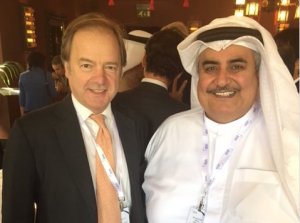
This is MP Hugo Swire with Jill Elson who has been a Tory councillor for FORTY years. She has been the Cabinet Member for Sustainable Homes and Communities at East Devon District Council and Chairman of Resources (Governor) of Exmouth Community College.
Sustainable homes? Communities? See this article from yesterday – you need 10 TIMES the average salary to buy a home in East Devon:
https://www.midweekherald.co.uk/news/east-devon-homes-cost-10-times-average-salary-1-5971058
Governor responsible for resources at a college that is asking donations of £15 per first child and £5 per subsequent child to make end meet!
Owl rests its case for the need for change!
Vote Independent!
31 days to voting – today’s pictures
Which party (or Independent) do you think better represents you – and which one do you think has East Devon’s interests at heart locally?
Conservative?
Swire – always away, mostly in the Middle East, does not live in his constituency, prefers Mid-Devon:
Parish – prefers his farming and hunting friends around his farm on the Somerset/North Devon border:

or Independent Claire Wright, East Devon born and bred and always actively in and around her patch:

Downing Street has new idea for Brexit decision
This is a better idea than Owl’s which is that on 3 days a week the border in Ireland is Irish, 3 days a week Northern Irish and closed all day Sunday:

“BREXIT will be decided at midnight tonight with the help of Larry the Downing Street cat.
Exhausted government officials have turned to the resident feline to make a decision one way or another after agreeing they would never agree.
A cat-flap has been installed in the door of Number 10. If Larry walks out more often than he goes back in during the course of the day, Britain will leave the EU with no deal. If he goes back in more often – or chooses not to venture out at all – we’re staying.
No-one in Government is sure where the idea came from, although rumours suggest officials learned from French Brexit Minister Nathalie Loiseau, who decided to call her cat Brexit after watching him wrestle with indecision. She said: “He wakes me up every morning meowing to death because he wants to go out. When I open the door he stays in the middle, undecided and then gives me evil looks when I put him out.” (source: Le Journal du Dimanche, March 2019).
But Larry, being British and assisted with a Union Jack ‘Le Brexit’ cat flap surround designed by Glamflaps International, is expected to be more decisive than his French cousin.
A Whitehall source, said: “It’s an obvious solution really and I can’t think why it’s taken us so long. Larry knows his own mind and doesn’t tolerate rats anywhere near Whitehall – the exact opposite of what goes on in Parliament.
“As a bonus, he’s respected and the public likes him.”
1 April 2019
https://www.devonlive.com/news/april-fools-day-2019-live-2706429
32 days to local elections – today’s picture
Well, the relocation went well didn’t it! Puffed up as “cost neutral” the latest estimate for the new HQ is £10 MILLION (with a resale value of around £3 million according to a local expert).
Innovation? Can anyone name one innovative thing EDDC Tories have accomplished in the last 4 years?
2016:

33 days to local elections – today’s picture

Swire’s choice for PM mocked on social media
PR obviously isn’t Hugo’s forte!
“It can be safely assumed that Dominic Raab does not have a library in his house.
Or if he does, perhaps the lighting wasn’t sufficient for a live interview on the BBC on Friday.
But how does a Tory MP convey his well-read and knowledgable depths without a library? With a hastily cobbled together pile of books on a window sill of course.
But nine books does not a library make, and more than a few people, including Labour’s Jess Phillips, [and many more!] chipped in with their own analysis of the window dressing. ….”
https://www.huffingtonpost.co.uk/entry/dominic-raab-books_uk_5c9fcf7be4b0bc0daca99bdb?guccounter=1
Councillors discovering a new sense of purpose – just before elections …
Elections are funny things. Just before them some councillors seem to find a new sense of purpose …
Take Seaton, where disgraced ex-Mayor Peter Burrows (who has refused to resign as a town and district councillor despite a unanimous vote at town level for him to do so and where the district Monitoring Officer has admonished him) has recently developed a burning interest in beach cleaning and has organised two within a few weeks of each other, with lots of publicity for them.
Seaton will surely have one of the cleanest beaches in East Devon before 2 May!
BUT the Plastic Free Seaton Facebook page (admin Peter Burrows) is a CLOSED group so you have to ask his permission to contribute. Mr Burrows sure does like to control his websites!
If you have further stories of new councillor interests, feel free to share them.
‘Why not spend a little more?’
“There’s always one. There you are, with your grand plan for making everything better, and everyone thinks it’s great. Why not, everyone is beginning to think; why can’t we fix climate change and close the gap between rich and poor and give everyone a decent economy and a non-ruined planet to live on?
And then from the back of the room, up pops the hand. And you sigh because you know what the owner of that hand is going to say: all very well and good, its owner tuts, and this sounds lovely, but how are we going to pay for it?
Before answering that question, it would be remiss not to point out that the guy in charge of President Kennedy’s budget didn’t think the country could afford to put a man on the moon, and the UK Treasury didn’t want to build the Victoria Line (or set up a Green Investment Bank, as just one more contemporary example). Some people don’t want to pay for things, which is a very different thing from asking how we should pay for it. With the momentum building around a Green New Deal, it’s really important not to let this great idea be derailed by those who mean ‘I do not like this thing’ but who say ‘this thing is too expensive’.
Oh, and obviously we should pay for it. We are talking about the actual viability of human life on Earth.
But the good news is that the money is there, or could be. Much of it is being lavished on things we can’t really do any more, like prospecting for yet more fossil fuels, so we need to spend it on other stuff instead. We don’t yet properly make the polluter pay for the impacts that all of us end up paying for in flood defences or costs to the NHS from air pollution or heatwaves. And if we’ve learned one thing from the misadventures of the last twenty years, it’s that we can blinkin’ well pay for things on a massive scale, provided we actually want to.
1. Direct existing money to the right things
Ending the fossil fuel age in short order will require lots of money. But that’s OK, because there’s an awful lot of money around: global annual spend on all infrastructure is around $2.5 trillion, a lot of which is actively helping to speed us towards climate breakdown. So before we even need to start thinking about ‘new’ money, it has to be the job of financial regulators, the Treasury, and the Bank of England to ensure existing money flows out of the destabilising brown economy and into the green economy.
“It’s hard to think of a better candidate for increasing public borrowing than re-kitting the economy to be modern, sustainable, healthy, and prosperous.”
One way to do this it to change the way existing banks lend, or supersede them entirely by creating new ones. On the first of these, the Bank is slowly but surely recognising that climate breakdown is bad for the economy, but isn’t yet walking the talk on making sure its own lending doesn’t prop up fossil fuels — a precursor to a welter of other changes to the financial rules, such as introducing higher capital requirements (i.e., defining as ‘more risky’) investments in high-carbon assets.
To get this all to happen faster the Treasury may need to get more directive regarding the Bank’s mandate, or at the very least expand its brief on financial risk to include risks from environmental change. Which itself means the Treasury will need to see environmental action as an absolute imperative.
NEF has also long advocated for the Royal Bank of Scotland to be broken up into a network of local investment banks, tasked specifically with delivering the funds that are needed by the specifics of the region, people and assets that they serve — and such banks could also have a green mandate written into their investment missions as well.
Financial regulators like the Treasury and the Bank of England need to expand their mandate to recognise environmental action. Image: 10:10 (CC BY-NC-ND 2.0).
2. Tax things we don’t want to see to pay for things we do
One of the most eye catching elements of Alexandria Ocasio-Cortez’s crowd-sourced Green New Deal manifesto is its focus on fairer taxes. We need these anyway — for example, the poorest 20% of families in the UK pay a higher proportion of their income in tax than anyone else. A higher price on carbon, in some form, is likely to be a central part of any plan to rapidly get our economy off fossil fuels, not least to act as a further disincentive to high-carbon investment. But this or any other putative ‘green’ tax must be fair, and must be seen to be fair.
This is because a climate mission must be a national mission. In a democracy, social licence for rapid change is not a luxury, it’s essential. History, most recently the Gilets Jaunes protests in France, is riddled with examples of ostensibly ‘green’ taxes butting up hard against the court of public and tabloid attention, sometimes with good reason.
So care will need to be taken to consciously generate new sources of income in a way that helps actively correct the unfairness of our tax system. NEF’s proposed frequent flyer levy — which would replace Air Passenger Duty with a tax rate that increases the more you fly – is one such way to do that. And any new money raised must be specifically earmarked – ‘hypothecated’, in wonkish parlance – for visible, socially progressive investments in the parts of the climate transition that make everyone’s daily lives better, particularly the less-well-off: world-class, reliable and ultra-affordable public transport, like buses; insulation for homes; vast tree planting schemes; and programmes to create new, lasting work in sustainable industries around the country.
Green taxes need to both be fair, and be seen to be fair. The Gilets Jaunes protests in France are an example of what can happen when this isn’t the case.
3. Borrow — yes, you heard — to invest
When governments decide they want to spend big, then they spend big. Propping up the banking sector cost an extraordinary £1 trillion, all in, including the unprecedented creation of money by central banks. When there’s a war to be fought, the money can be found. Austerity notwithstanding, we spend huge if insufficient sums on healthcare, social care and education, because we rightly see them as important and worth spending money on.
“The question is not how we can pay for a state-led programme of green investment – but whether we want to.”
Austerity, however, does withstand. This has been a decade driven by an obsession with controlling the size of state spending. It has hollowed out the ability of the state to properly lead a green transition. So-called ‘fiscal rules’ – government targets for debt and borrowing – are cited as if they are the laws of physics. They need to change. Just as it is would be unjust to allow future generations to suffer the consequences of today’s unsustainable economy, so too is it unfair that today’s taxpayers are asked to shoulder 100% of the costs. It is also hard to think of a better candidate for increasing public borrowing than the re-kitting of the economy to be modern, sustainable, healthy, and prosperous, via a huge state-led programme of green investment.
So look. The question is not how we can pay for it – there’s enough money, and precedent for just about all the things we’d need to do to marshal the cash – but whether we want to. Perhaps therefore we should pay less attention to Kennedy’s budget controller, baulking at the cost of sending a man to the Moon, and more to his then Vice President Lyndon Johnson: “would you rather have us be a second-rate nation, or should we spend a little more money?”
https://neweconomics.org/2019/03/why-not-spend-a-little-more
Clyst St Mary ‘being swallowed by Exeter’ (and Cranbrook too)
“Villagers in Clyst St Mary watched in horror as yet another lorry overturned within feet of their back gardens this week – the second identical crash in recent months – and they say it is just one symptom of growing traffic problems.
DevonLive went to ask villagers about the overturning lorry problem – but it turns out that is just one of the many traffic issues they are dealing with. One villager whose house backs on to the roundabout says she remembers it happening four or five times before.
Over the years villagers have witnessed a huge increase in traffic. Now they feel they are in danger of ‘being swallowed by Exeter’ as yet more development is planned.
Clyst St Mary sits only about 200 yards from the busy M5. It also gets all the traffic heading to Westpoint, the Devon County Show-ground and the village is bisected by the A376 and A3052 to Exmouth and Sidmouth. …
… Ultimately they need to slow the traffic. It’s supposed to be 40mph – but they don’t slow down on the roundabout if there is nothing coming from the right.
“For us getting out of the village and driving on to that roundabout is a real issue. People in the village think there should be traffic lights so we can get out safely. At rush hour you take your life in your hands.”
https://www.devonlive.com/news/devon-news/overturning-lorries-just-one-problems-2688548
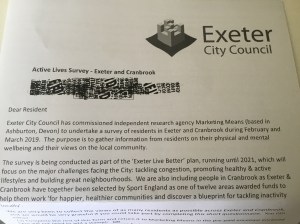
And just in case you weren’t sure if Cranbrook is a suburb of Exeter, a local resident sent this to Owl, received through the door recently a survey of how active residents are, complete with Exeter City Council address and logo:
34 days to local elections: today’s picture
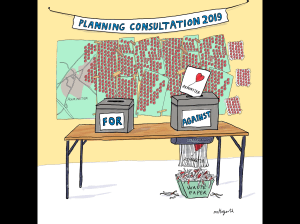
Independent councillors have consistently held the Conservative majority to account over inappropriate developments and planning decisions taken without thought for or interest in the consequences for residents.
35 days to lical elections – today’s picture
Independent EDDC East Devon Alliance councillors and DCC Independent Councillor (continually) fighting for our NHS:

36 days to local election: today’s picture and its grubby history

The sleazy way that Sidford Business Park was sneaked into the Local Plan at the last-minute will make scenes like this even worse.
Full (grubby) details here:
https://eastdevonwatch.org/2018/06/18/sidford-business-park-a-grubby-
history/
VOTE INDEPENDENT FOR CHANGE
“Pressure” on fat cat pay (including Persimmon)

“The UK’s biggest companies are facing pressure to impose caps on bosses’ pay as part of recommendations to tackle “corporate greed”.
The report by the business, energy and industrial strategy committee of MPs highlighted “huge differentials” in awards at top firms following a string of pay rows, such as those at Unilever and BT.
The most high profile was a backlash against £85m for Jeff Fairburn when he led housebuilder Persimmon – a reward that ultimately led to him being forced out of the door.
MPs argue it is time to break what they regard as a heavy reliance on overgenerous, incentive-based executive pay that is deliberately made complex to shake off shareholder opposition.
The report says failing remuneration committees should face action from the regulator formed to replace the Financial Reporting Council, which has been ridiculed by the committee for its role in the collapse of Carillion.
It said the new Audit, Reporting and Governance Authority must be “more robust and proactive in bearing down on excessive executive pay”.
The MPs recommended pay committees “set, publish and explain” an absolute cap on pay for executives in any financial year.”
https://news.sky.com/story/mps-demand-executive-pay-caps-and-profit-sharing-to-tackle-greed-11675321
Parliament
Exmouth: Agreement with Grenadier finally signed!
Note that, according to recent reports, Grenadier MUST begin construction within FIVE DAYS of the road being completed (current estimate for completion 19 June 2019).
Presumably, if it is not started within 5 days the contract can be voided …
And also presumably (since we will never be allowed to see the contract) EDDC will be following new government guidelines following the collapse of Carillion and the problems at Interserve, by having a “legacy plan” in case the contractor cannot fulfil the contract for any reason.
http://eastdevon.gov.uk/news/2019/03/agreement-signed-for-new-watersports-centre-in-exmouth/
“Persimmon bosses paid another £90m: Trio pocket £193m in just two years”
“Three Persimmon bosses have been paid nearly £200m in just two years as they cash in on Help to Buy.
Jeff Fairburn, Dave Jenkinson and Mike Killoran were handed £90m last year as the housebuilder racked up record profits of £1.1 billion.
That followed awards of £102.8m in 2017, taking their total earnings over the period to £192.8m.

Critics branded the ‘egregious’ payouts – which were disclosed in the company’s annual report – as ‘completely inappropriate’.
Persimmon has faced a fierce backlash over the rewards, which stem from a generous bonus scheme set up in 2012. The builder has also been criticised for shoddy workmanship and the sale of homes with rip-off leases.
Persimmon has benefited from the Government’s Help to Buy mortgage scheme that offers families loans from the taxpayer so they can secure a mortgage. Nearly half of the 16,449 homes it built last year were sold through Help to Buy as Persimmon cashed in on the subsidy.
The pay row, however, cost Fairburn his job. The 52-year-old – who was handed £45.7m in 2017 and a further £39m in 2018 – was forced out at the end of last year as Persimmon sought to draw a line under the scandal.
Chairman Roger Devlin, brought in to repair the company’s battered reputation, promoted Jenkinson to replace Fairburn.
In a bid to draw a line under the row, Jenkinson’s salary was held at £515,000, the same as when he was managing director, and he has agreed not to take a bonus this year. But the 51-year-old was paid £20.4m in 2017 and £25m last year, according to the annual report. Finance director Killoran, 56, was handed £36.7m in 2017 and £26m in 2018.
Sources at the company pointed out that these payouts dated back to the 2012 bonus scheme and would not be repeated.
And writing in the annual report, Devlin said the builder was transforming the way it behaved: ‘We are changing our pay and incentives to include greater emphasis on both quality and customer care with plans that are more rigorous than we have had in the past.’
But Luke Hildyard, director of the High Pay Centre, said: ‘These egregious pay outs are completely inappropriate.
‘They are a massive embarrassment for the company and really ought to be an embarrassment for the individuals as well.
‘It shows a total failure of corporate governance.
‘This view that a few top executives need these vast payments lavished upon them in order to get out of bed in the morning is worrying and damming of the culture at the business.
‘The company has tried to draw a line under this and this is the result of past practices. But it continues to cause damage.’
Labour MP John Mann, a member of the Treasury Select Committee, said: ‘These vast sums of money will rightly disgust homebuyers struggling to get on the ladder. They suggest once again that housebuilders’ profits – and pay packets – are out of control.’
“Shadow state” part 2
To be read with the chilling post below. When The Guardian AND The Times agree, something is DEFINITELY going wrong!
“The government has been accused of “irresponsibility” as it emerged that Interserve won £660 million worth of public contracts as it slid into a financial crisis that led to its collapse into administration last week.
Analysis of government projects has revealed that the outsourcing giant was handed public jobs worth £432 million in 2017 and £233 million last year. The deals were awarded even while it advised investors of its financial problems.
On Friday the parent company of the key government contractor entered administration after its largest shareholder, a US hedge fund, blocked a rescue deal. It was immediately bought out by lenders, wiping out shareholders and leading to uncertainty for its workforce. Interserve had annual revenues of £2.9 billion but a move into building energy-from-waste incinerators went awry. It cost the business £280 million and its share price collapsed.
Research by Tussell, a data analytics provider specialising in government contracting, shows that the company continued to win lucrative jobs. For example, the Foreign and Commonwealth Office awarded Interserve £66 million for facilities management services in July. The company had issued profit warnings in May 2016 and twice in 2017. Since it began lining up a rescue deal in December, it had won £6 million of taxpayer-funded work.
Interserve is one of Britain’s leading providers of privatised public sector services, with 45,000 workers maintaining and cleaning schools, hospitals, railway stations, government departments, armed forces facilities and job centres. The rapid “pre-pack” sale of the company to its lenders has allowed its operating subsidiaries to continue trading with customers and suppliers.
A spokesman for the Cabinet Office said: “The awarding of contracts follows a robust process, including financial checks.”
Source: Times (pay wall)

