DCC Health and Social Care “Scrutiny” – Claire Wright continues her battle

“Health and Adult Care Scrutiny Committee meeting: A PACKED AGENDA….

I asked for several items, including the future of our community hospitals, the plight of local carers, the local NHS deficit and what is being done to reduce it.

Also, on the agenda is how the local NHS coped with winter pressures (something I have asked for, for months and even resorted to a Freedom Of Information request on – it was refused, I have issued a formal complaint)……..

I have been really disappointed in recent months and years at what I see as a systemic lack of accountability in the NHS. As a Health Scrutiny Committee member, I would expect to get straight answers to straight questions at meetings, but unfortunately this rarely happens, which is why I was forced to submit a Freedom of Information request about a basic set of data tables relating to winter pressures.

I will not hesitate to do this again.

The report on carers starts on page 55 of the link below. This came about after I read a detailed survey and saw that local people who are caring for loved ones may not feel very supported.

I subsequently had a meeting with senior officers and saw the raw (anonymised) data from local focus groups. It was disturbing and it appeared to me that many local carers are having a really hard time managing, because of the government’s austerity agenda. I asked for the report to be referred to the Health Scrutiny Committee, but was told this wasn’t possible as consent had not been given by the participants of the focus group.

A version of the report has been submitted instead. I am pleased that a number of measures have been put in place by officers to try and improve matters, however, I have already told senior officers that leaving out the comments has meant that the voice of carers has been lost, in my view.

I believe that there should have been an attempt to secure retrospective consent for the publication of the report, as without a proper voice, the government will simply carry on ignoring carers’ plight – and they deserve better.

If you want to read the reports – and if you care about our NHS I would urge you to! The link is here
http://democracy.devon.gov.uk/ieListDocuments.aspx

Members of the public are permitted to address the committee in the 15 minute slot at the beginning of the meeting, but need to register four days ahead to do so. Email Gerry.rufolo@devon.gov.uk

The meeting starts at 2.15pm on Thursday 7 June. It will be webcast from this link:

https://devoncc.public-i.tv/core/portal/home

and archived afterwards.
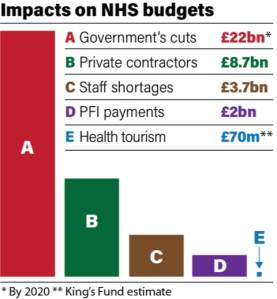
“8,900 checks on NHS ‘health tourists’ find just 50 liable to pay”

It almost certainly cost more to find the 50 than to leave this alone.

So, knock on the head – it is underfunding to speed privatisation that is bringing our NHS to its knees NOT health tourism!!!

https://www.standard.co.uk/news/health/8900-checks-on-nhs-health-tourists-find-just-50-liable-to-pay-a3850121.html

NHS and taxes: pay once, pay twice, pay three times

Once: original taxes
Twice: new additional tax
Thrice: means-tested assistance with care needs:

“Taxes are going to have to rise to pay for the NHS if the UK is to avoid “a decade of misery” in which the old, sick and vulnerable are let down, say experts.
The Institute for Fiscal Studies and Health Foundation said the NHS would need an extra 4% a year – or £2,000 per UK household – for the next 15 years. …”

Most interesting of all is this table:

The Lib Dems didn’t do themselves any favours in coalition did they!

http://www.bbc.co.uk/news/health-44230033

And here’s Owl thinking we paid once!

“NHS England and Capita misunderstood the risks in outsourcing primary care support services …” says hard-hitting report

Summary:

NHS England and Capita misunderstood the risks in outsourcing primary care support services resulting in services to 39,000 GPs, dentists, opticians and pharmacists that were a long way below an acceptable standard. Capita’s performance against the contract has improved but widespread failures are still being experienced by primary care practitioners, says today’s report by the National Audit Office (NAO).

In August 2015, NHS England entered into a seven-year, £330 million contract with Capita to deliver primary care support services. NHS England aimed to reduce its costs by 35% from the first year of the contract and provide a high-quality and standardised service. Capita expected to make a loss of £64 million in the first two years of the contract, which it planned to recoup in later years.

NHS England’s decision to contract with Capita both to run existing services but also simultaneously to transform those services, was high risk. Capita was incentivised through the contract to close existing services to minimise its losses but the interaction between running, closing and transforming services was more complex than Capita or NHS England had anticipated.

Performance issues emerged in 2016 shortly after Capita started closing primary care support offices and making other changes to the service. Capita acknowledges that it made performance issues worse by continuing to close support offices in summer 2016 even though it was aware the customer service centre was struggling to meet demand at that time. NHS England was contractually unable to stop Capita’s aggressive office closure programme, even though it was having a harmful impact on service delivery.

Failure to deliver key aspects of the end-to-end service, delivered by Capita and other organisations, impacted primary care services and, potentially, put patients at risk of serious harm. For example, 87 women were notified incorrectly that they were no longer part of the cervical screening programme; processing issues led to an estimated 1,000 GPs, dentists and opticians being delayed from working with patients and some of these practitioners lost earnings. No actual harm to patients has been identified.

Users continue to experience poor delivery with seven severe service failures in February 2018. A number of organisations have contributed to underperformance as Capita relies on other organisations to provide some services.

NHS England has made savings, in line with expectations, of £60 million in the first two years of the contract, as the financial risk of increased costs sits with Capita who have made a £125 million loss over this period. To date, NHS England has deducted £5.3 million from payments to Capita as penalties for poor performance but it expects it may have to pay up to £3 million in compensation to primary care providers.

NHS England has not yet secured all the benefits it wanted to achieve as Capita’s transformation programme was halted while it focused on operational issues. NHS England remain concerned about three of the services – the national performers lists, payments to opticians and GP payments and pensions but recognises that some of the issues with them pre-date the contract with Capita.

Two and a half years into the contract basic principles are still not agreed, which limits NHS England’s ability to hold Capita to account. NHS England and Capita have still not agreed how to calculate 11 performance measures, and how these data should be used to calculate payments owed to Capita for delivering the services.

The NAO recommends that NHS England should determine whether all current services within the contract are best delivered through that contract or be should taken in-house by NHS England.

“Neither NHS England nor Capita fully understood the complexity and variation of the services being outsourced. As a result, both parties misjudged the scale and nature of the risk in outsourcing these services. “While NHS England has achieved financial savings and some services have now improved, value for money is about more than just cost reduction. It is deeply unsatisfactory that, two and a half years into the contract, NHS England and Capita have not yet reached the level of partnership working required to make a contract like this work effectively.”

Amyas Morse, the head of the NAO, 17 May 2018″

https://www.nao.org.uk/press-release/nhs-englands-management-of-the-primary-care-support-services-contract-with-capita/

Full report here:

“Inpatients at Exmouth Hospital to be temporarily relocated during fire safety improvement project”

Owl adds: Did you know there were closed wards at Exmouth Hospital?

“News Release 16 May 2018

Inpatients at Exmouth Hospital are being temporarily relocated to another ward on the site while building owner NHS Property Services invests in fire safety improvements.

Beds on Doris Heard Ward are being moved to the vacant Geoffrey Willoughby Ward while a £50,000 project to safely remove asbestos and improve fire resistance takes place. A deep clean and air testing will also take place.

The works, carried out by Integral, will be undertaken from 21 May with the ward planned to be fully reopened during the week commencing 11 June 2018.
Due to the constraints of Geoffrey Willoughby Ward, the number of available beds will be temporarily reduced from 16 to 12 during this period.

Rosemary Kearney, Senior Facilities Management Business Manager for NHS Property Services (NHSPS) in the South West, said: “We’re working closely with our partners at the hospital to ensure services can, as far as possible, continue as normal.

“We’re sorry for any inconvenience but this is an essential project that will ultimately improve the fabric of Exmouth Hospital for patients for years to come.”

Donna Robson, Royal Devon and Exeter NHS Foundation Trust’s Matron at Exmouth Hospital, added: “Maintaining continuity of care for patients is our top priority. We’ve been working with NHSPS to ensure that any disruption is kept to a minimum during these necessary maintenance works. We’d like to thank our patients and visitors for their understanding during this time.”

All other services at the hospital are unaffected and patients should continue to attend their appointments as normal.

The need for the work was identified as part of a survey undertaken by NHSPS.”

The press release also includes background information for editors on NHSPS. This is not usually published with the press release but is information in the public domain, so Owl reproduces it here:

“NHS Property Services brings property and facilities management expertise to thousands of sites across the NHS estate.

At a time of major change and increasing demand for the NHS, NHS Property Services is reducing costs, creating a more fit for purpose estate and generating vital funds that are being reinvested to support improvements in frontline patient care.

The company’s portfolio consists of 3,500 properties – worth over £3 billion – which represents around 10 percent of the entire NHS estate. The vast majority of our sites are used for clinical, local healthcare and fall into one of three categories:

Health centres and GP surgeries; Hospitals/hospital- related properties; or Offices.

The company has a major role as both landlord and service provider for its NHS customers. Services fall into four main business areas:

1. Strategic estates planning – supporting our customers to deliver healthcare premises that meet future needs for patient services

2. Asset management – proactive asset management to create value and reduce overall costs of property

3. Construction project management – managing the development of new buildings and refurbishment of existing buildings, along with investment in our estate

4. Facilities management services – including health and safety, maintenance, electrical services, cleaning and catering.”

“NHS outsourcing ‘put patients at risk’ “

THIS IS EXACTLY WHAT OUR CCG IS ATTEMPTING TO DO – SLASH COSTS AND IMPLEMENTING NEW MEASURES AT THE SAME TIME YEY OUR DEVON TORIES ARE HAPPY FOR THE CCG TO EXPERIMENT ON US UN THIS WAY!

“Incompetent staff may have been allowed to carry on practising, the watchdog warned

“Patients were put at risk of cancer and other serious harm because of a botched £330 million NHS outsourcing deal, the spending watchdog has found.

An attempt at cost-cutting has led to more than two years of chaos in back-office services for GPs, opticians and dentists, the National Audit Office said.

Dozens of women were wrongly told that they no longer needed cervical cancer screening and incompetent staff may have been allowed to carry on practising, the report concludes.

The outsourcing company Capita and NHS England are still bickering about the deal, leading to failures including a backlog of half a million patient registrations, the NAO warns.

“Trying to slash costs by more than a third at the same time as implementing a raft of modernisation measures . . . potentially put patients at risk of serious harm,” Meg Hillier, chairwoman of the public accounts committee, said.”

Source: The Times (pay wall)

CCG somewhat opaque on future of Honiton and Seaton hospital closures

Owl says: This is the sort of Press Release the CCG excels at. Telling us what the situation is at present but giving no guarantees that there will not be future cuts to current services (some of which, such as dermatology in Seaton, have already been closed.

Owl would also like to know how many of the extra 20,000 deaths noted in the first quarter of this year were in East Devon.

From EDA DCC Councillor Martin Shaw:

“NEW Devon CCG have issued the attached statement criticising ‘inaccurate information’ about Honiton and Seaton hospitals, after Dr Simon Kerr, Chair of the CCG’s Eastern Locality, was credibly reported as saying that these two hsopitals are ‘at risk’ in their Local Estates Strategy due this summer.

I welcome the CCG’s statement that it has no plans to close either hospital. However it has not denied that Dr Kerr said that they were at risk.

The CCG could end this controversy today if it gave an unequivocal assurance that both hospitals will continue for the foreseeable future with the present or enhanced levels of service. People in Honiton and Seaton were badly let down by the CCG over hospital beds and they won’t trust them now without a clear statement that our hospitals are safe in the coming Local Estates Strategy.”

The statement from the CCG reads:

“There have been reports today that the future of Honiton and Seaton Hospitals is under question.

NHS Northern, Eastern and Western Devon Clinical Commissioning Group wishes to make clear that there are no plans to close Honiton and Seaton hospitals.

In March 2017, the Governing Body of NHS Northern, Eastern and Western Devon Clinical Commissioning voted to implement a number of changes following a 13 week public consultation. This included the decision to close inpatient beds at both Honiton and Seaton hospitals.

Beds were closed in both hospitals in August 2017 as more care was introduced to look after people at home. Both hospitals are still open, thriving buildings providing more than 50 day services and clinics combined.”

“NHS has lost 1,000 GPs since Jeremy Hunt set workforce target”

Pulse is the newsletter for GPs:

“The GP workforce in England is continuing to decline, as official statistics reveal that 316 full-time equivalent GPs have left the profession in the last three months.

The figures released by NHS Digital today also reveal that the number of FTE GPs in the workforce has decreased more than 1,000 since September 2015 – when health secretary Jeremy Hunt announced he would increase the number of FTE GPs in England by 5,000.

NHS England is recruiting from overseas in a bid to boost GP numbers, but Pulse revealed last month that they had only managed to recruit 85 by April – despite originally touting the figure of 600.

The latest statistics show that in the last three months, the workforce has fallen from 33,890 FTE GPs in December 2017 to 33,574 as of 31 March 2018.

Meanwhile, the workforce is 1,018 GPs worse off than it was in September 2015.

This is despite the success of NHS England’s induction and refresher scheme, which has tempted 546 GPs back into the workforce since its launch in 2015.

The news comes as a Pulse investigation, published earlier this month, showed a steep rise in the number of GPs claiming their pension early. Since 2013, almost 3,000 GPs have claimed their pension before the age of 60.

The BMA has previously warned the Government that continued sub-inflation uplifts to GP pay is going to further exacerbate GP workforce shortages, having asked the independent review body on doctor’s pay to recommend a 2% uplift for 2018/19.

Dr Richard Vautrey, chair of the BMA’s GP Committee, said the latest workforce statistics are ‘extremely concerning’.

He said: ‘It’s more than two and a half years since the health secretary promised to recruit 5,000 more GPs before 2020, and these figures are a damning progress report. With less than two years until this target date, the trend is clearly going the other way and it’s a sign that a step change in action needs to be taken.

‘As GPs struggle with rising demand, increasing workloads and burdensome admin, and are expected to do so with insufficient resources, it’s no surprise that talented doctors are leaving the profession and although the number of GP training places have increased, this is not enough to address the dire recruitment and retention crisis.’

RCGP chair Professor Helen Stokes-Lampard said: ‘These figures are yet another hammer blow for family doctors, for whom going the extra mile is now the norm, and for our patients. The stark truth is that we are losing GPs at an alarming rate at a time when we need thousands more to deliver the care our patients need, and keep our profession, and the wider NHS, sustainable.

‘It is clear that substantial efforts to increase the GP workforce in England are falling short – and we need urgent action to address this. We have made great strides over the past couple of years encouraging more medical students and foundation doctors to choose general practice, but these efforts will be futile, if more GPs are leaving the profession than entering it.’

She said this comes as ‘GP workload is escalating, both in volume and complexity, and the hardworking GPs we do have are burning out as we try to cope without the resources and support we need’.

‘Longer and longer days in clinic is what our members are telling us they face when they come to work in the morning, exacerbated by a mountain of bureaucracy and paperwork. This isn’t safe for GPs, our teams, or our patients, and if it isn’t tackled GPs will continue to leave the profession early, and new GPs will be put off from joining,’ she added.

Labour’s shadow health secretary Jonathan Ashworth said the data marked ‘yet another broken promise on NHS staffing from ministers’.

‘It’s an embarrassing failure for the secretary of state that far from delivering the extra GPs primary care desperately need, there are now 1,000 fewer family doctors than in 2015.

‘The truth is that the Tories have failed to bring forward a sustainable long term plan for the NHS. The consequence is the biggest financial squeeze in its 70-year history and a failure to recruit the frontline doctors and nurses we need to care for patients.’

A department of health and social care spokesperson said: ‘We are committed to meeting our objective of recruiting an extra 5,000 GPs by 2020. This is an ambitious target and shows our commitment to growing a strong and sustainable general practice for the future.

‘More than 3,000 GPs have entered training this year, 1,500 new medical school places are being made available by 2019 and NHS England plans to recruit an extra 2,000 overseas doctors in the next three years.’

http://www.pulsetoday.co.uk/news/gp-topics/employment/nhs-has-lost-1000-gps-since-hunt-set-workforce-target/20036703.article

Claire Wright responds on threat to close Honiton and Seaton hospital day services

“Seaton and Honiton Hospitals may be at risk, local GP and chair of the NEW Devon CCG’s Eastern Locality, Dr Simon Kerr reportedly revealed at a meeting with health campaigners last month.

Dr Kerr was apparently speaking of the long-awaited Estates Strategy, which will list all the assets held by the local NHS and what it plans to do with them.

NEW Devon CCG is in considerable financial difficulty. Devon is one of three most financially challenged health trusts in the country.

The background is that 12 community hospitals across Eastern Devon were acquired by the private company (wholly owned by the Secretary of State for Health) NHS Property Services, last year.

As yet, we haven’t heard about the fate of the remaining 10 community hospitals now in the ownership of NHS Property Services. This of course, includes our beloved Ottery Hospital, as well as Exmouth, Sidmouth, Whipton, Okehampton and Crediton.

Many of these hospitals, including Seaton, Honiton, Ottery St Mary and Okehampton and Whipton, have sadly now been stripped of their beds in cost cutting measures. But they still are home to a range of services and clinics that are very much needed locally.

Up until now, NHS England has been picking up the tab for the extortionate rents charged by NHS PS, of well over £3m a year, across the area.

A stupid stupid system, set up to fail. All over the country health trusts are being forced to sell off estate because it can’t afford the ridiculous rents charged by NHS PS for a building that used to be in NHS ownership.

Honiton Hospital has a treatment centre and is home to East Devon’s out of hours GP service.

The idea that the building could be lost and with it the treatment centre and out of hours service is totally ludicrous and appalling. The RD&E’s A&E department is full to capacity much of the time and staff are struggling to manage the volume of patients.

It means someone unwell living in the far east of the area – Axminster, for example, would have to travel around an hour to Exeter, to be seen by a GP if they were unwell out of working hours. It is quite unacceptable.

The amazing maternity unit which has been ‘temporarily’ closed for the best part of a year, was also based at Honiton Hospital.

There are so many cuts to the health service now it is difficult to keep up with them, let alone fight them.

Cllr Shaw has written to the CCG chair, Dr Tim Burke demanding assurances that the buildings remain open.

I have asked for an urgent item on the next Health and Adult Scrutiny Committee agenda, which is held on Thursday 7 June.

I will keep you posted.

Here’s Cllr Shaw’s blog – https://seatonmatters.org/2018/05/14/ccg-chair-says-seaton-and-honiton-hospitals-at-risk-of-closure-in-local-estates-strategy/

http://www.claire-wright.org/index.php/post/seaton_and_honiton_hospitals_at_risk

“Suspension of birth services at Honiton Hospital extended”

“The suspension of birth services at Honiton maternity unit has been extended.

The Royal Devon and Exeter NHS Foundation Trust (RDE) has today delayed its reintroduction until mid-September 2018.

The Trust took the decision last year to temporarily suspend births and subsequent in-patient stays at Honiton Hospital.

It said the step was taken to maintain patient safety due to a combination of factors affecting the stability of the services at this site and the other units it operates in Tiverton and Exeter.

Zita Martinez, head of midwifery at the RDE, said: “We are sorry for this continued suspension in services. Although we have successfully recruited to a number of our midwifery vacancies, we are still managing a high level of staff absence, including maternity leave.

At the same time, the positively received implementation of national policy in the Better Births and Saving Babies’ Lives guidance has meant that the complexity and acuity of women and babies we are caring for has significantly increased.

“This means that our main maternity unit in Exeter is experiencing greater levels of demand on the specialist care that we provide.

“In the context of increasing complexity, re-opening Honiton maternity unit for births and in-patient stays would result in the Trust stretching our workforce too far and potentially compromising safety in our other delivery units.”

The Trust has agreed with NEW Devon Clinical Commissioning Group to extend the suspension of births and subsequent in-patient stays at both Honiton and Okehampton until mid-September 2018 in order to ensure the safety of services across a wider geographical footprint and therefore, for more women and babies.

All antenatal and post-natal appointments, support clinics and home births will continue as normal in both communities.”

http://www.midweekherald.co.uk/news/suspension-of-birth-services-at-honiton-hospital-extended-1-5517432

East Devon Alliance DCC Martin Shaw responds to threat of full closure of Seaton Hospital

“Martin​ Shaw
County Councillor for Seaton and Colyton​

LETTER TO THE CHAIR OF NEW DEVON CCG

Dear Dr Burke,

We have seen draft notes prepared by 38 Degrees of your meeting with them on April 5th. According to these, Simon Kerr said (before your own arrival) that Seaton and Honiton hospitals were ‘at risk’ in the coming Estates Strategy. These remarks, written down at the time, have been confirmed to us by several participants. While we appreciate that no formal decision may have been taken, there seems little reason not to take them as a clear indication of CCG thinking.

As the two elected local politicians on the organising group of Seaton Health Matters, the community conversation launched together together with the CCG and RD&E, we hosted Dr Kerr at the launch meeting on 23rd March, which also heard Em Wilkinson-Bryce (copied in) appeal to the audience to trust in the ‘good intentions’ of the speakers from the NHS organisations. We have no reason at all to doubt her sincerity, but it is difficult for us to believe in the good faith of Dr Kerr and the CCG, as (unless he had only just picked up the names of the ‘at risk’ hospitals) it seems to us that you may have helped launched us into a discussion of local health needs knowing that you may be moving to deprive us of our major health resource, Seaton Hospital.

Our initial Health Matters discussion broached many areas of constructive cooperation between the local community and the NHS, which we are keen to pursue. However it also left no doubt of the need to maintain the 50+ outpatient services currently based in the Hospital, the desirability of bringing in additional services if place-based care is to be meaningful, and the needs of an elderly community (with significant pockets of deprivation and poor public transport) for as many clinics, etc., as possible on the doorstep rather than in other towns. We are ready to explore the possibility of a combined health hub for the Axe Valley, but on the basis that services would be more or less equally shared across the two hospitals and there would be no reduction in the overall level of services in each. The other thing that was clear from our discussion was that the community considers the Hospital a community resource since its building was half-funded by local donations and it has been maintained by local contributions ever since. I am sure that people in Axminster and Honiton feel the same about theirs.

You should not underestimate the local anger, only just subsiding, over the removal of beds from Seaton Hospital. It bears repeating that this was widely regarded, including outside Seaton, as an unjust choice based on a misuse of the JSNA data and misleading assumptions about the relative agedness of the populations of Seaton and Sidmouth (their age structure is in fact almost identical and the comparison did not justify a choice of Sidmouth over Seaton). It was also based on false claims that the Sidmouth option would involve a better geographical spread: a glance at the map would have shown that, on the contrary, it left the remaining community beds concentrated in the southwestern corner of East Devon with none in the Axe Valley. There is similar feeling in Honiton because the Your Future Care consultation did not even include an option which would have retained their hospital’s beds.

We mention this history not to try to reverse the beds decisions (although the shortage of beds in the recent winter should lead to it being looked at again) but because the treatment of Seaton and Honiton in those decisions should be a reason for generosity in the distribution of outpatient services and in the Estates Strategy. It is adding insult to injury to place Seaton and Honiton on a shortlist of potential closures. Having switched your decision last time against Seaton, you should now reconsider again in Seaton’s favour. This is not, of course, to suggest that any other hospital should be closed instead. On the contrary, all East Devon towns have community hospitals which reflect real local needs and you should be devising a system of health hubs which enables all communities to have a solid base for place-based care.

The next meeting of Seaton Health Matters is scheduled for 24th May. We do not wish it to be dominated by the fallout from Dr Kerr’s remarks but without an unequivocal assurance that Seaton Hospital will remain open, it is unavoidable that this will be the main topic of discussion.

We look forward to hearing from you at the earliest opportunity. We have also copied this to Sonja Manton since we discussed the Health Matters process with Em and her before it began. We should like to meet with you about this, but before the 24th any meeting would have to be late that afternoon or on the 23rd, as one of us is away until the morning of the 22nd.

Regards,

Martin Shaw
County Councillor for Seaton & Colyton

Jack Rowland
Seaton Town Council”

Seaton and Honiton hospitals “at risk ” of full closure says CCG

“CCG chair says Seaton and Honiton hospitals ‘at risk’ of closure in Local Estates Strategy”

POSTED ON MAY 14, 2018 by Councillor Martin Shaw

It has been revealed that Dr Simon Kerr, Chair of NEW Devon CCG’s Eastern Locality, told a meeting with representatives of 38 Degrees on 5th April that Seaton and Honiton hospitals were ‘at risk’ in the CCG’s Local Estates Strategy due in July. His remarks were taken down by the 38 Degrees member who produced draft notes of the meeting, and have been confirmed by other participants, but have not yet been confirmed by the CCG.

Although the hospitals both lost their inpatient beds last summer, Seaton Hospital currently hosts over 50 outpatient services (and there are probably at least as many in Honiton). Both are vital community health resources, created with decades of financial and practical support from people all around the Seaton and Honiton areas.

As part of a move to promote ‘place-based care’, the CCG and RD&E are currently taking part in two ‘community health conversations’, Honiton’s Health Matters and Seaton and Area’s Health Matters, which local voluntary groups, town and parish councils etc. are involved in. However if place-based care means anything, it should mean that communities should keep their local hospitals as health hubs, with more rather than fewer services.

Together with Cllr Jack Rowland, who stood down as mayor of Seaton last week but remains the town council’s representative on the Health Matters organising group, have written to Dr Tim Burke, Chair of the CCG, to ask for an unequivocal assurance that the hospitals will remain open.

I am hoping to shortly announce a meeting of the hospital campaign group.”

https://seatonmatters.org/

At least one business is profiting from those extra 20,000 deaths (so far) since winter!

“A surge in the number of deaths helped funeral provider Dignity get its financial year off to a strong start as it battles to get back on a positive footing after warning it was struggling against fierce competition.

Britain’s only listed funeral operator revealed a 2pc increase in revenues for the 13 weeks to March 30 on the back of an 8pc increase in deaths, holding its underlying operating profits steady at £37.5m. …”

https://www.telegraph.co.uk/business/2018/05/14/dignity-turnaround-efforts-lifted-higher-death-rate/

“Patients trapped by care closures: Elderly face being STRANDED in hospital wards” [or just stranded if there are no hospital wards]

“In the past financial year, 148 care home businesses entered insolvency – an 83 per cent rise on the 81 failing in 2016-17.

The figures sparked a call for urgent action from the Government to tackle a growing crisis in social care which could impact badly on the NHS.

And experts warn of a “care home crash” as closures cause a shortage. Although the Government announced a £2billion package for social care over three years last year, local authorities are spending £6billion less than in 2010. …

Mike Padgham, chairman of the Independent Care Group which advises care providers in north Yorkshire, said: “We have been warning for years that the £6billion cut from social care would eventually mean more and more care homes closing.

“For every home closure there are older and vulnerable people either forced to find somewhere else to live or unable to have a place.

“About 1.2 million people are now going without the care they need and unless action is taken this will very soon be us. We now face a further £2.3billion funding shortfall and that is going to mean more and more people not getting care. …

Local authorities in England and Wales had planned to make savings of £824million in their social care budgets in 2017-18 according to the Associate Directors of Adult Social Services, despite demand increasing as the population ages.

A Competition and Markets Authority report highlighted a £1billion shortfall in public sector funding of care homes in 2017 and the Local Government Association says that the sector faces a £2.3billion gap by 2020.

Accountancy firm Moore Stephens, which released the insolvency figures, found the cost of providing a high standard of care has increased over the years. The National Living Wage rose again last month to £7.83.

It stood at £6.70 just three years ago. The annual rise places increased strain on care home margins. The average home now spends 52 per cent of its turnover on wages. …

A report by the Public Accounts Committee in September said that an “intolerable” number of older patients were waiting too long to be discharged from hospital, costing the NHS £170million a year.

The MPs said that every day, 3,500 older people remain in hospital in England after being declared fi t to leave because arrangements had not been made for them to move. In 2011, operator Southern Cross shut down and as many as 31,000 elderly and vulnerable residents had to find somewhere else to live. …”

https://www.express.co.uk/news/uk/959234/care-home-crisis-uk-government-elderly-care-bankruptcy

The cost of austerity and underfunding – 20,000 extra deaths last winter

We cost the NHS and Social Services nothing when we are dead.

“Researchers have called for an urgent investigation to find an explanation for more than 20,000 ‘additional deaths’ so far this year, amid severe pressure on the NHS.

Figures from the Office for National Statistics (ONS) show that in the first sixteen weeks of the year, there were 20,215 more deaths in England and Wales compared to the previous five years.

In March, academics raised concerns that Britain was facing a rise in mortality and argued that “health chiefs are failing to investigate a clear pattern of worsening health outcomes”, in an editorial for the British Medical Journal (BMJ).

The piece centred on the finding that there were 10,000 ‘additional deaths’ in the first seven weeks of the year and concluded “that neither ‘flu, nor cold weather appeared to be the main cause.”

Now the authors have now updated their findings to account for fresh statistics covering the first sixteen weeks of the year.

Their response, published on the BMJ website this week, argues that the latest statistics “sadly provide little reassurance of this being a ‘blip’ as some have suggested.”

There were 198,943 deaths in the first sixteen weeks of 2018, compared to an average of 178,778 deaths in the same period over the previous five years. The rise represents an 11.3 per cent increase on the five year average.

The weekly average for the same period was 12,434 deaths, ahead of the five year average of 11,174. The 20,215 figure is equivalent to an ‘additional death’ every eight minutes throughout the first sixteen weeks of the year. …”

https://www.telegraph.co.uk/news/2018/05/11/calls-urgent-investigation-explain-20000-additional-deaths/

“Over a million elderly people missing out on help they need due to dire state of social care system, watchdog warns”

“More than a million vulnerable elderly people are missing out on help they need because of the dire state of the social care system, the UK’s spending watchdog has said.

The National Audit Office (NAO) called for urgent action as it published a detailed report citing evidence showing the number of people over 65 with unmet care needs jumped by some 200,000 in the last year alone.

The body said a spiralling turnover of poorly paid staff and increasing job vacancies are at the root of the problem, which is being worsened by ongoing deep cuts and fewer employees from the European Union since Brexit.

In particular, the NAO struck out at the Department of Health and Social Care (DHSC) for being unable to demonstrate how it is going to fund care for the elderly in the face of burgeoning future demand.

Ministers know working out how to pay for social care is one of the biggest challenges they face, but have been unable to bring forward clear proposals of how to meet it.

The report said the DHSC’s own modelling had shown the number of full-time jobs in the care system would need to rise by some 2.6 per cent per year until 2035 to meet increased demand.

But the annual growth in the number of jobs since 2013 has been two per cent or lower.

The report said: “The failure of formal care to meet this increased demand may have contributed to the growth in individuals’ care needs not being met.

“Age UK estimated that 1.2 million people over the age of 65 had some level of unmet care needs in 2016/17, up from one million in 2015-16.”

The NAO found that In 2016/17, the annual turnover of all care staff was 27.8 per cent – with care workers. …”

https://www.independent.co.uk/news/uk/politics/elderly-people-vulnerable-million-missing-dire-poor-social-care-system-a8199506.html

Swire discovers “health hubs”

Written Answers – Department of Health and Social Care: Health Services (9 May 2018)

https://www.theyworkforyou.com/wrans/?id=2018-04-30.139412.h&s=speaker%3A11265#g139412.q0

Hugo Swire: To ask the Secretary of State for Health and Social Care, what his Department’s policy is on the establishment of health and wellbeing hubs in former community hospitals.”

Owl’s policy is that NHS community hospitals are much more important than commercial juice bars and personal trainers and should therefore be funded BEFORE health hubs, not abandoned to insert “health hubs” in their place.

” ‘Perfect storm’ over rural social care costs”

“Rural residents are unfairly penalised when it comes to Improved Better Care Funding, MPs have been told.

The Rural Services Network issued the warning in response to an inquiry by MPs who are examining the long-term future of adult social care.

The Long Term Funding of Adult Social Care Inquiry is being undertaken by the Housing, Communities and Local Government Committee of the House of Commons.

Submitting evidence to the inquiry, the Rural Services Network said the average predominantly urban resident will attract £37.74 per head in Improved Better Care Funding in 2019/20.

This is £8.20 more than rural residents who attract just £29.54 per head.

In 2017/18 Adult Social Care Core Funding is met by Council Tax to the tune of 76% in rural areas compared to just 53% in urban.

The Rural Services Network said there was no relationship between the numbers of people requiring social care and either Council Tax or Business Rates.

Growth in business rates or council tax income is in no way correlated to the service needs of care services, it pointed out.

“It is obvious that the rising costs of caring for the growing elderly population cannot be met by local taxation and must be funded per capita by central government,” said the network.

In rural areas, there are significantly more residents aged 65+, fewer businesses required to pay business rates and Council Tax levels are already much higher than in urban areas.

The network added: “Thus, there is created a ‘perfect storm’ of rising costs and limited income in the rural areas across England.”

Cost pressures in Social Care Services mean county and unitary councils serving rural areas are having to cut other budgets to the detriment of the well-being of rural residents and businesses.

Council tax per head is reflected in the Final Settlement for 2018/19 is £541.46 for Predominantly Rural Areas compared to £450.58 in Predominantly Urban Areas.

“The gap, at circa £91 per head, is inexcusable,” said the network.

There appears to be a conscious policy decision by the government that in rural areas Spending Power will be increasingly funded by council-taxpayers, it added.

In other words, the government appeared content for people in rural areas to pay more council tax from lower incomes and yet receive fewer services than their urban counterparts.

“This is manifestly unreasonable and totally inequitable,” said the network.

The role of preventative services in respect of adult social care was not formally recognised by government and district councils were not funded for public health.

With increasing pressures on district council budgets, there remained uncertainty as to how public health interventions delivered at a local level would be funded in the future.

http://www.rsnonline.org.uk/perfect-storm-over-rural-social-care-costs

“Tax on pensioners proposed to heal inter-generational divide”

A Robin Hood tax? Owl doubts pensioners in East Devon (quite a few of whom have probably given their kids and grandkids substantially more than £10,000) would agree!

“A £10,000 payment should be given to the young and pensioners taxed more, a new report into inter-generational fairness in the UK suggests.

The research and policy organisation, the Resolution Foundation, says these radical moves are needed to better fund the NHS and maintain social cohesion.

Its chairman, Lord Willetts, said the contract between young and old had “broken down”.

Without action, young people would become “increasingly angry”, he said.

The Resolution Foundation says its goal is to improve outcomes for people on low and modest incomes. ….”

http://www.bbc.co.uk/news/business-44029808