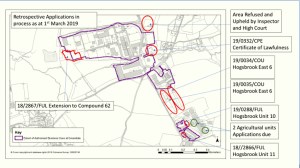
How many Retrospective Applications can one company do at once? Answer 9! Where? Greendale Business Park!

In 2017 FWS Carter and Sons, the owners of Greendale Business Park, appealed against an “Enforcement Notice” against the removal of various industrial compounds and buildings at their Business Park, which they had built prior to obtaining planning permission.

They lost their appeal with the Planning Inspector, who stated in his report that FWS Carter and Sons had misinterpreted the East Devon Local Plan and that their interpretation was “patently wrong”.

But undaunted the company challenged the Inspectors decision in the High Court. Early last year the company lost the appeal in the High Court. The Judge’s decision also restricted the owners any further opportunity to appeal and them to pay all costs arising from the case.

The Company was required to return the area back to agricultural use, but it transpires that they imported soil and laid this over the concrete yards and simply reseeded it.

It remains to be seen if the covering the concrete is enough to satisfy the Planning Inspectors requirement that the land must return to agricultural use.

Lessons learnt?

So once bitten, twice shy you would have thought with substantial losses, large court fees and professional fees involved!!

Unfortunately, it would seem not, for this family run business. Now there are 9 applications which are known to have been or are in the process of building work before the Planning Applications were submitted.

18/2866/FUL. A retrospective planning application for a rear roller shutter door and concrete pad on the rear of an industrial building onto agricultural land at Unit 11 Hogsbrook Farm. This application is before East Devon’s Planning Committee on Tuesday 4 March.

19/0034/COU. A Retrospective Application at Hogsbrook East 6. A retrospective change of use from agricultural use to industrial. An interesting history to this one! Originally built for a gas pipeline contractors’ compound that had to be returned to agricultural use when the pipeline was completed. However, FWS Carter and Sons applied for planning permission to retain the secure compound for fruit farming. Instead of fruit-growing, Woodbury Carbreakers as tenants stored scrapped vehicles there instead! After 3 years and a court case they were eventually evicted by the Environment Agency, but the owners then used it for commercial storage. Their application for industrial use failed 3 years ago, but just before an Enforcement Notice was served in late 2018 they submitted a further application. But they withdraw it and submitted this latest application.

19/0035/COU. A Retrospective Application next to Hogsbrook East 6. Very similar to the previous application which was used for the gas pipeline company. FWS Carter and Sons submitted, what is called a “Certificate of Lawfulness” which in planning terms means that after 10 years of illegal use they would not require planning permission, to allow to continue operations. However, their own documents clearly stated that gas pipeline contractors had been tenants until July 2009. As this was classified at permitted lawful use the submission was refused. Just as the previous application prior to an “Enforcement Notice” was served as the previous site in late 2018 they submitted a further planning application. They again withdraw it, a submitted this further application.

19/0332/CPE. This was a submission of a “Certificate of Lawfulness” at Greendale unit 33A. Following the publication of the East Devon Villages Plan it was realised that this unit was outside the permitted “Employment Zone” for Greendale Business Park. This was because in its 15 years of operations, planning permission had never been applied for! Therefore, the Local Authority asked the company to summit the paperwork to legalise the operation.

19/043/FUL. A Retrospective Application for 3 Freezer storage pods at Compound 31. The compound is used by DHL Logistics for parcel distribution, but early last year after winning a distribution contract with Kentucky Fried Chicken they started frozen food distribution as well. Several residents living close by the noisy freezer units and hearing the loading and unloading during the night reported the problem to Environmental Health at East Devon. They suggested to the Planning Department that a retrospective application should be submitted.

19/0288/FUL. A Retrospective Application for an extension to Unit 10 at Hogsbrook Farm to extend an Industrial Building which sits on the Employment Boundary of Greendale Business Park. This would mean that the extended building would straddle the boundary between Industrial/Agricultural use.

18/2867/FUL. A Retrospective Application to extend Compound 62 beyond the Employment Boundary into agricultural and landscaping area. The area has been built up over recent years with inert waste material under an Environment Agency permit but it would seem the Company has gone beyond the permitted landfill area.

There are 2 further Retrospective Planning Applications due for extensions to Agricultural units that have been reported to the Enforcement Officer at East Devon District Council.

That’s nine Retrospective Applications in a row. Is that a record!!

And the Government still insist that Planning Authorities treat Retrospective Applications the same as any other Application!

Planning troubles in Torbay ….

“Interesting news from Torbay – a private investigator has been hired to look into the planning decisions of Torbay Council. A fat file of evidence has been passed to the investigator based on dozens of interviews of local residents, existing and former council employees.

The investigator who has taken charge is a journalist with twenty plus years of experience with national newspapers, including the Daily Mail. She has a passion for local history and has thwarted numerous campaigns in the past relating to listed buildings and parks. Her connections across Westminster and the media are extensive.

The plan – sponsored by local residents and not by any particular organisation or body – is to publish all the evidence that is collected in a safe place online. Mainstream media outlets are already interested in documentary production and stories emanating from this body of evidence. The investigation is not solely directed against Torbay Council, as other entities have been found wanting, notably the local press.

An email address to send evidence to the investigator has been published. It is thetorbayinvestigation@gmail.com If you have information that you think might help them then please feel free to email it across to them.

So far £900 has been raised privately to help pay for the investigator who has travelled down to Torbay from London. A GoFundMe campaign was launched yesterday and can be accessed at the following URL:

https://www.gofundme.com/torbay-investigation

An independent investigation by this respected and renowned investigator and journalist must surely be welcomed.”

The Torbay Investigation

Greater Exeter Strategic Plan – where are we? In trouble!

All change on the Planning Front for East Devon.

Ever since David Cameron’s coalition government’s efforts to provide local communities with a say in local planning decisions with the “Localism Act” in 2011 (giving communities the power to draft “Neighbourhood Plans,” designed to provide a degree of self-determination to how local communities could be developed in the future) the powerful developers and landowners lobby has been active to reclaim their powerful grip on developing our communities.

First was the new National Planning Policy Framework (NPPF) in 2012 which threw out the old planning regulations and provided a “developer-driven” new planning policy, with just a “nod” to the Localism Act, Neighboured Plans and District wide plans.

The new NPPF introduced a policy that if the District or Neighbourhood Plan was not “up to date” then there would be a presumption of allowing any proposed development from a developer. Therefore, Councils and local communities quickly set about drawing up their Neighbourhood Plans and District Plans to plug the gap created by the new 2012 NPPF policies.

East Devon District Council who had been dragging their feet for years to complete their Local Plan, finally managed to obtain the approval of the Planning Inspectorate in January 2016 to cover the period up to 2031. Lympstone had got its Neighbourhood Plan approved in 2015 and since then over 30 Neighbourhood Plans are either approved or in the process of being drafted by community groups within East Devon.

It was therefore thought that East Devon and its communities had substantial protection from greedy landowners and developers up to 2031 and with the extra protection of the East Devon Villages Plan, approved in July 2018 (which gave further defined policies for larger Villages and some large Business Parks) residents and developers appeared to understand where development would or would not be allowed.

However, in late 2016 Exeter City Council, whose Chief Executive Karime Hassan (previously East Devon’s District Council officer who created and developed the concept of the new town of Cranbrook) proposed a joint “Strategic Plan”, along with neighbouring councils East Devon, Teignbridge, and Mid Devon.

The four councils then started a joint over-riding masterplan for Exeter and the surrounding area known as the GESP (the Greater Exeter Strategic Plan).

It was clear that Exeter was almost completely built-out and the infrastructure in roads and transport required for further city centre and commercial growth was urgently required if the continued success known as the “Exeter Growth Point” was to continue. Without a joint plan for infrastructure, the commute into the City would become intolerable and hinder the targeted housebuilding requirements set by the Government for each of the 4 separate councils.

In October 2018 the Government draw up yet another updated version of the NPPF (National Planning Policy Framework) very much on the lines of the 2012 Policies, but with various tweaks to assist in the over-riding government strategy of encouraging developers to build many more dwellings.

The new 2018 NPPF provided clearer guidance that if an individual Council was unable to provide enough development land for extra dwellings required by the government’s growth targets, neighbouring councils may be allowed to build out extra housing for their partner and other neighbouring authorities.

According to East Devon District Councils Strategic Planning Committees agenda item 12 for discussion on the 29th January 2019:

“Timetable for production of a new East Devon Local Plan”

Within the introduction to the agenda item it states:

…given changing circumstances and other factors, that a “light touch” review of the currently adopted local plan is unlikely to be a practical option for a new local plan.”

What the changing circumstances and other factors are, is not explained but it is clear from the report it is clearly in relation to GESP.

Because the GESP Strategic Plan policies will over-ride the East Devon Local Plan policies, the report seems to suggests that the “changing circumstances and other factors” relate to the new GESP policies which override the Local Plan, Village Plan and probably most Neighbourhood Plans – affecting a large area of East Devon! So much so that, rather than the GESP plan dovetailing into the 3-year-old approved East Devon Local Plan and 1-year-old Villages Plan with all the years of public consulting, Council debate and literally years of work by the planning team, it will be jettisoned for a brand-new Local Plan to dovetail into the strategies of the GESP plan!

Although the GESP plan has been in preparation for 2 years, no formal discussion or meeting has been held at any Council Chamber at any of the four Councils involved. Meetings have taken place to consider the 700 plus sites throughout the Greater Exeter area submitted for assessment by what is known as the “Housing and Economic Land Availability Assessment (HELAA) panel” The Panel is made up of “key stakeholders”, with a recognised interest in the development of land for housing and employment, and housing and economic development sector, including housebuilders, social landlords, local property agents and other related professionals together with local community representatives and other agencies. The membership of these meeting has been confidential and there has there been no publication of their deliberations or recommendations.

To be clear: meetings between two lead councillors from each Authority, plus officers have kept the draft policies and site options totally under lock and key – with none of the meetings been reported or minuted.

However, all is to be revealed AFTER the local council elections in May 2019 – consultation has always been scheduled to begin no earlier than June 2019.

This suggests that the draft policies and site options affecting East Devon will be so radical and so totally at variance to the East Devon Local Plan and Villages Plan that they will all require total re-writing, with a brand-new Local Plan (subsidiary to GESP) and all the costs and uncertainties this will bring.

Why have these Councils been so secretive on the GESP proposed development site considerations for proposed strategies for commercial and housing development for this part of Devon? Could it be that Tory controlled East Devon, Teignbridge, and Mid Devon Councils have elections on May 2nd this year (Labour Exeter elects only one-third of its council this year) and a brand new super-growth plan – superseding their Local Plans – will not be considered much of vote-grabber?

Don’t say you weren’t warned!

“Say NO to Sidford Business Park” campaign newsletter and fundraising event

“We hope that you had a good Christmas and wish you a very Happy New Year!

In this newsletter –
v Approaching any potential planning appeal
v A fundraising event on 23 February
v Opening a Campaign bank account

Approaching any potential planning appeal
We still don’t know whether the applicants who submitted the planning application to build the Business Park in Sidford intend to appeal against the District Council’s decision to refuse planning permission for this site, the second application in as many years. Should the applicants want to appeal they have up to 6 months from when the District Council made its decision to do so.

The applicants therefore have until 18 April to lodge any appeal. Should the applicants decide not to appeal it would be nice to think that they would announce this so that local residents can be put out of their misery as otherwise this matter sits uneasily over us all.

We have had to assume that without any evidence to the contrary, the applicants will at some point submit an appeal. We are therefore preparing ourselves should an appeal happen.

At an appeal the District Council will have to defend its decision to refuse the planning application. As its grounds for refusing planning permission were restricted to the narrow issue of the highway not being suitable for the anticipated size and volume of traffic that the Business Park could be expected to generate, we have decided that we would want the Campaign to be a party to the appeal process.

The Campaign, and many of you who have supported it, have cited broader reasons, than those put forward by the District Council, for opposing the proposed Business Park. Therefore, the Campaign would want to become a formally registered party which could fully participate at an appeal. We believe that the District Council was wrong to only rely upon highways arguments for its refusal, hence the reason why we feel the need to be a party to any appeal hearing.

However, if the Campaign is going to do all of this effectively, we believe that we are going to have to employ a planning professional to make the arguments and to cross examine the applicants’ representatives and witnesses for us. As you can imagine to do this won’t come cheaply. Potentially, we would need to raise several tens of thousands of pounds to be professionally represented. We are in the process of contacting various people with the intention of identifying such a professional and a likely cost.

It is also our hope that other organisations who submitted objections to the planning application would also want to be a party to any appeal process. In particular, we would encourage the Town Council, which submitted a broad set of objections, would make its arguments at any appeal hearing. Indeed, there is no reason why other organisations such as the County Council couldn’t do likewise.

As we say, we are having to assume that we will need to be professionally represented at an appeal if one is held. That means that we have to think about how we might raise many thousands of pounds. One way will be to seek pledges of funds from our supporters. This is something that we will return to in a future newsletter.

A fundraising event on 23 February
In the meantime we are holding a fundraising ceilidh on the evening of Saturday 23 February in Sidford Hall. Tickets will be £5.00 and you will be able to bring your own drink. We will be holding a raffle and inviting donations of prizes for it. Further information about this event will be circulated soon and, in the meantime, we are approaching several businesses in Sidford and Sidbury to see whether they would agree to sell tickets.

If you are willing to donate a prize for the raffle please let us know! Please put this date in your diary!

Opening a Campaign bank account
So far, we have managed to run this Campaign on the basis of raising cash from you, our supporters. At our last public meeting we explained how much we had raised and what we had spent it on. On several occasions we have been asked whether we have a bank account to allow supporters to give donations by cheque. We have resisted opening a bank account as frankly it’s a time-consuming process.

But as we may now have to possibly raise a significant amount of money to pay for professional representation at an appeal, we have started the process of opening a Lloyds Bank account. Once this process has been finalised, we will circulate its details.

As we said at the beginning of this newsletter, we wish you a Happy New Year. Let’s hope that our wishes for this matter to come to a quick conclusion come to fruition.

Best wishes

Campaign Team”

“Grenfell warning over creation of ‘a new generation of slums’ “

“The lessons of the Grenfell Tower fire risk being ignored because developers can convert office blocks into homes without full local authority checks, a former housing minister has warned.

Nick Raynsford said that “a new generation of slums” was being created in Britain because developers did not have to submit a planning application when converting old commercial properties into flats. The policy leaves councils with limited power to ensure that the buildings adhere to national standards.

Mr Raynsford said that “permitted development” rules were designed to minimise bureaucracy when making “modest adaptations” to existing properties, but developers were using them to create thousands of new homes in old commercial buildings.

“The council doesn’t have the power [to force developers] to comply with minimum standards on space, lighting, children’s play facilities, or fire safety,” said Mr Raynsford, who was a housing minister under Tony Blair.

A studio in Newbury House, a former office block in Ilford, east London, was planned with 13 sq m of space. The minimum standard is 37 sq m. Windowless flats have been marketed in a former office block in Brixton, south London, illuminated only by light wells that channel light from flats above.

More than 100,000 homes have been built under permitted development since 2013, accounting for up to 40 per cent of new homes in some areas. The Local Government Association found that 92 per cent of councils were “moderately or very concerned” about the quality of these homes, with 59 per cent worried about safety.

Many standards, including on space, are not compulsory and only apply to plans that go via the planning system.

Julia Park, of Levitt Bernstein architects, said such developments “tend to be occupied by vulnerable people” and were often used as temporary housing.

Mr Raynsford said: “There should be early engagement by planning authorities with the fire and rescue authority when an application for a high-rise residential development is submitted. That runs counter to the whole ‘permitted development’ approach, where obligations on developers are minimal and the council does not have the resources to explore the implications, to ensure fire engines can access the site, for example.”

The government is consulting on whether to extend the rules.

Mr Raynsford referred to evidence emerging from the Grenfell inquiry, after the fire in June last year in which 72 people died. “It seems to be extraordinary that one arm of government is pushing in a direction that’s very different to the conclusions emerging from the public inquiry in which failings, in terms of preparations for coping with serious problems, have been highlighted,” he said.

Hugh Ellis of the Town and Country Planning Association said the conditions in some developments were “Dickensian”, and added: “It is some of the most appalling slum housing this country has seen in the post-war era.”

Kit Malthouse, the housing minister, said: “All developments, including offices converted into homes, remain subject to strict fire safety rules.”

It is understood the government will look at permitted development when considering recommendations made by Dame Judith Hackitt’s Grenfell report. …”

Source: Times, pay wall

“Developers Have Used A Legal Loophole To Dodge Building 10,000 Affordable Homes”

“Developers have dodged providing more than 10,000 affordable homes due to the government’s failure to close a loophole in the law, HuffPost UK can reveal.

Using ‘permitted development rights’, builders have sidestepped their duty to provide affordable homes when they convert non-residential buildings like office blocks.

The rules were designed to speed up the planning process, as they allow developers to transform a property without having to apply for town halls’ planning permission – something which could see council chiefs demand social housing as part of planning conditions.

Housing charity Shelter handed an analysis to HuffPost which shows that 10,340 affordable homes have been lost over the last three years in England as a result.

Polly Neate, chief executive, said: “With hundreds of thousands of people homeless today, it’s obvious that we need as many social homes as we can get. But despite this, the government is now considering new plans that could supercharge a social housing get out clause for developers.

“Developers shouldn’t have a license to dodge social housing when so many are without a home they can afford. Instead of creating a social housing black hole, the government should halt these plans and bring down the cost of land to build the social homes we need.”

The government says the rules simplify the planning process, but for every 10 homes built using the conversion rules, three affordable homes have been lost.

As the housing crisis deepens, ministers are now considering a new plan which could allow developers to further exploit the rules.

Using the same legal mechanism, developers may be able to demolish and replace commercial buildings.

Labour’s shadow housing secretary, John Healey said the government must act.

“We can’t make housing more affordable if we don’t build more affordable homes, but Conservative ministers are letting developers cash in without making any contribution to the community,” he said.

We can’t make housing more affordable if we don’t build more affordable homes Labour shadow housing minister, John Healey
“These changes have given developers a free hand to dodge their duty to build homes that are affordable to local people.”

A spokeswoman for the Ministry of Housing, Communities and Local Government underlined that more than 32,000 homes had been provided using permitted development rights.

“We’re committed to speeding up the planning system to help deliver the homes the country needs,” she said.

“By introducing additional permitted development rules we’re providing flexibility, reducing bureaucracy and making the most effective use of existing buildings.

“Our £9bn affordable homes programme is set to deliver 250,000 affordable homes by March 2022 and we’re scrapping councils’ borrowing caps, setting them free to build a new generation of council housing.”

https://www.huffingtonpost.co.uk/entry/exclusive-legal-loophole-let-developers-dodge-building-10000-affordable-homes_uk_5c0a5b6ee4b0de79357bc719

Raynsford Report on planning: hot on problems, cold on solutions!

Executive summary here:
https://www.tcpa.org.uk/Handlers/Download.ashx

Honestly, Owl can barely raise a talon. Nothing new, so let’s just stick with this paragraph:

” …The defining challenge for the future of planning is not to be found in any technical fix, but in the degree to which there is consensus in favour of an effective and democratic system to manage the future development of our communities and our nation.

The institutional and technical changes are possible and achievable.

The question is whether we have the will and foresight to secure the health and wellbeing of all our communities now and for the future …”

… rhubarb, rhubarb, rhubarb….

Yeah, right, ok …. zzzzzzzzzzzz.

Yet Another Planning Saga at Greendale!

Clearly FWS Carter and Sons, the owners of Greendale Business Park are not taking “no” for an answer!

They have submitted two further retrospective planning applications 18/2661/COU and 18/2660/COU for two compounds on Hogsbrook Lane between Greendale Business Park and their farm at Hogsbrook.

There is a very long history going back 12 years for these two Industrial Compounds known as Compound East 6 at Greendale Business Park.

The area was an agricultural field up to 2007 when a Gas Pipeline Contractor building a new Gas Main through Devon used a “permitted development rights” application to construct a service yard for contractor’s equipment and storage, but with an agreed condition that it had to be returned to agricultural use following the completion of the project.

However, FWS Carter and Sons submitted a planning application APP 09/0099/FUL for the retention of hard standing and security fence for growing fruit! The retention was claimed by the applicant to be justified as fruit growing was an agricultural use and the project needed security fencing and a hard standing.

However, immediately after the approval, the site was used for the storage of scrapped vehicles by Woodbury Carbreakers. As the site did not have the appropriate planning nor Environment Agency permit a court case followed against the tenant and the site was eventually cleared after 3 years.

The Site Owners then used it for commercial and industrial purposes and finally submitted a retrospective planning application App 16/0568/FUL for Storage of HGVs in the Fruit Farm Enclosure. However, this application was refused. East Devon District Council were informed that the applicant would appeal. The applicant had 6 months up to 23/11/2016 to lodge an appeal, but no appeal was submitted, but the industrial use continued.

During this time EDDC Local Plan was approved in 2016 which included Policy E7 which allows extensions to Employment sites (except Greendale and Hill Barton that were considered too large for their rural locations). The East Devon Villages Plans approved in Feb 2018 also included a section on the “Greendale Employment Area” which excludes these specific locations off Hogsbrook Lane.

FWS Carter and sons in 2017 then applied for a Planning Variation order 17/2350/VAR to remove a planning condition to the original 2009 application which required the security fence and hardstanding to be removed if the fruit farm business failed. This application was held up for approximately 12 months due to legal matters. The Application was finally agreed in Oct 2018 but with a condition stating that the use must remain agricultural.
East of Compound 6 and further from the Hogsbrook Lane is an area that over the years has become a storage area for Industrial and agricultural products and equipment. It was originally used for the Gas Pipe line contractors and following their departure in 2009 it has been used by the landowners and their tenants.

In 2017 the owners submitted a Certificate of Lawfulness 17/2441/CPE. These Certificates are used by landowners who have used a specific area for more than 10 years without the correct planning permission and therefore are able to claim that the current use is now “lawful” after 10 years illegal use.

However, it was highlighted to the Planning Authority by the local “Woodbury Salterton Residents Association” that some of the use was agricultural and anyway the Gas Pipe Line Compound was “permitted development”, so the application failed the 10-year time requirement. Therefore, the submission failed.

It is normal practice that a planning Authority would inform landowners that an “Enforcement Notice” would eventually be served in cases like this where there has been breaches in planning regulations.

To presumably delay the Enforcement Notice, FWS Carter and sons have now submitted two further retrospective applications for a change of use application 18/2661/COU at compound East 6 and a further application 18/2660/COU for the compound relating to the failed “Certificate of Lawfulness”

Therefore, the Enforcement Notices will not be served whilst these applications are considered, with the decision to serve the Enforcement Notices being subject to the decision on these latest two applications.

The Saga of Hogsbrook Lane therefore continues!

A parish councillor says planning system is broken

Guardian letters:

“The planning system is broken. At the London launch this week of Nick Raynsford’s Review of Planning in England, speakers described demoralised councillors and planners; frustration over constant changes of policy; and anger that the system is not delivering what people want. Parish councils are at the sharp end of this failure to reform the system. Communities here in Kent and across Britain are facing the threat of opportunistic, unplanned development. Landowners and developers are exploiting the fact that it takes time to prepare, consult on and get approval for a new local plan, to bring forward applications for housing development on unsuitable sites.

Additionally, where a local authority does not have a five-year “housing supply” (an arbitrary figure and a rather nebulous concept as the number of houses in the pipeline fluctuates continually), the new national planning policy framework (NPPF) dictates that councils must grant permission, unless there are overriding reasons to refuse. A developer-led planning process, crude housing targets, no joined-up regional thinking, and flawed “consultation” has resulted in communities being pitted against each other as they try to protect the environment and their health.

The Raynsford review makes 24 recommendations to create a simpler, fairer system. These include strategic regional planning, a (limited) community right to challenge in an attempt to redress the balance of power, and a duty on local authorities to plan for high-quality and genuinely affordable homes. I hope the government will listen carefully to the arguments for reform. Change is desperately needed.
Richard Byatt
Chair, planning committee, West Malling parish council, Kent”

https://www.theguardian.com/society/2018/nov/30/our-broken-housing-market-urgently-needs-fixing

Reuse, repurpose, refurbish: “The rise of the ‘meanwhile space’: how empty properties are finding second lives”

“Hospitals are rarely places of cheer and creativity, but the former Saint-Vincent-de-Paul hospital in Paris’s 14th district is one of the most exciting places on the left bank. Former ambulance bays and car parks now house allotments, a boules court, a makeshift football pitch and an urban campsite, and up to 1,000 visitors a day come to browse its market, eat at its cafes or catch a free live performance.

Renamed Les Grands Voisins, or The Great Neighbours, the site is a magnet for Parisians and tourists alike, its former treatment rooms, A&E building and wards now a hub of social and commercial enterprise. Alongside a hostel providing 600 beds for the homeless are artisan studios, pop-up shops and startups.

It’s like a village, an inclusive space with social areas and job opportunities where different people can interact,” says William Dufourcq, director of Aurore, the charity that runs the homeless shelter. “We were overwhelmed with its success.”

Closed since 2011, the hospital is slated for redevelopment into a new neighbourhood with eco credentials, private and social housing, shops, commercial and public facilities and green space.

Planning, clearance and construction on such a large scale takes time and, rather than leave the 3.4-hectare site empty for years, the developer, Paris Batignolles Aménagement, opened it to local organisations rent-free. The lease was scheduled to end this year, but has been extended until mid-2020 while construction begins on other parts of the site.

Les Grands Voisins is an example of a “meanwhile space”: a disused site temporarily leased or loaned by developers or the public sector to local community groups, arts organisations, start-ups and charities. Calls for making use of such spaces in other crowded urban centres are getting louder. A report published in October by the thinktank Centre for London highlights both the need for and positive possibilities of utilising empty urban sites and how this could transform the landscape of cities around the globe.

“The aim was to show the value ‘meanwhile use’ can add in cities where there is pressure on space,” says Nicolas Bosetti, one of the report researchers. He says public and private operators in Paris are more ambitious than those in London in exploring the use of disused buildings from metro stations to former nightclubs for short-term use as charity and cultural venues.

Other meanwhile spaces in Paris include Exelmans, a former police residence repurposed as a shelter for the homeless and refugees, run by Aurore on a two-year lease, and the Parmentier electricity substation, where the art collective La Générale has operated since 2008.

The substation, which is soon to be redeveloped, was included in Paris Reinvented, an initiative from the mayor’s office currently in its second year. Disused public sites are put up for auction to developers and architects who compete with plans for their redevelopment. “Les Grands Voisins showed how something like this can change an area and help plan future urban projects,” says Marion Waller, adviser to Paris’s deputy mayor for urban planning. “We didn’t want to sell buildings to the highest bidder but to the most innovative solution.”

The idea of loaning empty urban spaces to worthwhile causes is gaining ground elsewhere, with thriving projects in the Danish city of Aarhus and Philadelphia in the US, where it’s called “temporary urbanism”. However, in space-squeezed London, urban sites can remain empty for years, mainly because they have no obvious commercial potential or are waiting for permission to be developed.

The Centre for London found that an estimated 24,400 commercial properties in London are currently empty, with around half having been unused for more than two years. The total available vacant space, 6.5m sq metres, is equivalent to 27 times the footprint of Westfield London, Europe’s largest shopping centre. The majority of such places are owned by local authorities and developers. “Only one of 33 London borough councils publishes a database of vacant property and only one council keeps a list of groups interested in vacant spaces,” says Bosetti.

Bosetti thinks property owners could do more to match available sites with needy groups but says local authorities are afraid of squatters or allowing in destructive elements. “One of the main barriers to meanwhile use is the perception that hoarding a site is safer,” he says. “Often the opposite is true. Opening a site to a community and encouraging interaction with residents usually sees a reduction in antisocial activity.”

Squatting and vandalism are more likely if a building remains empty for too long, so one benefit of temporary tenants is the reduction in security costs. Another, according to Simon Hesketh, director of regeneration with the British developer U+I, is the connection a meanwhile space can forge with the community prior to redevelopment.

“We’ll try to organise events in temporary spaces for the widest cross-section of residents, to get their views and ask what they’d like and what works,” he says. “Not just to smooth the planning process, but because we can learn what we might include in our proposals.” …

https://www.theguardian.com/cities/2018/nov/28/the-rise-of-the-meanwhile-space-how-empty-properties-are-finding-second-lives

Local Government Association wants two affordable housing loopholes to be closed

Permitted development rules allowing offices to be converted into housing without planning permission are exacerbating the nation’s housing affordability crisis and should be scrapped, the Local Government Association has said.

The LGA has also urged the government to drop proposed plans, contained in the Budget, to extend the rules to allow upwards extensions to be built without planning permission and allow the demolition of existing commercial buildings for new homes without planning consent.

The Association claimed that communities had missed out on more than 10,000 affordable homes in the past three years as a result of government rules on permitted development.

According to the LGA, latest figures show that since 2015, a total of 42,130 housing units in England have been converted from offices to flats without having to go through the planning system. “As a result, they included no affordable housing or supporting investment in infrastructure such as roads, schools and health services.”

The LGA added that while this amounted to approximately 7% of new homes nationally, in some parts of the country it represented a much higher proportion of all new housing. Office to residential conversions under permitted development rules accounted for 40% of new homes in Islington, Welwyn Hatfield, Mole Valley, Croydon and Derby in 2017/18.

A survey of councils in England has meanwhile found concerns about the rules, finding that:

Around nine out of 10 councils were concerned about the quality/design and the appropriateness of the location of housing as a result and almost six out of 10 were concerned about safety.

Around two-thirds thought that both contributions by developers to affordable housing and contributions for other infrastructure through section 106 agreements had reduced. A similar proportion (61%) thought that demands on local infrastructure/services had increased.

60% of councils said they were concerned about the demand being placed on health and social care services and school place planning as a result of homes being built through permitted development rules

Cllr Martin Tett, LGA Housing spokesman, said: “Permitted development rules are taking away the ability of local communities to shape the area they live in, ensures homes are built to high standards with the necessary infrastructure in place and have resulted in the potential loss of thousands of desperately-needed affordable homes.

“The loss of office space is also leaving businesses and start-ups without any premises in which to base themselves.

“Extending permitted development rules risks exacerbating these problems.”

http://www.localgovernmentlawyer.co.uk/index.php

People using self-storage units permanently because their homes are too small

“… The average household in the UK is 2.4 persons, larger than both Germany and France, yet we have the smallest average property size, making the UK population “one of the most squeezed in Europe”, according to the SSA.

So it’s not surprising that people are turning to self-storage, with it cheaper to rent extra space than it is to buy or rent a bigger home, says Rennie Schafer, chief executive of the SSA.

A “room away from home” is how he describes it. …”

https://www.bbc.co.uk/news/business-46100793

“Take business park land out of Local Plan say campaigners”

“Campaigners have called for land earmarked for a multi-million pound Sidford business park to be taken out of the Local Plan.

t follows East Devon District Council’s decision to throw out an application to build 8,445sqm of employment floor space on an Area of Outstanding Natural Beauty (AONB).

The proposed development for the Two Bridges site received 255 comments of objection and 111 in support. A campaign group also submitted a petition to the council with 1,400 signatures opposing the plans.

Now campaigners are calling on council bosses to look at removing the area, earmarked for development, out the Local Plan, claiming it should have never been there in their first place.

The Herald understands the application could once again go to appeal following a response from East Devon District Council saying it would not be appropriate to respond to the campaigners’ comments.

An EDDC spokeswoman said: “As we understand that this matter is now going to appeal, it would not be appropriate to make any comments about the status of the Local Plan.

“The campaigners can make their points direct to the Planning Inspector in support of the council’s decision to refuse.”

Councillor Marianne Rixson has spoken out on the reasons why the town should join her rallying call to pressure the authority to look at taking the site out of the Local Plan at the earliest opportunity.

The Local Plan

“When a Government inspector was examining the suitability of the site in 2014, county Highways failed to point out that the roads would not be able to cope with the traffic an industrial estate would bring. Highways only admitted their error in September 2016.

“After the draft Local Plan had been sent to the Inspector for final approval in 2015, district councillors realised they’d made a mistake and voted almost unanimously to try to remove it from the plan but no effort was made to explain to the Inspector the reasons why the site was unsuitable – consequently he had no option but to rule that the site should remain, subject to planning.”

Flooding issues:

“It is on a floodplain and flooding will inevitably get worse with climate change.

“The Two Bridges site is in zones 3A and two flood risk zones – yet another reason why this site is unsuitable.”

Area of Outstanding Natural Beauty (AONB):

“England has 34 AONB all of which are supposed to have the highest rate of protection in law and Government policy.

“We should only build on AONB if there is an overwhelming need for a development. The owners’ plans for a business park were market driven so there isn’t any hard proof. Surely we need to know for sure that there is an overwhelming need for employment space in the Sid Valley before we destroy this AONB?

“I would advocate for the district and town councils to work together to look seriously at how we can attract good quality, well paid jobs into the valley and how we can most effectively locate them without encroaching into the AONB and where there is good transport infrastructure.

“We need to attract good quality, well paid jobs into the area. Surely we can do this without encroaching into the AONB and where there are better road links? Regrettably by mid November Sidmouth will have lost three banks and building societies. Far better to turn these buildings into offices, which would help to keep our town vibrant, rather than build new offices on the outskirts.

Roads:

“Traffic cannot cope on this narrow road as it is due to the bottlenecks and number of HGVs already using the A375 – it will not be able to cope with more.

“Highways now agree this is not suitable for HGVs. “For two lorries to pass you need 6.5 metres. The main access for business park would be School Street which has a pinch point of 4.77 metres. There are several points through Sidbury too where the road is less than 5.5m, including Sidbury Mill and Cotford Bridge.

“Surely there should be a weight restriction on this road?

“According to an FOI submitted by the Say No Sidford Business Park campaigners some 30,000 cars travelled along the road in one off-peak week in April.

“I’d like to call for a weigh restriction on these struggling roads.

Endangered Bats and Japanese knotweed:

“The Two Bridges site is an important wildlife site for species that are protected such as horseshoe bats, otters and dormice.

“Knotweed exterminators have been seen on the site – it takes several years to get rid of.

Light Pollution

“The Norman Lockyer Observatory is both historical and the home to an active amateur astronomical society.

It also has plans to build a £70,000 extension so more experiments can take place than ever before.

“The light from any business park there will have an impact on the night sky, which currently has semi rural dark skies status at Sidford.”

http://www.sidmouthherald.co.uk/news/campaigners-reasons-why-sidford-business-park-land-should-not-be-in-eddc-local-plan-1-5772366

Save Clyst St Mary update

NB:
East Devon Watch readers will recall the earlier history of this plant:
https://eastdevonwatch.org/2018/07/13/investigation-launched-at-greendale-business-park-by-the-environment-agency/

“It’s been a while since any new large scale planning applications have been submitted in Clyst St Mary and I’m aware that there are a number of residents interested in our Campaign who are new to the village. We have recently been inundated regarding the new planning applications for the expansion and variation of the Anaerobic Digester. This is situated in Oil Mill Lane and has historically been the cause of some extremely offensive smells in the village.

Such increases do not comply with the original 2014 concept for a small, sustainable on-farm digester and planning conditions limiting site size, infrastructure, tonnage, transportation and output were specifically included to protect the amenities of local residents and control over-development. We support sustainable, environmentally friendly energy production – but approving a small on-farm Anaerobic Digester in Clyst St Mary is entirely inconsistent with approving a huge industrial-sized one!
Since 2014 the Applicants have systematically pursued enormous expansion and, as a village, we have suffered hugely from odours, noise and congestion from the multiple farm vehicles visiting the site.

One of our members has written some detailed sample letters objecting to the variation of conditions and extension to the anaerobic digester. If you want to object, please use one of the sample letters for the variation and a second one for the expansion. Add your details and send your emails to planningwest@eastdevon.gov.uk or you can print a copy off and post through our letter box (11 Clyst Valley Road) before 21st November 2018. I will ensure they get to East Devon District Council.

As you’re probably aware we are still expecting an amendment to the Winslade Park development (a very large scale housing development) and therefore The Save Clyst St Mary group is always very grateful for more hands-on support from residents, so if you would like to get more actively involved, please do let me know.”

Saveclyststmary.org.uk

Housing minister threatens councils on housing numbers – NOT developers!

The Express headline is:

‘Make their EYES water!’ Housing minister WARNING to councils who FAIL to meet targets

and the article goes on to blame councils for low housing numbers rather than developers who are hoarding hundreds of thousands of planning permissions, trickling out completions to keep house prices artificially high.

Message to Minister: stop shooting own foot, stop shooting councils, start squeezing developers till THEIR pips squeak!

Oh, and that bit about “developers starting on site” within two years. Legally, all they have to do is put in minimal foundations then they can leave the site unbuilt for as long as they want.

“Kit Malthouse MP was speaking to Nick Ferrari on national radio this morning to explain how the Tories are intending to “up the ante” for both developers and council planning teams so as to roll out new housing.

Mr Malthouse cited the introduction of a new scheme, the ‘Housing Delivery Test’, as one way in which the government’s building objectives might be more effectively met.

He said councils “have to hit a certain percentage of the forecast housing in their plan, and if they don’t we essentially take it out of their hands.

“If they drop below 85 percent of delivery they have to use an action plan, but if they drop below 25 percent delivery the government takes it out of their hands and they lose the ability to control a certain amount of housing in their area.”

“We want them to issue two year planning permissions, not three or five years, and if the developer doesn’t start on site within the two years that they’re able to say ‘your site’s out now’.

“You only have to do it once or twice for the development community to realise that we’re serious about this.”

The Minister explained that the Tories would give developers “big tools” to compel them to develop.

He concluded: “We’re putting big pressure on local authorities, big pressure on developers to come together.

“I do feel sometimes a bit like a marriage guidance councillor between the two because they do all shout at each other and point across the table at events that I’m at.”

Ministers say they will build 300,000 new homes a year, considerably up on the current build rate and more than in any year since the 1960s.

But a survey for the Royal Institution of Chartered Surveyors (RICS) found that only 12 percent of members expressed any confidence in that number of new homes being delivered.”

Exmouth has too much employment land says retirement developer*

* How odd – Sidmouth doesn’t have enough employment land and Exmouth has too much – maybe Exmouth could take the companies that want to occupy the Sidford Business Park!

“The planning inspectorate has now set a date of February 5, 2019, to hear arguments for and against a 59-apartment retirement community on land near Tesco, in Salterton Road originally refused by East Devon District Council as the land has been earmarked for commercial use.

In its appeal statement, developer YourLife Management Services – a joint venture between Somerset Care and McCarthy and Stone – argues that the employment allocation is ‘surplus to requirements’ and not a ‘viable’ proposition ‘now or in the near future’.

Ian Cann, vice chairman of the emerging neighbourhood plan – currently being assessed by independent examiners ahead of a public referendum – has urged the planning inspectorate to consider the need for employment land in Exmouth.

He said: “One of the focuses of the neighbourhood plan is for Exmouth to be ‘demographically balanced’ and at the moment it’s out of sync and we need to retain our younger people in the town.

“It’s all well and good giving them a house but they need to have job.

“If you want to retain this people in the town you need to create as many jobs as possible. To do that, we have to identify as much commercial land as possible.

“We have to defend against other uses of land identified for commercial use – we have to defend that to the hilt.”

If the planning inspector agrees with developers, the application, which includes self-contained flats for those over 70 years old, would be approved.

Exmouth Town Council’s planning committee has twice opposed the application, despite the developer putting its case forward.

All previous representations made about the proposal have been forwarded to the planning inspectorate and people have an opportunity to either change or add their comments by Monday, November 12.

Visit https://acp.planninginspectorate.gov.uk or emailing west2@pins.gsi.gov.uk to comment on the plans.

http://www.exmouthjournal.co.uk/news/planning-appeal-date-set-for-rejected-exmouth-retirements-flats-plan-1-5762317

“Landowners to be forced to sacrifice profits for more affordable houses, under plans expected to be unveiled in budget”

Owl says: Oh, the poor, poor darlings! We must set up a charity or a crowdfunding page for them. We could make the aim of the charity “To unite Tory developer donors to pressurise government to create other ways of making obscene profits”.

“Councils would be able to strip landowners of large portions of profits from the sale of their land, under proposals expected to be unveiled in the Budget, The Sunday Telegraph can disclose.

An official review commissioned by Philip Hammond, the Chancellor, is to endorse controversial calls for the state to “capture” more of the increase in value of sites when they are granted planning permission.

Sir Oliver Letwin, the former minister carrying out the review, is expected to recommend that local authorities should be able to seize greater amounts of landowners’ profits in order to fund the construction of local infrastructure such as roads and affordable homes. …”

https://www.telegraph.co.uk/news/2018/10/20/landowners-forced-sacrifice-profits-affordable-houses-plans/

Sidford Business Park: a begged question

If the Sidford Business Park was turned down because of

“the potentially lethal combination of narrow roads and increased heavy goods vehicle usage” …

why was it hurriedly and grubbily added to the Local Plan at the last minute?

https://eastdevonwatch.org/2018/06/18/sidford-business-park-a-grubby-history/

“Planners have said NO to Sidford Business Park and turned down the controversial plans over a potentially lethal combination of narrow roads and increased heavy goods vehicle usage.

East Devon District Council planners rejected plans to build industrial, storage and non-residential institutions on agricultural land to the east of Two Bridges Road in Sidford.

They were refused on the grounds of harm to highway safety, relating to increased heavy goods vehicle usage of the area’s narrow roads and the decision was made by officers with the Chairman of Development Management Committee, Cllr Mike Howe, in accordance with the Council’s Constitution. …”

https://www.devonlive.com/news/devon-news/planners-refuse-controversial-sidford-business-2120014

“A land banking scandal is controlling the future of British housing”

“How often have you heard private developers and their allies say they can’t build more homes because planning rules have created a shortage of land?

Kate Andrews of the Institute for Economic Affairs (IEA) summed up this view in The Daily Telegraph, saying: “There is only one way to solve the housing crisis and bring down the extortionate cost of homes: liberalise the planning system and build more houses. A bold but pragmatic policy would be to release greenbelt land – just a small fraction of which would be enough to build the million homes needed to address supply.”

A million more homes? That’s a tantalising prospect. So is there any basis for her argument that the only way to solve this problem is to liberalise (or deregulate) planning?

A little digging into the latest financial reports of the top 10 housebuilders reveals a very different story. Between them, they have a staggering 632,785 building plots on their books, of which more than half have planning permission. At the same time, these 10 companies reported building a total of just 79,704 homes – which means they have, on average, eight-years’ worth of plots in their land banks at the current rate of construction.

Among the top 10, there is a wide variation. At the upper end, Berkeley and Taylor Wimpey are hoarding 15 and 13 years’ worth of land respectively. At the lower end, McCarthy & Stone and Bellway have land banks equivalent to four years’ current output. The difference is mainly in what are known as the ‘strategic’ land banks – reserves that have not yet gained planning permission. All ten have ample land with consent, ranging from three to five years’ worth of output.

The top 10 builders accounted for about half of the 159,510 homes completed by the private sector in 2017.

It is often the case that the stories an industry feeds to the media are at odds with the trading information individual companies give shareholders via regulated stock market announcements. A classic example of this is car insurance where the industry body complained of an “epidemic of fraud” while the major providers told the market that claims volumes were falling.

In the case of housing, the market reports of the top 10 builders are brimming with confidence about future trading. You might expect Bellway, for example, to be feeling the pinch from a supposedly burdensome planning system because of its smaller-than-average land bank. But its trading update in August said that it had detailed planning permission on all its 2019 building plots and had increased land acquisition by 12 per cent to an annual level 30 per cent higher than its output. “The land market remains favourable and continues to provide attractive opportunities,” the company said.

The top 10 builders accounted for about half of the 159,510 homes completed by the private sector in 2017. So, what about the other players? Information is patchy because many are private companies, but random checks on those that are publicly listed suggest that smaller housebuilders also hold enough land to keep them going for years.

And then there are the companies that combine building homes with developing sites to sell on to other builders. The latest trading update from Inland Homes, for example, said that in the first six months of this year it has built 357 units and sold 837 plots to other housebuilders but still has 6,808 in its land bank – nearly six times as many as it built on or sold.

The pattern is clear: across the private housebuilding sector big land banks are the norm. If the top 10 companies – equating to half the market – are hoarding 600,000-plus plots, it is safe to assume that well over a million plots are in the land banks of the sector as a whole. Far from needing greenbelt land, the builders already have enough plots to deliver a step-change.

But will they? The IEA believes ‘markets’ solve economic and social problems, but the last 30 years have shown that is certainly not the case with housebuilding. When Margaret Thatcher slashed funding for council housing in the 1980s, the idea was that the private sector would fill the gap. But it didn’t happen: while the number of homes built by councils slumped from 110,170 in 1978 to 1,740 in 1996, private sector output stayed at much the same level as it was under Labour in the 1970s. With housing association output also virtually unchanged, total housebuilding has halved from more than 300,000 annually under Jim Callaghan to an average of 154,000 since 2010.

This situation suits housebuilders nicely. Constrained supply has helped push up the average price of a new house by 38 per cent since 2010, against an average of 30 per cent for all houses. And booming prices have in turn generated record-breaking profits and dividends. Taylor Wimpey, for example, cleared a £52,947 profit on each of the 6,497 houses it sold (at an average price of £295,000) in the first six months of 2018 and was able to promise shareholders that it would pay out £600m in dividends in 2019, a 20 per cent increase on 2018.

The government has responded to growing anger about land banks by setting up a review under Tory MP Oliver Letwin to “explain” why the “build-out rate” on land with planning permission is so slow. Letwin’s interim report has already admitted that housebuilders complete homes at a pace “designed to protect their profits”. His final report is due in time for the Autumn Budget, but don’t expect anything radical: he has made clear that his recommendations won’t “impair” the housebuilders.

Labour, meanwhile, has published a wide-ranging green paper promising “the biggest council housebuilding programme for over 30 years” delivering more than 100,000 “genuinely affordable” homes annually. To achieve this, Labour would use existing public land, such as sites owned by the NHS and the Ministry of Defence, and set up a Sovereign Land Trust to work with local authorities in England to help them acquire land at lower prices. Taking inspiration from the 1945 Labour government, it would also legislate to create another generation of new towns and garden cities.

Labour’s policy would, in effect, draw a line under the Thatcher era by restoring to the public sector the proactive role it played in providing housing prior to the 1980s. In doing so, it would limit the scope for the big housebuilders to hoover up nearly all the available sites and hoard them in order to drive up prices and profits. As for planning, far from being the cause of the housing crisis, it would be a means of solving it.

Steve Howell is a journalist and author of Game Changer, the story of Labour’s 2017 election campaign.”

https://www.bigissue.com/latest/finance/a-land-banking-scandal-is-controlling-the-future-of-british-housing/

Second judicial review as a Development Management Committee defies first one!

Owl says: another “follow the money” situation?

“Folkestone & Hythe District Council faces its second judicial review in a year over a dispute concerning a proposed holiday park.

Local businessman Tim Steer was granted an application for the latest judicial review by Deputy High Court judge John Howell QC.

The case concerns an application to develop a 5.5 hectares site at Little Densole Farm, which is within the Kent Downs Area of Outstanding Natural Beauty (AONB) and locally designated as a special landscape area.

Planning and licensing committee members rejected officers’ advice and allowed the application last year, leading to Mr Steer successfully taking the council to judicial review.

When the application came before them again in July councillors again went against the officers’ recommendation and gave planing permission.

Judge Howell: “It is at least arguable that [the committee] failed to give any reasons for rejecting their officer’s appraisal that the development and associated landscaping proposed would not conserve the existing character of this part of the AONB…and that it would introduce alien and incongruous features that would permanently change the existing character of the landscape in that area.”

Mr Steer said: “Not for the first time the council will waste taxpayers’ money defending the blatantly questionable decisions of its planning and licensing committee, a committee which in my view is not fit for purpose and is unable to grasp or follow policy and legislation.

“It might appear to some that this particular committee simply follows its own agenda.”

He said the project would cause “permanent destruction” of the AONB.
Clive Goddard, chair of the planning and licensing committee, said: “Leave has been granted by the court to apply for judicial review in respect of Little Densole Farm. The council has nothing further to add and will be seeking legal advice.”

Folkestone & Hythe was known until last April as Shepway District Council.”

http://localgovernmentlawyer.co.uk/index.php?option=com_content&view=article&id=36987%3Arow-over-holiday-park-sees-permission-granted-for-second-judicial-review&catid=63&Itemid=31