Will hospitals be sold off to US interests after Brexit?

One pundit thinks so:

“Leading Brexiter Tories have revealed their plans to allow private US firms to take over NHS hospitals. They are also planning for the UK to adopt lower US environmental and food safety regulations and allow imports of things that are presently banned for health reasons such as chlorinated chicken into the country.

The radical plans were revealed in recommendations by a think tank called ‘The Initiative for Free Trade’.

The IFT was launched in September 2017 by a small but influential group of right-wing Conservative figures.

Who might those figures be?

None other than Tory party leadership contender Boris Johnson, Tory International Trade Secretary Liam Fox who both launched the think tank along with IFT president, Tory MEP Daniel Hannan.

https://tompride.wordpress.com/2018/10/31/tories-reveal-plans-to-sell-off-nhs-hospitals-to-us-firms-after-brexit/

with back information here from 2017:
https://tompride.wordpress.com/2017/04/23/theresa-mays-secret-plans-to-replace-nhs-england-with-private-us-healthcare-system-kaiser-permanente/

“The Tories Have Accidentally Revealed The Personal Mobile Numbers Of Hundreds Of MPs And Journalists On Their Conference App”

These are the people charged with our Brexit it negotiations and keeping the UK safe!!!

“The Conservative party has accidentally allowed the personal mobile phone numbers of hundreds of MPs, journalists, and party members to be revealed to the public on its conference app.

A security flaw allowed anyone who downloaded the app to log in as any attendee to the party conference, which begins in Birmingham tomorrow, using only their email address. No password was required to view any attendee’s personal details, including their mobile phone number.

BuzzFeed News was able to access the personal mobile phone numbers of cabinet ministers, MPs, journalists, and Tory party members within seconds.

Users of the app are also able to change the privacy settings of other attendees using only their email address, allowing anyone else using the app to search their name and then view their mobile number.

An MP who had their personal phone number tweeted out told BuzzFeed News: “CCHQ genuinely can’t be trusted to do anything. This is a serious security breach and no laughing matter. Whoever is responsible needs to go.”

Labour MP Jon Trickett said: “How can we trust this Tory Government with our country’s security when they can’t even build a conference app that keeps the data of their members, MPs and others attending safe and secure?”

Journalist Dawn Foster reported being able to log in as Boris Johnson and then view his personal mobile number.”

https://www.buzzfeed.com/alexwickham/the-tories-have-accidentally-revealed-the-personal-mobile

Farmer Neil Parish might want to slap Michael Gove’s wrist!

“It’s beginning to dawn on many UK farmers that the British government might not be quite so clued up as they had been led to believe. Not only do they now doubt that the current levels of subsidies they receive will continue post-Brexit, they also worry that their needs for seasonal workers to pick vegetables and soft fruit have not been fully understood.

The latest cause for alarm has been a video produced by the Department for the Environment, Food and Rural Affairs (Defra) to promote its vision for post-Brexit agriculture.

It’s all very nostalgically rustic, with fields of barley rippling in the wind and glorious sunsets. A vision of mellow fruitfulness. Except for one thing. Some sections of it were filmed overseas.

As the magazine Farmers’ Weekly has observed, the scene in which Defra promise that farmers can expect less red tape was actually footage of an inspector visiting a Slovenian cattle shed, while the section on British farmers being rewarded for improving air and water quality was filmed on a German farm. To complete the hat-trick of errors, the part where Defra promise kick-backs for farmers who try to prevent climate change was accompanied by a framer planting a Bonsai tree.

We pay these people.”

https://www.theguardian.com/uk-news/2018/sep/21/theresa-may-memorabilia-why-not-now-may-be-her-time

“Bombshell No Deal Brexit documents show councils fear billions in lost funding and soaring poverty”

Remember, EDDC has confirmed it has done NO Brexit planning:

https://eastdevonwatch.org/2018/09/06/eddc-has-done-no-brexit-planning/

“Councils have compiled a dossier of No Deal Brexit documents which warn that thousands could be left destitute in communities across the country.

Local authorities fear they may be left “unable to effectively support local communities” but they warn that the Government is failing to heed the warnings.

They say that a post Brexit downturn could see businesses up and down the country go bust.

While a series of major investment proposals have been put on hold due to Brexit.

A number of councils suggested Brexit will make desperately needed regeneration projects “unviable”.

Strikingly some of the most stark warnings come from areas which voted to Leave.

Fenland District Council rank the risk associated with a no deal Brexit on the same level as that of a natural disaster.

The area in the East of England depends on unskilled labour from Eastern Europe and 70% of people living there voted to Leave.

It produced a corporate risk register in June which gave the risk of failing to take action to prepare for Brexit a score of 25/25.

That rating is reserved for items with the potential for “catastrophic impact” and equal to the threat posed by a natural disaster.

Hackney Council raised concerns over the impact of Brexit on local job growth, with one local business claiming Brexit had “traumatised our office and the sector we cover”.

Hackney also echoed other local councils in reporting a spike in hate crimes since the 2016 referendum.

Harrow Council in London also predicted an increases in levels of poverty, homelessness and health inequalities in the Borough.

Lancashire County Council highlighted the importance of EU trade, with 62% of Lancashire’s exports (£1,876 million per year) destined for the EU market.

Around 300 councils replied to the Freedom of Information requests which were put in by campaigning group Best for Britain- making the project one of the largest bodies of research into Brexit planning undertaken so far.

Commenting on the findings, Best for Britain champion Layla Moran MP said: “These internal council documents are devastating. They show Brexit will cause tremendous damage to their ability to provide the quality public services towns and cities up and down the country so desperately need.

“The only thing scarier than these documents is the fact that some councils haven’t done them – effectively they’re walking off a cliff blindfolded.

“The finger should point directly at those extremist Brexiteers in the Tory party with a gun to the country’s head. We cannot let this sinister gang of hucksters usurp common decency and sensible politics.

“Thankfully, the fight isn’t over. We can still put a stop to this madness through a people’s vote with the option to stay in the EU. Only then will the people of this country be able to compare the devastation of Brexit – as shown in these documents – with the bespoke deal we’ve been building up over the past four decades.”

https://www.mirror.co.uk/news/politics/bombshell-no-deal-brexit-documents-13238369

Neil Parish and Brexit – here’s how you can find out his view on farming post-Brexit – and his take on the Irish border!

While local non-Tory oiks are not allowed into Parish’s talk about Brexit next week (see post below – even non-member spouses will be thrown out of the meeting) we CAN find out what he thinks about post-Brexit farming, thanks to the fact that he WILL talk to lawyers about it! Presumably, all lawyers are paid-up party members!

And he DOES have a view on the thorny question of the Irish border problem:

“The Irish border is important because pigs and lambs go either way. The border issue needs to be right, if it is difficult as neither side will want to be blamed but this might ultimately help us get a deal.”

https://www.clarkewillmott.com/blog/brexit-and-agriculture-a-conversation-with-neil-parish/

Neil Parish will only talk to party members about Brexit – not even non-member spouses allowed! And questions in advance only

“Date Thursday, 13th September 2018
Time 1900
at COLLITON BARTON EVENTS AND TRAINING CENTRE, BROADHEMBURY, EX14 3LJ

(by kind permission of the Persey family)

ROGER PERSEY, past President of Tiverton & Honiton Conservative Association, to host and moderate the evening.

Please take this opportunity to make your voice heard via our MP.

Timetable & format

7:00pm Arrival and take your seats

7:15pm Questions from members – submitted in advance to arrive by email or post by 5:30pm on 11th September

8:15pm Final questions and finish followed by cheese & wine provided by Neil Parish M.P.

8:45pm Close

This event is only open to current Conservative Party members of the Tiverton & Honiton Conservative Association. This means that spouses, partners or others arriving with a member must themselves be current members – otherwise with regret they will be refused admittance.

RSVP,with details of any companions, by 5:30pm on 11th of September”

https://www.tivertonhonitonconservatives.co.uk/events/brexit-question-time-neil-parish-mp

EDDC has done no Brexit planning

Response to Freedom of Information request:

“Brexit impact assessments

Date submitted: 3 August 2018

Summary of request

1. Please provide any Brexit impact assessments conducted by your council, or other forms of Brexit planning. If you haven’t undertaken any Brexit impact assessments please provide other forms of Brexit planning, as well as any notes for context.

2. Please provide any emails relating to Brexit planning/the impact of Brexit.
Summary of response

1. Please provide any Brexit impact assessments conducted by your council, or other forms of Brexit planning. If you haven’t undertaken any Brexit impact assessments please provide other forms of Brexit planning, as well as any notes for context – EDDC have not carried out any Brexit impact assessments or any other forms of planning. For further information please refer your enquiry to the Brexit Resilience Group ran by Phil Norrey at Devon County Council:

Frances Williams
Executive PA to the Chief Executive & Head of Organisational Development
Devon County Council
County Hall
Topsham Road
EXETER
EX2 4QD
Tel: 01392 383201 or Frances.williams@devon.gov.uk

2. Please provide any emails relating to Brexit planning/the impact of Brexit – None

Date responded: 14 August 2018”

“Council in legal bid to force disclosure of Brexit impact”

“Plymouth City Council has claimed to be the first to use the Sustainable Communities Act to try to force the government to reveal the impact of Brexit.

It will also encourage other local authorities to take similar steps. Leader Tudor Evans has used the act to ask the government share with the council what it knows about Brexit’s affect on the city, even if the information concerned is considered confidential.

In a letter to communities secretary James Brokenshire, Cllr Evans demanded: “Immediate receipt by Plymouth City Council of all government departmental information and analysis pertaining to the impacts upon Plymouth’s communities and businesses of the UK’s withdrawal from the European Union, including any information deemed by the government to be confidential.”

The Sustainable Communities Act 2007 allows local authorities to ask central government to remove legislative or other barriers to the improvement of the economic, social and environmental well-being of their area.

Plymouth’s use of it is based on the council’s fears about the impact of Brexit on the city’s economy.

Cllr Evans said: “Brexit is going to have an impact on Plymouth, that is for sure. But for this council to do the job of protecting businesses and residents, we have to know exactly what the government has planned for us because at the moment, we don’t know.

“We’ve seen various dossiers released in the last few weeks. They have been at best woolly and do not address what Brexit means for individual communities.”

He said Plymouth relied on imports and exports, and half of its 20 largest companies were foreign owned and had invested there because of the direct access to the EU market.

“Although we are the first council to use the [sustainable communities] act in this way, I don’t expect us to be the last,” Cllr Evans said. “I will be speaking to colleagues all around the country in the next few days to help put pressure on the government for answers.”

http://localgovernmentlawyer.co.uk/index.php?option=com_content&view=article&id=36539%3Acouncil-in-legal-bid-to-force-disclosure-of-brexit-impact&catid=59&Itemid=27

Britain’s richest (pro-Brexit) person moves himself and ALL his assets to tax-free Monaco

“Reclusive titan of industry Jim Ratcliffe has found himself under unusual scrutiny after being declared Britain’s richest man, with his political leanings and tax affairs coming under the microscope.

The 65-year-old head of the Ineos chemicals group has assets worth an estimated £21 billion ($26.7 billion, 23.5 billion euros), putting him top of the 2018 Sunday Times rich list.

He was only 18th on last year’s list but the value of his company, of which he owns 60 percent, soared last year, propelling him up the ranks and earning him a knighthood from Queen Elizabeth II.

It is a long way from his humble beginnings, growing up in social housing in Manchester, northern England. …..

Despite his success, Ratcliffe has long-remained a “secret” and “lonely” character, earning nicknames such as “JR” — in reference to manipulative oil baron in the US TV saga “Dallas” — and James Bond villain “Dr. No”, according to a 2014 Financial Times profile.

Privacy is also a hallmark of his Ineos group, which is not listed on the stock exchange and therefore has no obligation to disclose its accounts.

However, the businessman has made his views known on the thorny issue of Brexit, coming out as one of the few bosses to support the move to leave the European Union, like fellow entrepreneur James Dyson.

“The Brits are perfectly capable of managing the Brits and don’t need Brussels telling them how to manage things,” he told the Sunday Times a year before the June 2016 referendum.

Despite his professed patriotism, Ratcliffe has shifted his fortune to Monaco, according to British media, taking advantage of the principality’s generous tax regime.

The move put him in the sights of pro-EU politicians, who accused him of hypocrisy.

“It’s strange for someone who presents themselves as highly patriotic and has been given honours to move to a notorious tax haven,” Liberal Democrat leader Vince Cable told The Times.

“It’s unfortunate that when we make a song and dance about a national hero who’s investing in the UK, they disappear to Monaco.”

Tax concerns had already led him to relocate the headquarters of his company to Switzerland in 2010, before returning to London in 2016, saying he wanted to demonstrate his confidence in Britain’s post-Brexit economy.

“Local council plans for Brexit disruption and unrest revealed”

Owl wonders what EDDC and DCC (and our Local Enterprise Partnership) have arranged for us.

“Councils around the UK have begun preparing for possible repercussions of various forms of Brexit, ranging from potential difficulties with farming and delivering services to concerns about civil unrest.

Planning documents gathered by Sky News via freedom of information requests show a number of councils are finding it difficult to plan because they are not clear about the path the government in pursuing.

The responses, from 30 councils around the UK, follow the publication of details of Kent council’s no-deal planning, which suggests thatparts of the M20 might have to be used as a lorry park to deal with port queues until at least 2023.

Bristol council’s documents flag up a potential “top-line threat” from “social unrest or disillusionment during/after negotiations as neither leave nor remain voters feel their concerns are being met”.

One of the fullest responses came from Pembrokeshire council, which released a Brexit risk register detailing 19 ways it believes leaving the EU could affect the area.

Eighteen are seen as negative, of which seven are deemed potentially high impact, including the “ready availability of vital supplies” such as food and medicines.

The one positive impact was that Brexit may drive people to move away from the UK, which could reduce demand on council services.

A number of councils, including East Sussex, are worried about the provision of social care after Brexit because of the potential fall in the number of EU nationals working in the sector.

According to Sky, East Sussex’s report says: “There has already been a fall in the number of EU nationals taking jobs in the care sector and the county council has great concerns that the end of freedom of movement will put further pressure on the sector that is already stretched and struggling to deliver the level of care required for our ageing elderly population.”

A number of councils have expressed concern about the disappearance of various EU funding streams and whether thethe Treasury would step in to replace them.

The local authority in the Shetlands released a document saying that tariffs on lamb exports under a no-deal Brexit would mean 86% of sheep farms could expect to make losses. The current figure is about 50%.

One common complaint, according to Sky, was frustration at the lack of central government information about which plan might be pursued. Wirral council said: “Given the lack of detail from government about any proposed deal or arrangements, it is difficult to carry out an assessment that is not purely speculative at this time.”

https://www.theguardian.com/politics/2018/aug/01/local-council-plans-for-brexit-disruption-and-unrest-revealed

“Councils anticipate cutting services to ‘legal minimum’ “

Owl says: But this was always the ambition of Conservatives who much prefer “the big society” (charities and volunteers providing services) and “the small state” (councils providing minimum services). We should not be surprised at that – it is what their voters vote for. But what we SHOULD be surprised at is that it is taking MORE of our money to achieve this, not less.

Labour councils are most pessimistic (83% believe this vill happen within 5 years), as they should be, as they are generally in poorer areas and/or the North where reliance on business rates (which will be the main source of council revenue with council tax) will be tricky, particularly in a post-Brexit economy. But Tory councils, even those in business rate-rich areas are also pessimistic (63%).

A sorry state of affairs to look forward to if this government remains in power: higher taxes, lower (rock bottom) services.

“Two-thirds of councils believe they will only be able to deliver minimum services required by law within five years.

The results of a survey by the New Local Government Network (NLGN) comes as Northamptonshire County Council voted through an action plan to cut services to the bone in order to tackle a likely budget deficit for this year of up to £60m–£70m.

NLGN’s second Leadership Index survey found that councils with social care responsibilities are the most pessimistic, with 88% indicating they will be unable to deliver discretionary services by 2023.

Adam Lent, director of the NLGN, said: “This should be a sober wake-up call for a government that is overseeing a country with ever deepening social divisions and growing inequality.

“Councils are best placed to tackle these problems, and should be receiving greater investment to do this, not seeing their services stripped to the bare minimum.”

Lent said areas stripped of libraries, park maintenance, pothole repairs and advice to residents on care, or housing, were likely to see a narrowing of opportunity for residents.

The survey was carried out from 7th June to 2nd July, with 191 council leaders, chief executives and mayors replying.

Labour-run councils are the most pessimistic with 83% predicting that discretionary services will disappear by 2023, compared to 63% of Conservative-run authorities.

Northamptonshire, on Thursday afternoon, approved an action plan that agreed “spending priorities”. These include safeguarding vulnerable children and adults. Also in the plan is a review of contracts with third party suppliers. Around 70% of Northamptonshire’s services are delivered through external suppliers.

Paul Carter, County Councils Network chairman and leader of Kent County Council, said: “It is clear that unless government finds a long-term solution to council funding and a fairer distribution of resources between authorities, other well-managed county councils could find themselves unable to balance the books.

“The new secretary of state for local government recognises the situation we face, but the Treasury needs to better understand the pressures we are under and support counties with short-term resources for the next financial year, ahead of a longer-term deal in the spending review.”

Northamptonshire will also review its external contracts, including Private Finance Initiative Schemes, as well as its capital programme.

Before the meeting, Andrew Lewer, Conservative MP for Northampton South, tweeted that the county council’s “problems are national as well as local”. He revealed he has written to communities secretary James Brokenshire and health secretary Matt Hancock to request a meeting about the authority’s position.

Pressure on the government to provide further assistance to Northamptonshire also came from Anne Longfield, children’s commissioner for England, who tweeted that her organisation was “writing to ministers asking for them to also ensure no vulnerable children are put at risk by cuts to services”.

It also emerged this week that East Sussex County Council last month agreed plans to reduce services to the bare minimum required by law.

Becky Shaw, chief executive, said: “Careful planning, efficiency savings, innovation, hard work and commitment to our four key priorities have enabled us to make the best use of our dwindling resources, but the pressure created by local residents’ needs cannot be met by income raised locally.

“Having transformed our services and saved £129m since 2010, we need to be realistic about what further budget cuts will mean for the residents, communities and businesses of East Sussex.

“Our core offer paints an honest picture of the minimum that we realistically need to provide in the future and we want to use this as the basis for discussion with the government, partner organisations and residents in East Sussex.”

The Times reported this week that the chancellor, Philip Hammond, has told non-protected departments, including the Ministry for Housing, Communities and Local Government, to earmark further cuts before next year’s spending review.

Some departments believe that these budgets could be cut by as much as 5%, according to the report.”

http://www.room151.co.uk/funding/councils-anticipate-cutting-services-to-legal-minimum/

Neil Parish and his “coastal communities” blind spot

Long article by Somerset farmer and Tiverton and Honiton MP on the impact of Brexit on “coastal communities”.

Two-thirds of the article is about the impact of Brexit agriculture, one-third is about its impact on fishing.

https://www.devonlive.com/news/news-opinion/nowhere-impact-eu-membership-been-1865271

Anyone notice a glaring omission? TOURISM!

Does he have any idea of the effect of Brexit on tourism – one of East Devon’s biggest earners? Apparently not.

Oh, and by the way, as with nearly 100% of our railways and most of our utility companies, many British fishing boats are NOT British owned:

“Nearly half of the total English fishing quota is controlled by companies from overseas, according to an investigation into the extent of foreign dominance over UK waters. …”

https://www.independent.co.uk/environment/half-of-english-fishing-quotas-controlled-by-overseas-firms-9836970.html

o

Our LEP asked businesses about Brexit – probably not happy with answers

From the blog of East Devon Alliance DCC Councillor Martin Shaw (Seaton and Colyton):

“The Heart of the South West Local Economic Partnership (LEP) has belatedly published a report (dated May 2018) on local businesses’ views of Brexit.
This table shows answers to the question, ‘What is your overall assessment at this stage of the likely impact of Brexit on your business?’

POSITIVE (1)
NEGATIVE (9)
Neutral (7)
Mixed (6)
Don’t know (6)

The LEP summarises this table as ‘Businesses’ assessment of the overall impact of Brexit at this stage is quite varied.‘

VARIED? ONE BUSINESS OUT OF 29 THINKS ITS IMPACT WILL BE POSITIVE, COMPARED TO 9 WHO THINK NEGATIVE, AND THAT IS VARIED?

Other findings:

two-thirds of businesses have done no formal planning for Brexit

uncertainty is a big concern

the biggest specific concerns are about are changes to regulatory alignment [i.e. departure from the Single Market] and the speed of customs arrangements [i.e. departure from the Customs Union]

only 1 out of 29 expects it to be positive for their sector; 9 out of 29 expect it to be negative (the rest expect it to be ‘neutral’ or ‘mixed’, or don’t know)

This report (How firms across HotSW are preparing for Brexit, Report to HotSW LEP, Devon County Council and Partners) was prepared in March and April 2018, drawing on interviews conducted in February and March 2018, so it is already seriously out of date.

In the spring, businesses could reasonably have hoped for a deal:

What do businesses think now that May’s government has caved in to Rees-Mogg and ditched plans for a customs union with the EU?

What do they think of the ‘no deal’ scenario?

How are they going to cope if they still haven’t done the formal planning?
It isn’t difficult to guess. And why has this report been so delayed? Why wasn’t it reported earlier to DCC?”

Local Economic Partnership massages local businesses’ anxieties about Brexit: just 1 business out of 29 surveyed thought it would have a ‘positive’ impact, 9 said negative, many were worried – but that is just a ‘quite varied’ assessment according to the LEP!

“Local council [and LEPs?] plans for Brexit disruption and unrest revealed”

Owl says Wonder what EDDC, DCC, Greater Exeter and our Local Enterprise Partnership have up their sleeves? Or do they have sleeves at all! Will they enlighten us?

Councils around the UK have begun preparing for possible repercussions of various forms of Brexit, ranging from potential difficulties with farming and delivering services to concerns about civil unrest.

Planning documents gathered by Sky News via freedom of information requests show a number of councils are finding it difficult to plan because they are not clear about the path the government in pursuing.

The responses, from 30 councils around the UK, follow the publication of details of Kent council’s no-deal planning, which suggests thatparts of the M20 might have to be used as a lorry park to deal with port queues until at least 2023.

Bristol council’s documents flag up a potential “top-line threat” from “social unrest or disillusionment during/after negotiations as neither leave nor remain voters feel their concerns are being met”.

One of the fullest responses came from Pembrokeshire council, which released a Brexit risk register detailing 19 ways it believes leaving the EU could affect the area.

Eighteen are seen as negative, of which seven are deemed potentially high impact, including the “ready availability of vital supplies” such as food and medicines.

The one positive impact was that Brexit may drive people to move away from the UK, which could reduce demand on council services.

A number of councils, including East Sussex, are worried about the provision of social care after Brexit because of the potential fall in the number of EU nationals working in the sector.

According to Sky, East Sussex’s report says: “There has already been a fall in the number of EU nationals taking jobs in the care sector and the county council has great concerns that the end of freedom of movement will put further pressure on the sector that is already stretched and struggling to deliver the level of care required for our ageing elderly population.”

A number of councils have expressed concern about the disappearance of various EU funding streams and whether thethe Treasury would step in to replace them.

The local authority in the Shetlands released a document saying that tariffs on lamb exports under a no-deal Brexit would mean 86% of sheep farms could expect to make losses. The current figure is about 50%.

One common complaint, according to Sky, was frustration at the lack of central government information about which plan might be pursued. Wirral council said: “Given the lack of detail from government about any proposed deal or arrangements, it is difficult to carry out an assessment that is not purely speculative at this time.”

https://www.theguardian.com/politics/2018/aug/01/local-council-plans-for-brexit-disruption-and-unrest-revealed

Flybe has post-Brexit worries

“Flybe, whose headquarters is in Exeter, is warning that no agreement is in place for services to mainland Europe after Brexit.

With only eight months until Britain leaves the EU, airlines have no legal, commercial or political deals in place.

Flybe said it was already selling fares for next summer, with fingers crossed that common sense would prevail. But it warned there was no certainty.

Chief commercial officer Roy Kinnear said: “Customers are used to buying their flights in advance.”

https://www.bbc.co.uk/news/live/uk-england-devon-44951601

Food or houses?

If, as it seems is essential after Brexit, we have to grow more of our own food to make us more self-sufficient, how do we do it if more and more high-grade agricultural land is being gobbled up for housing, while developers ignore brownfield sites?

In World War 2 everyone was encouraged to “grow your own”. But how do you do that with a tiny patio or no patio at all and no extra allotments?

For many years we have relied on food imports to cover shortages. Do we really want bleach-washed American chicken on the dinner tables of our tiny new homes built on agricultural land?

Oops, sorry, no space for a dining table – on our knees in front of the TV in our tiny new homes!

Urgent action needed on political advertising

“Following a request by the Culture Media and Sport committee, Facebook released the adverts Vote Leave ran during the EU referendum.

The series of adverts targeted specific Facebook users – but in many it was not clear who had paid for them.

We know who sends us leaflets during elections – we should know who’s paying for online adverts too.

Openness and transparency should be the standard during election and referendum campaigns, not the exception.

Will you sign our petition for online imprints and to release all the official adverts from the EU referendum?”

Sign the petition:
https://action.electoral-reform.org.uk/page/28040/petition/1

“Jacob Rees-Mogg’s investment firm launches second Irish fund”

“A second investment fund has been set up in Ireland by the City firm co-founded by Jacob Rees-Mogg, after it warned earlier this year about the financial dangers of the sort of hard Brexit favoured by the Conservative MP.

The fund, which is backed by $50m (£38m) in seed money from the Swedish national pension plan, was created to meet demand from international investors, according to Somerset Capital Management (SCM).

Uncertainty over the UK’s stance on withdrawal from the EU and the potential impact on banking and related services has led asset managers based in London to establish new financial products in European financial hubs including Dublin and Frankfurt.

A spokesperson for SCM said that for many years it had plans to launch a dedicated strategy for UK and European investors, saying: “Our decision to choose Ireland as a domicile had absolutely nothing to do with Brexit. We have funds domiciled all over the world including in Europe, the US and Australasia, and we will continue to offer a global service to our client base.”

In March, SCM described Brexit as a risk in a prospectus to a new fund, which has been marketed to international investors who want to keep their money in the EU long-term.

The disclosures have been used by political opponents of Rees-Mogg, who has been working part-time at Somerset Capital in addition to his work as an MP and who has repeatedly dismissed the concerns of those worried about the financial risks of Brexit.

The MP has a stake of more than 15%, according to the register of MPs’ financial interests.

On Saturday, Rees-Mogg said Britain was heading for a no-deal exit from the EU but said falling back on World Trade Organization terms was “nothing to be frightened of”.

Rees-Mogg chairs the European Research Group, which continues to put pressure on the prime minister to adopt a more antagonistic stance towards Brussels as the UK negotiates its exit from the EU.”

https://www.theguardian.com/politics/2018/jul/22/jacob-rees-mogg-second-irish-fund-scm

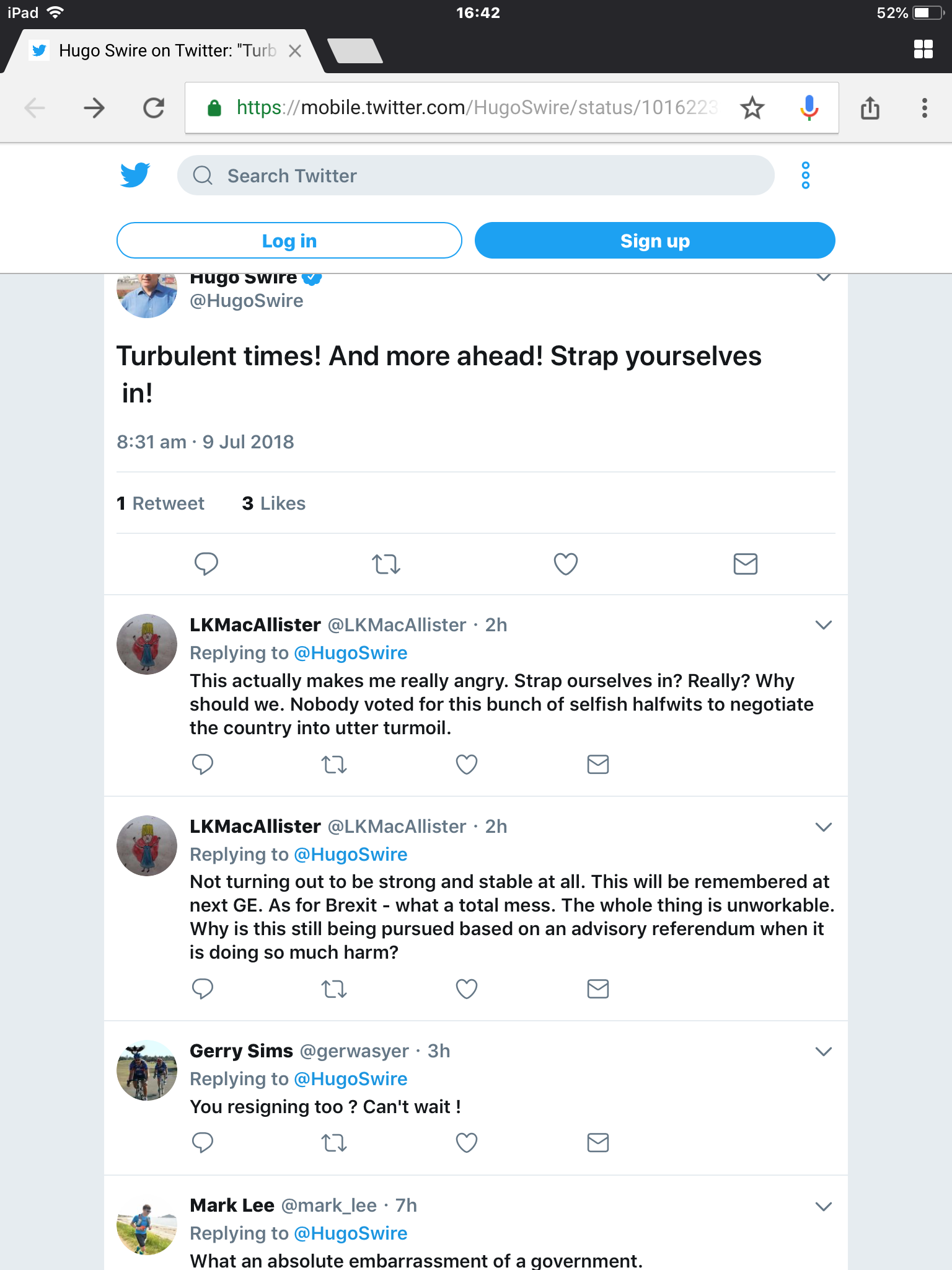
Swire tells us to “strap ourselves in” …

Swire’s advice to us in his Twitter post?

“Turbulent times! And more ahead! Strap yourselves in!”

Unfortunately it was followed by several replies on the lines of:

  • your lot caused it so why crow about it;
  • not a good example if “strong and stable”; and
  • when can we look forward to your resignation

Rather backfired …. seems to be catching.

Devon Tory GP MP pours cold water on “extra” NHS funding promise

Owl says: surely “extra” money for the NHS means ALL CCG costings have to be revised? And all the arguments about WHY services have to be cut must be revisited.

“Theresa May has come under fire for promising that a Brexit windfall will provide an extra £400m a week for the NHS. May – who will pledge an extra £20bn in annual real terms from 2023-24 in a major speech – has been ridiculed for linking the money to Brexit savings. “At the moment, as a member of the European Union, every year we spend significant amounts of money on our subscription, if you like, to the EU,” she said on BBC One’s Andrew Marr show. “When we leave we won’t be doing that.”

Two senior Tory MPs, who are also doctors, took aim at May: “The Brexit dividend tosh was expected but treats the public as fools. Sad to see Govt slide to populist arguments rather than evidence on such an important issues,” tweeted Sarah Wallaston, who chairs the Commons health and social care committee. Dr Philip Lee, MP for Bracknell, tweeted: “There is no evidence yet that there will be a ‘Brexit dividend’ – so it’s tax rises, more borrowing or both.”

The PM’s decision to frame extra spending specifically as a benefit of leaving the EU has been widely seen as a sop to hardline Brexiters in her cabinet, echoing Boris Johnson’s suggestion during the EU referendum that Brexit would free up £350m a week extra for the NHS.”

https://www.theguardian.com/world/2018/jun/18/monday-briefing-nhs-windfall-is-brexit-dividend-tosh-says-tory-mp