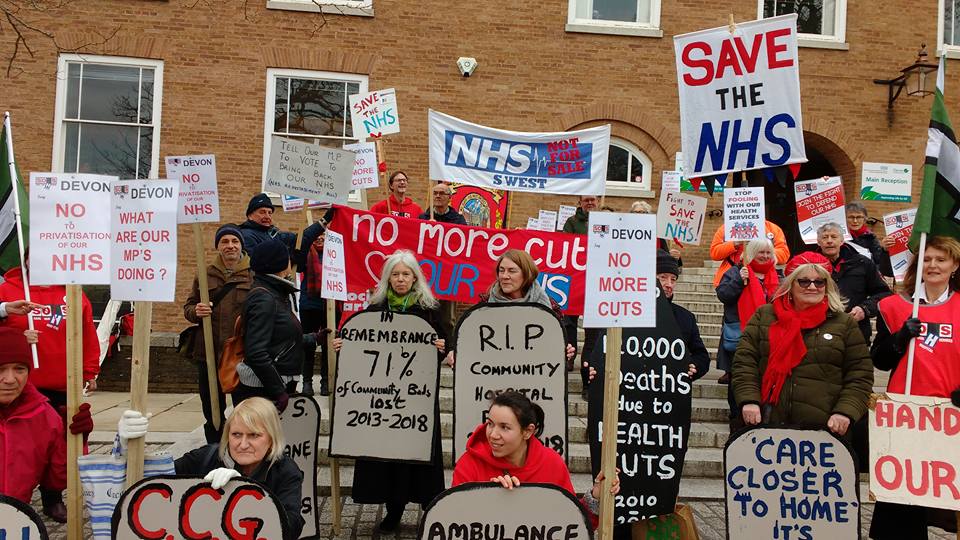
How privatisation and outsourcing of public services fails

And, at the time, directors changed rules so they would get more protection from the losses.

“Carillion used suppliers to “prop up a failing business model” and conceal true levels of debt, say MPs investigating the failed government contractor.

The parliamentary inquiry into the collapse of a company that provided a host of vital public services, including catering in schools, prison maintenance and construction of new NHS hospitals will conclude on Wednesday with the publication of the MPs’ final report. It is expected to name and shame those responsible for the failure of the listed company, which had a UK staff of nearly 20,000 when it crashed into administration in January.

Carillion bosses displayed ‘greed on stilts’, MPs claim

In a taste of what is to come, the work and pensions committee chairman, Frank Field, said: “Carillion displayed utter contempt for its suppliers, many of them the small businesses that are the lifeblood of the UK’s economy.

“The company used its suppliers as a line of credit to shore up its fragile balance sheet, then in another of its accounting tricks ‘reclassified’ this borrowing to hide the true extent of its massive debt.”

Field’s comments came as the joint inquiry with the business, energy and industrial strategy committee, published evidence from Santander, the bank that operated the company’s early payment facility. Its loss was one of the events Carillion’s directors attempted to blame for its eventual failure.

However, in the letter the Santander chief risk officer, Patricia Halliday, sets out why the bank pulled the plug on the facility in December 2017. In the wake of a profit warning that summer, Halliday said Santander had worked with other banks on a refinancing plan contingent on the company making disposals.

“Despite the provision of these new money commitments and continued close engagement with Carillion into December, the envisaged disposals did not take place and the detailed business and restructuring plans originally expected to be received by 8 December were further delayed,” Halliday writes. “This series of events … further undermined Santander’s confidence in Carillion’s financial position.

“In light of the lack of progress with the restructuring plan, Santander took the decision to terminate the … facility,” she adds. …”

https://www.theguardian.com/business/2018/may/14/carillion-displayed-utter-contempt-for-suppliers-frank-field

What a surprise! “Outsourced public services ‘still not adopting ethical standards’ “

“Little significant progress has been made on reinforcing ethical standards in outsourced public services, a Lords committee has cautioned.

It also suggested a consultation be set up looking at whether the Freedom of Information Act should apply to private sector providers working on public sector contracts, the Lords committee on standards in public life also said in report out yesterday.

Chair Lord Bew noted “very little progress” had been made on implementing the recommendations of the committee’s 2014 report, aimed at enhancing the ethical standards of contractors commissioned by the public sector.

“Disappointingly, very little progress has been made on implementing these recommendations and evidence shows that most service providers need to do more to demonstrate best practice in ethical standards,” Bew said.

He called for services providers to “recognise that the Nolan Principles apply to them, for moral courage among key financial and other professionals in securing and maintaining high ethical standards”.

The Nolan Principles were drawn up in 1995 and are seven ethical standards people in public office are expected to uphold: selflessness, integrity, objectivity, accountability, openness, honesty and leadership.

Bew added: “Some [service providers] remain dismissive of the Nolan Principles or adopt a ‘pick and mix’ approach which is not in the public interest.”

The committee noted one-third of government spending is on external providers and that “the public is clear that they expect common ethical standards”. But some providers were not applying these public sector ethical standards in their work, the Lords concluded.

Bew said the committee called for a “consultation on the extension of the application of the Freedom of Information Act to private sector providers where information relates to the performance of a contract with government for the delivery of public services”.

The committee recommended that service providers should acknowledge the Nolan Principles applied to them.

Bew also said: “The committee remains of the view that more must be done to encourage strong and robust cultures of ethical behaviour in those delivering public services.”

The CSPL report suggested commissioners of services should include a ‘statement of intent’ in addition to contracts to set out the ethical behaviours expected by the government.

In the light of the collapse of Carillion, the committee suggested it is “essential” that ethical standards are reinforced for those delivering services with public money.

The report released yesterday is one in a series being done by the committee on ethical standards of providers of public services.”

https://www.publicfinance.co.uk/news/2018/05/outsourced-public-services-still-not-adopting-ethical-standards

EDDC charge £40 to tell you they don’t know the answer to a simple planning question

https://m.facebook.com/groups/175988535857207?view=permalink&id=1528476497275064

and

https://m.facebook.com/story.php?story_fbid=1450832245038963&id=959780427477483

“UK parks save NHS more than £111m a year, study suggests”

And guess what? They are being sold off (as in land appropriated by EDDC for PegasusLife) or kept under the control of developers – as in Cranbrook.

https://www.theguardian.com/uk-news/2018/may/07/uk-parks-save-nhs-111m-year-study-suggests

“RURAL RESIDENTS FACE SOCIAL CARE ‘LOTTERY'”

The government’s system of funding social care services is unsustainable and unfair for rural communities, the Rural Services Network has warned.

Service providers operating across rural areas face inequitable costs compared to their urban counterparts for both adult and child social care, said the network.

Rural council taxpayers also faced unfair costs, warned the network in response to an inquiry by MPs who are examining the long-term future of adult social care.

RSN chief executive Graham Biggs said: “Social care is a national issue but it is in crisis.

He added: “While continuing to be delivered locally with flexibility for councils to respond to local circumstances and priorities, it should be 100% funded by central government to provide an adequate core service level for all residents nationally – irrespective of where people live.

“Council tax is an unsuitable taxation vehicle for demand responsive services and means rural residents face a postcode lottery when it comes to social care provision.”

Mr Biggs said council tax should only be used to fund social care if a given local authority decided extra money was needed to boost services above a core level locally.

It should not be used to fund the core, national, service, he added.

Mr Biggs said: “It costs substantially more to provide social care in rural areas than it does in larger towns and cities – and there is higher demand for services in rural areas.

“As a statutory duty, services have to be prioritised and other budgets – such as rural transport support, for example – are being cut significantly as a consequence.”

This was because older people make up a higher proportion of the population in rural areas than they do in urban areas, said Mr Biggs.

At the same time, the twin challenge of isolation and distance made it harder and more expensive to deliver services to dispersed rural populations.

Such costs inevitably and unfairly penalised rural councils – and were compounded by issues such as poor economies of scale and poorer external markets for delivery.

Mr Biggs said: “A future formulae to fund social care services must fully reflect the different costs of delivery imposed by both geography and population.”

http://www.rsnonline.org.uk/rural-residents-face-social-care-lottery

“Free” schools – anything but free!

“The government’s free schools policy has come under renewed fire after it emerged that another of its studio schools, set up using millions of pounds of taxpayers’ money, is to close this summer after a brief, troubled existence.

Plymouth studio school will be the 19th of its kind to shut its doors to pupils since the policy was introduced in 2010, at

an estimated collective cost of £48.3m

according to the National Education Union (NEU).

This week it also emerged that Isle of Wight studio school, which opened four years ago, will close in the summer of 2019 due to lack of demand.

The NEU says the latest closures bring the total to 66 new schools launched under the government’s flagship free schools policy that have either closed, partially closed or failed to open at all, at an estimated cost of almost

£150m

in startup costs and capital funding. …”

https://www.theguardian.com/politics/2018/apr/25/free-schools-policy-under-fire-as-yet-another-closure-announced-plymouth

“Scrutiny in public sector ‘struggling’ “

“Public sector scrutiny “struggles to keep up” with the “increased complexity of modern government”, according to a think-tank.

The collapse of construction contractor Carillion showed the government’s failure to effectively evaluate the use of private providers in the public sector, the discussion paper released by the Institute for Government yesterday also said.

Five million public sector workers were responsible for delivering services, the IFG noted, but still “there are weaknesses in the UK’s system of accountability, which often struggles to keep up with the realities of modern government both nationally and locally”.

Because government has failed to keep pace with the “increased complexity of modern government”, it has not properly scrutinised public-private partnerships’ value for money, Accountability in modern government added.

The think-tank suggested often in government accountability is replaced by a “pervading culture of blame”.

This culture, the think-tank argued, has been evident in the roll out of Universal Credit – which combines six working-age benefits in one – and more recently in the Windrush immigration cases.

IfG said: “While accountability certainly involves apportioning blame when something goes wrong, it should also foster an environment that lead to improvement.

“This is what the public cares most about- preventing failures recurring, rather than simple retribution.”

Benoit Guerin, a senior researcher at the Institute for Government, said: “Accountability helps people know how the government is doing and where to go when things go wrong.

“A lack of accountability is worrying because it increases the risk of failure and decreases legitimacy of the state in the eyes of the public.”

He said the IFG hoped to start a debate on how accountability in the public sector could be strengthened with the aim of making recommendations for reform.”

https://www.publicfinance.co.uk/news/2018/04/scrutiny-public-sector-struggling

“Why I started a petition against NHS privatisation”

by Jamie Snape:

Today in Westminster MPs will debate a petition calling on the government to stop the privatisation of NHS services. Now, if I’m entirely honest, the date of a petition debate isn’t something that would normally appear in my calendar, however this particular debate I’m responsible for myself.

Until starting this petition I’d never campaigned on behalf the NHS, nor had I any connection to the plethora of local or national NHS campaign groups. So what drove me to begin the petition in the first place?

Well, it was after I’d encountered for myself the already privatised NHS services in my local area. Following this I was left with a clear understanding of what it means in reality, when our healthcare is provided by a profit-orientated business rather than an organisation focused on patient outcome like the NHS, and indeed what it is we are losing by privatising it.

As a parent, seeing my young children’s well-being affected directly and indirectly by NHS privatisation on more than one occasion, it motivated me to a degree that I might not otherwise have been.

So I began reading more about NHS privatisation, and why people like the late Stephen Hawking were so concerned. I concluded I could perhaps make a little difference myself by using a petition as a vehicle to help voice the concerns that many people have and that I share about creeping NHS privatisation.

This belief panned out, indeed a single post I wrote on Facebook about the petition was shared over 73,000 times, meaning it was very likely to have been read by more than a million people.

There are over 6,500 petitions on the parliament website right now, and it’s fair to say the UK public are petitioned out. Despite that, not too far short of a quarter of a million people took the time to sign this petition, which ultimately resulted in the scheduling of today’s debate in parliament.

NHS privatisation can mean so many things as there are so many aspects to it, so in terms of the debate itself, my hope is simply that I will observe a well-informed one. I hope that all the MPs involved demonstrate a real knowledge of the issues relating to it, such as the scale of current NHS privatisation.

What simply must be covered are the concerns surrounding the introduction of Accountable Care Organisations later this year, and their potential for leaving a back door wide open for a massive new wave of NHS privatisation.

If the debate centres around the small part of NHS privatisation, where a few people get bumped up the waiting list by having a routine operation performed by a private company, then I will of course be disappointed.

The concept of the NHS is erroneously referenced by many now in historic terms, especially when they are arguing in favour of NHS privatisation.

Personally, I see the NHS as something very much of the future, indeed I’m entirely certain that in years to come, a nation will only be considered civilised if it provides comprehensive free healthcare to all of its citizens.”

Source: Times (pay wall)

Carillion accounts? Audit? Think of a number …!

“Carillion owed almost £7bn when it went bust at the start of the year, a far higher amount than had been ­previously thought.

The Official Receiver, a civil servant appointed by the courts to handle bankruptcies, estimated the construction giant had liabilities of £6.9bn when it entered liquidation three months ago. …

… While accounts had previously ­revealed liabilities of £2bn at the end of 2016, a letter from the Official Receiver, detailing reports for the 27 UK-based Carillion Construction companies in liquidation, estimated that total liabilities stand at £6,905,532,000.

A spokesman for the Official ­Receiver confirmed the figure, first ­reported by Construction News, but said that it was “expected to change significantly as assets and debts are fully identified”. …”

https://www.telegraph.co.uk/business/2018/04/14/7bn-carillion-debts-revealed/

“Hospitals launch legal challenge over rates relief”

“A group of 20 NHS hospital trusts has launched a legal challenge for business rates relief. The trusts have started legal proceedings against 49 local authorities who want to be treated the same as private hospitals for relief on business rates bills. A preliminary hearing took place yesterday. The LGA is supporting councils involved in the case. …”

Source: Mail Online, Express p5

“Two-fifths of private hospitals in England are failing safety standards”

As waiting lists get longer and bed numbers get fewer, many people in East Devon are now resorting to using their savings to pay for private hospital treatment.

Maybe think twice.

“Two-fifths of private hospitals in England fail to meet expected safety standards, according to a report by health inspectors.

While most independent acute hospitals provide good quality care, inspections by the Care Quality Commission (CQC) raised concerns over the safety and leadership of some services.

The regulator also said “a lack of effective oversight” of consultants with practising privileges was a “major concern”.

The issue had been “brought into sharp focus” by the case of the rogue breast surgeon Ian Paterson, who carried out unnecessary operations in NHS and private hospitals, it added.

The Royal College of Surgeons (RCS) said the report “exposes the poorer practices of some independent providers and underlines the need for a renewed focus on improving patient safety”.

Of the 206 independent acute hospitals inspected, 62% were given a “good” rating overall and 8% were described as “outstanding”. However, 30% of private hospitals were deemed to need improvement.

The CQC said it was particularly concerned about safety, with 41% of private hospitals rated as requiring improvement in this area and 1% as inadequate. Almost a third were rated as requiring improvement and 3% as inadequate in terms of how well they were led. …”

https://www.theguardian.com/society/2018/apr/11/two-fifths-of-private-hospitals-in-england-are-failing-safety-standards

“DCC cabinet decides tomorrow if to back Health Scrutiny resolution over controversial health plans”

Claire Wright’s blog, as she ploughs (with EDA DCC Councillor Martin Shaw) the lonely furrow of integrity and common sense – both sadly lacking in the DCC Health and Social Care Scrutiny Committee:

“Devon County Council’s cabinet will decide tomorrow whether to back the Health and Adult Scrutiny Committee’s resolution on deferring the implementation of the controversial Integrated Care System, which many local people have huge concerns over.

At the last Health and Adult Care Scrutiny Committee on 22 March, I proposed the following which was supported by the majority of the committee.

An additional line on a public engagement, was voted down by Conservative councillors:

Here’s what the cabinet will be considering. If it supports the resolution, it will be implemented with immediate effect…..

I will be speaking in support of the resolution tomorrow…… If you are keen to know the outcome or hear the discussion, the meeting is webcast live here – https://devoncc.public-i.tv/core/portal/home

(a) record the Committee’s concerns over the emerging Devon Integrated Care System being a single Integrated Strategic Commissioner, a number of Local Care Partnerships, Mental Health Care Partnership and shared NHS corporate services;

(b) defer the implementation of the Integrated Care System process until assurances are provided on governance, funding, the future of social care from a democratic perspective;

(c) recommend Councillor Ackland’s paper and proposals on the reformation of the Health and Wellbeing Board as a sound democratic way forward to provide the necessary governance on a new integrated system;

(d) give assurance that the proposals will not lead to deeper cuts in any part of Devon as a result of the ‘equalisation of funding’; and

(e) provide a copy of the business plan being developed and a summary of views from staff consultations.

For more background on Integrated Care Systems see my blog
post –

http://www.claire-wright.org/…/devons_nhs_asked_to_provide_…

“Academy trust has failed Devon’s most vulnerable pupils”

Owl says: Academies: they were supposed to be BETTER than local authority schools because they were free from the financial constraints and poorer management of local authorities they would raise standards (while making pots of money for the private companies running them!!! Right!

Transpose to the NHS and hospitals and you can see where this is leading …

“A multi-academy trust in Devon which was commissioned to support children who are unable to attend mainstream school is being replaced due to serious failings.

Devon’s alternative education provision (AP) has been running as a sponsored academy by SchoolsCompany who this week have apologised to parents for its financial mismanagement and not providing a high quality of education.

The SchoolsCompany currently run three AP academies in Devon – Central Devon Academy in Exeter, North Devon Academy in Barnstaple, and South and West Devon Academy in Dartington.

AP includes pupil referral units and education for children with medical needs or who are in care.

As a result of its failings, it has closed Tavistock Youth Café, a community-based model of education provision for children who are out of school.

The decision was based on concerns over the quality of education being provided, and health and safety.

At the beginning of the year North Devon Academy pupil referral unit was placed into special measures after a damning Ofsted report deemed it to be “inadequate” across the board.

In October 2017, a monitoring Ofsted inspection report following a visit to Central Devon Academy concluded safeguarding is not effective.

The academy was formed in March 2015, replacing the Devon County Council Pupil Referral Unit.

South and West Devon Academy in Dartington was last inspected in July 2014 and was rated good. At that time it was seeking to become a sponsored academy.

SchoolsCompany has already come under scrutiny this year following revelations of financial mismanagement of its other academy in Kent.

In February it apologised to its pupils and parents after admitting “unacceptable failures of financial management”.

The educational consultancy, school management and training company describes itself as being dedicated to improving services for children, but has now had to issue another apology this week.

A spokesperson for SchoolsCompany said: “The academies in Devon have fallen short of the high standards that young people should expect and there have been shortcomings in the trust’s overall financial management.

“We would like to apologise to our students and their parents. Young people deserve the very best education.”

At the beginning of the year the trust’s chief executive Elias Achilleos was suspended and replaced by an interim, Angela Barry.

In Devon, a short-term service level agreement has been made for Plymouth-based ACE Schools Multi Academy Trust to step in and have identified actions to address the current shortcomings.

It has not been confirmed who will take over as new sponsors of Devon’s AP.

A spokesperson for SchoolsCompany continued: “We agree with the respective Regional Schools Commissioners that new academy trusts should be identified as prospective sponsors to take over the trust’s four schools in Devon and Kent.

“These strong trusts will provide the expertise and stability needed to run the academies successfully. No decisions have been taken as to who these new sponsors will be.”

Concerns have raised by the impact the trust’s failings are having on Devon’s most vulnerable pupils.

An education worker, who asked not to be named said: “Huge amounts of Devon County Council funding have gone into the contract, along with central government funding via the Education and Schools Funding Agency.

“In the meantime all sorts of injustices are being meted out to the most vulnerable young people in the county and closure of provision in some localities.

“SchoolsCompany were already a failed company before Devon took them on. Their reputation in Kent, for example, is associated with the failure of a number of schools in an academy group.

“The very sad thing is Devon was one of the first counties to commission the education provision for its most vulnerable children in this sponsored academy way. That’s the greatest tragedy.

““The county took a massive risk but they were also under a lot of pressure from the Department for Education to make their local authority education provision over to sponsored academies.”

A spokesman for Devon County Council said: “The three academies are overseen by the Regional Schools Commissioner on behalf of the Government and are not Devon County Council schools.

“However, these academies serve vulnerable Devon children and we have been having continuing discussions with the RSC and the provider about improving the quality of education and care for these pupils.

“The Plymouth-based ACE academy trust is now working with SchoolsCompany and we are regularly meeting with them to monitor the situation and to ensure the needs of these vulnerable pupils are met.”

https://www.devonlive.com/news/devon-news/academy-trust-failed-devons-most-1425284

“I don’t believe it!” – NHS Providers say we are short of at least 10,000 hospital beds and are treating our elderly shamefully!

“The NHS is more than 10,000 beds short of what it needs to look after older people properly, hospital leaders have said.

NHS Providers, which represents hospitals, said that it was impossible for waiting time targets to be met this year and warned that the government’s pretence that they would be met created a “toxic culture” similar to that which led to the Mid Staffordshire scandal.

This week Theresa May promised that a long-term plan for NHS budget rises would be agreed within months, and will be under pressure to agree increases of up to £20 billion over five years.

However, Jonathan Ashworth, the shadow health secretary, said that “a nod and wink from the prime minister” was not enough for patients.

The NHS has not hit any of its main targets for more than two years. Chris Hopson, chief executive of NHS Providers, said: “The levels of performance expected and the savings demanded for next year are beyond reach. While we strongly welcome the prime minister’s commitment to increase long-term funding for the NHS, it makes no immediate difference to the tough task facing trusts for next year.”

Mr Hopson’s report estimates that 3.6 million patients will not be treated within four hours at A&E over the next year and 560,000 will be denied routine surgery within 18 weeks. He said that hospitals could make £3.3 billion in savings next year but that ministers had demanded 20 per cent more than this.

“This creates a toxic culture, based on pretence, where trusts are pressurised to sign up to targets they know they can’t deliver and then miss those targets as the year progresses,” his report said.

The NHS is probably somewhere between 10,000 to 15,000 beds short on a bed base of about 100,000.”

One hospital chief executive suggested that hospital overcrowding pointed to deep social problems. He said: “As a country we don’t look after old people well. We have too many people living by themselves in houses that are unsuitable . . . In the end they get really unwell and call 999.”

Source: The Times, pay wall

Insolvent Tory council to be run by Commissioners

“A ‘bankrupt’ Tory council will be TAKEN OVER by Commissioners in a drastic, rare step after completely running out of money.

Northamptonshire County Council will be stripped of the power to run its own affairs after a damning inspection into the financial crisis at the town hall.

Now it will be run by Commissioners following a decision by the Ministry of Housing, Communities and Local Government.

Labour said they were vindicated as Local Government Secretary Sajid Javid announced the move in the House of Commons.

Shadow Local Government Secretary Andrew Gwynne blamed “eight years of intransigence and austerity” as “the council bragged about its pioneering approach to services, basically running them like a business.”

“The private sector cannot deliver adequate services when there is too little funding,” he said. …”

https://www.mirror.co.uk/news/politics/bankrupt-tory-council-taken-over-12259651

Is NHS privatisation a good idea? “Carillion bosses displayed ‘greed on stilts’, MPs claim”

We are not allowed to see or scrutinise contracts placed by the NHS with private companies. Carillion (formerly Tarmac) had many service contracts with the government.

“… When considering clawbacks – an arrangement for retrieving executive rewards in the event of poor performance after a bonus has been paid – the board opted to rule out extending the use of the device beyond a handful of its most senior directors. The papers show the remuneration committee feared more conservative pay arrangements for particular contracts “would have a detrimental impact on performance”.

The trove of information from the select committees also shows that Carillion’s adviser, Deloitte, said in September that weak provisions didn’t allow any bonuses paid in cash to be clawed back at all.

The remuneration committee extended its clawback conditions to cover serious reputational damage and failures of risk management around that time, however, the MPs said they had seen no evidence to suggest any further attempts were made to return cash from bonuses to the business.

The latest swathe of evidence against the company comes amid the continuing fallout of Carillion’s collapse in January with debts to its 30,000 suppliers worth about £2bn. …”

https://www.theguardian.com/business/2018/mar/26/carillion-bosses-displayed-greed-on-stilts-mps-claim

Campaign group forces further consideration of “integrated care” in Devon

Save Our Hospital Services scored a major victory today when after its demonstrations (including another one today):

Emails, public speaking and media onslaught led to the DCC Health Scrutiny Committee refusing to agree to the commencement of the secretive and undemocratic imposition of an “Integrated Care System” (accelerating privatisation of health and social care) being forced on the county from 1 April 2018 (probably not coincidentally April Fool’s Day).

Well done SOHS!

BUT remember we are in the national local government election period and it may well be that, once this has passed, the Tory enthusiasts for this privatisation by the back door may well rediscover their taste for it!

Control of community care in Nottinghamshire falls to controversial US company

“NHS Protectors’ worst fears are being realised as USA’s Centene is likely to control Greater Nottingham Accountable Care System, by taking over the NHS Commissioner’s role in a £206m community services contract.

At the very time that its discredited subsidiary Ribera Salud – which is being kicked out of Spain by the Valencia Green/Podemos/Socialist government – has appointed former New Labour Health Secretary Alan Milburn as a Director and has sent lots of executives to UK to help Centene UK with its plan of buying primary care and mental health companies.

The UK subsidiary of Centene – a US sub-prime health insurance profiteer that has got rich off managing Obamacare’s publicly-funded Medicaid programmes which provide health insurance for people on a low income – is likely to take over the NHS commissioner’s role in the £206m, 7 year contract for out-of-hospital community services, that Nottingham City Clinical Commissioning Group recently awarded to Nottingham City Partnership Community Interest Company. …”

This seems to bear out NHS protectors’ worst fears that Accountable Care Systems or Organisations are Trojan horses designed to import US companies into key controlling positions in these new types of local NHS and social care services.

Centene UK, assisted by executives from its discredited Spanish subsidiary Ribera Salud, is also studying the acquisition of primary care and mental health companies in the United Kingdom, according to recent reports from Valencia Plaza.

Ribera Salud recently appointed the former New Labour Health Secretary Alan Milburn to its Board of Directors, to help it “continue with its expansion plans.” In addition, during the recent visit to Valencia of the United Kingdom’s ambassador to Spain, Simon Manley, a British manager of Ribera Salud contacted him to explain the company’s plans. …

Nottingham City Clinical Commissioning Group will become part of the Nottinghamshire/Greater Nottingham Accountable Care System. This will be:

“a single risk bearing entity to managing [sic] the entire care continuum. The successful provider must form part of the ACS and…will be expected to help shape and deliver its part of the single risk bearing entity.”

This sounds like the Accountable Care Organisation contract – which NHS England is not approving now and which is the subject of two Judicial Reviews in the Spring and a public consultation at some unspecified point in time.

The contract notification says that when the Accountable Care System is implemented, this will require a contract variation which:

“will require the successful provider to provide its consent to the potential future transfer of the CCG’s role under the contract.”

This contract variation will mean transferring the contract from Nottingham Clinical Commissioning Group to another provider, or the Care Integrator (Centene UK).

It seems that Nottingham City Clinical Commissioning Group has taken a gamble on the likelihood that NHS England will be approving the Accountable Care Organisation contract by the time the Sustainability and Transformation Partnership has figured out its business case to consider the options for partner organisations in managing the Accountable Care System components and has secured legal and procurement support to advise on this.”

https://calderdaleandkirklees999callforthenhs.wordpress.com/2018/03/19/usas-centene-to-take-over-nhs-commissioners-function-in-206m-community-services-contract-as-accountable-care-system-sets-up/

Privatisation: consultants hire more consultants to bail them out (maybe)

(The final paragraph gives some perspective to the Capita boss’s upbeat message!)

The embattled outsourcing giant Capita is plotting a £700m fire sale of assets alongside a heavily discounted rights issue intended to raise a similar sum.

The new chief executive of the former FTSE 100 favourite is understood to be working on a more aggressive than expected review that could lead to the sale of six or seven businesses.

Jonathan Lewis, who overhauled the oil services company Amec Foster Wheeler, admitted in January that Capita needed a rescue cash call.

Delivering a profit warning that almost halved the market value to £1.1bn, Lewis said Capita had underinvested and relied on acquisitions to fuel growth.

The company has contracts ranging from army recruitment to customer services for Tesco Mobile [and BIG contracts with local authorities such as Barnet where they run just about everything]. It is wrestling with a debt pile that totalled £1.2bn at the end of last year and a reported £381m pension deficit.

Capita has hired the consultancy McKinsey & Co to work on its strategy and Bain & Co to help scythe through costs.

Lewis said in January that two businesses would be sold — Constructionline and ParkingEye — as part of non-core disposals. It is understood Capita has now identified six or seven businesses, worth up to £700m, that could be sold in stages. With the rights issue, this would allow Capita to raise up to £1.4bn of fresh capital. The company has had more than 120 approaches from potential bidders interested in its offshoots.

Capita has delayed publishing its 2017 results until it finalises the rights issue, which could be launched within weeks. Lewis is expected to reveal a cost-cutting plan that will strip hundreds of millions of pounds from its overheads.

The turnaround drive comes amid a toxic climate for outsourcing companies, illustrated by the collapse of Carillion in January.

Interserve is trying to refinance its £513m debt. The share price leapt last week on hopes that a deal with lenders may be agreed within days.

Lewis has insisted Capita is not in the same position as Carillion, pointing out it has £1bn of cash and bank facilities. Its shares closed last week at 168p. A year ago they were trading at 518.6p.

● Advisers to Carillion were handed £6.4m just before its collapse. Law firms including Clifford Chance and Slaughter and May and the investment bank Lazard were among the firms that were paid fees on January 12, an inquiry by MPs has found. Carillion went into liquidation 72 hours later.”

Source: Sunday Times (pay wall)

Government gave special treatment to failing private training provider

“The government gave England’s largest commercial further education provider ‘special treatment’ even though its performance was declining, a group of MPs concluded.

A Public Accounts Committee report out today has criticised the government’s continued commitment to its multi-million pound contract with Learndirect.

The report shows that the Education and Skills Funding Agency and its predecessor the Skills Funding Agency gave Learndirect almost £500m in the academic years from 2013-14 to 2016-17.

However, the PAC also notes that the quality of Learndirect’s apprenticeships have been in steady decline – Ofsted gave it a rating of ‘good’ in March 2013 but downgraded this to the lowest possible rating of ‘inadequate’ in March 2017.

Learndirect instigated a legal challenge challenging the ‘inadequate’ rating, which delayed the publication of Ofsted’s inspection report.

The Department for Education would normally cancel an ‘inadequate’ provider’s contract and withdraw funding immediately, but Learndirect warned that this would impact its 75,000 learners.

The government has since said it is ending Learndirect’s contract to provide apprenticeships and adult education.

Learndirect received £121m from central government in 2016-17 and is expected to get another £105m in the current financial year, the PAC pointed out.

PAC chair Meg Hillier said: “It cannot be right that individual contractors should command such large sums of public money regardless of their performance.

“No commercial provider should be allowed to become so essential to the delivery of services that it cannot be allowed to fail.”

She added: “Government has a duty to manage taxpayers’ exposure to risk diligently and we urge it to act on the recommendations set out in our report. … ”

http://www.publicfinance.co.uk/news/2018/03/dfe-gave-inadequate-training-provider-learndirect-special-treatment