“MPs and peers in call to ‘age-proof’ homes in rural areas”

“Rural England needs more homes that are suitable for an aging population, an all-party parliamentary group has said.

Following a nine-month inquiry, the All-Party Parliamentary Group on Housing and Care for Older People, today published a report calling on local planning authorities to ensure provision of new homes for older people.

The inquiry found that 50% of rural households would be over the age of 65 by 2039.

The APPG’s report said the Department for Environment, Food and Rural Affairs needed to play a key part in the integration of policies for housing, health and social care in rural areas for older people.

Other recommendations were directed at the Ministry of Housing, Communities and Local Government, suggesting all new homes be built to the Lifetime Homes standard of accessibility.

Inquiry chair Lord Best said: “For all the advantages of living in the countryside, life can be pretty miserable if your home is no longer right for you; if you can no longer manage the steps and stairs, if maintaining the property is costing too much, if keeping warm is a trial and your energy bill’s a nightmare, if you can no longer tend the once-beautiful garden.”

Best said that the APPG was concerned that older people would face “a huge challenge to their independence and wellbeing if their homes are no longer suitable.”

Izzi Seccombe, chair of the Local Government Association’s community wellbeing board, said: “Councils want to see a desperately needed residential revolution in older people’s housing.

“It’s essential that housing for older people enables them to live independently at home for longer, by including adaptations which enable them to get around easily and support them at home.

“If councils are given the right tools, we could trigger that residential revolution and deliver the homes our older residents need, but with an ageing population, the clock is ticking.”

MHCLG has been contacted for comment.”

https://www.publicfinance.co.uk/news/2018/04/mps-and-peers-call-age-proof-homes-rural-areas

“RURAL RESIDENTS FACE SOCIAL CARE ‘LOTTERY'”

The government’s system of funding social care services is unsustainable and unfair for rural communities, the Rural Services Network has warned.

Service providers operating across rural areas face inequitable costs compared to their urban counterparts for both adult and child social care, said the network.

Rural council taxpayers also faced unfair costs, warned the network in response to an inquiry by MPs who are examining the long-term future of adult social care.

RSN chief executive Graham Biggs said: “Social care is a national issue but it is in crisis.

He added: “While continuing to be delivered locally with flexibility for councils to respond to local circumstances and priorities, it should be 100% funded by central government to provide an adequate core service level for all residents nationally – irrespective of where people live.

“Council tax is an unsuitable taxation vehicle for demand responsive services and means rural residents face a postcode lottery when it comes to social care provision.”

Mr Biggs said council tax should only be used to fund social care if a given local authority decided extra money was needed to boost services above a core level locally.

It should not be used to fund the core, national, service, he added.

Mr Biggs said: “It costs substantially more to provide social care in rural areas than it does in larger towns and cities – and there is higher demand for services in rural areas.

“As a statutory duty, services have to be prioritised and other budgets – such as rural transport support, for example – are being cut significantly as a consequence.”

This was because older people make up a higher proportion of the population in rural areas than they do in urban areas, said Mr Biggs.

At the same time, the twin challenge of isolation and distance made it harder and more expensive to deliver services to dispersed rural populations.

Such costs inevitably and unfairly penalised rural councils – and were compounded by issues such as poor economies of scale and poorer external markets for delivery.

Mr Biggs said: “A future formulae to fund social care services must fully reflect the different costs of delivery imposed by both geography and population.”

http://www.rsnonline.org.uk/rural-residents-face-social-care-lottery

“Building free-for-all [in new planning regulations] puts rural West at risk”

Western Morning News article, Saturday 21 April:

“Pristine protected areas of the South West could be at risk from housing developments plans, a conservation charity has warned. Even officially designated Areas of Outstanding Natural Beauty would face developments due to “vague” proposed new planning guidance for local authorities the Campaign to Protect Rural England (CPRE) says.

The Government argues that the new rules, part of a move to open up land to solve the housing shortage, would still protect the environment.
However Justin Hague of the South Hams CPRE, said “this would be game over” for conservationists.

Some of the south West’s pristine and most beautiful landscapes could have houses built on them under Government plans conservationists have warned.

The Campaign to Protect Rural England says even officially designated Areas of Outstanding Natural Beauty would face major development due to the “vague” new planning guidance for local authorities.

The proposals- which are being consulted on until May 10 – would end the fight to preserve the precious areas, said the chairman of the group in one of the most under-pressure parts of the regain.

“Not to sound too dramatic, but for countryside campaigners it would be game over” said Justin Hague, chairman of the South Hams branch of the Campaign to Protect Rural England. (CPRE)

Areas of Outstanding Natural Beauty (AONB) would be handed “on a plate to the developers”

He is urging people to write to their MPs to build opposition to the proposed changes.

The controversy is over sections of the National Policy Planning Framework (NPPF) which sets out the Government`s Policies on proposed developments and how they are expected to be applied.

Changes are being but forward partly to help solve the housing crisis.
The aim is to “bring forward more land in the right places” for development, the Government says “Protecting and enhancing the natural environment “ is one of the three key objectives , the document states.

However conservationists are concerned by what they say is watering down of the NPPF policies protecting special areas of the countryside and coast which were put in place in 2012.

Their attention focuses on one section of the proposals, Conserving and Enhancing the Natural Environment.

In the existing document, reference is made to protected areas such as National Parks and AONBs as having the “highest status of protection in relation to landscape and scenic beauty.

The wording disappears under the new proposals.

Mr Hague said absolute tests that helped reinforce protection of the special areas would also go if new guidelines were agreed.

“The proposals say major developments will only be allowed in exceptional circumstances. But what is “major”? Is that 100 homes? In the South Hams in the AONB 10homes could have a huge impact.

“It massively opens the door for development in AONBs” he said.

“My concern is these proposed changes are buried in a huge document that few people have the time or interest to read.

Mr Hague said he had an “unprecedented” response since he expressed his concerns in newsletter to fellow CPRE members in the South Hams.

“Usually I get three or four responses” he said “This time I had 70!”
Mr Hague said the South Hams faced particular pressure for development because of the desire for second homes.

Developers were struggling to sell homes in less-desirable areas, even with the assistance of the Governments Help to Buy Scheme “

They would be able to sell those houses like hot cakes to second home owners if they were able to build in beautiful areas and on the coast” he said.”

Best live in western East Devon and not in northern or eastern East Devon!

In some parts of East Devon you are lucky to get a couple of buses each day!

“East Devon District Council gave the go ahead to fund four projects, unlocking new jobs and employment space locally.

Some £530,000 has been allocated over three years for an ‘enhanced’ bus service connecting the Enterprise Zone – Exeter Science Park, Skypark, Airport Business Park and Cranbrook town centre – and Exeter, with some services also running to Woodbury and Exmouth. This will be for a three year period from summer 2018. …”

http://www.exmouthjournal.co.uk/news/enhanced-bus-service-for-exmouth-to-boost-job-opportunities-1-5481849

“Countryside dwellers ‘abandoned to poor coverage’ by big mobile phone companies”

“People living in the countryside have been abandoned and left in the “digital wildnerness” by big mobile phone operators, it is claimed, with the worst-hit areas getting no new masts.

A Freedom of Information request has found that in areas where signal is the poorest no new applications have been submitted for new mobile phone masts in the past three years. …”

https://www.telegraph.co.uk/politics/2018/04/07/countryside-dwellers-abandoned-poor-coverage-big-mobile-phone/

“Rural counties suffer broadband speeds three times slower than nearby cities”

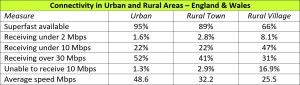
“Broadband speeds in rural areas are up to three times slower than those in neighbouring cities, analysis has found.

Statistics published by the county councils network show that more than two-thirds of England’s counties are below the national average download speed of 45mbit/s.

In some places rural counties lag significantly behind neighbouring urban areas.

For example, in north Yorkshire residents have an average download speed of 30.2mbit/s, compared to York’s average speed of 102mbit/s.

The rural county of Ryedale, which includes part of the North York Moors, has average speeds of just 25.8mbit/s, less than a fifth of those experienced in the nearby city.

Rural Dorset has average speeds of 26.9mbit/s, less than half those enjoyed in neighbouring Bournemouth, of 61.2mbit/s.

The slowest broadband in Britain is in west Devon, the report adds, at just 21.8mbit/s.

Ofcom data shows that 91 per cent of homes and businesses in the UK now have access to superfast broadband, defined as 30mbits/s.

The network said that all but four of the 79 areas council areas which have speeds below this level are based in non-urban counties. …”

https://www.telegraph.co.uk/news/2018/04/06/rural-counties-suffer-broadband-speeds-three-times-slower-nearby/

“BBC investigates rural hospital transport”

“Broadcast on Friday (30 March), the whole episode of BBC Radio 4’s Farming Today programme on Friday (30 March) examined the issue of hospital transport.

The programme details the impact of large-scale cuts on bus services since the introduction of austerity measures.

At the same time, medical services have been increasingly concentrated in ‘centres of excellence’ in towns and cities, with few specialist facilities available in local community hospitals.

Rural Services Network chief executive Graham Biggs told the programme more and more services were being centralised into larger towns.

“Accessing those services is increasingly difficult whilst at the same time public transport is being reduced,” said Mr Biggs.

It was true there was a shortage of medical specialists but something had to be done around accessibility – whether via public transport or some other means, he said.

Patients in rural areas needing to use public transport to get to hospital often faced painfully long journey times, reported the programme.

Presenter Emma Campbell travelled to hospital with a listener called Sandra, who has to take three buses in each direction to get from her home in Somerset to her appointment in Bath.

Sandra faced a travel time of over three hours each way, for a 10 minute appointment – a situation which was “not uncommon at all” for rural residents, said Mr Biggs.

The programme also heard from representatives of Age UK’s ‘Painful Journeys’ campaign, who also explained the extent of the problem in rural areas.

The full programme can be heard by clicking here

https://www.bbc.co.uk/programmes/b09wpn4f
(available until 28 pril 2018)

DEFRA not fit for purpose on countryside policies and issues

“The UK government is failing rural communities and the natural environment, a report says.

The Lords Select Committee document says there should be radical change in how the countryside is looked after.

It recommends stripping the environment department Defra of its power to regulate on rural affairs, and reforming the Countryside Code.
The Lords said Defra had focused too much on farming and agriculture, rather than other aspects of rural life.

The report describes a “consistent failure, over a number of years, to prioritise the ‘rural affairs’ element” of the remit of the Department for Environment, Food and Rural Affairs (Defra).

All this, it says, has had a “profound negative impact … to the cost of us all”.

The Select Committee on the Natural Environment and Rural Communities (NERC) Act 2006 recommends that responsibility for rural affairs should transfer to the Ministry of Housing, Communities, and Local Government.

According to the report, the body responsible for conserving the natural environment and promoting public access to the land, Natural England (NE), has been “hollowed out” and is now largely ineffective.

The report’s chairman, Lord Cameron of Dillington, said: “The last major research was done by the Commission for Social Mobility last year, and it said some of the worst spots for deprivation and intergenerational poverty exists in rural England.

“That it’s as bad as if not worse than our inner cities. We feel they have been neglected by government, that Defra is not doing a good job and that changes need to be made.”

Budgets slashed

Severe budget cuts and the abolition of the Rural Communities Policy Unit means that NE no longer has the budget or power to effectively and independently regulate government policy. It also means that not enough is being done to promote responsible access to the countryside.
Taking advice from the National Farmers Union, it says that the Countryside Code should be re-launched, so more people are aware of how to properly enjoy rural areas. …”

http://www.bbc.co.uk/news/science-environment-43475030

“Barn conversion developments `could heap more pressure on rural infrastructure´ “

“A potential surge in barn conversion homes could heap more pressure on rural schools and roads in England, the Local Government Association (LGA) claims.

The LGA fears that changes to permitted development regulations, which come into force on April 6, may trigger a dramatic increase in the number of conversions.

It said currently, landowners can convert agricultural buildings into three new homes without the need for planning permission, but changes will soon allow conversions of individual agricultural buildings into five new homes.

The LGA said this means an increasing number of larger agricultural to residential conversions could take place without having to get planning permission or contributing towards local services, infrastructure and affordable housing.

It said there has already been a 46% jump in residential conversions from agricultural buildings in England in recent years.

In 2015/16 226 homes were created from agricultural buildings and in 2016/17 this figure was 330, it said.

Councillor Martin Tett, the LGA’s housing spokesman, said: “Councils want to see more affordable homes built quickly and the conversion of offices, barns and storage facilities into residential flats is one way to deliver much-needed homes.

“However, it is vital that councils and local communities have a voice in the planning process.

“At present, permitted development rules allow developers to bypass local influence and convert existing buildings to flats, and to do so without providing affordable housing and local services and infrastructure such as roads and schools.”

He continued: “Relaxations to ‘agri to resi’ permitted developments risk sparking significant increases in the number of new homes escaping planning scrutiny in rural areas.”

Housing Minister Dominic Raab said: “Through strengthening planning rules and targeted investment, we are ensuring we are building the homes the country needs as well as the local services needed by communities.

“In rural communities our changes will mean more flexibility on how best to use existing buildings to deliver much-needed properties.

“This is part of our ambitious plans to get Britain building homes again and ensure they are affordable for local communities.”

http://www.dailymail.co.uk/wires/pa/article-5525143/Barn-conversion-developments-heap-pressure-rural-infrastructure.html

Effect of “viability loophole” on rural communities

House builders are exploiting a legal loophole so they don’t have to build as many affordable homes in the countryside, claim campaigners.
Homeless charity Shelter and the Campaign to Protect Rural England (CPRE) analysed data they say shows that housing developers are shirking their responsibilities.

The two charities released their findings ahead of a speech by communities secretary Sajid Javid who is expected to outline government reforms to national planning rules.

Looking at eight rural councils over one year, the analysis shows that half the affordable homes that councils were required to build were lost when viability assessments were used.

Shelter and CPRE said their findings demonstrated that the housing crisis was not just confined to cities – but was having a serious impact in the countryside as well.

They said developers were using ‘viability assessments’ to argue that building affordable homes could reduce their profits to below around 20%.
This gave them the right to cut their affordable housing quota.
It meant developers were over-paying for land and recouping the costs by squeezing affordable housing commitments – a tactic often used by developers building big housing schemes.

Shelter and CPRE are calling on the government to use planning rules to stop developers from using this loophole to wriggle out of providing the affordable homes that communities need.

Similar research carried out by Shelter on housing lost to viability assessments in urban area paints a national picture of the affordable housing drought right across the country.

Shelter chief executive Polly Neate said: “We can see for the first time the true scale of our housing crisis – it’s not just blighting cities but our towns and villages too.

“Developers are using this legal loophole to overpower local communities and are refusing to build the affordable homes they need.”
Both charities said the government should use their current review of planning laws to close the loophole and give local communities the homes they required.

CPRE chief executive Crispin Truman said: “A lack of affordable housing is often seen as an urban problem, with issues of affordability in rural areas overlooked.

“It cannot be ignored any longer.

“Too much of our countryside is eaten up for developments that boost profits, but don’t meet local housing needs because of the “viability” loophole.”

Without adequate affordable housing, rural communities risked losing the young families and workers they needed to be sustainable, said Mr Truman.
The full report is available here.”

http://rsnonline.org.uk/community/loophole-means-fewer-affordabler-homes

£2 million unspent on broadband cannot be reallocated

“Councillors in Devon have been told that they cannot use £2m of unspent funds from a major broadband project.

External funding has been used to finish the first phase of the Connecting Devon and Somerset scheme, the largest government-funded superfast broadband programme in the UK.

However, councillors who wanted to use the extra £2m to accelerate the project have been told that it is not within the county council’s power to reallocate funds.

“Councillor Stuart Barker, Devon County Council cabinet member for economy and skills, said: “The money isn’t for us to redistribute.

“We are not the accountable authority or the contract holder, so it is not for us to redistribute that money.”

The first phase of the Connecting Devon and Somerset project has been used to install superfast broadband in homes on Exmoor and Dartmoor with other difficult areas due to be completed by next year.

http://www.bbc.co.uk/news/live/uk-england-devon-43377890

Rural extra-fast broadband grants exclude East Devon

“Thirteen areas win funding for broadband

Thirteen areas have been awarded a share of £95 million to help with the rollout of ultrafast broadband – which delivers internet speeds of up to 1GB per second – which is currently only available to three per cent of the population. The successful bidders include Manchester, London, Blackpool, Cambridgeshire, Coventry, Mid Sussex, North Yorkshire, Portsmouth and Wolverhampton.”
Source: i p10

and full list:
https://www.ispreview.co.uk/index.php/2018/03/brief-summary-13-new-uk-full-fibre-local-network-projects.html

Cranbrook will grow to 8,000 homes over 15 years

Owl says: and still it has no town centre and developers refuse to fund one!

“Feedback on how Devon’s newest town, Cranbrook, should grow and develop over the next 15 years, goes before councillors next week.

The Cranbrook Plan: Preferred Approach’ document sets out how the growth of the town up to around 8,000 households over the next 15 years will be achieved.

A community consultation ran for eight weeks from mid-November last year to early January and it gave residents of Cranbrook and its neighbouring communities the opportunity to comment on the proposals for the future of the town contained within the document ‘Cranbrook Plan: Preferred Approach’.

In addition to identifying land for new houses, the document also identified land for sport and community, economy and enterprise, schools, allotments and Gypsy and Travellers pitches. …

Outline planning permission for the first 2,900 homes at Cranbrook was issued in October 2010 followed shortly by the reserved matters for the first 1,100 homes in April 2011. Today there are approximately 1,700 households living at Cranbrook, equivalent to a population of around 4,000 people, but the Local Plan anticipates Cranbrook comprising approximately 7,850 new homes by 2031. This equates to a population of around 20,000 people meaning that Cranbrook will have quickly expanded to become the second largest town in the District.

The consultation revealed that there is a concern over relationship with properties at Broadclyst Station, who are keen to retain a separate identity, that the East Devon New Community partners say that the Treasbeare area could accommodate a minimum of 1,000 dwellings as opposed to the 800-950 stated in the masterplan, and that there should be a school in both of the Bluehayes and the Treasbeare area of Cranbrook..

On transport issues, the responses reveal that the delivery of a half-hourly rail service is a key ambition of the plan in order to encourage use of rail travel as an alternative to the car, but that despite the wishes of residents for the old A30, the B3174 London Road to remain as a bypass to developed, it is scheduled to be downgraded from its current status and to become an integral part of the town. …”

https://www.devonlive.com/news/devon-news/council-discuss-how-devon-town-1328118

Blackill Engineering Extension – is this an excuse to drive a new industrial site into the heart of the Pebblebed Heaths?

These days most large developers pay for pre-application advice before submitting a planning application. A recent Freedom of Information request has uncovered the advice that was offered to someone (name redacted) seeking such advice on proposed business units at Blackhill Quarry, Woodbury in early October 2017.

Specifically this proposal was for the erection of AN ADDITIONAL industrial building to support the existing business, Blackhill Engineering, being operated form the site together with the erection of FIVE ADDITIONAL industrial buildings for use by other businesses.

In summary the advice given was that this would not comply with the protective policies that cover this sensitive site. A much stronger employment benefit case regarding the expansion of the existing business to justify a departure from these policies would be needed. The five speculative industrial buildings would not justify a policy departure.

On 20 December 2017, within three months of this advice, planning application 17/3022/MOUT was submitted for outline application seeking approval of access for construction of up to 3251 sqm (35,000 sq ft) of B2 (general industrial) floor space with access, parking and associated infrastructure.

The accompanying justification reads:

“There is considerable and clearly identified need for the existing business at Blackhill Engineering to expand as a result of that business having grown considerably over recent years and with its existing premises now at full capacity. The provision of additional facilities on the application site would allow the company to continue its expansion and so deliver additional economic and employment benefits to the local area…. With the winding down of the existing quarry use of the site, there is a short and fortuitous window of opportunity in which to address BESL’s growth requirements with the reuse of an area of former minerals processing site….It is a crucial part of both local and national employment strategy to protect existing businesses and to encourage their expansion. If approved, the scheme would allow the existing business not to only remain at the site but also to expand. The resulting investment will enable a substantial increase in the provision of highly skilled jobs in the area, increased training opportunities for apprentices and added value to the local economy. Furthermore, the expansion of the Blackhill Engineering will help reinforce the vitality of its parent organisation…”

So, is this application all about the needs of Blackhill Engineering to expand, having already designed flood defence gates for New York City Hospital, worked for the European Space Agency and the pier at Hinkley Point, which in October seemed to require only one building; or more about Clinton Devon Estates trying to generate rent from a new industrial park? Restoration provides no income.

For those interested here is the detailed pre-application advice, given on an informal basis and without prejudice, in about half the words:

The extant planning permission on the site requires a restoration and aftercare scheme to be implemented following cessation of the quarrying operations. As part of this condition, alternative schemes (subject to planning permission) can be considered but two policies are of particular relevance:

East Devon Local Plan- Strategy 7 – Development in the Countryside.

This strategy states that development in the countryside “will only be permitted where it is in accordance with a specific Local or Neighbourhood Plan policy that explicitly permits such development”. In this instance, there is no local or neighbourhood plan which would permit the proposal and, therefore, it is considered that it would not comply with Strategy 7.

East Devon Local Plan- Policy E5 – Small scale Economic Development in Rural Areas.

This policy states that the expansion of existing businesses designed to provide jobs for local people will be permitted where

1. it involves the conversion of existing buildings. Or

2. if new buildings are involved, it is on previously developed land. Or

3. if on a greenfield site, shall be well related in scale and form and in sustainability terms to the village and surrounding areas.

In this instance, the Local Planning Authority recognise the previously developed nature of the site, however, in the ‘Glossary of Terms’ section of the Local Plan (which echoes those contained in the National Planning Policy Framework) previously developed land specifically excludes land that has been developed for minerals extraction or waste disposal by landfill purposes where provision for restoration has been made through development control procedures.

Accordingly, the land would be considered as greenfield.
In terms of Policy E5, as the site would not be well related in sustainability terms to Woodbury or surrounding areas, the proposal would be contrary to policy.

However, if sufficient justification can be made in terms of the needs of the existing business being operated from the site to expand into an additional building, then the economic benefits may outweigh the environmental harm, of the unsustainable location as a departure from the Local Plan.

For this purpose, an economic benefits statement would need to be submitted as part of an application.

The five speculative units being located in an unsustainable location would not be acceptable.”

Developers and loopholes – go together like a horse and carriage!

Owl says: as millions of pounds meant to be used for affordable homes was returned to the Treasury by the Department of Communities, Local Government and HOUSING, we can only assume this government doesn’t give a stuff about this.

“Property developers have used a legal loophole to halve the number of affordable homes that they are building in the countryside.

A study of more than 150 new housing developments found that confidential viability assessments had been used to cut the number of affordable houses by 48 per cent. The assessments let developers break promises made to get planning permission, if they can show those commitments will eat into profits.

The research, which was commissioned by Shelter, the charity for the homeless, and the Campaign to Protect Rural England (CPRE), found that eight rural councils lost 938 affordable homes after viability studies over the course of a year. “The viability loophole is slashing affordable housing supply in the countryside,” the report said. “The profits of volume housebuilders are rocketing, yet affordable housing provision by the same developers is being undercut on the grounds that it is not profitable enough.”

In one instance in Cornwall, the owners of a disused tin and copper mine promised that 40 per cent of the site’s 99 new homes would be affordable. They cut that commitment to zero with a viability study. The owners then advertised the plot for sale, boasting in the brochure that all of the plots had been approved for “open market housing” without any “liabilities”.

Central Bedfordshire, which was the worst affected of the eight councils in the study, lost 533 affordable homes in the 2015-2016 financial year.

Affordable housing includes homes for social rent, shared ownership and other intermediate tenures. “The term affordable in this context does not necessarily mean that these homes are in fact genuinely affordable to local people,” the report said.

The profits of Britain’s three biggest builders, Barratt Developments, Taylor Wimpey and Persimmon Homes, have quadrupled since 2012 to £2.2 billion a year. Yet they regularly cite financial constraints to reduce the percentage of affordable homes at new developments.

At Sowerby Gateway in North Yorkshire, Taylor Wimpey promised to build 256 affordable homes. A viability study cut that promise to zero. “Too much of our countryside is eaten up for developments that boost profits, but don’t meet local housing needs because of the viability loopholes,” said Crispin Truman, the chief executive of CPRE.

Councils can challenge viability studies but the government has guaranteed big builders at least a 20 per cent profit. If the builders can show that they stand to make less, the government will side with them.

“Developers are using this legal loophole to overpower local communities and are refusing to build the affordable homes they need,” said Polly Neate, the chief executive of Shelter.

Sajid Javid, the communities secretary, has promised to review how “viability is assessed” when he starts a consultation next week to overhaul the planning laws.

Separate research by the Institute for Public Policy Research, a think tank, found that the number of people sleeping rough in rural parts of England increased by 42 per cent from 397 in 2010 to 565 in 2016.

Houses are 26 per cent more expensive in the countryside because of pressure from wealthy retirees and buyers of second homes, but wages in rural areas are 26 per cent lower, which has created an exodus of young families.

Andrew Whitaker, from the Home Builders Federation, an industry body, said local authority targets were always negotiable. “There is a limit as to what can be extracted from development sites before they become unviable and you get no homes of any sort,” he said.”

Source: Times (paywall)

Are EDDC Tory councillors having broadband problems?

Written Answers – Department for Digital, Culture, Media and Sport: Broadband: East Devon (26 Feb 2018)
https://www.theyworkforyou.com/wrans/?id=2018-02-07.127464.h&s=speaker%3A11265#g127464.q0

Hugo Swire: To ask the Secretary of State for Digital, Culture, Media and Sport, what estimate his Department has made of the number of homes that have access to superfast broadband in East Devon.

Written Answers – Department for Digital, Culture, Media and Sport: Broadband: East Devon (26 Feb 2018)
https://www.theyworkforyou.com/wrans/?id=2018-02-07.127464.h&s=speaker%3A11265#g127465.q1

Hugo Swire: To ask the Secretary of State for Digital, Culture, Media and Sport, what estimate his Department has made of the number of businesses that have access to superfast broadband in East Devon.

“east devon” : 1 Written Answer
===============================

Written Answers – Department for Digital, Culture, Media and Sport: Broadband: East Devon (26 Feb 2018)
https://www.theyworkforyou.com/wrans/?id=2018-02-07.127464.h&s=%22east+devon%22#g127464.r0

Margot James: According to Thinkbroadband, currently 90.02% of premises in *East Devon* can access superfast broadband. This is up from 9.4% in 2012. DCMS does not hold data on broadband coverage which distinguishes between homes and businesses.

EDDC to help unauthorised Greendale businesses to relocate

Owl says: Here is EDDC’s version of the Greendale High Court decision.

With hindsight, EDDC might have been better served by not allowing the unauthorised businesses on to the site in the first place. And if the owners allowed businesses on an unauthorised site, maybe the owners and the businesses should be paying for specialists when those businesses have to move this time, not availing themselves of a free service from EDDC – especially as the rest of us are paying more and more for OUR EDDC services.

EDDC PRESS RELEASE

21 February 2018
Enforcement action taken to remove unauthorised development at Greendale Business Park
Council will work with park owners to find alternative locations for businesses

East Devon District Council has successfully fought a planning appeal by Greendale Business Park against an enforcement notice requiring the park owners to remove an unauthorised extension.

The business park has been extended into the countryside after four fenced compounds were created, concreted over and were used variously for the storage of mobile homes, shipping containers, portakabins and, in the case of one of the compounds, had two permanent buildings on it.

Following the latest High Court hearing, it now means that the owners of Greendale Business Park, FWS Carter and Sons, must comply with the enforcement notice, remove the extension and return the land to countryside within six months of the court’s decision.

Councillor Mike Howe, chairman of the district council’s development management committee, said that the council will work with the park owners to find alternative locations for businesses on the unauthorised site affected by the enforcement notice.

“This case demonstrates that we take unauthorised development very seriously and as a local authority are charged with using our enforcement powers to ensure that development carried out without planning permission is removed.

“We will work hard with the site owners to find alternative locations for the businesses currently operating from this unauthorised area.

“We’re pleased that the courts have now stopped this appeal from proceeding any further and the enforcement notice to get these works removed has now taken effect.”

The works were all carried out without planning permission and a subsequent planning application was refused due to the harm that the extension caused to the countryside and the visual amenity of the area.

Following the refusal of planning permission, the council served an enforcement notice on the owners requiring the uses to cease and the land returned to its former condition including the removal of temporary and permanent buildings, fencing and hard surfacing.

Although the owners appealed against the enforcement notice, a planning inspector ruled in favour of the council and directed the owners to stop using the land in the way it was and return it to its former condition within six months.

The owners subsequently appealed against the decision in the High Court arguing that the planning inspector had made an error in law by concluding that the East Devon Local Plan specifically covered the issue of development at Greendale Business Park.

In responding, the Secretary of State for Communities and Local Government argued that FWS Carter and Sons had misinterpreted the Local Plan and that their interpretation was “patently wrong”. Ultimately, the court did not grant the owners a further opportunity to proceed with an appeal and they will have to pay all costs arising from the case.”

Greendale Business Centre: FWS Carter and Sons application fails at the High Court

PRESS RELEASE:

“After 3 years challenging the planning system, Greendale Business Park owners are required to return an area back to Agricultural use.

It may have taken 3 years but finally the Planning Department at East Devon District Council (EDDC) has succeeded in winning a long running planning and legal challenge.

It was the 8th Feb 2015 when earth moving and general building works were first reported to EDDC Enforcement Officers by neighbours of Greendale Business Park. This was on a 3.5Ha site, east of the existing permitted development area at the Business Park near the village of Woodbury Salterton.

Following investigation, the Local Planning Authority (EDDC) served an Enforcement Notice to the owners FWS Carter and Sons, but they chose to ignore the notice and carried on developing the site at “their own risk”.

A planning application was submitted nine months later (06/11/2015 15/2592/MOUT) but the development was considered to lie outside the agreed development area for Greendale Business Park and it was refused by EDDC. A second attempt was made with a similar proposal split into 2 separate planning applications the following December but this was also refused (06/12/2016 16/2597/FUL and 16/2598/MFUL).

The Local Planning Authority then issued the owners with an Enforcement Notice, requesting the removal of the industrial concrete hardstanding, fences, buildings and the return of the land to agricultural use. The company then appealed to the Government’s Planning Inspectorate in March 2017 for the decision to be revoked.

on Dec 7th, 2017 the Inspector found in favour of the Local Authority and upheld their enforcement decision, but within days the Company lodged an appeal with the High Court. Last week 08/02/2018 the Judge ruled that there was no case to answer and therefore the decision by the Local Authority was upheld and costs of £3998 was set against the applicants, FWS Carter and Sons.

The Company now has 6 months to remove all industrial activity and return the land to agricultural use. This work will be monitored very closely

Another section of the Business Park (an area approximately 1Ha) south of the Greendale Business Park and just off Hogsbrook Lane, has also been developed without planning consent. The owners FWS Carter and Sons claimed in Oct 2017 that this land has been in “unlawful” industrial use for more than 10 years and they applied for a little-known planning regulation loophole known as a “Certificate of Lawfulness ” (17/2441/CPE) to enable the area to continue to be used without requiring further planning approval.

However, the Local Planning Authority followed Legal Advice and concluded that the land had not been used “unlawfully” for 10 years because there was lawful permitted development with a gas pipeline contractor occupying the site for 3 years. Because of this, the Certificate of Lawfulness was refused and it is expected that an Enforcement Notice will be served on the Company for this breach of planning shortly.

Councillor Geoff Jung, EDDC Ward Councillor for Raleigh Ward which includes Greendale Business Park says, “It is a great shame that the Company started to develop this area prior to any planning permission being in place. The efforts and costs incurred by the company in developing the site, including the cost of architects, planning consultants, barristers, solicitors, court costs, contractors’ costs and everyone’s time has all been wasted.”

“Add to that the considerable costs to the local authorities` planning, enforcement and legal teams in endeavouring to provide a sound and fair case.”

“It’s quite clear the Planning System has moved on enormously in the last 15 years, with much more openness and clarity, mainly down to modern technology. Planning applications and official documents are now open to scrutiny at the touch of a button and can be viewed without leaving your house.”

“Previously documents were available only at District and Town Halls, for interested parties to view but now the internet and Local Authority Planning Portals provide everyone with a better understanding of the planning regulations and legal issues involved.”

“I look forward to the day when all developers will follow the normal planning procedures and not proceed in such a cavalier way. This may have been the way it was done in the past but its proving much more difficult now.”

“I would like to thank the many local people who have frequently written to the Planning Authority to comment whenever it was required, as well as the Planning and Legal Team at East Devon District Council who ensured that the Planning Regulations were correctly upheld”

“Britain’s bus coverage hits 28-year low”

“Britain’s bus network has shrunk to levels last seen in the late 1980s, BBC analysis has revealed.

Rising car use and cuts to public funding are being blamed for a loss of 134 million miles of coverage over the past decade alone.

Some cut-off communities have taken to starting their own services, with Wales and north-west England hardest hit.

The government has encouraged councils and bus companies to work together to halt the decline.

One lobbying group fears the scale of the miles lost are a sign buses are on course to be cut to the same extent railways were in the 1960s.” …

http://www.bbc.co.uk/news/uk-england-42749973