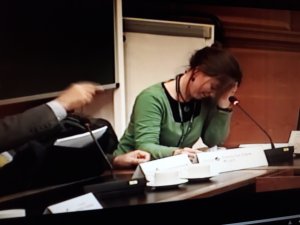
DCC Health Scrutiny Committee – not fit for purpose

The DCC Health Scrutiny Committee lurches from poor practice to bad practice to utter chaos under the continued Chairmanship of Sarah Randall-Johnson

Can you imagine saying you will vote against questioning NHS Property Services about their intentions on the future of community hospitals which they now own “because they might not come”! And Randall-Johnson saying she is “not aware of any threat to any community hospital!!!

[CCGs have been offered match funding from the government for any properties sold in their areas]
http://www.mirror.co.uk/news/politics/naylor-plan-outline-sell-nhs-10544577
http://www.property.nhs.uk/asset-management/

Claire Wright’s Blog:

NHS Property Services will be invited to attend the next Health and Adult Care Scrutiny Committee in January.

But my simple request prompted a debate lasting over half an hour, at Tuesday’s meeting (21 November).

The lengthy and baffling discussion gave a poor impression of the committee in my view, with some Conservative councillors claiming confusion and dismissing the proposal several times as “premature.”

It all started off with a presentation to the committee by Independent councillor, Martin Shaw, under the final work plan agenda item.

Cllr Shaw rightly pointed out how many people were concerned about the potential loss of the hospital buildings, that they had put their own money into them and still there was no clarity over their future, yet NEW Devon CCG were (or at least would very soon be) paying large sums of money in rent each year when previously they owned the buildings outright.

NHS Property Services, a private company wholly owned by the Secretary of State for Health, set up under the Health and Social Care Act 2012, acquired the ownership of 12 community hospitals in Eastern Devon at the beginning of this year.

Given that the NEW Devon CCG is one of three most financially challenged health trusts in the country and must make huge cuts to try and stem a deficit of over £400m by 2020, people’s concerns about the future of the hospitals are very valid.

Following my proposal to invite NHS Property Services to the January meeting, chair, Sara Randall Johnson said there was a full agenda for the next meeting so it may not be possible to include it. She said that she was not aware that there was a threat to any community hospital.

Liberal Democrat, Brian Greenslade said NHS PS had been invited previously but questions had been remained unanswered and so should be invited again.

Conservative, Phil Twiss, who represents Honiton which has lost its own hospital beds, claimed in a number of long statements that it was “premature” to invite the company because the future of the buildings had not yet been decided.

He later added that they wouldn’t come anyway.

I replied that waiting until the March meeting was far too long and could mean that decisions were already made. Surely we need to talk to NHS PS and the CCG before their decisions?

I attempted to explain again why it was important we invited the company to the January meeting.

But apparently confusion reigned.

Conservative members became very fixated with the legacy issue, even though I had made it clear that it was about questioning NHS PS and the CCG about their plans on the future of community hospitals and the legacy issue was only part of that.

Chair, Sara Randall Johnson, suggested holding a meeting first to agree some questions to ask NHS PS. I have not seen this approach in my four and a half years as a member of the committee.

I had to make my proposal numerous times, while one or two persistent Conservative members continued to challenge it.

There was an amendment by Liberal Democrat, Nick Way, who wanted a spotlight review into the issue as well.

Phil Twiss then changed his tack and claimed there was no point in asking the company to attend as they wouldn’t come. He was in favour of a spotlight review instead (spotlight reviews are held in private).

But when the vote finally was taken, it was on the spotlight review amendment and not my original proposal to invite NHS PS to the next meeting …

I tried to intervene. Fortunately, the officers corrected matters… and then the majority of the committee voted in favour of my proposal. Finally.

My proposal couldn’t have been more straightforward or uncomplicated. It was entirely within the committee’s remit.

It was also within a couple of hours of hearing the county solicitor’s presentation about how scrutiny should do its job properly. Or be culpable. See this blogpost here – http://www.claire-wright.org/index.php/post/devon_county_council_solicitor_tells_health_scrutiny_committee_you_have_a_v

Here’s the webcast. It is the final item on the agenda – https://devoncc.public-i.tv/core/portal/webcast_interactive/302658

Pic: Me exasperated!”

http://www.claire-wright.org/index.php/post/nhs_property_services_will_be_invited_to_next_devon_county_council_health_s

Grenfell Tower resident blogged that fire would be result of council’s deliberate neglect – local media refused to take up the story

Local media knew about this for YEARS but refused to take it up or investigate, leaving a lone Grenfell Tower blogger to document the unfolding disaster. One so-called “local” journalist was actually filing copy from Dorset!

“[Edward] Daffarn [a social worker who had lived in Grenfell Tower for 15 years] is understandably emotional when reflecting on the last few months, but more than that he is angry. Angry with the way he feels Grenfell residents were treated by the Kensington and Chelsea Tenant Management Organisation – the people who were entrusted to maintain the estate and keep its residents safe. Angry with the Royal Borough of Kensington and Chelsea Council, which was meant to scrutinise the KCTMO. Angry with a society which didn’t seem to care about people like him – people who live on housing estates – until it was too late.

“The reality is if you’re on a housing estate it’s indifference and neglect, two words that sum up everything about the way we were treated,” he says. “They weren’t interested in providing housing services, keeping us safe, maintaining the estate. They were just interested in themselves.”
It wasn’t for us to tell the council what they should be doing we were just trying to raise an alarm.

Edward Daffarn, Grenfell Action Group blog

Daffarn and fellow Grenfell resident Francis O’Connor had been blogging on behalf of the Grenfell Action Group since 2012. They wrote about issues that concerned their tight-knit community – air pollution, the closure of the local public library, and their fears that corners were being cut during the refurbishment of the tower.

“We wanted to record for history how a community on a housing estate in the fifth richest country in the world could be ignored, neglected, treated with indifference. We never thought we could make change. We just wanted to record what was happening,” he says.

Daffarn and O’Connor shared a theory that Kensington and Chelsea – a London borough more widely known for its museums, designer shops and flower shows – actually wanted its council estates to go into decline, so that the residents would leave and expensive flats could be built in this sought-after location. For this they were described as fantasists.

“We weren’t fantasists,” he says, visibly hurt. “We were trying to raise genuine concerns about how our community was being run down.”

The natural consequence, he concluded, would be loss of life. Which is why on 20 November 2016, frustrated and desperate, Edward wrote the blog post KCTMO – Playing with fire!

“It is a truly terrifying thought but the Grenfell Action Group firmly believe that only a catastrophic event will expose the ineptitude and incompetence of our landlord.”

A few months earlier a fire had ripped through five floors of a tower block in Shepherd’s Bush, just down the road. Edward was worried that if a fire broke out in his tower block residents wouldn’t know what to do. They had been given no proper fire safety instructions from the KCTMO. There were no instructions on individual floors on how residents should act in the event of a fire, there was only a recent newsletter saying residents should remain in their flats – advice which in the case of the Shepherd’s Bush fire would have led to fatalities.

There’s a lot of abusive behaviour evidenced forensically about what was happening to our community, but it wasn’t sexy so it never got picked up.

In March 2017 the KCTMO installed fire safety instruction notices in the entrance hallway to Grenfell Tower and outside the lifts on every floor of the building, again urging residents to “stay put” unless the fire was “in or affecting your flat”.

It wasn’t the first time the Grenfell blog’s authors had raised concerns about fire safety.

Before the blog began, when a school was built on the only green space the residents had, they wrote to the borough pointing out that access for fire and emergency vehicles had been compromised.

Later they blogged about the blocking of a fire exit with mattresses during the refurbishment and the power surges in 2013 that manifested in flickering lights, computers and stereos blowing up, and entire rooms filling with smoke. These continued for three weeks, Daffarn says.

“We were tenants we weren’t fire safety specialists but we were switched on enough to feel this was important and it was not being dealt with on our estate and that’s why we were blogging. It wasn’t for us to tell the council what they should be doing., We were just trying to raise an alarm.”

An alarm that went unanswered. The November 2016 blog post represented the last moment at which something might have been done to avert the disaster which followed six months later. But why didn’t anyone heed or investigate Daffarn’s claims?

Hidden within the story of the Grenfell blog is another story of the decline of local media. There simply was no local press on the ground in the borough of Kensington and Chelsea scrutinising the authorities and helping to amplify the voice of people like Edward Daffarn.

The last time he had the attention of a local journalist was in 2014 when Camilla Horrox, the reporter for the Kensington and Chelsea Chronicle ran front page stories about Grenfell residents’ concerns regarding the possible presence of asbestos on the site of the new school and about the power surges.

She had met Daffarn several times, and had been concerned about KCTMO’s dealings with the residents of the properties it managed.

But when the newspaper was closed down later that year Horrox was made redundant and all her Grenfell articles disappeared from the web. The Kensington and Chelsea Chronicle was incorporated into a website that reports on 29 west London districts.

Horrox’s replacement was expected to report on three boroughs – Kensington and Chelsea, Westminster and Hammersmith and Fulham – while based in Surrey, an hour’s drive away.

Some residents of the borough might have been under the mistaken impression that they did have a local newspaper. In 2015 a free paper, The Kensington and Chelsea News, was established to fill the gap left by the closing of the Chronicle.

But when I tracked down its reporter he explained that he was the sole reporter working on the paper, and on two other local newspapers – his salary was £500 a week and he did almost all his reporting from home in Dorset, 150 miles away. He made it to the borough only twice in two-and-a-half years, and the one story he ever published about Grenfell was from a council press release about the installation of the new cladding.

Though he always searched for a “good front page splash” for each of the three editions, he also made sure to find two pages of royal stories and two pages of entertainment stories.

Edward Daffarn didn’t take his concerns to the media in November 2016 because he no longer thought anyone would listen. But the blog was out there for everyone to see, he points out, if only they had been looking.

“We’d been blogging for three or four years and you go back over that time there’s a lot of abusive behaviour evidenced forensically about what was happening to our community, but it wasn’t sexy so it never got picked up.”
For Edward, what was going on at Grenfell wasn’t just a local story, but a national one. A story about invisible people in a society that cared more about celebrity and wealth than its most vulnerable residents.

Close to tears, he admonishes the nation’s journalists.

“If you look back now our whole community of North Kensington, the policy that the local authority was taking every public space and privatising it, that that could be missed by the BBC, by Channel Four, by these wider news agencies… The question should be for you, why did you miss it?
“Why aren’t our lives important enough for you?”

http://www.bbc.co.uk/news/stories-42072477

More political donor sleaze

“The publication of Northern Irish political donors’ identities has been postponed to the new year because of a delay by the government in putting the necessary legislation before parliament.

The Electoral Commission had planned to publish information on donors who had given money to parties registered in Northern Ireland for the first time on Thursday.

Ann Watt, the head of the commission in Northern Ireland, said it was “extremely disappointed that we are unable to provide the public with the information they expected on how political parties in Northern Ireland are funded”.

“The continuing secrecy only serves to undermine trust and confidence among the public in the democratic process,” she said. “We were consulted by the Northern Ireland Office several months ago on draft legislation and provided detailed comments.”

The non-disclosure of information on donors to political parties in Northern Ireland dates back to the Troubles. It means that while Northern Irish political parties have to divulge donor information to the Electoral Commission, it cannot publish information identifying those donors.

The provision came under intense scrutiny when it emerged earlier this year that the Democratic Unionist party had spent £425,000 in the run-up to the 2016 EU referendum campaigning for Brexit.

Following questions from the media, the DUP MP Sir Jeffrey Donaldson said the cash had come from the pro-union Constitutional Research Council, chaired by the former Scottish Conservative party vice-chairman Richard Cook. The CRC’s donors are unknown.

The majority of the money was used to pay for a wraparound advert in the Metro newspaper, which is not published in Northern Ireland, while £32,750 was paid to AggregateIQ, a social media political consultancy based in Canada, also heavily used by Vote Leave, the official leave campaign.

Earlier this week, the Electoral Commission announced an investigation into Vote Leave over whether it breached the £7m EU referendum spending limit. The official leave campaign spent £6.8m itself and donated £625,000 to a fashion student’s campaign called BeLeave. At issue is whether BeLeave was genuinely independent of Vote Leave: the money it received was sent directly to be spent on social media marketing for AggregateIQ.

A government spokesperson said: “There remains widespread support for full transparency among the people of Northern Ireland.

“In line with that aim, we have brought secondary legislation before parliament that would provide for the publication of all donations and loans received by Northern Ireland parties.”

The Electoral Commission then updated its position in a second statement from Watt: “We are pleased that the UK government has acted to make this important change a reality. Transparency in how our political parties are funded is key to ensuring public trust and confidence in the democratic process.”

https://www.theguardian.com/uk-news/2017/nov/23/publication-of-northern-ireland-party-donors-delayed-until-new-year?CMP=Share_iOSApp_Other

Some councillors on DCC scrutiny committee seem to have difficulty in grasping the concept of ………. scrutiny

Claire Wright’s blog:

Devon County Council’s solicitor, Jan Shadbolt, reminded the Health and Adult Care Scrutiny Committee of its legal responsibilities at Tuesday’s (21 November) meeting.

I had asked for this agenda item following a disastrous meeting in July where a referral to the Secretary of State for Health on the closure of 72 community hospital beds in Eastern Devon was thwarted by the Conservative members of the committee, resulting in over 20 complaints from members of the public.

Mrs Shadbolt read out a paragraph from the Mid Staffordshire NHS Foundation Trust Public Inquiry, led by Sir Robert Francis in 2013. Many people had tragically died there as a result of poor care.

The local council’s scrutiny committee was deemed to have failed in its duty to effectively scrutinise the local health trust and identify problems.

Mrs Shadbolt said it was the first time that non-executive members of a local authority were held to account because they were deemed to have failed in their duty.

New regulations were brought in afterwards to beef up the legal powers of health scrutiny committees. These were that health scrutiny committees can:
– Require a local officer to attend to answer questions
– Expect to be consulted by an NHS body or service provider on substantial developments (although there is no definition of substantial developments)
– Refer to the Secretary of State for Health (subject to a series of constraints)

The county solicitor told the committee that we had a “very powerful role to play within the community” and that we were “unique in scrutiny committees” on that basis.

Conservative, Phil Twiss wanted to know who “scrutinises the scrutineers.” The county solicitor replied that the ultimate scrutiny was being called to account over the failure of a service provider, but that generally speaking councillors were answerable to the community.

Cllr Twiss then wanted to know how the committee knew it was performing properly. Mrs Shadbolt said that the committee’s role was to ask pertinent questions, call any officer to present. She added that there are all sorts of bodies who can give information to help with this, such as Healthwatch.

Conservative councillor, Paul Crabbe, wanted to remind the committee that this agenda item had been added because “some members felt we failed to scrutinise correctly…” He went on to say that a “chap from south Devon was fizzing with excitement over the success and how about how wonderful his new system was” then they were later asked to vote that it was “rubbish.”

Cllr Crabbe said that this struck him as a nonsense then and still struck him as a nonsense and just because the committee voted against “someone’s particular view” it didn’t necessarily mean that the committee was not fulfilling its role.

Liberal Democrat, Cllr Brian Greenslade asked the county solicitor to remind councillors that scrutiny is not a normal committee of the council in that it is not supposed to be political. He said that he thought it was worth underlining this point…”

Here’s the webcast – https://devoncc.public-i.tv/core/portal/webcast_interactive/302658

“The House of Lords is a rolling expenses scandal – now politicians must act”

“At the end of 2015, the ERS conducted an audit of the House of Lords, Fact vs Fiction. It challenged claims that the Lords is a beacon of independence and professional diversity and demonstrated the huge democratic and financial cost.

Indeed, in the 2010-2015 parliament, £360,000 was claimed by peers in years they failed to vote once. On independence, over a third of Lords (34%) previously worked in politics.

The research also found that the Lords represents only a small section of society: 44 percent of Lords listed their main address in London and the South East, while 54 percent were 70 or older. More members have worked in the Royal Household than in manual jobs.

But the problems of an unrepresentative, inefficient and growing house have not improved since those revelations. The ERS’ new report, The High Cost of Small Change: The House of Lords Audit, shows that 109 peers failed to speak at all in the 2016/17 session. Sixty-three of those claimed expenses – claiming a total of £1,095,701.

More shockingly, 33 peers have claimed nearly half a million pounds between them while failing to speak, table a written question or serve on a committee in the past year. Particularly at a time when Parliament is dealing with major legislative upheaval, this kind of behaviour is unacceptable.

We know the upper house is grossly oversized. But we also know that the bulk of the work of the Lords is carried out by a smaller number of peers. The top 300 voting peers account for over 64% of all votes in divisions during the 2016/17 session – suggesting much of the work of the Lords is done by a minority of peers.

Indeed, nearly 1 in 10 of the peers eligible to vote throughout 2016/17 (9.2% – 72 of the 779) are inactive when it comes to scrutinising the government’s work on committees, in the chamber, or through written questions – vital roles for the revising chamber.

This is something that is finally being recognised by the upper house. The Lord Speaker’s Committee on the size of the House was set up to discuss how to shrink the supersized second chamber. In October 2017, they released their plans to reduce the size of the Lords to 600 in 11 years and move to 15 year terms by 2042. But by that time NASA plans to have landed humans on Mars.

Calls for reform are often dismissed on the basis that the Lords is a bastion of independence. We can reveal the truth is far from it. Our analysis shows that nearly 80 percent of Conservative peers didn’t once vote against the government last year.

Of the Labour peers who voted, 50 percent voted against the government more than 90 percent of the time. And non-partisan crossbenchers often don’t turn up – over 40 percent voted fewer than 10 times last year: leaving decisions in the hands of the party whips.

Finally, the House hosts 184 ex-MPs, 26 ex-MEPs, 11 ex-MSPs, 8 ex-Welsh AMs, 6 ex-London AMs, 11 ex-MLAs and 39 current or ex-council leaders, as of April 2017. Rather than an independent chamber, the Lords is increasingly being used as a retirement home or a gift to those no longer wanted by parties.

The ERS are calling for a much smaller, fairly-elected upper house the public can have faith in. Around two thirds of voters agree in both the need for a drastic cut in its size, and for it to be largely elected.

This report lays out the state of Britain’s second chamber today. It’s now up to politicians to meet the challenge – before trust in our democracy falls even further.”

https://www.electoral-reform.org.uk/money-for-nothing-weve-audited-the-house-of-lords/

The full reportis here:

https://www.electoral-reform.org.uk/latest-news-and-research/publications/the-high-cost-of-small-change/

Swire’s donors and Parish’s lack of them

A recent comment got Owl digging into donations to out two MPs. Direct personal donations rather than those to the Conservative Party. All donations over £7,500 have to be registered here:

https://publications.parliament.uk/pa/cm/cmregmem/171113/contents.htm#P

This register was last updated on 13 November 2017 and covers only this current Parliament 2017-2019.

In the most recent list of donors to individual MPs, the largest donation to East Devon MP Hugo Swire is of £10,000 from a Mrs Rosemary Said.

https://publications.parliament.uk/pa/cm/cmregmem/171113/swire_hugo.htm

Might this be the wife of arms dealer Wafic Said?

https://en.m.wikipedia.org/wiki/Wafic_Saïd

https://www.theguardian.com/uk/2006/nov/29/business.politics

“Syrian-born Wafic Said is reported to be a ‘former operator of a kebab restaurant who made millions in commissions on a 1985 British Aerospace arms deal to sell Tornado fighters to the Saudi royal family’.[1] Said’s chief Saudi patron is reported to be Prince Bandar.[1]

Rosemary Said has given the Conservative Party almost £580,000 and is reportedly a member of David Cameron’s Leaders’ Group of elite donors that enjoy direct access to the UK prime minister by virtue of donating more than £50,000 a year.”

and here:
http://powerbase.info/index.php/Rosemary_Said

and good to see a billionaire member of Swire’s family ( Sir Adrian Swire)
chipping in £5,000:

https://en.m.wikipedia.org/wiki/Adrian_Swire

By contrast, Tiverton and Honiton MP Neil Parish declares zero donations:
https://publications.parliament.uk/pa/cm/cmregmem/171113/parish_neil.htm

DCC, EDDC, Scrutiny, broadband and East Devon Alliance: not a good mix!

The Department for Communities and Local Government Parliamentary Committee asked for evidence on local authority scrutiny.

This interesting evidence was provided by BR4DS – a campaign group which is attempting to ensure that all parts of Devon and Somerset get fast broadband provision:

Written evidence submitted by B4RDS Broadband for Rural Devon and Somerset [OSG 006]

1. Executive summary:

1.1 At the first public meeting of a newly appointed Devon County Council (DCC) Scrutiny Committee in June 2017, the newly appointed Chairman delegated scrutiny of the Connecting Devon & Somerset (CDS) superfast broadband programme to an ongoing/standing task group of four Councillors who take evidence from Council Officers, suppliers and others in private, behind closed doors, with press and public excluded and with no formal minutes taken. This follows two years during which the previous committee required CDS to provide a quarterly written report on progress and answer questions in public, in front of the Committee.

The Terms of Reference for the ongoing/standing Task Group allow for it to continue in operation for seven years and the only information that will be put in the public domain will be reports by the four Councillors on their scrutiny of this subject. This is a major reduction in openness and transparency for the taxpayers of Devon and is contrary to the Council’s own constitution, the Nolan Principles and the expectations of the Secretary of State for Communities and Local Government as expressed at the 2017 Local Government Association Conference:

“If people are going to trust their elected representatives, they have to see them working in the harsh light of the public eye, not in comforting shadows behind closed doors. Not only must democracy exist; it must be seen to exist. It can’t be about decisions made in private meeting rooms.” – Rt Hon. Sajid Javid MP.”

http://data.parliament.uk/writtenevidence/committeeevidence.svc/evidencedocument/communities-and-local-government-committee/overview-and-scrutiny-in-local-government/written/70794.html

The East Devon Alliance also provided information to this committee which can be found here:

http://www.parliament.uk/business/committees/committees-a-z/commons-select/communities-and-local-government-committee/inquiries/parliament-2015/inquiry6/publications/

Its executive summary states:

Written evidence submitted by East Devon Alliance [OSG 040]

Executive Summary

East Devon Alliance understands that encouraging economic development is a crucial task in local government. However, we are concerned that the increasing influence of unaccountable business interests on council decisions damages the health of local democracy, and can threaten the wider interests of local communities. The climate of unhealthy cynicism about politics, and a failure to engage in the democratic process, is reinforced whenever there is an apparent failure of scrutiny to make councils transparent and accountable.

Overview and Scrutiny (O&S) can too easily be rendered ineffectual by a dominant majority party in a cabinet-led-executive.

Government advice that members of a majority party should not chair O&S committees must be made mandatory.

Chief Executives must not be able to have inappropriate influence on O&S committees.

Scrutiny Officers need to be independent of influence and interference from senior officers or members of cabinet.

The scrutiny role needs to be strengthened to be able to call witnesses. It should be a legal requirement for officers and members of Council and associated bodies to cooperate.

With increasing privatisation, commercial confidentiality must not be used to shield public expenditure from scrutiny.

Scrutiny should “reflect the voice and concerns of the public” by giving local people more say in what issues are chosen for scrutiny.

There is no scrutiny mechanism of the new tier of local government created by the unelected and self-selecting Local Enterprise Partnerships who now control over £2 billion a year in England. Proposals made in 2013 by the Centre for Public Scrutiny could form the basis for scrutiny of such devolved bodies.”

“ Abolish Devon district and borough councils to create super authority’ “

BUT, BUT, BUT – it’s already happening – EXCEPT we are keeping district councillors on the payroll!

Why does Owl say this?

Currently we have (at least) these new bureaucratic (and non-accountable) quangos in our area:

The Heart of the South West Local Enterprise Council
The “Greater Sourh West” group of LEPs
The “Joint Committee” of councils, NHS quangos and others in Devon and Somerset
“Greater Exeter”

and others working in the shadows.

In the middle of all this East Devon District Council is paying millions to build a new HQ and has not reduced its staff numbers throughout the period of austerity.

Questions … questions … but none of these groups are answerable to us and all choose how much (or more likely, how little) scrutiny they wish to have.

“The Government could deliver a £31 billion boost to the economy over five years by abolishing 201 district and borough councils in England and handing over their powers to county halls, a new report has said.

The report from think tank ResPublica calls for the abolition of the historic two-tier system of local government, which sees most rural areas of England covered by both a county council and a smaller district or borough authority with sometimes overlapping responsibilities.

ResPublica director Phillip Blond said the system is causing “needless confusion”, as businesses and developers find their plans frustrated by “parochial” decision-making on strategic issues.

Ditching the two-tier system and following the example of unitary councils adopted by most cities would help iron out wide variations in productivity which see workers in Cornwall take five days to produce the same value that can be delivered in three days in Surrey, he said.

With uncertain economic conditions after Brexit, the report said it was “vital” for counties to be prepared to weather the possible storm, particularly as those which voted most strongly to leave the EU are thought to be most vulnerable to any decline in trade resulting from it.

“The needless confusion that frustrates the ambitions of business and government alike in our county areas must end now,” Mr Blond said.

“With Brexit on the horizon and our city-regions already benefiting from devolution, we can’t afford the waste and complication that the current system creates.

“Single councils at the county scale are the future and we call on the Government to move rapidly to encourage them.”

Baroness Jane Scott, the leader of Wiltshire Council, said the move to a unitary authority in the county in 2009 had been a “great success” and warned that counties which fail to follow its lead face “the real risk of … being left behind”.

“Streamlining counties will contribute billions to the national economy and will be good for business,” said Lady Scott, the County Councils Network’s spokeswoman on reform.

“But the real winners are local residents who will benefit from improved public services, less bureaucracy, and access to more housing and facilities that meet local need and demand.”

The report will be launched at the County Council Network’s annual conference on November 20.

A spokesman for the Department for Communities and Local Government said: “Moving to a single tier large unitary authority can often give residents a better deal for their local taxes, improved local services, less bureaucracy and stronger and more accountable local leadership.

“However, we are clear that any such move must be both locally led and have support from the community.”

http://www.devonlive.com/news/devon-news/abolish-devon-district-borough-councils-790015

Local campaigner’s brilliant analysis of “development” in Devon

Georgina Allen is a local campaigner based in Totnes – suffering similar problems to East Devon. This has been published by the Campaign for Rural England (CPRE). For further information, see the South Devon Watch Facebook page

“The papers at the moment are full of grim warnings about the Green Belt. It is anticipated that seventy percent of new builds will be built within the Green Belt, very few of which are going to be affordable, none of which, I suspect are going to be well built or add anything to the landscape or to the lives of people who live there.

Our countryside is under threat is the general theme, but it is more than under threat, it is under attack. Already thousands of acres have been swallowed up by new mass developments. Little towns are consumed under the weight of great new estates, so often built without thought or reason other than to make money for distant shareholders.

This government has removed, as it loves to do, much of the restraint and red tape around the building industry. A few well placed lobbyists, the understanding that the ‘conservative’ part of the Conservative Party was on its way out and the housing plan was hatched. It’s all been very cleverly done.

The housing crisis was basically used as a smokescreen to hide the fact that the building industry was going to be used to prop up the economy. It’s a short term solution of course, not much of a solution at all really. It’s been used in so many other places and at the end fails, not until a lot of land has been ruined of course, but at least a few people make a lot of money.

We don’t have a shortage of homes, of course. What we have is a shortage of houses that people can actually buy. I was 35 when I bought my first house. The mortgage was three times that of my teacher’s salary. It was a stretch, but I coped and then, of course, house prices soared; my little house became a valuable asset and when I sold it, the price was above the reach of a similar teacher in my area.

This is the problem.

If the government actually wanted to solve the housing crisis, they would put money into social housing, control land value tax and limit the amount of housing that investors from overseas can buy. But of course they don’t. Osborne was caught on tape saying that he had no interest in social housing, – it only bred Labour supporters. At least that was honest. What isn’t honest is the way they’ve gone about building the myth of housing need to cover up the fact that they are lobbing enormous amounts of our money to the building industry.

I went to look at Canary Wharf recently. It’s still an impressive sight, all jostling, shiny towers, cranes everywhere, but a little investigation revealed that many of the new skyscrapers, the residential ones at least, are left empty. Investors come in right at the beginning, when the ink on the architectural drawings is still wet and buy the whole build, neglecting often to rent the new flats out – and why should they? If they are allowed to use our buildings as gold bricks, then it seems reasonable that they should keep the value of their investment high.

It makes sense to ensure that demand continues to outstrip supply and that the number of houses available to the public is limited. Thousands of new-builds are breaking the skyline in East London and yet this huge amount of building is yet to bring prices down. People move out of the centre because they can’t afford to live there and migrate to the outskirts, the outskirts get more expensive, so they move further out, dislodging the inhabitants there, who are moved even further out and so on and so on, the ripples continuing across the country. Our major cities are hollowed out and people live in areas they don’t necessarily want to be in, finding themselves dependent on their cars and transport to get them back to the place where they have a job.

By the time the ripples get to Devon, they’ve changed slightly.

These ripples are the people who have decided they no longer need to commute to the city. They discover they can buy two houses in Devon for the price of their one in the South East and realise that they can fund their retirement/break through a buy-to-let. This has been the pattern of movement around us in South Devon recently.

The new-builds, which were of course spun to seem as if they would solve our local housing issues, have often gone to people moving into the area. These builds come with all sorts of assurances as to improvements in infrastructure – anything over 14 houses is supposed to trigger money for healthcare, transport, leisure, – all sorts of things are promised. Local councillors talk grandly of new parks, new hospitals, but of course that doesn’t feed into the ultimate aim of all this building, which is to make money, so the government has cleverly inserted all sorts of get-out-of-jail free cards, which the developers are only too happy to take on.

Viability studies are the worst of these.

S106 monies are promised before the build at planning stage. The local council pauses, – they know that this new build on the edge of AONB will severely impact local roads, local services, destroy a farmer’s land, restrict access to a town, but they might well run the risk of being sued if they say no and at least afterwards they can point to all the lovely benefits – all that money coming in to improve the swimming pool, health care etc.

Planning permission is granted, work starts, ancient hedges are ripped up, protected trees are undermined, the wildlife disappears. Then a viability study is done. Ah, it appears that we won’t make enough profit if we build more than 10% of these houses as affordable, so here are our new plans. Also, sorry, but we have no money for S106s, as it proved a little more expensive than we realised to flatten this hill, so that money has gone too.

The council, hamstrung by the more than 40% overall cut to its budget and short of legal expertise and planners, has to agree. For example, we’re getting 1,200 houses around our little town of 8,000 and are yet to see the great improvements, any improvements in fact to our town’s infrastructure. There’s a need for housing we keep getting told. There’s a need for actual affordable housing and improvements to roads, we reply and are greeted by silence.

But the worst spin of all is the calculation of need. We need houses and to deny this is selfish and this is said across the political spectrum. So how is local need calculated?

Here in Devon, during devolution at least; local need was worked out by a group called the Local Enterprise Partnership, the LEP. These groups have evolved out of the old rural business development model and are in place across the country. Their primary role is to support business and investment in their region. and they are paid vast sums of money by the government to invest locally. So far, so good.

Just a quick look at their board. Our one at least seems to be made up almost entirely of property developers, arms manufacturers and the CEOs of major construction companies; almost all of the construction companies at work in the South West seem to be represented. Their conflict of interest declarations cover many pages. So these are the people who came up with the figures of housing need. The fact that they could benefit personally from having high figures here, does not seem to have been challenged in any meaningful way.

How did they come by the figures? They do not need to say, they are not an accountable organisation and the calculations behind these figures are not accessible to the general populace. There are three or so councillors on the board [our own Paul Diviani is one and he’s responsible for housing!]; they represent the democratic will of the people, the rest of their work is none of your business. The LEPs are not democratically elected, their meetings are held in secret, their minutes are concealed, their work is surrounded in mystery and yet they spend our money. They are funded with public money.

The audit office has criticised them, our councillors have criticised them, everyone does, but they are the creation of government and can take the criticism. The people on the board benefit directly from much of the building they do with the public purse. Their companies build the roads that lead to the new developments, their companies finance the new developments, their companies profit from the new business parks set up around the new developments. The conflicts of interest are so huge they seem to be forgotten about.

Newton Abbot is a case in point. Despite the fact that the population of Newton Abbot has hardly grown at all in the last five years, it was calculated by the LEP that the town housing stock would need to double in the next ten years.

I asked the head of Teignbridge planning – Why? The answer – Housing need. How was this calculated? Ah well, its a very complex process, which I personally do not fully understand. Ok, can you point me in the direction of someone who can explain? No. And that’s the typical response you get for any of this type of questioning.

The LEP was given a multi-million growth fund payment from the government. It’s widely understood by local councillors here that the 40% cut to council budgets has reappeared as payments to the LEP. Our council’s money has in part gone into financing a group we have no say over. £46 million of the growth fund money is going into the Newton Abbot expansion, despite the rejection of this plan by local residents. The money is going into widening the roads and building further access. Who is building the roads? Galliford Try. The CEO of Galliford Try is on the board of the LEP. Who made the decision to spend this money in Newton Abbot? The LEP. Who gave planning permission for this huge expansion into the green belt around Newton Abbot? The leader of the council led the decision. The leader of the council is on the board of the LEP.

I am not of course, saying that this is corrupt. It is not illegal, – it is happening the way it was intended by central government. These are the sweeteners to keep the building going. The government can say they’ve built new houses, – they point to these spurious housing need figures. The building industry is delighted of course, – they can build cut-price housing in the most desirable areas for the greatest returns. Local councils have been so starved of cash that the promise of new homes bonuses keep them pliable and if they complain, if doesn’t matter, they have no money to mount any type of challenge to development anyway.

The building trade and certain powerful councillors have formed alliances through the LEP, where they all profit through the public purse and can talk happily of growth and building. The only people left out of this equation are the people who actually need houses, local people, who are completely sidelined and ignored. Their wishes and needs are irrelevant.

The biggest loser though, of course, is our countryside, our most valuable resource. In survey after survey, the British people cite the NHS and the countryside as the most precious and valuable assets we have. Our countryside is invaluable really and to see it treated the way it is at the moment, for the profit of shareholders and government is sickening.”

Source: CPRE magazine

UK politics and corruption – it’s not (only) “Johnny Foreigner” to blame

This article, written in December 2016, foresaw developments this week. We have had the warnings, but where is the path to change when all the paths are obstructec by the corrupt?

“… Our media likes to write about crime and corruption as though they are the funny fetishes of Johnny Foreigner: Italian mafia, Russian oligarchs or Mexican drug lords. But this year alone, the former banker and anti-corruption campaigner Roman Borisovich made the claim that three-quarters of the money looted in Russia comes to Britain, the Italian mafia expert Roberto Saviano described the UK as “the most corrupt place on earth”, and our biggest bank was sued for its involvement in laundering Mexican drug money: appropriate, given than HSBC was founded by criminal drug dealers on the back of the Opium Wars.

This racket is big enough to have vast control over our politics. An enterprise dogged by criminal charges can pay to hush up the nation’s biggest broadsheet. It’s hard to look at party funding in the last two UK general elections without concluding that it was the donations of the financial sector and prominent tax dodgers which put David Cameron into Downing Street twice to ensure that they weren’t regulated after the 2008 crash.

And it’s not just the Tories. After trade unions, the biggest ‘donors’ to the Labour party before the 2015 elections were the accountancy firm PricewaterhoueCooper, who ‘gave’ in the form of £600,000 of research ‘help’. Then shadow-chancellor-now-TV-dancing-supermo Ed Balls effectively outsourced £200,000 worth of policy work to these much criticized wizards of tax accountancy for the mega-rich, while shadow business secretary Chukka Ummuna got £60,000 worth of ‘support’.

Not wanting to miss out on the action, the Liberal Democrats accepted 1371 hours of policy ‘technical support’ from PwC in 2015 alone, the year after the Luxemburg Leaks revealed the firm’s significant involvement in helping the hyper-rich slash their tax bills through complex accounting arrangements. It’s worth pondering on who wrote the maze of loopholes into the laws in the first place…

Once they leave office, the deal only gets better for our prominent politicians. Former British foreign secretaries like Malcolm Rifkind, Jack Straw and David Miliband have auctioned access to themselves for huge sums of money. Former British health secretaries like Alan Milburn, Virginia Bottomley and John Hutton have all quietly slipped from government into the private healthcare sector, and now make millions of pounds between them cashing in on NHS privatisations they (and their cousins) pushed through. Former British Chancellor George Osborne has seen his best man’s firm rake in £36 million from his bargain-basement privatisation of the Royal Mail. Former British prime minister Tony Blair used the links made in office to secure vast sums of money running round the globe as a lackey for the violent royal dictators of the United Arab Emirates, and working as an advisor, lobbyist and spin doctor to a cast of characters including Nursultan Äbishuly Nazarbayev, the dictator of Kazakhstan and Aleksandar Vučić: once Slobodan Milošević’s Information Minister, now Serbia’s prime minister.

Our country is represented in the world by a trade minister who was previously sacked as defence secretary for allowing a businessman funded by companies which “potentially stood to benefit from government decisions” to sit in on at least 40 meetings and a foreign secretary whose time as London Mayor included overseeing property deals described by the former chairman of the government’s Committee on Standards in Public Life as “having the smell of semi-corruption” involving large donations to the Conservative party. Do either of them have an eye to the second career profits of their predecessors? We’ll have to see.

And those who wish to buy influence get their way. David Cameron promised “no ifs, not buts, no new runways” at Heathrow. Theresa May came out publicly against the scheme. Boris Johnson and Zac Goldsmith both tied their reputations to their opposition to it. But it is going ahead, costing the Tories an MP and a bucket of political capital across marginal seats in West London.

It seems to me that there is a simple explanation for what would normally be seen as an astonishing act of political self-harm: as the organisation 10:10 puts it: “15% of the population took 70% of all flights in 2014. People in that 15% group earn more than £115,000 a year. They tend to have a second home abroad. And their most popular destinations? Tax havens.[1]” The third runway only makes sense if seen from the top of the towers of Canary Wharf. But in Britain, that’s the view that matters.

The scar of living in a country run by and for the rich is marked by more than a runway, though. Even if you ignore the vast quantity of wealth hidden in tax havens, Britain is the sixth most unequal country in the OECD, after Chile, Mexico, Turkey, the USA and Israel. This is a level of inequality of the scale that tears whole societies apart; or is only possible in places that have already been rent asunder: three of those countries have governments at war with their own citizens; and the USA just elected Donald Trump.

By some measures, the UK has nine of the ten poorest regions of Northern Europe, while London is the richest. We produce 18% less per hour worked than the G8 average, and real wages have fallen 10.4% since 2007: a figure only matched across the OECD by Greece. Children in England are among the least happy in the world, and in 2013, the UK was criticised by the UN for a mortality rate among under 5s that’s higher than in countries including the Czech Republic and Slovenia. Meanwhile, the bonfire of the London housing market sucks in ever more of our cash, ensuring the nation’s wealth is squandered on making homes in the most expensive city on earth ever-more expensive, rather than investing that capital in anything productive.

For those of us who seek answers to serious questions about how to build a just, sustainable economy in this archipelago, one of the first questions must surely be what vehicle we have to do this through. And whilst government is certainly necessary, the ancient British state; built to run an empire, seems utterly unfit for the purpose. Without the modifying influence of the EU, though, it’s all that England is left with.

In this context, any conversation about tax in Britain must include a thought about the constitutional position of our tax havens. Any discussion of regional inequality has to look at the vast centralisation of power in our supposedly sovereign parliament. Any talk of financial regulation has to ask why the City can have such vast influence within our politics. Any look at income inequality must also survey inequalities of political reach. Because once you accept that the state has a decisive role in our economy – and it does – you need next to ask who runs that state, in whose interests, and how that can change.

In 2016, millions of British people voted to leave the EU because they wanted to ‘take back control’. The remaining question, then, is a simple one: to whom will that control be returning? Will it be the same ruling class, using the same holes in the same wood-wormed constitution to squirrel away wealth and power and plunder the country like they plunder the planet? Or will the process force us to realise that Britain’s problem aren’t the fault of foreigners from whom we can escape; but come instead from our own failure to free ourselves from Medieval subjecthood, and fight for real democracy?

[1] This research was done by the Tyndall Centre, using the PwC list of tax havens.”

https://www.opendemocracy.net/neweconomics/britain-is-not-what-it-thinks-it-is/

“Private equity firm made struggling care home operator take costly loan”

“Britain’s second biggest care home operator was made to borrow money through a very expensive loan from its private equity owner in a deal designed to extract £890m in cash from the struggling business.

The disclosures are likely to raise fresh concerns over the future of Four Seasons Health Care, which operates more than 300 care homes across the UK, and has been drowning in debt.

Described in reports as teetering on the brink of ruin, Four Seasons has been hammered by cuts to council care budgets brought on by years of austerity. This month, its private equity owner, Terra Firma, will plead with lenders to approve a financial rescue package.

However, filings in the tax haven of Luxembourg and data from the Paradise Papers reveal how Terra Firma hoped to make a vast profit from the business after acquiring it in 2012.

Four Seasons was made to borrow £220m from Terra Firma subsidiaries. The repayment terms were huge – 15% interest a year, on a compound basis, over 10 years. By 2022, when it was due to be repaid, Four Seasons would have owed its controlling shareholder four times the original sum.

The debt was later written off because of the financial struggles at Four Seasons. However, the bond stated a nominal repayment value of £890m. The intention seems to have been to extract profits from any future sale of the business largely tax-free – a manoeuvre that will raise concerns about whether buyout groups are suitable owners for businesses that form a key part of Britain’s care infrastructure. …”

https://www.theguardian.com/news/2017/nov/08/private-equity-terra-firma-care-home-four-seasons-loan

Do tors question privatisation – no confidence in contractor Capita

Oh Lord, government says it is “holding Capita’s feet to the fire”. Would that be the same fire that MP Neil Parish said he was holding the CCG’s feet to, just before Honiton and Seaton hospitals closed?

Not much of a fire, feet rather a long way from it.

“Doctors raise alarm about controversial private company’s plans to overhaul cancer screening

GP representatives have raised concerns about the potential risk of delayed or missed cancer diagnosis from a new IT service being developed to administer smear testing for cervical cancer.

The British Medical Association’s GP Committee (GPC) has written to NHS England chief executive Simon Stevens to highlight the continued failures in key back-office functions from paying doctors to registering patients.

The problems all relate to a major contract for primary care “support services” that are essential to the day-to-day running of GP practices, dentists, opticians and pharmacists.

NHS England decided to contract for a single national supplier and awarded a contract to outsourcing giant Capita, starting in September 2015.

The BMA letter says major problems have persisted since NHS England commissioned the service two years ago, changes the letter says are “putting patients at risk”.

But it warns there are more changes planned for next year.

GPC chair Dr Richard Vautrey writes: “We understand that new systems for both cervical screening and GP payments and pensions are due to go live in July of next year.

“We are very concerned that preparations are not sufficiently advanced at this stage of the projects to guarantee a seamless transfer to the new service.”

“We have no confidence in Capita’s ability to deliver this service,” the letter adds.

A spokesperson for Capita told The Independent that a final date had not been set, but did confirm that a July deadline has been discussed.

They added that the new service was being developed alongside NHS England, NHS Digital and Public Health England.

Capita’s support services website shows it is responsible for updating and operating key elements of the National Cervical Screening Programme.

The programme invites women aged 25 and 64 years for a routine smear test every three years, and health chiefs warned earlier this year that screening uptake had hit a 19-year low. …

… A Capita spokesperson said: “This is a major transformation project to modernise a localised and unstandardised service, which inevitably has meant some challenges.

“This letter does not accurately reflect our involvement and responsibilities in PCSE, nor does it reflect our recent correspondence from NHS England who have recognised the improvements and significant progress being made across services in 2017, which has been demonstrated through improved and increasing customer satisfaction.

NHS England said: “We are holding Capita’s ‘feet to the fire’ on needed improvements”.

http://www.independent.co.uk/news/health/nhs-cancer-screenings-changes-capita-overhaul-doctors-raise-alarm-a8036381.html

Offshore accounts and dodgy friends

Owl wishes it to be known that – unlike Lord Ashcroft, the Queen and the man who owns Everton – it has never had an offshore bank account nor has it had questionable relationships with Russian oligarchs or other dodgy people.

Could our councillors perhaps be made to confirm in their declarations of interest that they have no iffy external sources of income or very dodgy friends in whom MI5, HMRC or the police might be interested?

http://www.bbc.co.uk/news/uk-41876942

“Dark money” in British “democracy” – a disturbing development

“… Whatever the grim necessity of these [sexual harrassment] revelations, they contribute to a sense of decline and institutional failure, and thus to an increasingly dangerous lack of trust.

But the rot in Westminster goes beyond alleged sexual harassment, to other forms of subversion that have yet to be exposed. As May prepared to go to the House of Commons for the weekly Prime Minister’s Questions, there was a very significant development in the continuing but almost unnoticed investigations by a handful of journalists—most operating outside the mainstream media—into the financing of the Vote Leave campaign in 2016.

After inquiries led by the independent media outlet OpenDemocracy, Britain’s Electoral Commission announced an investigation to see whether an insurance entrepreneur named Arron Banks broke the law by allegedly channeling $11 million in loans and gifts to a campaign for the U.K. to leave the E.U. (Banks, in response, tweeted, “Gosh I’m terrified.”)

The source of the money is somewhat of a mystery. OpenDemocracy, led by editor Mary Fitzgerald, carried out an analysis by Iain Campbell and Alistair Sloan of Banks’s financial affairs that allegedly showed he was not nearly as rich as he claimed, and suggested the $11 million came from elsewhere.

Some suspect the source is Russia, whose dark money has allegedly been used to fund operations of destabilization across Western democracies.

While Labour MPs Chris Bryant and Ben Bradshaw have consistently promoted the need for scrutiny on this and other possible Russian influence, Banks mocked the idea. “Allegations of Brexit being funded by the Russians . . . are complete bollocks from beginning to end,” he said. Meanwhile, his representatives tried to menace OpenDemocracy. “Make sure you get it right—it’s clearly a political hatchet job and our lawyers will take action if you get one bit wrong,” read a recent e-mail to Fitzgerald.

The Russian ambassador to Britain, Alexander Yakovenko, was quoted on the Russia Today site as saying the story was “outright insulting for the British government and the British people,” which is not, if you read it carefully, a categorical denial.

There are two other big concerns about the influences on the Brexit vote, which are equally important yet still ignored by the largely Brexit-supporting press and—more shockingly—by the BBC.

In this respect, Britain differs radically from the United States, where media and institutions have taken seriously their duty to hold the Trump administration to account on possible Russian involvement in the presidential election a year ago. In the U.K., there is a kind of chill that surrounds the subject of the E.U. referendum—anyone who dares to doubt that the result was purely the “people’s will” is ignored.

The first area of doubt concerns a donation of $574,000 to the leave campaign from the right-wing Democratic Unionist Party in Northern Ireland, which now props up the May government in Parliament.

As OpenDemocracy has revealed, the money was channeled through a secretive group called the Constitutional Research Council (C.R.C.). Because Northern Ireland has special rules to allow donations to be made anonymously, it is impossible to discover whether the money comes from a legitimate source, as defined by British electoral law. But a hint of something unorthodox came when the Electoral Commission levied a fine of $8,000 in connection with C.R.C.’s activities.

The more worrying development, which Britain shares with the United States, is the use of big data and voter targeting on social media by the far right, which is now believed to have been very influential in the Brexit referendum.

Where to draw the line between the activities of the Russians and the far right is difficult because their interests and methods overlap. However, a recent academic study has shown that a network of Twitter bots comprising 13,493 accounts tweeted on the E.U. referendum, only to vanish the day after the vote.

It is hard to know whether these were controlled by Russia or the far right. “Putin’s agents tried to influence the U.S. election,” E.U. chief negotiator Guy Verhofstadt tweeted this week. “We need to know if they interfered in the #Brexit vote too.” (If you want a very full explanation of this new peril, it is worth reading the research in full.)

Research:
http://journals.sagepub.com/doi/10.1177/0894439317734157

Source:
https://www.vanityfair.com/news/2017/11/britain-sex-dossier-scandal

Academy school heads – many paid £150,000-£425,000 a year

England’s highest earning academy bosses are revealed today in a Tes analysis of 121 trusts identified by the Department of Education (DfE) as paying salaries of more than £150,000.

The DfE last week named the academy trusts that paid at least one individual trustee or staff member more than £150,000 a year in 2015-16. However, it declined to name the individuals or reveal their salaries, despite saying last year that it would do so.

But Tes has used the list of trusts named by the DfE to compile a full list of the highest-paid employees, and their salaries, based on information in academy trust accounts.

Their combined salaries come to more than £21 million, with almost one in five (19 per cent) of the individuals paid at least £200,000 a year, before their pensions are taken into account.

Salaries range from at least £150,000 a year to the £420,000-£425,000 that Sir Dan Moynihan, chief executive of the Harris Federation, is paid.

Sir Dan’s overall package is approaching half a million pounds a year once his pension contributions of £50,000-55,000 are taken into account.

However, many of the academy bosses now earning more than the prime minister are from far smaller trusts, some of which run just one school.

Simon Barber, the principal of Carshalton Boys Sports College, who earns at least £195,000 a year, is one example. Another is Michael McKenzie, headteacher of Alexandra Park School in London, who earns at least £155,000, according to trust accounts.

The extent to which academy trusts are paying large six figure salaries comes amid mounting concern over the levels of remuneration of academy bosses.

Earlier this year national schools commissioner Sir David Carter told Tes that having “challenging conversations” about chief executive pay is a “very important” part of the work of the eight regional schools commissioners he oversees.

And in July this year Lord Adonis, who developed the academies policy under New Labour, told Tes, “If I had realised that academy principals or trust chief executives were going to be paid sums in excess of £150,000 when I was a minister then I would have intervened to stop it”.

One of the lower paying trusts is the Inspiration Trust, which had education minister Sir Theodore Agnew as its chair of trustees until September this year. The trust runs five primary schools, seven secondary schools and one sixth form in Norfolk and Suffolk.

Its chief executive, Dame Rachel de Souza, is at the bottom end of the top earners, on between £150,000 and £155,000 a year.

There has been a 70 per cent rise in the number of trusts paying at least one person in excess of £150,000 a year, with 121 academy trusts listed as doing so in 2015-16, up from 71 in 2014-15….”

https://www.tes.com/news/school-news/breaking-news/exclusive-top-earning-academy-bosses-revealed

New defence minister “hypocrite”

Gavin Williamson has been accused of “rank hypocrisy” by the Labour Party for arguing against cuts to local services in his constituency.

Before his promotion this week, Williamson served as Theresa May’s Chief Whip and was responsible for ensuring Tory MPs voted with the government.

But in an articles on his website, Williamson said he campaigned against cuts to the police, fire services, prisons and libraries.

In one post, the South Staffordshire MP’s constituents were told he had “started a national campaign to protect the [local] police station after learning that the facility was being considered for closure”.

And in another press release, the then Chief Whip said he was “was very concerned to hear that Cheslyn Hay Library’s opening hours have been dramatically reduced”.

Jon Trickett, Labour’s shadow Cabinet Office minister, said Williamson’s “commitment to his career advancement appears to be stronger that his commitment to his constituents”.

“As Chief Whip, Gavin Williamson was guilty of rank hypocrisy, whipping Tory MPs to vote for cuts to local councils, police forces, fire services and prisons while railing against them in his local papers,” he said.

“Now that he is defence secretary and a full member of the Cabinet, we expect him to keep his word to people in his South Staffordshire constituency and speak up against these cuts that are destroying their public services.”

Williamson was May’s surprise pick to run the Ministry of Defence after Sir Michael Fallon resigned amid the ongoing Westminster sexual harassment scandal.

His appointment triggered a backlash from some Tory MPs. One minister told HuffPost UK it was an “appalling appointment” and another said Williamson was a “real slimeball”.

In further posts on his website, Williamson said he had “campaigned against proposals to close Fire Stations” in his constituency.

And he said in September that prisons needed to “have the right resources to maintain order” and “sentences should be extended considerably” following disruption at HMP Featherstone and HMP Oakwood near his constituency.”

http://www.huffingtonpost.co.uk/entry/gavin-williamson-accused-of-rank-hypocrisy-by-labour-for-arguing-against-cuts-to-local-services_uk_59fc9627e4b01b47404a2481

Could harassment scandal topple Government? Robert Peston thinks it might

Robert Peston:

“The growing fear among Tory MPs is that the sexual-harassment scandal is evolving into the equivalent of the MPs’ expenses debacle – and that it could bring down the government.

It’s all the fault of that bloomin’ list of MPs and their alleged misdemeanours that was compiled by Tory aides and was published by the Guido website overnight, with names blacked at.

The blacking out is not preventing reputational damage to a pair of cabinet ministers and several other senior members of the government.

Their names are being openly touted in Westminster – and it won’t be long till they are outed on social media, and on offshore websites.”

Council Finance Officers should ALL be responsible for scrutinising Local Enterprise Partnerships

“Section 151 officers [Responsible Financial Officer of a council, often called a Chief Financial Officer] should be given a beefed up role in ensuring Local Enterprise Partnerships spend public money wisely, according to a government-commissioned review.

The review, by Department for Communities and Local Government (DCLG) non-executive director Mary Ney, was instigated after MPs raised concerns over transparency and governance.

It found a lack of consistency in how section 151 officers overseeing LEPs are able to influence decisions and provide advice.

The review said that, accordingly, the government, in association with CIPFA (the Chartered Institute for Public Finance and Accountancy), should revise the National Assurance Framework (NAF), which sets out what government expects LEPs to cover in their local assurance frameworks.

Ney said: “The clarification of the role of the section 151 officer could also consider the scope for the LEP chief executive and the section 151 officer to provide a formal joint annual governance statement which is reported to the LEP board.

“It is also recommended that the NAF sets a requirement for the section 151 to provide a report to the Annual Conversation on their work for the LEP and their opinion with a specific requirement to identify any issues of concern on governance and transparency.”

Changes to the framework should cover:

mechanisms the section 151 officer uses to fulfil their role;
requirements in terms of access to decision-making bodies;
ability to provide written and verbal financial advice;
role of their transactional services;
operation of normal checks and balances in approving expenditure;
management of risk of fraud and corruption;
monitoring of programme spend against resources;
treasury management and borrowing;
role of internal audit and external auditors and provision of an audit opinion for the LEP;
visibility of reporting arrangements to both the accountable body and the LEP
production of accounts;
inter-relationship with the LEP’s own accounts, if relevant.
Last year, the National Audit Office identified concerns in governance arrangements for LEPs.

Amyas Morse, head of the National Audit Office, said: “LEPs’ role has expanded rapidly and significantly but they are not as transparent to the public as we would expect, especially given they are now responsible for significant amounts of taxpayers’ money.

“While the Department has adopted a ‘light touch’ approach to overseeing Growth Deals, it is important that this doesn’t become ‘no touch’.”

A subsequent inquiry by the House of Commons local government select committee concluded that the DCLG, “should enforce the existing standards of transparency, governance and scrutiny before allocating funding. LEPs themselves also need to be more transparent to the public by, for example, publishing financial information”.

Separately, this week’s review found that many LEPs are frustrated by the mismatch between long-term LEP spending programmes and annualised budgets resulting from central government funding arrangements.

Nye’s report said: “This could also impact on good governance if late and speedy decisions are made by LEPs which give insufficient time for all the checks and balances of the normal processes.

“The annual uncertainty of funding also has the consequence of some LEP staff being on fixed-term contracts, which is counter-productive in terms of efficiency and may have unintended impacts on good governance if it leads to insufficient organisation stability and continuity.”

http://www.room151.co.uk/151-news/report-calls-for-bolstered-s151-role-for-leps/

Foreign companies pay no corporation tax on UK commercial property sales

“… According to the British Property Federation there is about £871bn worth of commercial real estate in the UK – 10% of our nation’s net wealth. Not only is this hugely important in its own right, its value impacts on the price of land, and hence of new homes. About 20% of commercial real estate is sold each year – worth an eye-watering £115bn in 2015, according to Her Majesty’s Revenue and Customs.

When a seller is a UK individual or company, they are subject to UK corporation tax on their capital gains. Yet where the seller is foreign they are not. Approximately one-third of all UK commercial real estate – including most high value property – is held through offshore companies. Typically these companies are in tax havens, or structured so they pay no tax on the capital gain. Indeed, British taxpayers should be asking tough questions as to why their government turns a blind eye to anyone who holds UK property in offshore companies. …

In 2015 the then chancellor George Osborne made a big deal of taking action against non-doms who avoided paying tax – ending permanent non-dom status and changing the rules on inheritance tax. He also introduced capital gains tax on residential property sales by non-doms – but crucially not commercial properties. This has created the world’s most obvious loophole where overseas individuals and companies can repurpose property as commercial to avoid it. Closing this loophole could be very lucrative – estimates suggest it would raise between £5bn and £8bn per year.

Those worried that this would put Britain itself at a disadvantage against our competitors can be reassured: the United States taxes foreigners making a capital gain on US real estate, as do Spain, France, Germany, Italy, Canada and Australia. The Organisation for Economic Co-operation and Development rules explicitly allow nations to tax foreign-owned companies on the sale of their real estate. Yet successive UK governments have quietly let this injustice continue.

Last week I [Stella Creasey, Labour MP] tabled legislation to try to tackle this – but the government didn’t want to know. Treasury minister Mel Stride simply said it would be too “complex” to implement. With such sums at stake, our public services cannot afford for us to leave this in the “complicated” box any longer: the dividends could make a real contribution to our cash-starved schools and hospitals. In addition, it would improve the fairness of our tax system and help take some of the heat out of the UK’s inflamed property market.

We have another opportunity this coming week to finish what Osborne started. Parliament can act by supporting my amendment to the finance bill at its report stage on Tuesday 31 October. With cross-party support already building for it, this Halloween it’s time to give those overseas companies not paying their taxes a real nightmare.”

https://www.theguardian.com/commentisfree/2017/oct/30/egregious-loophole-property-capital-gains-tax-close-foreign-owners-commercial

Is a new, powerful supra-regional authority being created without public consultation?

Owl says: yes!

On 1 January 2018, a new “Joint Committee” will come into being.

It is charged with delivery of a “productivity strategy” for the whole Devon and Somerset area.

For its (sinister?) aims and objectives, see section 1.3 here:

Click to access 011117bpcabinethotsw%20jcarrangementsappendixc.pdf

Truly, we live in disturbing times as NONE of this has had ANY public consultation, yet, at EDDC, it will be decided on the nod at its Cabinet meeting on 1 November 2017:

Click to access 011117combinedcabinetagenda.pdf

Some really worrying points:

In Section 2.2 it says that the joint committee can at any time extend its powers as it sees fit.

Section 9.2 says a simple majority of votes will decide actions [the membership will be overwhelmingly Tory]

Section 12.0 Chief Executives and Monitoring Officers will be able to add items to the agenda.

NO DOCUMENT PUT FORWARD HAS ANY MENTION OF SCRUTINY OR TRANSPARENCY

The new “joint authority” authority consists of:

[MEMBERS]

Dartmoor National Park Authority
Devon County Council
East Devon District Council
Exeter City Council
Exmoor National Park Authority
Mendip District Council
Mid Devon District Council
North Devon Council
Plymouth City Council
Sedgemoor District Council
Somerset County Council
South Hams District Council
South Somerset Council
Torbay Council
Taunton Deane Borough Council
Teignbridge District Council
Torridge District Council
West Devon Borough Council
West Somerset Council

PLUS CO-OPTED NON-VOTING MEMBERS:

Heart of the South West Local Enterprise Partnership
NHS Northern, Eastern and Western Devon Clinical Commissioning Group
NHS South Devon and Torbay Clinical Commissioning Group
NHS Somerset Clinical Commissioning Group

AND ANY OTHER CO-OPTED MEMBERS THAT THE JOINT COMMISSIONING GROUP DECIDES TO INVITE