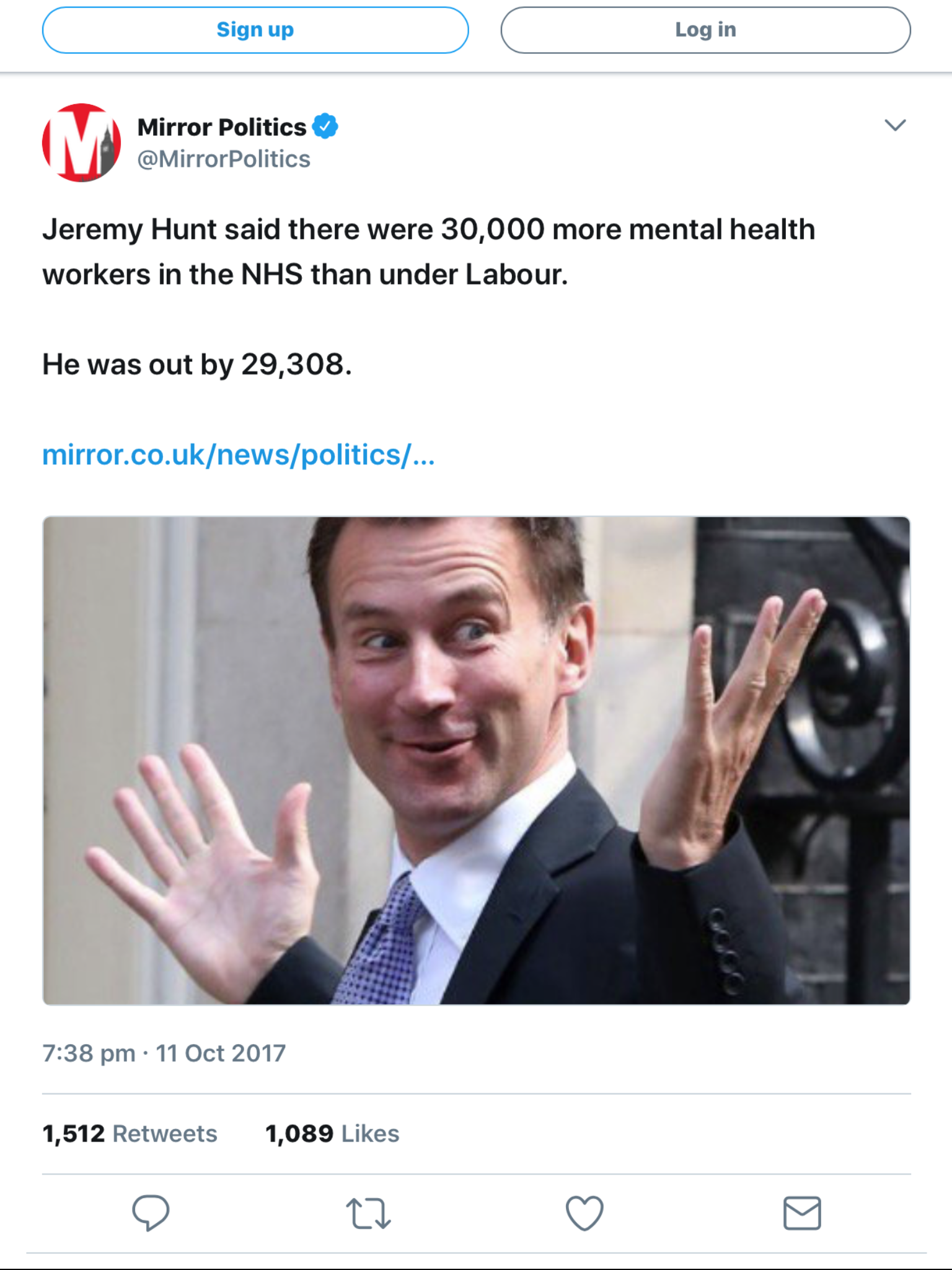
Hunt overestimates increase in mental health nurses by 98%!


This is extraordinary. In any other walk of life a bully would be punished and his or her victim given support. In this increasingly mad party, it is the other way round. In this case the bully is being joined by other bullies to force the victim out of a job.
And as for raising more money from “ordinary” voters – do people not realise that these donors are now desperately squirreling away their cash to cushion them against Brexit problems. With lots of it probably going to those tax havens they love so much.
As an employer – for that is what Tory donors are – these rich donors who are calling the tune – it should be ashamed of themselves. But alas, shame is something rich Tory donors have never and will never experience.
And every member of the Conservative Party shares in this – including our MPs Swire and Parish if they stay silent and join in bearing in mind Swire tweeted his support of bully-boy Johnson very recently, after his attack on May.
Tory party members – you are all complicit with the behaviour of these bullies. Pay your subs and be one of the rabble they will call up on their behalf – that’s your role. And take over paying for their share while they still pull your strings.
“Conservative donors have called for Theresa May to stand down because she is being “bullied” by colleagues including Boris Johnson.
Following an ill-fated conference speech and rumours of a backbench plot against the prime minister, two wealthy supporters said the party must act quickly and install another leader.
In a further development, the party is discussing plans to emulate Labour and widen its financial support away from large donations from a select group of wealthy donors to smaller donations from its ordinary members.
Charlie Mullins, the founder of London-based Pimlico Plumbers, said May must leave because she was being bullied and undermined by Johnson.
He said: “She has got to go for her own sake. It is getting embarrassing. If this was a boxing match, the fight would have been stopped. She has been put in a position where she is being bullied, she is being intimidated, they are making her life hell. These are Conservative people who are destroying this woman and it needs to stop.”
Mullins, who has donated £50,000 and spent £30,000 on a stall at this year’s conference, said the foreign secretary had been successfully undermining the prime minister.
“She is a broken woman. They are setting her up,” he said. “Boris is not a fool. He knows what he is doing. Boris is knocking her at every opportunity he gets because he wants to be prime minister. Boris has been a big part of destroying this woman. …
A second donor said May appeared to be too weak to fight the business community’s corner and should leave by Christmas if the party wants to retain financial support from entrepreneurs.
The businessman, who has given more than £300,000 in total, said: “[The party] is losing support in the City. People worry that the Tories are taking us over a Brexit cliff edge and May looks too weak to control her ministers.
“We need to act now. Whether she is replaced by an old guard member like Michael Fallon or new blood, I am not sure.”
The Conservatives have grown increasingly concerned about the party’s failing support from big donors in the business community.
While the Tories generated £1.5m in membership fees last year, Labour raised £14.4m, according to figures published in August by the Electoral Commission.
John Griffin, the founder of taxi firm Addison Lee who has given more than £4m to the Conservatives, told the Guardian that he has had preliminary talks with party officials about helping to widen financial support from a select few individuals to other less wealthy donors.
“I think the party has performed very poorly in that particular area, so I have a cunning plan and we will be having meetings about that this month. They have underperformed in the area of collecting money,” he said.
“We don’t really want donors to give large sums. We want lots of people to give smaller sums. That is the plan. The Labour party are making a better fist of it. We need to consider that and emulate them.”
Griffin declined to go into further details but said he raised the idea with May at a fundraising dinner at the Dorchester hotel in central London last month. “She supports the idea in principle,” he said.
Griffin, who gave £1m to the party before this year’s election, said he wantedMay to remain as prime minister and called for Johnson to be given a “smacked bum” for undermining her.
“Boris has been a naughty boy and needs a smacked bum. That’s where I stand. He is a nice bloke, but there is a time for everything and he needs a bit more dignity,” he said. “I have encouraged the prime minister to make sure that these people in the cabinet stand in line and she must exercise her power.”
“Theresa May is facing further calls to sack Boris Johnson after he said that a war-torn Libyan city only has to “clear the dead bodies away” to become a world-class tourist and business destination.
Johnson was accused by Labour of being “unbelievably crass, callous and cruel” about those who died in the battle to reclaim Sirte from Islamic State (Isis), after he was asked at the Conservative party conference what it was like visiting Libya as foreign secretary.
Speaking about the potential of Sirte, the Libyan city where Muammar Gaddafi was killed, Johnson drew gasps and embarrassed laughter from the audience as he said: “There’s a group of UK business people, wonderful guys who want to invest in Sirte, on the coast, near where Gaddafi was actually captured and executed as some of you may have seen. And they literally have a brilliant vision to turn Sirte, with the help of the municipality of Sirte, to turn it into the next Dubai.
“The only thing they’ve got to do is clear the dead bodies away and then they’ll be there.” …”
“The boss of Monarch was setting-up his own firm as the stricken airline was going to the wall, it has emerged.
Andrew Swaffield insisted he was “heart broken” by the firm’s collapse, with the loss of more than 1,800 jobs. Yet as Monarch was for fighting for survival, polo playing Mr Swaffield found time to get a new firm for himself off the ground.
Records show electronic paperwork to establish Alcedo Consulting Services was received by Companies House last Friday. The two directors are Mr Swaffield and his partner William Low, 51. The company was formally incorporated on Monday – the same day Monarch plunged into administration.
Stefan Stern, director of the High Pay Centre, branded the timing “shocking”. He said: “He appears to have been planning his escape route before the passengers or crew. “It used to be women and children first, now it seems to be chief executive first. “It’s such bad taste and, frankly, stupid, to do this now.”
The firm is named after Mr Swaffield’s polo team, Alcedo, which recently won several trophies at the Cowdray Park Polo Club in West Sussex.
In a message seen by the Mirror, he insisted Monday’s collapse of Monarch was “the hardest day of my entire career. “Seeing the end of the company and 1,800 people losinzg their jobs has been heart breaking.’
Mr Swaffield previously ran a consultancy firm, CST Consulting, after losing his job at British Airways in 2005. He said: “I have done the same again today knowing that I am leaving, so that I can start the process of planning my future and if I manage to secure any work I will have a company through which to process it. “It can take up to a year to secure chief executive level roles and consulting is a good stop gap.”
Records show Mr Swaffield became chief executive of another company, Shelfco 2017, that was set-up on September 25. The other directors include Nils Christy, Monarch’s chief operating officer, and Christopher Bennett, its finance director. It is registered at Monarch’s Luton Airport headquarters.
It came as millions of holidaymakers and bank customers are set to pick-up the bill for Monarch’s rescue flights.”
http://www.mirror.co.uk/news/uk-news/boss-monarch-set-up-new-11282103
Owl REALLY tried to cut some of this article but HAD to print it in its entirety – PLEASE we have to get people like this out of Parliament.
“Unmarried men often grow into “dysfunctional” human beings and become “a problem” for society, Iain Duncan Smith has said.
Speaking at a fringe event at the Conservative Party conference in Manchester, the Tory MP also claimed cohabiting couples have “inherently unstable” relationships.
He went on to claim men out of wedlock were “released to do all the things they wouldn’t normally do” such as committing crimes, drinking too much, taking drugs and fathering multiple children.
Couples living together were more likely to break up as the arrangement “suits the man” more than the woman, he went on to claim, and if men were not taught of the importance of marriage they would develop “low value for women” and seek out “the alternative on the internet”.
“Cohabitation is a very different relationship from marriage,” he said. “It is inherently unstable. The level of breakup is staggering high compared to marriage, and for the most part, these relationships break up upon arrival of a child.”
He went on: “The answer I think is because cohabitation suits one of the partners more than the other. Almost invariably it suits the man, because they have to make good on their commitment and when that commitment is facing them they then withdraw.
“In marriage, having made that commitment, the child becomes a focus for your responsibility and you commit more. They commit automatically once the child arrives.”
He went on: “Out there, these boys particularly, when left without the concept of what [marriage/commitment] is about will find the alternative on the internet.
“And the alternative on the internet, now so readily available, is about abusive sex and low value for women. That is where they will go.
That’s why, certainly at the bottom end of the income scale, there is such collapse of self-worth among young girls because they see themselves as objects because they are taught from the beginning that is the only way to get a man.”
He said men “unanchored” from a partner were more likely to get into debt and commit crimes, adding: “What has been going on all these years is the men that have been absent from these families in many of these low income groups are now a problem.
“They are out, no longer having to bring something in for their family, so they can be released to do all the things they wouldn’t normally do and shouldn’t do, so levels of addiction, levels of high criminal activity, issues around dysfunctional behaviour, multiple parenting – all those things are as a result of the un-anchoring of the young man to a responsibility that keeps them stable and eventually makes them more happy.”
The former Work and Pensions Secretary, who introduced Universal Credit, said there was a “family breakdown crisis” in Britain among lower income groups, but “middle class opinion” meant ministers were “scared stiff” of tackling it.
He cited research by the Centre for Social Justice, the think tank he founded and of which he is chairman, that found that teenagers from the poorest 20% of households were 65% more likely to experience family breakdown than teenagers in the top 20% of households.
He said one in five dependent children had no father figure at home, and added: “A child in Britain is more likely to experience family breakdown than anywhere else in the world, not the western world, the world.”
He compared marriage to buying into a golf club membership, which would see men sign up for “absurd things” and claimed the current system financially rewarded single people.
Duncan Smith said: “If something really matters to you in life, you commit to it. People join golf clubs and they sign up for the most absurd things that you have to do, wearing trousers, shoes, all sorts of things.
“They will sign up to all of that. They will sign contracts on housing, they will do financial contracts that they will sign and never question.
“On the most important relationship in our lives, the thing that will damage or make us, family formation, we let the middle class sit there and tell us this is a lifestyle choice, and we shouldn’t ever tell people that it matters that you make an absolute commitment such that it is written down on a piece of paper.
“Education is critical.”
He added: “We don’t ask for special privileges for marriage and stable families, we simply ask to get that pendulum back in the middle so that people who make a choice do not have to make a choice that is financially damaging rather than benefiting.
“The whole system is set up to reward those living by themselves and essentially penalise those who stay together, because they get more money.
“If you are on a very low income and the choice is between, basically, losing money or gaining money, ultimately you will choose the path of gaining money because that is how it works.”
The fringe event was the only one at the party conference discussing family breakdown, he said, before adding: “The truth is I sit in a building where people are scared stiff of this subject.”
Sir Paul Coleridge, chairman of the Marriage Foundation, also spoke at the event.
He said: “The problem is that there is a view out there, borne of ignorance I’m afraid, that all cohabiting relationships are of equal worth, of equal value, of equal stability. I’m afraid they are not.”
Marriage means a relationship three times more likely to last until a child is into their teenage years, he said.
“I think a very straightforward message from the government through the tax system, like recycling your rubbish or anything else, it is the message that you send to people; that one form of a committed relationship is more valuable and useful to society than another.”
He said men not in marriage were more likely to die earlier, experience health problems and get into debt.
He added: “It’s not a moral crusade, it is a public health campaign.”
http://www.huffingtonpost.co.uk/entry/marriage-iain-duncan-smith_uk_59d3b8f9e4b04b9f92054af5
“Boris Johnson has told friends his minister’s salary of £141,405 a year is not enough to live on, according to reports.
The Foreign Secretary told friends his annual earnings were insufficient because of his “extensive family responsibilities”, according to a report in The Sunday Times.
The Tory MP has four children with his second wife, Marina Wheeler. He also fathered a daughter during an affair with arts consultant Helen MacIntyre, failing to get an injunction to prevent the reporting of her existence. …”
David Mitchell nails it in The Observer:
“The Tory politician James Duddridge pockets £3,300 a month from a lobbying company, but don’t worry. If it were a problem, it wouldn’t be legal.
What is the advantage of letting sitting MPs work for lobbying firms? What are the pluses of that, for the country? Because we do allow it, so I’m assuming there must be some upside.
After all, there are clear advantages to many things we don’t allow: smoking on petrol station forecourts, for example. Allowing that would mean, if you’re addicted to smoking, or enjoy smoking, or think smoking makes you look cool, you could do it while filling your car with petrol, polishing its bonnet, going to buy snacks, checking the tyres and so on. You wouldn’t be inconvenienced by either the discomfort of nicotine withdrawal or a hiatus in the image of nonchalant suavity that having a fag in your mouth invariably projects.
And the same goes for those essaying auras of Churchillian defiance and grit, or Hannibal from The A-Team-style twinkly maverick leadership, to which a lit cigar clamped between the teeth can be vital, particularly if you’ve got a weak chin.
Similarly, if you’re a pipe-smoking detective of the Sherlock Holmes mould and are, perhaps, investigating a crime on a petrol station forecourt, or merely passing across one while contemplating the intricacies of a non-forecourt-related mystery, you wouldn’t have to suffer a lapse in the heightened analytical brain function that you’ve found smoking a pipe crucial to attaining. Interrupting such processes to buy petrol may cause murderers to walk free.
And then there’s the possibility that allowing smoking at petrol stations will marginally increase overall consumption, and therefore sales, of tobacco products – all the Holmeses and Churchills and Bonds will be able to get a few more smokes in before they die of cancer – which would slightly improve trade and GDP, and so create jobs.
Maybe Duddridge just pops in once a month and is a master of clearing photocopier jams.
Nevertheless, I am not, on balance, in favour of allowing smoking on petrol station forecourts. The manifold advantages are, in my view, outweighed by the several disadvantages: passive smoking for non-smoking users of the forecourt, nicotine staining of the underside of the canopy, and various others I can’t currently bring to mind.
But you’d think, in a system that flattered itself as non-mad, as I believe the British one still does, practices that are legal would be bristling with more boons for the community than those that aren’t. That’s got to be the vague rule of thumb, right? So then, what are the good things about allowing sitting MPs to take paid work from lobbying firms? What are the upsides to that?
The downsides are as hard to miss as a few hundred thousand litres of subterranean petrol suddenly exploding. Let’s take an example from the news last week. It was reported that James Duddridge, a Tory MP who was minister for Africa from 2014 to 2016, is being paid £3,300 for eight hours work a month by a lobbying company called Brand Communications.
It’s one of the few lobbying companies not to have signed up to the industry’s code of conduct, which prohibits employing sitting MPs. You may say that makes it a nasty firm, but I don’t blame it. Why would it sign up to extra rules if it doesn’t have to? That’s like volunteering to observe a lower speed limit than the one prescribed by law.
The law is absolutely fine with Duddridge’s little earner. Former ministers’ jobs just have to be approved by the Advisory Committee on Business Appointments, itself described by the Commons Public Administration and Constitutional Affairs Committee as a “toothless regulator” (these committees are so bitchy!), since it has no statutory powers of redress. Then again, as its rulings are almost invariably “That’s fine”, what powers does it really need?
Duddridge himself says it’s all legit because Brand Communications is “not a public affairs company”, but the company’s website says “James will bring his deep knowledge of Africa, experience of operating at the highest levels of government and extensive networks to Brand Communications”, which sounds a bit public affairsy to me.
But I don’t know: maybe it’s fine. We can’t know it’s definitely not fine. Admittedly, according to the Times, the head of one of Britain’s leading lobbying firms called it “an appalling example of bad practice”, and the chairman of the Association of Professional Political Consultants said, “MPs should not be lobbyists. It is wrong to be a lobbyist and make the law at the same time,” but maybe it’s still fine.
Maybe James just pops in once a month and is incredibly helpful in ways that don’t conflict with his public duties. Maybe he’s full of creative ideas, a huge boost to office morale and a master of clearing photocopier jams. And then he pops back to parliament and doesn’t think about Brand Communications until the next month, no matter what issues concerning their interests cross his desk as an MP and member of the Commons International Development Committee. Yes, maybe it’s fine.”
Summary: Rees-Mogg doesn’t mind at all if his investments are unethical and it’s ok to lie about what pills can be used for – the Vatican would find that ok.
“Multi-millionaire Tory Jacob Rees-Mogg has admitted his investment firm profits from abortion pills – even though he wants to deny rape victims the right to terminations.
His company has nearly £5million-worth of shares in the Indonesian firm Kalbe Farma, which produces the pills to prevent ulcers.
They also trigger terminations, can be bought in pharmacies and are used widely in Indonesia – where there are an estimated two million illegal abortions each year.
Father-of-six Mr Rees-Mogg defended the investments and said he would not resign his investment post.
But he admitted: “It would be wrong to pretend that I like it but the world is not always what you want it to be. …
The staunch Catholic, who is tipped to succeed PM Theresa May, is a partner in Somerset Capital Management, the investment firm he co-founded in 2007.
The North East Somerset MP, 48, is paid more than £14,500 a month for 30 hours of work for the company.
He will not reveal the dividend payments he receives for his 15 per cent share in the firm, based in London’s upmarket Belgravia.
But partners have trousered nearly £60million between them since 2010.
According to this year’s interim report, two of Somerset Capital Management’s investment funds hold £4.8million in shares in Jakarta-based Kalbe Farma.
The pharmaceutical firm make misoprostol, a generic abortion drug sold under the brand name Invitec. They also manufacture oral contraceptives.
Invitec is marketed under its other use as a gastric ulcer preventer because abortion, other than in cases of rape or to save a mother’s life, is illegal in Indonesia.
But the international women’s rights organisation Women on Waves say it is available in Indonesian pharmacies.
The Dutch-based organisation advises women in Indonesia on how to obtain the drug and the circumstances in which terminations are legal in the country.
It says: “Abortion is permitted to save a woman’s life, in cases of foetal impairment and in cases of rape. Spousal authorisation is required. Misoprostol is available in pharmacies under the names Chromalux, Citrosol, Cytostol, Gastrul, Invitec and Noprostol.”
Mr Rees-Mogg defended the investments.
He said: “Kalbe Farma obeys Indonesian law so it’s a legitimate investment and there’s no hypocrisy. The law in Indonesia would satisfy the Vatican.”
In an earlier phone call, Mr Rees-Mogg said he had been unaware the company made the drug.
But he added: “I don’t manage the funds and haven’t done so since I became an MP. But the funds have to be run in accordance with the requirements of the investors and not according to my religious beliefs.
“This is not something I would wish to invest in personally but you have a duty as an investment manager not to impose constraints on investors.”
Mr Rees-Mogg accepted he did profit “in a very roundabout way”.
He went on: “This company does not procure the abortion of babies. It’s not my money in these investments and I profit from the total amount of client money we hold, not the investments we make.”
The Eton and Oxford educated MP caused uproar this month when he was interviewed on ITV’s Good Morning Britain by Susanna Reid and denounced abortion as “morally indefensible” in all circumstances.
That, he said, included cases of pregnancy caused by rape or incest. He added: “Life is sacrosanct and begins at the point of conception.”
The MP said this was not government policy, but his own personal view based on Catholic teachings.
… Misoprostol can be prescribed to prevent stomach ulcers, or induce labour in pregnant women by causing contractions.
But when used with another drug, mifepristone, it ends pregnancy in NHS medical abortions to avoid surgical procedures.
Misoprostol is often used alone to bring about an abortion, particularly in countries where termination is illegal.”
Source: Daily Mirror
http://www.mirror.co.uk/news/politics/pro-life-tory-multi-millionaire-11267331
The head of the Fire Brigade Union at the Labour Conference:
“They say don’t politicise Grenfell Tower, and we’ve not tried to politicise Grenfell Tower. But the truth is that actually when we examine this, and we do that, we’re already doing that, we will find – and any serious inquiry if it is genuine will find – that what led to the situation whereby Grenfell Tower could happen is a whole series of decisions, decisions that go back probably 30 years in reality, that go back over those three and a half decades.
“Decisions that altered the safety regime. Decisions that altered the housing regime. Decisions that altered inspection regimes and enforcement regimes.
“A process of deregulation and supposedly cutting red tape, where the previous Prime Minister David Cameron described health and safety as a ‘monster that should be slain.’ This is the language we’ve had off these people in power.” “And it is political decisions that have created the regime whereby Grenfell Tower, that atrocity, could happen.
“So there is no getting away from the fact that it is a political matter and we shouldn’t be afraid of saying it is a political matter.
Echoing Shadow Chancellor John McDonnell’s controversial claim that Grenfell victims were “murdered by political decisions”, Mr Wrack said: “They’re decisions and decisions are made by politicians. So by definition they are political decisions.
“To me it is a national political scandal. It is the sort of the scandal on which governments should fall, by the way.”
Mr Wrack said only London’s fire service was big enough to be able to give the level of cover needed to fight the fire.
“Plymouth has tower blocks that failed the tests” for flammable building cladding, he said. “They have night duties when they have 18 firefighters on duty.”
Turning to the inquiry, he added: “If we conclude, and if representatives of the residents and survivors and bereaved conclude, that the whole thing is a pointless stitch-up, then actually we may conclude that we’re going to walk away and boycott that inquiry.
“I hope it doesn’t happen but I think we need to tell the inquiry people that that’s where we stand.”
http://www.mirror.co.uk/news/politics/grenfell-tower-fire-crime-should-11237179
As the article says: The NHS spends 1.02% of its budget on agency staff where the Cabinet Office has spent nearer 8% of its budget on such staff. But that is a mere drop in the ocean … read on …
“While all eyes were on the Labour Party conference, Theresa May’s Cabinet Office (CO) quietly published its accounts. And buried in the 114 pages was the fact that it spent a whopping £43.8m on agency staff in 2016/17.
But this was just the tip of a half a billion pound spending iceberg – with the CO blowing £8.86m on staff perks, and even giving [pdf, p89] former Lib Dem leader Nick Clegg £114,982 from the public purse. …
Excruciating figures
Some of the most notable spending compared to 2015/16 was:
£43.8m on agency staff, up 54%.
£2.47m on staff “termination benefits” when they left the CO, up 162%.
£8.86m on staff travel, food and “hospitality”, up 63%.
£196.8m on total staff costs, up 20%.
£50.2m on Police and Crime Commissioner elections.
£1.54m on Private Finance Initiative (PFI) contracts, up 387%.
£21.7m on renting buildings, up 38%.
Writing off £2.3m of “bad debt”, up 5,342%.
But the £43.8m spent on agency staff (7.8% of the CO’s entire budget) does not tell the whole story. Because another set of CO figures reveals that it only employed 299 agency, interim, or consultant staff in 2016/17. Meaning the average cost of one of these, including agency fees, was £146,488.
The CO spent, overall, £558.58m in 2016/17; down £1.24m or 0.22% on 2015/16. The spending increases listed above were mostly offset by savings from not having the cost of a general election, reductions in pension costs, and less being paid out for “professional services”.
But delve a little deeper into the figures and some of the CO spending is even more questionable.
Nudging paper
The full CO accounts reveal that it paid out [pdf, p89] £538,067 in total to all living former Prime Ministers as “public duty costs”. But this also included £114,982 to former Deputy PM Clegg; a 12.8% increase on his payment in 2015/16.
The CO has [pdf, p99] £210.6m worth of agreements with private contractors to pay out over the course of their durations. It also holds [pdf, p101] £64m of investments in six private companies that operate within the public sector/government. One of these is Behavioural Insights Ltd, also known as the controversial ‘Nudge Unit’. As writer Sue Jones noted in 2015, the Nudge Unit is:
aimed at ‘changing the behaviours’ of citizens perceived to ‘make the wrong choices’ – ultimately the presented political aim is to mend Britain’s supposedly ‘broken society’ and to restore a country that ‘lives within its means’, according to a narrow, elitist view, bringing about a neoliberal utopia built on ‘economic competitiveness’ in a ‘global race’.
The Canary approached the CO for comment on its accounts, but at the time of publication had not received a response.
May’s money for nothing
John Manzoni, Chief Executive of the Civil Service, said [pdf, p9] in his introduction to the CO accounts that:
This year the Cabinet Office celebrated 100 years… ensuring that government works efficiently and effectively for citizens across the UK.
Manzoni’s hopes of the CO “ensuring efficiency” are laughable, at best, when you have a government department that happily spends £43.8m on agency staff and nearly £9m on ‘perks’ for its employees.
But the CO’s seemingly frivolous spending should contrast with other government departments. Because during 2016/17, the DWP cut Personal Independence Payments (PIP) for 164,000 people living with mental health issues. It reduced their payments from the enhanced to the standard rate, saving it £27.45 per person, per week. So, this saved the DWP £234m, or 0.11% of the welfare budget.
Also, the NHS spends around 1.02% of its budget on agency staff, but is criticised for doing so. So, when the CO claims “efficiency” but sees fit to spend 7.8% of its budget on agency staff, yet the DWP cuts crucial support from some of the poorest in society to save it a mere 0.11%, we have a truly broken government.”
“With a taxpayer-funded MP’s salary of £80,000 a year, Andrew Bridgen is hardly poor. But the bleating Tory moaned to a judge about having to pay for Remembrance Sunday wreaths out of his own pocket so he can honour Britain’s war dead. And he reckons a bitter divorce battle with ex-wife Jacqueline, 40, has left him virtually penniless – while it is claimed he manages to pay high rent on a £2million property and lavishes gifts on new partner Nevena Pavlovic.
The 52-year-old asked a court to stop a monthly £1,100 maintenance payment to Jacqueline for their two children. He said: “On Remembrance Sunday I buy five wreaths for the five main services, I will attend three and I will read the names at all of them. “It is now de rigeur that MPs can’t put in claims for wreaths or travel. £175 on wreaths it will cost me, £200 [including travel] to be the MP of North West Leicestershire on that Remembrance Sunday. “Something I do gladly but which is not appreciated by the general public. “So the remuneration of an MP is not the same as if I was working for the Co-op. There are huge costs to being an MP which can never be claimed for. I have not had a holiday this year.”
But his griping sparked fury at a time when the Tory party has plunged millions of ordinary people into poverty with crippling austerity and cuts to public services and the military.
Labour MP John Mann said: “He should stop moaning. It’s a privilege to be an MP. His attitude just brings all MPs into disrepute. “He’s an embarrassment and a disgrace. I’d call on Theresa May to withdraw the Tory whip, for him to make a public apology and announce
he’s resigning.”
Colleague and Afghan war veteran Clive Lewis added: “Tory cuts have hit the armed forces hard, our servicemen and women who are suffering under the public sector pay cap probably won’t have a lot of sympathy with a Tory MP who voted for austerity having to pay for a wreath. “This just adds insult to injury.”
Bridgen, of Coleorton, Leics – who married 38-year-old Serbian opera singer Nevena in April – made his pleas of poverty during a family court hearing to try to stop maintenance. He claimed the split from trainee teaching assistant Jacqueline cost him more than £1million in payments to her and he had to sell his £2.2million mansion at a cut price. And he said he has forked out more than £500,000 in legal fees on the divorce.
The court heard Bridgen’s brother has frozen him out of his family farm business, which had netted the MP £110,000 a year. And his income fell after he lost chairmanship of a select committee. He said: “My personal assets run to less than £20,000 and that would be if I sold all the furniture in the house I rent. I have no car, no house and a bad credit rating. Until I am paid I have less than £200 in the bank. “My income has dropped by 70%. I fought two general elections in the last two years, where I could have lost my job, and, who knows, we might be fighting another one soon. “There is no more insecure employment than politics.” But that won no sympathy from District Judge Richard MacMillan who told him: “You chose to go into politics, Mr Bridgen.”
And Jacqueline told the hearing at Nottingham crown court her ex “chooses to live a luxury lifestyle to the detriment of our children” and she cannot bring them up properly without maintenance payments. She also claimed he recently bought a £3,000 ring for Nevena, transferred £2,500 to her account and spent thousands visiting her in Serbia.
She added: “The court should put the needs of our children above his needs. His income is approximately £4,000 a month and he chooses to spend over half on rent for a property that is way beyond his means. “My income is £8,000 a year while his is 10 times that. Frankly without that money I don’t know how I’m going to manage each month.
“I have spent the last 20 years being bullied and controlled by Mr Bridgen, there is no one more desperate than me to be out of his control. However, I still need the support of spousal maintenance payments so I can meet the needs of our children. “I have to sit here and fight and listen to the foul things Mr Bridgen has to say because I have no alternative to provide for my children.”
Throughout the two-hour hearing, Bridgen continually interrupted his ex-wife’s evidence. Judge MacMillan finally lost patience with his outbursts and told him: “We are not in the Commons now.” Bridgen even tried to stop the Mirror attending the hearing on Friday. But the judge said he saw no reason to exclude the press “however embarrassing it may be”.
The MP had applied to have around £5,000 in maintenance payments given back to him by his ex. Judge MacMillan refused but agreed he was not obliged to hand over £7,673 of payments he had missed this year.
The couple married in 2000 but had an acrimonious split around five years ago. The court heard Jacqueline is now living with a Mr Gittins at an address in Packington, Leics, meaning her circumstances had changed.
Perjury query weeks before court date
Andrew Bridgen wasted Government time asking questions about family courts weeks before his maintenance hearing. On September 4 he asked the Justice Secretary David Lidington : “How many people have been prosecuted for perjury in the family court in each year since 2007, by gender?”
When told the answer could only be got “at disproportionate cost”, he asked on September 14: “How many (a) men and (b) women were prosecuted for perjury in the family court in 2016?”
Outside court we asked the MP whether tabling Government questions on personal matters called into question his impartiality. He said: “It’s perfectly appropriate. I have a personal and professional interest.”
http://www.mirror.co.uk/news/politics/tory-mp-moans-spending-175-11231238
£81,000 to £95,000:
“The board that oversees Glasgow’s three further education colleges has dropped plans to award a 17% pay rise to a senior official.
This followed intervention by the deputy first minister after the proposal was roundly criticised by Holyrood’s public audit committee.”
MEANWHILE, here in Devon:
£90,727 to £115,000:
“So, here we are: Somerset County Council theoretically holds the purse strings – except it obviously doesn’t! There is no scrutiny or transparency, no way of stopping this juggernaut that we have never been consulted about.
AND we have no way of knowing how Diviani voted – the LEP doesn’t release such information.
“Chris Garcia, chief executive of the Local Enterprise Partnership (LEP), could see his pay jump nearly 27% from £90,729 to £115,000. [This was agreed today with the two councils objecting].
“Somerset council leader John Osman said: “The pay of £90,000 is already too much so I believe it should be at least 10% less than that.”
https://eastdevonwatch.org/2017/01/17/17562/
As a recent commentator points out:
“Two key points:
1. LEP is completely and utterly unaccountable either to the people of the SW directly or via our elected representatives on the CCs.
2. Unlike the Scottish government, the UK government is unwilling to step in in the interests of prudent and acceptable public spending, and by failing to step in is giving the appearance that they promote this sort of excessive pay for their friends (and in some case party sponsors) in what many of would consider a corrupt way.
Funny how there is never any money for essential rank-and-file public sector workers like nurses and firemen and prison officers and the police etc. whose pay rises (when they get them) continue to be below inflation, but they never have anything to say and never take any action when it is their mates and sponsors who are getting them. And if the excuse is because of the weight of their responsibilities and the stresses of the position, why does not that also apply to nurses etc. who face danger and traumatic experiences every day, and whose workloads are increasing due to cuts in staff numbers?
SUMMARY: Its one rule for the Conservative elite and their friends / sponsors, and another for the remaining 95%-98% of the population.
CONSERVATIVES: “For the few not the many.”
CMA fines estate agents cartel £370,000 for rate fixing
“A group of estate agents who secretly conspired to keep their fees high to make “as much profit as possible” have been fined £370,000 for operating an illegal cartel.
The Competition and Markets Authority (CMA) said this was the second time in two-and-a-half years that it had taken enforcement action against estate agents, and this latest case raised concerns that the sector “does not properly understand the seriousness of anti-competitive conduct and the consequences of breaking competition law”.
The six estate agents, all based in the Burnham-on-Sea area of Somerset, had a meeting and agreed to fix their minimum commission rates at 1.5%, thereby denying local homeowners the chance of getting a better deal when selling their homes. Between them the agents dominated the local area: their market share was said to be potentially as high as 95%.
The CMA said it was publishing full details of the case to remind other agents to comply with the law and avoid being fined.
Penalties totalling £370,084 were imposed on five firms: Abbott and Frost Estate Agents Limited, Gary Berryman Estate Agents Ltd (and its ultimate parent company Warne Investments Limited), Greenslade Taylor Hunt, Saxons PS Limited, and West Coast Property Services (UK) Limited.
The sixth, Annagram Estates Limited, trading as CJ Hole, has not been fined as it was the first to confess its involvement in the arrangement and cooperated with the investigation.
The price-fixing cartel was formed in early 2014 when the estate agents met with each other to “have a chat about fees”.
Email evidence showed that the agents’ rationale was “With a bit of talking and cooperation between us, we all win!”. The correspondence also explained how “the aim of the meeting … will be to drive the fee level up to 1.5%” and “… it’s really important we all give it the priority it deserves (making as much as profit as possible!)”.
The estate agents took steps to ensure the minimum fee agreement was kept to by emailing each other when a specific issue arose, such as accusations of “cheating” on their agreement. Each business also took it in turn to “police” the cartel to make sure everyone was sticking to the agreement.
However, in December 2015 the CMA carried out searches of the estate agent offices and seized documents and digital material. Stephen Blake, senior director of cartel enforcement, said: “Cartels are a form of cheating. They are typically carried out in secret to make you think you are getting a fair deal, even though the businesses involved are conspiring to keep prices high.”
He added: “We have taken action against estate agents before and remain committed to tackling competition law issues in the sector.”
In May 2015 the CMA ruled that three members of an association of estate and letting agents, the association itself, and a newspaper publisher infringed competition law. That case involved the advertising of fees in the area around Fleet in Hampshire, and resulted in penalties totalling more than £735,000 being imposed.
“A minister today took a swipe at her own Government for refusing to relax rules restricting the campaigning charities can do the year before elections.
The Government last week revealed it will not amend the controversial Lobbying Act – despite a government commissioned review calling for major changes.
And in a move suggesting division in the heart of government over the decision, civil society minister Tracey Crouch retweeted an article criticising the decision.
The article warned the decision will fuel concerns that Theresa May’s administration is a ‘weak minority Government that largely only has eyes for Brexit’.
And it questioned what influence Ms Crouch ‘genuinely has within Government’ if she has not been able to convince her fellow ministers of the need for change.
‘A divided government bogged down by Brexit doesn’t have the time or the inclination to push through sensible changes to poorly-drafted legislation.
‘Tracey Crouch deserves credit for speaking out but the truth is the country is suffering as a result’. …”
Note that professional lobbyists have no restrictions – only charities and non-governmental organisations.
“Charities have condemned ministers for rejecting changes to the Lobbying Act which were made by a government-commissioned review body. Campaign groups say they will be left unable to speak out for vulnerable and marginalised people in society because the law has a chilling effect on freedom of speech.
The Lobbying Act restricts what non-governmental organisations can say in the year before a general election.
As a result of an outcry from the charities sector, the government commissioned a review of the recommended amendments.
Lord Hodgson of Astley Abbotts called for the scope of the act to be reduced to include only activity intended to influence how the public vote. The Conservative peer also called for the period during which its rules apply to be reduced from a year.
But the Cabinet Office has said in a statement it would make no changes to the law. In a statement the Cabinet Office said: “The rules on third-party campaigning in elections ensures that activity is transparent and prevents any individual, company, or organisation exerting undue influence in terms of an election outcome.
“We recognise and value the role that charities play in our society and are keen to work with voluntary bodies to ensure the rules are well understood.”
Charities and NGOs said this amounted to a blanket rejection of recommendations made by by Hodgson’s review.
The Cabinet Office decision comes a few weeks after more than 100 charities sent a letter to the civil societiy minister Tracey Crouch to put pressure on ministers to overhaul the act.
The charities and campaign groups who signed the letter represented a wide range of domestic and global issues including health, social care, global poverty, human rights, environment, and vulnerable groups. They included Greenpeace, Girlguiding, Deafblind UK and Action for Children.
Greenpeace was the first NGO to be fined under the Lobbying Act.
Tamsyn Barton, chief executive of Bond, the UK network of organisations working in international development, said: “How are charities supposed to speak up for the most vulnerable and marginalised people in society, both here and globally, when they are at risk of being penalised by the Lobbying Act? The government is legislating the sector into silence at a time when our voices are needed the most. This is a terrible day for British democracy.”
Greenpeace fined under Lobbying Act in ‘act of civil disobedience’
The Conservative government led by David Cameron passed the act as a result of high-profile corporate lobbying scandals. It amended existing rules on non-party organisations introduced in 2000, requiring groups to register with the electoral commission if they plan to spend more than £20,000 in England or £10,000 in the rest of the UK on so-called “regulated activities”.
Critics say the government’s definition of these activities is so broad it can include any activity that could be interpreted as political.
Vicky Browning, chief executive of the charity leaders network Acevo, said of the government’s decision: “Charity leaders will be dismayed by the Cabinet Office’s decision to ignore wholesale Lord Hodgson’s recommendations to reduce campaigning restrictions. This decision is in direct contradiction with the views of not only Lord Hodgson but the cross-party Lords select committee on charities and over 100 charity leaders from across the country.
“Lord Hodgson insisted that his reforms would ensure the clarity and definition of campaigning boundaries. Without them, the Lobbying Act’s restrictions remain deeply intimidating.”
“Knowle Council Chamber yet again rang with cries of “Shame” from the public gallery, as entrenched Party allegiance took precedence over East Devon’s wellbeing, and the Motion of No Confidence in the EDDC Leader was lost by 31 votes to 18.
Of the 32 Tory members present (there were some notable absences, including some who had distanced themselves from Diviani), one abstained and 31 voted against. The Motion, called by the Independent Group, was supported by strong and clear arguments condemning Diviani for his conduct at the Devon County Health Scrutiny Committee*. As Cllr Roger Giles (Ottery St Mary) spoke of it as “a day of shame and infamy”, adding, ”In 26 years on this Council, I cannot think of a single occasion where a Leader has gone against his Council”.
Condemnation came from Council representatives far and wide across the District, to frequent applause from the crammed-full public gallery. Cllr Ben Ingham (Lympstone), who had called the Motion, pointed out why Diviani’s conduct had failed “all of the 7 Nolan principles in one go”, indicating how “This council continues to fester under a pernicious Leader”. Cllr Val Ranger (Newton Poppleford and Harpford) reminded Members that “We relied on Paul Diviani”, and arguing that “He does not understand the role of his own Scrutiny Committee.”
Cllr Cathy Gardner (Sidmouth) sympathised with Tory Councillors now finding themselves “between a rock and a hard place” (as they’d voted unanimously for the decision that their Leader had then ignored), and asked them, “Are your principles with your Party or with the people of East Devon?”
Cllr Geoff Jung (Woodbury) put his support for the No Confidence Motion succinctly, “Cllr Diviani agreed to take our vote to the DCC meeting, but he voted the other way”. Cllr Cllr Marianne Rixson (Sidmouth-Sidford ) said, “He’s betrayed everyone. How can we trust a Leader who ignores us? When will he do it again?”. Cllr Susie Bond (Feniton & Buckerell) reported her own town council’s “unanimous and extreme dismay”. Cllr Steve Gazzard (Exmouth) reasoned that “The Leader has got it totally wrong” . Cllr Peter Burrows (Seaton) said, “Councillors should support Community first, Party second.” Cllr Peter Faithfull (Ottery St Mary) drew attention to the central issue that “The personal views of one councillor (Diviani) is not what this is about. It’s whether we can have confidence in him”.
In contrast, contributions from the Conservative Councillors supporting their Leader, seemed to be largely out of focus. Cllrs Mark Williamson , Geoff Pook, Ian Hall and others, spoke mainly about NHS difficulties, some citing personal stories at some length. There were frequent calls of “irrelevant” from the public.
The Chair made no attempt to remind them of the wording of the Motion they were there to debate, but cautioned the public on several occasions, that hecklers would be removed.
So many members of the public had registered to speak, but the time allocation of 15 minutes in total, meant that several questions could not be put. The Chair, Andrew Moulding (Axminster) did however ensure that one question to the Leader, from East Devon resident, Jane Ashton, was answered straightaway. Here it is, with the response.
Jane Ashton : “When members of the public stand up for democracy, honesty and representation, to accuse them of being politically motivated is disrespectful. Would you acknowledge that?”
Paul Diviani replied that he “doesn’t recall himself ever saying these words. I would not like to be seen to be disrespectful in any way.”
The Leader’s reply might perplex the public who were there last night for the second Extra Ordinary Meeting concerning the fate of the Exmouth Fun Park.
Full report on both Extra Ordinary Meetings on the Devonlive news:
http://www.devonlive.com/news/devon-news/council-leader-survives-vote-no-473700”
“Training company Learndirect should face an investigation after it was rated “inadequate” by Ofsted, the chair of the Public Accounts Committee says.
The firm is estimated to have received more than £600m of public funding since 2011, but Meg Hillier said the government must demonstrate there were consequences for failure.
Ofsted has told the BBC no training provider should be beyond scrutiny.
Learndirect said it had made strong progress in improving its provision.
Ofsted’s report, which the company tried to prevent being made public, rated Learndirect inadequate overall, with failings in apprenticeships and lesser problems in adult learning.
No termination of contract notice has been issued, which would normally follow a similar rating.
Officials have told the BBC that because there is a need to “protect learners and maintain other key public services run by Learndirect Ltd”, the contract will run its course until next summer with intensive monitoring.
But those officials will face questions about their handling of the contract when they next appear before the influential Commons Public Accounts Committee (PAC).
‘Real slap’
Labour MP Ms Hillier MP said: “It’s a very big contract and we’re concerned the way Learndirect is treated is a sign the government considers it is too big to fail, which raises wider issues about how we contract these things out.”
She said she had asked the National Audit Office to consider looking into the contract. “If something is failing, the government needs to take action,” Ms Hillier continued. “It needs to show there are consequences, and it’s a real slap in the face to providers out there doing a good job, who are rated good or excellent by Ofsted, who then see a failing provider seemingly getting away with it.”
Learndirect Ltd has dozens of subcontractors, and takes a share of the contract value in return for passing the work on. But this case raise may wider questions about the scrutiny of major public contracts.
The head of Ofsted, Amanda Spielman, spoke exclusively to the BBC and FE Week in a joint interview about the lessons that need to be learned.
“We have to make sure that we say what we have to say about quality, no matter what,” she said. “We have to do that as early on as possible in the life of providers so we don’t end up with more Learndirects where there are 20,000 apprentices not getting what they should be getting.” She refused to be drawn on her view of the response by the Department for Education (DfE) following the Ofsted report, saying: “It is not for us to decide what happens to Learndirect.”
But she added: “I hope that the lessons from Learndirect will really focus people’s minds on what can be done up front, especially with very large providers. “In any system there are always going to be some problems, some providers with difficulty, and making sure the system can cope with the failure of any provider is an essential part of a functioning market.”
There is a risk for Ofsted that if robust action isn’t seen to be taken following a critical report, its own authority is undermined.
‘Act swiftly’
In a BBC interview, Skills Minister Anne Milton said Learndirect Ltd was not seen by the government as too big to fail. “It is most certainly not untouchable, we have the learners’ interests at heart. “We will continue to act swiftly with Learndirect and any other provider that fails to do as their contract specifies.” She also gave an undertaking to recoup any public money for training not delivered – the first time the government has said this publicly. “We will claw back from Learndirect any bit of their contract they have failed to fulfil.” That could only happen after an audit of the contract, if it was found that some training had not been delivered.
This criticism of Learndirect comes at a time when a significant expansion of apprenticeships is about to unfold.
The prospect of the new employer-funded apprenticeship levy has led to around 2,000 potential providers joining a new government register.
Ms Spielman said: “There are very clear risks. One is about people who shouldn’t be providing training at all, making sure they don’t get onto the register, or recognising that at the earliest possible moment before lives are disrupted.
“One is about making sure that people who have the potential to do it well stay in control of their business model and don’t lose sight of apprentices through layers of subcontracts that aren’t managed well.”
The new system will be very different, because employers will commission as well as fund the training.
Learndirect said it was making improvements to its adult training. “We remain committed to working with current employers and apprentices to ensure they receive the training and skills they need to succeed,” it said.
“Our focus is on delivering the highest levels of service and outcomes, and we will continue working closely with the DfE and ESFA [Education and Skills Funding Agency] to ensure its requirements around quality measures are met.”
A separate company Learndirect Apprenticeships Limited has been set up for business under the new apprenticeship levy.
A spokesman for that company said Ofsted had recognised it had prepared well for the new system and that corporate apprenticeship customers were happy with the standard of learning.”
“The Conservative government “cannot yet confirm” whether nearly £1bn of money it was supposed to have given to charities has been “spent as intended”. And even worse, £200m of funding, which former prime minister David Cameron promised would go to young people, has seemingly been lost altogether.
Promises, promises
In the wake of the Libor rate rigging scandal, then chancellor George Osborne promised in 2012 that the £973m the banks were fined would “go to the benefit of the public”. And Cameron went further in 2015, saying the money from a specific £227m fine on Deutsche Bank would be used to create 50,000 apprenticeships. He said at the time:
“We’re going to take the fines from the banks who tried to rig markets – and we’re going to use it to train young people and get them off the dole and into work.”
But now, the National Audit Office (NAO), which is responsible for checking how the government spends public money, has investigated the £973m fund. And it found a catalogue of errors, mismanagement and lax behaviour by the Tories.
Dodgy dealings
The NAO found that:
The government is “is unable to demonstrate” if it actually spent £200m on 50,000 apprenticeships.
It gave £196m to groups, without any “terms and conditions” on how they should spend it.
The government “cannot yet confirm that charities spent all grants as intended”.
It has not evaluated whether the money actually benefitted the public, or not.
Some of the money went directly into an internal Ministry of Defence project.
Missing millions
The office said, specifically in relation to the apprenticeships, that:
although the money was used to fund apprenticeships in general, the government did not report any increase in its already announced 3 million target. The Department for Education, now responsible for apprenticeships, was not directed to use the £200 million to pursue a specific policy to deliver apprenticeships for unemployed 22-24 year olds and cannot demonstrate whether 50,000 new apprenticeships for this group have been provided.
But what is most revealing is just which charities the government gave £973m to.
The NAO said that:
The majority of this money has gone towards Armed Forces and Emergency Services charities. The Treasury and the Ministry of Defence (MoD) have distributed £592 million of the fund to a range of different causes.
Tories: cutting to the bone
Meanwhile, since 2010, the Tories have:
Cut defence spending to 5% of all public spending.
Left around 7,000 ex-military personnel homeless in the UK.
Presided over more service personnel taking their own lives than actually dying in battle.
And, also since 2010:
The NHS has seen a real terms cut in the amount of money given to it per patient.
The government has cut the number of people getting social care by 26%. And it has cut the equivalent of almost £50m from children’s mental health services.
20,000 police officers have lost their jobs and £2.3bn has been cut from police budgets.
10,000 firefighters have lost their jobs and budgets have been cut by a third.
As sneaky as sneaky can be
So, essentially, the government has used the £973m from the bank’s fines to paper over the cracks created by their austerity, via charities. And as The Canary reported only this week, the blowback from austerity is beginning to severely show, with the police dealing with more cases of mental health issues than ever before. We knew that Cameron couldn’t be trusted with the public purse. And now we know that the Tories will use it to try and cover their disastrous tracks, too.”
https://www.thecanary.co/2017/09/08/tories-just-lost-1bn-charity-money-back-sofa/
Owl says: alas it doesn’t matter one jot what our district, town or parish councils think about the removal of community hospitals in general and removal of Honiton’s maternity services specifically, since the majority party cannot even trust their own Leader of our district council – Paul Diviani – to represent them.
(One more reason to turn up at Knowle on 13 September 2017 and watch those cowardly Tory councillors rally round him and turn out in numbers to overturn a vote of no confidence in him – even though it was THEIR confidence that he sabotaged at DCC when he voted against their instructions to refer bed closures to the Secretary of State- at the notorious scrutiny meeting where Sarah Randall-Johnson ensured that no contrary voices would be heard – only those echoing their Tory masters. Diviani being one of those enthusiastic voices.
“Campaigners backed by four councils have won the first round of their legal action over a claim that a consultation over changes at Horton General Hospital was flawed.
They want to prevent plans by Oxfordshire Clinical Commissioning Group (CCG) to downgrade maternity and critical care services at the hospital in Banbury.
Their campaign has been supported by nearby councils: Cherwell District Council, South Northamptonshire Council, Stratford-on-Avon District Council and Banbury Town Council.
A statement from barristers at Landmark Chambers said: “Campaign group Keep the Horton General has won an important first step in the battle against the downgrading of Horton Hospital.
“Fraser J today granted permission to apply for judicial review of the consultation process.”
The Administrative Court in July refused on the papers permission for a full hearing, but Cherwell successfully challenged that decision this week.
Oxfordshire CCG said last month that its proposed changes would “ensure safety, quality and better outcomes for patients”.
It said the critical care unit at Horton would be downgraded to cater only for less seriously ill patients and it would also lose some beds.
A single specialist obstetric unit would be created at Oxford’s John Radcliffe Hospital and only a midwife service would remain at Horton, though it would gain an improved diagnostic and outpatient service.
A CCG spokesperson said: “We are fully aware of the outcome of today’s oral hearing seeking permission for a judicial review and will co-operate with the process as appropriate.”
“Sports and betting companies top the list of donors treating MPs to gifts and hospitality.
The Ladbrokes Coral group appeared 15 times in the register of members’ interests, more than any other donor.
Out of 187 donations from UK sources registered by MPs, 58 were from the world of sport. A further 19 were from betting companies.
Ladbrokes Coral said it wanted MPs to take decisions “from a position of knowledge”.
But campaigners for tighter rules on gambling said companies could use hospitality to lobby MPs not to change rules on fixed odds betting terminals.
MPs are required to declare any gifts, benefits and hospitality over a value of £300. The latest register was published on 29 August and most declarations date from the beginning of 2016 to July 2017.
The Ladbrokes Coral Group accounted for 15 entries including trips to Ascot, Doncaster and Cheltenham races, the Community Shield at Wembley and dinner at the Conservative Party conference.
Altogether, the group of companies donated £7,475-worth of hospitality to four MPs, Conservatives Philip Davies (eight occasions – totalling £3,685), Laurence Robertson (four occasions -£2,550) and Thérèse Coffey (twice – £890) and Labour’s Conor McGinn (once – £350).
The total does not include any gifts or hospitality worth less than £300 as MPs do not have to declare this.
ITV appeared eight times and Channel 4 was mentioned five times. BBC Northern Ireland appears once. …”
 East Devon Watch