And is second highest (after Bournemouth) in percentage terms:
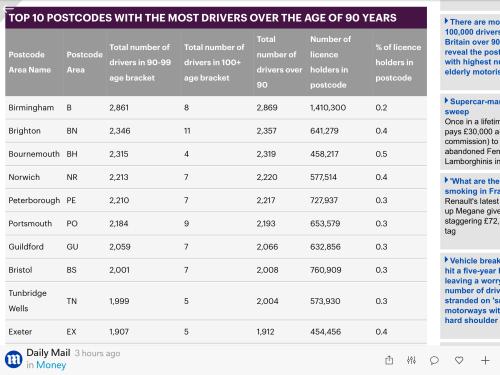

And is second highest (after Bournemouth) in percentage terms:
“A Labour peer claimed almost £50,000 in attendance and travel expenses covering every single day the House of Lords was sitting last year, despite never speaking or asking any written questions, a Guardian investigation reveals.
The former trade union general secretary David Brookman was among dozens of other lords and baronesses who never took part in a single debate, while almost a third of the 800 peers barely participated in parliamentary business over a 12-month period despite costing almost £3.2m in allowances.
The details have emerged from a new analysis of public data that will raise fresh questions about the size and effectiveness of the Lords, and the funds that can be claimed by those who fail to regularly contribute.
The findings show:
Eighty-eight peers – about one in nine – never spoke, held a government post or participated in a committee at all.
Forty-six peers did not register a single vote, including on Brexit, sit on a committee or hold a post. One peer claimed £25,000 without voting, while another claimed £41,000 but only voted once.
More than 270 peers claimed more than £40,000 in allowances, with two claiming more than £70,000.
The former Lords speaker Frances D’Souza, a long-term advocate of reform, said the findings corroborated “what everyone suspects is going on”, and that a minority of peers risked discrediting the hard work of their colleagues.
“There’s clearly a need to reduce numbers,” Lady D’Souza said, adding that the research “clearly shows there are people who are attending the House of Lords who are not contributing, and therefore they are simply redundant”.
The Guardian’s analysis covers the attendance, participation and allowances claims of 785 lords serving for a full year between 2017 and 2018. They comprise 244 Conservatives, 196 Labour and 97 Liberal Democrats, as well as 248 crossbench peers and various others.”
u”The UK and its “corporate tax haven network” is by far the world’s greatest enabler of corporate tax avoidance, research has claimed.
British territories and dependencies made up four of the 10 places that have done the most to “proliferate corporate tax avoidance” on the corporate tax haven index.
The UK ranked 13th on the list, which was published by the Tax Justice Network on Tuesday.
The shadow chancellor, John McDonnell, said the findings showed the government’s record on tax avoidance was “embarrassing and shameful”.
McDonnell added: “The only way the UK stands out internationally on tax is in leading a race to the bottom in creating tax loopholes and dismantling the tax systems of countries in the global south.
“The rot has to stop. While Tory leadership hopefuls promise tax giveaways for the rich, a Labour government will implement the most comprehensive plan ever seen in the UK to tackle tax avoidance and evasion.”
A government spokesman said tackling tax avoidance was a priority and the UK had “been at the forefront of international action to reform global tax rules”. …”
Now that the Local Election is over, we can see from this report in the Sidmouth Herald:
that potential sites for new villages in support of the Greater Exeter Strategic Plan (GESP) have been found and are due to be unveiled shortly.
A whopping 57,000 new properties cross the four council areas adjoining Exeter will have to be built to satisfy Exeter’s growth aspirations.
Quite soon, therefore, we can expect that the newly elected Councillors who represent us on the GESP, Councillor Susie Bond and Councillor Philip Skinner, will have to decide how many new villages East Devon will take and where they will be sited. Obviously close proximity to Exeter will be a significant factor and places like Lympstone, Woodbury, Clyst St Mary, Farringdon and West Hill must be in the frame.
To give an example of the impact to expect. A tiny community between Broadclyst and Pinhoe – Westclyst, has had a whopping 1200 houses imposed upon it. Where the highest quality agricultural land lay four years ago, bounded by about 30 bungalows, there are now sprawling housing estates.
In the past these decision have been kept a closely guarded secret. Will the new regime now act with transparency and openness?
We know from the CPRE study on “Devon’s Housing Needs” that:
•Far too many homes are already being planned for Devon in the next 10 years.
•Two thirds of these will be occupied by inward migration.
•Vacant and second homes are becoming a problem across the County.
•We in East Devon are taking a disproportionate share of development. Our Local Plan annual housing target is the highest in the Greater Exeter Area: 58% higher than Exeter, 53% higher than Teignbridge and nearly three times that of Mid Devon.
•Whilst we are planning too many houses, we are failing to plan for enough homes of the right type in the right location, especially for locally generated households.
Ex Councillor and one time Leader, Paul Diviani boasted in council, just before Christmas, that the high growth policy he advocated for East Devon was justified because “we have the land and we are good at it”.
In the election Paul Diviani was decisively rejected by the electorate, receiving a derisory 319 votes.
On 3rd May the voters clearly voted for change but are they going to get it?
As Owl has been saying for YEARS – THESE EMPERORS HAVE NO CLOTHES!!!!! Neither do they have transparency or accountability.
It’s verging on the corrupt, definitely a conflict of interest and is certainly unethical – it means a very, very few business people, taking no risks for themselves or their businesses, divvying up OUR money for their own pet projects, with almost no oversight from the councils they have robbed of funds and no loss for them if projects fail or over-run in time or cost.
A national scandal.
“Private sector firms are not matching public sector funding for local regeneration, senior civil servants have admitted.
Two senior civil servants at the Ministry of Housing, Communities and Local Government told MPs on Parliament’s Public Accounts Committee (PAC) that cash from the EU, public sector and higher education are still the main sources for funding regional development projects.
The department’s permanent secretary Melanie Dawes and director general Simon Ridley said match funding for the £9.1bn Local Growth Fund is largely dependent on match funding from councils and other public bodies.
Ridley also admitted there were still challenges over transparency and the boundaries of some Local Enterprise Partnerships (LEPs).
The LEPs were set up following the abolition of regional development agencies with the idea that they would be a partnership between business and local government – with an expectation that firms would help funding regional regeneration.
Ridley told the committee that the main private sector input into the LEPs is the time and expertise of board members who work for free.
Committee member Anne Marie Morris said: “Clearly, you are having the private sector involved, so how come you haven’t got a significant financial commitment from them?”
Ridley responded: “The capacity funding we give requires match from the LEP in different ways.
“A large number of business people on the boards do it without renumeration. A lot of the capacity support around the accountable body that the local authority provides is paid for by the LEP.
“Our core expectation was to set up partnerships between the private sector and local government to think about local area development.
“Some of those funding streams are matched by private sector funding schemes.”
Committee chair Meg Hillier asked if developers and construction firms were giving over and above Section 106 contributions to enable projects.
She said: “There is a danger that without having any skin in the game, businesses can walk away and local taxpayers end up picking up the bill.”
Ridley replied: “What the LEP is seeking to do is bring forward projects in the local area that wouldn’t otherwise be coming forward.
“They are often funded by more than one funding stream from the public sector.”
The committee also challenged the pair over a claim that LEPs tended to go to the top-five local employers and as a result, other firms were being left out of key decisions.
Oxford University has become a major decision-maker for its LEP, the committee heard.
Committee member Layla Moran asked: “How do we know that everyone who is a stakeholder in this money is actually involved in the decision?”
Hillier also questioned if the LEPs were accountable, citing Oxfordshire, where meetings were not being held in public.
Dawes said the use of scores in the LEPs annual performance review were conditional for funding being released and this had impacted on responses.
She said: “The real test is how it feels for local communities and I think that’s something that’s very difficult for us to judge in central government. We are on a bit of a journey here. It’s going to take a while.”
Ridley said local authorities had a crucial role in oversight, specifically through Section 151 officers who are ideally placed to deal with complaints.
He said: “All LEPs have got their complaints procedures. We have a clearer role realisation with the accountable body and the 151 officer, so they [the public] might write to them.
“The section 151 officer does have to get all the information that goes to the LEP board. I can’t personally here guarantee that absolutely all of that is in front of every scrutiny committee.”
Dawes confirmed the department has no metrics for assessing complaints being made about the LEPs.
MPs also raised concern about territorial battles between LEPs and combined authorities.
Decisions have still yet to be made about the boundaries in nine LEPs.
Dawes told the committee: “There are legitimate reasons why these geography questions are there. We are working actively with them.
“What ministers will have to work through is whether to impose a decision centrally.
“That would be a matter of last resort.”
Tories draft law to protect MPs if parties overspend
“Conservative ministers are drawing up a new law to protect MPs and party officials from prosecution if their national parties overspend during elections, leaked documents disclose.
It follows the conviction in January of Marion Little, a Tory party organiser from head office, and the acquittal of the MP Craig Mackinlay after they were accused of breaking electoral law as the party fought off a challenge from Nigel Farage in Thanet South. …
Transparency campaigners believe the government’s latest move is an attempt to avoid future prosecutions and would overturn a ruling by the supreme court.
Alexandra Runswick, the director of Unlock Democracy, said a “test of authorisation” would give candidates and party officials another level of defence from prosecution. “Such a move would not appear to be about reinforcing and strengthening electoral law. This would instead protect party candidates and open up the possibility of outspending rivals.”
Plans for a new law have emerged in correspondence seen by the Guardian and sent to cabinet ministers by Kevin Foster, the minister for the constitution.
“Legislation currently requires candidates to account for free or discounted goods or services that are made use of by or on behalf of the candidate. There have been calls to amend this legislation to include a test of authorisation by or on behalf of the candidate,” he wrote.
Foster told members of a cabinet subcommittee that the law on notional expenditure was tested in July when the supreme court ruled that the statutory requirement for an election candidate is to declare notional expenditure incurred on their behalf during a campaign. This might arise where a national party provided additional campaigning support in the constituency and was not limited to authorised campaigning.
Foster wrote: “There is a concern that candidates, their electoral agents and others acting on their behalf could be operating under legal risk. I am seeking the committee’s agreement to announce at an appropriate time that the government is exploring options to clarify the law on notional expenditure to alleviate the concerns highlighted. Any amendments in this area of law would require primary legislation,” he wrote.
Little, who had been employed by Tory campaign headquarters since 1974, was charged with three counts of encouraging or assisting an offence related to the filing of election expenses. …”
https://www.theguardian.com/politics/2019/may/21/tories-draft-law-protect-mps-party-overspend
An EDW blog reader who stresses they are NOT a lawyer or data protection specialist, but who has extensive knowledge of the subject, has this to say about the questionnaire currently being circulated by the local Conservative party as part of their electioneering:
“Your story on the East Devon Conservatives’ questionnaire led me to take a look at their privacy policy available here:
https://www.eastdevonconservatives.org/privacy
If you have contact with anybody who knows about GDPR and the Data Protection Act 2018, you might like to get them to take a look. My knowledge is better than average but not complete. However, I think the policy is dodgy:
Item 3 says ‘All processing is carried out by consent’. The problem here is that Consent cannot be assumed to have been given. It MUST be a positive action on the part of the data subject so in the case of the questionnaire that you mention, there must be a means by which respondents can give their consent to having their data stored and processed.
Item 3 adds ‘or public interest’. This isn’t a lawful basis for storing and processing data. The Information Commissioner’s Office (ICO) has a list of the 6 permitted lawful bases here:
There are 6 lawful bases:
Consent (as I say this MUST be given by a positive action – it cannot be assumed to have been given or be ‘given’ by means of a pre-checked tickbox. Contract (e.g. if you buy something from an organisation, they can store your data in order to complete the contract).
Legal obligation (can be used if the organisation needs to store and process personal data ‘to comply with a common law or statutory obligation’. Vital interest (to be used if the data must be processed in order to protect somebody’s life so passing medical history to A&E if you have an accident falls under this one).
Public task (The ICO says that this one ‘can apply to any organisation that exercises official authority or carries out tasks in the public interest’. It would be interesting to see whether the ICO would consider the Conservatives’ distribution of election material to be in the public interest).
Legitimate interests (is a catch-all category but the ICO says ‘It is likely to be most appropriate where you use people’s data in ways they would reasonably expect and which have a minimal privacy impact, or where there is a compelling justification for the processing’. This is one that’s used, for example, by membership organisations because a member would expect the organisation to retain and process members’ details. Again, it would be interesting to see this one tested with the ICO in the case of the Conservatives.)
Overall, I think it could be argued that the Conservatives should be relying only on Consent when it comes to campaigning activities. Obviously Legitimate interest is the the correct lawful basis in the case of members of the Association. However, if they’re relying on Consent, the questionnaire must include a checkbox that respondents must tick in order to give their consent to having their data stored by the Conservative Association.
Item 6 relates to Special category data which includes some of the data identified in your story viz. ‘ethnic origin, political opinions, and religious, philosophical and other beliefs’. The Data protection legislation says that this data requires special handling. This is a complex area but it doesn’t look as if the East Devon Conservatives have understood it.
Item 8 is their data retention policy. They appear to be saying that they may hold the data for up to 10 years ‘two election cycles’. For ordinary voters who are not members of the Association, this looks to me to be excessive.
Item 10 appears to say that they’ll share people’s data with a surprisingly wide range of organisations: ‘entities of Political Party associations, federations, branches, groups and affiliates’. I doubt that this permitted under the legislation without specific consent.
Item 11 says, amongst other things, ‘you have the right to object to certain types of processing, such as direct marketing’. They appear to be confusing the Data Protection Act 2018 with the Privacy and Electronic Communications Regulations (PECR). This sits alongside the DPA but isn’t part of it. PECR governs the use of personal data for electronic marketing e.g. email, text messaging, telephones etc.
Item 11 also says ‘you also have the right to be subject to the legal effects of automated processing or profiling’ [my emphasis]. This looks like a typo.
Item 11 also says you have the ‘Right to judicial review:’. This seems to be a curious and confusing way of telling people that they have the right to complain to the ICO which is dealt with in Item 12.
I think one of the difficulties of this privacy policy is that it is trying to cover all instances of gathering, storing and processing of data by the Association. If somebody contacts their local Councillor or MP with, for example, a housing problem, then Legitimate interest would apply. The same is true of somebody applying to join the Association. However, to collect, store and process personal information gathered through the type of questionnaire you describe is probably (and I emphasise probably) in breach of the legislation.”
“I still get angry – and that is the word for it, angry – 10 years into the role, when I see badly-thought-through programmes and wasted public money,” says outgoing watchdog chief Sir Amyas Morse. “And the reason I’m angry is because the citizen ends up picking up the tab. They are the ones who end up suffering.”
For almost a decade, as comptroller and auditor general – the head of the National Audit Office – it’s been Morse’s statutory duty to keep an eagle eye on the spending of central government departments, holding ministers and civil servants to account for cost overruns, project mismanagement and profligacy with taxpayers’ money.
He doesn’t have far to look. As he prepares to leave his post in May, Morse’s final public speech at the Institute for Government last week included a damning list of failures: Crossrail costing £2.8bn more than forecast; changes to probation costing £467m to put right; the smart meters fiasco that will cost at least £500m more than originally estimated; and the Ministry of Defence’s latest unaffordable and unsustainable 10-year equipment plan going over budget by at least £7bn. And that’s just a selection from the past few months.
Morse looks back in anger at the billions that could have been spent on vital services, wasted instead through what he calls “inappropriate bravado” on the part of government ministers, lording it over cowed civil servants, behind an increasing amount of secrecy and spin. “We don’t need people jumping out of an aeroplane in the dark with a parachute of taxpayers’ money,” he says.
A proud Scot – his only meeting with Theresa May was a “brief conversation” at a No 10 Burns Night last year – Morse cares passionately about public services. While his upbringing has contributed to his concern for fairness, it’s his decade at the watchdog, to which he came from a senior position in consultancy PricewaterhouseCoopers via the MoD, that has fuelled his rage over the wasteful ways of too many government ministers. “I really realised that society belongs to us. We’re all paying for it.”
Public money is finite, he points out. There is no magic money tree. When money is lost in one place, it’s taken away from another programme, usually one that’s easier to cut. Every wasted £1bn, he says, is enough to run NHS England for three days, fund 625m A&E attendances, 135m day cases in hospital, or 4m ambulance attendances.
Morse has warned the government that it needs to invest more in the NHS and social care, to meet the needs of an ageing population. In 2016-17, the UK spent just over £170bn on health and social care – more than 10% of GDP, but less than the 11.2% of GDP Germany spent in 2015 on health alone. …”
“More than £100bn of property in England and Wales is secretly owned, new analysis suggests. More than 87,000 properties are owned by anonymous companies registered in tax havens, research by the transparency group Global Witness reveals.
The analysis reveals that 40% of the properties are in London. Cadogan Square in Knightsbridge, where the average property costs £3m, hosts at least 134 secretly owned properties. Buckingham Palace Road is also home to a large number, with a combined estimated value of £350m.
The revelation comes as parliament’s joint select committee on the draft registration of overseas entities bill meets on Monday to hear evidence on the impact of property ownership by anonymous companies.
The government committed to introduce a register of UK property owners at its anti-corruption summit in 2016, but since then progress has been slow.
“It’s increasingly clear that UK property is one of the favourite tools of the criminal and corrupt for stashing and laundering stolen cash,” said Ava Lee, senior anti-corruption campaigner at Global Witness.
“This analysis reveals the alarming scale of the UK’s secret property scandal.”
The combined value of the properties was at least £56bn, according to historical Land Registry data at the time of their acquisition. Once inflation is factored in this would exceed £100bn.
Some 10,000 of the properties are in Westminster, while almost 6,000 are in Kensington and Chelsea. Camden is home to more than 2,300 of the anonymously owned properties while almost 2,000 are in Tower Hamlets.
Global Witness says its investigations have shown how criminals and corrupt politicians use the UK property market to hide or clean dirty cash, and to secure safe havens for themselves and their families.
In 2015 it revealed how the mystery owner of a £147m London property empire owned via a network of offshore companies could be linked to a former Kazakh secret police chief accused of murder, torture and money-laundering.”
“There is a need for a step change in transparency by local public bodies and particularly those in the NHS, MPs have said.
In a report, Auditing local government, the Public Accounts Committee noted that in 2017-18, auditors found that more than 1 in 5 local public bodies did not have proper arrangements in place to secure value for money for taxpayers.
“The numbers are worst for local NHS bodies such as clinical commissioning groups and hospital trusts, where 38% did not have proper arrangements,” it said.
The MPs added that some local bodies were not putting enough information in the public domain about their performance, including reports from their external auditors.
The report called on central government departments to make clear their expectations, “not only for what is made publicly available, but also for making the information accessible to users and so helping citizens to hold local bodies to account”.
The PAC said there appeared to be few consequences for those local bodies who did not take auditors’ concerns seriously and address them promptly. “Even where local auditors use their additional reporting powers to highlight failings, this does not always lead to the bodies taking immediate action.”
The report also recorded the MPs’ concern that, as partnership working becomes more complex, accountability arrangements will be weakened, and the performance of individual local bodies will become less transparent.
Meg Hillier MP, chair of the committee, said: “Taxpayers must be assured that their money is well-spent but in too many cases local bodies cannot properly safeguard value. Particularly concerning are NHS bodies such as Clinical Commissioning Groups and hospital trusts: last year almost two in five did not have adequate arrangements.
“As we reported last week, many CCGs are underperforming and this must improve as they take on responsibility for commissioning services across larger populations.”
Hillier added: “It is vital that local bodies take auditors’ concerns seriously, address them swiftly and ensure meaningful information on performance is made accessible to the public.
“Our report sets out ways central government can help to drive improvements at local level and we urge it to respond positively to our recommendations.” …”
Response to Freedom of Information request”
“Thank you for your request for information. Please find the response to your query below.
“Recently an email from a Conservative councillor was released into the public domain regarding the purchase of a “very large table in the members room” as a result of “an auction of council furniture, chattels, etc” to the benefit of members and EDDC staff. The email went on to state “I have been told that I have been successful in my bid so the table along with the 8′ extension is heading back to Exmouth to sit in (address of councillor), Exmouth in its rightful town (some may say)” and then stated arrangements for its removal date in order that it could be used for the Councillor’s Christmas dinner for 22 family members. Subsequently on 21st December 2018, the Leader of the Council made a statement about the disposal of a range of items, including this table. He said the large table “attracted little professional interest with one valuer estimate of just £50”. I would like to know:
1. If one valuer’s estimate was £50, what were the other estimates?
Other valuers viewed but were not interested in estimating for the table due to its low value
2. What are the names of the valuers who gave estimates for the table?
The other agents who attended to provide estimates were;
Potburys
Whittons
Lyme Bay
MST
3. Does EDDC audit not require a range and record of estimates for the disposal of council assets, as well as a record of disposals?
It is not clear what specific information is being requested here. Bids and disposal receipts will be recorded.
4. EDDC, like other councils, should have a written policy and procedure for the disposal of assets such as used equipment, furniture and other plant, What is that policy and procedure?
There is a link below to the ‘Property Matters’ section of the Council Constitution which is on our website, specifically items 15 & 16;
15. Authority (after consultation with the relevant Portfolio Holder) to dispose of property assets which have a market value which does not exceed £30,000.
16. Sale of vehicles, equipment or machinery surplus to the Council’s needs where the consideration does not exceed £30,000.
http://eastdevon.gov.uk/media/2537547/cj…
5. Who was the Councillor that successfully bid for “the very large table in the members room”?
This information is exempt from disclosure under s40 of the Freedom of Information Act as being personal data.
6. How much did the Councillor pay?
The bid was £400
7. Was the ornate clock on the mantel piece (as shown on the cover of the Residents Magazine, December 2018) part of this disposal process?
The clock in question originally belonged to Honiton Rural District Council and has been offered to Honiton Town Council.
If so, what was the valuation given? ? See above
What price was paid? ? See above
Who bought this clock? ? See above
8. How much money was raised from this sale of “items of sentimental interest or practical use”?
The items have not been sold yet so no information is currently held. We anticipate that a figure in the order of £2,000 will be raised which will be ring-fenced in the Civic Fund.
9. What are the “other sales” Councillor Thomas refers to?
The vast majority of items are office furniture (desks, chairs, cabinets). Items will be disposed of in a number of ways. These include via public auction, items given to local groups, town and parish councils in return for donations and income from bulk clearance.
10. How much money was raised from each of these “other sales”?
No information held
11. What is the total now of the Chairman’s Civic Fund?
The Civic Fund is a budget and therefore there is no ‘total’ fund as such. The ring-fenced fund is currently £0 as the items have not been made available for collection / payment.
12. Information about the Chairman’s Civic Fund is not easily accessible on the EDDC website; a word search on the site produces “no result”. Where can details of this fund and its administration be found?
Civic Fund and Civic Expenses are agreed as part of the Council’s annual budget: this is identified in the Councils approved Budget book for 2018/19:
http://eastdevon.gov.uk/media/2413383/re…
The relevant items can be found on page 7 and page 24.
I hope this information is helpful but, if you feel dissatisfied with the way we have responded to your request, please contact our Monitoring Officer, Mr Henry Gordon Lennox, to request an internal review [email address]
You may also approach the Information Commissioner for advice at http://www.ico.org.uk
https://www.whatdotheyknow.com/request/auction_of_council_furniture_cha#incoming-1300789
According to Cllr Stott who has now stopped any more comments being made on her post on the Exmouth Community page the Grenadier EDDC agreement has already been signed although she appeared to correct herself as the post went on:
Pauline Stott to Deborah Russell
Yes was signed this week
Deborah Russell to Pauline Stott
This is interesting to know because according to Devon Live an agreement has not yet been signed. Please advise where you have your information from?
Pauline Stott
We were told at the Cabinet meeting that it would be sign (sic) this week
Deborah Russell to Pauline Stott
Great news when do we get to see a copy of it?
Pauline Stott Of what?
Deborah Russell to Cllr Pauline Stott
the agreement.
Pauline Stott
What for do you ask (sic) to see all agreements the Council make
Deborah Russell
So that in an open and transparent democracy everyone is privy to how and why this community asset was gifted.
Pauline Stott You can ask the Council under freedom of information
Deborah Russell Pauline Stott Will do and thank you.
Owl has been pondering the potential for conflicts of interest between some of Clinton Devon Estates’ (CDEs’) more environmentally sensitive development plans and the activities of its Estates Director, John Varley.
On the CDE website, at the time of going to press, Estates’ Director, John Varley is described as follows:
“John’s current non-executive positions include Board Member of the Environment Agency (EA) and Natural England (NE).”
Clearly he is a very influential man.
Owl remembers him being appointed to the Environment Agency Board in 2012 (£21,002 per annum). [This coincided with CDE’s their first planning to extend their cow sheds in the Otter flood plain at the bottom of Colaton Raleigh – something we will return to]. Owl finds John is still on EA’s Board.
But he seems to be a bit confused about his role with Natural England. Owl doesn’t see his name listed as a current Natural England Board member. So Owl has had to call in the Ferrets.
They report that John Varley, whilst on the Environment Agency Board, was also welcomed onto board of Natural England on 29 April 2015 (remuneration £10K-£15K). They also have discovered that he was reported as being “sad to depart before the end of his term” at the meeting of 22 March 2017.
They also note that he has popped up again as chair of the review which will consider all aspects of Network Rail’s approach to vegetation management 12 July 2018.
There is no suggestion whatsoever that John Varley has ever failed to declare an interest. Indeed, the Ferrets find that, quite properly, he had to leave the room during discussion of the agenda item on the reintroduction of beavers on the River Otter at the Natural England Board in September 2015.
What worries Owl is the conflicts, real or imagined, this might pose to the local staff of the Environment Agency and Natural England as they comment on CDE planning applications “without fear or favour”. Owl is also concerned about how it looks in the daylight.
In the old fashioned world Owl was brought up in any potential conflict would have been avoided. Those in a position to wield influence would do the “honourable” thing of either resigning or at least ensuring any applications they could be associated with were made in exemplary fashion.
Owl is not convinced that CDE’s recent planning applications could be described in this way. For example, consider the controversial 2012 applications to extend the cow sheds at Otter Farm, Church Road, Colaton Raleigh (application 12/0400 superseded by 12/2660).
One aspect of the controversy concerns whether or not either of these applications should have had a flood risk assessment. The fact is that Otter Farm is in flood zone 3, but it was claimed that the adjacent cow shed site, literally only yards away, would only lie in Zone 1 (1 in a 1,000 years risk). This was confirmed by EA on 6 February 2013:
“We have had a look at this one and feel, due to the nature of the development that a Flood risk Assessment would not be necessary. Of course we would still expect the applicant to demonstrate a commitment to SUDs in the design of their surface management for the site.”
[SUD – Sustainable drainage system]
However, this was queried by many on the basis of local knowledge including the Parish council, which, in February 2013, asked “for a better assessment in view of recent flooding incidents in the area”. The details were spelled out rather more graphically by one resident who expressed concern that “recently slurry was allowed to escape into the river (Otter) and into Railway Cottages”.
EA wrote again later in February: “Regarding the above, we have been advised that the site is over 1ha, if the new access road is included. If this is the case we are happy to review the application if accompanied by a Flood Risk Assessment”.
Eventually a detailed Environmental Management and Waste Management plan was submitted in April along with a Sustainable Drainage System Design of 66 pages. In May the Environment Agency recorded its thanks to: “you and your colleagues for meeting on site with [ ] to consider measures that could reduce flooding risks for the nearby Railway Cottage.”
Owl now flies forward to a more recent, even more controversial, case that of CDE’s application 17/3022 to extend the Blackhill Engineering works on Woodbury Common, submitted in December 2017.
It is clear from NE’s first comments that the Visual and Environmental Impact Assessments accompanying the application were still not up to scratch. NE’s comments 6 February 2018 read: “As it stands, we have significant concerns regarding the potential impacts of these proposals. We will provide more detailed advice once we have reviewed the additional information.”
“Interesting news from Torbay – a private investigator has been hired to look into the planning decisions of Torbay Council. A fat file of evidence has been passed to the investigator based on dozens of interviews of local residents, existing and former council employees.
The investigator who has taken charge is a journalist with twenty plus years of experience with national newspapers, including the Daily Mail. She has a passion for local history and has thwarted numerous campaigns in the past relating to listed buildings and parks. Her connections across Westminster and the media are extensive.
The plan – sponsored by local residents and not by any particular organisation or body – is to publish all the evidence that is collected in a safe place online. Mainstream media outlets are already interested in documentary production and stories emanating from this body of evidence. The investigation is not solely directed against Torbay Council, as other entities have been found wanting, notably the local press.
An email address to send evidence to the investigator has been published. It is thetorbayinvestigation@gmail.com If you have information that you think might help them then please feel free to email it across to them.
So far £900 has been raised privately to help pay for the investigator who has travelled down to Torbay from London. A GoFundMe campaign was launched yesterday and can be accessed at the following URL:
https://www.gofundme.com/torbay-investigation
An independent investigation by this respected and renowned investigator and journalist must surely be welcomed.”
“On 30 January 2019, the Committee on Standards in Public Life published its long-awaited report on local government ethical standards, reflecting evidence obtained via a consultation exercise carried out from January-May 2018.
The report makes 26 recommendations.
Below we highlight the top five that will be of interest to local authorities, in particular to monitoring officers.
Some of the recommendations could be implemented quickly without the need for primary legislation – most important of these is the recommendation concerning amendments to registrable interests.The wide-ranging report, which runs to over 100 pages, finds that while the majority of councillors and officers maintain high standards of conduct, there is clear evidence of misconduct by some – mostly bullying, harassment or other disruptive behaviour. The report also raises concerns about risks to standards under the current rules governing declaring interests, gifts and hospitality.
The report provides an excellent review of the current framework governing the behaviour of local government councillors and executives in England and then makes a number of recommendations to promote and maintain the standards expected by the public. While it identifies numerous points of best practice, it makes 26 separate recommendations for improvement.
Top five recommendations
The top five recommendations, likely to be of most interest to those in local government, are:
Updating the model code and extending it to parish councils: the report finds considerable variation in the length, quality and clarity of local authority codes of conduct. It therefore recommends enhancing quality and consistency by requiring the Local Government Association to create an updated model code. In a bid to help ease the burden on principal authorities (who must investigate code breaches by parish councillors), the report also recommends requiring parish councils to adopt the code of conduct of their principal authorities or the new model code.
Presumption of official capacity: perhaps the most arresting suggestion, the report recommends combatting poor behaviour by presuming councillors to act in an official capacity in their public conduct, including statements made on publicly-accessible social media. This arises from the perennial concern that the current understanding of public and private capacity is too narrow, undermining public confidence.
Extending the list of registrable interests: the report considers that current arrangements for declaring councillors’ interests are too narrow and do not meet public expectations, so it suggests refining the arrangements for declaring and managing interests, including extending the list of registrable interests to include two categories of non-pecuniary interest:
(1) relevant unpaid commercial interests such as unpaid directorships; and
(2) trusteeship or membership of organisations that seek to influence opinion or public policy. As this does not require primary legislation to be implemented, this is one recommendation which may soon be acted upon. We are particularly pleased to see written evidence submitted by members of Cornerstone Barristers was cited in relation to recommendation (iii): see more below.
A new “objective” test for when councillors must withdraw or not vote:
monitoring officers will be particularly interested in the discussion in the report about the need to update the test for when councillors are forbidden from voting or participating in discussion on matters in which they have an interest.
The report recommends the test be overhauled and that councillors be required to refrain from voting or withdraw whenever they have any interest at all – whether registered or not – that a member of the public would reasonably regard as so significant as to likely prejudice the councillor’s decision-making.
Strengthening the sanctions system:
the report considers the current sanctions insufficient and so recommends allowing local authorities to suspend councillors without allowances for up to six months, with suspended councillors enjoying a right of appeal to the Local Government and Social Care Ombudsman for investigation and a binding decision on the matter.
Other conclusions and recommendations
The report further concludes that there is no need for a centralised body to govern and adjudicate on standards and that various benefits exist to local authorities maintaining their responsibility for implanting and applying the Seven Principles of Public Life.
A number of other recommendations are likely to be of interest, including:
Assisting local authority monitoring officers, the “lynchpin of the arrangements for upholding ethical standards” (p 81), by extending disciplinary protections and offering additional training for the statutory officers who support them.
Giving local authorities a discretionary power to establish a standards committee to advise on standards issues and decide on alleged breaches and/or sanctions for breaching the code of conduct.
Abolishing the current criminal offences in the Localism Act 2011 relating to disclosable pecuniary interests, which are said to be disproportionate in principle and ineffective in practice.
Requiring local authorities to take a range of steps to prevent and manage conflicts of interest that can arise when decisions are made in more complex and potentially less transparent contexts such as Local Enterprise Partnerships and joint ventures.
Fostering an ethical culture and practice by requiring councillors to attend formal induction training by their political groups, with national parties adding the same requirement to their model group rules.
The report recognises that many of its recommendations would require primary legislation and therefore be subject to parliamentary timetabling. The remaining recommendations – in particular those relating to registrable interests (as mentioned above), statutory officers and formal training for councillors – could however be implemented relatively quickly.
The Committee intends to monitor the uptake of its suggestions in 2020.”
Robin Green, Estelle Dehon and Dr Alex Williams, all members of the Cornerstone Planning and Government teams, submitted written evidence item 281 to the committee. Their evidence was cited at p 45 of the report in relation to recommendation (iii) above, on registrable interests.
Robin and Estelle are also contributors to Cornerstone on Councillors’ Conduct (Bloombsury Professional, 2015), which identifies and explains the law following the changes implemented by the Localism Act 2011 in relation to the standards system governing the conduct of elected members in local government.”
Owl says: remember, the Chief executive, Mark Williams, is supposed to be a NEUTRAL civil servant and yet ALL of the refused motions are from ALL the minority groups ONLY……!
“Motions to support recycling, to call for a new property ombudsman to streamline complaints against shoddy builders, and for East Devon to get its fair share of the police precept rise will be discussed at next Wednesday’s full council meeting.
But motions over the full relocation costs of the move from Sidmouth to Honiton, to put electric charging points in all car parks, what to prioritise in a ‘No Deal’ Brexit and on climate change will not be discussed.
Various motions that councillors had put forward for debate at East Devon District Council’s full council meeting on Wednesday, February, were rejected by the council’s chief executive, as either the agenda already provides the opportunity for debate or the wording of the motions were inaccurate.
RELOCATION
Cllr Cathy Gardner had proposed a motion calling for the council to commit to publish an annual ‘summary of accounts’ for the relocation project until break-even is reached as relocation from Sidmouth to Honiton was proposed and predicated on the basis that the project would breakeven within 20 years and deliver cost-savings to the council tax payers of East Devon.
Cllr Gardner said: “Whilst some of this information is already available we feel it is vital for the ongoing costs to be published to show confidence that this project will breakeven. A majority of Councillors voted for relocation on the basis that money would be saved on energy bills. We are left unsure of whether breakeven will ever be proven.”
But an EDDC spokesman said: “The rejected motion contained inaccuracies and omissions that had the potential to mislead councillors and it was also premature. It is however proposed to bring a report to the next meeting of the Cabinet that will summarise the position reached with regard to the sale of the Knowle and the relocation. Cllr Gardner can raise the matters she is concerned about as part of the debate into that report.”
The motion would have called for the accounts to include
energy costs for the Knowle for the past 20 years (for comparison);
energy costs for both Blackdown House and Exmouth Town Hall per year;
the capital receipt for the sale of the Knowle;
a Red Book valuation of Blackdown House as of 1 March 2019;
the full costs for the relocation project since its inception, including: project management; removal, furnishing and equipment;
staff retraining and travel expenses;
new-build costs for Blackdown House; refurbishment costs for Exmouth Town Hall; and any other associated costs.”
CLIMATE CHANGE
Cllr Matthew Booth’s motion had called for the council to recognise that Climate Change and Global Warming are the key issues of our time, to acknowledge the strong concerns of young people in particular the recent walk out of school children and for the council to commit to introducing a policy of carbon measurement and reduction within all aspects of its own activity.
He said: “I personally do not care how we begin to do this, or who does it, but that we act now not wait for some planned strategy in the future.”
An EDDC spokesman said that the issue of climate change emergency is acknowledged to be of critical importance but that it would be appropriate to wait to see what Devon County Council decides. They added: “Currently, however, the County Council is considering its position and will shortly debate the matter. As we are in a two tier area it is appropriate for the District Council to assess the position taken by the upper tier authority and then respond accordingly. The public would expect us to work in partnership with the County Council rather than unilaterally.”
ELECTRIC VEHICLE CHARGING
Cllr Eleanor Rylance had submitted a motion calling for the council to plan for and implement over the next five years a full rolling renovation programme of its car parks estates to fit and bring into operation electrical charging points at every space for domestic cars, and cycle parks with charging points for all types of cycle and that there should be mandatory EV charging points for the parking spaces of every new-built house in East Devon.
She added: “This council should approach the future of electrically-powered domestic vehicles with enthusiasm and proactivity, play a positive role in helping develop the use of electrical and should make this infrastructure, that will be a necessity within the next ten years, available in advance of full electrification of domestic vehicles in 2042.
But an EDDC spokesman said: ““The agenda already provides an opportunity for this issue to be raised so this motion was inappropriate.”
BREXIT
Cllr Rylance had also submitted a motion that said in the event of a No Deal Brexit or a version of Brexit that causes significant disruption, the council should approach this event as a situation of emergency in respect of its most vulnerable residents, dedicating any available human, material and financial resources required to palliate any negative outcomes for these groups, but the motion was rejected.
Talking about all the motions, a council spokesman said: “The council agenda for February contains the most important annual decision, namely the setting of the budget and the approval of the Council Tax for the forthcoming year. The process leading to this meeting has included several meetings where members were encouraged to raise all items of future relevance so these could be assessed as part of our service planning process and for assessment as part of the budget.
“It is unfortunate that some members did not take these opportunities and have chosen instead to submit their proposed motions.
“It is also noted that the wording of the motions was not checked in advance with relevant officers who would have been able to give timely advice as to their wording.”
But motions on the police precept, protection for new home owners and supporting recycling will be discussed.
POLICING
Cllr Tom Wright’s motion says: “In view of the £24 per band D property increase in policing precept, this council urges the Chief Constable to recognise the needs of East Devon when deciding how to allocate extra resources. East Devon residents are the biggest contributors to the police budget in Devon, other than Plymouth. It is only fair that we should get a fair share of the larger cake.”
NEW HOMES
Cllr Douglas Hull’s motion says: “The Government has stated that it would therefore be introducing as a priority a new property ombudsman to streamline complaints against shoddy builders. As a council that not only provides an excellent and highly regarded building control service but also has seen significant levels of new building in its district, we call on the government to fulfil its pledge to provide this much needed remedy for homeowners as a matter of the highest priority.”
RECYCLING
Cllr Peter Burrows’ motion says: “This Council continues to support the fine work done by the EDDC Recycling team in achieving the best results in Devon and to support and encourage local Organisations and voluntary groups who are involved in trying to reduce the amount of single use plastics used in their communities & beaches by making resources and expertise available, where appropriate. The order of priority should be – Reduce, Reuse, Recycle. To actively help promote such activities through the Councils social media platforms.”
The full council meeting will be held at East Devon District Council’s new Honiton Heathpark HQ on February 27 at 6pm.”
https://www.devonlive.com/news/devon-news/relocation-cost-no-deal-brexit-2557565
“East Devon District Council’s senior management team have been rebuked by scrutiny councillors after failing to consider the public perception over the sell-off of assets from their former Knowle HQ.
The council this week completed its move from its former Sidmouth home at the Knowle, to Exmouth town hall and the new Honiton Heathpark HQ, and as part of the move, they had to find homes for various items that are unsuitable for its new building.
But a furore erupted just before Christmas when it was first revealed that council staff and members, but not the general public, were given the chance to bid on various items, and then when an email was leaked claiming a councillor managed to buy a large mahogany dining table and 20 chairs for £50 at the internal staff auction, instead of allowing it to be publicly auctioned for the best possible price.
A council spokesman had said that this leaked information was totally incorrect with the bid being for £400 and only including some of the chairs, and that the bid was withdrawn when Exmouth Town Council, who initially declined the offer of the table originally, changed their view just before Christmas and are now expected to take ownership of the table.
Cllr Ian Thomas, Leader of East Devon District Council, had previously said in a statement: “Our council relocation team has been working with professional auctioneers, Sidmouth Town Museum, charities and clearance specialists, to value and dispose of a wide range of items from our old East Devon District Council offices at The Knowle in Sidmouth.
“As part of this process, we offered our staff and elected members the chance to bid for items that may be of sentimental interest or practical use, but are of negligible commercial value.
“The value of items to be disposed were identified based on the view of experienced professionals. They included the large table from the Members area, which attracted little professional interest with one valuer estimate of just £50.
“All proceeds from this sale and those raised from other sales will go to the Chairman’s Civic Fund, to be donated to nominated charities.”
East Devon District Council’s scrutiny committee considered the disposal of the contents of the Knowle at their meeting last Thursday.
Richard Cohen, the Deputy Chief Executive, produced a report that outlined the process of disposal of items from the Knowle prior to handover to PegasusLife for demolition.
He said: “As part of that process and prior to the handover of the old office buildings to the developer, the council needs to clear the buildings. In total there are just over 2,600 separate items in the Knowle.
“The vast majority of these are office furniture: desks, chairs, cabinets etc of varying ages, condition and size. There are also a number of particular items of varying antiquity and value: these involve both furnishings and fixture and fittings. From a perspective of bulk disposal the estimated total weight of all these items is 45 metric tonnes.”
He outlined that Sidmouth Museum and Sidmouth Town Council were both interested in re-home various items, multiple local auction houses were invited in to look over items but that the majority of items were not of interest to them, and that for remaining items an opportunity was offered for council staff and members to bid for items whether for practical or aesthetic reasons.
He said: “These were items that had been attributed little or no sale value by the various professional auctioneers and ranged from standard office furniture items to cupboards, upholstered furnishings, tables, curtains for example. This element of the disposal process involves around seventy separate items and is likely to raise of the order of £2,000 for the Chairman’s chosen charities.”
Mr Cohen added that groups such as Action East Devon, Green Furniture Aid and Hospicare who are all either networked with voluntary groups or can sell furniture via charity outlets were asked whether they had an interest in some of the for the more generic items such desks, chairs and tables, but the response has been largely muted.
Town and parish councils will also be contacted asking them whether they have an interest in any items with the requirement that they transport said items away themselves, he added.
But councillors said that contrary to what Mr Cohen said, a full list of the items for disposal had not been circulated to them.
Scrutiny committee chairman Cllr Roger Giles said: “There has not been a list that we have seen so could someone produce a list that will be circulated very soon.” He also asked wat do town and parish councils know about the process, as the answer he had heard from them is nothing.
Cllr Cathy Gardner added: “Why was the full explanation of the process not circulated to members before we were given the chance to bid for items? The reason there was a furore around the subject as the offer of sale of items internally was offered in isolation and the lack of communication meant there was a lack of understanding of the wider process that this sat.”
Her recommendation, which the scrutiny committee backed unanimously, was that they remind the senior management team of the council to always consider the public perception of actions taken, particularly when it is involves public assets, and the disposal of public assets.
https://www.devonlive.com/news/devon-news/council-management-team-rebuked-over-2545040
“A CATALOGUE of errors detailing how two district councils were run have been exposed in a ‘gobsmacking’ report.
Initial findings from an investigation into contracts signed by Vale of White Horse and South Oxfordshire district councils between 2010 to 2016 show councillors’ knowledge was stymied by a ‘lack of information’.
The two councils are conducting reviews into several contracts after fears were raised last year that contracts could have been handed out improperly.
All of them have a value of or more than £10,000. Between the two councils, there are 162 of those in total.
A report also highlights there was an ‘over reliance’ on briefing cabinet members informally, rather than decisions being made at public cabinet or council meetings.
‘A lack of detail’ was also found to be a problem in papers for those cabinet briefings and at cabinet meetings.
The review also found there was ‘poor procedural compliance by officers and members, most notably in documenting decision making’.
Debby Hallett, Lib Dem councillor on Vale council and former group leader, said the ‘gobsmacking’ papers seemed to indicate a ‘culture of sloppiness and shortcuts’ over key contracts.
But she added: “The thing that surprised me is [the councils] have promised to have this done by March, which is putting this in the public domain before the local elections [in May].”
That, she said, showed the councils’ willingness to conduct the reviews in a spirit of ‘transparency and integrity’.
Adrianna Partridge, the councils’ head of corporate service, notes in the report: “This review has identified a significant risk that the councils have incurred expenditure that has not been adequately approved in accordance with the councils’ constitutions, which could have both financial and reputational risk.”
In the report which will go to the councils’ joint audit and governance committee on Monday, she states: “Action has already been taken to address and strengthen the decision making process on individual projects, and it is acknowledge that a greater transparency is needed, including an increase in the number of formal papers taken to cabinet and full council which the senior management team is enforcing.”
The councils have set aside a budget of £30,000 for legal advice if they need to take any action over contracts in the future.
Confidential papers will be discussed next week.
They are understood to refer to specific details of the councils’ eight to 10 contracts which are being reviewed.
“A community group is taking Gloucestershire County Council to court over the award of a £600m incinerator contract. Community R4C, a non-profit mutual society which has had support from celebrities including Jeremy Irons, Jonathon Porritt, Hugh Fearnley Whittingstall and Kevin McCloud, claims the contract was unlawfully awarded, resulting in a massive rise in costs to taxpayers and a breach of procurement law. They filed a lawsuit with the High Court on Friday.
Campaigners have been opposing the waste incinerator at Javelin Park for years, saying the project wasted taxpayers money, was bad for health and the environment and that there were cheaper and better alternatives. Requests to see the contract, the largest the county has ever entered into, were consistently refused until a tribunal forced its disclosure in 2017, by which time a revised contract had been signed. This was only released on 20th December 2018.
“It was a very difficult decision to take this course of action when so much taxpayer money has already been spent on legal battles”, says Patricia Watson, a waste consultant and volunteer director of the group. “The underhand behaviour of the council and contractor has led to a far higher price than anywhere else in the country for the lowest possible environmental benefit.”
Board member Sue Oppenheimer says: “The contract has increased by a staggering £150m making it 30% more expensive. By law, it should have been retendered. Instead Gloucestershire County Council has spent around half a million pounds keeping this information secret. With the support of the community, we had been working on a much cheaper waste processing plant and would have bid for the contract. Our plant would have increased recycling, reduced pollution and would have been a better deal for the environment and the taxpayer.”
Tom Jarman, another board member says: “There is a strict 30 days limit to bringing this sort of claim and it seems to us that the council timed the disclosure of the relevant information strategically, just before Christmas, so to make it almost impossible for anyone to bring legal action in time. Keeping a 30% increase in cost secret from the public and its own audit committee is not the way we expect a public authority to conduct itself.”
https://www.unitynews.co/people-of-gloucestershire-have-to-sue-their-own-council/
“Academy schools are not “sufficiently transparent or accountable to parents and local communities”, MPs have said.
Half of all children in English state-funded schools are educated by academy trusts, the Public Accounts Committee noted, in a report out today.
Academies have greater freedoms than local authority-maintained schools and can set staff pay and conditions, determine their own curriculum and are directly responsible for financial as well as educational performance.
But the PAC report said that parents and local people “have to fight to obtain even basic information” about trusts, and they do not explain decisions on how they are spending public money.
PAC chair Meg Hillier said: “When things go wrong in schools, pupils can be badly affected. We have seen the troubling consequences of poor governance and oversight of academy trusts government must raise its game to ensure the failures of the past are not repeated.
“Parents and the wider community are entitled to proper access to transparent information about their local academy schools. They must have confidence that when issues arise, robust measures are in place to deal with them.”
Academies have been criticised in recent years for paying excessive salaries to members of staff.
The Education and Skills Funding Agency had tried to tackle this issue, on the PAC’s advice, the committee noted.
The ESFA wrote to 29 single academies in November 2017 asking for justification of salaries over £150,000.
But, the committee said, the ESFA action alone would not prevent academy staff being paid excessive salaries.
The PAC also noted that Ofsted and ESFA are not able to assess the impact of funding pressures on the quality of education and the outcomes schools achieve.
It recommended the ESFA should require academy trusts, in the academies financial handbook 2019, to make financial information more readily available. The guidance should also require academies to be more transparent about governance and decision-making at all levels. …”
https://www.publicfinance.co.uk/news/2019/01/academy-schools-not-accountable-enough
 East Devon Watch