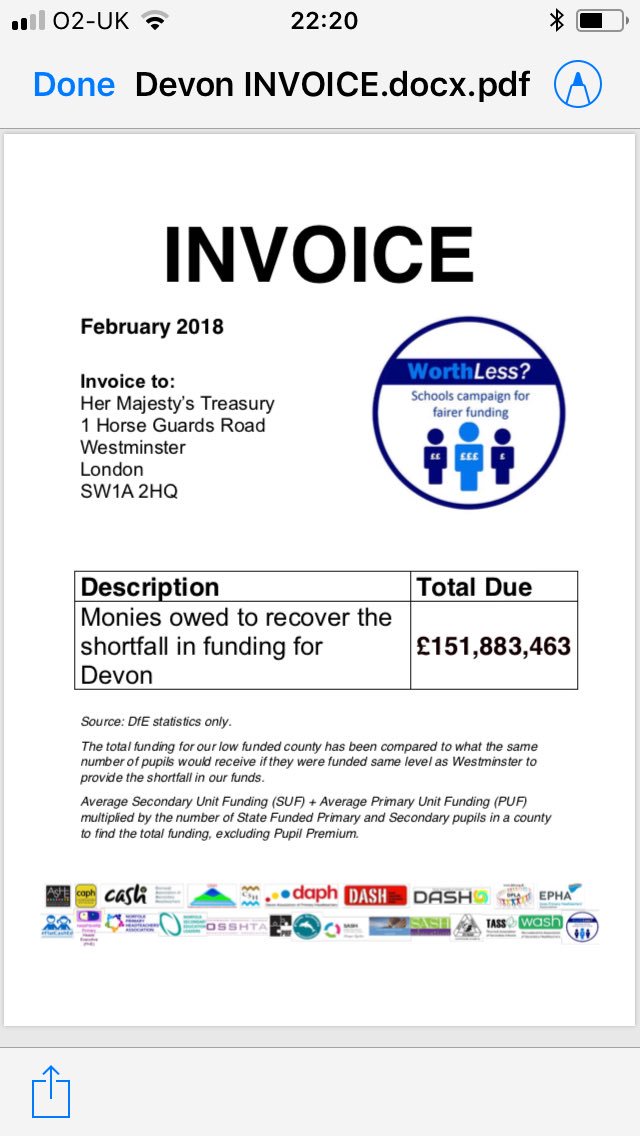
The bill for the shortfall in Devon school funding

“Jeremy Corbyn has accused the government of being “in the pockets of rogue landlords” and unable to fix what he called a “crisis level” of squalor at the bottom of the rented housing market.
More than half a million people aged under 35 are estimated to be living in rented properties so hazardous they are likely to lead to residents needing medical attention, the Guardian reported on Sunday.
Responding to the story, the Labour leader said: “The squalid and unsafe conditions that hundreds of thousands of people face are at crisis level. The broken housing market is in urgent need of a complete overhaul. The Conservatives can’t fix the housing crisis because they’re in the pockets of property speculators and rogue landlords, not on the side of tenants.” …”
From the blog of Claire Wright:
“The latest round of government budget cuts to public health is set to result in a loss of around 30 health visitor posts across Devon, it emerged at last Thursday’s (25 January) Health and Adult Care Scrutiny meeting.
During a presentation by Steve Brown, assistant director of public health for Devon County Council, I asked for clarification on the budget cuts as a result of reduction in funding of over £700,000 from central government ….
The narrative in the agenda papers stated that several of the budget lines are set to save mobey due to contract renegotiation. I asked for assurances that this meant only a renegotiated contract and not a reduction in service. Mr Brown confirmed that there would be no service reductions in those areas.
However, due to budgetary pressures in 0-5 children’s services, the contract currently managed by Virgin Care, it is anticipated that there will be a loss of 30 health visitor staff, due to ‘natural wastage’ (staff leaving and not being replaced), in the next financial year 18/19.
NHS funded mental health support in schools set to be lost
A cut of £223,000 to the public mental health in schools budget could mean that NHS funded emotional health and wellbeing service in schools will be scrapped, it was also revealed at last
Thursday’s meeting.
When I enquired, Mr Brown confirmed that the contract for the service was coming to an end and his department was searching for a new provider. He said it was a really valued service and if further efficiency savings could be made elsewhere, this service would be top of the list for funding.
I was completely dismayed at what I was hearing, given that anxiety and depression among young people is rocketing.
I proposed that the Health and Adult Care Scrutiny Committee relay its grave concerns to Devon County Council’s cabinet about the impact of the cuts on the public health budget. In particular, the loss of 30 public health visitors and the potential significant impact on young people the cut of £223,000 to public mental health budget, especially at a time when anxiety and depression among young people is rising.
I also proposed that the Health and Adult Care Scrutiny Committee writes to all Devon MPs, asking them to take up the issue with the Secretary of State for Health.
Another proposal from the chair on continuing the push for fairer funding for public health in Devon was also put forward.
All recommendations were supported unanimously.
You can view the speaker-itemised webcast here”:
https://devoncc.public-i.tv/core/portal/webcast_interactive/315014
“Carillion “wriggled out” of payments into its company pension schemes as its troubles grew, while it carried on paying shareholder dividends and bosses’ bonuses, say MPs.
The Work and Pensions Committee is questioning the way pension investments were managed at the collapsed outsourcing giant.
The schemes overall are in deficit.
But last year contributions to the pension funds were deferred until 2019, to help shore up the firm’s finances.
The committee has published a letter from Robin Ellison, chairman of trustees of Carillion’s pension scheme, giving an account of the last few years and suggesting they have been left with a funding shortfall of around £990m.
The letter shows that pension trustees were “kept in the dark” about the state of Carillion’s finances until late last year, the committee argues, and that dividends and bonuses were paid out at the expense of pension fund contributions.
On Monday, the Financial Reporting Council, the UK’s accountancy watchdog, said it would launch an investigation into KPMG’s audit of Carillion’s financial results between 2014 and 2016 as well as the work it carried out during 2017.
The FRC said the probe would “consider whether the auditor has breached any relevant requirements, in particular the ethical and technical standards for auditors”.
It will examine KPMG’s audit work on areas including estimates and recognition of revenue on significant contracts and accounting for pensions.
KPMG said it believed that “we conducted our role as Carillion’s auditor appropriately and responsibly”, adding that it would co-operate fully with the FRC’s investigation.” …
“A relief fund worth £300m set up by Philip Hammond, the Chancellor, to support small firms struggling under the weight of business rates rises has proved a “false hope” after failing to pass on tens of millions of pounds 300 days after its launch.
Research by Gerald Eve, the property consultancy, has found that more than £70m of the £175m allocated to councils for the year to March 2018 has yet to be passed on to local firms.
The Federation of Small Businesses said some of its members were still waiting for the essential funding.
“Our research showed that one in five firms facing business rates hikes were planning to sell, hand-on or close their business,” said Mike Cherry, the chairman. “The Chancellor’s £300m hardship fund offered a small glimmer of hope. For many, it’s proved to be false hope.” …
Forests, fields and parks are disappearing under concrete at the fastest rate for a quarter of a century, an investigation by The Times has found.
“On average, 170 sq km of greenfield land were built on every year from 2013 to 2016 after the government relaxed planning rules to ease the housing shortage.
The rate of development is more than two-and-a-half times the 25-year average and five times higher than the rate between 2006 and 2011.
If the construction of new homes, shops and infrastructure continues at the present pace, an area the size of Greater London will have been built on by 2028.
Greenfield land — not to be confused with green belt — refers to “previously undeveloped land” that includes farmland, gardens, forests and “grassed areas” in towns and cities.
The Campaign to Protect Rural England said that the government figures were “startling”. Graeme Willis, head of rural campaigns, said: “To use land more sustainably, we must start using it more efficiently. This rate of loss cannot be endured without losing huge swathes of our countryside. It is a non-renewable resource. Once built on, [it] is lost forever.”
The government changed the planning laws in 2012 to increase the rate of building with “a presumption in favour of sustainable development”, which required local authorities to allocate land for development.
“What you saw after 2012 was local authorities getting their houses in order in terms of land supply,” Duncan Hartley, director of planning at Rural Solutions, a property consultancy, said. “They have been allocating sites for development and those sites have had to be substantial to meet housing needs.” The single biggest use for greenfield sites once developed was housing at 17 per cent. The other significant uses were for industrial sites, transport infrastructure, offices and shops.
A spokesman for the Ministry of Housing said: “We will be working to put the environment at the heart of planning, making sure any new development improves the environment locally and nationally, while contributing to the wider commitment to build 300,000 homes a year.”
From 1989 to 2011, most developments were on brownfield sites.
From 2013-16, the pendulum swung the other way, with greenfield sites supplying 54 per cent of the land.”
Source The Times, paywall
Owl says: the sixth RICHEST country in the world …. where landlord MPs refused to pass a law about habitable housing because … well just because they can.
“Rented housing so squalid it is likely to leave tenants requiring medical attention is being endured by hundreds of thousands of young adults in England, an analysis of government figures has revealed.
Rats, mouldy walls, exposed electrical wiring, leaking roofs and broken locks are among problems blighting an estimated 338,000 homes rented by people under 35 that have been deemed so hazardous they are likely to cause harm.
It is likely to mean that over half a million people are starting their adult lives in such conditions amid a worsening housing shortage and rising rents across the UK which are up 15% in the last seven years.
Visits by the Guardian to properties where tenants are paying private landlords up to £1,100 a month have revealed holes in external walls, insect-infested beds, water pouring through ceilings and mould-covered kitchens.
A 30-year-old mother near Bristol said her home is so damp that her child’s cot rotted. A 34-year-old woman in Luton told of living with no heating and infestations of rats and cockroaches, while a 24-year-old mother from Kent said she lived in a damp flat with no heating and defective wiring for a year before it was condemned. …
Government figures suggest as many as 2.4 million people in England live in rented homes – both in the private and social sectors – with category 1 hazards. That includes 756,000 households living in private rented properties – almost one in five of the whole private rented stock – and 244,000 households in social housing.
Sajid Javid, the housing secretary, said he was determined “to do everything possible to protect tenants” and pledged government support for new legislation that requires all landlords to ensure properties are safe and give tenants the right to take legal action if landlords fail in their duties..
“In practice you have fewer rights renting a family home than you do buying a fridge-freezer,” said John Healey MP, Labour’s shadow secretary of state for housing. “Too many people are forced to put up with downright dangerous housing. After the terrible fire at Grenfell Tower, it’s even more important that ministers back Labour’s plan to make all homes fit for human habitation.” …
Owl says: Does this disgraceful behaviour go top down, bottom up – or both? Owlis of the opinion it is the latter!
“Former cabinet ministers have been exposed attempting to profit from a new cash for Brexit gravy train in Westminster, following an undercover investigation.
Lord Lansley, the former health secretary, was secretly filmed offering to use his knowledge and connections from within Westminster to provide “intelligence” on Brexit to a Chinese company offering him tens of thousands of pounds.
The peer, who has previously been accused of “ripping the heart” out of a bill to regulate lobbying, showed he was willing to pick up information from a key Brexit cabinet minister. He advised how the deal could be kept secret from the authorities by employing him through his wife’s company.
Peter Lilley, the former deputy Conservative Party leader, was also willing to approach key ministers on the Chinese company’s behalf. As part of his pitch for the job he described how he attended two advisory groups with influence over the Brexit ministers, one of which has never previously been revealed.
A third former minister, Andrew Mitchell MP, also appeared happy to give paid Brexit advice to the Chinese company. He charges £6,000 a day and disclosed that he was looking to work up to 10 weeks a year for private clients despite being paid £74,962 as an MP. “My constituents don’t mind what I’m paid,” he said.
The three men were secretly filmed as part of a joint undercover investigation by The Sunday Times and Channel 4’s Dispatches into politicians improperly making money from Britain’s negotiations to leave the European Union. …”
[there follows several pages of sleazy revelations]
Source: Sunday Times (pay wall)
” An Observer piece questions the growth of academy schools, warning that: “There is no evidence that, on average, academy chains do any better at managing schools than the local authorities they replaced. Instead, the reforms have created a structural mess, opening up profound gaps in accountability and governance.” The paper also reports that six out of 10 of the biggest academy trusts have raised “warnings over pressures on pay, staffing levels, building maintenance and mounting deficits”, which “raises the spectre of what would happen if a major academy chain were to go bust”.
The Observer, Page: 46
“More than half of the major operators of the government’s flagship academies programme have sounded the alarm over school funding, heaping further pressure on Theresa May to ease the squeeze on public spending.
An Observer investigation into the Conservatives’ treasured education initiative found that six out of the top 10 academy trusts, which operate hundreds of schools across England, have raised warnings over pressures on pay, staffing levels, building maintenance and mounting deficits.
The revelation will worry Tory MPs, many of whom blame pressures on school budgets for the party’s disastrous election result last year. It comes with the prime minister already under intense pressure over NHS funding and facing internal criticism over a lack of focus on domestic issues.
An analysis of the most recent accounts of leading multi-academy trusts reveals that eight of the top 13 largest groups have issued warnings. One said that funding was failing to keep pace with costs and inflation, creating risks of “unsustainable deficits” and staff cuts. …”
“Carillion made £500m in revenue from selling off Private Finance Initiative (PFI) projects between 2003 and 2011, with many deals handing the construction firm returns of more than 15 per cent per year.
The most lucrative sale was of three NHS hospital buildings in Staffordshire, Swindon and Glasgow in 2007 which netted Carillion a 38.7 per cent annual return, according to analysis by the European Services Strategy Unit (ESSU). Around £200m of the sales came after 2010, the figures show.
Several of the purchasers are based offshore meaning they pay no UK corporation tax on the profits they derive from the schemes, which are ultimately paid for by taxpayers, the ESSU research found. …
… There are currently 735 operational PFI and PF2 deals, with a capital value of around £60bn. Annual charges for these deals amounted to £10.3bn in 2016-17, the NAO found. Even if no new deals are entered into, future charges which continue until the 2040s will amount to £199bn.
Earlier research by the ESSU found that nine offshore funds own between 50 per cent and 100 per cent of the equity in 335 PFI projects across the UK. The funds own 45 per cent of all current projects, ESSU said. …”
From the blog of Claire Wright:
“Carers aren’t available to look after people in their homes, a Sidmouth GP told Devon County Council’s Health and Adult Care Scrutiny Committee on Thursday (25 January).
So concerned at the unavailability of care in people’s homes – the service designed to replace community hospital beds, Dr Mike Slot travelled to County Hall to share his concerns with the health scrutiny committee.
After he had finished his submission I tried to ask a question, but was prevented from doing so by the chair and scrutiny clerk, who informed me that it was against the rules for councillors to ask questions of public speakers! This was the first I knew of it since my proposal to bring in public speaking to scrutiny was agreed two years ago.
The Head of Social Care and the committee chair both intimated that Dr Slot’s view may be an isolated one…. I am less convinced.
At the end of the meeting in the work programme I successfully proposed a spotlight review to investigate Dr Slot’s concerns fully.
Another member of the public was told she was not able to speak to the committee because she missed the deadline, despite there being slots available.
I have since contacted the officer presiding over the Procedures Committee (which I am a member of) to get the rules reviewed. They will now be debated at the the April committee.
I asked Dr Slot for a copy of his speech, which is below.
“If community hospital beds was intended to be offset by increasing the capacity of community care so that patients could be cared for in their own homes. This may or may not have been realistic since many of the patients in the hospital system cannot be managed in the community even with excellent community services.
However, with or without community hospital beds it is an excellent idea to expand community services so that all those patients who can be cared for out of hospital can remain at home. Unfortunately there is not sufficient capacity in the home care services to do this job.
When GPs ring the single point of access number asking for rapid response or night sitting, the carers are not available. This is partly due to lack of resources and partly due to difficulty with recruitment. I suspect that part of the difficulty with recruitment may be due to the terms and conditions. If the carers only get paid if they are required then this may not be particularly attractive.
We understand that a hospital only functions well with a maximum of 85% bed occupancy, and similarly with the home care service we need to accept that there will be some unused capacity otherwise the service is never able to accept unexpected cases. Thus we need to allocate enough resource so that we can offer both an attractive rate of pay and attractive terms and conditions.
This is in fact an essential part of the answer to the problem the entire NHS is experiencing. If the level of water in a reservoir is steadily rising and then overflows, you can either try and build the banks higher in which case it will just overflow a bit later, or you can look at the streams going in and going out of it.
Similarly when you see an overflowing A&E or hospital you can buy more A&E or acute beds (very expensive) or you can increase community capacity to prevent people going in and facilitate people coming out (relatively much cheaper but you still have to pay a proper rate for it).”
Owl says: Alas not Clinton Devon Estates Blackhill Quarry, promised for environmental restoration, now subject of a heavily industrial planning application:
… “A conservation project to turn 50 quarries into nature reserves by 2020 has been completed two years early and is already saving endangered species, like the turtle dove.
In 2010, the RSPB joined forces with building materials supplier CEMEX to rejuvenate dozens of disused quarries.
And within fewer than eight years, 1,000 hectares of grassland, woodland, heath and wetland has been created which is helping rare and unusual species to flourish including 50 ‘at risk’ species.
Threatened birds which have moved into the conservation areas include turtle doves, choughs and twites, all of which have seen huge falls in numbers in the past decades. …
… Andy Spencer, Director of Sustainability, CEMEX UK said: “While supplying our customers with concrete, cement, sand and stone we also aim to balance the needs of operations with the protection and enhancement of the natural world. The RSPB has been pivotal in helping us to achieve this aim.
“The 1000th hectare that has just been created is a significant and outstanding milestone and our partnership to date has helped create some amazing places for communities and nature.”
Owl says: most homes in the Devon and Somerset Local Enterprise Partnership area are being built near Hinkley C nuclear power station to house up to 5,000 largely temporary workers.
“… England’s fragile economic growth is underpinned by household expenditure, which accounts for 63% of gross domestic product. This is dependent upon perceived wealth, which is directly correlated with the price of housing. House price growth has left homeowners (particularly in London) feeling richer while renters feel poorer. To undermine that perception of affluence among homeowners would have a significant economic impact.
So there is huge demand for new housing, but little incentive for policymakers to deliver this where greatest demand exists. We need an answer that is politically expedient, economically pragmatic and socially responsible.
The government needs to avoid house price depreciation but stabilise prices in London, where there is highest demand. Affordability is a spatial problem that demands a spatial solution. It must focus attention on areas where the ability to purchase and the cost of doing so are more closely aligned. The mayor’s plan for London could then focus policies on providing genuinely affordable homes for Londoners.
The Midlands engine and northern powerhouse are attracting and retaining investor attention, and elected mayors in Bristol, Birmingham and Manchester, among others, are beginning to flex their muscles. Yet this is as much a reaction to the London market as any proactive national policies. Clearer government leadership would expedite change and provide greater long-term certainty.
Investment and infrastructure decisions are being made but are too often buried within various national plans ‘and strategies. They should be bought to the forefront. Every other country in western Europe has a national spatial plan; England should publish one too. This would make clear how spending and policy decisions are related, supporting regional revival.
The housing paradox is stifling. To solve it, we must take a pragmatic approach that supports England’s regions. That would not be at the expense of London, but we could all be better served by casting a wider net.”


“The Ministry of Justice has confirmed it commissioned an independent review into prison maintenance, millions of pounds of which was outsourced to the stricken giant, early last year.
The review was carried out after prisons minister Sam Gyimah said he was “not impressed” by Carillion’s maintenance work and the firm was sent a formal warning in September 2016. Despite the row, the firm went on to win another £40million in Ministry of Justice contracts last year – before collapsing leaving 20,000 jobs in the balance. Yet ministers say the report – together with other reports on Carillion’s effectiveness including an “improvement plan” – will not be handed to the independent House of Commons Library.
Justice minister Rory Stewart wrote: “There are no plans to place the information in the library as the report contains commercially sensitive information.”
Shadow Justice Secretary Richard Burgon said: “It’s outrageous that the govenrment is now refusing to publish this or any other reports that the Ministry of Justice has done into Carillion’s performance in our prisons.
“What has it got to hide?
“All too often with deals signed with private companies in our justice system, there is a lack of transparency and openness.
“This makes it incredibly difficult to hold the private sector to account and to ensure that companies are working in the public interest and not their own.”
A string of parliamentary questions by Mr Burgon revealed the Ministry of Justice spent £11.4million over three years on its 97-strong team of officials whose job it was to monitor contracts. But ministers admitted an “underestimation of the historical costs” meant some contracts did not achieve the savings they promised.
Mr Stewart said the independent report in early 2017 was “used to support several improvement initiatives.”
He added the department had meetings with Carillion at various levels “at least weekly” to discuss “specific issues”. He was unable to name the total number of meetings.
The minister told Mr Burgon: “A formal letter of concern was issued in 2016 to advise Carillion of performance failures.
“A performance action plan was put in place to address these failings and some improvements were made.”
It came as the government tonight said it has saved 1,000 Carillion prisons jobs by setting up its own facilities management firm. The staff in 52 jails who previously employed by the giant will move to the new company, Gov Facility Services Limited, with their terms and conditions preserved. Their work includes cleaning, maintenance and building repair.
Justice Secretary David Gauke said: “I want to reassure staff that their jobs are secure and essential to making prisons safer and more decent.”
https://www.mirror.co.uk/news/politics/tories-refuse-publish-official-report-11920351
“More than half of the 1,900 ultra-luxury apartments built in London last year failed to sell, raising fears that the capital will be left with dozens of “posh ghost towers”.
The swanky flats, complete with private gyms, swimming pools and cinema rooms, are lying empty as hundreds of thousands of would-be first-time buyers struggle to find an affordable home.
The total number of unsold luxury new-build homes, which are rarely advertised at less than £1m, has now hit a record high of 3,000 units, as the rich overseas investors they were built for turn their backs on the UK due to Brexit uncertainty and the hike in stamp duty on second homes. …”
From the blog of East Devon Alliance Councillor Martin Shaw:
“In my third and final report from yesterday’s Health Scrutiny, I come to the report on the future of the hospitals by NEW Devon CCG and NHS Property Services, in response to the Committee’s request for clarification. (This arose from my presentations at the September and November meetings). While NHS PS stressed that in principle they will eventually have to charge market rents, Claire Wright elicited the useful information that currently NHS England are still paying for the buildings, and the company said they are ‘always happy to work with local communities to consider local services’. Scrutiny’s resolution requested that NHS PS ‘uphold this undertaking’ and keeps the Committee informed on the timeline for changes in the status of the hospitals.
The CCG’s Sonja Manton confirmed that the community conversations the CCG and RD&E are now promoting to develop ‘place-based systems‘ around ‘market towns’ – which have already begun in Honiton and Okehampton – can certainly include the services people want to have delivered locally in the hospitals. While there are cost constraints and not everything which people want will necessarily be delivered, local communities can certainly discuss these services with the NHS organisations, as well as how voluntary organisations can help the NHS and adult social care. Okehampton’s Conservative county councillor, Kevin Ball (below front left, with Non-Aligned Group leader Frank Biederman behind), stressed the progress his community had made in the recent meeting in the town. He and Okehampton’s mayor, Jan Goffey, mentioned that FORCE Chemotherapy will soon be opening a service in the hospital.
In my speech (1:34:20) I welcomed the new ‘place-based’ focus and stressed the importance for towns like Seaton – which is 45 minutes to an hour from acute hospitals – of using the free space in the community hospital to deliver routine treatments and operations for which people currently have to go to Exeter. I pointed out that constituents complain to me all the time about the stress, strain and cost of repeated travelling, often when unwell, without parking, park-and-ride space or bus services – while Exeter complains of congestion!
I mentioned the request of the RD&E’s Em Wilkinson-Bryce, in Honiton last week, for the community to trust the NHS organisations, and said that a serious conversation about local services – in which the NHS takes on board what people want – would be the best way to create this. We wanted to keep the beds, but know they are gone proper ‘place-based’ strategies for each of our towns offer the prospect of working together with the NHS. Preparations are underway for a meeting similar to ‘Honiton’s Health Matters’ in Seaton in March, and I will give more information as soon as the date is fixed.
“Estate Rent Charge Agreement to proceed
In August last year the Town Council (CTC) decided that it would proceed with negotiating with the Consortium to replace the estate rent charge by including this cost in the council tax. At an extraordinary meeting in January, the Town Council approved the Agreement. This Agreement, when signed by all the parties involved, removes the estate rent charge from 1 April 2018 and transfers ownership and responsibility to the Town Council for the first phase of public open space, including parts of the Country Park and St Martin’s and Hayes Square play parks. Under the Agreement, further areas of open space will transfer to the Town Council as they are finished in years to come.
Following approval of the Agreement, the Town Council finalised the budget which would be needed up to the end of March 2019 and agreed a precept (the Cranbrook Town Council element of the council tax) of £388,398. The precept will be collected by East Devon District Council through the council tax from April onwards.
By moving to council tax, households will be able to pay monthly and benefit from any discounts available under the council tax scheme.
How much council tax will I pay?
The amount of council tax paid by each household depends on the band which applies to the property eg. band A – H. The band is shown on the council tax bill.
Around 97% of homes in Cranbrook are in bands A – E and these households will be paying less under the new arrangements next year than they would have paid with the previous council tax and estate rent charge combined this year, and this does not take into account how the estate rent charge may have increased next year had it remained. …
The Town Council will also be holding surgeries for residents to discuss the change with Councillors on an individual basis. Residents are invited to call in to any of the surgeries which will be held in the Younghayes Centre on:
Monday 29 January (6.30pm – 8.30pm) Saturday 3 February (10.00am to noon) Monday 12 February (6.30pm – 8.30pm) Saturday 17 February (10.00am to noon)”
“Cranbrook Herald
“What’s been your experience of getting car insurance in Cranbrook?
Has it been easy, with no problems and affordable premiums, or has it been difficult, with high premiums to pay?
Tell us your stories – good and bad.
Please email Cranbrook Herald reporter Paul Strange at paul.strange@archant.co.uk
with your views.
Please include your contact details.”

