Hinkley C: do contractor changes signal problems?

” … On 21st August 2017, Balfour Beatty announced that it had now been awarded that very contract from under Costain’s nose.

Today Costain chief executive Andrew Wyllie said this on the matter: “Costain continues to undertake a number of enabling works contracts at Hinkley Point C. However, the group will cease its involvement in the marine works contract at Hinkley Point C following completion of a further circa £20m of existing obligations, anticipated to be concluded by the end of December 2017. Since Costain announced its initial appointment in October 2013, there was a significant delay in the approval for Hinkley Point C. While Costain has worked closely with EDF through the £40m of early contractor involvement phase to date, it was not possible to reach agreement on the final terms and conditions for the overall completion of the works.”

Mr Wyllie said that the company was still committed to, and involved in, the nuclear sector. “Costain remains involved in the planned UK new nuclear power plants and has started to develop opportunities in the small modular reactors market,” he said. “At Sellafield the Evaporator D contract is near completion and we have fully mobilised our team in support of the Decommissioning Delivery Partnership Framework. We have recently been awarded a major construction and programme management contract for AWE in the development of one of its nuclear facilities.”

http://www.theconstructionindex.co.uk/news/view/costain-explains-loss-of-hinkley-point-contract

and it seems workers at the site prefer to rent cheaply rather than buy in the area – not a sign of confidence:

“… workers on site at Hinkley seemed to be looking to rent as cheaply as possible, with many of them even travelling home on weekends.

… The people working on Hinkley at the moment are mainly construction workers and they are mainly opting to rent rather than buy,” Mr Zorab said.

“This has pushed up prices for buy to let properties but house prices in general have not been affected in a major way yet.”

He said the majority of the people who would be on site in the long term had not arrived yet, and expected a more noticeable increase when they started to arrive in year three of the project.”

http://www.somersetcountygazette.co.uk/news/15435410.What_impact_is_Hinkley_C_having_on_West_Somerset_s_housing_market_/

Tory general election call centre being investigated by police

“Police say they are carrying out an investigation of “scale and significance” into allegations the Conservative Party broke the law during the election campaign with its use of a call centre in Wales.

The investigation into the contracting of the business in Neath was confirmed in a letter from South Wales Police to Labour MP Wayne David.

Secret footage obtained by Channel 4 News suggested the Tories may have broken data protection and election laws by using Blue Telecoms to directly contact voters in marginal seats.

The Conservative Party has said it did not break the law by using the company, which it said was hired to carry out legal market research and direct marketing.

The CPS statement on charging an MP in Tory electoral fraud in full
In a letter to Mr David, South Wales Police confirmed the investigation is being carried out by its economic crime unit, who have experience in dealing with “electoral integrity investigations”.

It adds there is no timescale for the investigation because it is of “sufficient scale and significance that South Wales Police are unable to offer any specific timescale”.

“Rest assured that the officers within this department have the required specialist skills and expertise for this often challenging area of business and will, as with all investigations, act in a diligent and expeditious manner,” the letter said.

The Information Commissioner’s Office also confirmed it is “currently investigating the Conservative Party in relation to a possible breach of Regulation 21 of the Privacy and Electronic Communications Regulations 2003”.

“The allegations that the Conservative Party and Blue Telecoms broke electoral law during a general election campaign are extremely serious and the public need to have confidence in our electoral process. That is fundamental to our democracy.”

A spokesman for South Wales Police said: “South Wales Police is currently reviewing information received in regards to Blue Telecoms.

“It would be inappropriate to comment further at this time.”

A Conservative spokesman said: “We are unable to comment on an ongoing investigation.”

http://www.independent.co.uk/marketing/apps

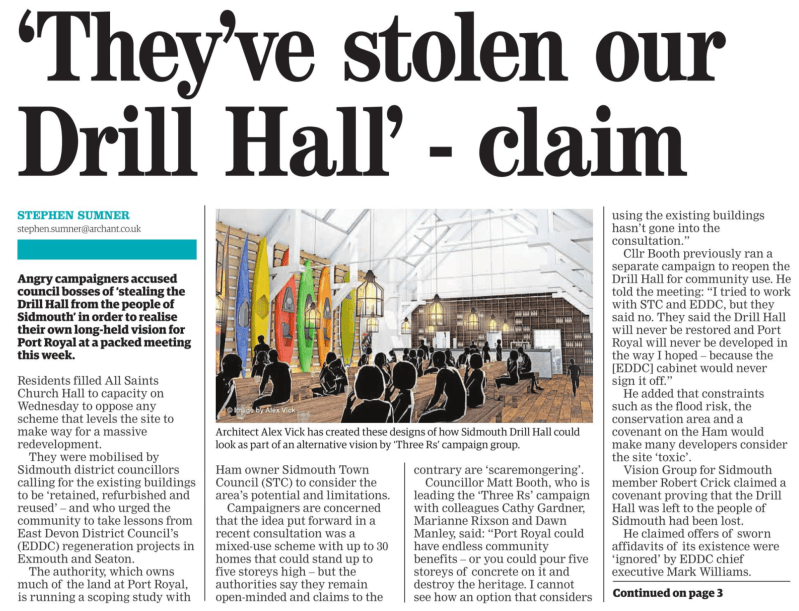
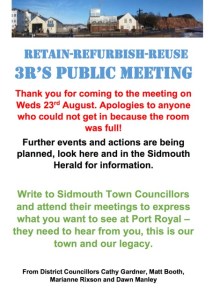
More on Port Royal “Retain, Reuse, Refurbish” meeting last night

All the presentations, and programme for the meeting, are detailed here:

Vigorous audience participation at last night’s ‘3Rs’ Public Meeting, for a Retain-Refurbish-Reuse alternative for Sidmouth’s Port Royal

Slides are here:

Click to access 23-aug-3rs-final-slides.pdf

Report of meeting:

“The five perfectly-pitched short presentations at last night’s Public Meeting were each restricted by Chair, Di Fuller, to not much more than 5 minutes. This maximised the time for questions and comments from the audience packed into Sidmouth’s All Saints’ Church Hall, and ensured ample time for the questions to be answered. There was a clear strength of opinion in the room, that Port Royal regeneration should be carefully conceived as a suitable legacy for the town. Local knowledge from those attending, raised issues such as flood risk and contamination that could disadvantage residential development on this site. Potential loss of existing public parking behind the lifeboat station was also a concern.

Speakers were EDDC Councillors Marianne Rixson (Ward Member Sidmouth-Sidford), Cathy Gardner and Matt Booth (Ward members Sidmouth Town); and local residents Mary-Walden-Till and Jeremy Woodward.

Mary Walden-Till concentrated on The Ham conveyance land.

She told the crowd:

“Under the terms of the Conveyance the land was given to the inhabitants of and visitors to Sidmouth as a place of recreation ‘for ever’. Subject only to ‘reasonable restrictions and regulations in accordance with the law for the time being affecting the use of Public Parks and Pleasure Grounds’.
It was a Trust for which Sidmouth Town Council is now the Trustee, with all the legal responsibilities that entails. Sidmouth Town Councillors act to manage that trust on behalf of the Council. It is a complex legal arrangement but it does not in any way affect the terms of the Conveyance which forms the Governing Document of the Charity.

It was therefore incorrect to allow part of The Ham to be included in the Local Plan area ED03 as being available for redevelopment. The toilet block stands on Ham land, and the Land Registry deed says it is covered by the terms of the Conveyance. I have asked EDDC Councillors to correct the boundary of ED03 but they never even bothered to acknowledge my email.
None of The Ham land is available to be built on or to be used in any way other than for free recreation for all. It can not be used as parking for cars or boats, as that is restricting its use. Using it as car parking was suggested, and thrown out, in the early part of the 20th C. Nothing has changed since then as far as the Conveyance is concerned. And nothing can change with the Conveyance except through our connivance or apathy.

It is in breach of charity law to do anything which adversely affects the rights of a charity’s beneficiaries, and any of those beneficiaries has the right to complain to the Charity Commission. Anyone who has ever been to Sidmouth is covered by the terms of the Conveyance, so there are a large number of people who can demand that the terms are kept.”

Vigorous audience participation at last night’s ‘3Rs’ Public Meeting, for a Retain-Refurbish-Reuse alternative for Sidmouth’s Port Royal

Internal audit, external audit or no audit?

Gambling addict Mark Conway diverted Dundee Council money to his own account for seven years after running up online gambling debts and was only left with £7,337. …

He admitted defrauding £1,065,085 between August 2009 and May last year. The money was lost betting on football matches and only £7,337 was recovered.”

http://www.dailymail.co.uk/news/article-4822146/Gambler-siphoned-1m-council-cash-account.htm

SEVEN years!

Hawking totally skewers Hunt on NHS!

The NHS is facing severe crises, from staffing to funding. Hunt misquoting me and misrepresenting research doesn’t help.

The secretary of state for health, Jeremy Hunt, has challenged me on Twitter and in an article for the Sunday Telegraph over a talk I gave recently to the Royal Society of Medicine in defence of the NHS. Having been accused by Hunt of spreading “pernicious falsehoods”, I feel the need to respond.

Hunt doesn’t deny that he dismissed research contradicting his claim of excess deaths due to poorer hospital care and staffing at the weekend. He admits he relied on one paper by Professor Nick Freemantle and colleagues. But even if one accepts its disputed findings, the authors explicitly warn that “to assume these excess deaths are avoidable would be rash and misleading”. The editor-in-chief of the British Medical Journal, Fiona Godlee, wrote to Hunt to reprimand him for publicly misrepresenting the Freemantle et al paper. As a patient who has spent a lot of time in hospital, I would welcome improved services at the weekend. For this, we need a scientific assessment of the benefits of a seven-day service and of the resources required, not misrepresentation of research.

Hunt’s statement that funding and the number of doctors and nurses are at an all-time high is a distraction. Record funding is not the same thing as adequate funding. There is overwhelming evidence that NHS funding and the numbers of doctors and nurses are inadequate, and it is getting worse. The NHS had a £2.4bn shortfall in funding in 2015-16, bigger than ever before. NHS spending per person will go down in 2018-19. According to the Red Cross, the NHS is facing a humanitarian crisis. There is a staff recruitment crisis. The BBC reported that on 1 December 2015 there were 23,443 nursing vacancies, and a 50% increase in vacancies from 2013 to 2015. The Guardian reported in May that the number of nursing vacancies had risen further to 40,000. There are increasing numbers of doctor vacancies and increasing waiting times for GP appointments, treatment and surgery.

Hunt misquoted me, saying that I claimed the government wants a US-style insurance system. What I said was that the direction is towards a US-style insurance system, run by private companies. The increasing involvement of private health companies in the NHS is evidence for this. Hunt chose to highlight – dare I say, cherry-pick – the fact that private companies’ share of NHS contracts rose 0.1% over the last year. This is an anomaly among the data since 2006. The NHS private providers’ share was 2.8% in 2006-7 and rose steadily to 7.6% in 2015/16. The amount of private health insurance has fallen since 2009 as Hunt said, but that is because of the financial crash. We can conclude nothing about health policy from this and in any case, it is now increasing again. As waiting times increase, private companies report an increase in self-pay where patients pay directly for care such as hip and knee replacements.

Further evidence that the direction is towards a US-style system is that the NHS in England is undergoing a complete reorganisation into 44 regions with the aim of each being run as an “accountable care organisation” (Aco). An Aco is a variant of a type of US system called a health maintenance organisation in which all services are provided in a network of hospitals and clinics all run by the HMO company. It is reasonable to expect the powerful US HMO companies such as Kaiser Permanente and UnitedHealth will be bidding for the huge contracts to run these ACOs when they go out to international tender. Hunt referenced Kaiser Permanente as a model for the future budgetary arrangements in the NHS at the Commons health select committee in May 2016.

The NHS is political, but not necessarily party political. I am a Labour supporter but acknowledge that privatisation increased under Labour governments in the past. The question is whether democracy can prevail and the public can make its demands for proper funding and public provision undeniable by any government.

• Stephen Hawking, the author of A Brief History of Time, is director of research at the Centre for Theoretical Cosmology at the University of Cambridge, where he was Lucasian professor of mathematics”

https://www.theguardian.com/commentisfree/2017/aug/25/jeremy-hunt-attack-nhs-stephen-hawking-crisis

Silliest silly season spin headline?

The award goes surprise, surprise) to Archant newspapers (Midweek Herald, Exmouth Journal, Sidmouth Journal) for the headline from this EDDC press release:

Council backs campaign against hate crime

http://www.exmouthjournal.co.uk/news/council-backs-campaign-against-hate-crime-1-5162356

It isn’t offering money or resources. It isn’t doing ANYTHING AT ALL except issuing a press release backing a Devon and Cornwall Police initiative. No doubt one of those great ideas that come – at a price – from our Police and Crime Commissioner.

Can you imagine the furore if the council DIDN’T back it!

Now that WOULD be a headline!

(At least) five of EDDC’s councillors are also Freemasons

Ian Hall – Axminster Rural and Axminster DCC
Ian Chubb – Newbridges and Whimple and Blackdown DCC
Tom Wright – Budleigh
John Humphreys – Exmouth Littleham
Andrew Moulding – Axminster Town

http://www.devonlive.com/news/devon-news/dozens-devon-councillors-are-freemasons-342713

That’s a clean sweep for Axminster which must give the boys plenty to talk about at their Lodge(s). And all of them Conservative majority councillors wearing many hats in many posts, both at DCC and EDDC.

And that’s only the ones who declare it!

Why is it a problem? This very old article (1966) is still pertinent today:

Freemasons who sat on a council’s planning committee have been found guilty of malpractice after a lengthy inquiry by the local-government ombudsman.

The investigation into their activities on the council at Canvey Island, Essex, began after complaints that they had given a fellow lodge member the go-ahead to build a leisure complex. …”

The ombudsman said:

“Freemasonry is generally viewed with suspicion among non-Masons not least because of the secrecy attached to the `craft’ … in my view, knowing that a councillor and a planning applicant are Freemasons and members of the same lodge, members of the public could reasonably think that such a private and exclusive relationship might influence the member when he came to consider the planning application.”

http://www.independent.co.uk/news/in-a-small-town-where-the-tories-and-masons-hold-sway-1312466.html
(where you can also see details of other councils and councillors in Devon).

Though, nowadays, we don’t have a national standards board or a “National Code of Local Government Conduct” – both were abolished by national government some years ago.

Leaving each council to decide on its own standards – hhhmmmmm!

Lancashire County Councillors want to save money by combining CEO and Finance jobs – CEO doesn’t want them to

A county council cabinet that is prepared to force its CEO to take on two jobs which would “significantly reduce checks and balances” and cause her an enormous conflict of interest.

“Lancashire County Council has voted to merge its chief executive and section 151 officer roles, sparking a row about accountability.

At a meeting on Monday, the authority’s Conservative cabinet voted in favour of the unusual move in the teeth of vocal criticism from opposition Labour councillors.

The vote came at the end of a meeting at which current chief executive Jo Turton made a plea to keep both roles separate.

She told the cabinet: “Now plainly I do have a personal interest in this matter, but the report is not about me but about the future shape of the county council.

“I would simply emphasise there are reasons why there are three statutory officer roles and that combining them significantly reduces the checks and balances within the governance structure of this council.”

She added that a survey had confirmed that no other county or similar-sized metropolitan authority has such a combined role.

Turton also said she objected to part of the proposal which would separate children and adult services. Overall, the cabinet argued that the overall restructuring proposals would save £244,000 a year.”

During the meeting, a number of opposition councillors lined up to speak against the proposal. Councillor David Whipp said: “It is quite clear that there is a huge risk of consolidating executive power in the hands of a single person.

“There is a reason why there are checks and balances, why there is a division of responsibility, and that is to ensure that proper consideration is given to initiatives that come forward.

“A chief executive may wish to be very bold and that has to be tempered by a small ‘c’ Conservative officer exercising that section 151 responsibility.”

In tense exchanges with council leader Geoff Driver, Labour group leader Azhar Ali said:

“The question needs to be asked why Kent, Gloucestershire, Surrey, Buckinghamshire, North Yorkshire, Leicestershire – all these big counties which are all conservative controlled – have decided not to undertake that role.

“The answer simply is because it is not viable, not good governance.”

Worries over interim costs

Ali also said that the cost of employing an interim to perform the role of chief executive and section 151 officer – which he said could reach up to £2,000 a day – would wipe out any savings in the first year.

He also questioned whether the council would be able to find anyone capable of taking on the new role.

He said: “There is a small pool of people qualified at this level to undertake this work and that small pool of people is already in employment.

“There is a danger that the way this is being done – and the damage to this authority’s reputation that has already been done by this cabinet and leader – that the number of applicants might be very small.

“Therefore, there’s a risk of no appointments and again you’ll have to resort in part to either asking officers of this council to step up out of those roles which they might not want or resorting to interims. Again there is a cost.”

Responding to the criticism, Driver said: “We are in serious financial difficulties and we need somebody at the top with financial expertise who can advise the county council on both policy and financial matters at the same time.

“If it was felt inappropriate to combine the two roles the law would stop it happening and it doesn’t.”

Practice ‘died out’ in noughties

Speaking to Room151, Rob Whiteman, chief executive of the Chartered Institute of Public Finance and Accountancy, confirmed there is nothing in the rules that prevents the move.

He said: “If what members want from their chief executive is an organisational head of an organisation with strong management and planning and a focus on making the organisation more efficient it can make sense for the roles to be combined.

“If, on the other hand, they are looking for the chief executive to have a focus on regeneration deals and putting together development partnerships, then you are at risk of creating a conflict of interest.”

Whiteman served at London Borough of Barking and Dagenham in a dual chief executive and section 151 role in the early noughties.

At that time, it was not unusual for chief executives to also hold section 151 responsibilities, with Bob Coomber at Southwark, Tony Redmond at Harrow and Richard Harbord at Richmond all performing both roles.

However, the practice has virtually died out since the introduction of the cabinet system into local government in 2000. Last year, Lancashire warned that it faced the prospect of being unable to carry out its statutory duties due to a major structural deficit.

A report commissioned by the council from accountancy firm PwC found that even if the council is successful in meeting all of its cost reduction targets, it will have a cumulative deficit of £398m by 2021.”

http://www.room151.co.uk/resources/lancs-merger-of-s151-and-ceo-roles-sparks-accountability-row/

A new business rates sting for small and medium businesses

“A Plymouth businessman has spoken out against the new “staircase tax” which has cost him thousands of pounds.

Peter Cuddehay, who owns a printing business and art gallery on Plymouth’s waterfront, said new tax rules, which treat different floors in the same building as separate premises, are unfair.

The changes, which affect up to 30,000 small firms, have hit him in the pocket and sabotaged his investment plans.

“It’s an iniquitous tax,” the 67-year-old business owner said. “Where is the fairness? I think it’s wrong.”

Mr Cuddehay has been stung by a Supreme Court ruling which allows the Valuation Office Agency, which recalculated business rates in 2017, to levy rates individually on offices on separate floors or corridors.

Previously they were treated as a single premises.

Some firms face rate hikes of up to £15,000 as a result of the new rules – which are backdated to 2015.

Mr Cuddehay said he has been forced to rip up his accounts for the past two years and start again.

His business operates over three floors, the top one only being a store, which has now been defined by HM Revenue & Customs (HMRC) as “two premises”.

Mr Cuddehay, who employs five people, previously qualified for business rates relief because the rental value of his property was less than £12,000.

But he now has to pay a back-dated bill of more than £5,000 – and will face tax bills in future when before he didn’t have to pay anything for being below the limit.

He faces prosecution if he doesn’t pay up, so he’s handed over the cash, but appealed and is awaiting a date for his hearing.

“It’s a joke. We must have been one of the first companies to have been hit by this,” he said. “A retrospective action is outrageous, I can’t believe they can get away with it.”

And it’s a double charge for Mr Cuddehay, a member of the Federation of Small Businesses as he now expects his Waterfront Business Improvement District levy charge, calculated on rateable value, to rise too.

“All our plans for investment have gone out of the window,” he said. “We’ll also have to go back to out landlord and maybe say we don’t need the top floor storage.”

Mr Cuddehay has now written to Sutton and Devonport MP Luke Pollard about his predicament.

Philip Hammond, the chancellor, is now under pressure from backbench MPs to address the changes and perhaps overrule them when he announces his Budget in autumn 2017.”

http://www.plymouthherald.co.uk/news/business/businessman-loses-thousands-because-new-376567

Environmental Health Officers – the Guardian needs your views on pollution

“We want to hear from current staff and former council staff about the challenges of monitoring air quality at a local level. How hard it is to do? How does it impact on local planning decisions? Could it be done in a better way? What more council councils do to protect environments at a local level? Share your stories.”

https://www.theguardian.com/environment/2017/aug/24/air-pollution-for-a-council-share-your-experience-with-us

Diviani and Randall-Johnson are satisfied these questions have been answered on bed closures – do you agree?

30 [plus] questions” that must be asked BEFORE care at home can be implemented:

Pre-implementation

The model of care:

• Does the new model of care align with our overriding ambition to promote independence?
• Is there clinical and operational consensus by place on the functions of the model and configuration of community health and care teams incorporating primary care, personal care providers and the voluntary care sector?
• Is there a short term offer that promotes independence and community resilience?
• Is there a method for identifying people at highest risk based on risk stratification tool?
• Are the needs of people requiring palliative and terminal care identified and planned for?
• Are the needs of people with dementia identified and planned for?
• Is support to care homes and personal care providers, built into the community services specification?
• Is support for carers enhanced through community sector development support in each community?
• Has the health and care role of each part of the system been described?
• Have key performance indicators been identified, and is performance being tracked now to support post implementation evaluation, including impact on primary care and social care?

Workforce:
• Is there a clear understanding of the capacity and gaps in the locality and a baseline agreed for current levels and required levels to meet the expected outputs of the changed model of care?
• Is there a clear understanding of and plan for any changes required in ways of working:
o thinking
o behaviours
o risk tolerance
o promotion of independence, personal goal orientation

• Have the training needs of people undertaking new roles been identified, including ensuring they are able to meet the needs of patients with dementia?
• Do we have detailed knowledge with regards to investment, WTE and skill mix across the locality and a plan for achieving this?
• Are system-wide staff recruitment and retention issues adequately addressed with a comprehensive plan, and where there are known or expected difficulties have innovative staffing models been explored?

Governance, communications and engagement:
• Is there a robust operational managerial model and leadership to support the implementation?
• Has Council member engagement and appropriate scrutiny taken place?
• Is there an oversight and steering group in place and the process for readiness assessment agreed?
• Have providers, commissioners and service users and carers or their representative groups such as Healthwatch agreed a set of key outcome measures and described how these will be recorded and monitored?
• Is there a shared dashboard which describes outcomes, activity and productivity measures and provides evaluation measures?
• Is there an agreed roll out plan for implementation, which has due regard to the operational issues of managing change?
• Is there a comprehensive & joint communications and engagement plan agreed?
• Is there a need for a further Quality or Equality Impact Assessment?

Implementation
• Is there a clinical and operational consensus on the roles of each sector during the implementation phase including acute care, community health and care teams, mental health, primary care, social care, the voluntary care sector and independent sector care providers?
• Is there an implementation plan at individual patient level describing their new pathway, mapping affected patients into new services?
• Are the operational conditions necessary for safe implementation met?
• Have the risks of not implementing the change at this point been described and balanced against any residual risk of doing so?

Post Implementation
• Is there a description of the outcomes for individuals, their carers and communities?
• Are the mechanisms for engagement with staff, users of services and carers in place and any findings being addressed appropriately?
• Is there a process in place for immediate post implementation tracking of service performance including financial impact to all organisations?
• Is longer term performance and impact being tracked for comparison against pre-implementation performance?
• Have we captured user experience as part of the process, and have findings been addressed and recorded to inform the planning of future changes?
• Are there unintended consequences or impacts (e.g. on primary care or social care) which need to be addressed before any further change occurs?
• Is there a clear communication plan for providers and the Public describing the new system and retaining their involvement in community development?”

Source: http://www.newdevonccg.nhs.uk/about-us/your-

Cash for votes – Conservatives win by millions

“British political parties received a record £40m of donations in the three months before the election, with the Conservatives bringing in more than twice as much cash as Labour.

More than half of the money was given to the Conservative party, which raised almost £25m between April and June compared with £9.5m for Labour.

The funding received beat the previous record high for a three-month period, which was set during the runup to the election in 2015, by more than £9m.

The biggest donation to the Conservatives was £1.5m from Anthony Bamford, a Conservative peer and industrialist who also helped fund the Brexit campaign. Labour’s largest sum was from Unite, the trade union, which donated £1.3m.

Other wealthy businessmen who gave more than £1m each to the Tories including John Armitage, a hedge fund manager, John Gore, a musical theatre impresario, and John Griffin, the founder of the Addison Lee taxi firm.

The Liberal Democrats raised about £4.4m, while Ukip managed to get £150,000, the Greens around £175,000, the Women’s Equality party almost £300,000 and Plaid Cymru just £5,300.”

https://www.theguardian.com/politics/2017/aug/24/uk-political-parties-received-record-40m-of-donations-before-election

Journalism: too elitist, too removed from ordinary people – says journalist

“… Giving the MacTaggart lecture on Wednesday, the journalist [Jon Snow]said: “Amid the demonstrations around the tower after the fire there were cries of: ‘Where were you? Why didn’t you come here before?’

“Why didn’t any of us see the Grenfell action blog? Why didn’t we know? Why didn’t we have contact? Why didn’t we enable the residents of Grenfell Tower – and indeed the other hundreds of towers like it around Britain – to find pathways to talk to us and for us to expose their story?

“In that moment I felt both disconnected and frustrated. I felt on the wrong side of the terrible divide that exists in present-day society and in which we are all in this hall major players. We can accuse the political classes for their failures, and we do. But we are guilty of them ourselves.

“We are too far removed from those who lived their lives in Grenfell and who, across the country, now live on amid the combustible cladding, the lack of sprinklers, the absence of centralised fire alarms and more, revealed by the Grenfell Tower fire.” …”

https://www.theguardian.com/media/2017/aug/23/jon-snow-grenfell-mactaggart-media-diversity

and

… “The Grenfell residents’ story was out there, published online and shocking in its accuracy. It was hidden in plain sight, but we had stopped looking. The disconnect was complete. Our connectivity – life on Google, Facebook, Twitter and more – has so far failed to combat modern society’s widening disconnection. …”

https://www.theguardian.com/commentisfree/2017/aug/23/grenfell-british-media-divide

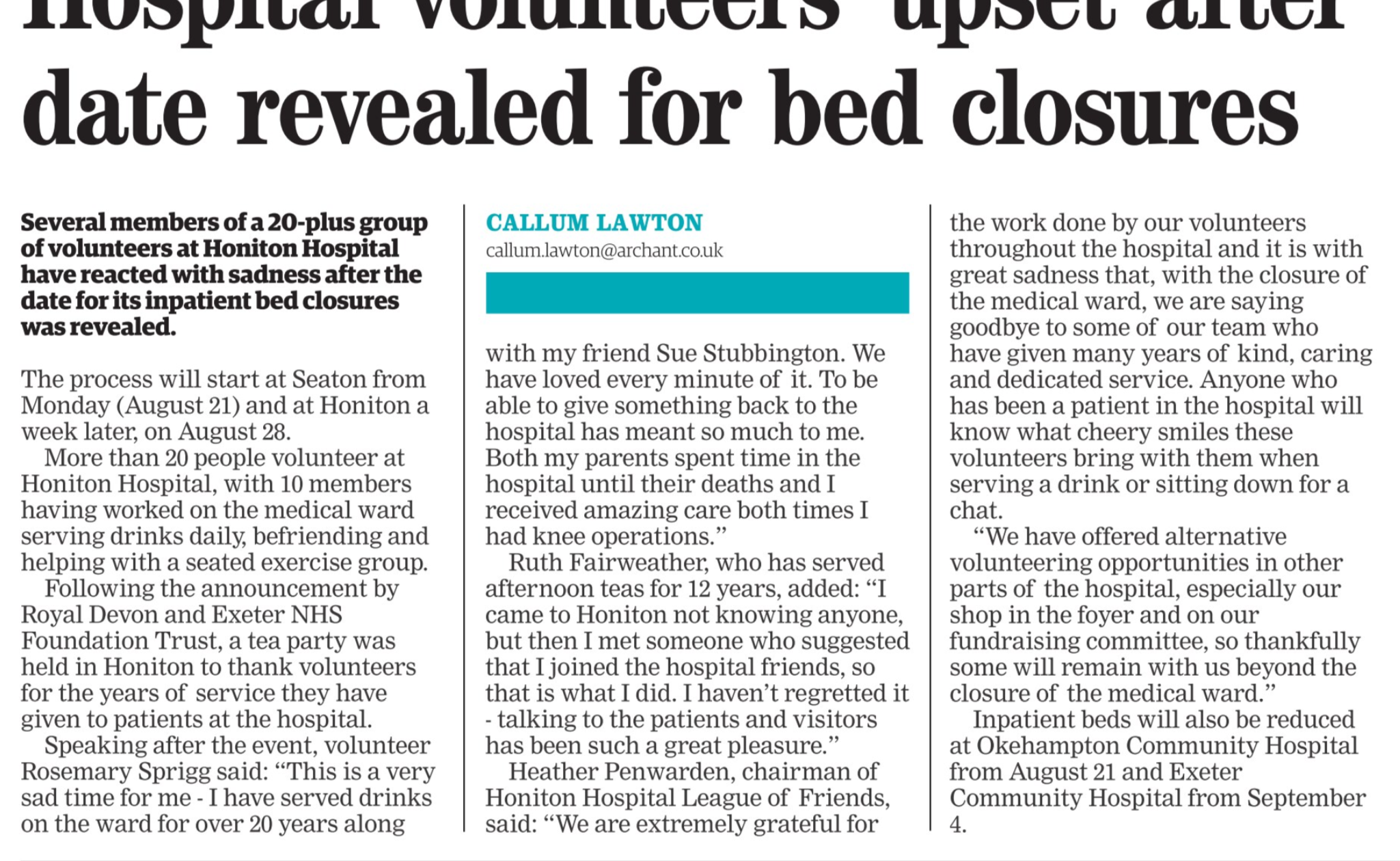
Now Seaton and Honiton hospital beds are closed, here’s something to look forward to

Better keep fingers crossed that you or your loved ones are not in a similar position to some of the people mentioned here.

But if you are one of the unfortunate ones, remember Paul Diviani (EDDC), Sarah Randall Johnson (DCC), Neil Parish MP, Hugo Swire MP, Minister Jeremy Hunt and Prime Minister Theresa May all put you there. They all have one thing in common: they are Conservative politicians whose decisions led to this situation – and think carefully about whether you would vote for them now or in the future knowing what you know now.

People who receive care at home have told a health watchdog that a lacklustre service has meant they have had to go two weeks without a shower, eat their dinner at 3.30 in the afternoon and be cared for by workers who can’t make a bed.

The failings highlighted in a report by Healthwatch England drew on the experiences of more than 3,000 people who receive care at home. Other problems described in the document include care workers coming at different times to those scheduled, not having enough time to fulfil all their duties and some missing appointments altogether.

Across England there are more than 8,500 home care providers, collectively helping an estimated 673,000 people with tasks such as washing, cooking, dressing and taking medication. The report suggested that home care was “in a fragile state” and that care packages were being “designed to meet the needs of the service provider rather than the service user”.

One home care user in Redcar and Cleveland said: “Sometimes they give me a shower but they go over their time. Most of the time they haven’t got the time to give me one so I go a couple of weeks without one and that is not right. I feel dirty.”

A woman in her 80s told Healthwatch Bradford her care workers were unable to boil an egg or make the bed, while another said staff needed to be taught “home care common sense”.

A care user in Barnet, north London, said: “I am diabetic and sometimes carers are late or don’t show up and that really affects my medications and insulin administration.”

However, Healthwatch, the health and care consumer champion, stressed that most people had positive things to say about their domiciliary care – with many older people praising the service because it enables them to remain in their own home and to maintain as much independence as possible.

Neil Tester, the deputy director of Healthwatch England, said: “We heard examples of compassionate care from dedicated staff, but people also talked about care that doesn’t meet even basic standards. Given the challenges facing the social care sector, it is more important than ever that people’s voices are heard.”

Izzi Seccombe, the chairwoman of the Local Government Association’s community wellbeing board, said: “This report shows that while most people report that their services are good there is a need to improve services.

“The financial pressure facing services is having an impact and even the very best efforts of councils are not enough to avert the real and growing crisis we are facing in ensuring older people receive the care they deserve.

“The continuing underfunding of adult social care, the significant pressures of an ageing population and the ‘national living wage’ are combining to heap pressure on the home care provider market.”

She added: “This study shows the strain providers are under, and emphasises the urgent need for a long-term, sustainable solution to the social care funding crisis.

“While the £2bn announced in the spring budget for social care was a step in the right direction, it is only one-off funding and social care services still face an annual £2.3bn funding gap by 2020.”

A Department of Health spokesman said: “Everyone deserves access to high-quality care, including those who receive it in their home. This is why we have introduced tougher inspections of care services to drive up standards, provided an additional £2bn for adult social care, and have committed to consult on the future of social care to ensure sustainability in the long term.”

https://www.theguardian.com/society/2017/aug/24/report-highlights-failings-of-home-care-services-in-england

Exmouth: EDDC and Grenadier sign contract

And here is the spin, spin, spin:

“East Devon District Council has confirmed it has signed a deal with Grenadier Estates for new watersports centre in Exmouth.

The watersports centre will be community focused and a not for profit development, and forms an integral part of the council’s plans to regenerate the seafront area, the new centre will be built on a former car park on Queen’s Drive.

As well as offering watersports facilities, a new access ramp will be incorporated within the development allowing easier access to the beach, and will further confirm Exmouth’s place as a leading UK watersports destination, the council say.

Cllr Philip Skinner, the council’s portfolio holder for economy, and chairman of the Exmouth Regeneration Board, said: “I am delighted that we are entering into this agreement with Grenadier Estates. There has been a long-held commitment to have this watersports centre for Exmouth and we are now taking a huge step forward to achieving this ambition.

“The council, through the Exmouth Regeneration Board, has delivered significant improvements for Exmouth over recent years including the new Strand in the town centre, the new Premier Inn and more recently, the re-opening of a brand new Mamhead slipway. The delivery of the first phases of the Queen’s Drive regeneration is now the next step in this exciting journey for Devon’s largest town.” …

http://www.devonlive.com/news/devon-news/deal-signed-developers-new-watersports-369821

There is more in the same vein, but Owl can’t bear to give them more oxygen of publicity.

A VERY extraordinary council meeting on Exmouth seafront businesses!

Owl predicts it will indeed be extraordinary – if it happens!

“East Devon District Council says it is to hold an extraordinary meeting to discuss the future of two Exmouth seafront businesses which are set to close imminently.

The council confirmed its chief executive was considering a request for a meeting to discuss the future of Exmouth Fun Park, set to close next week, and the Harbour View Café, set to close at the end of September.

A spokesperson said: “We will announce shortly when that meeting will be held.”

The sites of those businesses are needed for phase three of EDDC’s proposed three-phase seafront redevelopment plans, but there is currently no developer in place for this phase, and it was revealed last week that the site has not yet been remarketed to developers.

EDDC said last week that sites would be boarded up ‘for a time’, but that temporary attractions could be provided.”

http://www.exmouthjournal.co.uk/news/council-set-to-hold-extraordinary-meeting-on-exmouth-seafront-businesses-1-5160421

Do it for dogs and London hospital but not in your own constituency

Dogs:

London hospital:

Local hospital:

Claire Wright and MP Hugo Swire with protesters at Ottery St Mary hospital on Saturday Ref sho 21-16SH 4964. Picture: Simon Horn.