
Let’s hope our CEO and Electoral Officer manages to do a good job …. as he did manage to “lose” more than 6,000 voters a little while back …..
Monthly Archives: March 2019
Clinton Devon Estates: Director with too many fingers in too many public body pies?
Owl has been pondering the potential for conflicts of interest between some of Clinton Devon Estates’ (CDEs’) more environmentally sensitive development plans and the activities of its Estates Director, John Varley.
On the CDE website, at the time of going to press, Estates’ Director, John Varley is described as follows:
“John’s current non-executive positions include Board Member of the Environment Agency (EA) and Natural England (NE).”
Clearly he is a very influential man.
Owl remembers him being appointed to the Environment Agency Board in 2012 (£21,002 per annum). [This coincided with CDE’s their first planning to extend their cow sheds in the Otter flood plain at the bottom of Colaton Raleigh – something we will return to]. Owl finds John is still on EA’s Board.
But he seems to be a bit confused about his role with Natural England. Owl doesn’t see his name listed as a current Natural England Board member. So Owl has had to call in the Ferrets.
They report that John Varley, whilst on the Environment Agency Board, was also welcomed onto board of Natural England on 29 April 2015 (remuneration £10K-£15K). They also have discovered that he was reported as being “sad to depart before the end of his term” at the meeting of 22 March 2017.
They also note that he has popped up again as chair of the review which will consider all aspects of Network Rail’s approach to vegetation management 12 July 2018.
There is no suggestion whatsoever that John Varley has ever failed to declare an interest. Indeed, the Ferrets find that, quite properly, he had to leave the room during discussion of the agenda item on the reintroduction of beavers on the River Otter at the Natural England Board in September 2015.
What worries Owl is the conflicts, real or imagined, this might pose to the local staff of the Environment Agency and Natural England as they comment on CDE planning applications “without fear or favour”. Owl is also concerned about how it looks in the daylight.
In the old fashioned world Owl was brought up in any potential conflict would have been avoided. Those in a position to wield influence would do the “honourable” thing of either resigning or at least ensuring any applications they could be associated with were made in exemplary fashion.
Owl is not convinced that CDE’s recent planning applications could be described in this way. For example, consider the controversial 2012 applications to extend the cow sheds at Otter Farm, Church Road, Colaton Raleigh (application 12/0400 superseded by 12/2660).
One aspect of the controversy concerns whether or not either of these applications should have had a flood risk assessment. The fact is that Otter Farm is in flood zone 3, but it was claimed that the adjacent cow shed site, literally only yards away, would only lie in Zone 1 (1 in a 1,000 years risk). This was confirmed by EA on 6 February 2013:
“We have had a look at this one and feel, due to the nature of the development that a Flood risk Assessment would not be necessary. Of course we would still expect the applicant to demonstrate a commitment to SUDs in the design of their surface management for the site.”
[SUD – Sustainable drainage system]
However, this was queried by many on the basis of local knowledge including the Parish council, which, in February 2013, asked “for a better assessment in view of recent flooding incidents in the area”. The details were spelled out rather more graphically by one resident who expressed concern that “recently slurry was allowed to escape into the river (Otter) and into Railway Cottages”.
EA wrote again later in February: “Regarding the above, we have been advised that the site is over 1ha, if the new access road is included. If this is the case we are happy to review the application if accompanied by a Flood Risk Assessment”.
Eventually a detailed Environmental Management and Waste Management plan was submitted in April along with a Sustainable Drainage System Design of 66 pages. In May the Environment Agency recorded its thanks to: “you and your colleagues for meeting on site with [ ] to consider measures that could reduce flooding risks for the nearby Railway Cottage.”
Owl now flies forward to a more recent, even more controversial, case that of CDE’s application 17/3022 to extend the Blackhill Engineering works on Woodbury Common, submitted in December 2017.
It is clear from NE’s first comments that the Visual and Environmental Impact Assessments accompanying the application were still not up to scratch. NE’s comments 6 February 2018 read: “As it stands, we have significant concerns regarding the potential impacts of these proposals. We will provide more detailed advice once we have reviewed the additional information.”
Only Axminster chosen for cash for ailing High Streets
Bet it won’t only be Cranbrook with its non-High Street (currently only 5 shops for the growing town) that will be miffed but also Seaton, where the Tesco superstore has sucked the life out of its High Street!
“Axminster will be put forward as the East Devon town to try and grab a share of a £675m fund to ‘help failing High Streets’ – ahead of Cranbrook.
East Devon District Council’s cabinet on Wednesday night agreed to submit a bid for Axminster to the Government’s Future High Streets Fund.
The Future High Street Fund has been set up to help address the significant structural changes that are currently having an impact on towns and high streets throughout the UK. …”
https://www.devonlive.com/news/devon-news/councillors-choose-axminster-over-cranbrook-2619176
“One pensioner in five forced to cut back on heating this winter to afford bills”
Owl says: Still, no worries, we have that lovely nuclear energy from Hinkley C to look forward to. Oh wait, the Government set the price it will pay to its Chinese and French owners stratospherically high!
“More than one over-65s in five was forced to cut back on their energy use this winter just so they would be able to afford their bills.
Figures from comparethemarket.com also show almost half (48%) of the age group are worried about their the cost of their energy, while one in eight (12%) don’t think they can afford any increase.
One over-65 in 12 said their health suffered because they limit the amount of heating they use while one in 14 said they were considering downsizing their home to reduce their energy bills.
“Nobody should be forced to sacrifice their health in order to heat their home, and especially not some of the most vulnerable members of our society, the elderly,” said Comparethemarket head of energy Peter Earl.
“Cold weather and the resulting financial and health problems are a real issue for older people, who have to worry about cold temperatures every year.
“It should be an absolute priority to ensure that they are able to afford their energy costs and appropriately heat their home.” …”
https://www.mirror.co.uk/money/pensions-heating-energy-bill-afford-14096207
Claire Wright (Independent DCC councillor) asks unpaid carers in Devon to contact her
From Independent DCC Councillor Claire Wright’s Facebook page*
“I am chairing a scrutiny review into how unpaid carers in Devon are managing and would really like to hear from you if you are caring for a relative, spouse or friend.
It has taken quite a bit of pushing to get the review to take place. It was finally agreed at last September’s Devon County Council Health and Adult Care Scrutiny Committee meeting… and then it has taken a while to get the first meeting set up.
To recap, I last raised the issue as a matter of concern at committee over a year ago after seeing the results of a local focus group which indicated that unpaid carers were feeling exhausted, short of money and stressed from a lack of respite care.
I am pleased to report that the plans for a review now seem to be progressing well and there is some survey work to be undertaken before face to face discussions can begin.
The first review meeting will take place in July (after a local carers survey has been analysed) and the plan is for members of the spotlight review to travel to local carers groups and hear firsthand how people are managing.
The review is scheduled to report back to the September Health and Adult Care Scrutiny Committee, hopefully with some useful recommendations.
If you’d like to take part, I would love to hear from you in writing and/or in person.l
Please get in touch with me in the first instance by email at
claire@claire-wright.org
Thank you!
“Our Council Funding Crisis Will Not Be Solved By A Small Pot To Fix Short-Term Problems”
“When people voted to leave the European Union in 2016 it expressed a clear demand for change. Many felt that the places where they lived had been locked out and left behind by prosperity while they could not see opportunities for them and their families to achieve a better life.
On Monday, the government announced a new £1.6billion Stronger Towns Fund to be spread over seven years – but the lukewarm response has reflected the urgency for much more serious and sustained investment in all the communities that need it. There needs to be investment that people can see and feel, and prosperity that they feel they are a part of.
The announcement reflects the needs of many of our towns, but we need to see far greater ambition in terms of boosting job prospects and living standards throughout the UK. We need a series of significant investments as part of a long-term plan to transform prospects and help the four million people in working poverty in the UK.
The Government’s commitment to deliver on its Shared Prosperity Fund – a manifesto pledge to replace the EU structural funds for economically disadvantaged places – has far more potential. Fully implemented, it could make a much more significant difference to people in places that have been locked out of prosperity. EU Structural Funds are currently worth £2.4billion a year in EU and national match funding.
But we’ve been waiting over a year for the consultation to be published on what the Shared Prosperity Fund should look like, let alone seen any progress on delivering for the places that need it. It’s not just towns that are struggling, rural areas are too and some of the lowest employment and pay is found in cities such as Nottingham, Leicester, Manchester, Liverpool and Birmingham.
“I’ve done labouring and warehouse work, manual labour most of my life … work with bricklayers, joiners, different trades. Warehouses, packing … I’d prefer to … have a decent wage. I’ve never had secure employment. The longest I’ve worked is about three months max. There have been big stretches of unemployment, like years – two years.”
At JRF we root our work in the experiences of people in poverty, and as this man describes too often work provides an income but fails to deliver the security that enables people to build a better life. In parts of the UK this is sometimes all that is effectively on offer. While the country overall has a great story to tell on employment some people are locked out of this success because of where they live, with some places reporting employment rates over ten percentage points behind the average.
The Government has emphasised that both the Stronger Towns Fund and SPF will focus on closing productivity gaps – but this must be done in a way that delivers inclusive growth. That means growing the economy and creating jobs for those locked out of the labour market, making sure people have skills to get on at work, and improving firm performance in low pay sectors like hospitality and retail.
HuffPost’s joint investigation with The Bureau of Investigative Journalism into local authority selloffs, especially those being used to fund redundancies and cuts, demonstrates how these economic challenges can be compounded, leaving places with a sense of decline. Where towns, cities and rural areas lose jobs, services and their sense of purpose, people can be swept into poverty of every kind.
Living without secure employment means living without the ability to save or plan – one of the burning injustices which the Prime Minister pledged to tackle on taking office. It is absolutely right that we look at how to help communities around the country – whether it is Wigan, Bassetlaw or Doncaster. But the way forward must solve deeper problems than the parliamentary conundrum which currently faces the Prime Minister.
It is essential that the pledged funding via the Shared Prosperity Fund is based on need, as the communities secretary James Brokenshire pledged the new Stronger Towns Fund would be. Funding needs to recognise the real experience of economic challenges facing towns and cities across the UK, as highlighted in the HuffPost investigation.
People around the UK need to know how this wrong is going to be righted through the Brexit process and beyond. Implementing the Shared Prosperity Fund needs to be the priority for beginning to shape a new deal.
If the Government is serious about transforming towns, and anywhere else people are not enjoying the opportunities or living standards prosperity brings, it needs to bring serious money to the table. A small pot to fix short-term problems is not ambitious enough and may fail to solve the conundrums of either local prosperity or parliamentary arithmetic.
Campbell Robb is the chief executive of the Joseph Rowntree Foundation
https://www.huffingtonpost.co.uk/entry/local-government-cuts_uk_5c7ea408e4b0e62f69e6da2d
What is an Owl?
Thanks to a reader for this:

Rural communities and elderly will be hard-hit by cashless society
As banks and cash machines are being closed in rural areas, and where broadband for internet banking may be poor, people will struggle:
Ambulances not reaching rural areas quickly enough
The article includes a postcode checker to show the situation where you live.
“Critically injured patients in rural areas are at risk due to the time it takes the ambulance service to reach them, a BBC investigation has found.
Some rural communities wait more than 20 minutes on average for 999 crews or trained members of the community to reach life-threatening cases such as cardiac arrests and stab victims.
A response should come in six to eight minutes, depending on where you live.
Experts said delays could make the difference between life and death.
This was particularly the case for cardiac arrests where “every second counts”, the British Heart Foundation (BHF) said. …”
Quick! Get your letters in to Swire – you have a short window in which he might reply!
Many berate Swire for not answering their letters or giving “automated” replies.
Well, local elections and a possible general election seems to be concentrating his mind and rumours reach Owl that – VERY unusually – he (or his wife who draws a £35,000+ salary for “helping” him) is answering letters!
Get them in NOW! Once elections have passed and/or Brexit is sorted one way or the other, normal service will no doubt be resumed!
Owl would love to know if this also applies to Neil Parish in the east of our constituency. Time to nobble him about Persimmon in Axminster, perhaps!
” ‘Totally unfair’ and ‘no way to run public services’: Two councils slam government as £40m total cuts approved”
Owl says: but Conservative policy is to shrink or eliminate the “state” (i.e. public services) and use private companies to make profits out of services, so actually it IS their way of doing things and IS extremely successful!
“Two councils have approved over £20m worth of cuts as both authorities slam an “ever-increasing tough financial climate” due to austerity and a “totally unfair” year of drastic government cuts.
Doncaster Council and Nottingham City Council yesterday both approved budget proposals to make £21m and £23m of savings respectively, with substantial council tax hikes and job losses amongst the plans.
Nottingham council said its central government funding had fallen from £127m in 2013 to just £25m for next year, leading to difficult decisions such as the initial reduction of 27 jobs “with more likely.”
Other cuts at the authority include reducing Link Bus services, a range of changes to adult social care, reducing contributions to its youth centre, and a 2.99% council tax rise.
The council said independent analysis shows that places like Nottingham with higher deprivation have been hit harder by government funding cuts compared to areas such as Surrey, leaving the authority “with no other option” to enforce cuts and raise council tax.
Nottingham City Council leader Jon Collins went further, stating that the tenth budget in a row with funding cuts was made worse by the “totally unfair blatant favouring by government of Conservative-led councils in affluent southern areas.”
“It means setting this budget has been extremely difficult and we don’t take any pleasure in making decisions which detrimentally affect local service users.”
Doncaster Council has had to use some of its one-off reserves to meet its budget gap for 2019-20 and still forecasts a further deficit of £13m for the following year.
It has proposed a 5% council tax increase using the social care ‘precept’ to generate over £5m towards plugging the budget gap, but stresses that £323m will be given to capital funding for projects to stimulate growth over the next four years.
Mayor Ros Jones also slammed the government over a lack of certainty around local government funding.
He stated: “The government continues to cut our funding with no plans for the future.
“Doncaster has been hard hit and it is beyond belief that there is no firm plan for the sustainability of local government finances post 2020.
“It’s all well and good having individual funding streams and one-off pots of money that we can bid for but it’s no way to run public services.”
“Homeowner discovers 700 faults in £280,000 [Persimmon] new house after spending life savings”

“Great British sell-off: how desperate councils sold £9.1bn of public assets”
” … Far-reaching research by the Bureau for Investigative Journalism and the Huffington Post UK has found that nine years of swingeing central government cuts to local council budgets have resulted in a vast and irreversible sell-off of public assets. Of England’s 354 local authorities, 301 replied to the primary Freedom of Information (FOI) request, which revealed that between 2014 and July 2018, more than 12,000 publicly owned assets have been offloaded by local councils. In total more than £9.1bn was generated.
Some of the assets sold off are grand historic buildings; some are small scraps of land. All are now gone forever, in a one-off fire sale of public assets accumulated over many decades, intended to serve the public good, and now generating profit for their new private owners.
Replies to the Bureau’s second set of FOI requests were even more comprehensive (342 out of 354) – and alarming. These concerned the use of “flexible capital receipts”, and showed that in many cases local councils have begun offloading their assets – playing fields, community centres, libraries, youth clubs, swimming pools – to fund redundancies made necessary by central government cuts.
Until new legislation was introduced in April 2016, councils had to to use any proceeds raised from selling land and buildings they own to buy new assets. David Cameron’s government changed all that by allowing them to invest the proceeds of any assets sold by April 2019 to fund frontline services.
FOI data shows that in the first two years following the change in the law, at least 64 councils – one-fifth of those who responded – used these capital receipts to plug gaping holes in their budgets. Often, this has included redundancy payments.
In some cases, desperation has driven local authorities to offload these public assets at knock-down prices. Northamptonshire – which relied on selling assets to plug huge gaps in its finances – got rid of land or buildings it owned for less than they were worth on 12 separate occasions, potentially missing out on income of £6.3m. Half of these under-value sales were to property developers. …”
Temporary Exmouth seafront attractions have already cost us £300,000
Owl says: imagine if other coastal towns in East Devon had this much spent on them …
“Under questioning from [Independent councillor Megan Armstrong at last week’s East Devon District Council meeting, Councillor Philip Skinner revealed that £285,305, was spent by the council for the first year of the new attractions in Queen’s Drive, Exmouth.
Cllr Skinner said that the costs included £155,000 on the new dinosaur-themed play park, as well as other costs on the beach bar seating area, the events stage and making the whole site safe.
He also said the council spent £22,850 putting on events such as free live screenings from the Royal Opera House.
Under questioning from councillor Megan Armstrong at last week’s East Devon District Council meeting, Councillor Philip Skinner revealed that £285,305, was spent by the council for the first year of the new attractions in Queen’s Drive, Exmouth.
Cllr Skinner said that the costs included £155,000 on the new dinosaur-themed play park, as well as other costs on the beach bar seating area, the events stage and making the whole site safe.
He also said the council spent £22,850 putting on events such as free live screenings from the Royal Opera House.
In response, Councillor Skinner said he didn’t expect to be facing criticism for investing money in Exmouth.
He said: “We are trying to get more people into the town, and to get them to spend more money there.
“It shouldn’t be a criticism that we are investing more in Exmouth and the town councillors should be chuffed to think we are investing in the town.
“We tried new things and people did like them.
“Some events didn’t go well, but others did.
“We made all of our revenue costs back and made a profit, and I expect to do so in future.
“We are continuing to invest in Exmouth’s seafront and have also been invited to a Stage 2 bid for Coastal Communities Fund that will further benefit the seafront.
“For 2019, our budget is £75,000, which includes staffing, event cost, equipment hire, maintenance, security and utility costs.
“We expect to secure income of between £30,000 and £40,000 this year, depending on sponsorship secured, and a further £12,000 for the big wheel.”
https://www.exmouthjournal.co.uk/news/seafront-attractions-cost-1-5917372
Why all the good news? Because on 26 March “purdah” starts before local elections!
Expect a lot of good news from the majority party at EDDC for the rest of this month. Why? Because all political new from EDDC (not its individual councillors) has to STOP on 26 March 2019.
Why?
As local elections take place on 2 May 2019, a period of weeks before the election is called “purdah” and councils must stop pushing politicised events and publications to avoid charges of unduly influencing electors to vote for them.
A good explanation of purdah (and what to look out for if officers or councillors break these rules) can be found here:
“How to register to vote (spoiler: it’s very easy)”
“DON’T MISS OUT ON YOUR DEMOCRATIC RIGHTS
Deadline to register
for the May 2019 local elections across large parts of England:
Friday 12 April
To be able to vote, you have to be on the electoral register and to do that, you have to fill in a simple online form. Completing other official paperwork, such as getting a passport, paying Council Tax or getting a driving license doesn’t result in you being automatically added to the register. It is a separate process.
You only need to register once; you don’t need to register separately for every election. However, you do need to register again if you change your address, name or nationality.
You have to be 18 on polling day to vote (or 16 for Scottish Parliament and local elections, along with some but not all referendums). For that reason, you can register in advance of your 18th birthday so that if an election is called whilst you are under-age but you will be 18 on polling day, you can therefore still get your vote.
EU citizens are able to vote in the UK by the way – for council elections although not for the Westminster Parliamentary elections. Commonwealth and Irish citizens can also register to vote and they’re allowed to vote in all types of elections.
To register online right now, head over to the official registration site:
https://www.gov.uk/register-to-vote
If voting in person isn’t the right option for you, either for a temporary or permanent reason, then once who are on the register you can also apply for a postal vote:
https://www.yourvotematters.co.uk/how-do-i-vote/voting-by-post
or appoint someone to vote on your behalf (a proxy vote):
https://www.yourvotematters.co.uk/how-do-i-vote/voting-by-proxy
Got 5? Register to vote in the 2019 local elections!”
https://www.markpack.org.uk/8456/how-to-register-to-vote/?goal=0_8f22492d8e-73a05f74d3-312639877
Swire to attend CPRE seminar on Devon Housing – tickets available
Date And Time
Thu, 21 March 2019
11:00 – 15:00 GMT
at
The Estuary Suite
Sandy Park
Sandy Park Way
Exeter
EX2 7NN
Tickets £5 each available via Eventbrite
https://www.eventbrite.co.uk/e/devons-new-housing-need-a-government-local-authority-perspective-tickets-57377917897
“Have you noticed how many houses are being built in Devon? Do we need so many? What is the genuine underlying need? How many are genuinely affordable? Who are the planned new houses actually for? How many new homes are planned for your community and where?
To address these questions and more, we are delighted to have organised this important seminar where we will be joined by Kit Malthouse MP, Minister of State for Housing & Planning, Sir Hugo Swire MP East Devon and Stephen Walford, Chief Executive Officer Mid Devon District Council. CPRE Devon’s Dr Phillip Bratby will also be summarising the key findings of our recently commissioned independent Devon Housing Need Report.
What do you think of all the new house building in Devon? Please join us for this important and exclusive opportunity to hear from our guest speakers and to put your questions to them. All welcome. Admission by ticket only. £5, to include refreshments.
CPRE Devon – The Voice for Devon’s Countryside
http://www.cpredevon.org.uk
“Tory MP complains that Government isn’t giving Brexit bribes to South West MPs – because the region voted Conservative!”
From the blog of Independent DCC Councillor Martin Shaw, East Devon Alliance:
“The Government has announced its bribes to towns in order to persuade MPs, mainly Labour, to vote for its miserable Brexit deal.
Although it claims to have used a “need-based formula,” the South West is to receive the second-lowest allocation of cash (£33 million) despite being among England’s most deprived regions.
Coincidentally, it also has very few Labour MPs — and Sheryll Murray, the Tory MP for South East Cornwall, appears to have spotted the discrepancy.
“The fact this money appears to be directly routed to Labour-voting areas smacks of pork-barrel politics, and the public will know that,” Murray complains to The Times.
“It would be a crying shame if Conservative-voting communities were being disadvantaged because of the way they voted.”
How many Retrospective Applications can one company do at once? Answer 9! Where? Greendale Business Park!
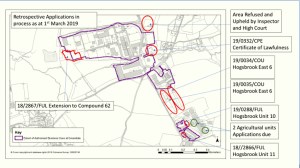
In 2017 FWS Carter and Sons, the owners of Greendale Business Park, appealed against an “Enforcement Notice” against the removal of various industrial compounds and buildings at their Business Park, which they had built prior to obtaining planning permission.
They lost their appeal with the Planning Inspector, who stated in his report that FWS Carter and Sons had misinterpreted the East Devon Local Plan and that their interpretation was “patently wrong”.
But undaunted the company challenged the Inspectors decision in the High Court. Early last year the company lost the appeal in the High Court. The Judge’s decision also restricted the owners any further opportunity to appeal and them to pay all costs arising from the case.
The Company was required to return the area back to agricultural use, but it transpires that they imported soil and laid this over the concrete yards and simply reseeded it.
It remains to be seen if the covering the concrete is enough to satisfy the Planning Inspectors requirement that the land must return to agricultural use.
Lessons learnt?
So once bitten, twice shy you would have thought with substantial losses, large court fees and professional fees involved!!
Unfortunately, it would seem not, for this family run business. Now there are 9 applications which are known to have been or are in the process of building work before the Planning Applications were submitted.
18/2866/FUL. A retrospective planning application for a rear roller shutter door and concrete pad on the rear of an industrial building onto agricultural land at Unit 11 Hogsbrook Farm. This application is before East Devon’s Planning Committee on Tuesday 4 March.
19/0034/COU. A Retrospective Application at Hogsbrook East 6. A retrospective change of use from agricultural use to industrial. An interesting history to this one! Originally built for a gas pipeline contractors’ compound that had to be returned to agricultural use when the pipeline was completed. However, FWS Carter and Sons applied for planning permission to retain the secure compound for fruit farming. Instead of fruit-growing, Woodbury Carbreakers as tenants stored scrapped vehicles there instead! After 3 years and a court case they were eventually evicted by the Environment Agency, but the owners then used it for commercial storage. Their application for industrial use failed 3 years ago, but just before an Enforcement Notice was served in late 2018 they submitted a further application. But they withdraw it and submitted this latest application.
19/0035/COU. A Retrospective Application next to Hogsbrook East 6. Very similar to the previous application which was used for the gas pipeline company. FWS Carter and Sons submitted, what is called a “Certificate of Lawfulness” which in planning terms means that after 10 years of illegal use they would not require planning permission, to allow to continue operations. However, their own documents clearly stated that gas pipeline contractors had been tenants until July 2009. As this was classified at permitted lawful use the submission was refused. Just as the previous application prior to an “Enforcement Notice” was served as the previous site in late 2018 they submitted a further planning application. They again withdraw it, a submitted this further application.
19/0332/CPE. This was a submission of a “Certificate of Lawfulness” at Greendale unit 33A. Following the publication of the East Devon Villages Plan it was realised that this unit was outside the permitted “Employment Zone” for Greendale Business Park. This was because in its 15 years of operations, planning permission had never been applied for! Therefore, the Local Authority asked the company to summit the paperwork to legalise the operation.
19/043/FUL. A Retrospective Application for 3 Freezer storage pods at Compound 31. The compound is used by DHL Logistics for parcel distribution, but early last year after winning a distribution contract with Kentucky Fried Chicken they started frozen food distribution as well. Several residents living close by the noisy freezer units and hearing the loading and unloading during the night reported the problem to Environmental Health at East Devon. They suggested to the Planning Department that a retrospective application should be submitted.
19/0288/FUL. A Retrospective Application for an extension to Unit 10 at Hogsbrook Farm to extend an Industrial Building which sits on the Employment Boundary of Greendale Business Park. This would mean that the extended building would straddle the boundary between Industrial/Agricultural use.
18/2867/FUL. A Retrospective Application to extend Compound 62 beyond the Employment Boundary into agricultural and landscaping area. The area has been built up over recent years with inert waste material under an Environment Agency permit but it would seem the Company has gone beyond the permitted landfill area.
There are 2 further Retrospective Planning Applications due for extensions to Agricultural units that have been reported to the Enforcement Officer at East Devon District Council.
That’s nine Retrospective Applications in a row. Is that a record!!
And the Government still insist that Planning Authorities treat Retrospective Applications the same as any other Application!
“Councils using cash from property sales to fund redundancies”
“Councils in England have spent £115m of money raised from property sales on funding redundancies, analysis has revealed.
Since former chancellor George Osborne relaxed rules on councils spending receipts from public assets in 2016, 64 councils in England have spent £381m generated by property sales – a third of which (£115m) was used to make staff redundant, according to the research by the Bureau of Investigative Journalism and Huffpost UK.
Previously, when a local authority sold off an asset, it could only use the money to fund the cost of replacing that asset. However, changes introduced by Osborne allowed councils to spend those receipts on cost-cutting measures.
Freedom of Information requests submitted by the Bureau revealed that councils that made the most of this law change had a redundancy rate 75% higher than councils that did not.
In Bristol, the number of council workers made redundant has jumped ten times since the change, from 39 in 2015-16 to 401 in 2016-17.
Simon Edwards, director of the County Councils Network, said: “In rural England, county authorities face a £3.2bn funding gap by 2020, largely due to costs outside of their control.
“It is therefore inevitable that councils have had to reduce highly-valued services to a minimum, with discretionary services disappearing and new charges introduced for services ranging from black sacks to parts of social care.
Urban councils also used asset receipts to fund redundancies, with five London boroughs doing so. Haringey spent £8m this way and job losses increased 70%, according to the data.
Northamptonshire County Council agreed the sale of its brand new council headquarters in April last year for a sum of £64m. This was the single most valuable asset sold since 2016, the research found.
Andrew Gwynne, Labour’s shadow communities and local government secretary, said: “Austerity has hollowed out the heart of our communities. This report reveals the shocking disposal of our community assets under the Tories.
“Cuts have forced many councils to sell off their parks, community centres and libraries; cut back on staff and the neighbourhood and care services that all of us rely on; and push up council tax – just to keep the lights on.”
https://www.publicfinance.co.uk/news/2019/03/councils-using-cash-property-sales-fund-redundancies
 East Devon Watch