John Crace, Guardian (humourist) columnist – but actually far, far too close to the truth.

“Left hand meet right hand. Just weeks after the prime minister insisted there was no extra spare cash for schools, the education secretary came to the Commons to make a statement on how she had miraculously found more money for schools.

Being a minority government is proving to be a very expensive drug habit for the Tories.

As is traditional with any U-turn, Justine Greening began by saying that everything was basically running brilliantly. Teachers had never been happier, pupils had never been happier.

Then came the but.

But she had listened to the concerns that people had raised during the election and had managed to come up with an extra £1.3bn over the next two years to offset any unfairness in a system that was definitely, totally fair.

“Let me be clear,” she said. “This is additional funding.” She had gone head-to-head with the chancellor, and Freewheelin’ Phil had blinked first. She’d tipped him upside down and a DUP-sized bung had fallen out of his pockets.

Only she hadn’t. At this point, Greening’s triumphal tone became more of the mumble of a remedial reading class. Barely audible were the words “efficiency savings”, “no cost to the taxpayer” and “transparently”.

So much of Greening’s statement had been barely audible that it took a while for the shadow education secretary, Angela Rayner, to actually make any sense of what had been said.

Justine Greening raids free schools budget for £1.3bn education bailout
It was only after mistakenly welcoming the “new money” that it dawned on her that nothing about the money was new. She hastily corrected herself and inquired where the savings were going to be made. Had the government finally admitted that its free schools programme was a bit of a waste of money?

“We’re not cutting the free schools programme,” Greening replied. The very idea. “It’s just we’re financing it in a different way.”

In a way that it would have £200m less. Even some of her own backbenchers had the grace to look embarrassed by this. Either the education secretary didn’t understand basic maths or she didn’t understand basic English.

Conservative Robert Halfon, the new chair of the education select committee, was quick to spot that, even after cutting £200m from the free schools budget, there was still £1.1bn of savings unaccounted for. Did she have any idea what other programmes she would need to cut?

Not really, Greening replied. There were a lot of different programmes and sooner or later she would get round to working out which ones were pointless and then she’d make the cuts accordingly. All she could promise for now was that the savings would definitely come in at £1.3bn in total.

It was quite some admission, as Greening rather fancies her chances of taking over from Theresa May.

Telling parliament she had been presiding over a government department that has been happily wasting £1.3bn a year, without feeling the need to do anything about it up till now, might not be the smartest job interview. There again, she isn’t up against the stiffest of opposition. The gene pool of available talent in the Conservative party is vanishingly small.

Having basically informed everyone that she wasn’t particularly good at her job, it was little surprise that everything rather went downhill for Greening from then on.

Labour’s Lucy Powell and the Liberal Democrats’ Ed Davey tried to help her out.

Let’s not worry about whether the £1.3bn was new or old money, they said. They understood that difference might be too nuanced for her. Let’s concentrate instead on the fact that £1.3bn is still going to be at least £1.7bn short of the figure the National Audit Office had said was required to maintain funding at its current levels, given rising costs and pupil numbers.

“Er …” Greening struggled. Er … All she could say was that under the new arrangements schools would be getting £1.3bn more than they had been getting an hour ago – apart from those whose budgets had been cut to provide the extra money for all the others – and it would be a big help if people could just be a bit more positive about the announcement.

Not even her own backbenchers could go along with that, and one after the other stood up to inquire if the unfairness in the funding formula would be addressed in their own constituencies.

Greening didn’t seem to have the answer to this. Or anything much. The government is now so weak that even what are intended to be good news statements are going down like a cup of cold sick.”

https://www.theguardian.com/global/2017/jul/17/tory-magic-money-tree-allows-justine-greening-to-splash-cash-on-schools

“Tory MPs Stop Public Submitting Petitions To Government Until At Least September”

“Members of the public are unable to submit any petitions to Parliament this summer thanks to Tory MPs.

Conservative backbenchers are delaying elections to Parliamentary committees until September – including the one which runs the petition website.

No new petitions have been allowed since Parliament broke up for the election on May 3, and all those open at the time were closed.

Mark Hunt, Communications Director at the charity Meningitis Now, is frustrated this vital tool for the public to put pressure on MPs is unavailable.

The charity helped sign up more than 823,000 people to a petition calling for the meningitis B vaccine to be given to all children after two-year-old Faye Burdett died just 11 days after contracting the illness.

Hunt said: “For us, the e-petition provided an open and transparent process for challenging government thinking around a topical and genuine issue, and whilst the petition didn’t succeed in its stated aim, it made the process of democracy more open and transparent.

“Having witnessed and been part of the e-petition process and the way that it gave the general public the chance to express its views, it would seem to be a retrograde step to postpone or deny them this opportunity even in the short term.”

The elections to parliamentary committees are organised by the Tories backbench 1922 Committee – but that body only held its own vote today on who should fill the officer positions needed to run the elections.

Should the Tories wish, they could hold the parliamentary committee elections before the summer recess – which starts on Thursday – but it has been reported the whips office are delaying the process.

Tory MP Julian Lewis – re-elected chair of the Defence Select Committee – last week resorted to asking Commons Speaker John Bercow for his help in moving the process along.

Bercow replied: “If memory serves me correctly, what the officers of the 1922 Committee usually do in respect of their party—perhaps something similar operates in other parties—is simply oversee the count.

“Whether the officers of the 1922 Committee have or have not been elected is not a matter for the Chair—that is a party matter—but, frankly, overseeing the count does not require Einsteinian qualities; it is a pretty prosaic task.

“I do not think it would be right to say that the resources of the House could be made available in what is essentially the oversight of a matter undertaken by parties.

“However, it would seem to be perfectly feasible, if my colleagues, the Deputy Speakers, were so willing, that they and I could volunteer our services to oversee the count, if the House thought that that would be helpful.

“My basic point stands: do colleagues want these Committees to be set up sooner rather than later?

“If they do not, that is a pity, but if they do, those of us who are of good will and can be relied upon to conduct the count perfectly fairly, would, I suspect, be very happy to offer our services.

Labour MP Helen Jones was re-elected chairman of the Petitions Committee last week, and spoke of her frustration that the system is in limbo.

She said: “The petitions site had to close when Parliament stopped unexpectedly for the general election. I know that this has been frustrating for many people.

“The site will open again once the new Petitions Committee is set up, so it’s essential that the Committee is established as soon as possible.

“This isn’t something that I can control, but I’ll be doing everything I can make sure that petitioners don’t have to wait longer than is absolutely necessary.”

http://www.huffingtonpost.co.uk/entry/tory-mps-petitions-government_uk_596ce991e4b0e983c057e8e8?
“More money for schools” con trick

There is no more money for schools – £1.3 million of the enormous free schools budget and money originally earmarked for new school buildings is being moved to the local authorities’ schools budget.

Robbing a very rich Peter to give a few crumbs to Paul!

“Justine Greening, the education secretary, has promised £1.3bn in funding for schools in England to head off a Conservative revolt, raiding the budget for free schools and new buildings to pay for the rise. …”

https://www.theguardian.com/education/2017/jul/17/justine-greening-raids-free-schools-budget-for-education-bailout

“The £104bn HS2 cover-up: Government refuses to publish report into whether the controversial rail route should be scrapped”

“Ministers were under fire last night after suppressing a key report into HS2 overseen by the country’s most senior civil servant.

The review assessed whether the UK’s biggest ever infrastructure project is on budget and provides value for money for taxpayers.

It was led by the Infrastructure and Projects Authority, which reports to the Cabinet Office, led by Sir Jeremy Heywood.

The review was concluded last summer, before the legislation required to build the first phase of the high-speed railway, between London and Birmingham, received Royal Assent.

But although the key findings were relayed to Sir Jeremy Heywood and the government spending watchdog, the National Audit Office, the report has never been published.

Sir Jeremy was nicknamed Sir Cover-Up after preventing the Chilcot inquiry into the Iraq War from seeing letters and records of phone calls between Tony Blair and George Bush.

The Government was last night under fierce pressure to release the findings after a rail expert warned that the London to Birmingham phase will cost £403million per mile to build, making it the most expensive railway in the world

How cash could be spent

An east to west high-speed trans-Pennine rail link – nicknamed HS3 – connecting Liverpool, Manchester, Sheffield, Leeds and Hull.

The electrification of the mainline between London and South Wales. Completion of this project has been delayed until 2024.

Improving rail links between London, Devon and Cornwall.

Rebuilding the vulnerable Dawlish coastal line between Exeter and Newton Abbot in Devon which has been repeatedly battered by storms and floods.

Reopening the Great Central passenger line between Burton upon Trent and Leicester. It was closed to passengers in the late 1960s as part of the Beeching cuts. Only freight trains now run on the line.

Electrification of the Valley lines in South Wales.

The calculations were produced by Michael Byng, the expert who devised the standard method used by Network Rail to cost its projects.

He told The Sunday Times that using his method the London to Birmingham phase, would cost almost £48billion – double the official estimate.

He claims the full scheme, including extensions to Manchester and Leeds, would cost up to £104billion. The first 6.6 miles, from Euston station in London to Old Oak Common, would cost £8.25billion, or £1.25billion a mile.
The Department for Transport stressed that it had not commissioned the report but said it would look at the figures.

One furious MP described a ‘pattern of concealment’ over HS2, with the Government also refusing to publish two critical Cabinet Office reports conducted in 2011 and 2012 on the project.

Ministers were finally forced to publish them in 2015, after losing a case in the Supreme Court brought by campaigners.

The Infrastructure and Projects Authority concluded last year that the £55.7billion project was £9billion over budget.

Sir Jeremy identified £9billion of savings that could be made, but because the full report has still to be published it remains unclear how he came to his conclusions.

Campaigners expressed fears that Sir Jeremy’s report had exaggerated the cost savings that could be made.

Opponents of HS2 believe the findings of the latest Cabinet Office investigation into the high-speed link have been kept quiet by ministers anxious to press ahead with the new railway without delay.

Cheryl Gillan, Tory MP for Chesham and Amersham, said: ‘No report on a project which uses so much taxpayers’ money should remain secret.

‘There is a pattern of concealment, with previous reports also withheld. If this report was positive the Government would have had no hesitation making it public.

‘This will make the public believe there is something highly risky about this project – which people like me know is the case.’

Andrew Bridgen, Tory MP for North West Leicestershire, said: ‘This white elephant is growing bigger and bigger.

‘It is especially galling to waste such eye watering sums on this disastrous vanity project when there are such pressing things to invest public money in.’

A fresh row is expected to erupt today as the Government announces the final route of the Manchester and Leeds arms of HS2.

Homes on a new housing estate in Mexborough could be bulldozed to allow the line to run into Sheffield city centre.

Transport Secretary Chris Grayling will stress the economic benefits of HS2 as he announces the winners of the first stage of the major construction contracts for the line. He will say the Government expects that the £6.6billion in contracts will support 16,000 jobs.

A Department for Transport spokesman said: ‘HS2 will become the backbone of our national rail network – creating more seats for passengers, supporting growth and regeneration and helping us build an economy that works for all.
‘We are keeping a tough grip on costs and the project is on time and on budget at £55.7billion.’ “

http://www.dailymail.co.uk/news/article-4701986/Government-refuses-publish-report-scrapping-HS2.html

EDDC: (second) postal votes fiasco WILL be scrutinised

“East Devon District Council’s chief executive will be asked to include an explanation of how 9,000 postal votes were sent out without an official security mark ahead of June’s General Election,

The postal vote pack sent out on May 25 to 9,000 voters by the Acting Returning Officer for the East Devon Mark Williams, who is also the council’s chief executive, contained voting slips that did not have an official security mark visible on the front of the ballot paper.

East Devon District Council were responsible for printing the ballot papers but Mr Williams issued a statement reassuring voters that no postal votes had been affected as a result of the error.

The council’s ruling cabinet committee voted on Thursday to agree with the council’s scrutiny committee that his forthcoming report to Cabinet on his two priority areas after the Parliamentary Election must include the explanation of the postal vote issue of May 25 that did not have an official security mark visible on the front of the ballot paper.

Paul Arnott, the chairman of the East Devon Alliance, had previously raised concerns about the fact that the council’s scrutiny committee were not able to investigate what he called the postal voting ‘cock-up’.

He was told that the current legal assessment is that the remit of the Scrutiny Committee does not extend to Parliamentary elections, which is the remit of the Electoral Commission. He queried this and was told that there is nothing laid down about where electoral matters can or can’t be discussed within the framework of local authority governance, and ultimately it is up to the Council and its operation of its scrutiny function as to whether any or all elections or electoral related matters are included in that scrutiny.

He has written to the council, asking them to take on board this advice and for scrutiny to investigate the matter, but in response, Henry Gordon Lennox, the Strategic Lead (Governance and Licensing) and Monitoring Officer of East Devon District Council, said that Mr Arnott had misinterpreted the advice he had been given and said that his query was ‘politically driven’.

Mr Gordon Lennox in a statement said: “In my view, Mr Arnott has misinterpreted the advice from the Electoral Commission, who said that there were no legislative provisions dealing with the role of Scrutiny and elections and therefore it is down to the rules of each authority that will dictate whether or not there is a role for Scrutiny.

“Mr Arnott has taken this to say that the Council’s Scrutiny Committee should be reviewing the conduct of elections. However, what they are saying, and it is my view too, is that effectively it is the Council’s Constitution and the Terms of Reference of the Scrutiny Committee that determine whether they can consider elections or electoral related matters.

“In general terms the role of Scrutiny is to review the actions relating to the various functions of the Council (in whatever form that takes). The role of Returning Officer is not part of the Council, save for the elections relating to towns and parishes and the district. It is for this reason that the Scrutiny Committee do not have the authority to consider the actions and conduct of the Acting Returning Officer / Deputy Returning Officer in the Parliamentary / County elections respectively.

“I think it important to also address the political side of this. I note that Mr Arnott says this is not political. However, Mr Arnott refers to the East Devon Alliance (EDA) report submitted to East Devon District Council following the May 2015 elections.

“Mr Arnott was at the time the Chair of the EDA and therefore a part of the Executive Committee who produced and submitted the report. At the County elections, Mr Arnott was an appointed election agent for the EDA.

“In the correspondence arising out of the postal vote issue during the Parliamentary election, Mr Arnott, when officially signing off his emails, referred to himself as the Chairman and Nominating Officer of the EDA.

“So my perception, notwithstanding what Mr Arnott says, is that his query is politically driven. To that end, the role of Scrutiny is supposed to be apolitical and I would be concerned that even if it were permissible for Scrutiny to be considering this matter, that the purpose for them so doing would be questionable.

“I have explained this matter in some detail in order to ensure that the correct context is understood and to give clarity on the issue. I would further confirm that, despite the above, it is my understanding that the Returning Officer will be presenting a report to Scrutiny at its next meeting on the key priorities he is working on, following what will now be the standard practice of a review process taking place after each election.”

In response, Mr Arnott said: “The independents who campaign under the protective umbrella of the East Devon Alliance have both a right and a civic duty in the public interest to ask questions about this matter without fear of partial criticism from the council’s legal chief.

“Nothing is more serious than questionable practices in a general election, and Mr Gordon Lennox’s boss, Mark Williams, has had since June 6 to the present day to simply explain why he printed the postal ballot papers sent out with no watermark or QR code himself and did not commission them from a professional printers. He has disdained to give a much-needed open answer and his team have focussed on giving reasons why he shouldn’t have to be questioned about it at Scrutiny. Why?

“Mr Gordon Lennox’s time would be better spent persuading his employer to answer councillors about their election concerns than taking swats at me. I am a volunteer while he and his boss are both handsomely paid by council tax payers.

“This matter, and the arrogant manner in which it continues to be dealt with is the essence of why the East Devon Alliance had to be constituted. When we say this issue is not political, what we mean is that Conservatives, Liberal Democrats and Independents alike at EDDC should all be equally alarmed about yet another badly-run election paid for by local people. If they aren’t, they should be.”

http://www.devonlive.com/east-devon-chief-executive-will-be-asked-to-explain-postal-vote-error/story-30443902-detail/story.html

“38 degrees” petition started on plans for Sidmouth’s Port Royal

“To: East Devon District Council c/o P Diviani and Sidmouth Town Council

Alternative plan for Sidmouth’s Port Royal – the 3R’s

Include our alternative plan for Port Royal: Retain, Refurbish, Reuse in your regeneration proposal in place of the current ‘multi-use development’.

Why is this important?

In October this year EDDC will decide on future development for the Port Royal area of our seafront. This follows a scoping study done in conjunction with Sidmouth Town Council. The large-scale development put forward in the consultation (and as proposed in the Local Plan) will have a huge impact on the views, use of the area and change its unique character. People in Sidmouth have been asking why the area can’t remain as it is, with subtle improvements and changes. We now call on EDDC to reconsider their plan for a large new building and adopt our proposal to Retain, Refurbish and Reuse. Retain existing buildings, allow careful refurbishment of the whole area and open up discussions on potential uses for the Drill Hall.

How it will be delivered

Delivery in person, to the Leader and Chair of EDDC and the Chair of STC”

https://you.38degrees.org.uk/petitions/alternative-plan-for-sidmouth-s-port-royal-the-3r-s?source=facebook-share-button&time=1500191579

“Devon crime commissioner faces another no- confidence vote”

Interesting that she could be voted in by only 22.8% of the Devon and Cornwall electorate (and only just over half of them voted for her) yet she can only be removed by the Home Secretary – not even by the Panel that is supposed to oversee her work, yet cannot stop her appointing any deputy she wants.

Democracy – go whistle!

“Members of Devon County Council, meeting this next week, are to debate whether to ask the Home Secretary to remove Devon and Cornwall’s Police Commissioner from office.

Liberal Democrat councillor Alistair Dewhirst will propose a vote of no confidence in Alison Hernandez at the meeting of the full council on Thursday, July 20.

If approved by the Conservative-controlled council, this would be another major setback for Ms Hernandez, who ran for office as a Conservative. The county council is being asked to agree that Ms Hernandez is “unfit and unsuitable for her job”.

“Devon County Council is extremely alarmed at the proposal by the Police and Crime Commissioner, Alison Hernandez, to drastically reduce the number of PCSOs, the eyes and ears of the force,” Cllr Dewhirst will propose.”

At a recent consultation by South Devon and Dartmoor Community Safety Partnership, Neighbourhood Watch co-ordinators, parish, town and borough councillors, district councillors and county councillors described the proposed changes as ‘dangerous’.

“Members are hearing reports from constituents of massive increases in low-level crime in our towns, villages and rural areas.”Additionally there is a general concern that the Police and Crime Commissioner is unfit and unsuitable for her job after making tactless comments about being ‘really interested’ in licensed firearm owners being allowed to act during terrorist incidents.

“We endorse Deputy Chief Constable Paul Netherton’s view that ‘Under no circumstances would we want members of the public to army themselves with firearms’.”

Cllr Dewhirst calls the vigilante idea “a crass and inadequate response to mounting concerns about police cuts”. He will say Ms Hernandez’s proposal to appoint a deputy Police and Crime Commissioner “is an appointment that is just not needed in these cash-strapped times”.

His motion says the Home Secretary should use “whatever powers may be available to remove Ms Hernandez from office allowing Devon and Cornwall Police to continue the fight against crime at all levels. and that Members of Devon County Council show their lack of support for the Police and Crime Commissioner by voting “No Confidence” in her office’.

The Police and Crime Commissioner has faced a barrage of opposition since her election last year.Last week Earlier this month Ms Hernandez put on hold plans to appoint a deputy after opposition from the panel that oversees her work.

The police and crime panel – made up of councillors and appointed members from across Devon and Cornwall – voted not to confirm Torbay councillor Mark Kingscote in the role.

Earlier, Ms Hernandez faced investigation over election expenses in her former role as agent for Torbay MP Kevin Foster and was only cleared shortly before the general election. Days after the election, she sparked controversy when she appeared to suggest members of the public might arm themselves against a terrorist incident.

She insisted later her remarks, on a BBC Radio Cornwall phone-in had been misinterpreted.Last month Plymouth City Council passed a vote of no confidence in Ms Hernandez for what it said were “stupid and dangerous comments”, and agreed to write to the Home Secretary asking her to the crime czar from office.

The office of the Police and Crime Commissioner declined to comment on Friday.”

Read more at http://www.devonlive.com/devon-crime-commissioner-faces-another-no-confidence-vote/story-30443664-detail/story.html

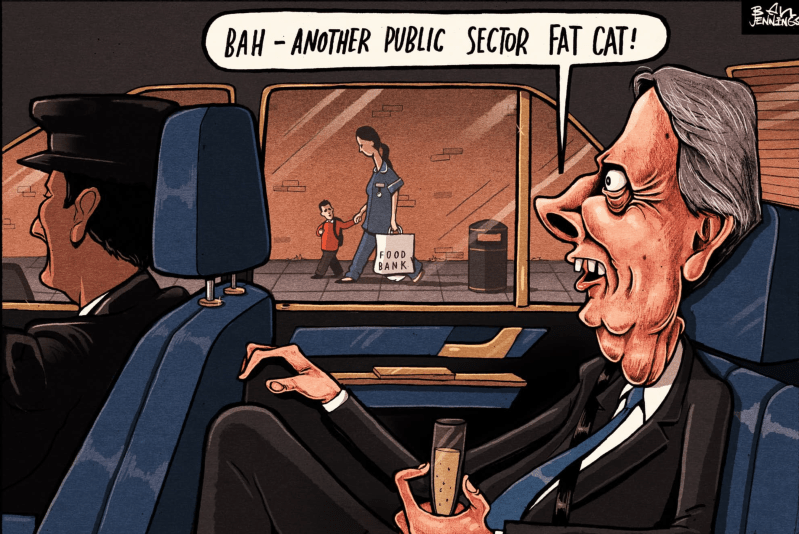
That public sector pay comment in perspective

The man who just got an 11% pay rise and will have a pension that probably pays out in a week what a nurse will earn in a year:

https://www.theguardian.com/commentisfree/picture/2017/jul/16/ben-jennings-on-philip-hammond-and-the-public-sector-pay-cap-cartoon?CMP=Share_iOSApp_Other

HS2 rail link £403 million per MILE!

First 6.6 miles from Euston to Old Oak Common could cost more than £8bn

http://www.independent.co.uk/news/uk/home-news/hs2-high-speed-railway-most-expensive-world-403-million-mile-michael-byng-a7843481.html

The execution of the NHS

The extent of the crisis in England’s GP services has been laid bare. And if there was any doubt as to why patients are struggling to get appointments with their doctors, Jeremy Hunt now has the answer right in front of him. And it’s staggering.

Staggering numbers

NHS Digital has released statistics [pdf] on the number of GP surgeries that have opened and closed, for the year up until 30 June 2017. And they show that, in the space of 12 months, 202 GP practices either closed or merged across England; with just eight opening to replace them.

As GP Online reported, the regional breakdown of closures and mergers was:

North of England – 64.
South of England – 54.
Midlands and East – 45.
London – 39.
GPs pushed to the brink

But the closures were confined to 47% of the 209 Clinical Commissioning Groups (CCG); meaning the majority of England saw no closures or mergers at all. In contrast, NHS Digital’s data showed that the number of patients registered with GPs had increased, again; up 55,178 in July compared to June. And there are now 2,427,526 more registered patients than in July 2013. Meanwhile, the number of full-time GPs dropped by nearly 3% in the year up to March 2017.

NHS Digital’s figures come as the British Medical Association (BMA) has balloted its GP members for industrial action. This would involve GP practices stopping taking any new patients. They would either suspend new patient registrations, or apply for a formal closure of patient registration lists.

The broader context

But any action by GPs comes in the context of a wider crisis within the NHS. As The Canary has repeatedly documented:

The amount the NHS paid to ‘independent’ companies has more than doubled since 2010 to over £8bn a year.

8% of government health funding now goes to private companies.
Private companies working in the NHS have seen their profits soar by up to 100%.

The NHS has seen a real-terms cut in the amount of money given to it per patient.

The Tories have cut the number of people getting social care by 26%. And they’ve cut £50m from children’s mental health services.

Successive Tory-led governments have capped [paywall] the pay rises of doctors, nurses and healthcare workers at just 1%.

Additionally, between 2010 and 2015, mental health trusts lost the equivalent of £598m a year from their budgets. And findings show that there are still £4.5m of mental health spending cuts to come. Also, there will be an additional £85m in cuts to public health budgets this year alone.

A GP speaks out

The Canary spoke to writer and GP Dr Kailash Chand OBE. And he perhaps best summed up the situation:

General practice, ‘the jewel in the crown of the NHS’, is at the brink of extinction. Across the board, GPs today are underpaid and overworked. The NHS is losing good people because GPs feel demoralised. They haven’t had a pay rise in seven years: a 1% uplift this year is a real-terms pay cut. The entire crop of GPs is undervalued, and more and more work and expectations are being put on them.

But the NHS is also facing financial meltdown, catastrophic workforce issues and political uncertainty. It is a world-class institution – with world-class practitioners now being torn apart by second-rate politicians. We are already on the way to the end of comprehensive healthcare, free at the point of need, available to all who need it.

Once the NHS is gone, it will be gone forever. And sick people will face the nightmare of not being able to afford the treatment they need. It’s time to stand up and fight!

The end of the NHS?

We have a now-permanent crisis in hospitals; GP surgeries over-subscribed and at breaking point; and social care is severely under-funded. But many believe that the Tories’ approach to the NHS is one of ‘shock therapy‘; that is, create a crisis so bad that the only apparent solution is to sell it off to private companies. And with this latest news about GP practices, we could – as Chand says – be well on the way to the end of the NHS as we know it.”

https://www.thecanary.co/2017/07/14/youre-wondering-cant-get-gp-appointment-jeremy-hunt-now-knows-shocking-answer/

Claire Wright has grave reservations on Tory Party and Swire’s commitment to environment

“I have submitted a question for the next Devon County Council full meeting prompted by the government’s lack of action and any assurance on moving current EU environmental protections into UK law.

The subject has concerned environmental charities enough for them to establish a coalition of 30 and a pledge for MPs to sign up to to prove their commitment to retaining such protections through the so called Great Repeal Bill, which is when EU law becomes domestic law.

Over 200 MPs have signed this pledge. When I asked Hugo Swire to sign the pledge he refused and wrote this disappointing blog post in response:

https://www.hugoswire.org.uk/news/blog-birds-and-bees-and-brexit

The Great Repeal Bill (coming very soon) gives an option for the government to strip out or amend any laws they don’t like look of.

Very concerned at some of the messages seeping out from senior Conservative ministers on this subject I lodged a motion at the April Devon County Council, as East Devon has some of the most spectacular and precious landscapes and wildlife currently protected under EU legislation and those protections absolutely must be retained.

My motion, which was supported by every DCC councillor bar one, can be found here – http://www.claire-wright.org/index.php/post/devon_county_council_signs_up_to_my_motion_on_protecting_devons_nature_afte

But when I checked up on the response from ministers to my motion I was deeply disappointed.

It contains absolutely no commitment whatsoever on retaining vital environmental protections nor does it even hint at it.

It rather takes the wind out of Hugo Swire’s claims on his blog post!

Ministers need to be urgently pursued on this and Hugo Swire is the route to do it.

I think we need to maintain a healthy scepticism here and if you are reading this blog PLEASE email Hugo Swire and ask him to work HARD and urgently on this issue.

He needs urgent meetings with his ministerial colleagues and he needs to make it clear PUBLICLY where he stands on any such vote. Residents should reasonably require him to speak against and vote against ANY attempt to water down or scrap this legislation.

Mr Swire needs to stop labelling any concerned voices as scaremongerers and actually take some action.

Here is my question scheduled for the full council meeting on Thursday 25 July – and the response from government to my motion that was backed by full council in April:

“Is the leader content with the reply from Kevin Woodhouse of DEFRA, dated 5 June, to my notice of motion approved almost unanimously by this council on 27 April, which called on government ministers to retain the same environmental protections as we leave the EU, as currently exist under EU legislation.

“The reply from Mr Woodhouse states: “The environment is a natural asset that provides us with numerous benefits such as clear water, clean air, food and timber, flood protection and recreation.

““Regarding future policy, until exit negotiations are concluded, the UK remains a full member of the EU and all right and obligations of EU membership remain in force.””

Here is more information about the so-called Great Repeal Bill – http://www.bbc.co.uk/news/uk-politics-39266723

Email Hugo Swire at hugo.swire.mp@parliament.uk

If you care about this, fight for it. Please. Before it is lost forever.

http://www.claire-wright.org/index.php/post/government_lack_of_commitment_on_environmental_motion_prompts_further_quest

Local government “needs tough questions” … but what about the answers?

Owl says: but what happens when people simply refuse to answer those tough questions because they have their employees and/or their council majority councillors under such tough control they can over-ride those tough questions by just ignoring them or spinning nonsensical responses!

“Good governance across the public sector requires people who are willing to ask tough questions, CIPFA conference delegates heard today.

Peter Welch, director of the European Court of Auditors, speaking at an afternoon workshop on governance failures, responded to a question asking why there was a “fundamental lack of understanding of role and responsibility” across the public sector.

“If we want governance to really work we really need people who are not afraid to ask tough questions,” he said.

Panellists and the audience talked about the lack of diversity in public sector auditing.

Welch said “diversity works” to ensure there are people in organisations to ask the tough questions.”

http://www.publicfinance.co.uk/news/2017/07/cipfa-conference-good-governance-requires-tough-questions

“Transformation plans” – a mortal danger to the public?

Our council talks a lot about its so-called “transformation plans” which are supposed to make it leaner and meaner – doing more with less. Except, of course, for its relocation plans, which get more and more bloated with every passing week (“doing the same with more”?).

It trumpets its plans – nay strategy, here:

Click to access transformation-strategy.pdf

There are objectives in it such as “WorkSmart”, “centred”, “clear”, “simple”, “fast”, “organised” and “rational”. As if our council was currently WorkDumb, off-centre, opaque, complex, slow, disorganised and irrational was the alternative. Hhhmm – let’s not go there!

But one word is missing – SAFE.

In the light of the Grenfell Tower disaster, we have seen that ALL of the above can impact directly on council tax payers to make them less safe – as cost-cutting (the REAL meaning of transformation plans) is the major driver.

The London Borough of Newham is so concerned that it has paused its transformation plans on hold saying:

“… Inevitably…in a programme of this scale there are certain areas which have associated risks to delivery both in timing and quantum. Due to the sheer complexity and scale of what the transformation programme is trying to achieve, there are risks attached with the programme being able to deliver fully against its target. Therefore, an adjustment of c£2m has been made to recognise potential non-delivery of savings/income shortfall for 2018/19.”

http://www.room151.co.uk/151-news/news-roundup-borrowing-to-increase-cash-needs-newhams-transformation-savings-residents-audit-lambeth-cipfas-ethics-update/

So, we (and EDDC) must ask: how far is too far?

And is the council’s relocation being done at great expense, when that money ought to be ploughed back into services that have been cut to the bone and may be much less safe for us all? In its race to be bottom of council tax bills has it also been a race to the bottom for our safety?

This is, of course, a national problem – driven by austerity cuts. But have our councils (DCC and EDDC) and other institutions such as the NHS been too passive or even too welcoming of these cuts and too conveniently blind to see their consequences?

EDDC officer accuses East Devon Alliance chairman of “point scoring” over (second) postal vote cockup

Owl says: if the point IS scored, surely that speaks for itself! And anyone reading this supposedly “neutral” officer’s report is bound to wonder if it is, er, political!

“East Devon District Council’s monitoring officer has accused the chairman of the East Devon Alliance of political point-scoring after he raised concerns that the council’s scrutiny committee were not able to investigate a postal vote ‘cock-up’ ahead of the General Election.

Packs that were issued on May 25 contained voting slips that did not have an official security mark visible on the front of the ballot paper were issued to more than 9,000 voters in the constituency.

East Devon District Council who were responsible for printing the ballot papers but Mark Williams, the council’s returning officer, issued a statement reassuring voters that no postal votes had been affected as a result of the error.

The ‘cock-up’ has left Paul Arnott, chairman of the East Devon Alliance, furious, and said that he would have more confidence in a village raffle than in Mr Williams running the forthcoming election and asked the council’s scrutiny committee at their last meeting in June to interrogate the reasons why 9,000 unmarked Parliamentary ballot papers were issued to postal voters.

But in response, he was told that the current legal assessment is that the remit of the Scrutiny Committee does not extend to Parliamentary elections, which is the remit of the Electoral Commission.

Mr Arnott queried this advice with the Electoral Commission, and says he was told that there is nothing laid down about where electoral matters can or can’t be discussed within the framework of local authority governance, and ultimately it is up to the Council and its operation of its scrutiny function as to whether any or all elections or electoral related matters are included in that scrutiny.

He has written to the council, asking them to take on board this advice and for scrutiny to investigate the matter, but in response, Henry Gordon Lennox, the Strategic Lead (Governance and Licensing) and Monitoring Officer of East Devon District Council, said that Mr Arnott had misinterpreted the advice he had been given and said that his query was ‘politically driven’.

The scrutiny committee have recommended to the council’s ruling Cabinet that the Chief Executive’s pending report on the election does includes explanation of the postal vote issue of May 25 that did not have an official security mark visible on the front of the ballot paper.

Mr Gordon Lennox in a statement said: “In my view, Mr Arnott has misinterpreted the advice from the Electoral Commission, who said that there were no legislative provisions dealing with the role of Scrutiny and elections and therefore it is down to the rules of each authority that will dictate whether or not there is a role for Scrutiny.

“Mr Arnott has taken this to say that the Council’s Scrutiny Committee should be reviewing the conduct of elections. However, what they aresaying, and it is my view too, is that effectively it is the Council’s Constitution and the Terms of Reference of the Scrutiny Committee that determine whether they can consider elections or electoral related matters.

“In general terms the role of Scrutiny is to review the actions relating to the various functions of the Council (in whatever form that takes). The role of Returning Officer is not part of the Council, save for the elections relating to towns and parishes and the district. It is for this reason that the Scrutiny Committee do not have the authority to consider the actions and conduct of the Acting Returning Officer / Deputy Returning Officer in the Parliamentary / County elections respectively.

“I think it important to also address the political side of this. I note that Mr Arnott says this is not political. However, Mr Arnott refers to the East Devon Alliance (EDA) report submitted to East Devon District Council following the May 2015 elections.

“Mr Arnott was at the time the Chair of the EDA and therefore a part of the Executive Committee who produced and submitted the report. At the County elections, Mr Arnott was an appointed election agent for the EDA.

“In the correspondence arising out of the postal vote issue during the Parliamentary election, Mr Arnott, when officially signing off his emails, referred to himself as the Chairman and Nominating Officer of the EDA.

“So my perception, notwithstanding what Mr Arnott says, is that his query is politically driven. To that end, the role of Scrutiny is supposed to be apolitical and I would be concerned that even if it were permissible for Scrutiny to be considering this matter, that the purpose for them so doing would be questionable.

“I have explained this matter in some detail in order to ensure that the correct context is understood and to give clarity on the issue. I would further confirm that, despite the above, it is my understanding that the Returning Officer will be presenting a report to Scrutiny at its next meeting on the key priorities he is working on, following what will now be the standard practice of a review process taking place after each election.”

The scrutiny committee have recommended to the council’s ruling Cabinet that the Chief Executive’s pending report on the election does includes explanation of the postal vote issue of May 25 that did not have an official security mark visible on the front of the ballot paper.

East Devon District Council’s Cabinet committee will consider the recommendation on Thursday, July 13.”

http://www.devonlive.com/east-devon-alliance-chairman-accused-of-politically-driven-query-over-postal-vote-scrutiny-request/story-30434940-detail/story.html

Swire’s latest question in Parliament – this time on India

While I welcome the fact that the Prime Minister raised the issue of the Chennai Six with Mr Modi at the G20, may I urge my right hon. Friend the Foreign Secretary to focus his efforts on the Chief Minister of Tamil Nadu and to seek an urgent meeting with her? Our boys have been languishing in jail there for almost four years—I visited them there myself—and it is time, frankly, that they were brought home.”

https://www.theyworkforyou.com/debates/?id=2017-07-11b.151.7&s=speaker%3A11265#g155.7

Who watches over East Devon with its busy absentee MPs?

Neil Parish was re-elected as chairman of the Environment, Food and Rural Affairs committee, beating Tory former London mayoral candidate [and multi-millionaire] Zac Goldsmith.

So, the Honiton and Tiverton constituency will be seeing very little of Parish, especially as he will return to his Somerset home when not in London.

And with Swire terribly busy with his other jobs which bring him in £5,000 a month (directorship of Photo-Me and chairmanship of the Conservative Middle East Council) and retiring to his home in mid-Devon on his days off we are mostly bereft of their company here in East Devon – except for the odd whistle-stop tours and photo opportunities.

That just leaves runner-up general election candidates Claire Wright (Independent, resident of Ottery St Mary) and Caroline Kolek (Labour, resident of Honiton) to watch over East Devon in their frequent absences.

Many might feel that this is the better outcome!

When privatisation goes bad – Carillion part 2

We are endlessly being told that “privatisation good, state ownership bad”. There is an implied belief that anything state-run is inherently badly managed, inefficient and wasteful whereas companies which take on former state-run entities are well-managed, efficient and better at using resources.

Carillion (and earlier on this year Capita and Mitie – not to forget all the utility companies) have proved that this idea totally wrong.

“… there is a support services arm [of Carillion], which includes maintenance on buildings and cleaning services. And, thirdly, there is PPP, where it might fund and manage the building of a new NHS hospital.

PPP is one of those financial inventions that was sold as being a win-win for both sides. The government might get some new infrastructure more quickly and without having to pay the huge upfront costs of building it, while the private companies financing the deal gained a valuable long-term income stream – often over 20 years or so. At least, that was the theory.

Just three Carillion PPP contracts – thought to be the Midland Metropolitan hospital in Smethwick, Merseyside’s Royal Liverpool hospital and an Aberdeen road project – are behind the bulk of the £375m losses that relate to the UK.

Industry watchers say that project delays – caused by such astonishing occurrences such as cold weather in Aberdeen over the winter – have introduced huge extra costs. Construction of the Royal Liverpool hospital has also been beset with hold-ups, most recently after workers found “extensive” asbestos on site and cracks in the new building.

Meanwhile, just before the profit warning, it was revealed that another Carillion project – an experimental tram-train linking Sheffield and Rotherham – has cost more than five times the agreed budget and is running almost three years late. The government has been forced to compensate tram operator Stagecoach for the delays with a £2.5m payment.

These types of setback are frequent complaints of investors in the sector and is one of the reasons the City has long taken a dim view of Carillion. For months, the company has been one of the UK stock market’s most shorted companies – meaning that investors have been placing bets on a fall in the company’s share price. …”

So, what do we learn from this? Well, one thing is that big investors, such as hedge funds, never lose. As soon as they sniff failure of a company, they lay bets on that failure and collect if they are right. Other “investors” seeing these bets also bet on failure.

Cream off profits, increase directors’ pay when things are going well, collect on bets when things go wrong and sometimes STILL increase director pay. And the state ends up picking up some, or all, of the losses.

Privatisation: as big as the sub- prime mortgage scandal but more secretive till the excrement hits the climate controller.

And here a couple of observations about the company from commentators on the article:

“Would love to see this company fold this is the best news I’ve heard all year. Having worked for this poorly managed company for 2 years from which I resigned because the management made life difficult this is music to my ears. Please remember this is also the company that operated the black book they kept a lot of good people on the dole because their faces didn’t fit. Hopefully They will be history very soon.”

and

“The FCA should look into this debacle. A company of almost 50,000 employees and annual revenue of £5bn does not suddenly sink like this without good reason. Many companies survive on slim margins in competitive industries. Senior managers must be held to account and for the umpteenth time …. what were the auditors doing?”

Don’t let (tax avoiding) Google influence your views

Google spends millions on academic research to influence opinion, says watchdog

“Google has spent millions funding academic research in the US and Europe to try to influence public opinion and policymakers, a watchdog has claimed.

Over the last decade, Google has funded research papers that appear to support the technology company’s business interests and defend against regulatory challenges such as antitrust and anti-piracy, the US-based Campaign for Accountability (CfA) said in a report.

“Google uses its immense wealth and power to attempt to influence policymakers at every level,” said Daniel Stevens, CfA executive director. “At a minimum, regulators should be aware that the allegedly independent legal and academic work on which they rely has been brought to them by Google.”

In its Google Academics Inc report, the CfA identified 329 research papers published between 2005 and 2017 on public policy that the company had funded. Such studies have been authored by academics and economists from some of the world’s leading institutions including Oxford, Edinburgh, Stanford, Harvard, MIT and the Berlin School of Economics.

Academics were directly funded by Google in more than half of the cases and in the rest of the cases funded indirectly by groups or institutions supported by Google, the CfA said. Authors, who were paid between $5,000 and $400,000 (£3,900-£310,000) by Google, did not disclose the source of their funding in 66% of all cases, and in 26% of those cases directly funded by Google, according to the report.

The CfA is calling for Google-funded academics to disclose the source of their funding to ensure their work can be evaluated in context.

Google described the report as “highly misleading” as it included any work supported by any organisation to which it has ever donated money. …”

https://www.theguardian.com/technology/2017/jul/13/google-millions-academic-research-influence-opinion

Tax avoidance:
http://www.itv.com/news/2017-03-31/google-accused-of-being-less-than-transparent-after-revealing-latest-uk-tax-payments/

Local authority companies ” should not have many council board members” – so why run the company?

Owl says: If councillors and officers are no good at running commercial companies – why are they being created?

“Local authority-run companies should avoid having too many council members on executive boards to ensure commercial success, CIPFA’s annual conference was told.

The advice on governance was issued today by Mike Britch, chief executive of Norse Group, a firm with a £300m turnover wholly owned by Norfolk County Council, at a workshop on councils and commercialism.

He told delegates the presence of too many members on executive boards could hamper the agility that a small and focused board needed to efficiently deliver services in a commercial environment.

Britch said: “You can’t run a commercial service as a department of a local authority, that means you have to get yourself from under the shackles of a 151 [financial] officer, the monitoring officer and everybody else who wants to reduce what they perceive as the risk to their shareholders.

“You need to have commercial and operational freedom to trade and to make the decisions you need to make.” …”

http://www.publicfinance.co.uk/news/2017/07/local-authority-run-companies-should-avoid-too-many-council-board-members

Crime czar Alison Hernandez does U-turn and puts deputy plan “on hold”

“Crime czar Alison Hernandez has bowed to pressure and abandoned a plan to appoint a Tory colleague from her local council days as her second-in-command. The Devon and Cornwall Police and Crime Commissioner asked the police and crime panel to rubber stamp the appointment of fellow Conservative and Torbay councillor Mark Kingscote on Friday.

Ms Hernandez wanted the 55-year-old NHS support worker, who specialises in mental health, to help her with the workload on a £30,000 salary.

But, amid concerns over his qualifications for the role and controversy over a tweet referring to lesbians as “lesbos”, the the panel of councillors rejected the proposal.

Mr Kingscote’s tasteless tweet was covered here by EDW:
https://eastdevonwatch.org/2017/07/08/the-police-and-crime-panel-and-that-tweet/

The hearing heard how the attempted appointment “smacked of nepotism”.

After a private meeting, the panel concluded that Kingscote – a staunch Conservative who once chained himself to a set of railings to protest about the downfall of his hero, Margaret Thatcher, “does not meet minimum requirements of the post”.

The ruling capped a bruising week for Ms Hernandez, in which a council voted she should be removed from her role for making “stupid and dangerous” comments about guns.

Plymouth City Council’s Labour group tabled a vote of no confidence in Alison Hernandez, saying they are “extremely alarmed” at her stance on how to tackle terrorists.

Ms Hernandez was not bound by the panel’s decision, which was revealed to the commissioner in a letter received yesterday.

However, she risked making enemies of a group which is constituted to oversee her work, placing her a loggerheads for the final three years of her tenure.

In a statement released today, Ms Hernandez accepted the decision and said she “has put plans to appoint a deputy on hold”.

“I am disappointed that the Panel did not feel able to support my choice of deputy but I am willing to accept its recommendation,” she said. “I will now spend some time contemplating my next move and will await the appointment of a new chief executive before making a decision.”

“I would like to thank Mark Kingscote for being willing to consider taking on this challenge on behalf of the people of Devon, Cornwall and the Isles of Scilly and I believe he would have served the people of our counties and islands well.”

Read Alison Hernandez’s letter to the panel:

Deputy Police and Crime Commissioner Confirmation Hearing Report

Thank you for your letter of 11th July following the confirmation hearing on 7th July.

I am disappointed that the Panel does not feel able to support my choice of deputy. However, while I feel there are some misunderstandings around both the role, and the process of appointment, I reluctantly accept the recommendation and will not be appointing Mark Kingscote as my deputy Police and Crime Commissioner.

The Panel represents our communities across Devon, Cornwall and the Isles of
Scilly and I absolutely respect the views of its members but, if you will allow me, I think it would be helpful to respond to the points raised about Mark Kingscote’s suitability.

In relation to estates, I require someone who can assist with the strategic overview of the planning and investment part of the process not the day to day maintenance. So while I can see that you may doubt his track record in estate management, I did feel Mark had the necessary experience in estate development as he has successfully steered multi-million pound planning applications.

On the second point Mark has apologised for his poor choice of words while using Twitter. Please be assured he did not mean to insult, offend or be discriminatory and he is sad that he was unable to convince the Panel of this.

Finally, and perhaps most importantly, I must address your point about working councillors. I am determined to encourage more working people to become elected councillors so that our communities can be better represented. Elected roles cannot only be for the retired, unemployed or wealthy. I myself worked after being elected and I strongly believe that Mark would have been able to serve both Torbay residents and the wider population of Devon, Cornwall and the Isles of Scilly well.

I will now spend some time contemplating my next move and will await the
appointment of a new chief executive before making a decision.

I look forward to seeing you in August at confirmation hearings for both the new Treasurer and CEO. Thank you for finding the time in your diary to enable this to happen outside of the normal schedule of meetings.

Yours sincerely
Alison Hernandez
Police and Crime Commissioner
Devon, Cornwall and the Isles of Scilly”

http://www.devonlive.com/crime-czar-alison-hernandez-performs-u-turn-on-unfit-deputy/story-30436982-detail/story.html