Greater Exeter Strategic Plan – Exeter leaks its “vision”*

“But not yet in East Devon until July 2019 (see below). It seems East Devon is the only council keeping ALL its plans secret until after the 2 May 2019 district council elections.

Fishy? You bet!

Anyway, here’s what we currently know:
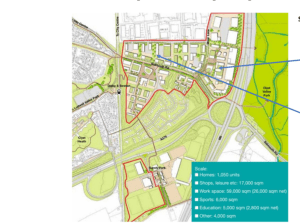
Interesting proposals for changes to Sidmouth Road and Junction 30 of the M5. The Motorway Services and Sowton Park and Ride being developed as a “Mixed Neighbourhood” (see image above).

The Governments require the Greater Exeter Housing target to be 53,200 new homes over the next 20 years. That is for the combined area governed by East Devon, Teignbridge, Mid Devon and Exeter.

Exeter’s housing ambitions

Karime Hassan, chief executive and growth director of Exeter City Council revealed this week a proposal for 12,000 new homes in the City of Exeter over the next 20 years. His vision of “Liveable Exeter”, for delivering a transformational housing programme for Exeter from 2020 to 2040. involves the creation of 8 new neighbourhoods.

Exeter’s published Vision

Red Cow Village (St David’s) – 664 homes in new neighbourhood, including new work space, on both sides of the railway around St David’s Station.

Water Lane (close to Exe Valley Park) – 1,567 homes. A space for expanding leisure attractions near the quay, with low traffic or car-free development with attractive cycle and walking connections.

Marsh Barton – 5,544 homes in a new neighbourhood. It will remain an important employment and retail area, but with the integration of living and working, to make better use of riverside location. Development linked to the new proposed train station. Creation of new types of work space, including light industrial, workshops, office and shared work space.

East Gate (Heavitree Road) – 962 new homes, an enhanced approach to the city centre from the east, reduced traffic on Heavitree Road and a greater provision for public transport, walking and cycling. New places to live close to the city centre will exist alongside existing neighbourhoods.

West Gate (Western Way) – 617 new homes, opening up access to the river and canal from the city centre, a new cultural destination, an expanded and connected park at the heart of the city, a “Green Bridge” promoting active travel across the river.

South Gate (Holloway Street/South Street linked via Topsham Road) – 300 new homes, establishing an improved link between the city centre and the historic quayside, with a greater emphasis on the wall, city gates and Southernhay.

North Gate (North Street) – 308 new homes, a new approach to the city from St David’s, uncovering the medieval city wall.
Sandy Gate (land off Sandygate roundabout) – 1,050 new homes in a new sustainable and well-connected mixed-use neighbourhood, bridging the city and the new and existing neighbourhoods to the east, providing recreational, cultural and entertainment space where Exeter meets the proposed Clyst Valley Park.

Mid Devon’s published ambitions.

Mid Devon’s Local Plan is almost complete with a Planning Inspectors hearing due in the next few weeks to consult on their final draft.

Culm Valley on the South side of the M5 opposite Cullumpton create a new community of up to 5,000, with a new Motorway junction and railway Station.

Junction 27. A landmark project for a leisure and tourism development involving Tim Smit from the Edan Project
Tiverton Eastern Urban Extension will cover 153ha, to the east of Tiverton.

Teignbridge future ambitions.

Teignbridge has just started a review of their Local Plan and therefore their plans are in the infancy.

Brownfield Their preferred option to develop brownfield land for development however, the required number of homes the government require Teignbridge to build, is not possible to meet the housing needs from brownfield land only. Therefore, open countryside will need to be considered for development to meet the housing needs.

Garden village is being considered with the new settlement proposal to be between 1500-10,000 homes.

So – What are East Devon’s Ambitions?

Hard to say.

Although the other 3 Authorities are keeping their residents well informed on their sections of the GESP proposals, East Devon has been an almost total blackout! There has been a Local Plan in place since 2016 with most of new development being built in an area known as the West End. That is an area close to Exeter’s border plus the new Town of Cranbrook.

At East Devon District Council Strategic Planning Committee on Tuesday 29th January it was hoped that Agenda item 12 would be able to explain more on the Greater Exeter Strategic Plan strategy and provide councillors some clarity on the East Devon Local Plan, plus the East Devon Villages Plan only agreed last year which most councillors only learned the previous week, would be jettisoned and replaced with a brand new East Devon Local Plan by 2023.

Local Plan to be replaced

At the meeting last week, the Head of Planning Ed Freeman explained that the present Local Plan was in 2 parts, with the section on Policies would require total re-writing because the Policies would be “substantially superseded” by the emerging GESP Policies. He also explained that the Villages Plan policies, will be merged into the new Local Plan.

Tory Councillor Philip Skinner who along with Tory Councillor Paul Diviani who are the only 2 East Devon`s elected representatives on the GESP “steering group committee” along with 2 elected members from the 3 other Authorities gave only a few hints on some of the latest thoughts for the GESP Strategy for East Devon.

Higher Density Housing for Exeter proposed for GESP

Regarding a question on Housing, he explained that it had been decided by the steering group, that each authority had a certain quota of dwellings proposed and it was not correct that if one Authority was unable to provide the housing numbers, other Authorities were required to build extra dwellings to offset the shortfall. He also explained that Exeter City Council had to return to the drawing board to enable extra dwelling numbers through “much higher density” within the confines of the City.

East Devon will take on most of the Industrial and commercial development for the GESP

Councillor Skinner also told the meeting regarding business development that he aimed to “Get the best for East Devon” and explained that to “Our strength and Exeter’s demise, they do not have the capacity, but we do!” and claimed most of the commercial and industrial development “will be in our patch”

After 2 years of joint secret meetings.

Exeter’s residents know what to expect with “Liveable Exeter”, Teignbridge residents are being told that their local plan is being re-assessed and are having public consultations, and Mid Devon residents have been through their public consultations and an agreed local plan about to be approved.

However, the residents of East Devon only know that their local plan is now being superseded by a new plan with substantial more housing and more industrial, commercial and business development.

All will be revealed in July 2019 after the District Council Elections. Who will you trust to steer East Devon through the next few years of obtaining the most appropriate and suitable Planning Policies. Leave it to the Tory Councillors who have kept everyone in the dark?

Or choose an Independent who are the major opposition for East Devon?

Ottery Town Council (particularly Councillor Carter) makes itself a laughing stock (again)

Owl says: It is well-known that Councillor Carter (one of the Greendale Carters) has no love for independent councillors!

https://eastdevonwatch.org/2018/11/07/majority-of-ottery-town-council-remarkably-unconcerned-about-the-future-of-their-hospital/

https://eastdevonwatch.org/2019/02/08/decision-overturned-to-set-up-ottery-hospital-working-group/

From the blog of Independent Councillor Claire Wright:

“Ottery St Mary Town Council revisited the contentious issue of whether it should support setting up a group to ensure the future of Ottery Hospital at yet another fraught meeting on Monday 4 February.

A bit of background information – at the town council meeting on 6 November a similar proposal was agreed by three votes to nil. Subsequently the town council abstainers (who thought that they had won) called for an extraordinary town council meeting to overturn the decision, which took place on 29 November.

Subsequently it became known that two members of the Health and Care Forum had established a limited company whose purpose is unclear.

I still find it hard to believe that a proposal to set up a working group to help retain the hospital, by a councillor – Geoff Pratt, who was asked as to help by the Health and Care Team Chair, has resulted in a bitter row lasting four months.

Our offer of help has been sullied, dragged through the dirt and subject to chicanery by political opponents who appear to be engaging in some kind of strange game of cat and mouse. I have been insulted on social media and mine and the town’s residents continued efforts over the years to retain the hospital and its beds have been rudely ridiculed and dismissed.

Myself and Dr Margaret Hall, who was also subject to unpleasantness, have both pulled out of any potential group as a result. It was difficult to believe the level of vitriol from a minority of people.

On Monday evening the town council finally agreed to meet with the hospital League of Friends Chair, Adrian Rutter, who came across as the voice of reason on Monday evening. However, as soon as the row seemed to abate, Cllr Paul Carter bizarrely decided to reignite it by insinuating that our offer of help was a bid to cause trouble.

One councillor announced that she didn’t think Mr Rutter should be allowed to speak as he hadn’t asked to do so at the beginning of the meeting!

Cllr Carter then accused me of smirking (I was doing anything but smirking!) and the mayor refused to let me respond. I did, however, manage to ask Cllr Carter why he was trying to reignite the row again.

Once again there were raised tempers, including from members of the public. One of whom told me afterwards it was one of the worst town council meetings he had ever attended.

It was not very clear what was agreed, but I believe the town council deferred a decision to establish the working group.”

http://www.claire-wright.org/index.php/post/ottery_town_council_to_meet_with_league_of_friends_chairman

“Decision overturned to set up Ottery Hospital working group”

What IS going on at Ottery town council? Sounds like a nest of vipers! AND a nest of political chicanery … Who IS it (or who are they) fomenting this silly behaviour – and why? If you can’t work together for the good of the community – should you even be a councillor at all?

“A proposal to create a working group to safeguard Ottery Hospital has been overturned following more heated debate over how to save it.

A motion was submitted on January 24, signed by councillors Glyn Dobson, Ian Holmes, Anne Edwards and Lynn Harding, to re-examine the decision to support or rescind a motion to set up the group.

The proposal was passed in November, with many councillors abstaining due to a lack of information or because they felt it would duplicate the work of the town’s health and care forum.

Residents had their say at an extraordinary meeting on November 29, when a motion was first made to re-examine the motion.

The decision was deferred until February to allow organisations involved in saving the hospital to meet and gather information.

Speaking at Monday’s town council meeting, Councillor Roger Giles, who supported the group, said: “The purpose of the working group was to bring all sorts of organisations and good people together to embrace the skill and expertise and energy of the LOF (League of Friends).

“I really can’t see why we are not doing something – we need to campaign, we need to get as many services as we can in Ottery Hospital.

“Fill it up, get it used to capacity, and ensure its future. That’s the essence of what I am trying to achieve.”

Adrian Rutter, chairman of the hospital League of Friends, said everyone had the same aim but did not share a way of working together.

Mayor Paul Bartlett offered to meet representatives from the health and care forum and League of Friends to discuss any problems between the two groups.

Members voted to rescind the group by five votes to three.

Following the vote, Deputy Mayor Paul Carter said he was ‘disappointed’ members were failing to pull together.

He said: “If you have expertise that can help what’s already happening, why not help and join in?

“I cannot believe we’re all grown-ups down this table and we keep going down different avenues.

“I would very much like, going forward, to try and pull together and look down the same road.”

He added: “We do not need to be going on independent routes to be a collective and a team.

“I always say we’re stronger together.”

https://www.sidmouthherald.co.uk/news/decision-overturned-to-set-up-ottery-hospital-working-group-1-5883068

“Firefighters to be trained as police officers for seven Devon towns”

Firefighters are already trained as first medical responders in many towns – now they will be fire/medical/police officers. Hope they get the salary increases that go with the extra responsibilities …..

And, no, it isn’t an “innovative project” as Ms Hernandez suggests – Owl believes it’s a cover-up for too few firefighters, paramedics and police officers.

“This innovative police and fire collaboration project is being funded by Devon and Cornwall’s police and crime commissioner Alison Hernandez who hopes it will improve access to the emergency services for communities in Devon.

The seven community responders have been recruited into locations where there is a need based on risk, vulnerability and harm – Cullompton, Crediton, Dartmouth, Honiton, Okehampton, Newton Abbot and Totnes.

Ms Hernandez has committed funding for an initial two years covering recruitment and ongoing training costs with the possibility of extending further. It forms part of her commitment to improving collaboration between the emergency services.

“I’m incredibly pleased to be able to support this collaboration. We don’t know what future funding will look like for any of our emergency services and working together on unique projects like this will improve the service both organisations can deliver to people in Devon.” said Ms Hernandez.

“I look forward to seeing the benefits that our communities will reap from this innovative work.” …

https://www.devonlive.com/news/devon-news/firefighters-trained-police-officers-seven-2521123

Devon Chief Constable: “thin blue line broken”

“The chief constable of Devon and Cornwall says the thin blue line of British policing is broken and lives in the two counties are more at risk than ever because of financial cuts.

Shaun Sawyer is supporting a proposal to increase the police council tax precept to fund 85 more police officers, but also said he would still be left with nearly 600 fewer than he had nine years ago. The force currently has just under 3,000 officers.

Mr Sawyer said the most vulnerable were at risk from the government’s decision to slash police budgets in 2010 and officers saw the “effects of those cuts every day”…

https://www.bbc.co.uk/news/live/uk-england-devon-47030320

“Millions more on incomes too low to have acceptable living standards – study”

“Two million more people are on incomes considered too low to have an “acceptable” standard of living compared with 10 years ago, new research has found.

A study by Loughborough University suggested three quarters of lone parent families had earnings too low to meet their minimum needs – up by 65% since the financial crisis in 2008.

And the number of single women in their early 60s – a group affected by an increase to the state pension age – living below the minimum standard of living was found to have doubled in the last decade.

The University’s Centre for Research in Social Policy (CRSP) conducted the research as part of its Minimum Income Standards programme, which calculates the minimum budget individuals require to cover their material needs and to participate in society.

Its findings suggested that, compared to 2008, two in five women aged 60-64 who live alone have incomes too low to meet their minimum needs, up from one in five. …”

https://www.itv.com/news/2019-02-06/millions-more-on-incomes-too-low-to-have-acceptable-living-standards-study/

Swire loses his job as auctioneer at fancy Tory ball

Swire’s poor taste quips were missing at this year’s Tory Black and White Ball

https://eastdevonwatch.org/2015/02/11/hugo-swire-is-auctioneer-at-15000-per-head-tory-ball/

but conspicuous consumption ruled, as always.

“An unnamed donor paid £75,000 for a private night at the Proms with Theresa May at the Tories’ lavish Black and White Ball fundraiser.

Super-rich Tory donors splashed tens of thousands of pounds on cosy dinners with ministers, hunting trips and luxury holidays at the bash, as they dined on Michelin star food and drank fine wine.

Guests paid up to £15,000 a table to rub shoulders with Cabinet Ministers and take part in an exclusive auction.

Private dinners and events with nine cabinet ministers and the Prime Minister herself were sold to the highest bidder.

Labour Party Chair Ian Lavery said it was “stomach-churning”

Tory Chairman Brandon Lewis told guests: “Whatever you bid at the auction it is less than you’ll pay in tax under Corbyn.”

Revellers dug deep to fill Mrs May’s election war chest, with a set of Conservative Party campaign posters signed by the Prime Minister also selling for a staggering £175,000 – the cost of a three-bedroom terraced house in Sheffield.

And Philip May, the Prime Minister’s husband, pledged a donation of £4,200 to pay for ground campaigning in the month of May.

The auction was presented by Wynne Evans, star of the Go Compare adverts.

Lots included included Lunch at Ivy, one of London’s most exclusive restaurants, with Tory austerity architect George Osborne with a minimum bid of £6,000.

Restaurant tycoon Richard Caring, who owns the Ivy, attended the party and is understood to have donated the prize.

Also up for grabs were a Japanese dinner with Jeremy Hunt for at least £3,000 and Dinner with Home Secretary Sajid Javid for at least £2,500.

A ‘private cinema experience’ with Work and Pensions Secretary’ Amber Rudd sold for at least £2,000.

The lucky winner taking 19 friends to watch Ms Rudd’s favourite film, Samuel L Jackson spy thriller The Long Kiss Goodnight.

International Development Minister Penny Mordaunt, who was a magician’s assistant before becoming an MP, offered a private magic lesson for up to six people.

And Environment Secretary Michael Gove and wife Sarah Vine, offered a cosy, home-cooked meal, prepared personally at the kitchen table of their London family home.

And a streak of humour was added to the auction by offering a British cheese tasting session with Treasury Secretary Liz Truss.

Ms Truss shot to fame after a 2016 conference speech in which she overdramatically said it was a “disgrace” Britain imports two thirds of our cheese.

One lucky bidder won the chance to have their portrait painted by renowned artist Peregrine Heathcote for upwards of £20,000.

Labour Party Chair Ian Lavery said: “This sort of cash for access undermines our democracy and goes to the very root of why people have lost faith in politicians.

“People will be shocked to learn that there’s a price tag on keeping company with the Prime Minister.

“While millions of people are struggling with squeezed wages and Universal Credit , the Tories auctioning off a seat next to the Prime Minister for £75,000 is stomach-churning.”

https://www.mirror.co.uk/news/politics/inside-tory-black-white-ball-13968469

“Council Cuts Could Wreck Chris Grayling’s No-Deal Brexit Ferry Plan”

“Chris Grayling’s plan to run no-deal Brexit ferries from Ramsgate is in danger of collapsing if the local council approves swingeing budget cuts to the port, a senior Whitehall source has admitted.

The transport secretary handed Seaborne Freight, a company with no ships, a £13.8m contract to lay on Channel crossings to relieve pressure on Dover if the UK leaves the EU without a deal on March 29.

But Thanet District Council is planning cuts of £730,000 to the port of Ramsgate, amid severe funding pressures.

If councillors approve the budget on Thursday night it would put the entire Seaborne venture “at risk”, the source told HuffPost UK.

The revelation prompted Labour to accuse Grayling of “incompetence on an epic scale”.

The transport secretary has already faced fierce criticism for giving the contract to Seaborne, a company which last month admitted error after apparently copying and pasting the terms and conditions section of its website from a takeaway delivery outlet.

The mayor of Ostend, at the Belgian end of the planned crossing, has also said it would be impossible to have a new service up and running by the end of March.

But the Department for Transport (DfT) said it continues to have “conversations” with the council, among other organisations, “over any plans to re-establish ferry services at the port of Ramsgate”.

The Ramsgate Action Group, which has been campaigning against the Seaborne plan, said it was now “dead in the water” unless the DfT steps in. …”

https://www.huffingtonpost.co.uk/entry/council-cuts-could-wreck-graylings-no-deal-brexit-ferry-plan-whitehall-source-admits_uk_5c5c53c8e4b073105bb9eadd

“Police force that axed PCSOs takes on zero-hours ‘scene guards’ “

“A police force that axed all its uniformed community support officers is hiring casual workers on zero-hours contracts to perform some of their duties.

Norfolk police are taking on a bank of “scene guards” to watch over crime scenes for £10 an hour. It is believed to be the first force in the country to take such a radical step, which critics say is policing on the cheap.

Labour said it was a sign of how far police forces were being stretched by government cuts.

Norfolk police say they believe it is the best way of getting value out of the resources they have. Those being recruited could be former police officers or people who have worked in the military.

Last year Norfolk eliminated its police community support officers, a decision that affected 150 people. The force said the money spent employing them had risen to the point where they cost almost the same as a fully trained police officer.

The more than £1m saved has been partly used for more police officers, who have wider powers, while some of the money will go to scene guards, who will be paid as and when they are required.

The advert for the role says duties will include “preserving the integrity of the crime/incident scene, detailing all persons entering/leaving the scene” and “dealing with enquiries from the public and media”.

Applicants need a set of skills including “ability to maintain concentration for prolonged periods” and it helps if those applying have “experience of working with confidential and sensitive information … experience of working in a police environment or similar … ability to problem-solve” and “experience of dealing with confrontation”.

Pay is £10.01 per hour and applicants must be free to stand guard four times a year at least. The advert also said: “Hours of work are on an ad hoc basis in line with the spontaneous nature of the policing environment. This post is offered on a casual (zero hour) basis.” …”

https://www.theguardian.com/uk-news/2019/feb/07/police-force-that-axed-pcsos-takes-on-zero-hours-scene-guards

Just about everyone puts the boot into the government on local authority funding

“The UK government is “in denial” over the sustainability of local government finances, a group of MPs has warned.

Councils are overspending on social care, reducing key services, relying on reserves and resorting to generating income from alternative sources, the Public Accounts Committee has claimed – adding that the government’s insistence that the sector is in fact sustainable is “extremely troubling”.

A PAC report, published today, noted that local authorities in England have seen their core funding from central government slashed by nearly 50% since 2010/11.

It added that such cuts have coincided with increasing demand for services such as housing – the number of homeless people in the UK has risen by one-third in the past eight years – adding that increased demand for social care means councils have had to cut spending in other areas. Spending on services outside of social care has fallen by 32.6% between 2010/11 and 2016/17, it stated.

The report added that, despite these figures, the Ministry of Housing, Communities and Local Government insists the sector remains sustainable.

“The government is in denial about the perilous state of local finances. It insists the sector is sustainable yet is unwilling or unable to back up this claim,” said Meg Hillier, chair of the PAC.

“Flimsy assertions have no place in financial planning. The fact that government has bailed out councils with short-term fixes should be evidence enough that all is far from well.

“Government needs to get real, listen fully to concerns of local government and take a hard look at the real impact funding reductions have on local services. And then it needs to plan properly for the long-term,” she added.

The cross-party group of MPs added that it was “deeply dismayed” that MHCLG views the financial sustainability of local authorities solely in terms of a “small set of statutory services”, such as social care, rather than the full range of services local people need.

“It is extremely troubling that the government views the financial sustainability of councils solely in terms of statutory services, rather than the full range of services local people need and can reasonably expect councils to provide,” Hillier said.

Overall local authority spending on services fell by 19.2% in real terms between 2010/11 and 2016/17, which the PAC says has pushed the MHCLG into using short-term cash injections, such as the £1.4bn allocated in the 2018 Budget.

Permanent secretary at MHCLG, Melanie Dawes, told the PAC in November: “We believe the sector as a whole is sustainable if the amount of resources available to it can deliver the statutory services that it is required to deliver.”

The report recommended that MHCLG should work with local authorities to collect evidence on the impact on service users of providing funding through one-off funding boosts as opposed to long-term funding arrangements.

In the 2019/20 local government finance settlement communities secretary James Brokenshire said that core spending power would increase from £45.1bn in 2018-19 to £46.4bn in 2019-20 – a cash increase of 2.8%.

“This year’s settlement paves the way for a fairer, more self-sufficient and resilient future for local government. That is why local authorities will have more control over the money they raise and a real terms increase in their core spending power,” he said.

The Local Government Association recently warned that discretionary services are under threat due to cuts to central government funding.

Further reaction to the report:

Rob Whiteman, CIPFA chief executvie, said: “It is widely accepted that the current funding model for local authorities is no longer viable, and without bold policy solutions vital public services will continue to be eroded in order to balance the budget.

“We should all share the concern that if current trends are allowed to continue, it will be some of the most vulnerable in society who will be missing out on services and experiencing worsening outcomes as a result.”

Richard Watts, chair of the Local Government Association’s resources board, said: “We agree with the Committee that the financial sustainability of local government cannot be defined by the ability of councils to just provide statutory duties.

“Pressures continue to grow in children’s services, adult social care, and efforts to tackle homelessness, and this is leaving increasingly less money for councils to fund other discretionary services, such as the maintenance of parks, certain bus services, cultural activities and council tax support for those in financial difficulty.”

Andrew Gwynne, shadow communities and local government secretary, said: “Nine of the ten most deprived councils in the country have seen cuts of almost three times the national average.

“And when you cut vital support services in such areas, social problems grow – and demand for those services only becomes greater.”

https://www.publicfinance.co.uk/news/2019/02/local-government-finances-unsustainable-mps-warn

“Devon is shamed for failing children with special needs and disabilities by having significantly weak services”

https://www.devonlive.com/news/devon-news/devon-shamed-failing-children-special-2512048

Bats versus Building [and Clinton Devon Estates] in East Budleigh

From the East Budleigh Parish Conservation and Wildlife Protection Group.

What they do not mention is that the barn is owned by Clinton Devon Estates – the company that puffs itself up as “gold standard” when it comes to conservation …..

Planning application, 18/1464/ful. The Pound, East Budleigh.

Since April 2018, the East Budleigh Parish conservation and wildlife protection group, have sought to do its utmost to protect the rare, and the not so rare species of Bat, as well as the other wildlife that inhabit the barn and adjacent green space known as ‘the Pound’ in East Budleigh.

All through this application we have researched extensively, bat law, wildlife protection, mitigation studies, European and domestic legislation and directives from the Bat conservation trust, the Back from the brink project, and Natural England to name but three.

Each body has standing advice on how to protect and conserve EPS (European Protected Species). We have shared that information with all the concerned councillors from parish to district level.

The advice from Natural England and Conservation bodies state that for rare species, the avoidance method should be taken, yet here we are fighting for those methods and laws designed to protect to be implemented.

Through our many conversations with various conservation trusts, the overwhelming response has been, “the laws are there to protect these species, if the LPA follow the directives and adhere to legislation, permission will be denied.”

Having studied the plans for mitigation, We have found shortcomings in all of the mitigation offered by the agent on this application, and areas of complete misunderstanding, or disregard for the laws that are supposed to protect all wildlife. So much so, that this contentious application has reached the next stage of the planning….. the development management committee.

Getting the application to this point is a small victory for the wildlife, as we feel sure, that had we sat by and done nothing, by now, the site would have been levelled, the new house been built and the wildlife displaced, gone, or even worse, dead.(as suggested possible in Richard Greens ecology report) So we have done incredibly well to get this far.

Now…according to EDDC planning agenda, the application is recommended for approval with conditions. It is due to be discussed at the next DMC, on

Tuesday February 12th at
11AM, in the
Council chamber at Exmouth town hall.

But, of course, as is usual in a ‘democracy’, free speech and independent opinion is subject to what the ‘powers that be’, decide on as to what can be discussed and what should be taken in to consideration, so that an informed decision and vote can be made!

During this long process, it has been, and still is, the groups aim to get the best possible outcome for our precious, rare wildlife and our local green space.

We are putting forward the argument that:

1) the Pound is a significant site, regardless of numbers, with no less than four rare species of Bat,( with up to fourteen species recorded by ourselves), evidence of Hazel Dormice and an active Badger sett.

2) the mitigation measures are not adequate, with little to no evidence that these measures are successful for the rarer, disturbance intolerant, more light adverse species such as the Grey long-eared, Greater and lesser horseshoe Bats. An opinion upheld by DWT’s conservation manager in his ‘neutral’ letter to EDDC.

3) the lighting plan is not in line with current research provided by the bat conservation trust, nor the ILP,(institute of lighting professionals) suggesting the maximum light spill should not exceed 0.45 lux lumen on a moonless night. whereas the current proposed lighting plan stands at 0.95. so still more than double.

4) These species ARE protected by law, but human interest is, once again, being favoured above the interest and protection of rare species and local wildlife.

We are, teetering on approval being granted, everything hinging on a committee of councillors who may not be able to see the bigger picture. Which is, if we all stand by and do nothing to protect our local patch and its inhabitants, we will lose more and more green space, more and more species and biodiversity.

Now we may not be able to make a difference globally, but if we all made a stand for our own little corner, couldn’t we, wouldn’t we, make East Devon a better place to be, not only for our wildlife, but ourselves too?

PLEASE STAND WITH US ON THE 12th.

We are meeting at around

10.15am outside the town hall in Exmouth,

to hold a peaceful protest prior to the DMC. So if you have time, We would greatly appreciate your support to stand beside us and be a voice for East Budleighs wonderful wildlife.

EBPCWP Group
ebpcwpgroup@yahoo.com

DCC Chief Executive appointed to group to ensure “orderly Brexit”

“The Ministry of Housing, Communities and Local Government has set up a network of nine local authority chief executives across England as part of preparations for the UK leaving the EU.

The Ministry said the chief executives would engage with councils in their region “to share information on preparations to support an orderly exit”.

It added that the chief executives would simultaneously be kept informed on national policy on EU exit that could have implications for local services, businesses and residents.

The chief executives participating in the network are:

Phil Norrey, Devon County Council (South West)
Becky Shaw, East Sussex County Council (South East)
John O’Brien, London Councils (London)
Nick Page, Solihull MBC (West Midlands)
Anthony May, Nottingham City Council (East Midlands)
Tony Reeves, Liverpool City Council (North West)
Martin Swales, South Tyneside Council (North East)
Tom Riordan, Leeds City Council (Yorkshire and Humber)
Richard Carr, Central Bedfordshire Council (East of England)”

Source: Local Government Lawyer

How’s Brexit prep for civil servants going? Not well

An anonymous civil servant gives his or her view on how Brexit preparations are going under “Operation Yellowhammer”*

Clue:

* Yellowhammer call is usually described as sounding like “a little bit of bread and no cheese”

“… We should by now be in Yellowhammer’s final, perhaps terminal, stage. In my own department, virtually all of the several hundred likely to be Brextracted are still waiting to hear. We know that directors are working behind the scenes to identify these poor buggers. But the worrying fact is that most people don’t yet know when they’re going to be deployed, how long for, or what they’ll be working on when they are. Then there’s the question of whether they’ll actually be qualified to do whatever their new job is, given a) anyone who’s spent even five minutes in a trade negotiating room has already been rounded up like a prized Angus by DExEU and DIT’s HR departments, and b) even now, nobody knows what is going to happen.

As reported by Civil Service World, around ten thousand civil servants are working on Brexit, with tens of millions of additional pounds being spent on consultancy fees. But 5,000 more civil servants will be needed, with the Institute for Government suggesting that even this won’t be nearly enough. You can’t help but wonder what could be achieved if this concentration of treasure and talent was lavished on other pressing national issues – education, housing, health, energy, climate change, the next series of The Bodyguard. We’ll never know, will we? …”

https://www.theguardian.com/commentisfree/2019/feb/05/civil-servant-no-deal-brexit-operation-yellowhammer

“Reining in the political ‘Wild West’: Why we need campaign rules for the 21st century”

Report here:

https://www.electoral-reform.org.uk/latest-news-and-research/publications/reining-in-the-political-wild-west-campaign-rules-for-the-21st-century/

More about Swire’s business pal Lord Barker (3)

“Foreign agents running a lobbying and influence operation to ease U.S. sanctions on companies tied to Russian oligarch Oleg Deripaska were paid $543,958 over the past six months, according to newly released Foreign Agent Registration Act (FARA) disclosures made available through the Center for Responsive Politics’ Foreign Lobby Watch tool.

In May 2018, Lord Gregory Barker of Battle, a member of the British House of Lords and chairman of En+ Group — a Russian energy company formerly controlled by Deripaska — inked a six-figure-per-month contract with Mercury Public Affairs to lobby for the removal of U.S. sanctions imposed for Deripaska’s role in Russian interference in the 2016 election. Barker has paid the firm more than $650,000 since May.

At the crux of the operation is former Sen. David Vitter (R-La.), who left the Senate in 2017 and quickly entered the revolving door. Despite a two-year “cooling off” period that restricts Senators from immediately lobbying their colleagues under the Lobbying Disclosure Act, Vitter is still able to lobby other key figures in the Trump administration.

Earlier in 2018, President Donald Trump nominated Vitter’s wife, Wendy Vitter, to a federal judgeship with the U.S. District Court in New Orleans.

Vitter received 12 reported disbursements from Barker in June and July 2018, eight of which were for client meetings. In April, Vitter had several meetings with State Department and Treasury Department officials briefing them on Barker’s situation.

Among his activities, Vitter sent form letters to ambassadors from Australia, Germany, Jamaica and Sweden, urging them to press federal offices on behalf of the sanctioned company.

Vitter wasn’t the only big name Mercury enlisted to beef up their lobbying efforts for the sanctioned companies. Mercury also brought on former Trump campaign aide Bryan Lanza, assembling a contingent of the firm’s top lobbyists and foreign influence operatives.

Days before Treasury Secretary Steven Mnuchin announced his agency was considering lifting sanctions, Mercury filed FARA disclosures with the Justice Department announcing a new plan for sanctions relief from the Treasury’s Office of Foreign Assets Control (OFAC) department.

Titled the Barker Plan, the document stated Deripaska had resigned as director of En+, that he agreed not to seek reelection as director of RUSAL and that the CEO and seven directors of RUSAL along with the president and director of En+, all of whom were appointed by or affiliated with Deripaska, had resigned.

Mercury advocated for the removal of the companies from the sanctions list by warning that “a failure by OFAC to provide a path forward would have severe negative repercussions for both the administration and the global economy.”

The firm also argued that if the Barker Plan was not fully put into effect, En+ could seek “a potential acquisition by Chinese interests or the potential nationalization of the company by Russia.”

Mnuchin also mentioned the threat of Russian nationalization when justifying the department’s December 2018 decision to lift sanctions on the companies, and noted they had been restructured to reduce Deripaska’s stake in the companies to below 50 percent.

In a letter to Congress, Treasury OFAC Director Andrea Gacki defended the decision to remove sanctions writing that “this action – a removal based on a change in factual circumstances that is in line with longstanding U.S. sanctions precedent and practice designed to change behavior – is not intended to significantly alter U.S. foreign policy.”

Senate Democrats and 11 of their Republican colleagues weren’t sold, voting Wednesday to block the Treasury’s decision but falling just short of the required 60 vote threshold. Senate Majority Leader Mitch McConnell (R-Ky.) voted against the Senate’s resolution. In September 2018, Vitter’s Louisiana Reform PAC gave $3,750 to McConnell’s Bluegrass Committee PAC. The House voted overwhelmingly on Thursday to formally disapprove of the rollback of sanctions.

OFAC has reportedly vetted trustees to oversee Deripaska’s shares that he will relinquish to Russia’s state-owned VTB Bank as well as those held by his family. …”

https://www.opensecrets.org/news/2019/01/senator-david-vitter-among-foreign-agents-sanctions-on-russian-oligarch/

A little more on Swire’s business partner, Lord Barker (2)

“A Conservative peer who chairs a firm being sanctioned in the US for its Russian links has declined to give public evidence about it to a parliamentary committee, leaked documents disclose.

Lord Barker of Battle, the chair of the aluminium giant EN+ which is majority-owned by Russian oligarch Oleg Deripaska, did not wish to appear in open session before MPs because he hopes to persuade Washington to lift the sanctions, letters show. [He was successful – Trump, against the advice of Congress and Senate – allowed Deripaska to operate again in the USA]

Sanctions were imposed on Deripaska and EN+ in April because of the oligarch’s close relationship with the Russian president, Vladimir Putin. The letters from Barker are due to be discussed by the foreign affairs select committee, which is looking into the flow of Russian money into the UK, on Wednesday.

The disclosure will raise concerns that the peer is being allowed to avoid parliamentary scrutiny. A Whitehall source said it was “highly unusual” for a parliamentarian not to give public evidence to a committee.

The letters also detail Barker’s attempts to persuade the US authorities to lift sanctions against EN+.

In April, the US treasury imposed sanctions on the company – whose assets include a stake in Rusal, the world’s second-largest aluminium producer – over what it called the Kremlin’s “malign activities”. Overall, it acted against seven oligarchs, 12 companies they own or control, as well as 17 senior Russian government officials amid allegations of Russian meddling in the 2016 presidential election and other issues. Deripaska resigned from EN+’s board in May but remains its biggest shareholder.

MPs are examining the issue of Russian money flowing into the UK following the nerve agent attack in Salisbury in March, which has been blamed upon the Kremlin, a charge it denies.

In a letter sent this week to the committee’s Tory chairman, Tom Tugendhat, Barker wrote that in light of sanctions against Deripaska, he is leading “a major effort” to take control of the company and would only give private evidence until negotiations with the US authorities have concluded.

“OFAC, the sanctions unit in the US treasury, has made it crystal clear that if certain changes are made to Deripaska’s controlling interest in the company, they are prepared to consider lifting the sanctions on the EN+ and Rusal group,” Barker wrote.

He said he would address MPs but only if the meeting was conducted in private. “Until this process is concluded, these measures remain financially and commercially sensitive. Nonetheless, given your interest in this area, I have offered your committee a confidential briefing in respect of this plan and my ongoing high-level discussions with the US treasury.

“You have declined that offer but I will be happy to return instead, as I have already informed you, once my discussions have concluded for an open public session,” he wrote.

In the letter, Barker also discloses that he offered to brief the security minister, Ben Wallace, about the US sanctions regime imposed on the firm and Deripaska. [Wallace refused].

However, he has denied allegations in the Times that he attempted to lobby Wallace.

Barker wrote: “I was very surprised to read this week in the Times, a leaked and partial extract of your correspondence with the minister that suggested that I had written to Mr Wallace ‘to request assistance for Russian associates’.

“As you know and as the attached letter makes absolutely clear, this is factually incorrect.

“I have written to Mr Wallace to kindly ask him to clarify the record and would be most grateful if you could also correct any false impression,” he wrote.

As supporting evidence to the committee, Barker included a letter he sent to Wallace in June in which he offered to meet the minister to explain how the firm planned to reduce Deripaska’s holding.

Barker, a former energy minister who has also been employed by Roman Abramovich, addressed the letter to “Dear Ben” and wrote: “I am now actively pursuing a number of radical changes in response to the imposition of US sanctions, details of which I would like to share with you.

“Together, these measures will result in the removal of Oleg Deripaska from the company and I am working closely with both the US administration, UK regulators and our minority shareholders to achieve this goal.

“Although I have no ask of you or any parliamentary colleague, I would be most grateful for an opportunity to come and update you on my progress and answer any questions you may have,” Barker wrote.

A source close to Barker said: “He wants to give a full account of himself but he cannot do that while negotiations are ongoing with Washington. Greg would be very happy to appear before the committee once negotiations have been concluded.”

https://www.theguardian.com/politics/2018/oct/30/tory-peer-declines-to-give-public-evidence-to-mps-over-russian-firm

A little more on Swire’s business partner, Lord Barker

From Wikipedia entry:

“…In 2001, Barker became the MP for Bexhill and Battle after the retirement of the sitting Conservative MP, Charles Wardle.

Barker’s nomination by the Conservative Party was hotly debated when sitting MP and former Home Office Minister Charles Wardle accused Barker of being disingenuous about his business career and formally requesting Conservative Party Leader Iain Duncan Smith to investigate possible links between Barker and the infamous Russian billionaire Boris Berezovsky.[4]

Wardle supported Nigel Farage (who later became the Leader of the United Kingdom Independence Party), but Barker won the safe seat securing over 10,500 votes ahead of LibDem Stephen Hardy. Close to Conservative leader David Cameron, Barker, in his capacity as Shadow Environment Secretary, accompanied Cameron on his trip to the Arctic Circle in April 2006 for a fact-finding mission about global warming.

In April 2011, Barker was filmed addressing an audience at the Moore School of Business at the University of South Carolina, during which he said of the Conservative-led British government: “We are making cuts that Margaret Thatcher, back in the 1980s, could only have dreamed of.” [5]

Barker was implicated in the 2009 MPs’ expenses scandal for his purchase and sale of London flats; this led to widespread outrage from tax payers.[6][7] On 5 February 2013 MP Gregory Barker voted in favour in the House of Commons Second Reading vote on marriage equality in Britain.[8] On 14 July 2014, he announced he would not be standing at the 2015 general election.[9]

House of Lords

In August 2015, Barker was nominated for a life peerage in the Dissolution Peerages List.[10] On 12 October 2015, he was created Baron Barker of Battle, of Battle in the County of East Sussex.[11] He now sits in the House of Lords as a Life Peer. On 10 November, he was introduced to the Lords. He was supported during the ceremony by John Browne, Baron Browne of Madingley, and Guy Black, Baron Black of Brentwood.[12]

Personal life

Barker married Celeste Harrison, an heiress to the Charles Wells brewery fortune, in 1992. Following a diary report in The Observer,[13] Barker confirmed he and his wife had separated, and on 26 October 2006 the British tabloid newspaper the Daily Mirror revealed that he had left his wife and children for vintage fashion expert William Banks-Blaney. The paper backed the story by quoting his mother-in-law.[14] The Sun reported that Banks-Blaney had been employed to oversee renovations on the Barkers’ Peasmarsh family home.[15] It was later revealed that Barker was divorcing his wife. The Independent on Sunday later reported that Barker has confirmed that he is homosexual.[16]

Barker’s wealth is estimated at £3.9m.[17]

In May 2012 Barker attracted media attention after it was reported he used a staff microwave at the Department of Energy and Climate Change to warm a cushion for his pet dachshund, Otto.[18] In January 2012 Otto was a participant in the 20th Westminster Dog of the Year Show, but was beaten to the winning prize by Star, a Norfolk terrier owned by Barker’s fellow Conservative MP, Charlie Elphicke.[19]”

https://en.m.wikipedia.org/wiki/Greg_Barker,_Baron_Barker_of_Battle

“Tory peer declines to give public evidence to MPs over Russian firm:

More (again) on Swire’s pal Lord Barker

A comment on EDW’s recent articles on Swire and his business pal Lord Barker:

https://eastdevonwatch.org/2019/01/28/swire-eagle-and-sham-an-unfortunate-choice-of-company-name/

throws more light on Barker’s past and recent dealings:

“Of course, as you report above, Oleg Deripaska has not only courted Conservative parliamentarians: he famously wined and dined Peter Mandelson on his yacht (together with George Osbourne):
https://www.telegraph.co.uk/news/politics/3210969/Peter-Mandelson-had-three-meetings-with-Russian-oligarch-Oleg-Deripaska.html

and

https://www.telegraph.co.uk/news/politics/conservative/3236659/George-Osborne-met-Russian-billionaire-Oleg-Deripaska-five-times.html

That was over a decade ago – but the lobbying continues:
https://www.independent.co.uk/news/uk/politics/exclusive-tories-under-fire-for-links-to-pro-russia-lobbyists-9583023.html

Last October, the UK’s security minister turned down a request to meet up with Lord Barker, “requesting government assistance for Russian associates”:
https://www.thetimes.co.uk/article/tory-peers-told-to-come-clean-about-russia-links-gskcs3tw9

And in July last year, Transparency.org looked at ‘In Whose Interest’ this lobbying is conducted – as “corrupt and repressive regimes seek influence and legitimacy through engagement with UK Parliamentarians.”
https://www.transparency.org.uk/wp-content/plugins/download-attachments/includes/download.php?id=7724

Now, I’m not of course suggesting that Hugo Swire is involved in any such lobbying – but what is disturbing is how the ‘networking’ by Russian oligarchs and others with very close connections to the Kremlin is not being questioned more readily here in the UK.

Not only is this very creepy, but it undermines (the vestiges of) our democratic system.

Well done the EDW for continuing to poke at this.”

Which? Report: USA sets out wish list for post-Brexit food trade deal

Which report
31 January 19

USA sets out wish list for post-Brexit food trade deal

“UK could be asked to accept chicken washed in chlorine and beef and pork fed with growth-promoting hormones.

The UK could be asked to accept more ‘flexible’ food standards if it wants to make a trade deal with the US after Brexit – including accepting practices banned by the EU.

Our research shows people do not want these foods and 90% think it’s important that UK food standards are maintained after Brexit.

Industry groups in the US have given their government wish lists for a post-Brexit UK-US trade deal.

The recurring theme is for the UK to move away from EU food standards and be more flexible on rules on imported foods.

• The US meat industry wants the UK to accept beef and pork from animals that have been fed growth-promoting hormones banned by the EU.

• It also wants the UK to accept imports of beef cuts and pork that have been washed in lactic acid, and chicken that has been washed in chlorine. Currently only whole beef carcasses washed in lactic acid are accepted into the EU.

• Farming groups and medicine manufacturers want to see rules over genetically modified crops changed and those for meat, fish and dairy treated with antibiotics dropped.

• They also want to see crops produced using pesticides and herbicides banned in the EU being allowed into the UK, and for maximum residue limits for pesticides and herbicides to be amended.

Consumers want standards maintained

Our research shows that people do not want these foods and 90% think it’s important that UK food standards are maintained after Brexit.

Other requests from US industry include limiting geographical labelling rules to enable US manufacturers to use EU-protected terms on their products such as prosecco, stilton and parmigiano reggiano.

Sue Davies, strategic policy partner at Which?, says: ‘The US food safety and standards system is weaker than the UK system, and provides a lower level of consumer protection. ‘One in six Americans are estimated to suffer from food-borne illness every year, much higher than in the UK. There must not be any relaxing of food standards – whether for domestically produced food or food that we import – and we should instead be looking at opportunities to enhance standards.’”