Why do we have such incompetent people running the country?

A theory (Guardian comment):

“For the last twenty or so years the Tories have neglected their structure of local branches. As a result they now have a tiny membership. Their declared figure of 124,000 is almost certainly falsely inflated. If you do the arithmetic on their declared income from subs, the only membership figure that makes any sense is somewhere around 41,000.

As a result many local branches are moribund and have been for years. Local branches were not just sources of income. They were also schools for rising talent. So with no schools for rising talent for quite some time, the Tories now do not have any talent at any level of their organisation.”

A frazzled mother starts huge bus service protest in Bristol

“I gave birth to my daughter in March, and I’ve begrudgingly had to place her in a nursery already because I have to work. The nursery is on the other side of Bristol to where I live. For more than a month now I’ve failed to drop her off on time because I’ve had to wait so long for a bus to turn up. The journey normally takes 45 minutes in the rush hour, but the waiting adds an extra 45 minutes (even though buses are supposed to run every 12 minutes).

Getting her home in the evening has been even more of an ordeal. Night after night we couldn’t get back before her bedtime. At the end of the week, my baby had bags under her eyes and red pupils – the sign of a true commuter, but she’s only seven-months-old. The waits were so long I had to breastfeed her on the side of the road. I don’t mind breastfeeding in public, but I’d rather not be outside in the middle of October balancing my baby on my knee.

I finally broke a week ago when the bus I was on – operated like most in the city by First Bus – was so full it passed two stops, leaving 60 passengers stranded. By the time I reached the city centre I’d used my phone to call for a demonstration on Facebook.

Over the next 24 hours 800 people signed up. Stories of missed hospital appointments, children being late for school and people being late for work flooded in. It quickly became clear I hadn’t just organised a demonstration; the outpouring of stories and anger was now online for all to see, share and sympathise.

First Bus contacted me after the demonstration was advertised to take place on 24 November in the centre of Bristol. They blamed students returning to Bristol’s two universities, schools restarting in September, road works and closures of the popular Bristol Parkway train station. But it has admitted that it is 150 drivers short in the west of England. To try to cope, staff have been brought in from as far away as Cornwall. Any company that runs an important service in a major city needs to have planning skills and the ability to recruit and retain staff.

Ironically, while this took place, the mayor of Bristol, Marvin Rees, announced he wanted to double the number of passengers using Bristol buses. The idea that the current system could support twice the number of passengers is laughable and shows how far removed elected officials have become from the reality of privately run services. This is because they have had too little say in how transport services are run since they were rapidly privatised in the 1980s.

This is not just a problem for Bristol. The national campaign group We Own It says prices have risen by 35% above inflation as result of bus privatisation, and in the past 10 years £1.8bn of revenue generated by the big five bus companies – Arriva, Stagecoach, First, Go-Ahead and National Express – has gone straight to shareholders. This is money that could be reinvested into bus services if they were nationalised. …”

https://www.theguardian.com/commentisfree/2018/oct/23/bus-revolt-bristol-privatised-services

Councillors must be of good character!

Owl says: now if only they could make councils and councillors adhere to the Nolan Principles- everything would be fine:

“The government will tighten rules in local government to prevent people found guilty of serious crimes from standing for office.

Anyone who is subject to an anti-social behaviour injunction, criminal behaviour order, sexual risk order or is on the sex offenders’ register will no longer be allowed to stand for elected office.

The changes, announced on Friday, will make sure those who represent their communities are accountable and held to the highest possible standards, the government said.

Local government minister Rishi Sunak said: “Elected members play a crucial role in town halls across the country, and are the foundations of local democracy.

“They are community champions, and have a leading role to play in building a better society for everyone.”

He added: “With such an important role comes great responsibility, and these changes will protect residents while upholding the values and high standards of behaviour we all expect.”

Previously, anyone convicted of an offence carrying a prison sentence of more than three months was banned from serving as a local councillor.”

https://www.publicfinance.co.uk/news/2018/10/new-rules-increase-accountability-public-office-roles

The “army” “weaponising” Ottery Hospital!

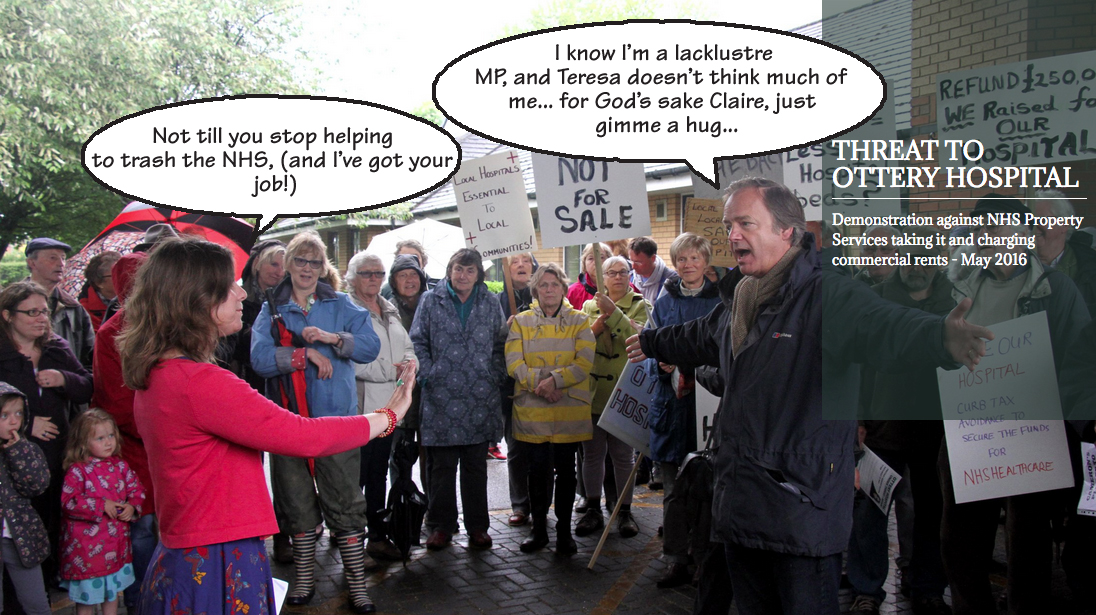
A few of the “weaponised army” at Ottery Hospital – the strapline picture from the blog of tireless health campaignet Claire Wright – the picture shows 2 children, a dozen ladies of a certain age and two mem. Can anyone see any weapons! Do placards and peaceful protest constitute weaponising?

Added to which, Claire Wright looks distinctly unarmed!

or perhaps this is more appropriate:

or this:


and remember, Swire signed up to this:

Open letter to Swire on hospital bed closures from DCC Independent East Devon Alliance councillor Martin Shaw

“Dear Hugo Swire,

In a recent Exmouth Journal article you said: “Regrettably, Ottery Hospital has been weaponised by an anti-Tory coalition for nigh on ten years with them telling a naturally alarmed local community that it will be sold off or closed. I have spent 10 years trying to counter this scaremongering. …”

It’s hardly scaremongering when the hospital has lost its beds and this July’s Devon NHS Sustainability and Transformation Partnership report said, ‘We know a large amount of space in our community hospital buildings is underused. The revenue cost of our community hospital estates is in the order of £20 million; money the NHS could use to improve other services. Working with other public sector partners, as part of the One Public Estate initiative, we will review the space that is required to deliver care, and plan to consolidate the number of sites to free up estate and generate money, which can be re-invested in technology and infrastructure.’

It’s also rich for you to talk about ‘weaponising’ community hospitals. In Seaton we remember all too well when the Clinical Commissioning Group launched its consultation on the future of community hospital beds in 2016, with its preferred option being Option A which would keep the beds in Tiverton, Exmouth and Seaton. You said in Parliament that ‘option B, which sees the beds retained in Tiverton, and also in Sidmouth and Exmouth, is the option worthy of support. Sidmouth has an extremely high proportion of over-85s, with people increasingly living longer, and of people with dementia. Exmouth is the biggest town in Devon with more than 35,000 people.’

Four months later the CCG followed your recommendation, changed its preference, and closed Seaton’s beds. The reasons given for preferring Sidmouth to Seaton were specious – Seaton has an almost identical proportion of elderly. In short, Hugo Swire, you sold Seaton down the river because it was no longer in your constituency (having been removed due to boundary changes in 2010) and you needed to save beds in Sidmouth as well as Exmouth to fend off the challenge from Claire Wright, who even so ran you close in the 2017 General Election.

Today Seaton Hospital, like Ottery, Honiton and Axminster, faces an uncertain future. If it closes, it will be a knock-on effect of the beds decision, and it will be partly on your head.

Martin Shaw, County Councillor for Seaton and Colyton”

Who’s ‘weaponising’ community hospitals, @HugoSwire? Two years ago you were happy to sell out Seaton Hospital to save your parliamentary career

Seaton councillor to ask searching question of EDDC on NHS

From the blog of DCC Independent East Devon Alliance councillor:

The question to be asked by former Mayor and Seaton Councillor Jack Rowlands:

“EDDC has recently decided not to list Seaton Community Hospital as an asset of community value citing that it does not meet the definition of “social wellbeing”. EDDC has now declined requests from 3 community hospitals in the district giving the same reason each time. Please explain why other district councils in Devon have agreed to list community hospitals as assets of community value e.g. Tyrell Community Hospital in Ilfracombe, Moretonhampstead Community Hospital, Bovey Tracey Community Hospital and Teignmouth Community Hospital.

Why is EDDC interpreting the definition differently to neighbouring district councils on this important issue where our community hospitals may be under threat of being fully closed and sold in the future by NHS Property Services?”

Why has EDDC refused to list Seaton and other community hospitals as ‘assets of community value’, when other Devon districts have done so? Jack Rowland will ask at the EDDC on Wednesday

“Landowners to be forced to sacrifice profits for more affordable houses, under plans expected to be unveiled in budget”

Owl says: Oh, the poor, poor darlings! We must set up a charity or a crowdfunding page for them. We could make the aim of the charity “To unite Tory developer donors to pressurise government to create other ways of making obscene profits”.

“Councils would be able to strip landowners of large portions of profits from the sale of their land, under proposals expected to be unveiled in the Budget, The Sunday Telegraph can disclose.

An official review commissioned by Philip Hammond, the Chancellor, is to endorse controversial calls for the state to “capture” more of the increase in value of sites when they are granted planning permission.

Sir Oliver Letwin, the former minister carrying out the review, is expected to recommend that local authorities should be able to seize greater amounts of landowners’ profits in order to fund the construction of local infrastructure such as roads and affordable homes. …”

https://www.telegraph.co.uk/news/2018/10/20/landowners-forced-sacrifice-profits-affordable-houses-plans/

Swire accuses Ottery hospital campaigners of “weaponising” their cause

In an extraordinary rant – no cancel that, Swire seems to be ranting much of the time these days so it isn’t at all extraordinary! – Swire accuses those campaigning for the retention of beds (gone)and services (some) remaining of “weaponising” Ottery St Mary hospital. By implication, he appears to include his arch-enemy, Claire Wright in this “weaponisation” (aka peaceful campaigning).

In a recent Exmouth Journal article (which they will presumably allow campaigners to respond to as a right to reply) he says:

“Regrettably, Ottery Hospital has been weaponised by an anti-Tory coalition for nigh on ten years with them telling a naturally alarmed local community that it will be sold off or closed. I have spent 10 years trying to counter this scaremongering. … “

He then goes on to puff up his recent visit to Ottery – well what do tou call a hospital with no beds? – let’s say “closed community bed building” with the new Secretary of State for Health, when said Secretary refused to meet tireless campaigner Claire Wright and other local people who are keeping up the pressure on him and his mates – though rumour has it that Sarah Randall-Johnson was somewhere in his vicinity. You know, the woman who thinks her DCC committee has no need to scrutinise these changes.

SWIRE MAKES NO MENTION OF THE FACT THAT THE MINOR INJURIES UNIT AND ALL INPATIENT BEDS HAVE ALREADY BEEN CLOSED AT THE HOSPITAL DURING THIS SO-CALLED 10 YEARS!!!!!!!

He says we must look to the future not back at the past and see how our changing needs can be met.

Owl has a suggestion: with the ageing population in East Devon how about a Minor Injuries Unit and Community Hospital beds?

Parliamentary Select Committee: are Local Enterprise Partnerships ignoring rural communities

“19 October 2018
The Select Committee on the Rural Economy questions local authorities and Local Enterprise Partnerships (LEPs) on their role in the rural economy.

Parliament TV – Rural Economy
Select Committee on the Rural Economy
Witnesses
At 9.45am

Cllr Sue Baxter, Chairman, National Association of Local Councils (NALC)
Cllr Bob Egerton, Cornwall Council
Cllr Mark Hawthorne, Chairman of Local Government Association (LGA) People and Places Board and leader of Gloucestershire County Council
At 10.45am

Richard Baker, Head of Strategy and Policy, North East LEP
John Mortimer, Chairman, Swindon & Wiltshire LEP
Cllr Louise Richardson, Chair, Leicestershire Rural Partnership, Leicester and Leicestershire LEP
Areas of discussion
Likely areas of discussion include:

Access to rural services
How the battle against rural crime is tackled
How devolution arrangements can be reformed to support the rural economy more effectively?
The impact of Brexit on rural economies and the role of LEPs

https://www.parliament.uk/business/committees/committees-a-z/lords-select/rural-economy/news-parliament-2017/leps-local-gov/

People with certain convictions to be barred from being councillors

“The government is to strengthen rules preventing people found guilty of serious crimes from serving on local councils, it has been announced.

Local Government Minister Rishi Sunak said the new rules would mean any person who is subject to an Anti-Social Behaviour Injunction, a Criminal Behaviour Order, a Sexual Risk Order or who is on the Sex Offenders’ Register, would no longer be able to stand for elected office in their community.

Current conditions make clear that anyone convicted of an offence carrying a prison sentence of more than three months is banned from serving as a local councillor.

The new measures will see the disqualification rules changed to include the alternatives to a prison sentence as a barrier to becoming a councillor.

They will require changes to primary legislation, in particular the Local Government Act 1972, the Local Democracy, Economic Development and Construction Act 2009, and the Greater London Authority Act 2009.

The government will “look to identify a suitable legislative opportunity to bring the changes into law”.

Once the rules are implemented, councils across England will have the power to prevent individuals from standing as a councillor or mayor at the point they trigger the revised disqualification criteria. These proposals will not apply retrospectively, the government said.

Sunak said: “Elected members play a crucial role in town halls across the country, and are the foundations of local democracy. They are community champions, and have a leading role to play in building a better society for everyone.

“With such an important role comes great responsibility, and these changes will protect residents while upholding the values and high standards of behaviour we all expect.”

The move follows a consultation. The government’s response can be found here.

https://www.gov.uk/government/consultations/disqualification-criteria-for-councillors-and-mayors

The great plastic waste con (that we all pay for)

“The first council in the UK has said it is planning to tell residents to stop recycling mixed plastic, sparking fears that years of progress on reducing black bag waste is on the verge of going into reverse.

It comes as the Environment Agency is understood to be investigating the plastics recycling industry over claims that millions of tonnes of plastic is never actually recycled, meaning consumers may have been wasting time separating plastic waste.

Plastic recycling waste has been building up in the UK since China stopped importing it last year, with the situation now so bad that councils have now started cutting plastic recycling services.

Swindon has said it wants households to put mixed plastic items, such as yogurt pots and plastic trays, in the bin with regular waste.

Instead of recycling it is proposing to incinerate it along with other household rubbish. The Environment Agency is said to be investigating claims that plastic meant for recycling is being left to leak into rivers and oceans.

The problem has led to Basingstoke Borough Council taking the decision yesterday to close all 29 of its mixed plastic “bring banks”.

And in Southampton, plastic left over in the bins will be removed in the next two weeks and incinerated to generate energy for the National Grid.

Geoff Quayle, sales director of Printwaste Recycling and Shredding which provides 19 banks to Southampton City Council and 29 to Basingstoke and Dean as well as other local authorities, said the company has already stockpiled around 40 tonnes of plastic since July.

… Julian Kirby, plastics campaigner at Friends of the Earth, said: “We can’t burn our way out of the plastic pollution crisis.

“Incinerators belch polluting, poisonous fumes and ash into the atmosphere. “The ultimate solution is to avoid the use of unnecessary plastics in the first place. This is why we’re campaigning for legislation to end the use of all but the most essential plastics.”

https://www.telegraph.co.uk/news/2018/10/18/plastic-recycling-crisis-first-council-plans-tell-households/

Not a good time for MPs with Middle East ties – but Conservatives Middle East Council thinks it is a “brand issue”

It’s hard to criticise a country on which our arms dealers are so dependent.

See here what the Conservatives Middle East Council (Chairman, Hugo Swire) thinks of “brand Saudi”

“Firstly, it needs to be said that Saudi Arabia will survive this crisis. Global politics are as they are, and the world will not stop buying Saudi oil, nor will Western nations abandon their decades old defence relationships with the Kingdom. Riyadh will not be any less secure as a result of the crisis, and with oil approaching $100 a barrel Saudi coffers will not be too adversely hit.

….. Whether Saudis want to admit it or not, the allegations of an horrific death of a journalist in a Saudi Consulate have resulted in the Crown Prince’s reputation taking a battering. Private sector companies have fled from the Davos in Desert conference scheduled to take place in late October. Ministers from foreign governments may still turn up, the cost of losing Saudi Arabia is too high. But the Ubers and JP Morgans of the world have calculated that the cost of being currently associated with brand MbS is higher than the cost of losing out on taking a slice of Saudi Arabia’s economy.

Like all brands, brand MbS might be able to resurrect itself, but it will take time. …..”

https://cmec.org.uk/depth/news-analysis/michael-stephens-cmec-what-next-house-saud

Here is what the Daily Mail has to say

“Crisis-torn Saudi Arabia has been lavishing hundreds of thousands of pounds on British MPs, the Mail can reveal.

The kingdom – under fire over the suspected state-sponsored murder of a journalist – has been pouring cash into a charm offensive.

In just two years it has tripled the amount of money spent on MPs to pay for luxury hotels, business-class flights and magnificent feasts.

Campaigners say 38 MPs who got freebies over the past five years are ‘accessories’ to a cynical bid to brush up the oil-rich Gulf nation’s tarnished image.

Saudi Arabia’s slick PR offensive comes as it battles international condemnation over the suspected murder of dissident journalist Jamal Khashoggi.

Screaming Mr Khashoggi, 59, is said to have been recorded in his country’s consulate in Istanbul apparently being chopped up while alive – as the chief Saudi government hitman listened to music on earphones.

Saudi Arabia is also under intense scrutiny for staging bombing raids across Yemen that have killed thousands of civilians.

In 2016, British parliamentarians accepted £35,062 of junkets, gifts and other benefits from the authoritarian regime. But this year the figure is more than three times higher at £106,418 – and it is only October. The total since 2015 has been put at £208,000.

….. Last night Andrew Smith, from Campaign Against the Arms Trade, said: ‘At the same time as the MPs were enjoying luxury flights and hotels, human rights defenders were being abused and Yemen was being bombed.

‘MPs should be speaking out and taking action, not accepting gifts and hospitality.

‘The Saudi regime has one of the most appalling human rights records in the world, and MPs should not be supporting it. …”

https://www.dailymail.co.uk/news/article-6292363/Brutal-regime-blamed-dissidents-death-triples-gifts-lavished-British-politicians.html

West Country Tory MP feels completely out of place in his party

“A Tory backbencher has criticised the government and said he would not have stood as an MP “if the situation was like it is now”.

Johnny Mercer told The House magazine he was no longer sure that his “set of values and ethos” were still “aligned with the Conservative Party”.

The party had “lost focus” on fighting for what it believed in and instead was focused on “technocrats and managers”.

Mr Mercer, an ex-Army officer, has said he never voted until he became an MP
The MP for Plymouth Moor View has been critical of the party before, telling the Telegraph in 2017 it was “in danger of losing credibility”.

In his interview with The House, Mr Mercer – who was first elected in 2015 – was critical of Prime Minister Theresa May’s response to a questions about investigations into Northern Ireland veterans, saying “she did not answer in a way that made me proud to be a member of the governing party”.

And, of her Chequers blueprint for post-Brexit relations with the EU, he said: “That is your classic professional politicians’ answer because it’s right down the middle. It doesn’t make anybody happy. It’s the ultimate in not making a decision.”

He said, “under this chief whip, under this prime minister, there is no role for people like me” but added: “That’s fine because nothing lasts forever.” He admitted he would like to be defence secretary – Mr Mercer has campaigned for veterans, including those with mental health problems.

Mr Mercer said that while his “set of values and ethos” had been aligned with the Conservative Party, “I’m not as comfortable that that’s the case anymore.”

And he added: “If the situation was like it is now, I can safely say there would be absolutely no chance that I would try and be a member of Parliament.

https://www.bbc.co.uk/news/uk-politics-45905581

“CIPFA warns councils over serious commercial activity concerns”

“CIPFA is to work on fresh guidance over concerns councils in England are putting public funds at “unnecessary or unquantified risk” when borrowing to invest in commercial property.

In a statement released today, the insitute suggested local authorities were investing in commercial properties disproportionately to their resources.

This would be against the requirements of the CIPFA’s Prudential Code and Treasury Management code, the joint statement from CIPFA chief executive Rob Whiteman and chair of CIPFA’s treasury and capital management panel Richard Paver, said.

Whiteman and Paver said that “in some cases these investments have been financed by borrowing” and CIPFA shared concerns there had been an “acceleration of the practice of borrowing to invest in commercial property”.

They warned councils the “prime policy objective of a local authority’s treasury management investment activities is the security of funds, and that a local authority should avoid exposing public funds to unnecessary or unquantified risks”.

CIPFA’s code and the government’s Statutory Guidance on Local Government Investments were “very clear that local authorities must not borrow more than or in advance of their needs purely in order to profit from the investment of the extra sums borrowed”.

The institute will “issue more guidance and will make it clear that these investment approaches are not consistent with the requirements of fiscal sustainability, prudence and affordability,” the statement said.

Government figures released last week showed an increase in local authorities’ commercial activities.

English councils’ acquisition of land and buildings rose by £1.2bn (43.1%) to £4bn in 2017-18 from £2.8bn in 2016-17, the Ministry of Housing, Communities and Local Government data revealed.

Total borrowing by councils in England had risen from £4.4bn in 2013-14 to £10bn in 2017-18.

The guidance is expected to be published before the end of the year.

Until it is released, CIPFA advised local authorities to refer to the government guidance, which cautions local authorities against:

– Becoming dependent on commercial income;

– Taking out too much debt relative to net service expenditure; and

– Taking on debt to finance commercial investments.

The MHCLG figures out last week showed the largest investors in commercial property were Spelthorne Borough Council at £270m and Warrington Borough Council with £220m. Eastleigh Borough Council also spent £194m.

In 2016, Spelthorne took out 50 separate Public Works Loan Board loans to fund the purchase of a £360m business park in Sunbury-on-Thames.

PF understands that MHCLG and the Treasury have expressed concern about the scale of commercial property investment.

MHCLG has been contacted for comment.”

https://www.publicfinance.co.uk/news/2018/10/cipfa-warns-councils-over-serious-commercial-activity-concerns

Crime up 17% in Devon and Cornwall police area

Owl says: one way to get more officers on the beat is to abolish the post of Police and Crime Commissioner and the 20+ staff that work for her. But would you believe (you would) that it is impossible to find out exactly how much she and her staff cost? Accounts are (designed to be?) impenetrable. AND there is no central register of the overall cost of the 40+ Police and Crime Commissioners in post!

“Devon and Cornwall’s Police and Crime Commissioner has said she is committed to “securing more funding for front-line officers” – as new figures show a rise in recorded crime.

Between July 2017 and June 2018, recorded crime was up 17% in the Devon and Cornwall force area, according to figures from the Office for National Statistics.

Nationally there was an increase of 10%.

Alison Hernandez said she was “concerned” about a rise in violent offences, although she said serious violent offences “are still very unusual in the peninsula”.

“It’s clear to me that more money is needed to support greater officer numbers,” she said.

She added she was working with her office to help tackle the increases.”

https://www.bbc.co.uk/news/live/uk-england-devon-45837866

“Politicians may finally be catching on: towns now hold the key to Britain’s future”

“… Everywhere we go, people talk about the fate of their town centres with amazing passion, and frustration. Obviously, the Altrincham model of regeneration will not suit everywhere, to say the least. Labour now has a five-point plan for high streets that takes in an end to ATM charges, free wifi, a new register of empty properties, free bus travel for under-25s and reform of business rates. It sounds promising, though perhaps evades something that is glaringly obvious: conventional chain-store retailing is dying fast and high streets need to find new uses. Until this sinks in, the mood of resentment and political disconnection that characterises many of our towns will fester on.

With good reason, the political debate about austerity tends to focus on cuts to such crucial services as adult and children’s social care, education, libraries and public transport. But there is also an overlooked ambient austerity manifested in streets festooned with rubbish and the decline and decay of public space – and it has a huge effect on how people feel about where they live and what politics has to offer them.

… Obviously, young people who are not happy in towns tend to leave. It is the older generations who stick around, and who feel the changes to town life more deeply. Despite the fashionable idea that Britain’s current malaise will be miraculously ended once they begin to die off, they are going to be around for some time to come.

Wherever we go, with good reason, most people we meet have no sense of which bit of government is responsible for this or that aspect of their lives – only that the forces making the decisions are remote, seemingly unaccountable and rarely interested in where they live. Many urban areas have been recently boosted by the creation of “city regions” governed by “metro mayors”; in Scotland and Wales, devolution has brought power closer to people’s lives. In most English towns, by contrast, systems of power and accountability are pretty much as they were 40 years ago.

… What this does to people’s connection with politics is clear. To quote a report by the recently founded thinktank the Centre for Towns, “on average, people living in cities are much less likely to believe that politicians don’t care about their area. Those living in towns are, in contrast, more likely to think politicians don’t care about their area – and won’t in the future.”

There lies the biggest issue of all. The future of our towns will only partly be decided by the high-octane rituals of Westminster debate, and general elections. What really matters is whether they might finally run a much greater share of their own affairs – and, to coin a memorable slogan, take back control.”

https://www.theguardian.com/cities/commentisfree/2018/oct/18/politicians-may-finally-be-catching-on-towns-now-hold-the-key-to-britains-future

“Optum CEO resigns from top NHS Job, Optum partner replaces him”

“This is an everyday story of the sordid revolving door between US Health insurance company United Health and the NHS.

In the UK, United Health’s subsidiary Optum sells the NHS what it needs in order to morph into a version of United Health – the previous employer of NHS England’s boss Simon Stevens.

With NHS England’s blessing, Optum is all over the NHS, installing their technology & redesigning the NHS through its use.

Optum sells the NHS:

Commissioning support services
Scriptswitch decision support for GP prescribing (which United Health UK acquired in 2009) is in most GP surgeries.
Referral management services
GP Empower (accelerating large scale GP practices

Integrated Care Systems support: “Optum® brings practical hands-on experience having delivered integrated care for over 20 years in the US. Our tried and tested approach has helped systems deliver proven results.” This updates an earlier brochure on accountable care systems/organisations which is no longer available. However NHS For Sale quotes Optum’s now defunct webpage: “We currently operate 26 accountable care organisations in the U.S., and are supporting sustainability and transformation partnerships in the U.K. to manage population health risk and deliver care as an integrated group of providers.”

The overall aim is to control, sideline and override doctors’ treatment decisions – as we can see through NHS England’s consultation on stopping funding numerous elective care treatments and its mandatory Integrated Urgent Care Services specification. This removes patients’ direct access to clinicians and redirects them through NHS 111 to a clinical advisory service that works off the algorithms in a clinical decision support tool.

And now it has its finger firmly in the National Institute of Health and Care Excellence pie – the organisation responsible for providing evidence-based guidance and advice to the NHS.

The revolving door that connnects United Health, Optum and the National Institute of Health and Care Excellence

This concerns:

former United Health Director Andrew Witty
Lord Darzi (head of the Imperial College department which is partnered with OptumLabs, a United Health business); and
a new public-private partnership in the National Institute of Health and Care Excellence called the “Accelerated Access Collaborative“, that’s about pushing new technology and drugs through the NHS.
It puts Optum centre stage in the Accelerated Access Collaborative. Now there’s a surprise. Or not. If you have been following United Health’s relatively rapid takeover of the NHS.

As a result of these shenanigans, we would treat any new recommendation from NICE with a pinch of salt.

Here is a short Witty timeline:

March 2017 – Andrew Witty leaves CEO position at Glaxo Smith Kline
August 2017 – Witty joins UnitedHealth’s Board of Directors
November 2017 – Following the Accelerated Access Review, the Department of Health appoints Witty as head of the Accelerated Access Collaborative. The job is to fast track drugs & technology into the NHS, to start April 2018
March 2018 – United Health announces Witty to be new Optum CEO, to start July 2018
Andrew Witty must have been rumbled somewhere along the line as he graciously resigned from the Government position in March 2018, due to the enormous conflict of interest of him starting as Optum CEO in July 2018. Ignored of course was the huge conflict of interest in hiring Witty in the first place while he was a Director of UnitedHealth.

And who replaced him? Lord Darzi.

Who is Lord Darzi

I am tired of writing about Lord Darzi. He stalks the NHS like a zombie. He was behind the New Labour government’s massive, failed and costly privatisation of elective NHS services in the horrible Independent Sector Treatment Centres – one of which totally messed up my son’s broken wrist – twice, before an NHS hospital fixed it for him.

This is what his nasty scheme has come to now. Regardless, he has returned to push his idea a second time as Accountable Care – with the apparent support of the Labour Shadow Health Secretary Jon Ashworth. This time from his perch in the Institute of Global Health Innovation (IGHI) at Imperial College, London.

Which, surprise surprise, is an OptumLabs partner.

What is OptumLabs

OptumLabs (launched in 2013) is all about United Health number crunching and framing raw patient data for academics to play with to derive the “best treatments” for patients.

OptumLabs is desperate to pass itself off as pioneering and respectable in the academic research field. But reality of the profit motive and UnitedHealth’s track record of

“deception, manipulation of data and outright fraud”

(see the Ingenix case ) means their number crunching will most likely point to treatments that United Health finds most profitable, not what’s best for patients. And OptumLabs is useful cover to collect patient data.

We pointed out some time ago Optum’s invidious position as a provider of commissioning support services, able to direct Clinical Commissioning Groups to commission Optum products. Now they have their fingers in the NICE pie too.”

Optum CEO resigns from top NHS Job, Optum partner replaces him

UK fish quotas and the Carters of Greendale … anyone remember this

Wonder what the situation is now?


“In a small marina in Exmouth sits the Nina May. The 4.8m fibreglass boat is not much to look at, with just a small outboard motor it pales against the luxurious sailing boats that crowd the harbour.

The boat is something of a legend amongst fishermen in the south west. Many have heard about this mysterious, tiny vessel but few have ever seen it sail.

That is because the Nina May has a secret. The tiny boat holds a massive amount of FQA, the unit used to dole out the right to fish in the UK.

In fact the boat holds nearly a fifth of all fishing rights for the South West of England, and has much more quota than all but one of the much larger fishing boats in the area.

But those figures seem to defy logic. According to government records, that amount of FQA equates to around 1,500 tonnes of fish a year. That means the tiny boat would need to fish an average of four tonnes of fish a day!

Greenpeace spoke to Robin Carter, who runs F W S Carter Limited, the fishing company that owns the boat along with 12 other, much larger vessels.

Carter explained that he transferred the FQA licenses onto the tiny boat and then sends out his bigger boats to write off their catches against that allowance.

By doing that Carter’s fishermen can essentially fish without risking being penalised on quota should they be caught breaking the rules.

“Why it’s on the Nina May is that if you get an offence, a log book offence, or some silly little offence, the ministry would freeze your licence. You wouldn’t be allowed to sell your licence or sell your quota on it.

“We took the precaution – because we got caught once – of taking the fish off all the boats and just putting it one the one boat.

“It’s on there for no other reason than that licence will never get frozen because it just goes in and out of the river and hopefully never commits an offence.”

Local news reports from 2011 state that a Robin Carter was charged £4,040 in fines and costs after pleading guilty to setting an illegal net off the coast near Sidmouth.

The chairman of the magistrates court which ruled on the case said that Robin Carter was an ‘experienced fisherman’ and described his actions as ‘deliberate and reckless.’

The company made an operating profit of £2,628,000 last year.

“We fish about 90% of the quota we have and lease the rest. We use the Marine Management Organisations set rates or the landing price to guide us, but markets prices move. It’s all about supply and demand. Quota is a currency you can swap,” Carter added.

The Marine Management Organisation, the government body that oversees fishing allocation, told Unearthed there are no regulatory restrictions on the number of FQA units that can be held on a single licence.

It said it has significantly improved the transparency of FQAs making data available through the FQA register which also enables FQA holders to transfer their FQA units electronically subject to Quota Management Rules.

Griffin Carpenter from the New Economics Foundation researches the economics of European quota systems. He says this type of hoarding goes against the spirit of the system.

“FQAs were intended to correspond to the actual fishing activity of vessels, but the case of the Nina May highlights just how far we’ve moved from matching quota with fishing activity. This practice may not be illegal, but it’s also not fulfilling any objective of the quota system, especially as many vessels are desperately trying to get access more quota and the government is trying to ensure that all existing quota is used,” said Carpenter.

Carter does not think there is anything wrong with holding so much fishing rights on a tiny dinghy.

“It’s an asset we’ve invested in for the last 20 years,” he explains. “Others sold themselves out of the industry- some people sold it off to foreign nationals- or sold it to us. We saw this system coming and that’s why we invested in quota.”

Investigation: Why this tiny boat has more fishing rights than many trawlers

“Expert” Swire on Saudi Arabian assasination of journalist and famine in Yemen? So far, no comment

Hugo Swire has spent (when at the Foreign Office) and still spends (by virtue of his Chairmanship of the Conservative Middle East Council) a lot of time in the Middle East and particularly in Saudi Arabia. Often in the company of British arms dealing companies.

So what does he have to say about the assassination squad, emanating from Saudi Arabia, that allegedly tortured and killed a critical journalist in their consulate in Turkey:

https://www.mirror.co.uk/news/world-news/jamal-khashoggi-screaming-saudi-journalist-13429570

And the dreadful famine conditions in war-torn Yemen – bombarded daily by Saudi jets:

https://www.theguardian.com/global-development/2018/oct/15/yemen-on-brink-worst-famine-100-years-un

So far, attempting to find anything he has said on Google – nothing.

“Local government fraud cases rise”

“The number of cases of fraud committed against local authorities went up in 2017-18 and the value prevented is a little lower, CIPFA has revealed.

In its annual fraud tracker, out today, the institute showed this type of crime remains a “major financial threat” to councils with housing fraud being the most common type.

The total value of fraud prevented is down from last year’s CIPFA estimates – from £336m to £302m – while the prevalence of fraud has increased from 75,000 cases to 80,000 this year.

Housing fraud remained the most common type – 74.1% of total fraud reported – as it was last year.

The largest growing area of fraud is in business rates, which jumped from £4.3m in 2016-17 to £10.4m in 2017-18. It now accounts for 3.4% of all fraud reported by councils. …”

Source: Lical Government Lawyer website