Cornwall unitary approaching the rocks at speed

“Cornwall to cut hundreds of jobs in bid to save £80m and avoid Northants-style disaster:

However, the proposed cuts are only the equivalent of 388 full-time jobs.

According to a report ahead of the council’s Cabinet meeting today, the amount of jobs to be cut will reduce to 167 after mitigations such as reducing the amount spent on agency staff.

It is not yet clear where in the council’s services the jobs will be cut from, but the report noted that workforce reductions will be delivered in line with the Public Sector Equality Duty, the Councils Equality of Opportunity Policy and Organisational Change Toolkits and guidance.

The report also said that, as funding from central government continues to fall and demand for public services increases, the council must find a further £77m of savings over the next four years on top of the £300m of savings it has already delivered.

Cornwall Council has seen significant cuts to its central grant funding since austerity began in 2010, according to the report. There has been a reduction of about 40% from 2009-10 to 2018-19, during which time £300m in savings have been made.

“Whilst the council is in a sound financial position, with a strong track record of delivering its budgets supported by reserves, it cannot continue to deliver the savings required year on year and deliver a balanced budget without impacting upon the delivery of services,” the report warned.

The report even went as far as pointing to recent events in Northamptonshire, Somerset and East Sussex to illustrate the challenges facing local government, particularly for those local authorities responsible for providing social care.

“Cornwall Council does not want to face the position currently faced by these authorities of only providing services at the statutory minimum,” it concluded.”

http://www.publicsectorexecutive.com/Public-Sector-News/cornwall-to-cut-hundreds-of-jobs-in-bid-to-save-80m-and-avoid-northants-style-disaster

Ottery St Mary continues its proud tradition of independence!

G Pratt, Ind. 715
J Sheaves. Con. 421
LibDem. 51
Green. 24
Labour. 20

What happens if most English local authorities fail due to inadequate funding?

Owl has a theory.

Their money (but with fewer responsibilities and much less scrutiny) will immediately be passed to Local Enterprise Partnerships!

Unelected, unaccountable, barely scrutinised they will be free to use our money however they wish. And responsible only to government.

A score of unelected business people of dubious quality, dubious expertise and with complex conflicts of interest get full power.

What could possibly go wrong?

“Devon has fewer good and outstanding schools and excluded pupil numbers are rising”

“Exclusion rates in Devon have risen above the national average while the number of schools rated as Good or Outstanding has fallen.

The figures for 2016/17 were revealed in a report to Devon County Council’s children scrutiny committee on Monday.

Dawn Stabb, head of education and learning at Devon County Council, told the committee that steps have already been taken through the Devon inclusion project to address the significant rise in exclusion figures and that Ofsted are being more rigorous in their grading.

The report said that Devon’s Permanent Exclusions have risen from 0.09 per cent of the pupil population to 0.14 per cent in 2016/17, and that permanent exclusions in Devon primary and secondary schools were slightly higher than nationally, 0.07 per cent in Devon primary schools compared to 0.03 per cent nationally, and 0.22 per cent in Devon secondary schools compared to 0.20 per cent nationally. “

https://www.devonlive.com/news/devon-news/devon-fewer-good-outstanding-schools-2025902

“£1bn in unpalatable county council cuts’ ahead in England”

“Council bosses in England say the “worst is yet to come” in cuts to services, as the government further reduces local authority funding.
The County Council Network predicts “unpalatable cutbacks” next year as the councils identify at least £1bn savings to plug a £1.5bn shortfall by 2020.

It also warns the risk of some councils stripping their services back to a minimum ‘core offer’ is growing.

The government said councils will get a real term funding increase in 2018-19.

It insists its approach strikes the right balance between relieving pressure on local government and ensuring taxpayers do not face excessive bills.

‘Cost-pressures’

But town hall bosses say local government funding from central government, through the revenue support grant, will have been cut by around 60% by 2020.
Cllr Paul Carter, chairman of the County Council Network and leader of Kent County Council said: “Counties will work hard to deliver the savings required, but the scope for making deliverable savings has dramatically reduced, and decisions for next year will be truly unpalatable if we are to fulfil our statutory duties.

“Without additional resource, the worst is yet to come.”

Some councils have reached a financial crunch point, such as Northampton – where £70m of savings are required by March.

And Somerset and East Sussex have had to rubber-stamp in-year funding cuts to keep to their 2018-19 budgets.

The County Council Network, which represents 36 larger authorities, surveyed its members about their budgets and what they planned to cut next year.

All 36 responded said they faced significant cost pressures, including a growth in demand in some areas – particularly children’s and adult social care, inflation and rising costs outside of their control.

The survey revealed council bosses had already ear-marked £1bn worth of services as potential sources of savings.

Some £685m of those are to balance the books going forward.

Twenty five councils who responded to a separate survey, set out what they were planning to cut, moderately or severely:

58% said highways and transport (including road improvements, streetlights, pothole filling)
47% said libraries
45% said early years and youth clubs.
44% ear-marked public health services like smoking cessation, sexual health, substance misuse
36% said children’s services.

Councils say they are expecting to have to switch funds from non-statutory services – the ones they are not obliged to provide by law – to ensure statutory services are provided.

Councillor Nick Rushton, CCN finance spokesman and leader of Leicestershire County Council, said authorities were in a “serious and extremely challenging financial position” and further cuts and rising costs would make a “bad situation even worse”.

“County councils across the country have no choice but to find a further £1bn of savings next year,” he said.

“There is not enough money today to run vital services. Next year there is even less from the drop in government funding.”

He added that councils were again at the point where council tax rises alone would not protect services.

Councillor Martin Hill, leader of Lincolnshire County Council, said his authority had to save £25m a year since 2010.

He said it would soon come to a point where the council would have to consider whether it can operate safely with regard to its responsibilities to vulnerable children and adults.

A Ministry of Housing, Communities & Local Government spokesman said local authorities were responsible for their own funding decisions, “but over the next two years, we are providing councils with £90.7bn to help them meet the needs of their residents”.

They said local councils would have the power to retain the growth in income from business rates and develop a system for the future.”

https://www.bbc.co.uk/news/education-45573921

A personal view of scrutiny

From Peter Cleasby, a member of the Green Party, who lives in Exeter.

The Centre for Public Scrutiny has been tasked by the government with contributing to the new statutory guidance on overview and scrutiny in local government [1]. Below are my own suggestions, drawing on experience with monitoring Exeter City Council, which I have sent to the CfPS and the government.

1. There should be a requirement that scrutiny committees are constituted so as to be able to challenge ruling group proposals effectively. Exeter City Council changed its rules a few years ago to require that the chairs of scrutiny committees would be drawn from the majority party only (previously the chairs could be taken by members of opposition parties). This reduces the independence of the committees and, for obvious party political reasons, reduces criticism of leadership group proposals.

2. There should be more opportunities for members of the public to ask questions and challenge councillors at meetings. Other Devon councils allow questions to be asked at meetings of their executives/cabinets, but Exeter limits this practice to its scrutiny committees. Although the questioner is allowed to speak at the end of any discussion following the question and answer, no opportunity is provided to ask a supplementary question. This reduces the effectiveness of the challenge and the quality of discussion, and a requirement for one supplementary question would be valuable.

3. Scrutiny committees should be required to engage independent specialists to help them understand and challenge leadership proposals which have a high technical content, for example: on air quality, waste collection and disposal, estimation of housing need. This would enable officer-led proposals, often informed by consultancy studies predicated on terms of reference and assumptions issued by those officers, to be debated on a level playing field of knowledge.

4. Officers should be required to inform scrutiny committees of any representations received from organisations and individuals, whether solicited or not, relevant to an item being discussed by a scrutiny committee.

5. It should be mandatory for all proposals which would incur unbudgeted expenditure in excess of (say) £50k should be discussed at a scrutiny committee; and the proposal should state explicitly where the funding for the proposal will come from, including the impact on existing specific budgets.

6. In the interests of measuring the extent to which members of the public are having to resort to FOI Act/EIR channels to obtain information, the number, nature and outcome of all such requests such be reported publicly to each scrutiny committee cycle.

Some of these requirements will have – modest – costs at a time when local authorities are under severe financial constraints. In the interests of restoring the health of our democratic arrangements, the government should be prepared to make available additional funding to support them.

NOTES:

[1] See https://www.cfps.org.uk/3323-2/

Another investigation of local authority scrutiny and accountability

Owl says: The time is coming for fewer reports and more action. As an example, council CEOs should be forced to attend such committees in public to answer for their more controversial and questionable behaviour.

“The National Audit Office is to conduct a study of local government governance and accountability that will “examine key elements of local arrangements in the light of current pressures”.

The watchdog will also examine how the Ministry for Housing, Communities and Local Government, which is responsible for maintaining the overall accountability system for local government, is exercising its responsibilities as the steward of the system.

The NAO said: “Council governance and accountability arrangements are key in securing value for money locally. However, these arrangements are being tested by the current financial circumstances in the sector. Increasingly difficult decisions need to be made to protect key services and ensure financial sustainability. This includes the design and delivery of large service transformation programmes and the pursuit of new sources of revenue income through commercial investments.

“Local governance and accountability arrangements provide assurance about decision making processes and support the mitigation of risk in this increasingly challenging and complex environment.”

The NAO report is expected to be published in early 2019.

A report from the Committee for Standards in Public Life on local government ethical standards is due to come out later this year.”

http://localgovernmentlawyer.co.uk/index.php?option=com_content&view=article&id=36710%3Anational-audit-office-to-investigate-local-government-governance-and-accountability&catid=59&Itemid=27

Buying votes with new social housing – but only after 2022!

Throughout this government’s term those in social housing have been demonised as scroungers and workshy. The government instead chose to line the pockets of already-rich developers and people being helped to buy houses that cost up to £600,000.

Today, as Brexit continues to be a shambles, education is at breaking point, inequality is at its widest, the environment is being trashed and the NHS is on its knees, May announces that, in fact, people in council houses are mostly hard-working people trying desperately to make ends meet. And that occupying such housing should not be a “stigma”!

So what changed?

Nothing, except that more and more people are deserting her party and their votes are, of course, going with them – to people like Claire Wright, for example. And to other feisty independent councillors such as East Devon Alliance’s Gardner, Rixon, Jung and Shaw.

Read the fine print on this housing. It is not promised until 2022 – when Tories may well not be in power and when our economic climate could be very different.

And if you want to know who thinks social housing is a stigma, read here:

“… Housing Secretary James Brokenshire, asked who Mrs May saw as the politicians who “look down” on social housing, told BBC Radio 4’s Today programme: “I think it’s more a sort of a greater public perception, sadly.”

Pressed further if there are Conservative politicians who take this view, Mr Brokenshire again referred to a “general stigma” which he said was a feeling among tenants who were consulted for a Government policy paper. … “

http://www.itv.com/news/2018-09-19/pm-to-push-for-social-housing-reform-amid-second-rate-citizen-stigma-concern/

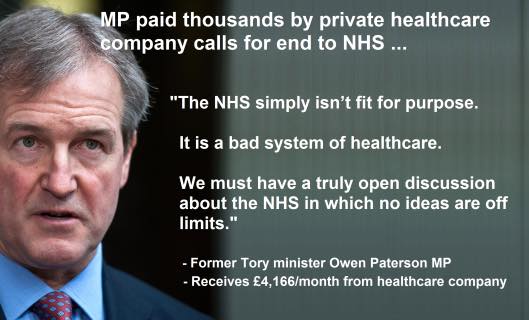
“Let American firms run hospitals, urges free trade group”

“Ministers should allow American healthcare companies to compete with the NHS to run hospitals as part of a free-trade pact after Brexit, a think tank recommends.

The Initiative for Free Trade (IFT) said that Britain should also end its ban on imports of products such as chlorinated chicken and accept American environmental and food safety regulations as equivalent to those in the UK.

The moves, it claimed, would help clear the way for a UK-US trade deal that would “rewrite the rules” of global commerce and allow Britain to take advantage of trade freedoms offered by Brexit. The IFT has received backing from Liam Fox, the international trade secretary, and Boris Johnson.

The report, edited by Daniel Hannan, a Tory MEP, was partly written by the trade lawyer Shanker Singham who has been consulted on free trade by Dr Fox, David Davis, Steve Baker and other ministers since the referendum.

Its conclusions will fuel suspicions that the think tank is being used as an “outrider” to align Britain with America on standards to secure a trade deal that would not be possible if the government signs a Chequers-style agreement with the EU.

The report, which was published simultaneously in London and Washington, was a collaboration between the IFT and the libertarian US think tank the Cato Institute.

It calls for Britain and the US to negotiate the most ambitious agreement ever that would allow British and American companies to compete on a level playing field in each other’s markets across both goods and services. Both countries should accept each other’s regulations on safety and environmental standards and open up all government procurement contracts to both sides.

It also suggests that any British or American citizen should be able to work in both jurisdictions if they have secured a job. It is the group’s proposals to open up the NHS to competition that is likely to prove the most contentious.

Daniel Ikenson, one of the report’s editors, described the NHS as an “incumbent” healthcare provider that should have competition. “The purpose of liberalising trade is to expose incumbent businesses to competition, including healthcare providers,” he added.

A Department for International Trade spokesman said: “We are currently seeking a wide range of views about four potential free-trade agreements, including with the USA, and we encourage all interested organisations and members of the public to make their voices heard through our online consultations.”

Source: Times (pay wall)

“Landowners Pocket £13bn Profit In One Year Just For Getting Planning Permission”

Is there an election in the air? Tories talking about removing the “stigma” of social housing! You know, the housing they don’t build because, as George Osborne said – why would you when Labour supporters live in them!

https://www.independent.co.uk/news/uk/politics/tories-refused-to-build-social-housing-because-it-would-create-labour-voters-nick-clegg-says-a7223796.html

“Landowners pocketed a staggering £13bn in profit last year simply for securing planning permission while a housing crisis continues to grip the nation.

Research by the Centre for Progressive Policy and the National Housing Federation has unmasked how land-holders are raising massive sums simply for being a proprietor.

Agricultural land now becomes 275 times more expensive once it receives planning permission, even before a single home is built. This is a huge uplift from just two years ago when planning permission increased the value of farmland by around 100 times.

It means proprietors are effectively sitting on a goldmine once planners green-light development on a site they own.

The CPP and NHF report found landowners’ combined profits were more than the global profits of Amazon, McDonald’s and Coca Cola combined and has increased by £4bn over the course of two years to reach £13bn.

Theresa May is due to announce that £2bn of Government funds will be directed towards housing associations to give them long-term certainty they need to build homes.

But the NHF and CPP say a radical overhaul is needed so some land sales profits can be captured and ploughed into the public purse for new affordable housing and infrastructure, such as roads.

David Orr, chief executive of the NHS, said: “This research shows the astronomical sums that landowners have been able to pocket, before they even build a single new home. At the same time, the numbers of people in desperate need of social housing is sky rocketing – we have to build 90,000 new homes for social rent every year to meet this need.

“In the face of a disastrous housing crisis, it is clear that the the broken housing market is simply not delivering. What’s more, the way we buy and sell land is the key cause. Now, we need a fundamental rethink to tackle this fundamental problem.”

It comes as house prices and demand for social homes soar, with housing associations trying to build council housing for poorer families increasingly outbid on land by private developers.

May, who will address the National Housing Federation Summit in London on Wednesday, said the £2bn will be separate to the £9bn of public funding put toward the existing affordable homes programme until 2022.

She will also focus on ending what she calls the “stigma” attached to social housing, claiming some view tenants are “not second-rate citizens”.

The PM will say: “Some residents feel marginalised and overlooked, and are ashamed to share the fact that their home belongs to a housing association or local authority.

“On the outside, many people in society – including too many politicians – continue to look down on social housing and, by extension, the people who call it their home.”

Gavin Smart, deputy chief executive of the Chartered Institute of Housing, said recognition of the social housing sector from the PM was welcome, and added: “But, as the Prime Minister recognises in her speech, it’s crucial that government investment helps housing associations to build the right kind of homes at the right prices.

“In practice this means building more homes at the lowest social rents – which is often the only truly affordable option for people on lower incomes.”

Labour also hit out at the Government plans.

John Healey, Shadow Housing Secretary, said: “Theresa May’s promises fall far short of what’s needed.

“The reality is spending on new affordable homes has been slashed so the number of new social rented homes built last year fell to the lowest level since records began.”

The English housing survey 2016/17 reported that 3.9 million households, approximately nine million people, lived in the social rented sector – which was 17% of households in the country.

The survey added 10% rented from housing associations and 7% from local authorities.

By contrast, 20% of households were private rented and 63% owner-occupied.”

https://www.huffingtonpost.co.uk/entry/landowners-pocket-ps13bn-profit-in-one-year-just-for-getting-planning-permission_uk_5ba12638e4b046313fbfe3ee

Peril of privatisation? Or just greedy Stagecoach?

Would this have been allowed to happen in a state-run utility company? Or is it just that all companies now seem to accept the unacceptable?

“Stagecoach bus driver and former mayor, 80, who ploughed his double-decker into a Sainsbury’s killing boy, seven and woman, 76, was driving dangerously, court finds.

A bus driver who crashed into a Sainsburys, killing two people, was driving dangerously when he caused the deaths, a fact-finding trial has found.

The double-decker bus driven by Kailash Chander, 60, smashed into the supermarket in October 2015.

Rowan Fitzgerald, seven, and Dora Hancox, 76, died when the bus crashed in Coventry.

Mr Chander, 80, from Leamington Spa, was judged unfit to plead or stand trial at Birmingham Crown Court.

Prosecutors allege the ‘shockingly bad driving’ by Chander, aged 77 at the time, occurred after he had worked three consecutive 75-hour weeks. …

The court heard that in 2014, the bus company, Midland Red installed a telematics system across its fleet to monitor driver performance.

The system was called ‘Ecodriver’ and was a ‘spy-in-the-cab’ device which would monitor driver performance electronically by measuring features such as braking, cornering, acceleration and speeding.

It was between July 2014 and September 2015 that Mr Chander received 24 letters relating to his Ecodriver performance.

Chander, from Leamington, has been judged medically unfit to plead or stand trial, and has been excused from attending a ‘finding-of-facts’ trial which began on Tuesday.

He has been charged with two counts of causing death by dangerous driving and two of causing serious injury. …”

https://www.dailymail.co.uk/news/article-6181235/Stagecoach-bus-driver-80-driving-dangerously-killed-two.html

“The government’s voter ID plans are ‘rearranging the deckchairs’ in the face of new threats to our democracy”

“On May 3rd 2018, 350 people were denied a vote in their local council elections. Their crime? Not possessing the right ID. The minister hailed these trials of mandatory voter ID as a ‘success’. The government must have a strange definition of success.

The scheme disenfranchised far more ordinary voters than potential wrongdoers: in a single day across the five councils, twice as many people didn’t vote due to having incorrect ID as have been accused of personation in eight years across the whole of the UK.

Out of 45 million votes last year, there were just 28 allegations of ‘personation’ (only one was solid enough to result in conviction). And yet the government seems determined to pursue voter ID, a policy we now know could cost up to £20 million per general election. This change to how we vote is a marked departure from the trust-based British way of running elections, and with little evidence to justify it.

It’s claimed that mandatory voter ID could boost faith in the democratic process. Yet according to academic research, 99 percent of election staff do not think fraud has occurred in their polling stations. Eighty-eight percent (88%) of the public say they think our polling stations are safe. And studies show that more accessible elections have greater electoral integrity – not the other way round.

The policy of mandatory strict ID presents a significant risk to democratic access and equality. Millions of people lack the strictest forms of required documentation. Documentation that is costly to acquire. It’s one of the reasons why organisations from the Runnymede Trust to the Salvation Army and Stonewall are concerned about these plans. The Windrush scandal earlier this year highlighted exactly the difficulties some legitimate voters could have in accessing identity documents – through no fault of their own.

If mandatory ID were to be rolled out nationally, it could potentially result in tens of thousands of voters being denied a say. And it would hit the already marginalised hardest: poorer C2DE social grade voters were half as likely to say they were aware of the ID requirements before the trials this May. And despite the costly publicity campaign this time, after election day, an average of around a quarter of residents were not aware of the pilots in four of the council areas – around four in 10 were not aware in Watford.

Imposing ID could have a significant impact on election outcomes, too. Thirteen seats were won at the 2017 Parliamentary election with a majority less than the number of people denied a vote in Bromley alone this May.

Yet still the government insists on running more trials of mandatory ID despite a broader commitment to improve democratic engagement and access. It is clear that much work needs to be done to remove barriers to voting, not to construct new ones. The most widespread problem poll staff have highlighted is voters turning up and not being on the register. Access for voters with disabilities is also a frequently cited problem.

We’ve learnt a lot this year, with our election and information regulators and parliamentarians highlighting the shocking state of the unregulated ‘wild west’ that is online campaigning. From the spread of disinformation, to secret political donations and ‘dark ads’, the real threats to our democracy are becoming clear.

In the face of these challenges, imposing voter ID is like rearranging the deckchairs of our democracy while we head towards an iceberg. The crucial task for government now is to focus on the real problems – we need to get to work solving them.”

Full report here:
https://www.electoral-reform.org.uk/latest-news-and-research/publications/a-sledgehammer-to-crack-a-nut-the-2018-voter-id-trials/

https://www.electoral-reform.org.uk/the-governments-voter-id-plans-are-rearranging-the-deckchairs-in-the-face-of-new-threats-to-our-democracy/

“Somerset [Tories] blames ‘broken’ [Tory] funding system for major cuts”

Too little too late, councillors. You froze your council tax and submitted yourselves willingly (nay, enthusiastically) to austerity – now reap your “reward”. Or rather cause your voters to suffer for your blind adherence over these years to the party line.

“Youth services, learning disability support and reserves contributions will be hit under new plans approved by the council.

Savings of £13m over the remainder of this financial year and £15m in total in 2019-20 are expected to be made through the plans, ratified by the council last Monday.

The young carers service was the only area given a ‘stay of execution’ while the council discusses with the carers and the families where else they could get support, such as voluntary groups. This service could still be cut.

Council leader David Fothergill said: “This is not the biggest set of savings Somerset has faced. But it is absolutely the most difficult set of decisions we have had to consider.”

He added: “The government model for funding local authorities is broken.

“Rural councils like ours don’t get the funding they need or deserve.

“I have taken every opportunity to lobby and fight to address this, but there has been no extra funding. That is hugely disappointing.”

The council also wants to make savings in areas including winter gritting, park and ride services and funding to Citizens Advice Bureau services.

Fothergill said he would be writing to the secretary of state to ask for help before the next budget.

As reported by PF in July, the council ruled out issuing a Section 114 notice, as Northamptonshire council did earlier this year. It did say at the time it would have to make “urgent decisions” to address its financial position.

The council will be consulting on proposals for councillors and staff to take two days’ unpaid leave for the next two years. Unite union has criticised this idea, saying it was “a step too far”.

Elsewhere, Fife Council is faced with a £32m budget gap by 2022, according to a council report.

The Scottish council will have to make savings of 5% every year to plug gaps in its finances, the report put to the council’s policy and coordination committee said.

The council predicted its budget gap will rise from £9.4m in 2019-20 to £23.1m in 2020-21 and reach £32.1m in 2021-22.

The report said the biggest budget pressures faced by the council include children’s services and education (48%) and health and social care (17%).

The council has been contacted for comment.”

https://www.publicfinance.co.uk/news/2018/09/somerset-blames-broken-funding-system-major-cuts

Wainhomes in the (bad) spotlight again

Many will recall Feniton’s problems with Wainhomes, for example:
https://eastdevonwatch.org/2016/05/31/wainhomes-feniton-another-second-chance-and-another-and-another/

and those in Axminster:
https://eastdevonwatch.org/2016/07/26/wainhomes-axminster-eddc-considers-legal-action-to-recover/

You might also have seen the feature on regional BBC Breakfast this morning where residents at the Wainhomes estate in Tawton having to move out because floors not finished, outside rendering falling off walls. They interviewed one unhappy house owner who’d been complaining for two-and-a-half years.

Interestingly enough there’s a website devoted to complaints about this company: https://www.thewainhomesnightmare.co.uk/?page_id=121

It seems to highlight a flaw whereby developers can build defective houses, but policing by NHBC not up to scratch.

Buyer beware, as they say!

Ottery fire: Claire Wright again shows us why she should be our MP

“Traffic and arrangements for catching buses has been chaotic since the fire on Friday in the Pine Shop that has tragically destroyed much of the historic building and rendered it and Roberts DIY next door, unstable.

Both shops remain closed and the access from the Square into Silver Street, which is one of the main routes in and out of Ottery St Mary, remains closed indefinitely.

Today, scaffolders continued to erect struts that take up much of the entire first section of Silver Street and also access to Brook Street – the first section is also closed from the bottom of Silver Street:

(Image provided by Claire Wright on blog)

Residents have taken to Ottery Matters Facebook page to vent their frustration at the arrangements with the traffic and buses, which have not been able to come into the town as they cannot turn around in the Square anymore

The diversion is not really directing traffic in a particular direction and many people (including me) are getting home or through the town via the teeny tiny Batts Lane, which is causing much reversing in and out of Yonder Street and Sandhill Street as a result. All very annoying.

I now have agreement from Stagecoach that drivers will drop people off and pick people up at the Sainsbury’s delivery entrance opposite the Land of Canaan Car Park and that Devon County Council will post a message on the electronic board next to the butchers directing people to the new temporary location.

I have also requested an urgent meeting with senior highways officers and building control officers to decide a way forward for the traffic and for the town. There are many implications for a long term road closure such as this and all need to be considered. At the very least it may affect trade at a time when traders can least afford it.

I send my thoughts to Martin from the Pine Shop and to Ros Brown, who are now unable to trade for the foreseeable future.

There’s much to consider and much to plan for.

I am on the case….”

http://www.claire-wright.org/index.php/post/picking_up_the_pieces_after_the_dreadful_fire_at_the_pine_shop_on_friday

Local Enterprise Partnership – Partnership: Arise Wessex! Or maybe not …!

Below is a comment on an earlier post:
https://eastdevonwatch.org/2018/09/16/greater-south-west-local-enterprise-partnership-partnership/

reprinted here as it raises some interesting questions, raised by David Daniel, who so eloquently spoke about the unrealistic expectations of our LEPs growth strategy to a largely uninformed and disinterested majority of Conservative councillors at DCC recently:
https://eastdevonwatch.org/2017/11/30/watch-eda-councillor-shaw-and-budleigh-resident-david-daniel-make-most-sense-on-lep-strategy/

This now seems to be the THIRD such trial marriage of various south-west LEPs. None of them seem to be made in heaven ……….

“WESSEX here we come!

English devolution is a mess, whether it will evolve into anything sensible is uncertain.

A third of people living in England outside London live in one of England’s nine combined authorities, six being cities with directly elected mayors. These are corporate bodies formed of two or more local government areas to enable decision-making across boundaries on issues that extend beyond the interests of any one individual local authority, like strategic transport planning.

Our nearest is the West of England Combined Authority of: Bristol; North Somerset; Bath and North East Somerset; and South Gloucester. The Government has encouraged the creation of these structures in order to provide the economic scale needed for devolution. These are on the fast track.

County identities are medieval in origin but they continue to lurk in our consciences. We identify with them democratically and historically. The focus of the Coalition 2010 white paper that set devolution in progress was to create administrations based on economic functional areas rather than regions. This has set in train a conflict between perceived economic necessity and community identity and democracy. A few Local Enterprise Partnerships (LEPs) followed county boundaries eg Cornwall and Scilly, and Dorset, but most did not. Some even overlapped.

Following on from the combined authorities, which are all centred on what one might describe as metropolitan areas, we are beginning to see the creation of new concepts by the combination of LEPs into “power” groupings such as the Council of the North, Midlands Engine, Oxbridge Corridor etc.

We now have the Great South West Partnership of: Heart of the South West (HotSW), Cornwall and Isles of Scilly, and Dorset LEPs. Or do we? The reason I add a question mark is because not very long ago (April to be exact) we had the Great South West Partnership comprising FOUR LEPs, including Swindon and Wiltshire “working together” to agree the next steps in implementing the recommendations of a report on Productivity. We were also told that GFirst (Gloucester) and West of England (Bristol) LEPs were also taking an active interest.

In his first interview on Somerset Live the new HotSW Chief Executive, David Ralph said “We’ve set a really big ambition about doubling the size of the economy in this area over the next 30 years.”

https://www.somersetlive.co.uk/news/somerset-news/everything-you-need-know-local-1872023

Previously the target had been to double the economy in 20 years. When I asked for clarification I was told it was a mis-speak, not a change of policy to something slightly more realistic.

So who knows where we are going?”

Cold homes are killing people

“… people in the UK were more likely to die from a cold home than in a road traffic accident during the cold snap last winter a report found. …

… the particularly cold spell between February 28 and March 3, dubbed the beast from the east, also left thousands of households stranded without access to support. …

We heard frequent reports of vulnerable people being discharged from hospital to homes with no light or heat. This is despite national guidance to the contrary.”

National Energy Action, as quoted in Sunday Times (pay wall)

How neighbourhood plans died

Concluding paragraph of the article:

“The new Framework introduces a two-tier hierarchy of policies: strategic and non-strategic. Strategic policies may be contained in either a development plan or a spatial development strategy made by combined authorities and mayoral combined authorities. The National Planning Policy Guidance still states that “A neighbourhood plan attains the same legal status as the Local Plan once it has been approved at a referendum.” [15] but such plans are now in fact doomed to occupy a permanent state of permanent relegation in the second tier of this new planning policy hierarchy.”

http://localgovernmentlawyer.co.uk/index.php?option=com_content&view=article&id=36521%3Areflections-on-the-revised-nppf&catid=63&Itemid=31