Old? Sick? Mentally ill? Disabled? Vulnerable? We’re cutting your benefits

“Plans to cap housing benefit for thousands of mentally ill, elderly and other vulnerable people in supported housing are to be re-examined after protests by MPs and charities.

The rethink, expected within weeks, also follows evidence from the National Housing Federation, which found that 85% of schemes to build new supported and sheltered homes for vulnerable people have been shelved by housing associations because of fears that the new funding system will make them unsustainable.

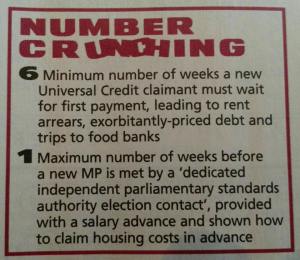
The move comes amid suggestions that ministers may cut the six-week waiting time for universal credit payments after an outcry from Tory MPs.

More than 700,000 people in supported housing usually have the accommodation element of their costs met entirely through housing benefit. But under plans announced by the government in 2015, and due to be introduced from next year, these payments would be capped in the same way as for people renting in the private sector.

As accommodation costs are higher in supported housing, because of the extra services and communal spaces provided, charities and others critics say the proposed system would leave residents facing big potential shortfalls. This is despite ministers saying that they could get help from special funds run by local authorities.

The plans have caused an outcry, with charities warning the system would be bureaucratic, unworkable and would leave people facing uncertainty and worry about whether they could afford to remain.

Supported housing provides a secure, safe place for the most vulnerable, the majority of whom are older people or those with long-term disabilities, as well as the mentally ill, people with disabilities, those at risk of homelessness and women fleeing domestic violence. An inquiry, by the communities and local government and work and pension committees in parliament, called for an urgent rethink, saying: “In particular, we have been concerned by reports of providers choosing to postpone or cancel investment decisions, as well as increased levels of anxiety among vulnerable tenants who fear they may no longer have the guarantee of a home for life.”

The communities secretary, Sajid Javid, told a recent session of the communities and local government committee the report had been “very helpful” and he expected to announce a decision soon that would show ministers had listened. Pressure for a climbdown is mounting before an opposition day debate on supported housing that will take place on Wednesday.

On Monday the charity Rethink Mental Illness will publish a report showing people with the highest needs, and the highest costs, are likely to suffer the biggest shortfalls in rent.

The charity says this will be most evident in parts of the country where rents are cheapest and therefore housing benefit payments will be lowest. Research has shown the cap will mean housing benefit will only cover about two-thirds of accommodation costs in some parts of the country. …”

https://www.theguardian.com/society/2017/oct/21/government-uturn-expected-on-housing-benefit-cap-after-protests

Pembrokeshire: empty home council tax to rise from 50% to 125% in year 3, 150% in year 4 and 200% in year 5

“Owners of hundreds of empty homes in Pembrokeshire are to be hit by a 125% council tax bill.

Empty homes in the county are allowed a 50% discount to the levy under current arrangements. But from April 2019 this discount will be scrapped, with owners of homes which have stood empty for more than three years being charged 125% of normal council tax.

Pembrokeshire council voted the plans through at a meeting on Thursday.
The council introduced a 50% premium for owners of second homes back in April and voted to extend it into the 2018-19 financial year. It will now look at giving the cash to local communities for projects.

Currently, there are 1,206 empty homes in Pembrokeshire, which are subject to a council tax discount. However, this will be scrapped under the changes and all properties which have been empty for three years from 1 April 2016 will be subject to a 25% council tax premium.

Homes which have been empty for four years will be taxed an extra 50%, or 150% tax, and five years or more will pay double or 200% council tax.
The council also voted in an amendment for an appeals process for homeowners trying to sell or refurbish their properties.”

http://www.bbc.co.uk/news/uk-wales-south-west-wales-41696113

‘Decisions are being taken out of our hands’ – social workers on care cuts

“More than two-thirds of social workers responding to Community Care’s survey said they were expected to cut care packages for vulnerable adults because of budget pressures within their council.

*Some names have been changed

Social workers feel under pressure to reduce care packages for vulnerable adults, with some fearing the reductions are unfair and unsafe, a Community Care survey has revealed.

More than two-thirds (68%) of the 469 social workers and other care assessors in England who responded to the survey said they were expected to cut people’s care because of budget pressures within their council.

More than a quarter of respondents (28%) also said they did not feel confident that the reductions they have made to care packages were fair or safe.

The survey was carried out by Community Care and the Care and Support Alliance, a coalition of over 80 charities representing older and disabled people and their carers.

It also found:

Less than half of respondents (43%) felt decisions about a person’s care and support were being left to their professional judgements.
More than a third (37%) said they felt unable to get people the care they need.

Less than half (38%) felt supported to have difficult conversations with service users and their families about meeting needs and changes to their care.

BASW said the findings highlighted the complexity of adults’ social work and the “increasing pressures of budget and target driven demands”.

UNISON said the impact of council cuts had been “devastating” and social workers’ professional judgements should not be “restricted by dwindling budgets”.

The Association of Directors of Adult Social Services said social care remained at a tipping point and the survey laid bare the “invidious decisions” social workers are making every day.

‘Cutbacks’

The findings are set in the context of six successive years of cuts to council budgets. Since 2010, directors have made £5.5.bn worth of savings from adult social care, and estimate that another £1bn needs to be found this year. Efficiencies and back office savings options have been exhausted, which means care packages have come under increasing scrutiny.

Last year, ADASS said 24% of planned savings for 2016-17 were due to come from reducing people’s personal budgets, or cutting back services. This fell to 19% for 2017-18.

In November 2016, the Local Government and Social Care Ombudsman reported that in 2015-16, it received 600 complaints about assessments and care planning; more than any other area of adult social care. It upheld 59% of the 300 complaints it investigated in detail.

The ombudsman’s report also warned that while the pressures on council budgets were well understood, local authority care provision should be determined by an individual assessment of need and take into account a person’s preferences.

Community Care also found eight examples of cases investigated by the ombudsman in the past 12 months, where councils were criticised for reducing care packages without a proper assessment of need, without explanation, or without considering the impact on individuals.

The majority of respondents to the survey (83%) had cut at least one care package in the past 12 months. Most (54%) said they had cut between one and 10, while 13% said they had reduced more than 20. The three types of support being cut most frequently were social and leisure activities, domestic tasks, and support to help people access their local community.

‘Losing a lifeline’

“Transport seems to be a major cutback. It used to be a local authority-run service but is now commissioned out. We’re encouraged to use the ‘door-to-door’ service because it’s cheaper and something that the service user can pay for.

“However, it doesn’t turn up at the times the day centre opens and so service users miss several hours a day of the centre experience. This is a big deal to people who use those centres as their lifeline.”

Source: a respondent to the survey

‘Change in need’

Respondents were also asked to list, in a free-text box, the reasons why they had reduced care packages. While a change in needs was listed as the most common reason, many also cited budget pressures and restrictions around the types of support their council will fund.

Some social workers said they were facing pressure from managers to reduce people’s care and support, or that the ‘strengths-based’ approach, a model of assessment which focuses on people’s strengths, rather than what they can’t do, was being used as a guise for cuts.

A number of respondents also pointed to a rise in the creation of funding panels, which are usually made up of service managers, to make decisions about care packages.

Earlier this year, a legal expert warned panels were now “rife in local authorities”, but were not being used in line with the Care Act. The guidance says panels might be appropriate for signing off large or unique care packages, but should not be used to “amend planning decisions, micro-manage the planning process, or be used purely for financial reasons”.

One social worker responding to the survey said:

The council has decided they will no longer fund medication or lunchtime calls. These reductions are being agreed at a panel without social work recommendations.
‘No choice and control’

More than three quarters of respondents (83%) to the survey did not think there was enough varied and quality provision in their local area to ensure service users had genuine choice and control over the care they receive.

Under the Care Act, local authorities are expected to shape local care provision to ensure it meets the needs of all people who require care and support, regardless of who funds it. The guidance states that councils should encourage a “diverse range of appropriate, high quality services” and ensure “the market as a whole remains vibrant and sustainable”.

More than half of respondents (51%) also said their council was placing exclusions on what people could spend their personal budget on to meet their eligible needs. Transport, social activities, shopping and other domestic tasks were again frequently mentioned.

One social worker responding to the survey said:

It has become so much more stringent lately. Everything has to be itemised and decided upon in advance. It removes the spontaneity of choice – and that, in itself, is restrictive
‘Uncomfortable position’

In-depth interviews with social workers who responded to the survey further highlighted the difficult decisions they are having to make in the current financial climate.

Sarah*, a social worker in the West Midlands, told Community Care that the atmosphere on the frontline in adults’ services now felt “very restrictive and frustrating”.

“As a social worker you come into the profession because you want to help people improve their quality of life, but it feels like you are becoming increasingly limited in your ability to do that and there is an ever-growing number of hoops to jump through,” she said.

Sarah said the toughest conversations were with service users who had received support for 20 years and this was now being questioned, despite there being no change in their needs.

“I find that very difficult and I’m not sure how comfortable I feel with that legally,” she said.

“We’re not supposed to do reviews just to cut care packages and you’re not supposed to necessarily cut things unless there has been a change in need.”

‘Expectation to reduce’

Lucy*, an agency social worker who has worked in Greater London and the North of England, said she has seen an increasing use of funding panels, with one council she worked for using a panel to agree “every financial decision or review”.

The social workers would often decide what would best meet the needs of a person, only to be told to try something else, she said.

“Things were taken out of our hands. At that point the panel were almost making casework decisions and telling you what you needed to do,” she said.

“I really hated that and so did all the other social workers I came across.”

She added that there was “no doubt” decisions about care were being financially driven, and sometimes “your professional opinion is overridden because of the need to reduce costs”.

“At each review there is an expectation [to reduce] – it’s dressed up in terms of value for money, because that doesn’t sound quite so bad as reducing people’s care,” she said.

“But that’s what service managers do, they sit in their office and work out how to reduce these expensive care packages because that is what the council is expecting them to do.”

‘Devastating consequences’

Maris Stratulis, manager at BASW, said: “The survey results highlight the complexity of social work with adults and the increasing pressures of budget and target driven demands. Social workers are experts in their own profession and need to be afforded the respect, value and support to do their job effectively, remaining person-centred at all times.

“BASW, ADASS, the Local Government Association, and other user and carer groups have an important role to play in highlighting the impact of budget restraints and finite resources to MPs and ministers. We must constantly strive to ensure high standards of professional practice and keep users of services and their carers at the heart of what we do.”

Matthew Egan, social care officer at Unison, added: “Social workers and other staff should be able to make care assessments based on their professional judgement and not be restricted by dwindling budgets. The huge cuts ministers have made to council budgets have had devastating consequences for the provision of care to those people in need.

“We see people effectively being abandoned and let down. It is not fair on social workers and it’s certainly not fair on care users.”

‘Invidious decisions’

Caroline Abrahams, co-chair of the Care and Support Alliance, said it was impossible not to be “angered and saddened” by the social workers’ descriptions of what the cuts mean for older and disabled people, and those with mental health problems.

She added: “It is though important to remember that while social care is a service administered by councils, the buck stops with ministers, and the suffering that vulnerable people are experiencing today is the direct result of the decisions successive governments have made to underfund social care.

“The extra £2bn this government has pledged will certainly help but the funding gap is far larger, so the situation is certain to worsen without further action.”

Margaret Willcox, president of ADASS, said: “This telling and poignant report lays bare the invidious decisions that are having to be made by social workers and managers every day.

“Working within finite budgets is challenging and staff have to consider how best to meet assessed needs within those financial parameters. Adult social care remains at a tipping point and this survey is further evidence of why the issue needs to be treated as a national priority. We look forward to contributing to debates about funding a long-term sustainable solution to adult social care funding and delivery.”

A spokesperson for the Department of Health said: “We know social workers do incredible work and we want to make sure that everyone, especially older and vulnerable people, receive compassionate care. That is why we have enshrined in law in the Care Act that local authorities must assess and meet the needs of people in their area.

“We have provided an additional £2 billion for social care and have committed to consult on the future of social care to ensure sustainability in the long term.”

‘We are not a load of tins in a supermarket, we are human beings’Rachel, 30, is visually impaired, has dyspraxia and autism.She received 17 hours of support a week for eight years, to help with cleaning and cooking, managing her medication and personal care. Two years ago her care was reduced at a review to just five hours a week.

Rachel was left with no one to help manage her medication and this meant she missed doses and had a seizure. To make things worse, while recovering she mistook her dog’s flea medication for her own and ended up in hospital. Rachel says these two incidents knocked her confidence and she became demotivated. She also stopped taking her anti-depressants

“Being in hospital left me feeling anxious and upset and I worried if something else might happen once I got home,” she says. “It had a massive impact on me.”

“I kept forgetting my tablets and I was struggling to keep a lid on my depression. I wasn’t interested in doing anything, I would only go out to take my dog out.”

Rachel’s care was reinstated and she now receives 20 hours of support a week. She says things are much better now because she’s “not being left alone for days at a time” and is on top of her medication.

She also receives some social support to help her get out and about.

She adds: “I don’t want this to happen to someone else. I was lucky that I had support from other people [when my care was cut], but there are people who don’t and that’s dangerous.

“We are not talking about a supermarket and a load of tins here, we’re talking about people, human beings, and I think sometimes that gets forgotten.”

COMMENTS ON THIS ARTICLE:

Neil Seach September 20, 2017 at 9:53 am #
I have had my budget slashed by almost a third resulting in many needs not being met and having to rely on family and friends to fill the gaps. Days they can’t it’s no physio exercises for me, no eating and drinking, really is no fun at all

Bobby September 24, 2017 at 7:27 am #
Carers have to be willing and able to care. If you are genuinely unable (as defined in the Care Act) to complete these tasks, then you need to complain. Not eating or drinking will most definitely have a significant impact. As long as you aren’t declining support, you should be recieving help with this. If the local authority doesn’t listen, you need to take it to the ombudsman.

chrissie September 20, 2017 at 11:12 am #
If any professional thinks it is unsafe then they MUST refuse to do it – they are the voice of the person and they have a duty of care.

Martin Porter September 21, 2017 at 8:45 am #
Social Workers very much need to be the voice of their service users. However they can’t refuse to implement cuts as they don’t ultimately control budgets.

All care packages need signing off by a manager, and often as not taking to a panel, so you can put your plan forwards as many times as you want, but the client won’t get you the money unless management agree.

Bobby September 24, 2017 at 7:29 am #
Then you all need to make a stand. Speak to your union, or find a LA to work for that operates ethically and legally.

Peter Endersby September 20, 2017 at 2:13 pm #
This just proves that evidence based practice is a myth as it is always subject to budgetary constraints which is what really drives practice. Where else in adult and children’s social work is there there a clear connection between budget cuts and practice? Social work will have to grow up as education has and accept that practice is driven by politics and money.

Louise Johnson September 20, 2017 at 5:30 pm #
This practice seems to be endemic. How can it possibly reduce costs when services are cut and there is an inevitable deterioration in the quality of people’s lives? Needs don’t just go away because funding is withdrawn – they pop up elsewhere. The quality of people’s lives cannot be reduced to a £ sign. We all know this is a result of the Tory’s austerity policy, and the opportunity they have taken to ‘cut the state’, but why isn’t there more resistance? Why do families and individuals find themselves in this Kafkaesque world where their support is blocked, reduced and taken away and the very professionals who are supposed to support them almost seem programmed to behave heartlessly. This is leading to misery and penury. Life in this country is now of such little value.

Martin Porter September 21, 2017 at 8:47 am #
It reduces costs by passing them to another agency. If someone is admitted to hospital because of inadequate care then the NHS pays, not Social Services.

This is not in the interests of tax payers any more than it is in the interests of the service user, but when middle managers are stuck between a rock and a hard place it happens.

J September 20, 2017 at 6:11 pm #
I have had my social care budget cut from £30k to zero. I went from being a vulnerable adult with severe mental health needs at risk of harm who my family couldn’t fully support to someone who was recently assessed as having no needs that couldn’t be met by my partner who is himself unwell. I challenged the assessment and was told if I had any other needs go speak to the Link visiting scheme. I used to have carers 6 days a week. respite stays in a care home when things got difficult, some activities were paid for to help me get out etc

Now I’m too scared to go out, I’ve become very depressed and get panic attacks, my partner is getting unwell and losing weight and shouts at me a lot of the time. It has put our marriage under strain. I have become suicidal as I also lost my mental health support because I’m told they no longer give long term support.

Bobby September 24, 2017 at 7:34 am #
Complain, or go straight to the ombudsman. This does sound right. Saying they don’t provide long term support is outrageous. I’m assuming the is an integrated mental health team for younger adults? If so, they have taken on the duties of social care, and do provide long term support to those who are eligible.

keithbc6472 September 21, 2017 at 1:41 pm #
If needs can be met through friends and family, then those needs should not have been agreed for local authority funding in the first place.

Alex September 22, 2017 at 10:35 am #
The Care Act is clear that local authority support must be made available if those needs cannot be met without having a significant impact on the wellbeing of the informal family carer or on the sustainability of that relationship. If, as the commentator above describes, the carer’s health is declining as a result of the demands of their role and the relationship itself is at risk of breaking down, her needs cannot reasonably be assessed as ‘able to be met by family and friends’.

Bobby September 24, 2017 at 7:36 am #
Carers also have to be willing and able. The ethical dilemma comes when the person themselves doesn’t want the carer to undertake the tasks. This however should be the choice of the person if their well being is being considered.

June Ross September 23, 2017 at 10:16 am #
Social Workers should be rigorously recording unmet needs and carrying out separate risk assessments where they believe cuts are placing individuals and/or families at risk. Also, carrying out a risk assessment of their own working conditions and presenting it to management can be a powerful and empowering strategy.”

http://www.communitycare.co.uk/2017/09/19/decisions-taken-hands-social-workers-care-cuts/

NHS: “losing all we have achieved since 2000” say NHS bosses

“Hospital bosses have taken the unusual step of publicly drawing attention to the NHS’s declining ability to treat patients quickly enough, with one comparing lengthening waits for care to the huge delays last seen in 1999.

Four NHS trust chief executives in England have posted comments on Twitter since Tuesday lamenting the challenges the service is facing while it struggles with a tight budget and mounting staffing problems.

Their interventions reflect acute anxiety within the highest levels of the NHS that patients are being let down and that it could collapse if there is another winter crisis.

NHS boss puts service on high alert in case of heavy winter flu burden
Andrew Foster, the chief executive of Wrightington, Wigan and Leigh NHS trust in north-west England, tweeted on Thursday: “A perfect storm of funding and workforce shortages vs an abundance of patients. I see people everywhere working unbelievably hard.”

Tony Chambers, from the Countess of Chester hospital, suggested that lengthening waits for treatment meant the NHS was heading back to the long delays and patients stuck on trolleys that helped prompt Tony Blair to introduce maximum waiting time targets.

Their remarks were prompted by Sarah-Jane Marsh, the chief executive of Birmingham Women’s and Children’s trust, tweeting on Tuesday about declining performances over waiting times. “It’s hard to watch us lose all we have achieved since 2000. But every year of reduced funding per patient and it seems further from our grasp,” she said.

Jackie Daniel, boss of University Hospitals of Morecambe Bay trust in Cumbria, retweeted Marsh’s post, adding: “The current situation is soooo frustrating. Every CEO I speak to is focussed and doing all they can but more is needed.”

Their comments follow disclosures by the BBC that more patients are waiting longer than the NHS Constitution says they should for A&E care, cancer treatment and non-urgent hospital operations.

Chris Hopson, chief executive of NHS Providers, which represents hospital trusts, said: “Chief executives tell us that they feel the NHS is under the greatest pressure in a generation – ‘it feels like a return to 1999’. Trusts are doing all they can to continue providing great care but the triple whammy of rapidly rising demand, the longest financial squeeze in NHS history and growing workforce shortages are taking their toll.”

A Department of Health spokeswoman said: “We know winter is always challenging for the NHS, but this year we are supporting hospitals with an extra £100m for A&E departments, as well as £2bn for social care. NHS national leaders are working with chief executives across the country to discuss the challenges they face.”

Last week Philip Dunne, the NHS minister, insisted that the NHS had enough money to do its job properly.”

https://www.theguardian.com/society/2017/oct/19/nhs-waiting-times-hospital-bosses-fear-a-return-to-1999

Want to comment on LEP’s business plan for us? Go to Torbay council website says Sidmouth Herald!

Sidmouth Herald (as part of Archant a BIG supporter of our LEP) prints a press release on the Sidmouth Herald website on “consultation” on the LEP’s new, improved, answer to all our prayers business plan, citing the enthusiastic words of Paul Diviani, the Deputy Chair of an un-named committee.

Unfortunately, according to the press release, the consultation document appears to be only on Torbay’s website! No link to an EDDC website or the LEP’s own website!

Sloppy.

Perhaps the first consultation comment might be: put your own house in order before you attempt to put a nuclear cell in those of other people!

Here is the press release, in full, in all its glory, where 20 or so business and council members, many with nuclear interests or nuclear-industry-supporting industries attempt to persuade the rest of us that most of their (ie our) money going to Hinkley C is a good thing:

County and district councils in the two counties, along with the Heart of the South West Local Enterprise Partnership (LEP), Dartmoor and Exmoor national park authorities, and NHS commissioning groups from Northern, Eastern and Western Devon, South Devon and Torbay, and Somerset, have worked together to come up with a draft productivity strategy for the area, referred to as the Heart of the South West.

This has now been put out for a consultation, which will run until November 30.

The partnership is said to be seeking the views of businesses, organisations, groups and individuals.

It says its ambition is to double the size of the area’s economy to £70 billion by 2036 and is seeking the right interventions and Government backing to achieve this.

The partnership says the area has ‘unprecedented opportunities’ in sectors including nuclear, marine, rural productivity, health and care, aerospace and advanced engineering, and data analytics.

Councillor Paul Diviani, deputy chair of the prospective joint committee of the leaders of the Heart of the South West, said: “The Heart of the South West economy is larger than that of Birmingham, so we need to be recognised for our true potential as a cohesive economic area.

“Our vision is for all parts of the Heart of the South West to become more prosperous, enabling people to have a better quality of life and higher living standards.

“To achieve that, we have to create a more vibrant and competitive economy where the benefits can be shared by everyone, and by working in partnership we can present a stronger proposition.

“We urge our stakeholders in business and the wider community to give us their views and help us create an effective strategy for delivery.”

The results from the consultation will be considered by the joint committee of the leaders of the Heart of the South West and the Heart of the South West LEP board, before a final productivity strategy is agreed early in 2018.

The consultation documents are available to view on Torbay Council’s website at

http://www.torbay.gov.uk/devolution.

http://www.sidmouthherald.co.uk/news/south-west-business-plan-up-for-consultation-1-5242862

Emergency cash for public services is just a “sticking plaster” not a solution

“Plugging funding gaps in critical public services will cost £10 billion over the next five years without fixing deep-seated problems.

The Institute for Government (IfG) and the Chartered Institute of Public Finance and Accountancy have concluded in a report that spending on frontline services has become trapped in a “reactive cycle” of allowing problems to mount until there is a crisis and an injection of emergency cash is the only solution, denying money for “transformative” projects.

Emily Andrews, of the IfG, the report’s author, said: “If the chancellor and government cannot break out of this cycle they must accept that budgets will rise or services will deteriorate.”

Emergency cash had already been pumped into schools and social care, the report notes.

The report says that even if should good decisions be taken by Philip Hammond in his November 22 budget, they “will not solve the underlying problems which have allowed this government to get into this reactive spending cycle”.

Times, pay wall

Rental repossessions increase in Devon

Concerns have been raised following an increase this year in the number of people in Devon having their homes repossessed.

Figures from Citizens Advice Exeter show an overall 3.8 per cent increase in the number of housing repossession cases listed at Exeter County Court in the six month period ending September 30. This is in comparison to the same period in 2016.

Steve Barriball, Citizens Advice Exeter chief executive, said: “In the last six months there were 296 cases listed for repossession, an overall 3.8 per cent increase, or 11 cases, on the previous year. However, there was a small reduction in mortgage repossessions, which were down by four cases.

“The biggest increase was in housing association repossessions, up by 12.7 per cent. There were further increases of 2.7 per cent in private rented sector cases and 1.8 per cent in local authority actions.

“For the last few years we have seen the headline number of cases listed for repossession level out. Therefore, these latest figures are concerning. …

http://www.devonlive.com/news/devon-news/spike-devon-home-repossession-cases-645768

Lack of home care keeps elderly in hospital longer

But, but, but – hospitals are fined for bed-blocking!!! Except in East Devon – where there are almost no beds to block. Which makes you wonder how early-discharge elderly people are really coping.

“Older people spent twice as long stuck in hospital waiting for home help last year compared with five years ago, according to analysis by Age UK.

Patients spent a total of a million nights in hospital because they were waiting for social care of one kind or another in 2016-17, up 27 per cent on the year before, the charity’s report said.

Some 342,000 of these nights were spent waiting for care in their own homes, up from 144,000 in 2011-12. The official figures are considered to be an underestimate, with NHS and council leaders arguing over who is to blame.

Doctors and academics said separately that families should urge elderly relatives to take the stairs and go for walks to help them carry on living independently.

Writing in The BMJ, they also said that hospitals must encourage elderly patients to walk around wards and perform chair-squats to halt dangerous declines that condemn them to care homes.

Scarlett McNally, an orthopaedic surgeon and lead author, said that there had been too much discussion of how to pay for social care and not enough on how to avoid the need for it in the first place. “Loss of fitness is not inevitable,” she said.

Nights in hospital cost about five times as much as a care home. Help at home with tasks such as washing and dressing is cheaper again.

Plans to reform social care have been delayed until next year after Theresa May dropped an election campaign pledge to require older people to pay more towards their care, widely dubbed a “dementia tax”.

Caroline Abrahams of Age UK said that the charity’s analysis showed the “impact of our failing social care system on the NHS, as well as on older people”, adding that it cost the taxpayer more than £173 million last year. She said that more people were “marooned” in hospital, risking infection and losing muscle while they were fit to leave.

The Local Government Association said that 60 per cent of delays were due to the NHS, adding: “Councils are doing all they can to try and help people live independently . . . But with unprecedented funding cuts since 2010 and social care services facing a £2.3 billion funding gap by 2020, this is becoming increasingly difficult.”

David Oliver, vice-president of the Royal College of Physicians, said: “Some delays are due to systematic cuts to social care budgets and provision. Others are due to a serious lack of capacity in community healthcare services.”

Times (pay wall)

DCC has no evidence that new way of working – is working!

From the blog of Independent East Devon Alliance county councillor Martin Shaw (Seaton and Colyton) who fought valiantly with Independent DCC councillor Claire Wright to save our community hospital beds, which was defeated by Conservative block voting for the closures.

“There is new evidence that Brexit is adding to the NHS’s chronic staff shortage. Far fewer nurses and doctors from other EU countries are coming for jobs in the UK, while many of those already here are leaving – or plan to leave.

Locally, the RD&E is struggling to recruit care workers for the ‘new model of care’ to replace community beds. Council officers freely admit that Brexit is making Devon’s social care recruitment crisis worse, and at the County Council meeting on 5th October I asked for figures on the number of people from other EU countries in health, social care and education in the county. The answer was that the Council can’t produce them – in a follow-up question I asked the Cabinet to remedy that, and also to reassure EU citizens that they are valued here.

Many people voted for Brexit partly to help the NHS – but are now realising that it is doing the opposite. Of course the Leave campaign said that it wanted to allow professionals like nurses and doctors still to come to Britain – it was more the unskilled workers it wanted to stop (although where that would leave our farming and tourism industries is another problem). What this argument overlooked is that doctors and nurses who move here are not just making a decision about a job – they are looking at whether the country is open and welcoming. The message that Britain didn’t want foreigners went out loud and clear to the people we need to keep our NHS going, as well as everyone else.

Leave voters rightly hoped to see more money go to our underfunded NHS. However it is now universally recognised that the Leave campaign’s idea of saving ‘£350 million a week’ was utterly misleading. Much of the money never goes to the EU (because of the rebate negotiated by Margaret Thatcher) and most of the rest comes back to support things like agriculture, scientific research and regional development in places like the South West – expenditure that the British government will need to replace. Recently it has become clear that the economy has fallen back since the referendum to the extent that the Government is already losing much more in tax revenues than it will eventually save by leaving the EU. So the NHS has no hope of gaining money from Brexit, and is hit on the staffing side too.”

New evidence that Brexit is harming NHS staffing – but Devon County Council has no figures for the local situation

“Local councils say they are being scapegoated over patients who cannot be sent home” (surprise, surprise)

Of course, in our area, and o its eastern side in particular, the problem of blocked beds is solved – by having no beds to block!

“Elderly patients are caught in a growing row between the NHS and councils over who is to blame for failing to reduce bed-blocking.

Councils have accused ministers of scapegoating after they were threatened with fines if they did not do enough to get patients out of hospital beds.

Hospitals have struggled even during the quieter summer months and warnings of a severe flu outbreak have left NHS leaders anxious about how they will cope this winter.

NHS England has said that unless 2,500 beds were freed by getting elderly patients off wards, there would not be enough staff to go round.

“Hospitals rightly tell us there simply are not ‘surplus’ non-employed nurses available to open yet further hospital beds to compensate for the failure to sort delayed transfers of care,” Pauline Philip, national director for emergency care at NHS England, wrote last week to NHS and council bosses.

Jeremy Hunt, the health secretary, and Sajid Javid, the communities secretary, went further, telling councils: “Improvements are neither consistent nor yet significant and the overall rate of improvement remains a considerable distance from where it needs to be.”

Figures published last week showed an average of 5,809 beds occupied every day in August by a patient who did not need to be there, a fall of only 4 per cent in a year.

Mr Hunt and Mr Javid warned 32 councils not meeting targets to reduce-bed-blocking that they could withhold their share of a £2 billion boost for social care promised in the budget.

“We will be looking for significant performance improvements in the September data,” they said. “We reserve the right to reduce the published allocation for a council should performance continue to fail to improve.” NHS chiefs insist that they are simply reminding local authorities of what they are meant to be doing but councils argue that a focus on spending money on bed-blocking will lead to older people being denied care in their homes.

Lord Porter of Spalding, Conservative chairman of the Local Government Association, said: “These letters are hugely unhelpful at a time when local government and the NHS need to work together to tackle the health and social care crisis . . . We urge the government and the NHS to focus equally on preventing people going to hospital as we are on helping people quickly to get out of hospital.

Caroline Abrahams, charity director at Age UK, said: “While these arguments rage on in the corridors of power you couldn’t blame older people for feeling that their best interests are not always at the forefront of health and care leaders’ minds. Older people badly need these disputes to be resolved.“

Source: Times (pay wall)

A hint as to where Devon’s “health service” could be headed

No more prescriptions, instead:

“We are all used to going to the doctor and have them write a prescription for medicine. But what we are less used to is the idea that the doctor or nurse or social worker might give us a prescription for a walking group, soup and sandwiches in the local village hall, an Age UK befriending service.”

Patricia Hewitt, ex-New Labour Blairite MP, privatisation enthusiast and now chair of the Norfolk & Waveney Sustainability and Transformation Plan (STP)

https://www.thecanary.co/discovery/2017/10/16/ex-labour-health-secretary-wants-take-medication-away-patients-save-money/

Needless to say, the walking classes which would likely be volunteer run for free, soup and sandwiches in the village hall perhaps provided by the food bank and befriending by an already overstretched and underfunded charity – definitely NOT by her STP!

Conservative county councils warn they can’t afford “dementia tax”

“Conservative council leaders have warned that county councils cannot afford to be hit by a £308m rise in care home costs if controversial social care plans dubbed the “dementia tax” go ahead.

Tory-dominated shire councils have warned they cannot afford the extra burden of the manifesto proposal that would offer state support to people with assets of £100,000 or less – a sharp increase on the current £23,250.

The County Councils Network (CCN), which represents the 37 county councils, said new analysis showed raising the threshold would push far more people into state care than local authorities could fund under current budgets. …”

https://www.theguardian.com/society/2017/oct/17/we-cannot-afford-to-fund-dementia-tax-proposals-councils-warn?CMP=Share_iOSApp_Other

Rural broadband: a lesson from Canada

“Former Liberal Democrat leader Tim Farron has criticised the government for failing rural people on broadband.

Mr Farron, who is the MP for the South Lakes in Cumbria, said the average household speed in the area was just 10.9Mbps, compared to the national average of 17Mbps.

New figures from the consumer rights group Which? reveal that 1 in 4 people in Westmorland and Lonsdale have less than 4.0Mbps broadband connection.
Under the Government’s Universal Service Obligation, 10Mbps is the minimum speed that anyone in the UK would be entitled to request by 2020.

The Cumbrian MP has tabled two parliamentary questions to the government.
The questions seek to establish what progress is being made towards the Universal Service Obligation, and whether BT will face financial penalties if the targets are not met.

Mr Farron said: “The fact that one in four people in the South Lakes have a broadband connection of less than 4Mbps is frankly not good enough.
“Many small businesses in rural areas like ours are finding it impossible to function without adequate broadband. “The government’s Universal Service Obligation target of 10Mbps is nowhere near ambitious enough.”
Canada, which was a much larger and sparsely populated country than the UK, had a target of 50Mbps, said Mr Farron. “The government must put in place measures which penalise BT if they fail to meet the targets.”

A government representative is expected to respond to Mr Farron’s questions over the coming weeks.

Meanwhile, the National Infrastructure Commission has warned that urgent investment is needed in the UK’s broadband and mobile networks.
Increased broadband speeds could add £17bn to UK output by 2024, according to an NIC report.

The report says the UK’s digital economy is the largest of any G20 nation as a percentage of GDP.

But it warns that almost one in four rural premises lack a decent broadband service.

The UK lags behind other developed countries – such as the USA, Netherlands and Japan – for 4G and broadband speeds, it adds.”

http://www.rsnonline.org.uk/services/rural-mp-slams-government-on-broadband

“Now police chief Alison Hernandez faces a no confidence vote from her own former colleagues”

It seems only local Conservative politicians are prepared to keep her – what a surprise! In any other walk of life she would probably now be at the job centre. What a waste of our money.

“Police and crime commissioner Alison Hernandez faces another vote of no confidence this week – from her own former council colleagues. Ms Hernandez was a member of Torbay Council before she took on the job as Devon and Cornwall’s police chief.

Now her old council will be the latest to move for a vote of no confidence in her. The Conservative commissioner has already endured votes of no confidence from Plymouth City Council, which she lost, and another by the police scrutiny panel, which she won.

Devon County Council’s cabinet also backed the commissioner last month. Cornish councillors are also expected to have a similar discussion this month.

Now Liberal Democrat councillors in Torbay have her in their sights. They are angry at police cuts as well as Ms Hernandez’ comments on using armed volunteers in response to terrorist incidents and her attempts to appoint a deputy.

They have also not forgiven her for taking a ‘selfie’ with firefighters at the Exeter Royal Clarence Hotel fire.

A motion to the council meeting on Thursday, proposed by Nick Pentney and seconded by Cindy Stocks, is headed ‘Crisis in Frontline Policing in Torbay’ and reads: “Torbay Council is extremely alarmed that under the watch of Alison Hernandez, there has been a drastic reduction in the number of PCSOs, the eyes and ears of the force in Torbay. …”

http://www.devonlive.com/news/devon-news/now-police-chief-alison-hernandez-632726

Tick-box “consultations”

“Consultations are often a legal requirement for government departments – but this sometimes means they are formulaic and ineffective. In an extract from his report, Creating a democracy for everyone: strategies for increasing listening and engagement by government, Jim Macnamara (University of Technology Sydney/ LSE) looks at some of the failings of government consultation, and the problems with one NHS consultation [NHS Mandate public consultation conducted in October 2015] in particular.”

http://www.democraticaudit.com/2017/10/16/many-government-consultations-are-more-about-meeting-legal-requirements-than-listening/

Is it right for charities to offer services you pay for if the NHS or social care system isn’t picking you up?

Does this let Jeremy Hunt off the hook and allow underfunding to continue? Is it privatisation by stealth or just local people doing good deeds for payment and to be encouraged and applauded?

“Ottery Help Scheme has launched a new chargeable service to offer more support to the community as well secure its future for years to come.

The charity says it is trying to be proactive by running a home services as it currently relies on donations from grants and members of the public. Through home services, user can pay a fee and book a member of the team come out to them. The employed staff will be able to assist with in a range of ways including cleaning, shopping, meal preparation and gardening as well as offering to sit in for carers. This will sit alongside the help scheme’s free or subsidised befriending, memory café and transportation services.

Last year, more than 100 helpers gave up nearly 6,000 hours in the community, with volunteer drivers driving 49,228 miles to take residents to appointments.

Helen Harms, chief officer for the help scheme, said: “The NHS is looking for schemes to help with allowing people to stay in their own home. “We are trying to become self-sufficient, we are trying to provide services which help people stay independent and living in their own homes and provide an income to sustain the help scheme for the future.

“We do really rely on donations and if they one day stopped we would have to fund ourselves. We are being proactive to be self sufficient and not hoping of getting enough donations in, we have been very luck for such a long time and we have been going for 20 years.”

The charity has recently been boosted by the La La Choir, which raised £1,300 at its last concert. It is also being supported by a trio of East Devon law firms throughout October as part of charity will month. Gilbert Stephens, East Devon Law and Christine Ashby, will donate 50 per cent of the service fee to the scheme.

Helen added: “We are so grateful to these local firms for their support over the setting up this scheme to benefit the charity, a 50 per cent donation for their will writing service is a significant contribution.”

http://www.sidmouthherald.co.uk/news/ottery-help-scheme-launches-home-services-to-boost-future-1-5233894

“Radical new strategy” (aka common sense) could release money for road repairs

Unfortunately, austerity cuts and HS2 (which has just been revealed is going through open-casr mining zones where big cracks are showing up) trump common sense …

“Pothole repairs and other local road improvements could be given a £400 million boost if Government funding mirrored rising income from fuel and motoring taxes, research shows.

The “radical new strategy” would help support the almost 30% increase in the number of vehicles on Britain’s roads since 2000, according to the Local Government Association (LGA).

The organisation, which represents more than 370 councils in England and Wales, wants the Government to match the increase in fuel and motoring tax income generated in the past 10 years in its funding for town halls.
This would mean an extra £418 million to improve local roads by fixing potholes, cutting congestion and protecting bus services, encouraging residents to use alternative transport where possible.”

http://www.dailymail.co.uk/wires/pa/article-4979732/New-strategy-provide-418m-boost-local-road-improvements.html

Telegraph: “There are more than 200,000 homes sitting empty in England – worth a total of £43bn”

“In England there are 200,000 homes that have been sitting empty for more than six months, according to new Government figures. This is equivalent to £43bn worth of housing stock.

In London alone there were 19,845 homes sitting vacant for over six months last year, property that is worth £9.4bn, taking into account average prices.

Kensington and Chelsea has the capital’s highest number of homes which are vacant for more than six months with 1,399 empty, up 8.5pc on last year, and 22.7pc higher than 10 years ago.

This is likely due to the buy-to-leave phenomenon, where wealthy buyers snap up homes as an investment, and leave them empty while waiting for its value to increase.

Communities secretary Sajid Javid downplayed the role of such foreign buyers in exacerbating the housing crisis, saying the problem “isn’t as bad as some people think”. A Savills’ report found that the majority of homes bought by people based overseas were being rented out, rather than left empty. …”

http://www.telegraph.co.uk/property/house-prices/200000-homes-sitting-empty-england-worth-total-43bn/