The cost of education cuts

“[All] Sixteen teachers have left Our Lady of Lourdes Catholic Primary School in Bristol since the start of the year and have been replaced by temporary staff, who leave their posts today.”

http://www.dailymail.co.uk/news/article-4717806/Primary-school-chaos-ENTIRE-teaching-staff-quit.html

“UK households could pay £50bn to France’s state-owned energy company to prop up Hinkley nuclear plant”

Well, at least it’s not just Devon and Somerset, though Owl suspects we will be paying far more than pur fair share:

“UK households could pay £50bn for the new Hinkley Point C nuclear plant in Somerset, new government figures reveal. That number is more than eight times greater than the National Audit Office’s initial 2013 estimate that a public investment of £6bn would be required.

The spiralling costs are due to the terms of the Government’s agreement with EDF, the French state-owned electricity company, which is building the plant in conjunction with China General Nuclear Power.

That deal guarantees EDF a £92.50 “strike price” for every megawatt hour of electricity that the new plant generates, a figure that critics have said is far too high. …”

http://www.independent.co.uk/news/business/news/hinkley-nuclear-plant-edf-uk-households-energy-power-somerset-government-a7849216.html

“”Police and crime commissioners, your time is up”

Jawad Iqbal, todays Times (paywall)

The role of police and crime commissioner is a discredited experiment and should be abolished. Research conducted before the most recent elections for PCCs, as they’re known, found that fewer than one in ten people knew who their local one was. This despite the fact that they control a policing budget of £12.5 billion and have the final say in appointing chief constables.

So, five years into an experiment that was meant to spearhead a revival of local democracy and police accountability, it is clearly far from a success. The warning signs were there from the beginning: turnout for the first round of voting in 2012 was only 15 per cent — the lowest figure ever recorded for a national election. One polling station in Newport, Gwent, registered no voters at all.

Things improved a little last year, with turnout at 26 per cent, but this had much to do with votes being held on the same day as local government elections.

PCCs who come to public notice usually do so for all the wrong reasons. The Kent PCC, Ann Barnes, was ridiculed for struggling to explain her job during a television interview, as well as for paying £15,000 to a 17-year-old “youth commissioner” who was forced to resign after it emerged she had sent abusive tweets.

Shaun Wright, the South Yorkshire PCC, tried and failed to cling to office, despite police failures in the Rotherham child abuse scandal. Cumbria’s PCC, Richard Rhodes, apologised for wasting £700 on two trips in a chauffeur-driven car. Most notoriously of all, the Devon and Cornwall PCC, Alison Hernandez, appeared to suggest last month that ordinary citizens with gun licences might be able to help in a terrorist crisis. And at a time when policing budgets are being squeezed, the salaries of the majority of PCCs — between £70,000 and £85,000 — don’t exactly represent value for money.

Ministers should have acted on the findings of the 2013 Stevens report into policing, which dismissed PCCs as a “fatally flawed” system. It is time we cut our losses and dropped them. The latest crime figures in England and Wales, published yesterday, show the biggest annual rise in a decade, with rising levels of the most serious violent offences. All the more reason for precious funds to go into frontline policing — not into a discredited vanity exercise that flatters the egos of overpromoted busybodies and failed MPs.”

Rules … what rules … none apply to HS2

“Fears that high-speed rail project HS2’s £55.7bn budget could spiral higher have been underlined by an audit showing unauthorised redundancy payments to staff, far above the government cap on payouts.

HS2 Ltd, the publicly funded company building Britain’s new high-speed rail network, spent £2.76m on payoffs in 2016, of which only £1m was authorised, according to the National Audit Office.

The head of the NAO, Sir Amyas Morse, said the findings highlighted troubling “culture and behaviours” at HS2, which needed to be addressed if taxpayers’ money was to be protected.

The NAO found that the redundancy payments were made in spite of explicit advice from the Department for Transport to HS2 Ltd that it was not permitted to exceed the civil service cap of £95,000.

HS2 circumvented the cap by placing a number of highly paid staff on gardening leave, continuing to pay them for several months although they were no longer working, on top of the maximum payouts. …”

https://www.theguardian.com/uk-news/2017/jul/19/hs2-cost-nao-redundancy-payouts

and, in the same article:

HS2 has an agreement with the Treasury to allow it to pay higher wages than elsewhere in the public sector, which Higgins has insisted is vital to recruit the best talent. The previous chief executive of HS2, Simon Kirby, hired from Network Rail in 2014 to oversee the start of construction on a £750,000 salary, quit last September.

John Crace, Guardian (humourist) columnist – but actually far, far too close to the truth.

“Left hand meet right hand. Just weeks after the prime minister insisted there was no extra spare cash for schools, the education secretary came to the Commons to make a statement on how she had miraculously found more money for schools.

Being a minority government is proving to be a very expensive drug habit for the Tories.

As is traditional with any U-turn, Justine Greening began by saying that everything was basically running brilliantly. Teachers had never been happier, pupils had never been happier.

Then came the but.

But she had listened to the concerns that people had raised during the election and had managed to come up with an extra £1.3bn over the next two years to offset any unfairness in a system that was definitely, totally fair.

“Let me be clear,” she said. “This is additional funding.” She had gone head-to-head with the chancellor, and Freewheelin’ Phil had blinked first. She’d tipped him upside down and a DUP-sized bung had fallen out of his pockets.

Only she hadn’t. At this point, Greening’s triumphal tone became more of the mumble of a remedial reading class. Barely audible were the words “efficiency savings”, “no cost to the taxpayer” and “transparently”.

So much of Greening’s statement had been barely audible that it took a while for the shadow education secretary, Angela Rayner, to actually make any sense of what had been said.

Justine Greening raids free schools budget for £1.3bn education bailout
It was only after mistakenly welcoming the “new money” that it dawned on her that nothing about the money was new. She hastily corrected herself and inquired where the savings were going to be made. Had the government finally admitted that its free schools programme was a bit of a waste of money?

“We’re not cutting the free schools programme,” Greening replied. The very idea. “It’s just we’re financing it in a different way.”

In a way that it would have £200m less. Even some of her own backbenchers had the grace to look embarrassed by this. Either the education secretary didn’t understand basic maths or she didn’t understand basic English.

Conservative Robert Halfon, the new chair of the education select committee, was quick to spot that, even after cutting £200m from the free schools budget, there was still £1.1bn of savings unaccounted for. Did she have any idea what other programmes she would need to cut?

Not really, Greening replied. There were a lot of different programmes and sooner or later she would get round to working out which ones were pointless and then she’d make the cuts accordingly. All she could promise for now was that the savings would definitely come in at £1.3bn in total.

It was quite some admission, as Greening rather fancies her chances of taking over from Theresa May.

Telling parliament she had been presiding over a government department that has been happily wasting £1.3bn a year, without feeling the need to do anything about it up till now, might not be the smartest job interview. There again, she isn’t up against the stiffest of opposition. The gene pool of available talent in the Conservative party is vanishingly small.

Having basically informed everyone that she wasn’t particularly good at her job, it was little surprise that everything rather went downhill for Greening from then on.

Labour’s Lucy Powell and the Liberal Democrats’ Ed Davey tried to help her out.

Let’s not worry about whether the £1.3bn was new or old money, they said. They understood that difference might be too nuanced for her. Let’s concentrate instead on the fact that £1.3bn is still going to be at least £1.7bn short of the figure the National Audit Office had said was required to maintain funding at its current levels, given rising costs and pupil numbers.

“Er …” Greening struggled. Er … All she could say was that under the new arrangements schools would be getting £1.3bn more than they had been getting an hour ago – apart from those whose budgets had been cut to provide the extra money for all the others – and it would be a big help if people could just be a bit more positive about the announcement.

Not even her own backbenchers could go along with that, and one after the other stood up to inquire if the unfairness in the funding formula would be addressed in their own constituencies.

Greening didn’t seem to have the answer to this. Or anything much. The government is now so weak that even what are intended to be good news statements are going down like a cup of cold sick.”

https://www.theguardian.com/global/2017/jul/17/tory-magic-money-tree-allows-justine-greening-to-splash-cash-on-schools

“The £104bn HS2 cover-up: Government refuses to publish report into whether the controversial rail route should be scrapped”

“Ministers were under fire last night after suppressing a key report into HS2 overseen by the country’s most senior civil servant.

The review assessed whether the UK’s biggest ever infrastructure project is on budget and provides value for money for taxpayers.

It was led by the Infrastructure and Projects Authority, which reports to the Cabinet Office, led by Sir Jeremy Heywood.

The review was concluded last summer, before the legislation required to build the first phase of the high-speed railway, between London and Birmingham, received Royal Assent.

But although the key findings were relayed to Sir Jeremy Heywood and the government spending watchdog, the National Audit Office, the report has never been published.

Sir Jeremy was nicknamed Sir Cover-Up after preventing the Chilcot inquiry into the Iraq War from seeing letters and records of phone calls between Tony Blair and George Bush.

The Government was last night under fierce pressure to release the findings after a rail expert warned that the London to Birmingham phase will cost £403million per mile to build, making it the most expensive railway in the world

How cash could be spent

An east to west high-speed trans-Pennine rail link – nicknamed HS3 – connecting Liverpool, Manchester, Sheffield, Leeds and Hull.

The electrification of the mainline between London and South Wales. Completion of this project has been delayed until 2024.

Improving rail links between London, Devon and Cornwall.

Rebuilding the vulnerable Dawlish coastal line between Exeter and Newton Abbot in Devon which has been repeatedly battered by storms and floods.

Reopening the Great Central passenger line between Burton upon Trent and Leicester. It was closed to passengers in the late 1960s as part of the Beeching cuts. Only freight trains now run on the line.

Electrification of the Valley lines in South Wales.

The calculations were produced by Michael Byng, the expert who devised the standard method used by Network Rail to cost its projects.

He told The Sunday Times that using his method the London to Birmingham phase, would cost almost £48billion – double the official estimate.

He claims the full scheme, including extensions to Manchester and Leeds, would cost up to £104billion. The first 6.6 miles, from Euston station in London to Old Oak Common, would cost £8.25billion, or £1.25billion a mile.
The Department for Transport stressed that it had not commissioned the report but said it would look at the figures.

One furious MP described a ‘pattern of concealment’ over HS2, with the Government also refusing to publish two critical Cabinet Office reports conducted in 2011 and 2012 on the project.

Ministers were finally forced to publish them in 2015, after losing a case in the Supreme Court brought by campaigners.

The Infrastructure and Projects Authority concluded last year that the £55.7billion project was £9billion over budget.

Sir Jeremy identified £9billion of savings that could be made, but because the full report has still to be published it remains unclear how he came to his conclusions.

Campaigners expressed fears that Sir Jeremy’s report had exaggerated the cost savings that could be made.

Opponents of HS2 believe the findings of the latest Cabinet Office investigation into the high-speed link have been kept quiet by ministers anxious to press ahead with the new railway without delay.

Cheryl Gillan, Tory MP for Chesham and Amersham, said: ‘No report on a project which uses so much taxpayers’ money should remain secret.

‘There is a pattern of concealment, with previous reports also withheld. If this report was positive the Government would have had no hesitation making it public.

‘This will make the public believe there is something highly risky about this project – which people like me know is the case.’

Andrew Bridgen, Tory MP for North West Leicestershire, said: ‘This white elephant is growing bigger and bigger.

‘It is especially galling to waste such eye watering sums on this disastrous vanity project when there are such pressing things to invest public money in.’

A fresh row is expected to erupt today as the Government announces the final route of the Manchester and Leeds arms of HS2.

Homes on a new housing estate in Mexborough could be bulldozed to allow the line to run into Sheffield city centre.

Transport Secretary Chris Grayling will stress the economic benefits of HS2 as he announces the winners of the first stage of the major construction contracts for the line. He will say the Government expects that the £6.6billion in contracts will support 16,000 jobs.

A Department for Transport spokesman said: ‘HS2 will become the backbone of our national rail network – creating more seats for passengers, supporting growth and regeneration and helping us build an economy that works for all.
‘We are keeping a tough grip on costs and the project is on time and on budget at £55.7billion.’ “

http://www.dailymail.co.uk/news/article-4701986/Government-refuses-publish-report-scrapping-HS2.html

“Schools asking parents for ‘money via direct debit’ owing to cuts”

“Schools are asking parents for money via direct debit or large one-off payments because of cuts to funding, a mother has said at a rally in central London.

Hundreds of parents, children and teachers took part in the demonstration on Sunday as part of the campaign, Fair Funding for All Schools.

Jo Yurky, co-founder of the campaign, said she was aware of schools that had asked parents if they would be willing to make monthly payments of £20 to £50 or a one-off payment of £250.”

https://www.theguardian.com/education/2017/jul/16/uk-schools-forced-to-ask-parents-for-money-due-to-cuts-mother-says

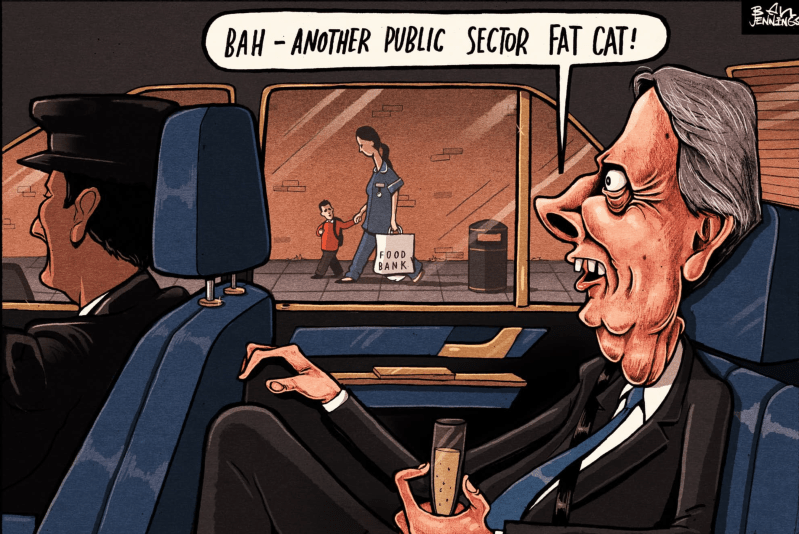
That public sector pay comment in perspective

The man who just got an 11% pay rise and will have a pension that probably pays out in a week what a nurse will earn in a year:

https://www.theguardian.com/commentisfree/picture/2017/jul/16/ben-jennings-on-philip-hammond-and-the-public-sector-pay-cap-cartoon?CMP=Share_iOSApp_Other

HS2 rail link £403 million per MILE!

First 6.6 miles from Euston to Old Oak Common could cost more than £8bn

http://www.independent.co.uk/news/uk/home-news/hs2-high-speed-railway-most-expensive-world-403-million-mile-michael-byng-a7843481.html

The execution of the NHS

The extent of the crisis in England’s GP services has been laid bare. And if there was any doubt as to why patients are struggling to get appointments with their doctors, Jeremy Hunt now has the answer right in front of him. And it’s staggering.

Staggering numbers

NHS Digital has released statistics [pdf] on the number of GP surgeries that have opened and closed, for the year up until 30 June 2017. And they show that, in the space of 12 months, 202 GP practices either closed or merged across England; with just eight opening to replace them.

As GP Online reported, the regional breakdown of closures and mergers was:

North of England – 64.
South of England – 54.
Midlands and East – 45.
London – 39.
GPs pushed to the brink

But the closures were confined to 47% of the 209 Clinical Commissioning Groups (CCG); meaning the majority of England saw no closures or mergers at all. In contrast, NHS Digital’s data showed that the number of patients registered with GPs had increased, again; up 55,178 in July compared to June. And there are now 2,427,526 more registered patients than in July 2013. Meanwhile, the number of full-time GPs dropped by nearly 3% in the year up to March 2017.

NHS Digital’s figures come as the British Medical Association (BMA) has balloted its GP members for industrial action. This would involve GP practices stopping taking any new patients. They would either suspend new patient registrations, or apply for a formal closure of patient registration lists.

The broader context

But any action by GPs comes in the context of a wider crisis within the NHS. As The Canary has repeatedly documented:

The amount the NHS paid to ‘independent’ companies has more than doubled since 2010 to over £8bn a year.

8% of government health funding now goes to private companies.
Private companies working in the NHS have seen their profits soar by up to 100%.

The NHS has seen a real-terms cut in the amount of money given to it per patient.

The Tories have cut the number of people getting social care by 26%. And they’ve cut £50m from children’s mental health services.

Successive Tory-led governments have capped [paywall] the pay rises of doctors, nurses and healthcare workers at just 1%.

Additionally, between 2010 and 2015, mental health trusts lost the equivalent of £598m a year from their budgets. And findings show that there are still £4.5m of mental health spending cuts to come. Also, there will be an additional £85m in cuts to public health budgets this year alone.

A GP speaks out

The Canary spoke to writer and GP Dr Kailash Chand OBE. And he perhaps best summed up the situation:

General practice, ‘the jewel in the crown of the NHS’, is at the brink of extinction. Across the board, GPs today are underpaid and overworked. The NHS is losing good people because GPs feel demoralised. They haven’t had a pay rise in seven years: a 1% uplift this year is a real-terms pay cut. The entire crop of GPs is undervalued, and more and more work and expectations are being put on them.

But the NHS is also facing financial meltdown, catastrophic workforce issues and political uncertainty. It is a world-class institution – with world-class practitioners now being torn apart by second-rate politicians. We are already on the way to the end of comprehensive healthcare, free at the point of need, available to all who need it.

Once the NHS is gone, it will be gone forever. And sick people will face the nightmare of not being able to afford the treatment they need. It’s time to stand up and fight!

The end of the NHS?

We have a now-permanent crisis in hospitals; GP surgeries over-subscribed and at breaking point; and social care is severely under-funded. But many believe that the Tories’ approach to the NHS is one of ‘shock therapy‘; that is, create a crisis so bad that the only apparent solution is to sell it off to private companies. And with this latest news about GP practices, we could – as Chand says – be well on the way to the end of the NHS as we know it.”

https://www.thecanary.co/2017/07/14/youre-wondering-cant-get-gp-appointment-jeremy-hunt-now-knows-shocking-answer/

Councillors and developers – a (happy for them) marriage made in hell

Journalist Anna Minton wrote a damning report in 2013 (“Scaring the Living Daylights out of People”) heavily featuring the chilling antics of the East Devon Business Forum and its disgraced Chairman, former EDDC councillor Graham Brown and mentions this in today’s article in The Guardian:

Click to access e87dab_fd0c8efb6c0f4c4b8a9304e7ed16bc34.pdf

This article on the politicisation of planning is reproduced in its entirety as there was not one sentence that Owl could cut. Although the article concentrates on cities it applies equally to areas such as East Devon.

“The politicisation of planning has come with the growth of the regeneration industry. While once planning officers in local government made recommendations that elected members of planning committees generally followed, today lobbyists are able to exert far greater influence.

It’s not easy to see into this world, but there are traces in the public domain. Registers of hospitality, for example, detail some of the interactions between councillors and the commercial property business. Take a week in the life of Nick Paget-Brown, the Kensington and Chelsea leader who resigned in the aftermath of the Grenfell fire. In October last year he had lunch at the five-star riverside Royal Horseguards Hotel courtesy of the property giant Willmott Dixon. The previous evening he had been at a reception put on by the business lobby group London First, whose membership is dominated by property and housing firms. He had breakfast with the Grosvenor Estate, the global property empire worth £6.5bn, and lunch at Knightsbridge’s Carlton Tower Hotel. This was paid for by the Cadogan Estate, the second largest of the aristocratic estates (after Grosvenor), which owns 93 acres in Kensington, including Sloane Square and the King’s Road.

Rock Feilding-Mellen, the councillor in charge of the Grenfell Tower refurbishment, who has stepped down as the council’s deputy leader, had his own list of engagements. As the Grenfell Action Group noted earlier this year, he was a dinner guest of Terrapin, the firm founded by Peter Bingle, a property lobbyist renowned for lavish hospitality.

Bingle is also a player in the other big regeneration story of recent weeks: Haringey council’s approval of plans for its HDV – Haringey development vehicle. This is a “partnership” with the Australian property developer Lendlease, a lobbying client of Terrapin’s. The HDV promises to create a £2bn fund to build a new town centre and thousands of new homes, but local residents on the Northumberland Park housing estate, whose homes will be demolished, are vehemently opposed. The Haringey leader, Claire Kober, has lunched or dined six times at Terrapin’s expense.

In Southwark, just as in Haringey and Kensington, there is a revolving door between politicians and lobbyists. The former leader of Southwark council, Jeremy Fraser, went on to found the lobbying firm Four Communications, where he was joined by Southwark’s former cabinet member for regeneration Steve Lancashire. Derek Myers, who until 2013 jointly ran Kensington and Chelsea and Hammersmith and Fulham councils, is now a director of the London Communications Agency, a lobbying agency with property developers on its client list. Merrick Cockell, the leader of Kensington and Chelsea until 2013, now chairs the lobbying firm Cratus Communications, which also specialises in property lobbying. In Westminster, the hospitality register for the last three years of its deputy leader, Robert Davis – chair of the council’s planning committee for 17 years – runs to 19 pages.

Cities other than London and rural areas also provide examples of worrying relationships. In East Devon a serving councillor was found in 2013 to be offering his services as a consultant to help developers get the planning decisions they wanted. In Newcastle a councillor who worked for a lobbying company boasted of “tricks of the trade” that included making sure planning committees included friendly faces.

Meanwhile the culture of regular meetings and socialising does not stop with councils. The diary of David Lunts, head of housing and land at the Greater London Authority for the first three months of 2017, reveals a lunch in Mayfair with Bingle, a VIP dinner laid on by a London developer, another meal paid for by a housing giant, and dinner on Valentine’s Day with a regeneration firm. Consultants and a developer furnished him with more meals before he headed off to Cannes for Mipim, the world’s biggest property fair. He also had dinner with Rydon, the firm that refurbished Grenfell Tower.

Further up the food chain, it was only because of Bingle’s boasts that we heard of a dinner he gave the then local government secretary, Eric Pickles. Held in the Savoy’s Gondoliers Room, it was also attended by business chiefs, including one who was waiting for a planning decision from Pickles’s department. The dinner was never declared on any register of hospitality because Pickles said he was attending in a private capacity.

Lunt’s former colleague Richard Blakeway, who was London’s deputy mayor for housing until last year, and David Cameron’s adviser on housing policy, became a paid adviser to Willmott Dixon. He is also on the board of the Homes and Communities Agency, the government body that regulates and invests in social housing. Its chair is Blakeway’s old boss, the former London deputy mayor for policy and planning Ed Lister, who is also a non-executive director of the developer Stanhope.

The MP Mark Prisk, housing minister until 2013, advocated “removing unnecessary housing, construction and planning regulations” as part of the government’s red tape challenge. He became an adviser to the property developer Essential Living, eight months after leaving office. Prisk advises the firm on legislation, providing support for developments and “brand” building. Essential Living’s former development manager Nick Cuff was also a Conservative councillor and chair of Wandsworth’s planning committee. A colleague of Cuff’s, who spent 30 years in the south London borough’s planning department, now works for Bingle’s lobbying firm, Terrapin.

This is the world that Kensington’s Paget-Brown and Feilding-Mellen, Haringey’s Kober and countless other council leaders inhabit. Socialising between these property men – and they are mostly men – is used to cement ties, and the lines between politician, official, developer and lobbyist are barely drawn. This culture, and the questions of accountability it raises, must be part of the public inquiry into Grenfell. It is perhaps no surprise that the government doesn’t want it to be.

• Tamasin Cave, a director of the lobbying transparency organisation Spinwatch, contributed to this article”

https://www.theguardian.com/commentisfree/2017/jul/14/grenfell-developers-cities-politicians-lobbyists-housing

“Transformation plans” – a mortal danger to the public?

Our council talks a lot about its so-called “transformation plans” which are supposed to make it leaner and meaner – doing more with less. Except, of course, for its relocation plans, which get more and more bloated with every passing week (“doing the same with more”?).

It trumpets its plans – nay strategy, here:

Click to access transformation-strategy.pdf

There are objectives in it such as “WorkSmart”, “centred”, “clear”, “simple”, “fast”, “organised” and “rational”. As if our council was currently WorkDumb, off-centre, opaque, complex, slow, disorganised and irrational was the alternative. Hhhmm – let’s not go there!

But one word is missing – SAFE.

In the light of the Grenfell Tower disaster, we have seen that ALL of the above can impact directly on council tax payers to make them less safe – as cost-cutting (the REAL meaning of transformation plans) is the major driver.

The London Borough of Newham is so concerned that it has paused its transformation plans on hold saying:

“… Inevitably…in a programme of this scale there are certain areas which have associated risks to delivery both in timing and quantum. Due to the sheer complexity and scale of what the transformation programme is trying to achieve, there are risks attached with the programme being able to deliver fully against its target. Therefore, an adjustment of c£2m has been made to recognise potential non-delivery of savings/income shortfall for 2018/19.”

http://www.room151.co.uk/151-news/news-roundup-borrowing-to-increase-cash-needs-newhams-transformation-savings-residents-audit-lambeth-cipfas-ethics-update/

So, we (and EDDC) must ask: how far is too far?

And is the council’s relocation being done at great expense, when that money ought to be ploughed back into services that have been cut to the bone and may be much less safe for us all? In its race to be bottom of council tax bills has it also been a race to the bottom for our safety?

This is, of course, a national problem – driven by austerity cuts. But have our councils (DCC and EDDC) and other institutions such as the NHS been too passive or even too welcoming of these cuts and too conveniently blind to see their consequences?

When privatisation goes bad – Carillion part 2

We are endlessly being told that “privatisation good, state ownership bad”. There is an implied belief that anything state-run is inherently badly managed, inefficient and wasteful whereas companies which take on former state-run entities are well-managed, efficient and better at using resources.

Carillion (and earlier on this year Capita and Mitie – not to forget all the utility companies) have proved that this idea totally wrong.

“… there is a support services arm [of Carillion], which includes maintenance on buildings and cleaning services. And, thirdly, there is PPP, where it might fund and manage the building of a new NHS hospital.

PPP is one of those financial inventions that was sold as being a win-win for both sides. The government might get some new infrastructure more quickly and without having to pay the huge upfront costs of building it, while the private companies financing the deal gained a valuable long-term income stream – often over 20 years or so. At least, that was the theory.

Just three Carillion PPP contracts – thought to be the Midland Metropolitan hospital in Smethwick, Merseyside’s Royal Liverpool hospital and an Aberdeen road project – are behind the bulk of the £375m losses that relate to the UK.

Industry watchers say that project delays – caused by such astonishing occurrences such as cold weather in Aberdeen over the winter – have introduced huge extra costs. Construction of the Royal Liverpool hospital has also been beset with hold-ups, most recently after workers found “extensive” asbestos on site and cracks in the new building.

Meanwhile, just before the profit warning, it was revealed that another Carillion project – an experimental tram-train linking Sheffield and Rotherham – has cost more than five times the agreed budget and is running almost three years late. The government has been forced to compensate tram operator Stagecoach for the delays with a £2.5m payment.

These types of setback are frequent complaints of investors in the sector and is one of the reasons the City has long taken a dim view of Carillion. For months, the company has been one of the UK stock market’s most shorted companies – meaning that investors have been placing bets on a fall in the company’s share price. …”

So, what do we learn from this? Well, one thing is that big investors, such as hedge funds, never lose. As soon as they sniff failure of a company, they lay bets on that failure and collect if they are right. Other “investors” seeing these bets also bet on failure.

Cream off profits, increase directors’ pay when things are going well, collect on bets when things go wrong and sometimes STILL increase director pay. And the state ends up picking up some, or all, of the losses.

Privatisation: as big as the sub- prime mortgage scandal but more secretive till the excrement hits the climate controller.

And here a couple of observations about the company from commentators on the article:

“Would love to see this company fold this is the best news I’ve heard all year. Having worked for this poorly managed company for 2 years from which I resigned because the management made life difficult this is music to my ears. Please remember this is also the company that operated the black book they kept a lot of good people on the dole because their faces didn’t fit. Hopefully They will be history very soon.”

and

“The FCA should look into this debacle. A company of almost 50,000 employees and annual revenue of £5bn does not suddenly sink like this without good reason. Many companies survive on slim margins in competitive industries. Senior managers must be held to account and for the umpteenth time …. what were the auditors doing?”

South Hams and West Devon district councils consider merger

Owl says: presumably this is not an option open to East Devon District Council, as no council would want to merge with one that is going to take out a big loan for its own new headquarters.

“Two Devon councils are considering a merger into one authority in a bid to save money – but the move could see your council tax increase.

South Hams and West Devon councils are considering joining forces, with a formal proposal to be put to councillors later this month, to make up for a budget shortfall of £1.9million each year after 2020.

South Hams leader John Tucker says there would be “severe consequences” if he cannot produce a balanced budget, suggesting his council could “run out of money”, reports plymouthherald.

“We know that there are some key concerns that the public will have, and in the proposal you will see how we plan to address those concerns,” he said.

“The biggest one for our residents in South Hams is likely to be the difference between our council tax rate and West Devon’s, which is approximately £63 a year on a band D property.

“If the proposal goes ahead we would need to bring the two council tax charges to the same level and this may mean that South Hams residents will see an increase over the next few years, until they are at the same level.

“In the proposal we have laid out some different options for how this could be dealt with.

“If we do not do this, there is a risk that South Hams will run out of money after 2020, due to the lack of funding, we therefore want to make sure we consider all options to continue funding those services we know are vital to our local communities.”

The merger could save up to £500,000 every year, excluding extra income from council tax.

“These savings would not be made through cuts to services, but because a single council will cost less to operate,” a spokesman said.

“Over the last few months a working group of councillors from both authorities, with representatives from across the political parties in South Hams and West Devon, have been exploring if the creation of one new council would be possible.”

http://www.devonlive.com/average-63-council-tax-hike-for-devon-residents-as-councils-plan-to-merge/story-30433679-detail/story.html

“What we should learn from the crisis at Government contractor Carillion”?

“Given how many have struggled, should we really be handing so many state services to these businesses?

How long can it be before a crisis at a Government contractor turns really nasty, and the National Audit Office’s warning that the big guns have become too big to fail proves prophetic?

The week in the City has kicked off with yet another finding itself in the midst of a very big mess. This time it’s Carillion.

Having trumpeted it’s “high quality order book”, reassured that performance was “in line with expectations” and repeated a pledge to reduce debt in March, things have taken a dramatic turn for the worse.

The company, that does everything from catering to construction, and employs 47,000 people worldwide, has issued a brutal profit warning and suspended its dividend in a bid to save cash. Chief executive Richard Howson is on his way out and a “comprehensive review” of the business is to be launched (KPMG is already poking around the construction operations).

Amid longstanding investor concerns about its finances, debt continues to rise, despite the actions that the company has taken to stop the rot.

They include exiting construction public private partnerships in this country, pulling out of construction in the Middle East, and being ultra careful when it comes to taking on new projects.

It looks awful, and it’s interesting to note that Mr Howson is supposed to be sticking around to help keep the show on the road with his interim replacement Keith Cochrane while the company tries to find someone to get it back on an even keel.

The thing is, we’ve seen this sort of thing before, and on repeated occasions. As the mania for outsourcing took hold on the part of Government and in the private sector, a host of companies like Carillon grew and got fat.

They used the vast revenues they earned to expand overseas, taking on more and more diverse streams of work in more and more parts of the world. Jacks of all trade, masters of… well it hardly needs saying.

Pick a contractor, any contractor, and Google will probably be able to find you a crisis like the one at Carillion.

Just last year, Capita’s shares hit a ten year low after the second profit warning in three months. Meanwhile Serco, which appointed Winston Churchill’s grandson to sort out its financial mess, has found itself smack in the middle of an operational foul up.

Having taken on a big contract at the four hospitals overseen by the Barts NHS Trust (ironically Carillion previously handled part of it), perhaps evidence of renewed official faith in its abilities, it managed to provoke a strike among cleaning staff at the Royal London Hospital after just three days.

Three months on, and 1,000 cleaners, porters, caterers and security staff, at the latter and the other hospitals, are poised to begin industrial action.

And so it goes on. And on and on.

Badly managed finances, badly managed contracts, unhappy staff, unhappy customers, unhappy workers.

You’d think, given all this, that someone would ask seriously whether it’s really such a good idea to have handed such a wide range of state services to companies that operate in this manner, and that keep falling flat on their faces.

Yet, with the notable exception of the NAO, it’s not happening.

Faced with situations like those above, the Government shrugs its shoulders, perhaps because, ultimately, the companies concerned have always just about found a way through their difficulties.

It seems we might have to wait for a truly dreadful crisis, one that really hurts people, for this to change.

It always seems to be that way in modern Britain.”

http://www.independent.co.uk/news/business/comment/carillion-government-contract-crisis-outsourcing-profit-warning-construction-richard-howson-a7833216.html

Budleigh “health hub” advertises its rooms for rent

Even the vaguest association with “health” that you can get people to pay for seems to be acceptable.

And lots of rooms for rent as the NHS appears to be using very few of them.

“Floor plans for Budleigh health hub revealed

Individuals and organisations in Budleigh Salterton are being urged to come forward to take rooms at the town’s new health and wellbeing hub.

The hub, which will be managed by Westbank, is currently under construction on the site of the former Budleigh hospital.

Floor plans have been released for the facility, which is due to open later this year.

Westbank is now looking for people and organisations to register their interest in taking rooms at the hub.

A spokesman for Westbank said: “We would like to offer a range of services which reflects the local community needs and as such are seeking expressions of interest from as many people/organisations as possible.

“Please can interested parties look at our website for more information to discuss things further.”

According to the floor plans, there will be a café in the main reception, three NHS clinical rooms, a nursery, a kitchen and a day service room.

There will also be two multi-use rooms measuring around 26sqm, as well as rooms dedicated to the hub and Westbank.

The second floor will have five more multi-use rooms, two NHS clinical rooms, as well as a smaller room earmarked for audiology.

A kitchen and a restroom are also planned for staff on the first floor, as well as a fitness and rehabilitation room and more office space for Westbank.”

http://www.exmouthjournal.co.uk/news/floor-plans-for-budleigh-health-hub-revealed-1-5096997

“Medical chiefs call fo 5,000 more beds to avoid logjam”!

Source: Daily Telegraph

and by the same author from February 2017:

“Breaking point is becoming “the norm” for the NHS, with 15,000 beds cut from hospitals in the space of six years.

The fall amounts to one in ten beds being lost, and has prompted warnings about patient safety amid rising pressure on the health service.

The British Medical Association yesterday said that the decrease in beds was directly contributing to long waits in crowded A&E departments.

The warning comes after three quarters of hospitals last month reported dangerously high occupancy rates of 95 per cent, even though managers are told to aim for a rate of 85 per cent to leave a safe margin of beds to cope with surges of patient demand.

In the first quarter of 2010/11 there were 144,455 available beds, but in the same period in 2016/17 the figure was 130,774 – a fall of almost 9.5 per cent. The loss is comparable to 24 hospitals being closed down. “

http://www.telegraph.co.uk/news/2017/02/20/nhs-breaking-point-now-norm-says-bma-bed-reductions-revealed/

Tuition fees benefit University Vice-Chancellors not students

Owl says: two university vice-chancellor (Plymouth: £310,149 gross in 2015/16; Exeter: £400,000 (including £58,000 performance-related remuneration) and a college principal of a college (South Devon College) offering university-level courses (salary not found) are all amongst the 21 board members of our Local Enterprise Partnership.

“Tuition fees in England should be scrapped after becoming a “Frankenstein’s monster” that loads £50,000 or more in debt on to the backs of graduates, according to the architect of the last Labour government’s education reforms.

Andrew Adonis, the former adviser to Tony Blair who also served as an education minister, has used a column for the Guardian to attack the system of student finances, accusing the government of running a Ponzi scheme that leaves students in England with crippling debts.

“In my view, fees have now become so politically diseased, they should be abolished entirely,” Adonis writes in the Guardian.

Admitting that he was “largely responsible” for the structure of fees and loans, with repayments pegged to graduate incomes, Adonis complains that greedy university leaders have failed to improve teaching quality but still rewarded themselves handsomely.

“[Vice-chancellors] increased their own pay and perks as fast as they increased tuition fees, and are now ‘earning’ salaries of £275,000 on average and in some cases over £400,000.

“Debt levels for new graduates are now so high that the Institute for Fiscal Studies estimates that three-quarters of graduates will never pay it all back. The Treasury will soon realise it is sitting on a Ponzi scheme,” Adonis writes. …”

https://www.theguardian.com/education/2017/jul/07/tuition-fees-should-be-scrapped-says-architect-of-fees-andrew-adonis

Seaton County Councillor organises another demo on community hospital bed losses

PRESS RELEASE:

Campaigners in the Seaton and Honiton areas are preparing for a crucial meeting of Devon County Council’s Health Scrutiny Committee on

Tuesday 25th July

Following a meeting in June when they postponed a decision, this committee will now decide whether to use its power to refer the decision of the NEW Devon Clinical Commission Group (CCG) to close all in-patient beds in Seaton, Honiton and Okehampton hospitals to the Secretary of State for Health.

In March, the Committee sent 14 questions, from a resolution proposed by County Councillor Claire Wright, about the proposals to replace 72 of East Devon’s 144 community hospital beds by care at home. The questions included the justification for the surprise last-minute switch of beds from Seaton to Sidmouth, which left no beds at all in the Axe Valley, since Axminster has already lost its beds. Cllr Wright and other committee members are expected to examine the 14 points in detail to see which of them the CCG has answered satisfactorily.

Among those who will be speaking against the plans are Seaton and Colyton County Councillor, Martin Shaw, Seaton Mayor, Jack Rowland, and the Chair of EDDC’s Scrutiny Committee, Councillor Roger Giles, with others from Axminster and Honiton. Cllr Shaw says, ”This is a crucial decision not only for the beds but also for the future of the hospitals. The CCG’s next step is its local estate strategy, which is likely to involve partial or even complete closures of hospitals. Seaton is more remote from acute hospitals than any other East Devon town and it is vital that we retain our hospital, which was built by the local community.’

As in June, protestors will gather outside County Hall from 1 pm, and will then observe the meeting which starts at 2.15. A bus is being organised to take people from Seaton to County Hall:

anyone who would like to book a seat should contact Cllr Shaw (cllrmartinshaw@gmail.com or 07972 760254).”

Councillors want more from business rates

“Local Government Association chairman Lord Porter this week confirmed the body’s new hardline approach to business rates retention, publicly rejecting any imposition of new duties from central government.

Last week, Room151 revealed a shift in approach by the LGA towards a stronger rejection of the idea that business rates retention should be accompanied by new service obligations for councils.

Speaking to the LGA annual conference, Lord Porter said that councils should expect to be rewarded for their success in slashing budgets during the recent period of austerity.

He said: “Councils can no longer be expected to run our local services on a shoestring. We must shout from the roof tops for local government to be put back on a sustainable financial footing.

“We’ve protected government for a long time by making sure all the cuts thrown our way were implemented in a way that shielded our residents as much as possible.

“But if austerity is coming to an end, then, as we were in the front of the queue when it started, we must also be at the front of the queue for more money when it ends . …”

Lord Porter: ‘We don’t want any new duties’ for business rates retention