Eastern Devon – your new fantasy health care after hospitals closed

“… Dr Sonja Manton, director of strategy for both Devon Clinical Commissioning Groups, said: “The current model of care is not sustainable either clinically or financially, so we have to look at doing something differently.

“We are extremely grateful to the Devon Health Scrutiny Committee members for the time they have put in to reviewing our plans in order to feel assured about the changes we are making. We thank them for their diligence and constructive challenge. Their insight was invaluable.

“We are now ready to move to the next step and start the final preparations of implementation and making the changes we have proposed.”

The Your Future Care proposals, which were subject to a 13-week public consultation that closed earlier this year, set out to move away from the existing bed-based model of care. Instead it focuses on a model of care that proactively averts health crises and promotes independence and wellbeing. By redirecting and reinvesting some existing bed-based resources, community services can be enhanced to support more home-based care by establishing:

Comprehensive Assessment
Single Point of Access
Urgent Community Response

The net result of this new approach will mean a reduction in inpatient beds in community hospitals in the Eastern* locality of Devon and an increase in community-based staff to support Out of Hospital Care.

Deputy Chief Executive/Chief Nurse of the Royal Devon and Exeter NHS Foundation Trust, Em Wilkinson-Brice, said: “The endorsement from the members of the committee coupled with the clinical recommendation to proceed from the assurance panel, will support public confidence that our plans are not only safe but will provide improved care.

“By moving to this model of care, we can help more people to have a better outcome – ensuring that across the whole of Eastern Devon everyone has access to safe, reliable services that promote independence and support people to live their life to the fullest.”

A significant amount of implementation planning including engagement with the workforce, stakeholders and local communities has already been undertaken and now that these two important milestones have been reached, the RD&E will, for the benefit of staff and patients, ensure that the move to provide more care and support in people’s homes is done in a safe and timely manner. In order to achieve this, the RD&E will continue to work closely with staff, partner organisations and communities to take a phased approach to implementation.

Further information specific to each of the four community hospitals will be provided in due course.

*The Eastern locality includes Exeter, East Devon, Mid Devon and parts of West Devon including Okehampton”

http://devonccg.newsweaver.com/GPNewsletter/un6s1ilvrc3qm5yxda10xa?email=true&a=2&p=1797435&t=289800
Hunt secretly visits Devon hospitals – too little too late? Or a privatisation dry run?

” … A Department of Health spokesman said: “Today he [Jeremy Hunt] visited Weston Hospital, Barnstaple Hospital and Exeter Hospital.

“The purpose of these visits was not to do media but to talk to hospital staff and managers about their work and gain insights into the local healthcare system.”

Councillor [Frank] Biederman [DCC Independent, Fremington Rural] sees the visit as more political than practical, he said: “Jeremy Hunt is at North District Hospital today. This tells me they are expecting another election, within 12 months, no other reason he would come to North Devon.”

Frank, with his tongue firmly in his cheek, added: “They should stamp on his foot, really hard and send him to Exeter for treatment.”

The visit comes a couple of months after the results of an Acute Services Review from the Northern Devon Healthcare Trust.

A report issued as a part of the review recommended that North Devon District Hospital, one of those visited by Mr Hunt today, retain its A&E, maternity, paediatrics, neonatal care and emergency stroke services.

Health campaigners from Save Our Hospital Services welcomed the news but are seeking clarification on how theses services will be funded in the future.”

http://www.devonlive.com/jeremy-hunt-tours-devon-hospitals-prompting-general-election-talk/story-30466779-detail/story.html

“Care homes face ‘huge shortfall’ in available beds” and more beds will be needed in hospitals!

“Up to 3,000 elderly people will not be able to get beds in UK care homes by the end of next year, research suggests.

Research commissioned by BBC Radio 4’s You and Yours programme reveals a huge shortfall in the number of beds available.

Increasing demand from an ageing population could see that grow to more than 70,000 beds in nine years’ time.

The Department of Health said local authorities in England had been given an extra £2bn to help fund social care.

But in the past three years one in 20 UK care home beds has closed, and research suggests not enough are being added to fill the gap. …

The research, carried out by property consultants JLL, found that since 2002 an average of 7,000 new care home beds had opened in the UK every year, but by 2026 there would be an additional 14,000 people needing residential care home places per year.

Lead researcher James Kingdom said: “We’re currently building half the number of care home beds every year that we need.”

“There are more people living longer.

“We know that over the course of the next decade there is going to be 2.5 million more over-65s, and as a result that means there is going to be demand for care home beds.

“To fix that, we need to double the rate of delivery”. …

In the past three years, 21,500 care beds have closed in the UK.

People in the care industry worry that as bed capacity decreases and demand increases, there will be more pressure on NHS beds as elderly people are admitted to hospital because they can’t cope at home.

The government estimates this already costs the NHS in England £900m a year.
Pete Calveley, from Barchester Health Care, said it was an increasing feature of the health and social care environment because there was not enough capacity in the community.”

http://www.bbc.co.uk/news/uk-40791919

New nuclear plants in USA axed in situation eerily similar to Hinkley C

“Billions of dollars spent on two new nuclear reactors in South Carolina went up in smoke Monday when the owners nixed plans to finish them after years of delays and cost overruns, dealing a severe blow to the industry’s future.

South Carolina’s state-owned public utility has voted to stop construction on two billion-dollar nuclear reactors. The reactors were set to be among the first new nuclear reactors built in the U.S. in decades, but the vote by Santee Cooper’s board on Monday, July 31, 2017 likely ends their future.

The reactors were set to be among the first built in the U.S. in decades. While the decision will save customers billions in additional costs, customers of the two utilities — Santee Cooper and South Carolina Electric & Gas — may get little to nothing refunded of the billions they’ve already paid for the now-abandoned project.

“I’m disappointed today not just for Santee Cooper and its customers but for our country and the industry as a whole,” said Santee Cooper CEO Lonnie Carter. “If you really believe we need to reduce carbon, this was the way to do it.”

Energy demands are far less than the utility’s pre-Great Recession projections that factored into the initial decision to build.
But Monday’s decision may eventually result in the utility putting a coal-fired unit idled earlier this year back in operation. Another option for supplying power needs in the decades to come include building a natural gas unit.

“Absolutely, this pushes us back to more carbon, whether it’s natural gas or coal,” Carter said.

Santee Cooper’s board said the decision to end construction will save customers an estimated $7 billion. The utility had already spent about $5 billion for its 45 percent share of the project, and completing it would have cost an additional $8 billion, plus $3.4 billion in interest.
“I’m not celebrating,” said Tom Clements of Friends of the Earth, which has questioned the project from the outset. “This is a sad day for South Carolina. So much money has been wasted. Ratepayers are losers any way you take it.”

He said the group will work to “get to the bottom line of how this happened, who’s responsible” and what that means for customers.

Gov. Henry McMaster called for legislators to hold hearings to get customers’ questions answered.

The project has been shrouded in doubt since earlier this year, when primary contractor Westinghouse filed for bankruptcy protection.

The utilities have since determined the project likely wouldn’t have been finished until 2024. Under a timeline adopted in 2012, the first reactor was supposed to be operational earlier this year. Westinghouse hasn’t been forthright since, according to Santee Cooper.

South Carolina Electric & Gas, which owns 55 percent, announced its plans shortly after Santee Cooper’s unanimous vote. SCANA, SCE&G’s parent company, will seek approval from regulators Tuesday about their abandonment plans.
Under the approved Santee Cooper resolution, all work will end within six months. How quickly within that timeframe workers at the site will lose their jobs is uncertain.

About 5,000 people are employed at the site by contractors and subcontractors. SCE&G employs an additional 600 workers for the project, according to the utility.

The utilities announced last week that Westinghouse’s parent company, Toshiba Corp., agreed to jointly pay them $2.2 billion regardless of whether the reactors are ever completed.”

http://www.apnewsarchive.com/2017/Billions-of-dollars-spent-on-two-new-nuclear-reactors-in-South-Carolina-have-gone-up-in-smoke-when-the-owners-nixed-plans-to-build-them-because-of-delays-and-cost-overruns/

Times article: scrap Hinkley C, frack for shale and to hell with carbon reduction

Britain’s energy policy keeps picking losers

by Matt Ridley

The public have paid the price for years of missteps: it’s time to scrap Hinkley Point C and support the shale revolution

Shortly before parliament broke up this month, there was a debate on a Lords select committee report on electricity policy that was remarkable for its hard-hitting conclusions. The speakers, and signatories of the report, included a former Labour chancellor, Tory energy secretary, Tory Scottish secretary, cabinet secretary, ambassador to the European Union and Treasury permanent secretary, as well as a bishop, an economics professor, a Labour media tycoon and a Lib Dem who was shortlisted for governor of the Bank of England.

Genuine heavyweights, in short. They were in general agreement: energy policy is a mess, decarbonisation has been pursued at the expense of affordability and, in particular, the nuclear plant at Hinkley Point C in Somerset is an expensive disaster. Their report came out before the devastating National Audit Office report on Hinkley, which said the government had “locked consumers into a risky and expensive project [and] did not consider sufficiently the risks and costs to the consumer”.

Hinkley is but the worst example of a nationalised energy policy of picking losers. The diesel fiasco is another. The wind industry, with its hefty subsidies paid from the poor to the rich to produce unreliable power, is a third. The biomass mess (high carbon, high cost and environmental damage) is a fourth.

The liberalised energy markets introduced by Nigel Lawson in 1982, embraced by the Blair government and emulated across Europe, delivered both affordability and reliability. But they were abandoned and, in the words of the Lords committee, “a succession of policy interventions has led to the creation of a complex system of subsidies and government contracts at the expense of competition. Nobody has built a power station without some form of government guarantee since 2012.”

All three parties share the blame. Labour’s Climate Change Act of 2008 made Britain the only country with mandatory decarbonisation targets, a crony-capitalist’s dream. The Lib Dems who ran the energy department for five years, Chris Huhne and Ed Davey, negotiated the disastrous Hinkley contract. The Tories reviewed the decision in 2016, by which time it was clear we had managed the unique feat of finding a technology that was untested yet already obsolete. They decided to go ahead anyway, missing the chance to blame the other parties for it. As the energy analyst Peter Atherton put it, the three parties “have managed to design possibly the most expensive programme for delivering nuclear power we could have come up with”.

The chief Lib Dem mistake was to ignore the shale gas and oil revolutions under way in America and assume that fossil fuel prices would rise from already high levels. By 2011, influenced by peak-oil nonsense and lobbied by professors of “sustainability”, the department of energy and climate change was projecting that the oil price would be between $97 and $126 per barrel in 2017. Today it is about $50 a barrel, roughly half the lowest of the 2011 projections. Gas prices were expected to be about 76p per therm by now, whereas they are actually about half that: 37p.

The shale revolution is gathering pace all the time. Britain has very promising shales and could prosper and cut emissions if it joins in, so let us hope the first wells about to be drilled in Lancashire by Cuadrilla, against the determined opposition of wealthy, middle-class protesters, prove successful. (No, I don’t have a commercial interest in shale.)

American industry pays about half as much for its electricity as we do
This forecasting mistake is behind much of the rising cost of Hinkley. In 2015 the whole-life cost of its power was expected to be £14 billion. Now it is £50 billion. Because consumers are on the hook to pay the difference between the wholesale price of electricity and the “strike price” for Hinkley, we must hope that the project is badly delayed, because that way our children will at least spend fewer years paying inflated electricity prices.

These bad forecasts, widely criticised at the time, make all strike prices horribly expensive, for onshore and offshore wind and solar as well. Lib Dem ministers kept saying at the time that subsidies for renewables and Hinkley would protect the consumer against “volatile” gas prices. Yes, they have done so: by guaranteeing high prices. Oh for a little downward volatility!

Britain’s industrial and commercial users now have some of the highest electricity prices in the developed world, which find their way to households in cost of living and a downward pressure on wages. American industry pays about half as much for its electricity as we do, and everyone benefits. Energy prices are not just any consumer price: they determine the prosperity of the entire economy.

It is just possible some new arrangement could be salvaged

Well, no use crying over spilt future money. What are we to do? Here is where it could get interesting. Almost nobody wants Hinkley to go ahead, apart from the contractors who get to build it. EDF and Areva, the French owner and developer, are in trouble over the only two comparable reactors in Europe. The one at Flamanville is still to start working, many years behind schedule. The French unions want Hinkley cancelled. Lord Howell of Guildford, the former energy secretary, wisely pointed out in the Lords that the key player is China, a partner in the project. Rather than cost, the government’s excuse for revisiting Hinkley last year was partly worries about security. This was a silly worry and bad diplomacy. However, it is not clear China wants to go ahead, and subtle negotiation could tease this out. The great prize for China was regulatory approval through Britain’s gold-standard “generic design assessment” process, which could unlock foreign markets and give a green light for a Chinese-built reactor at Bradwell in Essex.

But Lord Howell says the Chinese increasingly realise that the Hinkley design is a dead end, as costs escalate and delays grow. And they know that the future for nuclear power must lie in smaller, modular units, mass-manufactured like cars rather than assembled from scratch like Egyptian pyramids. Their “Nimble Dragon” design could slot into both the Hinkley and Bradwell sites, perhaps beside the larger Hualong design.

Cancellation would cost some £20 billion. But if the initiative comes from Beijing it is just possible that some new arrangement could be salvaged from the certain wreckage of the EDF scheme, without seriously damaging both livelihoods and our relations with China.”

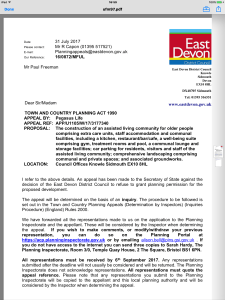
Knowle planning appeal inquiry – objections to Planning Inspector by 6 September

i

See your Police and Crime Panel in action – in Plymouth – and how to ask a question

Owl thinks the Police and Crime Commissioner is getting an easy ride when it comes to accountability. And thinks the Police and Crime Panel (which can make recommendations to her but cannot do anything else if she disagrees with them) is getting an even easier ride.

It is very hard for people in East Devon to get to Plymouth, where the panel always meets (time for an Exeter venue?) but for anyone who wants to attend and ask questions of the panel, here is the relevant information:

Devon and Cornwall Police and Crime Panel
Next meeting: Friday 18 August 2017 10.30 am

The agenda will be displayed in the week before the meeting

Proposed venue: Council House (Next to the Civic Centre), Plymouth

How to ask the panel a question

Members of the public can attend panel meetings (except where confidential or exempt information is likely to be discussed) and may ask questions at each meeting (up to two questions per person per meeting and up to 100 words per question) that are relevant to the Panel’s functions.

At the start of each meeting 30 minutes will be allocated to questions asked by members of the public. Responses may be oral or written.

Questions must be put in writing to the Democratic and Member Support Manager at Plymouth City Council at least 5 clear working days before the panel meeting.

Democratic and Member Support Manager
Plymouth City Council
Civic Centre
Plymouth
PL1 2AA
democraticservices@plymouth.gov.uk

Hinkley C: more bad, bad news – and they are moving to renewable energy!

Not looking like a good idea …

“Earnings at energy giant EDF have plummeted by a fifth in the first half of this year due to ongoing woes in its French fleet of nuclear reactors and lower profits from those in the UK.

The French state-backed group behind the UK’s first new nuclear plant in a generation, Hinkley Point C, has suffered a major setback to its domestic reactors, some of which have been closed for safety checks since October.

French nuclear power output fell by 3.9pc from the first half of last year to 197.2TWh in the six months to June 30, the group said. Despite a 4.2pc rise in UK EDF’s nuclear generation to 32.2TWh, the fleet of reactors were still a drain on earnings due to the weaker market price for electricity.

The slump in its two core markets wiped more than 20pc from its underlying earnings before interest, tax, debt and amortisation to €7bn (£6.3bn) but the group has assured investors that it remains on track to meet its guidance of between €13.7bn to €14.3bn for the year.

Jean-Bernard Lévy, EDF’s chairman and chief executive, underlined the “unfavourable market context” but said the group’s move towards renewable energy was accelerating.

The roll-out of subsidised renewables in the last decade has effectively driven the wholesale price of power down, cutting revenue for existing nuclear power plants, which sell their electricity into the market.

The decline in income highlights the need for a guaranteed set price for the new Hinkley Point plant in order to recover its eye-watering costs.

Earlier this month EDF confirmed that the cost of developing Hinkley had gone from £18bn to £19.6bn but was quick to point out that this would not be borne by customers because of the fixed price of £92.50 per megawatt-hour already agreed with the Government.

However, the declining wholesale market price means the top-up payment needed to meet this set price, which is paid by consumers, has spiralled to £50bn over the lifetime of the project from the £6bn bill estimated in 2013.”

http://www.telegraph.co.uk/business/2017/07/28/edf-profits-dented-nuclear-woes/

Seaton DCC Councillor on that shameful DCC Health Scrutiny meeting – and Diviani’s disgraceful behaviour

“Councillor-Sara-Randall-Johnson (from this article):

Why did Devon’s Health and Adult Care Scrutiny Committee block the proposal to refer the closure of our beds to the Secretary of State?

The idea that the Chair, Councillor Sara Randall Johnson (left), was settling an old score with Claire Wright makes a nice story but overlooks the concerted Conservative position. The collusion between Randall Johnson and Rufus Gilbert – who rushed to propose a ‘no referral’ motion before Claire could move her motion to refer – was obvious to all, as was her keenness to persuade her colleagues not to have a recorded vote.

Equally striking, however, is that only one out of 12 Tories on the Committee – Honiton’s Phil Twiss – voted against Gilbert’s motion. The other 7 Tories who voted were all for allowing the beds to be closed; 2 who had reservations abstained; 2 more were (diplomatically?) absent. Whipping is not allowed on Scrutiny committees, but this gives a strong impression of a Tory consensus. Members who were uncertain of their support were unwilling to defy it beyond abstention. Twiss was obviously a special case, as the one committee member whose hospital will lose its beds.

Clearly the Conservative Group on DCC gave their East Devon members the main role in dealing with the Eastern Locality hospital beds issue when in May (with its return to Scrutiny looming) they made Randall Johnson chair and nominated two Exmouth members, Jeff Trail and Richard Scott, as well as Twiss as members of the Health Scrutiny Committee. With East Devon Tory leader, Paul Diviani, representing Devon’s district councils, 5 of its Tory members were from East Devon and only 7 from the other five-sixths of the Tory group.

East Devon Tories on the committee certainly lived up to their role on Tuesday. All except Trail voted, making half of all Tory votes cast on the committee and 3 out of 7 on the pro-CCG side. In contrast, only 4 of the 8 Tories from elsewhere in the county cast a vote on this crucial issue: East Devon’s Tories may have convinced themselves, but not their colleagues.

Paul Diviani spills the beans

With Randall Johnson preoccupied with timekeeping (except when the CCG were speaking), Scott silent and Twiss asking questions, it was left to Diviani to express the Tory rationale. He claimed to speak for Devon district councils as a whole, but has acknowledged that he had consulted none of the others. He was happy to defy his own Council, which has voted to keep hospital beds, and spoke for himself – and East Devon Conservatives.

Diviani’s caustic little speech deserves more attention than it has been given.

He started by saying that those who decide to live in the countryside expect diminished service, and must cut their cloth accordingly in current times – forgetting that many have lived here all their lives, or moved here long before the present Tory government arrived to savage the NHS.

‘Costs will always rise without innovation’, Diviani continued, forgetting that the ‘costs’ of community hospitals are rising particularly because of the Tory innovation which gave them over to NHS Property Services and its ‘market rents’.

‘Local decisions should be made locally’, he averred, overlooking the fact that Sustainability and Transformation Plans, Success Regimes and NHS property sales are all national initiatives forced on the local NHS – while NEW Devon CCG is so unrepresentative even of local doctors that only full-time managers (Sonja Manton and Rob Sainsbury) are allowed to present its case in public while its ‘practitioner’ figurehead, Dr Tim Burke, hides in a corner.

When, however, Diviani warned that ‘attempting to browbeat the Secretary of State to overturn his own policies is counter-intuitive’, he expressed the truth of the situation. The closure of community hospitals results from the determined policies of the Conservative Government. (Referral would have served the purposes of delaying permanent closures, embarrassing the Government and forcing its Independent Reconfiguration Panel to give an assessment of the issue.)

East Devon Tories are the Government’s faithful servants. ‘Don’t trust East Devon Tories’ over the hospitals, I warned during the County elections. How right have I been proved.”

East Devon Tories were central to ditching Seaton and Honiton hospital beds

Claire Wright’s report on the shameful behaviour of DCC Health Scrutiny Committee Tories

“The Conservatives on Devon County Council’s health and adult care scrutiny committee on Tuesday, torpedoed local people’s views and any possibility of a referral to the Secretary of State for Health for a decision to close 71 community hospital beds.

I will keep this blog post short and instead post three articles that explain things just as well as I could have explained them.
Suffice to say that I am deeply disappointed.

Not just with the behaviour of chair, Sara Randall Johnson, who appeared to do her utmost to prevent any referral, both at the previous meeting last month and at Tuesday’s meeting.

But also with the attitude of the majority of the Conservative group, who used a variety of ill-informed views and remarks, to justify their determination not to refer, refusing to hear or see any member of the public’s distress, frustration and disbelief at the proceedings.

The chair’s attitude made me angry and led to a protracted row where I repeatedly asked her why she had allowed a proposal to be made and seconded at the very start of the meeting by her conservative colleague, Rufus Gilbert, NOT to refer to the Secretary of State for Health, when I already had a proposal that I had lodged with her and the two officers, before the meeting.

I had been indicating to speak since the start of the meeting, yet, Cllr Randall Johnson chose to call four councillors before me.

When I was finally called to speak I challenged her on why she had not made my proposal, which she had a copy of in front of her, known to the committee at the start of the meeting, which is the usual practice.

Cllr Gilbert’s seconded proposal before questions or the debate had even started had nullified my proposal, which was why I was so angry.

Cllr Randall Johnson admitted that it was her decision not make my proposal known to the committee and her decision on who is called to speak.

When they did what they did at Tuesday’s health scrutiny meeting, the Conservatives betrayed thousands of local people.

As I said in my final speech, local people had written letters, organised petitions, replied to public consultations, attended meetings, spoken at meetings, attended demonstrations, some had even spent significant sums of money on a legal challenge.

Time after time, month after month, the committee has asked questions which have not been properly answered on issues such as evidence that it will work, the staffing required, the finances, care of the dying. Local GPs are up in arms, staff have objected… yet the Conservative group knew best.

The vote was agonisingly close – six votes to seven, with two abstentions. All those who voted with Cllr Gilbert’s motion were conservative. Cllr Randall Johnson also voted with Cllr Gilbert – another unusual move at such a highly charged and significant meeting.

I am quite certain, that with a different approach by the chair, that the outcome would have been different. And local people’s views would have been respected and acted upon.

Councillors are elected by local people to represent their views.

Why was it so important to the chair and her colleagues that my proposal failed on Tuesday?

A whip at scrutiny committees, much least a legally constituted committee such as the health and adult care scrutiny committee of Devon County Council is strictly forbidden.

Yet to the members of the public present, who were repeatedly shouting “fix” it certainly appeared that way.

Since the meeting I have been inundated with messages from people who are disgusted at what happened.

Alongside two other councillors, I am seeking advice on what took place at Tuesday’s meeting.

The debate can be viewed on the webcast here – https://devoncc.public-i.tv/core/portal/webcast_interactive/293466

Seaton councillor, Cllr Martin Shaw, wrote an excellent account of the meeting here – https://seatonmatters.org/2017/07/26/the-health-scrutiny-committee-which-didnt-scrutinise/

My row with Cllr Randall Johnson has led to a local newspaper running a story about revenge… – see http://www.devonlive.com/tory-sara-randall-johnson-derails-claire-wright-s-health-campaign-six-years-after-election-defeat/story-30457493-detail/story.html”

http://www.claire-wright.org/index.php/post/conservatives_torpedo_local_peoples_views_on_community_hospital_bed_closure

Does our LEP have a plan B to replace European funding? And will it be a “functional economic area”?

“The Conservative manifesto earlier this year promised the government would use structural fund money that comes back to the UK following Brexit to create a UK “shared prosperity fund”.

However, deep concerns have been voiced about the replacement of EU structural funding. This week, Humber Local Enterprise Partnership chairman Lord Haskins aired doubts about the scale of the proposed fund.

He told the Hull Daily Mail that “so far, there is no indication it will match the sort of money we are currently getting from Europe”.

He added: “Long-term, I think we will have to start looking at other sources of funding for vital infrastructure work.”

The LGA also wants a new approach to distributing Westminster money that replaces EU regional aid, calling for a “single pot” for all domestic growth funding.

The association outlined three options for the future of funding currently sourced from the European Union. Its preferred method would see European Union structural funding, all other European funding streams and 70 UK funding streams supporting growth and regeneration pooled together.

The document said: “Under the single pot principle, local areas would be afforded maximum flexibility to target need and tailor provision, to stimulate growth in local areas and contribute to the national economy .”

The pot would be most effectively distributed to regional “functional economic areas” (FEAs) in England, and “appropriately identified” bodies in the devolved nations, the report said.

“In England, the FEAs could arguably follow the funding distribution geography of the current European Structural and Investment Funds (ESIF) programme,” the report added. It argued this would offer “much greater control over funding decisions , which would be devolved to all local areas.” …”

http://www.room151.co.uk/resources/billions-needed-to-match-eu-funding-for-local-communities-after-brexit/

“How Tory Sara Randall Johnson took down rival Claire Wright’s health campaign”

Owl says: So, Honiton and Seaton hospitals sacrificed to Randall-Johnson’s anger?

By P Goodwin, Western Morning News

“As the old saying goes: revenge is a dish best served cold.

For Conservative county councillor Sara Randall Johnson the wait to gain the upper hand on old rival Claire Wright stretched to six years.

When she did, the result was painful and public.

At this week’s bad-tempered and rowdy council health scrutiny meeting, Ms Randall Johnson used her new power of chairmanship to thwart the independent rebel and stamp her authority on the newly-elected authority.

In a move which prompted jeers and cries of “fix” from the public gallery, Randall Johnson ignored a tabled motion to halt hospital bed closure plans and instead allow a fellow Tory, Rufus Gilbert, to seize the momentum by kick starting the debate and swiftly proposing the exact opposite.

She then dismissed Ms Wright’s protest by telling her the power to choose was entirely at her discretion as chair, before moving to a vote against referring the proposals, which was won by a majority of one, with one abstention.

It was a swift and brutal piece of politics. The result: bad headlines averted, no need to trouble Jeremy Hunt with the protests of a rebellious council and the upstart put firmly in her place.

Former Lib Dem county council leader and respected political veteran Brian Greenslade remarked after the meeting that the move had been highly unusual.

He considered that not mentioning or circulating a table motion – one submitted before the meeting begins – was rare: not against procedure but definitely a departure from protocol.

In other words: a low blow but not quite below the belt.

It was clear from the tetchy exchanges during the meeting that there is little love lost between the two women and this is perhaps no surprise.

Wright pulled off a shock victory when she ousted Randall Johnson from her East District Council seat and her position as leader, relegating her into third place in a race for two seats, by the slender margin of just 25 votes.

The defeated leader put on a brave face, claiming she had got her life back after 20 years of public service, but this hardly sounds like the words of a woman who just two years earlier was vying with Sarah Wollaston to become MP for Totnes.

Since that victory, Wright, an outspoken independent campaigner, has become a painful thorn in the side of local Tories at district and county level, particularly around the NHS, where she worked in PR before launching her political career.

She has led the opposition ever since, including two general election campaigns in which she gave MP Hugo Swire a run for his money.

But the campaign to halt bed cuts and hospital closures has been a major factor in her rallying call to local people, the jewel in her campaigning crown.

The recent background to Tuesday’s meeting went like this:

Plans by the Northern, Eastern and Western Devon Clinical Commissioning Group to axe 71 beds across four cottage hospitals sparked anger in the Eastern locality.

Amid fears the NHS is planning to sell off the hospitals, relations between the public and NHS officials deteriorated with many accusing executives of lying about their true intentions.

Campaigners, angry that the case has still not been made for the Your Future Care model of home visits, labelled the consultation a sham and turned to the Health and Wellbeing Scrutiny Group for help.

It could refer to Mr Hunt though in reality it the plans would have gone to an independent reconfiguration panel who would make recommendations.

What many people wanted was a change in the way the CCG operates and communicates. they wanted a more open approach and they felt this might give the health trust a jolt.

Under the chairmanship of veteran Labour councillor Richard Westlake, the scrutiny group was poised to refer the plans to the Secretary of State if 14 documented points were not addressed.

But he stepped down at the election and Ms Randall Johnson took up control.

At the first meeting of the newly constituted committee in June, it became clear that she did not intend to let this happen.

Ms Wright had proposed to the last meeting that it was time to vote to refer to the Health Secretary and the chair repeatedly came under fire for not putting this to a vote.

There was a lack of clarity among one or two members about the whole process and eventually, members were persuaded to defer a decision until yesterday to get more information.

It appeared that the Conservatives had their ducks in a row on Tuesday.

Wright cried foul when her tabled motion was ignored, claiming she had never seen it happen in six years of committee meetings.

Unfortunately, the legal advice from the council backed Randall Johnson: Motions needed to be proposed and seconded in the meeting.

Would it have changed the vote? Maybe not. It was close though. East Devon leader Paul Diviani rebelled against his members and voted not to refer and one Tory did admit he was wavering.

The way the meeting was handled did little to foster good relations between the council and the community.

Ms Randall Johnson may have done nothing wrong but she certainly didn’t make any new friends in the public gallery.

As for old foes among the membership – no change there.”

http://www.devonlive.com/tory-sara-randall-johnson-derails-claire-wright-s-health-campaign-six-years-after-election-defeat/story-30457493-detail/story.html

Bed closures at Honiton and Seaton – the final stitch-up by Tory Councillors

Councillor Martin Shaw (EDA, Colyton and Seaton) reports:

[Names of those voters have been amended – it does not affect the result]

“The 7 councillors who voted NOT to refer the decision to close Honiton and Seaton hospital beds were:

Sarah Randall-Johnson
Paul Diviani (Leader of East Devon District Council, representing Devon district councils), and county councillors
Richard Scott (Exmouth),
Rufus Gilbert,
Sylvia Russell,
Paul Crabb and
Ron Peart.

The 6 councillors who voted against this motion, i.e. to refer the decision, were Claire Wright (Otter Valley, Independent), Brian Greenslade and Nick Way (Liberal Democrat), Hilary Ackland and Carol Whitton (Labour) and Phil Twiss (Honiton, Conservative).

Jeremy Yabsley (Conservative) abstained as did John Berry. Two other Tories,
Jeffrey Trail (Exmouth) and
Philip Sanders, gave their apologies.

Six public speakers, Cllr Roger Giles (Chair of East Devon’s Scrutiny Committee), Paul Arnott (Colyton), Cllr Jan Goffey (Mayor of Okehampton), Cllr Mike Allen, Bob Sturtivant and Stephen Craddock (Honiton), spoke eloquently against the closures for two and a half minutes each. County Councillor Ian Hall (Axminster) and I also addressed the committee for five minutes each.

Three representatives of NEW Devon CCG and the RD&E (who run the hospitals and are working with the CCG) were then allowed to make a very lengthy Powerpoint presentation and contribute freely to the discussion – which none of the public speakers, Ian Hall or I were allowed to do.

Claire Wright had prepared a detailed motion to refer the closures and had submitted it to the Chair before the meeting. However when debate began, Cllr Randall Johnson chose not to call Claire to speak but called Rufus Gilbert who immediately proposed the motion not to refer, which was quickly seconded by Sylvia Russell.

This blatant manoeuvre by the Chair meant that the committee never considered point by point, as Claire’s motion would have required it to, the 14 questions on which it had asked the CCG to satisfy it. Despite an excellent report from Hilary Ackland which concluded that the CCG had failed to convince, the Committee basically abdicated its scrutiny role and blocked a referral without discussing most of the objections which we had raised.

Claire and I are planning to complain about the way the meeting was handled. If you want to watch it, it’s online at

https://devoncc.public-i.tv/core/portal/webcast_interactive/293466.

Thank you all for your support for the hospitals over the last 9 months. Be assured, however, that this is not the end of the matter, since the CCG and RD&E are both developing ‘estates strategies’ which will centre on what to do with space freed up by the closures. “

The “care outside hospital” check list – cut out and keep

In December 2016, East Devon Watch published this article::

https://eastdevonwatch.org/2016/12/07/the-30-plus-questions-to-be-answered-before-care-at-home-is-authorised/

Owl has been passed a copy of the “30 [plus] questions” that must be asked BEFORE care at home can be implemented:

Pre-implementation

The model of care:

• Does the new model of care align with our overriding ambition to promote independence?
• Is there clinical and operational consensus by place on the functions of the model and configuration of community health and care teams incorporating primary care, personal care providers and the voluntary care sector?
• Is there a short term offer that promotes independence and community resilience?
• Is there a method for identifying people at highest risk based on risk stratification tool?
• Are the needs of people requiring palliative and terminal care identified and planned for?
• Are the needs of people with dementia identified and planned for?
• Is support to care homes and personal care providers, built into the community services specification?
• Is support for carers enhanced through community sector development support in each community?
• Has the health and care role of each part of the system been described?
• Have key performance indicators been identified, and is performance being tracked now to support post implementation evaluation, including impact on primary care and social care?

Workforce:
• Is there a clear understanding of the capacity and gaps in the locality and a baseline agreed for current levels and required levels to meet the expected outputs of the changed model of care?
• Is there a clear understanding of and plan for any changes required in ways of working:
o thinking
o behaviours
o risk tolerance
o promotion of independence, personal goal orientation

• Have the training needs of people undertaking new roles been identified, including ensuring they are able to meet the needs of patients with dementia?
• Do we have detailed knowledge with regards to investment, WTE and skill mix across the locality and a plan for achieving this?
• Are system-wide staff recruitment and retention issues adequately addressed with a comprehensive plan, and where there are known or expected difficulties have innovative staffing models been explored?

Governance, communications and engagement:
• Is there a robust operational managerial model and leadership to support the implementation?
• Has Council member engagement and appropriate scrutiny taken place?
• Is there an oversight and steering group in place and the process for readiness assessment agreed?
• Have providers, commissioners and service users and carers or their representative groups such as Healthwatch agreed a set of key outcome measures and described how these will be recorded and monitored?
• Is there a shared dashboard which describes outcomes, activity and productivity measures and provides evaluation measures?
• Is there an agreed roll out plan for implementation, which has due regard to the operational issues of managing change?
• Is there a comprehensive & joint communications and engagement plan agreed?
• Is there a need for a further Quality or Equality Impact Assessment?

Implementation
• Is there a clinical and operational consensus on the roles of each sector during the implementation phase including acute care, community health and care teams, mental health, primary care, social care, the voluntary care sector and independent sector care providers?
• Is there an implementation plan at individual patient level describing their new pathway, mapping affected patients into new services?
• Are the operational conditions necessary for safe implementation met?
• Have the risks of not implementing the change at this point been described and balanced against any residual risk of doing so?

Post Implementation
• Is there a description of the outcomes for individuals, their carers and communities?
• Are the mechanisms for engagement with staff, users of services and carers in place and any findings being addressed appropriately?
• Is there a process in place for immediate post implementation tracking of service performance including financial impact to all organisations?
• Is longer term performance and impact being tracked for comparison against pre-implementation performance?
• Have we captured user experience as part of the process, and have findings been addressed and recorded to inform the planning of future changes?
• Are there unintended consequences or impacts (e.g. on primary care or social care) which need to be addressed before any further change occurs?
• Is there a clear communication plan for providers and the Public describing the new system and retaining their involvement in community development?

Source: http://www.newdevonccg.nhs.uk/about-us/your-future-care/publications-and-evidence-sources/102085
( point 14, page 94)”

https://eastdevonwatch.org/2016/12/07/the-30-plus-questions-to-be-answered-before-care-at-home-is-authorised/

Tories sacrifice Honiton and Seaton hospitals to party dogma

“By 7 votes (all Conservative) to 6 (2 Liberal Democrats, 2 Labour, 1 Conservative and Independent, Claire Wright), Devon County Council’s Health Scrutiny Committee today sealed the fate of the beds in the two hospitals (and Okehampton) by voting not to refer the closure of beds to the Secretary of State for Health.”

Tory majority sacrifices Seaton and Honiton hospitals at Devon Health Scrutiny

Tory voters – this is totally down to you.

“Secret government cuts sound death knell for NHS”

Owl says: and newspapers are only just finding this out when we have known it for months and months! Amazing.

“SECRET Government plans to impose “radical and rapid” spending cuts on debt-ridden NHS trusts will lead to cancelled operations, redundancies and hospital closures, the British Medical Association has warned in a new report.

The effects of the proposed Capped Expenditure Process could be “devastating”, says the BMA, warning maternity and A&E wards would be closed and waiting times increased.

Experts say the plans, which would impose up to £250million of savings across the 14 health authorities which have the biggest deficits, could sound the “death knell” for the NHS.

The recent proposals, which have been discussed with NHS managers across the country, have not been put out for consultation with public or patients, a decision which has angered health care leaders, MPs and clinicians.

http://www.express.co.uk/life-style/health/831853/Secret-government-cuts-death-knell-NHS-BMA-report-spending-cap

EDA County Councillor Martin Shaw on Seaton hospital bed cuts

“PRESS RELEASE

Protestors from Seaton, Honiton, Okehampton and elsewhere in Devon will converge on County Hall again on Tuesday 25th July from 1 pm, before the special meeting of Devon County Council’s Health Scrutiny Committee at 2.15 which will decide whether to refer the closure of beds in the three hospitals to the Secretary of State.

NEW Devon Clinical Commissioning Group proposes to replace the beds with a new system of care at home. We shall be pointing out that:

The new system, which they have been developing only since March, has not been tested in winter, let alone a flu epidemic; it is uncertain that they will be able to staff it effectively over time given the complex travelling arrangements that it requires for medical as well as care staff.

The small number of beds (halved to 71) which they propose to retain across the 3 remaining community hospitals ignores the facts that East Devon has far more over-85s (the key users of community beds) than other areas of Devon and that these numbers are projected to treble in the next two decades.

The remaining beds will not be distributed in an ‘even geographic spread’ as the CCG claim but, concentrated in Tiverton, Exmouth and Sidmouth, give no provision at all in the Axe Valley which is the area of East Devon furthest from the RD&E.

The closure of beds is driven by the CCG’s aim of reducing the amount of rent which it has to pay to NHS Property Services for community hospital space, and is probably a prelude to the gradual elimination of community hospitals over the next few years.

Six speakers from the affected communities will address the Committee in the Public Participation session, and I shall be addressing them as County Councillor for Seaton and Colyton.

We urge that the Committee use its legal power to refer the CCG’s decisions to the Secretary of State.

Martin Shaw
Independent East Devon Alliance County Councillor for Seaton & Colyton”

DCC announces special needs education cuts on last day of term

“… It has prompted SENDCo teacher Hannah Rose, of Bradley Barton Primary School, in Newton Abbot, top launch a petition entitled ‘petition to withdraw harmful funding changes for pupils with SEND in Devon’, opposing the cuts.

She said: “These changes will affect all children in all schools in Devon. Where specialist support staff are lost through redundancies, ‘generalist’ staff who usually support all pupils’ learning will need to be diverted to support those with the highest needs. All children will be taught in higher ratios, with less support.” …

http://www.devonlive.com/council-announces-harmful-special-needs-funding-cuts-in-devon-schools-and-colleges/story-30451112-detail/story.html

Seaton and Beer risk being cut off from Exeter by proposed bus service reduction

Press release:

“At Devon County Council yesterday, Seaton & Colyton’s Independent East Devon Alliance councillor, Martin Shaw, asked Councillor Roger Croad, Cabinet Member for Transportation, if the Council would support peak services on the X52 bus service from Seaton and Beer to Exeter, which are threatened with closure by First Wessex.

First Wessex proposes to run only two off-peak buses a day in each direction from September. While better than nothing, these are inadequate for people in Seaton and Beer who want to work or study in Exeter or get to appointments at the Royal Devon and Exeter Hospital. Relying just on these services, people would barely be able to spend an hour in Exeter before having to get the bus back.

This is the only service direct from Seaton and Beer to the RD&E and this narrow window will not enable people to get to appointments. Using other services, people in Beer who want to get to the hospital will have to change twice in Seaton and Exeter Bus Station and the journey which currently takes an hour will take more than two hours each way, making it arduous and impractical for many people.

Councillor Croad initially replied to suggest that people could use these alternative routes. In a supplementary question, Councillor Shaw suggested that since hospital services are increasingly being centralised in the RD&E, the withdrawal of direct bus services discriminates against people without cars in communities like Seaton and Beer which are on the periphery of Devon. ‘Seaton is further from the RD&E than any other town in Devon and has the oldest population profile of any town in Devon’, he said. ‘We need direct public transport links to the acute hospital in Exeter.’

Councillor Croad then said that if Councillor Shaw would meet him afterwards, he would discuss the issue. When they talked, Councillor Croad agreed to look further at the question. The supplementary question and the reply can be seen from 1:47:50 to 1:49:15 on https://devoncc.public-i.tv/core/portal/webcast_interactive/283676.”

Can anyone make sense of remarks below?

“Devon and Cornwall police officer numbers have dropped below 3,000, according to new figures released in an apparent attempt by the Government to bury bad news.

The number of sworn officers at the force has reduced by 46 over the 12 months to March 31 and now stands at 2,914, a report published on Thursday shows. …

The former Devon and Cornwall police and crime commissioner, Tony Hogg, fought to keep officer numbers above the 3,000 figure for most of his four-year term.

His successor in the elected “crime czar” role, Alison Hernandez, unveiled a £24m plan to add 100 officers to the workforce in January by cutting around half of the police and community support officers (PCSO).

The Office for National Statistics (ONS) report published on July 20 also shows that PCSO numbers have dropped 10 per cent in the two counties, from 347 to 311 in the year to March 31.

Staff numbers also plunged by 12 per cent over the year, from 1,488 to 1,306, a reduction of 182, the report shows. …

The leader of Labour’s county group of seven, Rob Hannaford, blamed the commissioner for the move to halve PCSO numbers, saying the PCC role was an “American gimmick” and “not the way forward”.

“PCSOs often fill gaps and there is concern that huge reductions will only diminish all the good work that has been done,” he told the meetign at County Hall. …

Roger Croad, chairman of the police and crime panel which oversees the PCC, insisted that decisions to re-shape the force were the “sole province” of the chief constable, Shaun Sawyer, and not decided by Ms Hernandez.

Mr Croad said in his opinion a sworn officer was “worth his weight in gold”, adding that chief cos Sawyer had made it clear that cutting PCSOs for officers was “his decision alone”.

“I am not her (sic) as an apologist for the chief constable or the commissioner,” he added.

“Most police forces have reduced PCSO numbers over five years whereas Devon and Cornwall have not. The chief constable has decided that the time is right; also there is a national requirement to uplift armed capacity to deal with the terrorist threat.

“As of June 1 there are 310 PCSOs which the chief constable wants to reduce to 150 by 2021, enabling 100 new officers.

“Several PCSOs have made the transition; there are no plans for any redundancies. The chief constable said he wants the right people with the right skills in the right place doing the right things.”

http://www.devonlive.com/police-numbers-down-264-end-of-parliament-figures-8216-buried-8217-by-government-show/story-30451016-detail/story.html