
“Hello Cranbrook. Can you help? My Name’s Ian Griffiths and I work for the BBC on the consumer programme Rip Off Britain. We have been contacted by some people regarding their experiences with the District Heating Scheme in Cranbrook. We are looking to hear from others about what they think about the DHS. If interested please drop us a line at ripoffbritain@bbc.co.uk with your story and contact details or leave us note under this message and we’ll contact you back via Facebook Messenger. Bst wishes and thanks again Ian”
Category Archives: Cranbrook
Midweek Herald asks: where IS Cranbrook town centre?
Good question!
https://www.midweekherald.co.uk/news/cranbrook-town-centre-investigation-part-one-1-6175614
Made all the more relevant by Exeter City Council refusing ALL THREE applications for out-of-town developments aroundHoniton Road last night,citing, in part, the need not to stand in the way of the development of a town centre in Cranbrook.
Area around Science Park and western Cranbrook has high radon levels
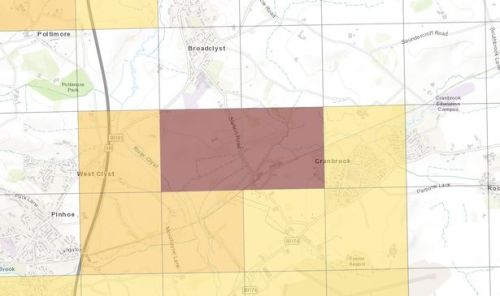
“Radiation: You would imagine it’s more of a concern for those living near the Chernobyl and Fukushima nuclear disaster exclusion zones.
But in truth Devon is notably radioactive and one of the worst affected parts of the UK as our soil and rock constantly seeps decaying uranium gas: Radon.
Above average levels of radon in Devon and Cornwall remains a silent killer in the rural parts of the county – and some residents are sat in homes that pose a greater risk of radiation absorption than working in a nuclear plant.
A map by Public Health England shows starkly how bad it is in comparison to other places. Even in the same county. For example, Exmouth shows little sign of radiation whereas Cranbrook has high than average levels.
Sobering facts also reveal thousands of deaths in the UK are linked to radon induced lung cancer, as the government works to help those impacted by it by ‘making safe’ their homes and workplaces. …”
https://www.devonlive.com/news/devon-news/devon-surprisingly-radioactive-parts-worst-3111033
Swire says new council must curtail Cranbrook development
But since he refused to say this to the previous Tory-led council, Owl will NOT be quoting him and will NOT provide a link to this hypocritical nonsense.
Cranbrook: “Banned from switching energy firm for 71 years”
“New-build homeowners across the country are being denied the chance to save hundreds on their energy bills because they are trapped in long-lasting contracts with a single supplier.
In the new town of Cranbrook near Exeter in Devon, residents pay nearly twice as much as the cheapest available tariff, yet they will not be able to switch for 71 years.
This is because the housing development gets its heat and hot water from an unregulated ‘district heating scheme’ run by Big Six provider, E.on.
The energy centre, half a mile from the small town, allows households to heat their homes without the need of a boiler — potentially saving homeowners £300 a year on maintenance costs.
But the heating scheme can only be run by one supplier, meaning all 2,000 homes are signed up to E.on for their heating, under an agreement which is currently in place until 2090. And a further 1,500 homes are set to be built in the growing East Devon town.
Suppliers of the environmentally friendly schemes also do not have to be regulated — so their tariffs do not have to stick to watchdog Ofgem’s price caps.
John Clements moved into his £300,000 property in Cranbrook with wife Katie, 39, a police officer, in March 2015. The couple, who have a six-year-old daughter, now pay E.on around £70 a month for their heating.
John, 56, a semi-retired child safeguarding professional, says: ‘Once you realise there isn’t any other option of switching supplier you do become concerned about the fact someone has a monopoly. You’re at the mercy of rising prices.’
Their bills are made up of a service or ‘standing’ charge — which covers the fixed costs of supplying your home including maintenance to the network — and the household’s energy usage.
Ofgem’s energy cap currently stands at 4p per kilowatt hour (kWh) for gas and £96.80 for an annual standing charge.
Yet the Clements are paying 8.7p per kWh, up from 8.19p per kWh in April 2018. And last year the couple’s standing charge went up from £196 to £205.
E.on was instructed to provide the heating in an agreement with East Devon District Council and developers, which include Taylor Wimpey and Persimmon Homes.
District heating systems distribute heat through insulated pipes, in the form of hot water and steam, after producing it off-site in an energy centre.
As the homes are all supplied by the centre, they are currently tied to the energy provider that runs it — unlike those who have a boiler of their own.
Single mother Boh Magassouba, 29, pays around £42 a month to heat the Cranbrook property she shares with her three children — the youngest of whom is four months old.
The former Exeter College cleaner, who will be 100 by the time she can switch supplier, says: ‘When I moved here five years ago, I didn’t realise I wouldn’t be able to switch provider.
‘It’s so unfair that I’m stuck with them. Sometimes when I see how much I am spending on my bills I feel like crying.’
E.on says it surveys local gas prices, standing charges and boiler maintenance packages, and prices its heat and service bills in line with them.
As these providers have to stay under the price cap, it claims its own charges are directly affected as a result.
But data from comparison site uSwitch shows the average household in the area could pay as little as £493 for a 12-month gas-only tariff with SSE.
The households are able to switch their electricity suppliers, as this utility is not supplied by the district heating system.
E.on, which operates around 60 district heating systems across the country, says Cranbrook will one day save 13,000 tonnes of CO2 a year.
The Competition and Markets Authority (CMA) says there were 14,000 heat networks across the country last year, supplying 450,000 customers.
Around 2,000 of these heat networks were district heating systems. The rest were smaller communal networks, which supply individual buildings, such as a block of flats.
But the CMA report also cited concerns that ‘some networks may be offering poor value for money’ and concluded that district heating networks should be regulated.
David Goatman, head of energy at estate agency Knight Frank, says: ‘District heating systems have only become more prevalent in the past ten years.
‘In the next five or ten years I suspect that most new developments, especially larger ones, will probably be supplied by a district heating system.’
The Committee on Climate Change estimates that around 18 per cent of UK heat will need to come from heat networks by 2050 if the UK is to meet its carbon targets cost effectively.
Richard Neudegg, head of regulation at comparison site uSwitch, says: ‘The concept of district heating networks is sensible if we are ever going to reduce emissions from heating our homes.
‘But if households are locked in to just one provider they’ll have no escape route if they find they face higher prices.’
Mark Todd, co-founder of energyhelpline, says an advantage of the scheme is households avoid paying for and maintaining a boiler, which could be around £300 a year.
But he says: ‘Being a captive customer must be worrying to some residents.’
An E.on spokesman says details of the scheme were clearly set out to residents, adding: ‘We hope customers feel reassured by having a secure, more sustainable and cost-effective heating supply.’
E.on is a member of the Heat Trust, a voluntary self-regulating scheme which provides district heating scheme households with access to the Energy Ombudsman.
It said its usage charges were not directly comparable to Ofcom’s cap partly because district heating is more energy efficient.
Cranbrook customers pay on a tiered system for usage whereby charges drop from 8.29p per kWh after the first 3250 kWh to 5.02p per kWh before VAT is added.
But while it is supported by the Government, as the Heat Trust is not a regulator with statutory powers, it cannot set price caps.
In April, Energy Minister Claire Perry wrote to heat network owners and operators advising that a policy consultation later in the year would set out plans for future regulation of the sector.
A Taylor Wimpey spokesman says the provision of a district heating system was a requirement for the planning permission issued by East Devon District Council.
He adds: ‘We are continually working to ensure that our customers benefit from both improved choice and flexibility.’
A spokesman from East Devon District Council says research commissioned in 2007 demonstrated it would be more cost effective to meet ‘increasingly stringent carbon performance targets at Cranbrook’ through a district heating system.”
Why is Exmouth Regeneration Board chaired by a Cranbrook councillor?
Exmouth Regeneration Board
Membership
Councillor Megan Armstrong (Vice-Chairman [Exmouth Halsdon]
Councillor Kevin Blakey (Chairman, Cranbrook)
Councillor Susie Bond [Feniton]
Councillor Nick Hookway [Exmouth Littleham]
Councillor Chris Wright [Exmouth Littleham]
https://democracy.eastdevon.gov.uk//mgCommitteeDetails.aspx?
Government to allow Community Infrastructure Levy to fund big projects
Oooh … just in time for Cranbrook’s latest expansion plans! AND when councils all over the country are declaring a climate emergency and trying to avoid unsustainable projects. Catch 22 there for TiggerTories!
Or perhaps it will go to a new National Park – lol.
“Councils will be required to report on the agreements reached with housing developers to pay for infrastructure, under new rules laid in Parliament this week.
Housing Minister Kit Malthouse claimed that “confusing and unnecessarily over-complicated” rules were being simplified, so that communities would know exactly how much developers were paying for infrastructure in their area.
Councils will have to set out how the money will be spent “enabling residents to see every step taken to secure their area is ready for new housing”.
The Government also claimed that the changes would make it faster for councils to introduce the Community Infrastructure Levy in the first place.
Restrictions are to be eased to allow councils to fund single, larger infrastructure projects from the cash received from multiple developments, “giving greater freedom to deliver complex projects at pace”, it added.
The Minister of State said: “Communities deserve to know whether their council is fighting their corner with developers – getting more cash to local services so they can cope with the new homes built.
“The reforms not only ensure developers and councils don’t shirk their responsibilities, allowing residents to hold them to account – but also free up councillors to fund bigger and more complicated projects over the line.
“The certainty and less needless complexity will lead to quicker decisions.”
The regulations will be debated once parliamentary time allows.
The Government has also published its response to the views received in its technical consultation on developer contributions reform.”
Cities (with highest wages) too expensive for young people to buy homes in
So, what happens when the towns and villages you do come from are just as expensive as Bristol (with wages in Exeter lower than those in Exeter)?
Well, in East Devon, you are mostly funnelled into Cranbrook – as that is where most so-called “Help to Buy” new homes are being built.
The national article uses an example of someone moving from East Devon to Bristol.
“More young people are getting stuck where they grew up or went to university because they cannot afford rents in places where they can earn more money, according to the Resolution Foundation thinktank. It found the number of people aged 25 to 34 starting a new job and moving home in the last year had fallen 40% over the last two decades. …
In 1997, moving from east Devon to Bristol increased median incomes by 19%, but rising rents cut that increase to 1% in 2018. …
Landlords blamed the government for failing to sufficiently increase the supply of new homes. The Residential Landlords Association (RLA) also criticised measures which appear to be encouraging landlords to sell up, including reduction in mortgage interest relief for landlords and an increase in stamp duty.
“The biggest threat to rent levels are the policies being pursued by the government which are choking off the supply of homes for private rent as demand is increasing,” said the RLA policy director, David Smith.
The findings came as the affordable housing commission released research found 43% of all renters were now facing affordability problems and that 5.5 million renters were unable to buy a home of their own.
The commission, which was established by the Smith Institute thinktank and chaired by the crossbench peer Richard Best, said that when rents or purchase costs exceeded a third of household income for those in work, it could lead to financial difficulties and these problems became critical where housing costs were 40% or more of household income.”
Now Tories are not in control Swire decides Cranbrook is a development problem!
Today’s Midweek Herald. SO odd that Hugo has JUST discovered that Cranbrook development is a problem … still TiggerTories involved in planning will be glad to know he is NOW onside! Such a pity he wasn’t so vocal when Tories alone were in charge!


Cranbrook to get massively BIGGER – first planning test for no-overall-control council
The first test of The Independent Group on large-scale development. It got to make up the EDDC Cabinet and its Leader, Ben Ingham, has appointed several current and former Tories to positions of influence.
What will each group’s stand be on large-scale development? And what happens if the smaller parties have different views to that of the Independent Group and Tories if they agree? Interesting.
There are a few worrying words in this press release – potential, proposed, outlines, capable of, vision, could, opportunities. Lots of leeway for developet mund-changing at a later date.
And missing words: affordable and social housing.
Plus our local NHS Trust wants more than £1.3 million before it considers the proposal sustainable for health needs.
“Plans for 930 new homes as part of the western expansion of Cranbrook have been revealed.
The proposals for the Bluehayes site would also see a primary school, sport and recreational facilities, community uses, green infrastructure, as well as a mixed use area of shops, food and drink and professional services built.
The Bluehayes site, which lies between the existing Cranbrook development and Broadclyst Station, is one of four proposed expansion areas of Cranbrook.
A new link road that would run from the Cranbrook railway station to London Road and to Broadclyst Station, through the middle of the Bluehayes site, is also proposed in the scheme handed in recently to East Devon District Council planners.
And the plans also reveal that a footbridge over the London Road that would connect the Bluehayes site with the proposed Treasbeare site, south of the road, could be built.
The Cranbrook Plan was backed by East Devon District Council’s Strategic Planning Committee in February which outlines the land where a further 4,170 new homes will be built.
It allocates 40 hectares of land at the Bluehayes Expansion Area for around 960 new dwellings, land capable of accommodating a community building, formal open space recreational land, a 420 pupil place primary school, formal play space with facilities for children and youth and allotments totalling an area of 0.55 hectare of land
Details with a planning statement submitted with the planning application says: “The submission of the new outline application for the Western Expansion of Cranbrook and the change of use of agricultural land to the north of Cranny Brook to SANG land, is consistent with the planning policy and the longstanding policy to deliver new homes to meet the needs of the area.
“The submission of the application for the Western Expansion area and their progression delivers certainty required in the long term delivery of growth and of the delivery of the vision for Cranbrook.
“The proposals have been designed to be residential led with the potential for the delivery of a new primary school and formal outdoor sports pitches to provide complementary community and social infrastructure to meet the needs of new residents.
“The application demonstrates provision of the necessary infrastructure to include internal roads, public transport provision, formal and informal open space uses to support itself and to mitigate any impacts of development on existing communities and wider infrastructure.
“Cranbrook and its Western Expansion have been fully justified in the context of local planning policy and in the context of the growth agenda and the national and local need for housing.
“The proposals will result in substantial and demonstrable benefits in terms of meeting the need for new homes in a sustainable manner, fostering economic development and further underpinning the sustainability of Cranbrook.
“The proposals will also help deliver the vision for Cranbrook and underpin the planning and delivery of infrastructure and the town centre.”
A 1.14 hectare site for a one-form entry primary school could come forward as part of the plans. The primary school will be built in either the Bluehayes or the Treasbeare allocation, depending on which is constructed first.
Details with the scheme also outline that a new link road from the Cranbrook station to London Road and to Broadclyst Station will be built.
There will be a new frontage to London Road which will comprise a mixed use area, providing opportunities for a range of residential, retail and small scale employment uses, and in future, a crossing over London Road to the southern expansion area may be accommodated.
But the Royal and Devon Exeter NHS Foundation Trust have requested a contribution of £1,332,313 from the developers, cash which will be used directly to provide additional health care services to meet patient demand.
Commenting on the application, they say: “Without the contribution being paid, the development would not be acceptable in planning terms as the consequence would be inadequate health services available to support it.”
Having considered the cost projections, the Trust say that they will require the full figure to ensure the required level of service provision is delivered in a timely manner.
They add: “Failure to access this additional funding will put significant additional pressure on the current service capacity, leading to increase delays for patients and dissatisfaction with NHS services.
“The contribution will ensure that Health services are maintained for current and future generations and that way make the development sustainable.”
The Bluehayes expansion is one of four proposed expansion areas for Cranbrook, which development also proposed for Treasbeare and Grange, south of the existing town, and Cobdens, to the east of the town.
A reserved matters application has also been submitted for 80 homes, for which outline planning permission has already been granted, for land north-east of the Cranbrook Education Campus.
East Devon District Council planners will determine the fate of the applications at a later date.”
https://www.devonlive.com/news/devon-news/cranbrook-getting-bigger-930-new-2923726
The new “sustainable” villages – beware estate rentcharges
Cranbrook has not recovered from the arrangenent where developers imposed charges on residents of their estates for such things as gardening and maintenance. In the end, the town council took over these charges and spread them over ALL residents, many of whom were naturally upset at extra charges they had never signed up for.
“Estate rent charges” – another warning on new-builds such as those in Cranbrook
Now, the new (brutalist architecture) estate developer in Exeter says it will severely restrict parking by having only 185 car parking spaces for 400 homes and residents will need permits to use the spaces.
BUT enforcement of these parking restrictions will be done by “a specialist management company which will patrol the site to ensure vehicles are parked within dedicated spaces and to ensure that non-residents aren’t using the site”.
And who will pay these charges? Just those who have parking spaces or ALL residents? And who will control escalation of the charges?
“Housing market ‘to be dealt a serious blow’ as most new home sales use Help to Buy scheme”
Many of the new homes in Cranbrook are bought using this scheme.
“Almost all new homes in some parts of the country are funded by the Help to Buy equity loan scheme, raising fears about a house price slump when the programme ends.
The Government lends buyers up to 20pc of the cost of a new-build house, meaning the would-be homeowner only needs a 5pc deposit and a 75pc mortgage. In London users of the scheme can borrow up to 40pc of a home’s value.
More than 97pc of new homes in Northampton were funded by Help to Buy last year, according to modular housebuilder Project Etopia. In Burnley the figure was 93.1pc, in Derby 92.4pc and in Warrington 91.4pc. …”
Research has shown it adds on average £33,000 to the cost of a new home:
https://eastdevonwatch.org/2019/04/14/help-to-buy-costs-first-time-buyers-an-average-33000-extra/
Leasehold houses: promise of fix … one day, maybe
“Housebuilders are to be investigated over the mis-selling of thousands of leasehold properties after a U-turn by the competition watchdog amid pressure from ministers.
The Competition and Markets Authority (CMA) said it would examine the scandal surrounding new-build homes sold on leases that were subject to substantial increases in ground rents and the charging of “permission fees” for home improvements. Developers and freeholders could face legal action if the watchdog finds evidence of leasehold mis-selling. The watchdog said it would decide whether the practices constituted “unfair terms”, a breach of consumer contract law.
James Brokenshire, the housing minister, has previously called on the CMA to use its influence to tackle the “culture of consumer exploitation rife in the housing industry” with an inquiry into the estimated 100,000 homes sold with “extortionate” leases.
However, in November, the CMA told the minister it would not investigate the issue, citing the legal complexities surrounding historic cases of mis-selling. In a letter seen by The Times, the watchdog also noted it does not have the power to fine companies using its consumer powers and blamed Brexit preparations for it not being able to prioritise problems in the housing industry.
The U-turn comes after the Commons housing committee published a damning report on the scandal in March, calling for the law to be changed to help people stuck in leasehold properties with crippling fees that they are unable to sell on. It also criticised solicitors for failing to warn clients about the unfair deals, accusing some of being too close to developers.
The leasehold scandal emerged as developers began to sell houses on leasehold rather than freehold, often without the buyer fully understanding the contracts. In many cases the freeholds were bought by offshore investors who demand large sums from homeowners to buy out the contracts.
Taylor Wimpey, one of Britain’s biggest housebuilders, has set aside £130 million to help its customers escape unfair leases it sold. More than 40 property developers and freeholders this year signed a government-backed pledge to help homeowners affected by the scandal by changing the terms of leases for those with onerous clauses.
Sebastian O’Kelly, of the Leasehold Knowledge Partnership, said: “We welcome the CMA looking into this. It’s long overdue and will be welcomed by the 12,000 owners of new leases with doubling ground rents, and 88,000 where the ground rent is above 0.1 per cent of the sale price and whose properties are unsellable.”
The investigation comes as the industry attempts to improve its public image after criticisms of build quality as well as punitive hidden charges.
Countryside Properties this week became embroiled in a row with Joe Anderson, the mayor of Liverpool, who reportedly told residents he would ban the housebuilder from building in the city due to historic cases of selling leasehold homes with “doubling clauses” for ground rents.
Countryside said it no longer sold leasehold homes, had signed up to the leasehold pledge and took action to fix the doubling of ground rent leases that were in place two years ago. A spokesman for the Home Builders Federation said: “The industry has made huge progress to identify and address the issues raised on particular aspects of leasehold sales.”
Source: Times (pay wall)
Cranbrook – Town Council tries to explain why it has no town centre
Cranbrook Town Council Facebook page – the first major headache for the 3 new district councillors:
“CRANBROOK TOWN CENTRE DEVELOPMENTS
The Town Council is very aware that there is considerable interest in the town centre and many demands to deliver it. There is an assumption that the Town Council, East Devon District Council and the Developer Consortium should be delivering shops and cafes.
But this is not how a town centre is delivered. The Developer Consortium owns the land but beyond that delivery of commercial activity and some buildings depends on commercial interest. With around 1,900 occupied dwellings in the town we understand there is not yet the level of footfall to attract a great deal of commercial interest from large stores, supermarkets and others with the ability to build commercial properties.
In addition the Consortium are not currently required to have provided such development as the triggers have not yet been reached which are set out in the legal agreements which were signed when Cranbrook first received planning permission.
So the question is what is being done?
Members of the Town Council are meeting weekly with East Devon District Council’s planning team, the Exeter and East Devon Growth Point, the Developer Consortium and their architect.
The aim is to identify particular uses which can be delivered and strategies for their delivery. Importantly uses which are being discussed are the town hall, health and wellbeing hub, children’s centre, youth centre, town square and a market hall.
The work will lead on to ways of unlocking funding for this infrastructure and that is very much linked to the development of the expansion areas. Without that investment there would not be sufficient funding within the current legal agreement (“Section 106”) terms to deliver what the town requires in key buildings.
The challenge is to design and create a town for the 21st century. We are all aware of the pressures on high streets, especially from competition by on-line retailers. What we do not want is a town centre which is designed on traditional grounds which could result in empty premises.
Cranbrook is a 21st century town and we need a town centre which delivers what we cannot do online and a town centre which complements and enhances online business rather than competes with it. The town centre should incorporate social and green space as well. This is a massive challenge but one which we are meeting.
We will communicate updates when progress has been made.”
3 out of 3 Cranbrook succesful candidates – Independent
Very low turnout compared to other areas. Yet to find out if Independent or “Independent” …

Cranbrook urgently needs temporary GP practice
Owl is amused at the idea that an extra GP practice would increase footfall in the “town”. But you just cannot call a settlement of 2,000 houses with 5 shops a town – maybe “suburb of Exeter” is now more appropriate!
“… Cranbrook temporary GP Practise
The Projects Director presented the report which sought approval for up to £150k of funding from the Enterprise Programme to enable the delivery of a temporary GP practice in Cranbrook town centre. This was an urgent requirement because of the lack of capacity at the current practice. Whilst Access Healthcare had had their contract extended there were significant concerns over the ability to deliver increasing patient numbers. Expanded facilities were therefore urgently required.
Discussions included the following:
if not supported this would create a massive health inequality
this was a loan therefore the borrowing would be repaid
as well as helping the health service, this was a benefit to the residents of Cranbrook as the existing provision was under pressure. …
The current GP practice in the Younghayes Centre was at capacity. The temporary GP practice would enable the continued delivery of primary care services in Cranbrook for a period of 5 years. It would also bring increased footfall to the town centre and act as a catalyst for attracting wider investment.”
Cranbrook featured (negatively) on Radio 4 today
EDDC made it onto Radio 4’s ‘You and Yours’ this morning – complaints about price hikes for green spaces maintenance in Cranbrook…
EDDC now wants Government to pay for a town centre at Cranbrook
Owl is confused. Don’t you include a town centre in initial “new town” plans – and pay for it with developer contributions? Otherwise, it isn’t a “new town”!
“The government is being urged to extend its £675m Future High Streets Fund to also help create and improve town centres in new towns.
East Devon District Council and Cranbrook Town Council have written to the Parliamentary Under Secretary of State at the Ministry of Housing, Communities and Local Government, Jake Berry MP, to request eligibility criteria for the Fund be changed to include new towns.
At a meeting of East Devon District Council’s cabinet earlier this month, they selected Axminster as the town to put forward to try and grab a share of a £675m fund. ..,”
https://www.devonlive.com/news/devon-news/allow-new-towns-like-cranbrook-2672297
Spare a thought for Cranbrook residents – tied to E.on for EIGHTY years
Cranbrook has a “district heating” system whereby residents are supplied from only one source owned by E.on and everyone in that system is licked in to E.in as their supplier”
“… E.on has an 80-year contract to supply Cranbrook, a new town in East Devon.
Once they’ve bought into a development, residents are locked into a monopoly. They are not allowed to fit solar panels or heat source pumps and, whether or not they use their heating, remain liable for often large standing charges which include maintenance and repair of the infrastructure. …”
https://www.theguardian.com/money/2017/feb/05/district-heating-fuel-bill-regulation
Now Cranbrook residents are forced to take their energy from one of the least popular suppliers:
“Eon, one of the Big Six energy suppliers, is losing customers at an ‘alarming rate’, a new report claims.
Of customers that switched provider last month, 21.65 per cent did so from Eon. On the flipside, just 7.07 per cent switched to it.
This is a net swing of 14.58 per cent, a snapshot of customer switching habits from Compare the Market shows. ..
Cranbrook suffering from Exeter traffic congestion
“… Exeter has been named as the slowest city in the country in a report published by Sport England in January. In its active lifestyle pilot for Exeter and Cranbrook it states:
“Exeter and Cranbrook is an area of rapid population growth with 22,000 new homes and 12,000 new jobs forecast by 2026. Despite this growth there are some big strategic challenges, namely traffic congestion, with Exeter being the slowest moving city in the country averaging just 4.6mph during rush hour.”
https://www.devonlive.com/news/devon-news/exeter-roadworks-helps-countrys-slowest-2635854
 East Devon Watch