It’s a mystery

So, the Conservatives get in because, although not enough people voted for them, they could bribe the DUP with £1 billion to prop them up.

They leave it to developers to decide housing policy and the developers get mega-rich while saying they are too poor to build affordable homes and even renting a home is now beyond many (working) people.

They cut public services such as the NHS, education – to the bone.

They privatise anything that can be privatised – including the NHS and education.

What they can’t privatise, they put under the control of unaccountable quangos such as “business led” Local Enterprise Partnerships, which make Walter Mitty claims that they will get “productivity” soaring (by making sure that government money gets funnelled into THEIR companies) and councils roll over for them (they are given no choice).

Public utilities – water, gas, electricity, railways – are now all mostly owned by foreign companies which repatriate profits to their own countries.

They cut benefits whilst allowing tax dodging by rich individuals and powerful companies on a truly breathtaking scale.

They get most of their funds from donors who benefit from privatisation and austerity and tax dodging.

They say they are returning “sovereignty” to the UK but strip MPs of their voting powers.

They refuse to accept that “green energy” is now cheaper than nuclear power and fossil fuels and instead commit to a nuclear white elephant that belongs to the French and Chinese (who are ceasing building massive nuclear power stations at home and investing instead in renewables)

We won’t mention the Brexit omni-omni-mega-no-words-good-enough-for-it shambles. Except that we can, they say, rely on the United States to see us right.

Yet, come the time when it looks like their “leader” is on her last legs and a snap election may be on the horizon they tell people they are going to do “something” about housing and the NHS – as if the mess they are in is not their fault. Perhaps a commission, perhaps a policy paper, perhaps a “consultation” … perhaps.

A little money will be shaken from the magic money tree (soon to be swallowed up by not-so-magic higher prices).

And thousands of people will say “Good enough for me – I’ll vote for them again”.

Truly we live in strange and frightening times.

“ Abolish Devon district and borough councils to create super authority’ “

BUT, BUT, BUT – it’s already happening – EXCEPT we are keeping district councillors on the payroll!

Why does Owl say this?

Currently we have (at least) these new bureaucratic (and non-accountable) quangos in our area:

The Heart of the South West Local Enterprise Council
The “Greater Sourh West” group of LEPs
The “Joint Committee” of councils, NHS quangos and others in Devon and Somerset
“Greater Exeter”

and others working in the shadows.

In the middle of all this East Devon District Council is paying millions to build a new HQ and has not reduced its staff numbers throughout the period of austerity.

Questions … questions … but none of these groups are answerable to us and all choose how much (or more likely, how little) scrutiny they wish to have.

“The Government could deliver a £31 billion boost to the economy over five years by abolishing 201 district and borough councils in England and handing over their powers to county halls, a new report has said.

The report from think tank ResPublica calls for the abolition of the historic two-tier system of local government, which sees most rural areas of England covered by both a county council and a smaller district or borough authority with sometimes overlapping responsibilities.

ResPublica director Phillip Blond said the system is causing “needless confusion”, as businesses and developers find their plans frustrated by “parochial” decision-making on strategic issues.

Ditching the two-tier system and following the example of unitary councils adopted by most cities would help iron out wide variations in productivity which see workers in Cornwall take five days to produce the same value that can be delivered in three days in Surrey, he said.

With uncertain economic conditions after Brexit, the report said it was “vital” for counties to be prepared to weather the possible storm, particularly as those which voted most strongly to leave the EU are thought to be most vulnerable to any decline in trade resulting from it.

“The needless confusion that frustrates the ambitions of business and government alike in our county areas must end now,” Mr Blond said.

“With Brexit on the horizon and our city-regions already benefiting from devolution, we can’t afford the waste and complication that the current system creates.

“Single councils at the county scale are the future and we call on the Government to move rapidly to encourage them.”

Baroness Jane Scott, the leader of Wiltshire Council, said the move to a unitary authority in the county in 2009 had been a “great success” and warned that counties which fail to follow its lead face “the real risk of … being left behind”.

“Streamlining counties will contribute billions to the national economy and will be good for business,” said Lady Scott, the County Councils Network’s spokeswoman on reform.

“But the real winners are local residents who will benefit from improved public services, less bureaucracy, and access to more housing and facilities that meet local need and demand.”

The report will be launched at the County Council Network’s annual conference on November 20.

A spokesman for the Department for Communities and Local Government said: “Moving to a single tier large unitary authority can often give residents a better deal for their local taxes, improved local services, less bureaucracy and stronger and more accountable local leadership.

“However, we are clear that any such move must be both locally led and have support from the community.”

http://www.devonlive.com/news/devon-news/abolish-devon-district-borough-councils-790015

EDA Councillor Shaw: “Pursuit of elusive ‘devolution’ deal is leading to a new layer of bureaucracy: an unelected, one-party ‘Heart of the South West’ combined authority”

This week’s DCC Cabinet meeting approved a Conservative proposal to set up a formal Joint Committee with Somerset (report at item 7 of the agenda). Objections were raised to aspects of the proposal by the leaders of the Liberal Democrat and Labour groups, and I spoke on behalf of the Non-Aligned Group (which comprises the three Independents and one Green councillor). You can watch the debate, and read my speech below:

“I think we know what is going with devolution. We have a government which is ripping the heart out of local government spending, pushing services to the border of viability; this is causing enormous difficulties for this council but also driving down local incomes and so weakening our regional economy. But at the same time it is holding out the carrot of giving us limited extra powers and returning a modest bit of the lost funding, if we jump through its ‘devolution’ hoops. The government barely seems to know what it’s doing over ‘devolution’ and the hoops keep changing, but we still have to guess what they are and do our best to jump.

And so we end up with the papers in front of us today. We are asked to endorse a ‘vision’ of higher productivity and economic growth and create an extra layer of bureaucracy to support it. The problem is that the vision bears little relation to reality. The ambition is to double the regional economy in 18 years, i.e. to increase its size by 100% – this requires a compound growth rate of 3.94%. In the real world, the actual growth rate in the SW over the last 18 years has been 30% and the annual rate 1.47%. Nationally, the UK economy has never grown by more than 3% p.a. in any of the last 18 years, and is currently veering downwards below 1.5%.

So we are asked to believe that we can increase local productivity growth from below the national average to well above it, and thereby buck not only regional but also national growth trends. How are we going to that? By waving the wand of the Hinkley nuclear white elephant and hoping that it somehow spreads some stardust over Devon? I can tell you that so far the LEP has produced almost nothing which offers help to the economy in the rural, small-town, coastal Devon which most of us represent.

Let’s take a reality check – if I come to the budget meeting and tell you, ‘the economy will grow by 4%, business rate receipts will shoot up, so spend, spend, spend’, you are going to look on me as a madman, and rightly so. So why should Devon County Council buy this phoney prospectus? And why should we embark on radical constitutional change to support it?

I know this is only a proposal for a Joint Committee, with limited financial implications. But it is clearly presented as enabling us to ‘move relatively quickly to establish a Combined Authority’ if that is deemed necessary. We already have 3 tiers of local government. This is the beginning of creating a fourth tier, without a mandate, without elections, and without balanced political representation.

95% of the people of Devon don’t even know they’re living in something called the ‘Heart of the South West’. It says everything about the lack of democracy in this so-called devolution that we are using this PR-speak rather than the county names which people understand. I know the Government prefers cross-boundary devolution projects, but Cornwall got a stand-alone deal, and we are much bigger in both population and area.

Apart from Hinkley there is no strong reason for us to tie ourselves to Somerset rather than Cornwall or Dorset. Our local government is being distorted to support an anachronistic nuclear project – for the benefit of companies owned by the French and Chinese states – instead of developing renewable energy for which we have a good basis in the SW.

I have this Cabinet down as a group of a level-headed people. But here we have fantasy economics, making claims which are about as credible as the figures on Boris’s battlebus, and constitutional change which means that Devon people and their councillors are asked to start handing over democratic control to a one-party quango in conjunction with unelected business people.

Since the Government is always changing its mind about devolution, there is no reason why we shouldn’t change our minds too. I ask you to

go back to the Government with a realistic agenda for Devon, that addresses the needs of all areas of the county and all sectors of our economy and society
back off from this unnecessary proposal for a joint committee.

Pursuit of elusive ‘devolution’ deal is leading to a new layer of bureaucracy: an unelected, one-party ‘Heart of the South West’ combined authority

UK politics and corruption – it’s not (only) “Johnny Foreigner” to blame

This article, written in December 2016, foresaw developments this week. We have had the warnings, but where is the path to change when all the paths are obstructec by the corrupt?

“… Our media likes to write about crime and corruption as though they are the funny fetishes of Johnny Foreigner: Italian mafia, Russian oligarchs or Mexican drug lords. But this year alone, the former banker and anti-corruption campaigner Roman Borisovich made the claim that three-quarters of the money looted in Russia comes to Britain, the Italian mafia expert Roberto Saviano described the UK as “the most corrupt place on earth”, and our biggest bank was sued for its involvement in laundering Mexican drug money: appropriate, given than HSBC was founded by criminal drug dealers on the back of the Opium Wars.

This racket is big enough to have vast control over our politics. An enterprise dogged by criminal charges can pay to hush up the nation’s biggest broadsheet. It’s hard to look at party funding in the last two UK general elections without concluding that it was the donations of the financial sector and prominent tax dodgers which put David Cameron into Downing Street twice to ensure that they weren’t regulated after the 2008 crash.

And it’s not just the Tories. After trade unions, the biggest ‘donors’ to the Labour party before the 2015 elections were the accountancy firm PricewaterhoueCooper, who ‘gave’ in the form of £600,000 of research ‘help’. Then shadow-chancellor-now-TV-dancing-supermo Ed Balls effectively outsourced £200,000 worth of policy work to these much criticized wizards of tax accountancy for the mega-rich, while shadow business secretary Chukka Ummuna got £60,000 worth of ‘support’.

Not wanting to miss out on the action, the Liberal Democrats accepted 1371 hours of policy ‘technical support’ from PwC in 2015 alone, the year after the Luxemburg Leaks revealed the firm’s significant involvement in helping the hyper-rich slash their tax bills through complex accounting arrangements. It’s worth pondering on who wrote the maze of loopholes into the laws in the first place…

Once they leave office, the deal only gets better for our prominent politicians. Former British foreign secretaries like Malcolm Rifkind, Jack Straw and David Miliband have auctioned access to themselves for huge sums of money. Former British health secretaries like Alan Milburn, Virginia Bottomley and John Hutton have all quietly slipped from government into the private healthcare sector, and now make millions of pounds between them cashing in on NHS privatisations they (and their cousins) pushed through. Former British Chancellor George Osborne has seen his best man’s firm rake in £36 million from his bargain-basement privatisation of the Royal Mail. Former British prime minister Tony Blair used the links made in office to secure vast sums of money running round the globe as a lackey for the violent royal dictators of the United Arab Emirates, and working as an advisor, lobbyist and spin doctor to a cast of characters including Nursultan Äbishuly Nazarbayev, the dictator of Kazakhstan and Aleksandar Vučić: once Slobodan Milošević’s Information Minister, now Serbia’s prime minister.

Our country is represented in the world by a trade minister who was previously sacked as defence secretary for allowing a businessman funded by companies which “potentially stood to benefit from government decisions” to sit in on at least 40 meetings and a foreign secretary whose time as London Mayor included overseeing property deals described by the former chairman of the government’s Committee on Standards in Public Life as “having the smell of semi-corruption” involving large donations to the Conservative party. Do either of them have an eye to the second career profits of their predecessors? We’ll have to see.

And those who wish to buy influence get their way. David Cameron promised “no ifs, not buts, no new runways” at Heathrow. Theresa May came out publicly against the scheme. Boris Johnson and Zac Goldsmith both tied their reputations to their opposition to it. But it is going ahead, costing the Tories an MP and a bucket of political capital across marginal seats in West London.

It seems to me that there is a simple explanation for what would normally be seen as an astonishing act of political self-harm: as the organisation 10:10 puts it: “15% of the population took 70% of all flights in 2014. People in that 15% group earn more than £115,000 a year. They tend to have a second home abroad. And their most popular destinations? Tax havens.[1]” The third runway only makes sense if seen from the top of the towers of Canary Wharf. But in Britain, that’s the view that matters.

The scar of living in a country run by and for the rich is marked by more than a runway, though. Even if you ignore the vast quantity of wealth hidden in tax havens, Britain is the sixth most unequal country in the OECD, after Chile, Mexico, Turkey, the USA and Israel. This is a level of inequality of the scale that tears whole societies apart; or is only possible in places that have already been rent asunder: three of those countries have governments at war with their own citizens; and the USA just elected Donald Trump.

By some measures, the UK has nine of the ten poorest regions of Northern Europe, while London is the richest. We produce 18% less per hour worked than the G8 average, and real wages have fallen 10.4% since 2007: a figure only matched across the OECD by Greece. Children in England are among the least happy in the world, and in 2013, the UK was criticised by the UN for a mortality rate among under 5s that’s higher than in countries including the Czech Republic and Slovenia. Meanwhile, the bonfire of the London housing market sucks in ever more of our cash, ensuring the nation’s wealth is squandered on making homes in the most expensive city on earth ever-more expensive, rather than investing that capital in anything productive.

For those of us who seek answers to serious questions about how to build a just, sustainable economy in this archipelago, one of the first questions must surely be what vehicle we have to do this through. And whilst government is certainly necessary, the ancient British state; built to run an empire, seems utterly unfit for the purpose. Without the modifying influence of the EU, though, it’s all that England is left with.

In this context, any conversation about tax in Britain must include a thought about the constitutional position of our tax havens. Any discussion of regional inequality has to look at the vast centralisation of power in our supposedly sovereign parliament. Any talk of financial regulation has to ask why the City can have such vast influence within our politics. Any look at income inequality must also survey inequalities of political reach. Because once you accept that the state has a decisive role in our economy – and it does – you need next to ask who runs that state, in whose interests, and how that can change.

In 2016, millions of British people voted to leave the EU because they wanted to ‘take back control’. The remaining question, then, is a simple one: to whom will that control be returning? Will it be the same ruling class, using the same holes in the same wood-wormed constitution to squirrel away wealth and power and plunder the country like they plunder the planet? Or will the process force us to realise that Britain’s problem aren’t the fault of foreigners from whom we can escape; but come instead from our own failure to free ourselves from Medieval subjecthood, and fight for real democracy?

[1] This research was done by the Tyndall Centre, using the PwC list of tax havens.”

https://www.opendemocracy.net/neweconomics/britain-is-not-what-it-thinks-it-is/

What do you have to do to get sacked if you are a Tory these days?

“As a prime minister drained of authority struggles to hold her party together, ambitious ministers feel increasingly able to cock a snook with impunity.

This week’s rows over Boris Johnson’s dangerous handling of a disagreement with Iran, and Priti Patel’s freelance policymaking in the Middle East may seem a coincidence.

But the conduct of the foreign secretary is bound together with that of the international development secretary.

Both Mr Johnson and Ms Patel are able to play fast and loose because normal collective cabinet disciplines no longer apply. The prime minister is afraid to reprimand or sack. In this government it is everyone for themselves. …”

and yet there are people who will continue to vote for them.

It says as much about their voters as it does about their Ministers and MPs.

And so many of their voters in East Devon – where we had our own mini-scandal when Diviani voted against his own district councillors at county council over closure of community hospitals.

Did Tory district councillors sack him? No, they rallied round him and agreed to keep him not just as a councillor but as their Leader.

Such is political life today. Thank you Tory voters – for worse than nothing.

Dark money, dirty money, money trees …

It really doesn”t matter what he took the money FOR, what matters is who he took it FROM:

“Steve Baker, a prominent Brexiteer who was promoted to the frontbench after his work with David Davis, took £6,500 from an organisation called the Constitutional Research Council (CRC).

The same group was behind a large donation to Northern Ireland’s Democratic Unionist Party (DUP) in the run up to the vote to leave the EU.

The CRC gave £425,622 to the DUP while the referendum campaign was in full swing.

There is very little information on the elusive CRC – they do not have a website, a press team or campaigns team, no membership list and appear not to be registered as a company.

Ben Bradshaw, the former Labour culture minister, has written to Kathryn Hudson, the parliamentary commissioner for standards, asking her to investigate the donation.

In his letter, Mr Bradshaw said there was “strong evidence” the donation did not come from “a permissible donor”.

However, the Electoral Commission would have had its hands tied during the campaign as it is not allowed to publish the names of donors in Northern Ireland.

Mr Bradshaw has previously raised the issue of the DUP with Andrea Leadsom, leader of the Commons. She said: “I share his concern that we need to make sure that all donations are permissible and legal.”

Last night Mr Bradshaw said: “We know a donation from this organisation to the DUP in the EU Referendum was ruled impermissible by the Electoral Commission and the DUP were fined.

“So, it is important the parliamentary standards commissioner can satisfy herself that a similar breach has not occurred here.”

A spokesman for Mr Baker said: “All the steps have been taken to ensure donations are registered and accepted in accordance with the rules, and we are confident that they do so.”

https://www.politicshome.com/news/uk/political-parties/conservative-party/news/90363/brexit-minister-steve-baker-reported-‘taking

“Dark money” in British “democracy” – a disturbing development

“… Whatever the grim necessity of these [sexual harrassment] revelations, they contribute to a sense of decline and institutional failure, and thus to an increasingly dangerous lack of trust.

But the rot in Westminster goes beyond alleged sexual harassment, to other forms of subversion that have yet to be exposed. As May prepared to go to the House of Commons for the weekly Prime Minister’s Questions, there was a very significant development in the continuing but almost unnoticed investigations by a handful of journalists—most operating outside the mainstream media—into the financing of the Vote Leave campaign in 2016.

After inquiries led by the independent media outlet OpenDemocracy, Britain’s Electoral Commission announced an investigation to see whether an insurance entrepreneur named Arron Banks broke the law by allegedly channeling $11 million in loans and gifts to a campaign for the U.K. to leave the E.U. (Banks, in response, tweeted, “Gosh I’m terrified.”)

The source of the money is somewhat of a mystery. OpenDemocracy, led by editor Mary Fitzgerald, carried out an analysis by Iain Campbell and Alistair Sloan of Banks’s financial affairs that allegedly showed he was not nearly as rich as he claimed, and suggested the $11 million came from elsewhere.

Some suspect the source is Russia, whose dark money has allegedly been used to fund operations of destabilization across Western democracies.

While Labour MPs Chris Bryant and Ben Bradshaw have consistently promoted the need for scrutiny on this and other possible Russian influence, Banks mocked the idea. “Allegations of Brexit being funded by the Russians . . . are complete bollocks from beginning to end,” he said. Meanwhile, his representatives tried to menace OpenDemocracy. “Make sure you get it right—it’s clearly a political hatchet job and our lawyers will take action if you get one bit wrong,” read a recent e-mail to Fitzgerald.

The Russian ambassador to Britain, Alexander Yakovenko, was quoted on the Russia Today site as saying the story was “outright insulting for the British government and the British people,” which is not, if you read it carefully, a categorical denial.

There are two other big concerns about the influences on the Brexit vote, which are equally important yet still ignored by the largely Brexit-supporting press and—more shockingly—by the BBC.

In this respect, Britain differs radically from the United States, where media and institutions have taken seriously their duty to hold the Trump administration to account on possible Russian involvement in the presidential election a year ago. In the U.K., there is a kind of chill that surrounds the subject of the E.U. referendum—anyone who dares to doubt that the result was purely the “people’s will” is ignored.

The first area of doubt concerns a donation of $574,000 to the leave campaign from the right-wing Democratic Unionist Party in Northern Ireland, which now props up the May government in Parliament.

As OpenDemocracy has revealed, the money was channeled through a secretive group called the Constitutional Research Council (C.R.C.). Because Northern Ireland has special rules to allow donations to be made anonymously, it is impossible to discover whether the money comes from a legitimate source, as defined by British electoral law. But a hint of something unorthodox came when the Electoral Commission levied a fine of $8,000 in connection with C.R.C.’s activities.

The more worrying development, which Britain shares with the United States, is the use of big data and voter targeting on social media by the far right, which is now believed to have been very influential in the Brexit referendum.

Where to draw the line between the activities of the Russians and the far right is difficult because their interests and methods overlap. However, a recent academic study has shown that a network of Twitter bots comprising 13,493 accounts tweeted on the E.U. referendum, only to vanish the day after the vote.

It is hard to know whether these were controlled by Russia or the far right. “Putin’s agents tried to influence the U.S. election,” E.U. chief negotiator Guy Verhofstadt tweeted this week. “We need to know if they interfered in the #Brexit vote too.” (If you want a very full explanation of this new peril, it is worth reading the research in full.)

Research:
http://journals.sagepub.com/doi/10.1177/0894439317734157

Source:
https://www.vanityfair.com/news/2017/11/britain-sex-dossier-scandal

New defence minister “hypocrite”

Gavin Williamson has been accused of “rank hypocrisy” by the Labour Party for arguing against cuts to local services in his constituency.

Before his promotion this week, Williamson served as Theresa May’s Chief Whip and was responsible for ensuring Tory MPs voted with the government.

But in an articles on his website, Williamson said he campaigned against cuts to the police, fire services, prisons and libraries.

In one post, the South Staffordshire MP’s constituents were told he had “started a national campaign to protect the [local] police station after learning that the facility was being considered for closure”.

And in another press release, the then Chief Whip said he was “was very concerned to hear that Cheslyn Hay Library’s opening hours have been dramatically reduced”.

Jon Trickett, Labour’s shadow Cabinet Office minister, said Williamson’s “commitment to his career advancement appears to be stronger that his commitment to his constituents”.

“As Chief Whip, Gavin Williamson was guilty of rank hypocrisy, whipping Tory MPs to vote for cuts to local councils, police forces, fire services and prisons while railing against them in his local papers,” he said.

“Now that he is defence secretary and a full member of the Cabinet, we expect him to keep his word to people in his South Staffordshire constituency and speak up against these cuts that are destroying their public services.”

Williamson was May’s surprise pick to run the Ministry of Defence after Sir Michael Fallon resigned amid the ongoing Westminster sexual harassment scandal.

His appointment triggered a backlash from some Tory MPs. One minister told HuffPost UK it was an “appalling appointment” and another said Williamson was a “real slimeball”.

In further posts on his website, Williamson said he had “campaigned against proposals to close Fire Stations” in his constituency.

And he said in September that prisons needed to “have the right resources to maintain order” and “sentences should be extended considerably” following disruption at HMP Featherstone and HMP Oakwood near his constituency.”

http://www.huffingtonpost.co.uk/entry/gavin-williamson-accused-of-rank-hypocrisy-by-labour-for-arguing-against-cuts-to-local-services_uk_59fc9627e4b01b47404a2481

Poorer Devon council refuses to merge with richer council which agreed to own council tax rise to take it over!

Definitely Devon!

Poorer West Devon District Council agreed to talks with richer South Hams District Council. A consultation showed that a majority of people in both districts were against the move, which would have seen the South Ham council tax rise to match that of (more sparsely populated) West Devon. Both councils have large Conservative majorities.

South Hams District Council agreed last night to merge with its poorer neighbour. But, in a surprise move, again last night, West Devon voted not to merge!

It appears councillors in West Devon feared a loss of autonomy (and their jobs?) and felt that other avenues for making up a £1 milion plus shortfall had not been sufficiently examined.

Owl feels there is a very complex political back story here!

“Plans for two Devon district councils to merge are off.

South Hams and West Devon councils already share some services but proposed a full merger, saying it would mean £500,000 in savings annually.

Last night, members of South Hams authority voted in favour of the proposals, despite the fact it would have meant higher council tax bills for its residents – a £25 increase a year for three years.

But, in a surprising twist, West Devon councillors voted against, even though it’s the poorer authority.

It leaves it needing to find another way to plug a £1m projected black hole in its finances.”

http://www.bbc.co.uk/news/live/uk-england-devon-41748437

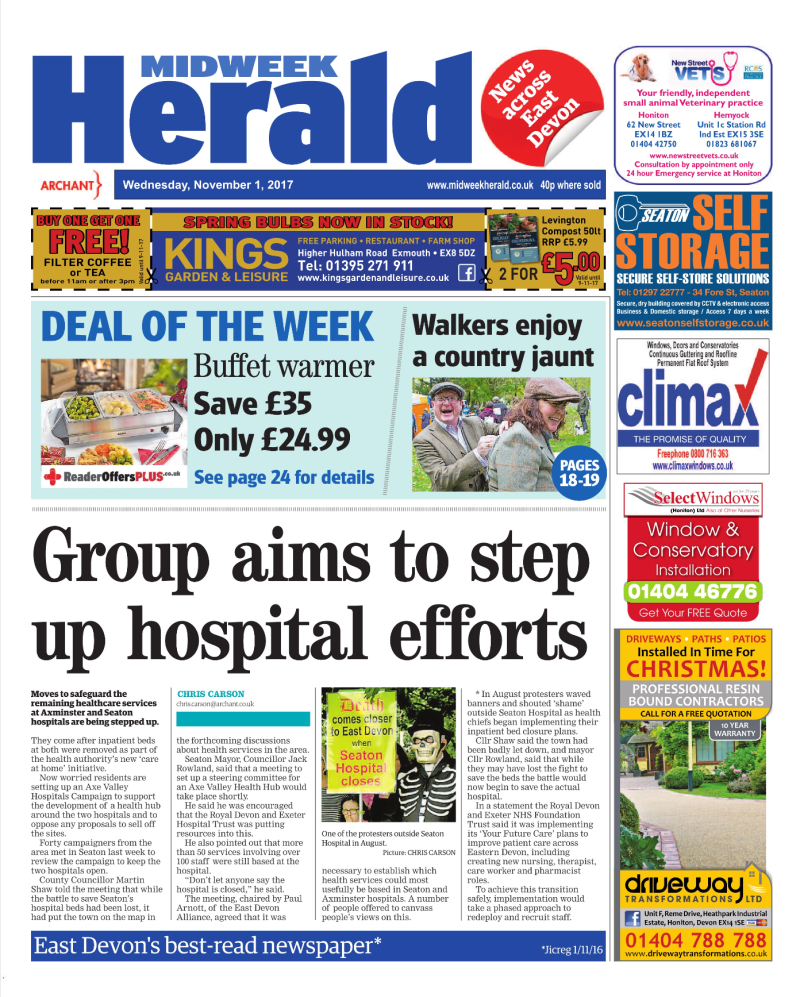
Save (what’s left of) Axe Valley hospitals hits the headlines

Things MUST be bad in the local NHS if they hit the front page of the Midweek Herald!

Powerful Tory committee blocked Cameron attempt to protect Commons staff alleges Evening Standard

“In the Evening Standard today Joe Murphy and Kate Proctor says the backbench Conservative 1922 committee opposed a bid by David Cameron to introduce a binding code of conduct for Tory MPs that would have strengthened the protections available to staff suffering harassment. Murphy and Proctor say:

The powerful 1922 committee of backbenchers mobilised against an attempt made by David Cameron to create a binding code of conduct that would have included a right for staff members to seek arbitration.

Mr Cameron attempted to persuade the speaker and other party leaders to support the measures following a sex scandal but his move met resistance from MPs, said sources.

The former prime minister then attempted to get his own MPs to sign up voluntarily.

But this was blocked by the 1922 committee, which saw the plan as a whips’ plot to impose “central control” on backbenchers.

The story is on the front of the Standard under the headline – Revealed: How backbenchers blocked bid to shield staff from sex pests.”

https://www.theguardian.com/politics/blog/live/2017/oct/30/commons-sex-abuse-claims-dossier-intensifies-demands-for-ministerial-statement-politics-live

Could harassment scandal topple Government? Robert Peston thinks it might

Robert Peston:

“The growing fear among Tory MPs is that the sexual-harassment scandal is evolving into the equivalent of the MPs’ expenses debacle – and that it could bring down the government.

It’s all the fault of that bloomin’ list of MPs and their alleged misdemeanours that was compiled by Tory aides and was published by the Guido website overnight, with names blacked at.

The blacking out is not preventing reputational damage to a pair of cabinet ministers and several other senior members of the government.

Their names are being openly touted in Westminster – and it won’t be long till they are outed on social media, and on offshore websites.”

The Nolan Principles of Public Life – a travesty

If Westminster staff need protection from MPs then we are obviously electing the wrong people. Yet, unless they resign – which they rarely do – we cannot get rid of them. In local government we can’t get rid of a councillor even if he deliberately votes against his own party’s wishes (and when members of his own party then protect him after he has done so).

It is even more unlikely that any Conservative MPs will be made to resign – even if they admit to calling an employee “sugar tits” (no asterisks for Owl on this one) and ordering her to make his sex shop purchases – both of which an MP has allegedly admitted to doing – because of their precarious grasp on power. Power which is held only because of a £1 billion bribe to a so-called Christian-values-based party the DUP – with its strong links to the fundamentalist Free Presbyterian Church of Ulster.

There must be a way of local voters being able to deselect an MP (or a councillor) when he or she is shown to be totally unfit for office, surely? Even a prison sentence doesn’t stop someone being a councillor – it has to be for more than a year!

“There is a requirement to inform the House, if Members are arrested on
criminal charges, of the cause for which they are detained from their
service in Parliament. The House is also informed when a Member has been
committed to prison for a criminal offence. In such circumstances, the
Speaker would normally make an oral statement or lay a copy of the
letter on the Table. The Representation of the People Act 1981
disqualifies from membership of the House any serving Member detained
for any offence in the UK or the Republic of Ireland for more than a
year or detained indefinitely, and their seat becomes vacant.

The House of Commons Library has compiled a list of MPs imprisoned since
1979 …”

https://www.whatdotheyknow.com/request/mps_with_criminal_records

We obviously cannot rely on the Nolan Principles for Public Life to protect us at any level of government – local, regional or national.

https://www.gov.uk/government/publications/the-7-principles-of-public-life/the-7-principles-of-public-life–2

What a lovely bunch our MPs are …

One of Theresa May’s Brexit Ministers was at the centre of a new Westminster sexism row last night after admitting he called his secretary ‘sugar t*ts’ and got her to buy sex toys for him.

The disclosures about Mr Garnier came as:

Former Cabinet Minister Stephen Crabb admitted sending ‘explicit’ messages to a 19-year-old woman after a job interview at Westminster.

Cabinet Minister Michael Gove sparked outrage by making a tasteless joke about Harvey Weinstein on BBC Radio 4’s Today programme. …

… Father-of-three Mr Garnier, 53, one of International Trade Secretary Liam Fox’s deputies, last night confirmed the claims. ‘I’m not going to deny it, because I’m not going to be dishonest,’ he said. ‘I’m going to have to take it on the chin.’

Campaigning anti-sleaze Labour MP John Mann called for a Commons Sex Pest Tsar to protect women at Westminster from male predators.

Claims emerged that women have had their drinks spiked with date rape drugs in Commons bars.

He denied it constituted sexual harassment. Mr Garnier said that the sex toys were bought after a Christmas lunch. ‘We bought some soap sets, that sort of stuff, scented candles. The vibrator shop was high jinks.’

Mr Garnier said he told Ms Edmondson he didn’t think it was a good idea, but she had gone ahead. ‘I hung around outside and she went into this shop. That was it.’

He said they later ‘fell out’ and claimed that ‘disgruntled’ Ms Edmondson ‘has been using [the incident] against me ever since’.

He vehemently denied sexual harassment, saying: ‘Not at all. It absolutely does not constitute harassment.’ “

http://www.dailymail.co.uk/news/article-5027709/Brexit-Minister-Mark-Garnier-sent-PA-buy-sex-toys.html

Is a new, powerful supra-regional authority being created without public consultation?

Owl says: yes!

On 1 January 2018, a new “Joint Committee” will come into being.

It is charged with delivery of a “productivity strategy” for the whole Devon and Somerset area.

For its (sinister?) aims and objectives, see section 1.3 here:

Click to access 011117bpcabinethotsw%20jcarrangementsappendixc.pdf

Truly, we live in disturbing times as NONE of this has had ANY public consultation, yet, at EDDC, it will be decided on the nod at its Cabinet meeting on 1 November 2017:

Click to access 011117combinedcabinetagenda.pdf

Some really worrying points:

In Section 2.2 it says that the joint committee can at any time extend its powers as it sees fit.

Section 9.2 says a simple majority of votes will decide actions [the membership will be overwhelmingly Tory]

Section 12.0 Chief Executives and Monitoring Officers will be able to add items to the agenda.

NO DOCUMENT PUT FORWARD HAS ANY MENTION OF SCRUTINY OR TRANSPARENCY

The new “joint authority” authority consists of:

[MEMBERS]

Dartmoor National Park Authority
Devon County Council
East Devon District Council
Exeter City Council
Exmoor National Park Authority
Mendip District Council
Mid Devon District Council
North Devon Council
Plymouth City Council
Sedgemoor District Council
Somerset County Council
South Hams District Council
South Somerset Council
Torbay Council
Taunton Deane Borough Council
Teignbridge District Council
Torridge District Council
West Devon Borough Council
West Somerset Council

PLUS CO-OPTED NON-VOTING MEMBERS:

Heart of the South West Local Enterprise Partnership
NHS Northern, Eastern and Western Devon Clinical Commissioning Group
NHS South Devon and Torbay Clinical Commissioning Group
NHS Somerset Clinical Commissioning Group

AND ANY OTHER CO-OPTED MEMBERS THAT THE JOINT COMMISSIONING GROUP DECIDES TO INVITE

“Information Commissioner finds Conservative call centre breached rules during general election”

“An update on the Conservative Party telephone call centre in Neath, Wales which Channel 4 ran an expose about earlier this year. The police investigation is still continuing, but the Information Commissioner’s investigation has now concluded.

An undercover Channel 4 News investigation raised concerns about the campaign involving calls made by Blue Telecoms, a firm in Neath, South Wales, on behalf of the Conservative Party.

These concerns prompted an ICO [Information Commissionier’s Office] investigation into the campaign’s compliance with data protection and electronic marketing law.

“We’ve found that two small sections of the written scripts used by those making the calls crossed the line from legitimate market research to unlawful direct marketing. We’ve warned the Conservative Party to get it right next time.

The issue is that the law governing marketing calls is stricter than the law governing market research calls. What the Conservatives did was follow the laws on market research but then used call scripts when went further than this and included direct marketing:

As part of our investigation, we studied scripts and call recordings and were satisfied that, in general, the questions reflected a valid market research campaign.

But we did have concerns about two sections which we believe fell outside the bounds of market research. These paragraphs referenced both Theresa May and Jeremy Corbyn in relation to policy choices.

We’ve stopped short of formal regulatory action because the overall campaign was genuine market research. The two sections we had concerns about were not enough to trigger formal enforcement action when considered along with the campaign as a whole. In addition, the results of the survey were not saved against any individual so they could not be targeted for future marketing.

But we have been clear about what we expect in the future.

We’ve warned the party that its campaigns must be rigorously checked for questions that fall outside the bounds of market research.”

https://www.markpack.org.uk/151883/blue-telecoms-neath-conservative-call-centre/

Cabinet Office minister “broke planning law”

“Caroline Nokes, the Cabinet Office minister, is facing calls to resign after planning laws were broken in obtaining permission for a new set of stables and a double garage at her constituency home.

A planning application to develop her £1m family house on the edge of the New Forest in Hampshire was submitted in the married name of her sister, who was identified as the property’s owner.

The form was submitted in the name of Elisabeth Bellingham and included a “certificate of ownership” signed on Bellingham’s behalf by Nokes’s agent.

[the article goes on to say she has criticised property developers for manipulating planning laws and her father is leader of Hampshire County Council and the New Forest National Park Authority says prosecuting her is not in the public interest]…”

https://www.thetimes.co.uk/edition/news/minister-broke-planning-law-720djmcr7

Source: Sunday Times (pay wall)

Should the East Devon district be split? The People’s Republic of Eastern East Devon?

A recent commentator on this blog wants to see Sidmouth leave EDDC.

This raises an interesting possibility.

There is a case for EDDC being broken up as it is already the largest District Council in Devon, and the fastest growing. Increasingly, our district council concentrates on its western side – the Science Park, Cranbrook – the LEP Growth Area – and aligns itself more and more with “Greater Exeter” with other communities feeling increasingly out on an ignored limb.

It would seem from anecdotal evidence that he vast majority of Sidmouth residents would vote to leave EDDC, especially when EDDC is cutting all its ties with the town and moving physically and increasingly representationally to Honiton/Exeter.

The interesting bit is whether other communities would wish to join with Sidmouth in a ‘breakaway’. Would Newton Poppleford, Otterton, Branscombe and Beer, Ottery, Budleigh, Colyton and Seaton be up for creating a new largely rural and coastal authority? And what to call it? Eastern East Devon? Jurassic Devon?

There would be no problem over viability. Some functions might still be shared. Others, such as street cleaning, could be devolved to town council level where it belongs.

There would be an obvious improvement in democratisation, and representation, and, crucially, a big improvement in the quality of councillors. There is also an interesting opportunity to create from the outset a non-party-political district responsible for its own planning. Far more people would stand for an authority when they had a much greater say in decisions affecting their own community; when they and they alone decided on such things as health care, education and environment without having to kowtow to “Greater Exeter”.

Jurassic Devon would have a population of about 50,000, which many would say would be close to the ideal.

Time to consider the break away?

“Have your say on changes to East Devon constituency boundary”

The East Devon constituency is set to lose part of Exeter (St Loyes) and instead gain Exe Valley in new proposals published today by the Boundary Commission. The Tiverton and Honiton constituency is unchanged.

Is our Electoral Office up to dealing with this change, given its many problems with the area it already covers?

“The Boundary Commission for England (BCE) today (Tuesday) opens its third and final consultation after revising half of its initial suggestions based on 25,000 public comments.

The body has been tasked with making independent recommendations about where the boundaries should be in order to cut the number of MPs from 650 to 600 and ensure that the number of electors in each constituency is equal.

The initial proposal for East Devon, currently held by Sir Hugo Swire, also saw it gain Cowley, Stoke Cannon and Up Exe from Mid Devon, which remains.

Sam Hartley, secretary to the BCE, said: “We’re delighted with the huge number of comments on our initial proposals that we’ve received from members of the public, many of which contain valuable evidence about people’s local communities.

“Based on what people have said to us, we have revised more than half of our initial proposals.

“The new map of the country we publish today is, we think, close to the best set of Parliamentary constituencies we can achieve, based on the rules to which we work and the evidence given to us by local citizens.

“But we still want people to tell us what they think of this latest map before we make our final recommendations to Parliament next year. It’s so important to have your say in this fundamental democratic exercise.”

As part of the BCE’s brief. the number of constituencies in the South West must reduce from 55 to 53. By law, every constituency it proposes must contain between 71,031 and 78,507 electors, as East Devon already does, with 73,355 people registered to vote.

The constituency consists of Broadclyst, Budleigh, Clyst Valley, Exe Valley, Exmouth Brixington, Exmouth Halsdon, Exmouth Littleham, Exmouth Town, Exmouth Withycombe Raleigh, Newton Poppleford and Harpford, Ottery St. Mary Rural, Ottery St. Mary Town, Raleigh, Sidmouth Rural, Sidmouth Sidford, Sidmouth Town, Whimple, Woodbury and Lympstone, and Topsham.

People have until 11 December to comment. Visit http://www.bce2018.org.uk to respond to the consultation. If agreed by Parliament, the new constituencies will be in use at the next scheduled General Election in 2022.”

http://www.exmouthjournal.co.uk/news/have-your-say-on-changes-to-east-devon-constituency-boundary-1-5241053

The new way to stay in power – do nothing (and just one Tory rebels)

The new way to stay in power – abstain on anything important

“… Dr Wollaston, chairwoman of the health committee, at one stage threatened to vote against the Government unless ministers recognised they need to address a “fundamental flaw”.

… Dr Wollaston rebelled against the Tory whip by voting in favour of Labour’s motion.

She was the only Conservative MP to do so, according to the division list.

The result of the vote released by the House of Commons also said DUP deputy leader Nigel Dodds voted in the aye lobby in support of Labour’s motion.

But Mr Dodds told the Press Association he did not vote in the aye lobby, adding: “They made a mistake.”

Labour MP Anneliese Dodds (Oxford East) was not listed on the ayes despite speaking out against UC roll-out in the debate.

Raising a point of order after the vote, Ms Abrahams said: “This is a major defeat for the Government on their flagship social security programme.

“Conservative whips and the Prime Minister have spent today strong-arming Conservative MPs to vote against a pause of the rollout of Universal Credit.

“While the Secretary of State has retreated on various aspects of his Universal Credit policy, in a panicked attempt to appease Tory MPs who know that the policy is not fit for purpose.

“Yet again, the Prime Minister and the Tories cannot command a majority in the House of Commons.

“The Prime Minister is in office, but not in power.”

Commons Speaker John Bercow said: “A resolution of the House of Commons is just that, an expression of the view of the nation’s elected representatives in the House of Commons.

“Constitutionally, and this is important…the House cannot direct ministers, and it is for ministers in the Government to decide how to respond to the clearly expressed view of the House.”

Mr Bercow added that he felt confident ministers would do so, having granted an urgent debate on the Government’s response to opposition day debates just two weeks ago

Tory MP Peter Bone (Wellingborough) said it would be helpful where a substantive motion was passed that the Government came to the House to explain what they intended to do about it.

Mr Bercow responded it was “a statement of fact” Labour’s motion was passed, adding: “I think it highly desirable that the Government, in the light of the result, should come to the House and show respect for the institution by indicating what it intends to do.”

Tory former minister Sir Edward Leigh questioned what the point of the Commons was if it merely expresses opinions “for the sake of it” as he made a point of order following the vote.

He said he had trooped through the lobbies to vote on hundreds of divisions on Wednesdays over 34 years as an MP, and that he was “under the impression that it served some purpose”.

And what worries me is that surely there is some sort of precedent here.

“This is not and should not be a university debating society, what is the point of the House of Commons if we just express opinions for the sake of it and surely when we vote it should have some effect?”

The division list was later updated, with Mr Dodds’ name no longer on the ayes list and Ms Dodds’ name appearing on the list of Labour MPs who supported the motion.”

http://www.devonlive.com/news/devon-news/totnes-mp-dr-sarah-wollaston-649637