Tory expenses scandal MPs in precarious position

“Conservative MPs accused of breaking election spending rules at the last election face the possibility of being prosecuted by the Crown while they are in the middle of fighting their re-election campaigns at this year’s general election.

14 police forces have sent files to the Crown Prosecution Service relating to the Tory 2015 ‘battle bus’ scheme, which it has been alleged led to Tory candidates breaking strict spending limits on elections.

The CPS is currently reviewing the evidence and considering whether to charge the MPs with breaking the election spending limits, which are put in place to prevent those with wealthy backers from gaining an unfair advantage during general elections.

A spokesperson for the CPS confirmed to The Independent on Tuesday evening that any charges would have to be made before the date of the general election, which Theresa May wants to hold on 8 June subject to a vote in Parliament tomorrow.

This means the CPS’s announcement must by law fall while the MPs are campaigning for re-election, before 8 June.

No charges have yet been made against any MP. All 14 police forces who sent files to the CPS last year applied for a 12 month extension to the prosecution deadline, which would have otherwise elapsed last summer.

Channel 4 News reported on Tuesday evening that the CPS is considering prosecution against over 30 individuals with regards to 2015 election expenses.

As a result, a decision has to be made by the CPS by late May or early June, meaning that any charges will land during at least the long election campaign period, and possibly even the short campaign.

Police forces who have sent files to the CPS relating to the spending allegations include Avon & Somerset, Cumbria, Derbyshire, Devon & Cornwall, Gloucestershire, Greater Manchester, Lincolnshire, the Metropolitan, Northamptonshire, Nottinghamshire and West Yorkshire.

Two dozen Conservatives are understood to be under investigation over claims that they did not include battle bus spending in their local campaign returns. The Electoral Commission is also investigating the allegations in parallel to the police.

The allegations centre on whether spending on hotels for visiting activists and certain campaign material was incorrectly registered as national spending rather than locally – potentially illegitimately taking advantage of a higher spending ceiling.

A Conservative spokesman said: “We are cooperating with the ongoing investigations.”

There have been suggestions that other parties may have failed to register similar spending in their local areas too.

In theory election results in individual seats could be declared invalid if laws are found to have been broken, though this is not an automatic process.

In recent weeks some Conservative MPs have hit out at party officials who they say have dodged blame for the fiasco at the expense of MPs’ reputation.
http://www.independent.co.uk/news/uk/politics/tory-election-fraud-prosecutions-cps-election-campaign-result-overturn-battle-bus-a7689801.html

“There’s going to be a general election, so let’s talk about the Tory MPs still under investigation for election fraud”

“Theresa May has announced a snap election on 8 June 2017. But as the country prepares for another election campaign, it’s important to remember that MPs in her party are being investigated for election fraud for the 2015 general election. And given the mainstream media’s reluctance to report the issue, we need to ensure it is kept firmly on the agenda.

Allegations of fraud

12 police forces have submitted files to the Crown Prosecution Service (CPS) over allegations that up to 20 MPs and/or their agents broke election spending limits in the 2015 election. The CPS is deciding whether charges should be brought. And a decision is expected soon – and is likely to come during the election campaign.

The allegations centre around the ‘battle bus’ campaign, and associated expenses such as hotel rooms. Many argue that the campaign promoted prospective local MPs in key seats. Under election law, any expenditure which promotes a local candidate should be covered locally. But the ‘battle bus’ and associated costs were declared nationally. Each constituency has a fixed amount of money it can spend locally. And including the ‘battle bus’ expenditure would have meant many candidates overspent.

Additionally, the Election Commission fined the Conservatives £70,000 for multiple breaches in connection to election spending during the 2015 campaign.

And there’s more

But it isn’t just the “battle bus” campaigns where the Conservatives have been accused of fraud. As The Canary previously reported, there are questions over how the party used social media and, particularly, Facebook, to target voters.

And a report by the London School of Economics has also warned [pdf] that Facebook targeting opens the door to electoral fraud:

The ability to target specific people within a particular geographic area gives parties the opportunity to focus their attention on marginal voters within marginal constituencies. This means, in practice, that parties can direct significant effort – and therefore spending – at a small number of crucial seats. Yet, though the social media spending may be targeted directly at those constituencies, and at particular voters within those constituencies, the spending can currently be defined as national, for which limits are set far higher than for constituency spending.
Implications

Theresa May might think she is avoiding difficult byelections if charges are brought in any of the constituencies. But she is equally taking a huge risk. There is a possibility that she will be running an election campaign while MPs are facing fraud charges. And then there’s the question of whether those MPs and their agents will run in this election.

Either way, the British public get to choose whether they want to vote for a party being investigated for fraud; and a party that’s already been fined £70,000 for election expenses breaches. But in order to do so, it is essential we do not allow the issue to be swept under the table.”

Source: https://www.thecanary.co/2017/04/18/theres-going-general-election-lets-talk-20-tory-mps-still-investigation-election-fraud/

Is Brexit your only concern in East Devon for the next General Election?

If so, Tories or UKIP will undoubtedly satisfy you.

However, if you are equally (or more) concerned about the underfunding of the NHS, school, adult social care and child services, non-existent affordable housing, then that will not be the party for you.

Think carefully. Brexit will go ahead however you vote, underfunding of local services (and the constant financing of vanity projects) will continue if you vote Conservative and they form a majority government.

What to do if you value local services and an MP who will (a) be here and (b) fight these cuts is: in a safe or marginal seat which a Conservative might win – vote for whoever is most likely to come second, except UKIP, whose local policies veer between the very vague and the crazy – in Somerset a UKIP county candidate believes all problems in the NHS are caused by having too many women doctors and he has not been contradicted or thrown out by their national party.

In East Devon this is certainly local Independent Claire Wright ( presuming she stands again); in Honiton and Tiverton it is, perhaps surprisingly, Labour, though much depends on who else stands there in June.

You really do have one chance this year to make local issues count.

Should MPs have their main home in their constituencies?

We are in the difficult situation in that neither of our MPs – Swire and Parish – have homes in the constituencies they represent. Swire has his second home in Mid-Devon and Parish has his farm in Somerset.

We must assume that Swire’s main home is in London, as he travels widely for his extra jobs and his wife works for him at the Houses of Parliament where he pays her a salary of £35,000 (Parish also employs his wife to work for him there as a “junior secretary” on around £20,000).

Can an MP truly understand the needs of his or her constituency if he or she does not live there?

Should living in the constituency be a requirement of the job (though Swire says it isn’t a job, making it sound in his case as more of a hobby)?

Should the home in the constituency be automatically assessed for their expenses as their main home? This would mean that MPs would be more likely to rent in London – which would not only give them a better appreciation of the cost of living in the city but might also make it more likely that they would spend more time in their constituencies.

Should they have to put in minimum hours IN their constituencies? NOT having half a dozen quick photo opportunities on Fridays when Parliament doesn’t sit and they get away early for their weekend breaks.

Should they have to attend a minimum number of surgeries per month/year to qualify for their salaries and jobs?

Should they have zero-hours contracts? No work for the constituency, no MPs pay?

Of course, if we had a truly local MP such as Claire Wright – born, raised and living in the constituency, steeped in the day to day concerns such as local hospitals, education and social care and with a daughter at school here – it wouldn’t be such a problem.

Swire gets £5000 per month from “other earnings” including £3000/month for 8 hours work being an adviser to a French photo booth manufacturer

“Swire, Sir Hugo (East Devon)

1. Employment and earnings

From 9 November 2016, Adviser to KIS France, a manufacturer of photo booths and mini labs. Address: 7 Rue Jean Pierre Timbaud, 38130 Echirolles, France. I expect to be paid £3,000 every month until further notice. Hours: 8 hrs per month. I consulted ACoBA about this appointment. (Registered 16 November 2016)

From 15 November 2016, Deputy Chairman of the Commonwealth Enterprise and Investment Council. Address: Marlborough House, Pall Mall, London SW1Y 5HX. I expect to be paid £2,000 every month until further notice. Hours: 10 hrs per month. I consulted ACoBA about this appointment. (Registered 16 November 2016)

4. Visits outside the UK

Name of donor: Ministry of Foreign Affairs, Government of Bahrain Address of donor: P.O. Box 547, Government Road, Manama, Kingdom of Bahrain
Estimate of the probable value (or amount of any donation): Flights, accommodation, food and transport with a total value of £3,550 Destination of visit: Bahrain
Dates of visit: 8-12 December 2016
Purpose of visit: Attendance at the IISS Manama Dialogue
(Registered 23 December 2016)

Name of donor: (1) Professor Magdy Ishak; (2) Egyptian Ministry of Foreign
Affairs
Address of donor: (1) private; (2) Nile Corniche, Boulaq, Cairo Governate, Egypt
Estimate of the probable value (or amount of any donation): (1) Flights to a value of £1,386; (2) accommodation, food and transport to a value of £596
Destination of visit: Egypt
Dates of visit: 16-20 March 2017
Purpose of visit: Parliamentary fact finding.
(Registered 03 April 2017)”

Click to access 170410.pdf

page 406

MP, want to conceal your financial (and other) affairs? Keep your dirty linen in Parliament!

An interesting remark in an article about millionaire former Cabinet Minister Cecil Parkinson (a favourite of Mrs Thatcher) where his former secretary and lover bemoans the financial plight of her disabled daughter, his acknowledged child, who was given minimal support during his lifetime:

“Cecil spent much of his time setting up offshore funds in the Bahamas and elsewhere,’ she says ‘He used to keep all relevant papers in the House of Commons as the Inland Revenue couldn’t raid it because it is considered a Royal Palace.”

http://www.dailymail.co.uk/news/article-4414944/Cecil-Parkinson-s-daughter-scorned-Tory-minister-father.html

Wonder how many current MPs (so many, many of whom are millionaires) have their dirty linen stored in their filing cabinets in Parliament?

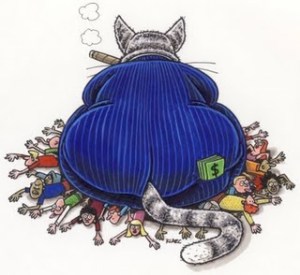
Swire’s mate Osborne one of the fattest of fat cats

“George Osborne is close to earning £1m for making speeches since being sacked as chancellor. His latest entry on the MPs’ register of interests shows he is set to be paid more than £150,000 for talks delivered last month.

He had already declared expected earnings of £786,450 for a series of speeches since losing his cabinet job when Theresa May took office.

The latest update shows he is set to receive a payment of £51,842 for a speech to the New York University in Abu Dhabi on 4 March. A further £51,754 is expected from the Hungarian central bank for two speeches, on 1 and 2 March, while £51,540 is expected from asset management firm Insight Investment for a speech on 17 March. These sums take his earnings from speeches up to £941,586.

As well as the speech income, Osborne is set to earn £650,000 a year working as an adviser to the US asset management fund, the BlackRock Investment Institute.

The register shows Osborne expects to be paid £162,500 a quarter for 12 days working as an “adviser on the global economy” and £120,000 this year to be a Kissinger fellow at the McCain Institute in Washington DC.

Osborne is yet to take up his most eye-catching appointment, as editor of the London Evening Standard, so details of his earnings from the role have not been entered in the register.

Despite his other interests, he has vowed to continue as MP for Tatton – a job which pays £74,000.”

https://www.theguardian.com/politics/2017/apr/14/george-osborne-racks-up-almost-1m-for-public-speaking

Swire much admires his pal having so many irons in the fire. Here are a few comments on George’s jobs from his recent blog post:

“The reality is that in all George’s Osborne’s positions he is being employed as a figure head rather than the man that gets his hands dirty. …

Sometimes we just can’t win! I remember the days when George Osborne (who had never had a job outside politics) was accused of being a member of the political class, a ‘professional politician’ who had no understanding of the real world because he only operated in the Westminster bubble. Ironically now he is a mere backbencher he is being criticized for going out to work! …

If an MP uses his time efficiently he has plenty of room for other interests. I, for example, have some paid outside interests but I’m also Chairman of the Conservative Middle East Council (CMEC) and Deputy Chairman of the Commonwealth Enterprise and Investment Council (CWEIC); both these posts keep my interest in foreign affairs active and enable me to ask informed questions to the executive on foreign matters. …

I fear much of the uproar surrounding Mr Osborne’s new jobs tells us more about salary envy than anything else, and that is not a good basis for an argument. …”

https://www.hugoswire.org.uk/news/blog-greed-george-osborne

“Parish councils: an unlikely urban safety net”

” … Parishes collect just 1.7% of the £26bn raised through council tax overall, so even eye-watering percentages are peanuts compared with the budgets of bigger councils. The average precept in 2016/17 was £54.15 (just over £1 a week), the average rise 6%.

I was part of a group that set up a parish council in Queen’s Park, north-west London, a few years ago, and for the past year have chaired our council. Our neighbourhood of 12,000 people is still the only civil parish in the capital. Residents will see their precept rise by 4.5% this month – under 20p a month on the average bill – but this increase has enabled the community council to provide a grant to our youth centre, which lost all its Westminster City council funding last year.

Did we set up a parish council to plug such gaps? No. Youth services ought to be statutory, and council tax bills for Queen’s Park residents in band E properties are now £46 higher than elsewhere in our borough. The fact that cuts are forcing parish councils to step into shoes vacated by bigger councils is cause for regret, even rage.

But there is an upside. Precept income has also provided additional funds for our neighbourhood park, where a wildlife area locked for years is now open. We have held on to our summer festival and November fireworks, and are working with partners on a jobs advice project. Our parish council can’t fill all the holes created by cuts to frontline services since 2010. But it is better than nothing.

There is another role for parish councils. The world is widely acknowledged to be in a phase of “democratic recession” – a phrase coined by political scientist Larry Diamond – with the hopes of the Arab spring a distant memory and authoritarians on the rise from Turkey to the US. But at the grassroots level, in much of Britain, there is little to retreat from. Most people find the idea of putting themselves up for election to anything utterly foreign. Even the school curriculum is largely empty of politics. However, parishes – if promoted in imaginative ways, as they have been in places such as Frome, Somerset – can provide new ways into local democracy for people who might never get involved in party politics. Indeed, about half of England’s 10,000 parish councils are not party political.

I am not proposing parish councils as a cure-all. There are issues with any form of voluntarism: time is money, and only some people can afford to give it away (parish councillors’ allowances are tiny, and many are retired). But in our divided and individualistic society, the pooling of resources by people who want to do things together should be supported. Civil parishes offer a model of local organisation that is progressive because it is democratic. And if you believe in public spaces such as playgrounds, libraries and sports pitches, there is no better place to make the argument for them than on the ground.”

https://www.theguardian.com/commentisfree/2017/apr/13/parish-councils-unlikely-urban-safety-net

Britain “drifting to elective dictatorship”

A pessimistic but hard-to-argue-with view of “democracy” as it stands. Note this is NOT about the Conservative Party, it embraces every government – New Labour, Coalition, Conservative – since 1997.

“Since 1997, simple parliamentary majorities have been used to radically alter the constitutional make-up of the UK. Devolution and the creation of the Supreme Court have transformed the country’s institutions. Nat le Roux argues that this is evidence of a growing imbalance of power. The executive can change the institutions of state at will – often for politically-motivated, short-term gain. The extent of the democratic mandate has been exaggerated, as the Coalition government shows.

There is a very widespread view in Britain that our political culture is dysfunctional. According to the survey carried out for the Hansard Society’s 2013 Audit of Political Engagement, two out of three citizens believe that the present system of governing Britain is in need of significant improvement. When asked how this might best be achieved, a large majority of respondents favoured action to increase the transparency of politics and the popular accountability of elected representatives.

It is easy to see why many people believe that a disjunction between citizens and elected politicians is the primary problem in an increasingly dysfunctional, and disrespected, political system. However this is at best a partial diagnosis. In reality, British politics are considerably more transparent than a generation ago: proceedings in parliament are televised, it is much easier to access many types of government information, and the public and private activities of the political elite are subject to relentless media scrutiny. From the perspective of the ordinary citizen, Westminster culture may appear introverted and opaque, but this is an inadequate explanation for the current malaise felt towards British politics and government.

Less evident to outsiders, but equally debilitating, is the growing and dangerous imbalance of power between the institutions of the state itself. Lord Hailsham coined the term elective dictatorship in 1976, and it is a more accurate description of the political landscape today than was the case forty years ago.

Two developments have taken us further down that road. The first is the increasing unwillingness of the executive to respect the independent authority of the judiciary, the civil service, local government and parliament itself. The second is the willingness of governments, especially after 1997, to introduce fundamental constitutional changes, many of them effectively irreversible. Perversely, it is the over-representation of democratic legitimacy as the dominant contemporary political virtue which arguably bears a large measure of responsibility for our current predicament. …

The reality of the democratic mandate

It is often argued by the proponents of executive supremacy that a government effectively enjoys a direct democratic mandate because most voters in general elections believe they are voting for a party manifesto and a prime minister at the same time as selecting a constituency MP. Political history suggests that this argument is a very weak one. Two of the last four prime ministers were installed by their parties between general elections, and this has always been an entirely normal route to No 10. Voters in 2010 did not choose to have a Conservative/Lib Dem coalition government (under the current electoral system there is no mechanism which would have allowed them to express such a preference). Many of the policies of that government were foreshadowed in the election manifesto of only one of the coalition partners, and some policies were in neither. The coalition’s policy platform was the coalition agreement, negotiated by the party leaders after the 2010 election and never endorsed by the electorate.

If democratic legitimacy implies substantial popular endorsement, then the democratic mandate of recent British governments rests on weak foundations. In the 2005 general election, Labour secured an absolute majority of parliamentary seats but only 35.2 per cent of the national vote. The turnout was 61.4 per cent of registered electors. Thus the Labour government which was in power between 2005 and 2010 enjoyed the active endorsement of less than one in four potential electors. …

The sovereignty of Parliament

The reality of party politics, in Britain as in other mature democracies, is that a government’s ability to sustain a majority is not based on an ability to convince legislators by reasoned argument of the merits of particular proposals.

Although backbench revolts are more frequent than a generation ago, nearly all divisions are along party lines. Bills are introduced and passed into law irrespective of their objective merit because, tout court, the government commands a majority in the House. Most MPs, most of the time, support their own party leadership for a combination of principled and self-interested reasons.

Despite the Wright reforms of 2010, it is government rather than the Commons itself which largely determines the Parliamentary timetable and enjoys a near-monopolistic control of legislative processes. At best, party loyalty severely muffles effective legislative constraint on executive action, except in those rare cases where a backbench rebellion is large enough to overturn the government’s majority. None of this is especially surprising or – arguably – objectionable in itself: that is how parliamentary democracies work. However, given the realities of parliamentary behaviour, government claims to an untrammelled and generalised authority may ring rather hollow.

Drifting towards instability?

A pessimist could easily believe that we are drifting towards institutional instability. Governments have become increasingly willing to alter very long-standing constitutional settlements for reasons which often appear short-term and politically self- interested. It seems likely that, even if the Scots vote No, the independence referendum will accelerate the breakup of the United Kingdom. A serious clash between government and the senior judges over the extent of the courts’ powers of judicial review seems increasingly likely. The constitutional position of the civil service is being challenged by the current government in a way which would have been unthinkable a generation ago. Government ministers are increasingly bold in asserting their democratic mandate – or rather an over-representation of it – to trump all opposition. All of this is taking place against a background of the general breakdown of public confidence in the political elite. Not so long ago, Britain was widely admired across much of the world as a model of strong constitutional democracy. It is hard to believe that is the case today.”

http://www.democraticaudit.com/2017/04/13/over-mighty-executive-since-1997-britain-has-been-drifting-towards-elective-dictatorship/

Hugo Swire’s latest questions in Parliament – motorcycle noise, Venezuela, Scotland, Egyptian tourisn

Verbatim from his official website:

You can read about Hugo’s activities in Parliament, including his most recent speeches and appearances below (provided by they workforyou):

Motorcycles: Noise | Department for Transport | Written Answers
To ask the Secretary of State for Transport, what the penalty is for motorcycles exceeding permissible noise levels on roads.

Motorcycles: Noise | Department for Transport | Written Answers
To ask the Secretary of State for Transport, whether he plans to reduce the level of acceptable noise from motorcycles in the next 12 mon

Motorcycles: Noise | Department for Transport | Written Answers
To ask the Secretary of State for Transport, what discussions he has had with industry to better regulate noise emissions from motorcycle

Motorcycles: Noise | Department for Transport | Written Answers
To ask the Secretary of State for Transport, what recent assessment he has made of the adequacy of legislation governing noise from motor

Motorcycles: Noise | Department for Transport | Written Answers
To ask the Secretary of State for Transport, how many prosecutions there have been for motorcycles exceeding acceptable noise levels in e

Venezuela: Politics and Government | Foreign and Commonwealth Office | Written Answers
To ask the Secretary of State for Foreign and Commonwealth Affairs, whether he has discussed the political and economic situation in Vene

Venezuela: Politics and Government | Foreign and Commonwealth Office | Written Answers
To ask the Secretary of State for Foreign and Commonwealth Affairs, what discussions he has had with his counterparts in Latin America on

Venezuela: Politics and Government | Foreign and Commonwealth Office | Written Answers
To ask the Secretary of State for Foreign and Commonwealth Affairs, what discussions he has had with his counterpart in Venezuela on the

Venezuela: Politics and Government | Foreign and Commonwealth Office | Written Answers
To ask the Secretary of State for Foreign and Commonwealth Affairs, what discussions he has had with his EU counterparts on the political

Venezuela: Politics and Government | Foreign and Commonwealth Office | Written Answers
To ask the Secretary of State for Foreign and Commonwealth Affairs, what recent assessment he has made of the political and economic situ

Sovereignty: Scotland | Scotland Office | Written Answers
To ask the Secretary of State for Scotland, what the cost to the public purse was of the 2014 Scottish referendum.

Aviation Security | Commons debates
I have just returned from a Conservative Middle East Council trip to Egypt, where we were able to see the devastating effect to the local

Aviation Security | Commons debates
I have just returned from a Conservative Middle East Council trip to Egypt, where we were able to see the devastating effect to the local”
[it goes on to request resumption of flights to Sharn el Sheikh …

https://www.hugoswire.org.uk/parliament?page=1

Hugo Swire – another job – Twitterer par excellence!

The proof? This wonderful picture of him, Stuart Hughes and A.N. Other – under another wonderful picture of an egg laid by one of the hens at his MID-DEVON home recently posted to his Twitter account:

Perhaps the photographer thought calves, ankles and feet were their best features to woo voters with.

Mrs Swire, who is employed at around £35,000/year in his office, is said to “help” with his publicity – perhaps she was the person taking the photo or putting it on to Twitter? Though never having seen her in the flesh locally (has anyone not in the higher echelons of the local Tory party EVER seen her?) Owl wouldn’t be able to identify her.

Perhaps she’s home in MID-DEVON looking after the hens. Important job if you want fresh breakfast eggs.

Just another reminder about Mr Swire’s view of his “non-job” in EAST Devon:
https://www.hugoswire.org.uk/news/blog-greed-george-osborne

MPs and conflict of interest: there’s no conflict if it is in their interests!

Hugo Swire says in his most recent blog that we should not worry about his mate George Osborne’s £650,000 job with a gigantic hedge fund (Blackrock). He says:

“… At Blackrock, his main job will be to advise on economic matters and to represent the company in a social capacity. As for abandoning his constituents, I shouldn’t think the hours he puts in will be any less than those of when he was Chancellor which, I might add, was also a second job and quite a considerable one at that! …”

https://www.hugoswire.org.uk/news/blog-greed-george-osborne

However, the Guardian newspaper has a different take on the matter:

” …the potential for conflicts of interest are enormous. Here is just one obvious example: BlackRock owns about 10% of AstraZeneca, the pharmaceutical firm at the centre of a political storm when US rival Pfizer launched an unsuccessful £69bn bid in 2014. If, for example, BlackRock had wished the takeover to go ahead, who better to have on board to assess the potential political reaction – and advise on ways around it – than the former chancellor?

Add in the fact that the same man is now editor of the Evening Standard – the City’s evening newspaper – and his influence is magnified further. When deals that can generate profits measured in hundreds of millions are on the table, Osborne’s £650k is a mere trifle. …


BlackRock … by numbers

BlackRock has a stake in every FTSE 100 company, worth a total of £145bn.
That means it owns nearly 8% of the UK’s leading share index. Its investment in the FTSE 100 accounts for around 3.5% of its total assets of £4trn. Its biggest stake by value is its £9bn investment in HSBC, its smallest a £9.3m shareholding in medical group Convatec.

Other shareholdings worth more than £5bn are AstraZeneca, British American Tobacco, GlaxoSmithKline, and the two classes of Royal Dutch Shell shares.

In percentage terms, its top holdings are Next (nearly 14%), BHP Billiton (13.29%), information group Relx (12.88%), Land Securities (12.46%), building materials group CRH (12.46%), cruise company Carnival (12.19%), gold miner Randgold Resource (nearly 12%), easyJet (11.83%), technology group Johnson Matthey (11.83%), and Severn Trent (11.55%).

It is the biggest shareholder in more than half of the FTSE 100’s companies: Ashtead, Aviva, AstraZeneca, British American Tobacco, British Land, BHP Billiton, BP, Burberry, Centrica, Compass, Croda, CRH, Diageo, Direct Line, Experian, GKN, GlaxoSmithKline, Hammerson, HSBC, 3i, Imperial Brands, Intertek, Johnson Matthey, Kingfisher, Land Securities, Legal & General, Lloyds Banking Group, London Stock Exchange, Marks & Spencer, Mondi, National Grid, Next, Persimmon, Royal Dutch Shell A and B shares, Relx, Royal Mail, Randgold Resources, Sage, Shire, St James’s Place, Standard Life, Smiths Group, Scottish Mortgage Investment Trust, Smith & Nephew, Severn Trent, Tesco, Unilever, Vodafone, Worldpay, and WPP.
(Source: Thomson Reuters)

Its joint venture infrastructure investments include a business park at Heathrow, windfarms bought from Centrica, solar farms in Derbyshire and Essex and a £75m loan to Trafford Housing Trust.”

https://www.theguardian.com/politics/2017/apr/06/why-worlds-largest-fund-manager-paying-george-osborne-650000-pounds

What you can do when you don’t have party politics to worry about!

“”A little-known candidate emerged as the star of the televised French presidential debate after challenging two of the frontrunners over their honesty and implication in fraud scandals.

The militant Philippe Poutou, of the New Anti-capitalist party, weighed into the far-right favourite, Marine Le Pen, and conservative François Fillon, who are both under investigation for misuse of public funds.

While the 10 other candidates stuck to their political programmes during the four-hour live televised debate – which was watched by 6 million viewers – Poutou was determined to address the elephant in the room.

Having refused to pose with the others for the official photograph, saying “they’re not my colleagues”, Poutou (whose name means “little kiss” in French) told Le Pen that ordinary workers did not have the option of ignoring a legal summons. …

… Poutou, 50, the son of a postman, left school without qualifications after failing his baccalaureate in mechanics. He currently works at a Ford factory repairing the production line machines.

He arrived at the studio wearing a beige T-shirt – in stark contrast to the other male candidates all in suits and ties – and was combative from the start.

Asked to introduce himself, he said: “I’m a factory worker and apart from Nathalie Arthaud, I believe I’m the only one to have a normal job”, adding that he was against the “indecent rich”.

When the moderators pointed out he was running over the time limit, Poutou said: “Just because I’m not wearing a tie, doesn’t mean you can interrupt me.”

At one point he added: “Everyone is fed up with corrupt politicians, and some here know that.”

Poutou stood in the 2012 presidential election, with the slogan “Let the capitalists pay for their crises”, and obtained 1.15% of the votes – 411,160 – in the first round.

This time his slogan is: “Our lives not their profits.”

An Ipsos survey on Wednesday suggested 65% of those asked considered honesty and probity important in a leader.” …

https://www.theguardian.com/world/2017/apr/05/french-election-factory-worker-philippe-poutou-emerges-as-star-of-tv-debate

Brexit trade deals – how low can we sink?

Owl assumes Hugo Swire is with Mrs May in Saudi Arabia persuading them to buy our arms – he’s been there before with the arms dealer British Aerospace.

“Liam Fox’s declaration of “shared values” with Rodrigo Duterte, the Philippines leader whose war on drugs has killed 7,000 people, has prompted dismay about the government’s approach to human rights as it seeks post-Brexit trade deals.

The international trade secretary, who will also visit Malaysia and Indonesia on his trip, said in an article published in local media that he wanted Britain to build stronger relationships with “our trading partners in south-east Asia” based on “a foundation of shared values and shared interests”.

As Fox visited the Philippines, Theresa May was in Saudi Arabia as part of a wider government effort to shore up the UK’s trading position after Brexit. Speaking to the BBC, she refused to criticise the government’s bombardment of Yemen, which is estimated to have killed more than 10,000 civilians and displaced more than 3 million people. …”

https://www.theguardian.com/world/2017/apr/04/liam-fox-meets-philippine-president-rodrigo-duterte

How you explain snout in trough when you are a Tory MP

A Conservative MP advocated in favour of subsidies for the biomass industry after accepting more than £50,000 in political donations and hospitality from companies in the sector.

Nigel Adams, who has accepted tens of thousands of pounds in hospitality and political donations from biomass firms both in and outside his constituency, has called parliamentary debates, tabled questions, written opinion pieces, and written to the prime minister in support of subsidies for the industry.

But records compiled by Energydesk, the journalistic arm of Greenpeace, and shared with BuzzFeed News, show that on a number of occasions he did not mention the donations when he advocated for biomass – a sustainable form of energy generation based on burning wood pellets or other materials instead of coal and gas – over other forms of renewable energy such as onshore wind.

Parliamentary rules allow MPs to accept donations and hospitalities from businesses and others provided they are declared on official registers, as Adams’ contributions were. The rules also require MPs to “open and frank in drawing attention to any relevant interest in any proceeding of the House or its Committees”.

Adams told BuzzFeed News he referred to his hospitality and donations from biomass companies in parliamentary proceedings when his interventions were “substantively” about the industry.

Hospitality he accepted includes an £8,578 three-night trip to the Ritz-Carlton hotel in New Orleans to speak at a biomass conference. Adams accepted a further four trips to the same conference in following years, held at the five-star Fontainebleau on Miami Beach, a holiday spot beloved of America’s elite.

Adams’ trips to the resort from 2013 to 2016, worth £5,460, £7,177, £4,210, and £4,950 respectively, were funded by Eggborough Power Limited and Draw Power Limited, both of which operate biomass plants in Adams’ Selby and Ainsty constituency.

Adams also accepted auction prizes worth a total of £17,800 from another biomass producer from outside his constituency, Simec, as well as a trip to Dubai worth £2,850 to attend a pro-Brexit event in the city for UK expats.

In 2015, Adams held a debate on scrapping subsidies for onshore wind, during which he described it as being “about as much use as a chocolate fireguard”, claiming it was inferior to biomass in handling spikes in demand – naming Drax and Eggborough in his speech – and stating that cutting wind subsidies would “allow other, more efficient technologies to benefit from government support”. He made no mention of his contributions from the sector in that debate.

Similarly, in March 2016 Adams urged Andrea Leadsom, then an energy minister, to increase deployment of biomass, without making any mention of his contributions from Drax, Simec, or Eggborough.

Adams heads parliament’s all-party group on biomass, which is funded by the industry, and in 2012 urged then prime minister David Cameron to prioritise biomass subsidies over onshore wind. He also held a further debate on biomass, in which he declared he had received contributions from the sector.

Adams has declared all of these donations on the official registers of MPs’ interests as required and said he believes he has not breached any parliamentary rules because he has declared his interests in parliamentary proceedings. However, his failure to declare these interests on some occasions has drawn criticism.

Tamasin Cave of the lobbying transparency group Spinwatch told BuzzFeed News Adams risked the appearance of conflicts of interest – likening his situation to that of recently appointed Evening Standard editor George Osborne.

“Who does Mr Adams think he is working for?” she said. “A few transatlantic trips and fine dining could leave someone a bit muddled.

“And as George Osborne has just demonstrated, it’s clear that some in parliament don’t take their public role that seriously. With all eyes on Brexit, we also arguably have less scrutiny of what our MPs are up to.”

Greenpeace told BuzzFeed News that Adams raised concerns about conflicts of interest.

“As an MP, he has some serious questions to answer about whose interests he’s been looking after – the common good or the biomass industry funding his trips to Miami Beach,” said Greenpeace campaigner Hannah Martin.

Martin added that Greenpeace had concerns about biomass because in its view it has question marks over sustainability not shared by other energy sources.

“Ministers have spent millions of taxpayers’ money on controversial biomass when they could have invested it in far cleaner and more mature technologies like onshore and offshore wind. As a staunch advocate of biomass and a fierce critic of onshore wind, Nigel Adams bears at least some responsibility for a policy whose environmental and economic benefits remain in doubt.”

https://www.buzzfeed.com/jamesball/a-conservative-mp-has-been-criticised-after-accepting?utm_term=.ymgj7VPY#.ro7rGP9l

Dirty money in UK elections – Electoral Commission has no teeth to prevent it

An urgent review of “weak and helpless” electoral laws is being demanded by a group of leading academics who say that uncontrolled “dark money” poses a threat to the fundamental principles of British democracy.

A working group set up by the London School of Economics warns that new technology has disrupted British politics to such an extent that current laws are unable to ensure a free and fair election or control the influence of money in politics.

Damian Tambini, director of the media policy project at the LSE, who heads the group made up of leading experts in the field, said that new forms of online campaigning had not only changed the ways that political parties target voters, but crucially had also altered the ability of big money interests to manipulate political debate. “There is a real danger we are heading down the US route where whoever spends the most money is most likely to win. That’s why we’ve always controlled spending in this country. But these controls are no longer working.”

Its policy brief published on Saturday concludes that current laws can no longer ensure the fundamental principle of a “level playing field”, or guard against foreign influence, and that parliament urgently needs to review UK electoral law.

It comes as questions continue to be asked about spending during the referendum campaign. In an interview published in Sunday’s Observer New Review, Arron Banks, the founder of the Leave.eu campaign, says: “We were just cleverer than the regulators and the politicians. Of course we were.”

The Electoral Commission is investigating whether work that the data analytics firm Cambridge Analytica may have done for Leave.eu constitutes an undeclared donation from an impermissible foreign donor. Cambridge Analytica is majority owned by the hedge fund billionaire Robert Mercer, who bankrolled Donald Trump. Filings from the White House disclosed on Friday that Steve Bannon, Donald Trump’s strategy chief, was paid $125,333 by the firm last year.

Asked whether he was worried about the Electoral Commission’s investigation into Leave.eu, Banks said: “I don’t give a monkey’s about the Electoral Commission.”

Banks also claimed that Vote Leave “cheated” to get around campaign financing rules by donating money to third party campaigns. “They cheated! They gave 650 grand to a student. Come on! They absolutely, 100% cheated.”

A spokesman for Vote Leave responded: “The Electoral Commission gave us a clean bill of health.”

Privately, the commission admitted that the only penalties it was allowed to impose by law offered no deterrent to political parties, particularly in a one-off referendum. In addition, the LSE found that loopholes in electoral law mean that spending by political parties during the referendum was almost entirely unregulated or even recorded. The real cost of the campaign – building databases to target voters via social media – occurred almost entirely outside the period regulated by law.

Tambini said: “We don’t have a system that is working any more. In this country, we have had laws to control spending by political campaigns but online campaigning has changed everything and none of the existing laws cover it. The ability to throw around large amounts of cash is almost completely uncontrolled. The key costs in campaigning – building the databases – is happening during the period when campaign spending is not regulated at all.

“There is a real danger that public trust in the democratic process will be lost. There is real potential for foreign influence. We have now the ability to manipulate public opinion on a level we have never seen before. And the current framework is weak and helpless.”

The Electoral Commission has not yet made any public statement but privately it said: “We did have this environment that guaranteed a level playing field. But with the shift online that has all changed. We won’t be able to limit the power of money in elections, that’s what we’re very concerned about.”

Tambini said: “It is urgent. There could be a wholesale loss of trust in the process as the result of a scandal or swinging of an election. Though some would argue that has already happened. There has to be a principle of transparency. The public needs to know where the money is coming from. And we don’t.”

Martin Moore, director of the Centre for the Study of Media, Communication and Power, at King’s College London, said the machinery of campaigning had changed so rapidly, the law has had no chance to catch up. “The first election where digital made a difference was in 2008. And now it’s where pretty much all the spending is. It has been a shift that has happened in less than 10 years. What we’re seeing is exactly the same sort of disruption that we’ve seen in news and music and other industries.

“That is exactly what is happening in politics. The problem is that if you disrupt politics, you are also disrupting the democratic process and you are creating a very dangerous or volatile situation.”

In addition, the Electoral Commission said privately that it did not have the resources to monitor campaigns in real time. “It’s just not practical. There is some proactive stuff that we can do but we simply don’t have the resources.” The only action it can take is once the campaign is over and then the only penalties are fines which “campaigns can simply cost into their spends”.

https://www.theguardian.com/politics/2017/apr/01/dark-money-threat-to-uk-elections-integrity

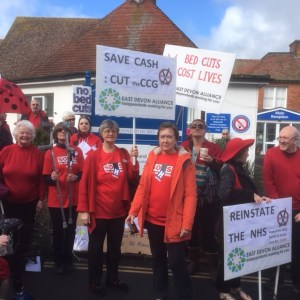
Sidmouth “red line” Save our Hospitals pics – Tory councillors conspicuous by their absence

Spot the Independent East Devon Alliance councillors: easy
Spot Tory councillors – impossible!

Exmouth Regeneration “Business Forum” (2) – the rules!

“The voting membership of the Board may invite additional non-voting members as detailed above to join the Board as they deem appropriate. The may also remove non-voting members from the Board as they deem appropriate.

Eligibility for non-voting membership of the Board will be subject to a protocol that ensures that members are fit and proper persons eg covering matters of criminal record, bankruptcy, not being subject to planning enforcement etc.

To assist the Board they may invite any individuals with particular expertise (including other elected Members) and/or representatives of organisations to attend.

Officers of the District Council, County Council and the Exmouth Town Clerk will attend in an advisory capacity only. The District Council will provide the secretariat service for the Board.”

Click to access combinedcabagenda050417publicversion.pdf

“Fit and proper persons” … fit for what and proper for what?