“MPs to be forced to drop lucrative second jobs if they stop them serving their constituents”

Aw, come on, since when did some MPs (and others in positions of influence nearer home) keep to the rules when extra money was on offer? They will say there is no conflict and blithely carry on – unless they get caught in a sting, of course.

“MPs will be forced to drop lucrative outside jobs if they “conflict” with their jobs serving their constituents, according to a proposed new code of conduct.

The MPs’ second jobs will be scrutinised by the Parliamentary standards watchdog for the first time in a major crackdown on politicians’ lucrative work away from the House of Commons.

A new code of conduct will require MPs to ensure that any outside work “does not conflict” with their day jobs representing constituents in Parliament.

The change in the rules – which are still to be approved by MPs – will radically cut back the amount of time MPs will be allowed to spend away from their constituents.

It could also make it easier for the Standards Commissioner Kathryn Hudson to stop MPs using their positions to win paid consultancy work outside the House of Commons.

An undercover investigation last year by the Telegraph found Jack Straw and Sir Malcolm Rifkind had offered to use their positions as MPs to win contracts. However they were cleared of wrongdoing by Mrs Hudson.

The new code of conduct for MPs proposes an additional rule, which have been introduced following “recent changes to other rules or issues that have become apparent during investigations”.

It says: “A member who undertakes outside employment must ensure that it does not conflict with his or her responsibilities under the Code of Conduct.”

The new draft code – the first for four years – has been signed off by members of the House of Commons standards committee ahead if a six week consultation.

It comes after a study last year from Transparency International found that scores of MPs are being paid millions of pounds a year for outside jobs.

The research found that 73 MPs were paid £3.4million in the past 12 months for “external advisory roles”, including in some cases board positions.

Tommy Sheppard, a member of the committee, said: “Most members of the public will take umbrage when MPs suggest doing this job is not a full time, or your principle, job.

“You should not be doing this on a part time basis; it is a full time wage and if you are doing the job properly it is well more than a 40 hour week.

“There needs to be some clarity in the system that when you are elected as an MP it is expected that it is a full time job and you do it on a full time basis.”

Mr Sheppard said the new presumption would be that MPs “usually” should not take second jobs but there could be exceptions such as for medical professionals or doctors.

He said: “There needs to be some a limit on any outside employment, either by remuneration or by hours undertaken. So that the second job is clearly seen as secondary.

There are people in this place who in terms of remuneration it would be hard to describe this any anything other than a part time job.”

Mr Sheppard said that the change to the code – which is open to comment from members of the public until November 30 – could be expanded to include MPs who are accused of using their positions to try to consultancy work.

Last year a Telegraph investigation showed how Sir Malcolm and Mr Straw had offered to use their positions as politicians on behalf of a fictitious Chinese company in return for at least £5,000 a day while they were MPs.

Mrs Hudson cleared Sir Malcolm and Mr Straw of wrongdoing”
http://www.telegraph.co.uk/news/2016/10/10/mps-to-be-forced-to-drop-lucrative-second-jobs-if-they-stop-them/

Pro-Leave MP calls own government “fundamentally undemocratic, unconstitutional and cutting across the rights and privileges of the legislature”.

A pro-leave Tory MP has applied for an urgent debate on Brexit in an attempt to prevent the government from negotiating the terms for leaving the EU without consulting parliament.

Stephen Phillips, who voted to leave in the referendum, said the government appeared intent on negotiating “without any regard to the House of Commons” in a way that was “fundamentally undemocratic, unconstitutional and cuts across the rights and privileges of the legislature”.

Phillips said: “I and many others did not exercise our vote in the referendum so as to restore the sovereignty of this parliament only to see what we regarded as the tyranny of the European Union replaced by that of a government that apparently wishes to ignore the views of the house on the most important issue facing the nation.”

Phillips said he voted to leave for reasons of restoring sovereignty but was not a supporter of the official leave campaign.

The barrister, a member of the public accounts committee, said it was apparent after the Conservative party conference that the government had no intention of consulting parliament about its negotiating aims, and this was “simply not an acceptable way for the executive to proceed”.

He said Theresa May’s government had “no authority or mandate to adopt a negotiating position without reference to the wishes of the house and those of the British people expressed through their elected representatives”.

He has written to the Speaker, John Bercow, to request the urgent debate for this week, which will be ruled on later on Monday.

Asked about Phillips’s comments, the prime minister’s spokesman said it was absolutely necessary for MPs to scrutinise the process of leaving the EU but that MPs should not be given a vote on the package negotiated.

He said: “Parliament is of course going to debate and scrutinise that process as it goes on. That is absolutely necessary and the right thing to do. But having a second vote, or a vote to second-guess the will of the British people, is not an acceptable way forward.”

There appears to be growing disquiet among MPs – both from the leave and remain camps – about the government’s decision to press ahead with triggering article 50, which starts the two-year “divorce process”, without consulting parliament about the kind of relationship the UK should have with the EU in the future.

Phillips’s application for the debate was in addition to former Labour leader Ed Miliband’s unsuccessful request for an urgent question on the issue in the Commons. Instead of the question, David Davis, the Brexit secretary, is due to give a statement on plans to repeal the European Communities Act 1972.

[Ed] ….Miliband told the Observer: “Having claimed that the referendum was about returning sovereignty to Britain, it would be a complete outrage if May were to determine the terms of Brexit without a mandate from parliament.

“There is no mandate for a ‘hard Brexit’, and I don’t believe there is a majority in parliament for [it] either. Given the importance of these decisions for the UK economy … it has to be a matter for MPs.”

Nick Clegg, the former Liberal Democrat leader, said: “My great worry is that while there will be a vote on repealing the 1972 European Communities Act, which is about the decision to leave the EU, it will be left to the executive alone to decide the terms of Brexit. That would not be remotely acceptable.”

http://www.theguardian.com/politics/2016/oct/10/tory-mp-anna-soubry-concerned-rush-hard-brexit

The ” Exmouth Splash”special song, dedicated to Andrew Moulding and Philip Skinner

Talking Heads, “Road to Nowhere”:

“Road To Nowhere”

Well we know where we’re goin’
But we don’t know where we’ve been
And we know what we’re knowin’
But we can’t say what we’ve seen
And we’re not little children
And we know what we want
And the future is certain
Give us time to work it out

We’re on a road to nowhere
Come on inside
Takin’ that ride to nowhere
We’ll take that ride

I’m feelin’ okay this mornin’
And you know,
We’re on the road to paradise
Here we go, here we go

[CHORUS]

Maybe you wonder where you are
I don’t care
Here is where time is on our side
Take you there…take you there

We’re on a road to nowhere

There’s a city in my mind
Come along and take that ride
and it’s all right, baby, it’s all right

And it’s very far away
But it’s growing day by day
And it’s all right, baby, it’s all right

They can tell you what to do
But they’ll make a fool of you
And it’s all right, baby, it’s all right
We’re on a road to nowhere.”

http://www.azlyrics.com/lyrics/talkingheads/roadtonowhere.html

What Trump tells us about global corruption, UK tax avoidance and government policies

Our own rich MPs (of all parties) hide their personal wealth by putting it in “blind trusts” for the duration of their parliamentary careers, supposedly not offering their “advice” on how the money is invested …. yeah, right!

“… Donald Trump is offering himself as president of a country whose federal income taxes he gives every appearance of dodging. He says he is fit to be commander in chief, after avoiding giving a cent more than he could towards the wages of the troops who must fight for him. He laments an America where “our roads and bridges are falling apart, our airports are in third world condition and 43 million Americans are on food stamps”, while striving tirelessly to avoid paying for one pothole to be mended or mouth to be filled.

Men’s lies reveal more about them than their truths. For years, Trump promoted the bald, racist lie that Barack Obama was born in Kenya and, as an unAmerican, was disqualified from holding the presidency. We should have guessed then. We should have known that Trump’s subconscious was trying to hide the fact that he was barely an American citizen at all.

He would not contribute to his country or play his part in its collective endeavours. Like a guest in a hotel who runs off leaving the bill, Trump wanted to enjoy the room service without paying for the room. You should never lose your capacity to be shocked, especially in 2016 when the shocking has become commonplace. The New York Times published a joint piece last week by former White House ethics advisers – one to George W Bush and one to Barack Obama, so no one could accuse the paper of bias. They were stunned.

No president would have nominated Trump for public office, they said. If one had, “explaining to the senate and to the American people how a billionaire could have a $916m ‘loss carry-forward’ that potentially allowed him to not pay taxes for perhaps as long as 18 years would have been far too difficult for the White House when many hard-working Americans turn a third or more of their earnings over to the government”.

Trump’s bragging about the humiliations he inflicts on women is shocking. Trump’s oxymoronic excuses about his “fiduciary duty” to his businesses to pay as little personal tax as he could are shocking. (No businessman has a corporate “fiduciary duty” to enrich himself rather than his company.) Never let familiarity dilute your contempt.

And yey, looked at from another angle, Trump is not so shocking. You may be reading this piece online after clicking on a Facebook link. If you are in Britain, the profits from the adverts Facebook hits you with will be logged in Ireland, which required Facebook to pay a mere €3.4m in corporate taxes last year on revenues of €4.83bn . If you are reading on an Apple device, Apple has booked $214.9bn offshore to avoid $65.4bn in US taxes. They are hardly alone. One recent American study found that 367 of the Fortune 500 operate one or more subsidiaries in tax havens.

Trump may seem a grotesque and alien figure, but his values are all around you. The Pepsi in your hand, the iPhone in your pocket, the Google search engine you load and the Nike trainers you put on your feet come from a tax-exempt economy, which expects you to pick up the bills.

The short answer to Conservatives who say “their behaviour is legal” is that it is a scandal that it is legal. The long answer is to invite them to look at the state of societies where Trumpian economics have taken hold. If they live in Britain or America, they should not have to look far.

The story liberal capitalism tells itself is heroic. Bloated incumbent businesses are overthrown by daring entrepreneurs. They outwit the complacent and blundering old firms and throw them from their pinnacles. They let creative destruction rip through the economy and bring new products and jobs with it.

If that justification for free-market capitalism was ever true, it is not true now. The free market in tax, it turns out, allows firms to move offshore and leave stagnant economies behind. Giant companies are no longer threatened by buccaneering entrepreneurs and innovative small businesses. Indeed, they don’t appear to be threatened by anyone.

The share of nominal GDP generated by the Fortune 100 biggest American companies rose from 33% of GDP in 1994 to 46% in 2013, the Economist reported. Despite all the fuss about tech entrepreneurship, the number of startups is lower than at any time since the late 1970s. More US companies now die than are born.

For how can small firms, which have to pay tax, challenge established giants that move their money offshore? They don’t have lobbyists. They can’t use a small part of their untaxed profits to make the campaign donations Google and the other monopolistic firms give to keep the politicians onside.

John Lewis has asked our government repeatedly how it can be fair to charge the partnership tax while allowing its rival Amazon to run its business through Luxembourg. A more pertinent question is why any government desperate for revenue would want a system that gave tax dodgers a competitive advantage.

What applies to businesses applies to individuals. The tax take depends as much on national culture as the threat of punishment, on what economists call “tax morale”.

No one likes paying taxes, but in northern European and North American countries most thought that they should pay them. Maybe I have lived a sheltered life, but I have no more heard friends discuss how they cheat the taxman than I have heard them discuss how they masturbate. If they cheat, they keep their dirty secrets to themselves. Let tax morale collapse, let belief in the integrity of the system waver, however, and states become like Greece, where everyone who can evade tax does.

The surest way to destroy morale is to make the people who pay taxes believe that the government is taking them for fools by penalising them while sparing the wealthy.

Theresa May promised at the Conservative party conference that “however rich or powerful – you have a duty to pay your tax”.

I would have been more inclined to believe her if she had promised, at this moment of asserting sovereignty, to close the British sovereign tax havens of the Channel Islands, Isle of Man, Bermuda and the British Virgin and Cayman Islands.

But let us give the new PM time to prove herself. If she falters, she should consider this. Revenue & Customs can only check 4% of self-assessment tax returns. If the remaining 96% decide that if Trump and his kind can cheat, they can cheat too, she would not be able to stop them.• Comments will be opened later

http://www.theguardian.com/commentisfree/2016/oct/08/free-market-in-tax-grotesque-idea-donald-trump-tax-havens

Councillors to be told about devolution ” myths” – though some of them seem to be reality!

According to this week’s EDDC Knowledge newsletter, all councillors have been invited to a meeting on Thursday 20 October at 5 pm to hear a presentation on a “Devolution – ‘myth busting’ briefing”.

This presentation has already been given to DCC councillors and here is one Councillor’s report (Robert Vint):

“On Monday Devon County Councillors were presented with a “Myth Busting” training session on Devolution. On Thursday there was a repeat session for South Hams District Councillors.

The “Myths” they were attempting to “bust” were that the Devolution process was led by the LEP, was undemocratic, would result in local government reorganisation / centralisation etc.

The explanations – or non-explanations – only strengthened my concerns. It was confirmed that there would be no public consultation on the economic development plan but only on the Combined Authority proposal and that the LEP had played a central role.

I asked why the plan did not start by identifying local needs such as rural unemployment and affordable housing then consult communities and small businesses on how to tackle these problems. They said not to worry as this was an outline economic plan – but later they confirmed that there would be no consultation on the economic plan or any opportunity to change it.

We have a Devolution Prospectus written by the few big businesses in the LEP to serve their own needs rather than those of the wider community of Devon and Somerset. This has then been rubberstamped by local authorities who did not have the staff, time or vision to rewrite it to meet our real needs and who failed to consult residents and small and family businesses. As a result we will be subjected, without any opportunity to comment, to a local economic development strategy that will serve the wealthy rather than the majority and that will fail to provide jobs where they’re needed or houses to the people who need them most.

In contrast the RSA – Royal Society of Arts – outlines how we should be delivering genuine, fair and inclusive devolution.

The UK’s economic status-quo has resulted in huge sections of our population being ‘left behind’. So the RSA are proposing a radical programme of devolution, inclusive industrial strategies and investment in human capital to create a more inclusive, equal society.”

EDDC afraid of democracy or afraid of independent councillors independence (and their skills)?

“Whilst I give my complete backing to Cllrs Dyson and Barratt for their upcoming work on the Port
Royal Scoping Study reference group (Herald, September 16), I would like to question the attitude of the regime that allows the controlling group at EDDC to pick one from three Town ward members.

Surely, if this process is to be truly open and accountable, this selection should have been the responsibility of the ward members themselves? After all, we were elected by residents to work on their behalf to uphold their wishes. It remains to be seen whether any of the important lessons from other EDDC projects (such as the relocation from Knowle and the beach management plan, let alone Seaton and Exmouth regeneration) have really been learnt.

Sidmouth Town Council may nominally be leading this project for now, but, in the long run, most of the land concerned is owned by EDDC and the final say on who buys it and for what use will be theirs. This includes the car parks and the swimming pool as well as the buildings on the seafront.”

Cllr Cathy Gardner
EDDC Sidmouth Town Ward
East Devon Alliance member

http://www.eastdevonalliance.org.uk/cathy-gardner/20161008/sidmouth-herald-i-question-attitude-regime/

“Campaigners to crowd fund legal challenge after Javid allows fracking”

“Campaigners are seeking to crowd fund a legal challenge to the decision by the Communities Secretary to overturn Lancashire County Council’s refusal of planning permission for fracking in the Fylde area.

Frack Free Fylde has so far raised more than £3,400 via the Crowd Justice website, with donations from 158 people. The group is hoping to raise £10,000.”

http://localgovernmentlawyer.co.uk/index.php?option=com_content&view=article&id=28577%3Acampaigners-to-crowd-fund-legal-challenge-after-javid-allows-fracking&catid=63&Itemid=31

Local Government Association on Fracking

“… Responding to the decision, Judith Blake, the LGA’s environment spokesperson, said it should be for local communities to decide, through their locally democratic planning systems, whether to host fracking operations in their areas.

“Ensuring communities feel safe is important. Any company that applies for a fracking licence must assure residents through their council that environment and safety concerns can and will be adequately addressed before planning permission is considered,” she said.

“People living near fracking sites, who are most affected by them, have a right to be heard. Local planning procedure exists for a reason – to ensure a thorough and detailed consultation with those communities.”

Lancashire County Council highlighted this was one of the biggest planning applications ever put before any council, with tens of thousands of responses and substantial amounts of technical detail.

Council cabinet member for environment, planning and cultural services Marcus Johnstone said authority’s development control committee carefully considered many hours of evidence both for and against the proposal.

“A local council, made up of councillors democratically elected by local people, and charged with serving their interests, is exactly the right body to make decisions on local matters. It is clear that the government supports the development of a shale gas industry, but I would ask them to do more to address the concerns of local communities and the councillors who represent them by supporting the best environmental controls,” he stated.”

http://www.publicfinance.co.uk/news/2016/10/lga-slams-fracking-approval-javid

LEP creates its own “Business Forum” – but it’s independent, honest guv!

Owl’s view: Unfortunately, it still walks like a duck, quacks like a duck and is still one hundred percent an LEP duck! Oh, and who is on it’s board – LEP Board member Tim Jones – quack, quack!

“A new business group has been formed to advise Government decision makers – but stressed it is not in competition with other South West business organisations.

B4SW will provide information and reports to the South West Local Enterprise Partnership (HotSW LEP) and ensure businesses across the region have a strong voice in discussions over Government investment.

“We have no intention of competing with other business groups,” Mr Marrow said. “They are doing good stuff.”

He explained that B4SW may be new, but is actually a “restructuring” of the Heart of the South West Local Enterprise Partnership’s (HotSW LEP) business forum.

That body was set up by the LEP, but was nevertheless independent of it, in order to provide business engagement.

But the forum was often mistaken as being part of the LEP, Chris Marrow, B4SW chairman, explained.

So, he said, B4SW has been formed as a community interest company (CIC), a type of social enterprise, to provide “a better structure to that of the forum, which had been “an informal group”.

Mr Marrow said the new organisation would report to the LEP, the organisation created by the coalition Government in 2011 to determine investment priorities, but is not constrained by the HotSW area of Devon and parts of Somerset.

“We meet around the region and will cover Cornwall,” Mr Marrow said, at an early meeting held in Plymouth.

“It’s a forum in which business people can come together and explore ideas and put their expertise back into the community for the advantage of the region.”

Mr Marrow said B4SW is composed of business people with vast experience in sectors such as maritime, supply chain, education, rural development and overseas trade.

“We have business people with particular expertise, a lot of experience in international affairs, with overseas contacts, and work with people in Africa and China,” he said.

He said the executive board has links to various other organisations such as universities and colleges, Chambers of Commerce, and the Federation of Small Businesses.

“The objective is to help businesses develop in the South West,” he said. “That includes improving exports, productivity, and job creation.”

He said B4SW would provide “blue sky thinking” and supply reports to the LEP.

He gave examples of studies into biofuels, ballast water management and kelp (seaweed) farming.

B4SW has also arranged a visit from transport training experts in South Africa and had discussions with Plymouth University and Flybe about maritime and aviation training.

Tim Jones, a B4SW board member, said the aim is also to bring together all business organisations across the HotSW and Cornwall and Isles of Scilly LEPs.

He said it was vital businesses shared a unified voice in order to push for Government investment, especially as political devolution is on the agenda.

“A combined business voice is essential, and becoming more so as we move down the devolution agenda and anther round of Government austerity,” he said. “So the cooperation of the business community is crucial.

“With devolution, although there is talk about business engagement, there’s a fear the voice of business will diminish.

“Combine that with the problems Whitehall has about infrastructure investment in the South West, it’s vital we have a single voice coming from the business community.”

http://www.plymouthherald.co.uk/new-business-group-set-up-to-push-for-government-investment-in-south-west/story-29775868-detail/story.html

Information Commissioner says Council business plans cannot be secret

Repercussions for EDDC? You can bet Exeter City Council will appeal!

“Exeter Green Party has clashed with Exeter City Council over secret information about the financial viability of St Sidwell’s Point.

The Greens made a request under the Freedom of Information Act (FOI) to access parts of the business case for the planned council owned leisure complex.

They say the council has “persistently refused” to give them the information.

Green Party member Peter Cleasby complained to the Information Commissioner, the independent authority set up by Parliament to uphold public access to documents.

Mr Cleasby said the public had a legitimate right to see information shared privately to councillors about the financial viability of the leisure complex project.

The commissioner agreed, and has ordered the council to publish its estimates of income from the leisure centre.

The council are seeking advice regarding an appeal against this decision.

Mr Cleasby said: “The public were not consulted about whether we wanted the leisure centre or not. We were simply told that £26 million of the Council’s money would be spent on building it.

“We were not offered the chance to suggest other uses for £26 million, and we were not allowed to see the assumptions made by the Council about whether the leisure centre could be run without being a drain on public finances.

“So as an individual I asked for this information to be made available for scrutiny by others who could form an independent view on whether the numbers added up. The Council refused, three times changing their reasons for not releasing it.”

A council spokesperson hit back, saying: “The public were consulted multiple times in accordance with the open and transparent planning process for what will be one of the greenest schemes of its kind anywhere in the country.

“As Mr Cleasby has pointed out, we are entitled to appeal the Information Commissioner’s decision and we are taking appropriate advice.”

Diana Moore, former parliamentary candidate for the Green Party in Exeter, said: “Exeter Green Party are not opposed to a new leisure complex in principle, but openness and real public engagement are essential in major projects of this sort.”

http://www.exeterexpressandecho.co.uk/exeter-council-clash-with-greens-ahead-of-st-sidwell-s-point-planning-decision/story-29781273-detail/story.html

Thank goodness we have an Electoral Commission!

“Speaking to Radio 4’s Today programme, UKIP chairman Paul Oakden said he would check with the Electoral Commission to see who the party leader was and admitted it could technically be Mr Farage.”

http://www.bbc.co.uk/news/uk-politics-37558485

Where is the “centre ground”?

With the centre of the Tories now being much more to the right and the centre of Labour being much more to the left, Lib Dems not sure where they are except on Europe, UKIP – well, they can’t even get a new leader who can stick the job, and Greens tending towards Labour and with the major parties outdoing each other with spin, back stabbing and infighting – who do you vote for if you are a centre-left Tory or a centre-right Labour voter or Lib Dem Brexiteer or a disaffected Kipper or a non-left leaning Green or anyone else who doesn’t want to be button- holed?

Why, an independents, of course – who occupy the real centre ground by just doing what they believe is right by the communities they serve without allegiance to any of the parties and with no party whip!

Or, as Claire Wright would say: Free to speak, free to act.

Be careful what you sign (independent) councillors

“A Bath councillor was asked to step out of discussions about a multimillion care contract after the council found out she had signed a petition opposing Virgin Care’s bid to win it.

Lin Patterson, who has called the incident “spooky” and “heavy handed”, said she was asked by a council officer to remove herself from relevant committee discussions over fears Virgin Care would sue.

The Lambridge councillor said she was told that she had a “conflict of interest” because she had signed a private petition opposing Virgin Care’s bid to win the £700m community care contract.

But at the time she was asked to step outside when the “Your Care, Your Way” contract was being discussed by the Health and Wellbeing Select Committee the names of the signatories were private.

The petition, hosted by 38Degrees, was not handed to Bath and North East Somerset Council until July 21. But Ms Patterson said she was “pulled aside” a whole month beforehand on June 20.

She said she was denied an explanation about how the council had found out she had signed the petition, and the council has since refused to answer the Bath Chronicle’s questions about the matter.

Ms Patterson, who represents the Green Party, added that the request for her to leave the room was “a bit of a departure”.

Conservative councillor Paul May said he had voluntarily excused himself from any committee or council discussions about the contract ever since becoming a non-executive director of the board of Sirona care and health, the other major bidder. When asked whether he thought Ms Patterson should have done the same, he said: “I don’t think I’m really qualified to say. My situation is very clear; hers I don’t think was quite so clear.”

Ms Patterson said: “The fact that the petition had not been submitted is actually very spooky and the fact that I was asked to leave the room I think was heavy handed.”

http://m.bathchronicle.co.uk/bath-councillor-removed-from-discussions-about-virgin-care-s-contract-bid-feels-she-was-spied-on/story-29774093-detail/story.html

One wonders how the matter would have been handled by her Party Whip had she been a majority party councillor …..

Sovereignty or dictatorship?

David Cameron did not discuss EU referendum with his Cabinet before he called it, claims Ken Clarke:

“David Cameron never discussed his decision to call a referendum on Britain’s membership in the European Union with his Cabinet, former Tory Cabinet minister Ken Clarke has claimed.

The 76-year-old Tory veteran criticised how Mr Cameron ran his Cabinet meetings, which he said met for 90 minutes one morning each week.

In his book, which is being serialised by The Sunday Times, Mr Clarke wrote: “This was an almost comically inadequate time within which to discuss any important subject.”

In particular, he said Mr Cameron failed to adequately discuss “his startling and catastrophic decision to call a referendum on Britain’s membership of the EU in cabinet”.

“… In my opinion, this is a disastrous way to run the government of a complex modern nation state,” he said. “It is a reaction to the hysterical constant 24/7 chatter that now dominates political debate.

“Media handling and public relations are now regarded as the key elements of governing, and a small army of advisers who are supposed to be PR experts but who are of frankly variable quality have far too big a role in policy-making.

“Next week’s headlines are given more priority than serious policy development and the long-term consequences for the nation.”

http://www.independent.co.uk/news/uk/politics/david-cameron-eu-referendum-brexit-ken-clarke-memoirs-pm-did-not-discuss-with-cabinet-a7342856.html

Yet another example of EDDC’s similarity to national government – secrecy and spin much more important than transparency and proper discussion.

Boundaries, election boundaries, constituency statistics and more: interactive election and statistical website

Lots and lots of useful information including AONB boundaries, parliamentary constituencies, census statistics, etc.

http://www.boundaryassistant.org/PlanBuilder2018.html

Tory MP says only proportional representation will fix our broken political system

An interesting comment, too, below about how MPs act like sheep for their Whips …

” … “Mr Howlett was the only Conservative MP to vote dfor Green MP Caroline Lucas’s bill in support of introducing proportional representation for elections, which she previously tabled as a private members bill.

He suggested that though few Tories supported electoral reform, some MPs appeared to be open to persuasion.

“I know a number of MPs who I spoke to just outside the lobbies who were asking ‘Is this a whipped vote, or not a whipped vote? Oh it’s not a whipped vote, I’m not going to go through.’” They did think ‘you know what, it would be quite interesting to be thinking about that’.”

Mr Howlett also threw his support behind a petition organised by the Make Votes Matter campaign group calling on the Constitution Minister to look at the possibility of changing the voting system.

Labour supported queued around the block at the party’s conference in Liverpool last weekend to hear about proportional representation in what is understood to be the biggest rally in favour of the policy in the party’s recent history.

MPs from across the opposition party’s factions – including John McDonnell, Clive Lewis, Chuka Umunna, and Stephen Kinnock threw their weight behind the policy. Labour’s leader Jeremy Corbyn has yet to decide on the issue, however. …”

http://www.independent.co.uk/news/uk/politics/proportional-representation-electoral-reform-ben-howlett-pr-make-vote-matter-a7341986.html

“Theresa May defends her plan to keep Brexit negotiation details secret from Parliament”

“Theresa May has defended her plan to keep key details of the EU exit negotiations secret from Britain’s Parliament.

The Prime Minister said that though MPs would be informed at “various stages”, they would not be privy to precisely what her negotiators were doing.

Last month Brexit Secretary David Davis told a Parliamentary Committee that he would “not be able to tell you everything, even in private”.

The approach is a stark contrast to the course being set by the EU, with plans reportedly being formed to keep the European Parliament informed with regular updates.

Questioned on the secrecy ahead of the Conservative party conference in Birmingham, the Prime Minister said transparency could jeopardise Britain’s negotiating position.

“First of all, of course parliament will be involved in this process. The Great Repeal Bill, Parliament will be having its say on that,” she told the BBC’s Andrew Marr Show.

“Of course at various stages we will be keeping parliament informed. This is not about keeping silent for two years but its about making sure that we are able to negotiate, that we don’t set out all the cards in our negotiation.”

“Because as anybody will know who’s been involved in these things, if you do that up front, or if you give a running commentary you don’t get the right deal. What I’m determined to do is get the right deal for Britain.”

http://www.independent.co.uk/news/uk/politics/theresa-may-article-50-brexit-details-secret-parliament-david-davis-a7341266.html

And that, ladies and gentlemen, is sovereignty.

It seems she has learned well from EDDC Jedi-masters!

Just substitute Diviani for May and Morai or “Greater Exeter” or devolution deals withe the LEP for Parliament and local democracy for sovereignty and it is exactly the same situation. We don’t tell you anything at all during negotiations, we tell you almost nothing at all after negotiations and then we tell you all how to vote about the negotiations! Or maybe we don’t allow you to vote at all!

If devolution is the answer – what was the question?

Devolution doesn’t always mean taking back control

Since Tony Blair became prime minister in 1997, successive UK governments have fiddled around with ways of devolving power from Westminster and Whitehall. The most radical has been Scottish devolution, which continues to evolve. The least coherent has been the patchwork of schemes developed across England, ranging from a well-thought out arrangement for London, with a directly elected mayor and assembly, to the make-it-up-as-you-go-along “devolution deals” for the rest.

The coalition government of 2010-15 abolished – wisely – the regional governance bureaucracies. The first big replacement idea was Local Enterprise Partnerships (LEPs), intended as “business-led” mechanisms for spending public money. The areas covered by LEPs were in some cases obvious, based for example on established city regions or former metropolitan counties. In others the rationale was less clear, perhaps nowhere more so than the Heart of the South West (HotSW) LEP, covering a massive area from Plymouth to the south of Bristol [1]. It’s tempting to think that after Cornwall decided to go their own way and Bristol wasn’t having any truck with its Somerset neighbours, that HotSW was the “bit left over”.

The performance of these fundamentally secretive and undemocratic bodies is not the focus of this post [2]. They are relevant because the LEP areas have in some cases – including HotSW – formed the basis of the subsequent devolution proposals in England.

The government has been inviting groups of local authorities to submit proposals for devolving decision-making in certain functions, particularly infrastructure and economic development, but not limited to these.

The rationale behind this approach is that increasing productivity, a key goal of government policy, is best achieved by local targeting of support measures through local authorities and business interests working together.

The government has made it clear that access to some central funding is dependent on devolution deals being agreed. Invariably, local authorities across the area commit to setting up a “combined authority” to take the decisions. Unlike London, this would not be directly elected but would be made up of the leaders of the constituent councils plus non-elected representatives of the NHS and the LEP. Initially, agreement to having a directly-elected mayor was a condition of a devolution deal but the government now seems to be less rigid on this.

One of the problems with this approach is that it was designed for large urban areas. Greater Manchester, for example, has operated as a partnership of councils across a coherent area since the 1960s when Passenger Transport Authorities were set up. Manchester is the trail-blazer in the current devolution game, and it clearly works for them.

What is less clear is that the combined authority structure will work well in those areas of England that aren’t part of a conurbation. A pretentious-sounding body called The Independent Commission on Economic Growth and the Future of Public Services in Non-Metropolitan England produced a report last year arguing for devolution deals for the rest of England [3].

It does make the useful point that LEP areas do not in most cases coincide with functional economic areas (a conclusion which should be enough to discredit the whole idea of LEPs), but is otherwise a typical product of this debate in that it focusses on structures and “partnerships” from which communities are largely excluded.

The councils within the HotSW area have submitted a devolution bid to the government [4]. The bid identifies 6 challenges for the area (low productivity growth, limited labour market, patchy performance in innovation and enterprise, an ageing population, health and care integration, infrastructure and connectivity) and 6 “Golden Opportunities” for improving growth and productivity (marine, nuclear, aerospace and advanced engineering, data analytics, rural productivity, health and care). The bid has a wholly economic focus: other than in references to care, the word “social” does not appear in the document, and there is no acknowledgement of the impacts of the plans on the natural environment.

If the bid succeeds – and at least some of the councils are treating the whole exercise with a degree of caution – decision-making on the plans and services covered by the bid will be sucked upwards from the councils and the people they represent. How the combined authority will balance the interests of, say, Plymouth with those of people in the Mendips will be discussed in officer-led groups behind closed doors – because that is the only way “partnership” working can be made to operate in practice. The need to prepare for joint meetings gives authority officers huge influence over agendas and decisions because of the need to coordinate positions and identify common solutions in advance of meetings.

The combined authority itself will be made up of leaders of the constituent councils and others. It will not be directly elected. Trying to influence its decisions will be next to impossible for individuals and community groups. The bid’s economic focus ignores environmental and community questions completely, so being able to provide a counter-balance is hugely important. As it is, the bid’s environmental credentials are defined by the partnership’s LEP-led role as a cheerleader for the new Hinkley Point nuclear power station.

Other devolution bids across England generate similar challenges. At a time when disillusion with our politics is at an all-time high, it is puzzling – to put it mildly – that decision-making is to move even further away from the people most affected

NOTES:

[1] The map of LEP areas at http://www.lepnetwork.net/the-network-of-leps/ shows just how large the area is.

[2] An excellent House of Commons briefing note (July 2016) provides a concise guide to LEPs including reviews of their performance – see http://www.parliament.uk/briefing-papers/sn05651.pdf

[3] See http://www.local.gov.uk/non-met-commission

[4] The bid document is at https://new.devon.gov.uk/democracy/files/2016/01/Heart-of-the-South-West-Devolution-Prospectus.pdf

https://petercleasby.com/2016/09/30/devolution-is-not-control/

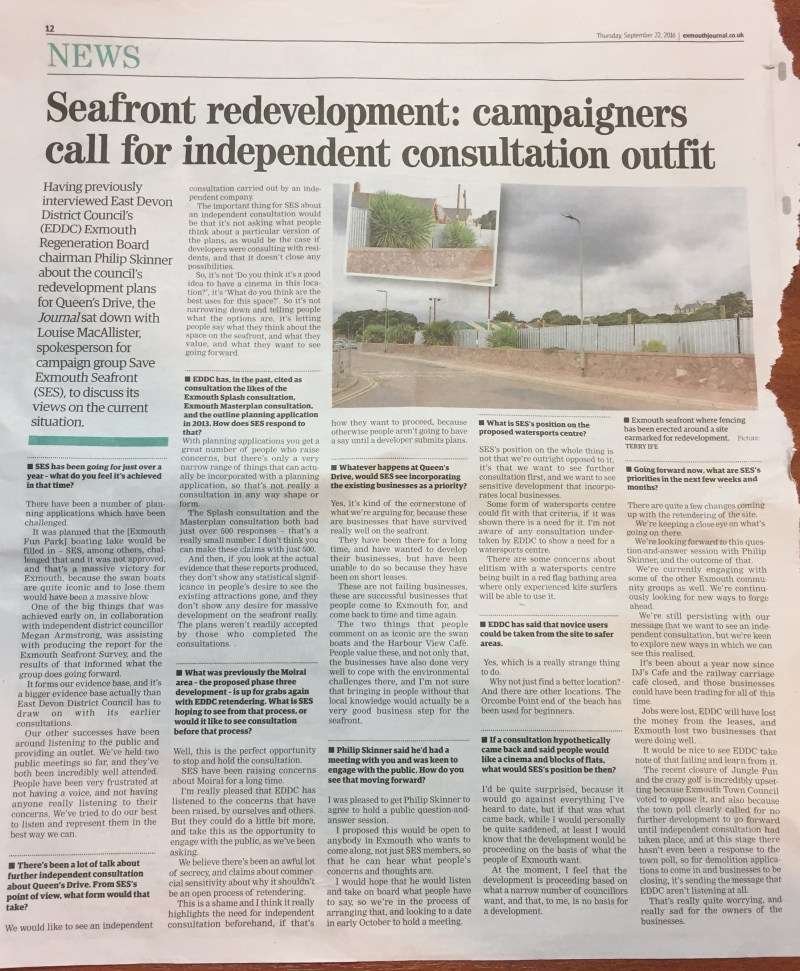
Exmouth seafront regeneration: an alternative view

In this week’s Exmouth Journal an interview with Dr Louise McAllister, spokesperson for Save our Seafront:

img_1304

Devolution “myths” not myths at all, says Devon County Councillor

From the Facebook page of Lib Dem Councillor for Totnes, Robert Vint:

“On Monday Devon County Councillors were presented with a “Myth Busting” training session on Devolution. On Thursday there was a repeat session for South Hams District Councillors.

The “Myths” they were attempting to “bust” were that the Devolution process was led by the LEP, was undemocratic, would result in local government reorganisation / centralisation etc.

The explanations – or non-explanations – only strengthened my concerns. It was confirmed that there would be no public consultation on the economic development plan but only on the Combined Authority proposal and that the LEP had played a central role.

I asked why the plan did not start by identifying local needs such as rural unemployment and affordable housing then consult communities and small businesses on how to tackle these problems. They said not to worry as this was an outline economic plan – but later they confirmed that there would be no consultation on the economic plan or any opportunity to change it.

We have a Devolution Prospectus written by the few big businesses in the LEP to serve their own needs rather than those of the wider community of Devon and Somerset. This has then been rubberstamped by local authorities who did not have the staff, time or vision to rewrite it to meet our real needs and who failed to consult residents and small and family businesses. As a result we will be subjected, without any opportunity to comment, to a local economic development strategy that will serve the wealthy rather than the majority and that will fail to provide jobs where they’re needed or houses to the people who need them most.

In contrast the RSA – Royal Society of Arts – outlines how we should be delivering genuine, fair and inclusive devolution (see below).

The UK’s economic status-quo has resulted in huge sections of our population being ‘left behind’. So the RSA are proposing a radical programme of devolution, inclusive industrial strategies and investment in human capital to create a more inclusive, equal society.

https://www.thersa.org/discover/publications-and-articles/rsa-blogs/2016/09/inclusive-growth-proposals