Today’s promise of 30,000 housing association dwellings put into perspective

Owl says note that the “affordable” hoysing will still be 80% of market value … making these homes still unaffordable for those on low incomes.

Chancellor Philip Hammond has today committed £3billion in extra borrowing to deliver 30,000 new affordable homes in England.

In the Spring Statement, the Chancellor announced that the Government will guarantee the extra borrowing by housing associations to support the delivery of the homes, but did not supply a timetable for delivery.

The Chancellor also announced that £717million from the £5.5billion Housing Infrastructure Fund will be used to help ‘unlock’ up to 37,000 homes at sites including Old Oak Common in London, the Oxford-Cambridge Arc and Cheshire. …”

BUT IN THE SAME ARTICLE:

“In November This is Money revealed that local councils have fallen over six years behind their own house building targets.

Councils’ own figures revealed that development across the UK is moving at such a glacial pace that 316 sites will have fallen short of targets by 889,803 homes within the next eight years. …”

https://www.thisismoney.co.uk/money/mortgageshome/article-6804561/Spring-Statement-Housing-associations-borrow-3bn-build-new-affordable-homes.html

“Persimmon Homes missing fire safety barriers confirmed in Cornwall as well as Devon”

“A Persimmon Homes family say their home is like living in a chimney, after discovering vital fire safety barriers were missing from their home.

The owner of the property, who wished to remain anonymous, asked for his property in Truro to be inspected after reading of the safety issues with homes in Exeter on Devon Live.

In January, a Persimmon Homes whistleblower urged all home owners to have their properties inspected after claiming the problem is widespread. Up until then, the building firm had only confirmed properties in one of its developments, Greenacres, and the Newcourt area near Topsham, had failed inspections.

The whistleblower – a Persimmon Homes employee – alleged the issue was not confined to the one development. Among other developments the employee claimed could also fail inspections were:

Coverdale, Paignton
Harford Mews, Ivybridge
Hill Barton Vale, Exeter
Agusta Park, Yeovil
Heathfield Gardens, Monkton Heathfield, Taunton
Chilmark Glade, Shaftesbury

Since then failures have also been reported at Persimmon Homes in East Devon new town Cranbrook, and now at Lowen Bre in Truro – which is the first confirmation the issue has been highlighted in Cornwall as well as Devon.

The issue was exposed following a ‘ferocious’ blaze which broke out in Trafalgar Road off Admiral Way and Topsham Road, last April, which spread into the roof spaces of two of the adjoining properties.

After reading the whistleblower’s recommendations on Devon Live, the owner of a house in Lowen Bre asked Persimmon Homes to inspect their five-year-old home, when cavity barriers were found to be missing, as well as stops and socks which prevent the spread of fire through walls and floors.

The owner, who asked not to be named, said: “My house is like a chimney because if there was a fire it would spread pretty quick through it. It’s negligence by Persimmon Homes and the National House Building Council (NHBC) who have signed the property off.

“After our home failed the inspection a few days later they returned and they were put in place, but I’m also missing about 50 per cent around the windows. We have 20 odd windows and doors.”

The development the owner lives on has about 160 homes and it is believed letters have been sent to some of its residents.

The home owner said: “I want to make everyone in the development aware of the issue so that they can get their home checked.

“As a national house builder, Persimmon Homes have a duty of care to ensure their homes are built correctly and I feel that this issue shows a lack of adhering to building regulations.

“We have lived in our property since October 2013. All this time we have been at constant risk due to the required fire safety details not being installed. With children in the house whose bedrooms are both on the top floor, it makes this situation even more unbelievable.”

The builder has already come under fire by residents after their voiced their frustrations after it took four years for work began on its promised as a condition of its planning permission.

Residents said they had to endure countless promises of start dates from Persimmon Homes for work at the playground to begin which were then broken the company.

A spokesperson for Persimmon Homes said: “The development as a whole is being inspected as part of the ongoing process. As Persimmon Homes has already confirmed it has committed to a thorough inspection process to ensure the required standards are met and is undertaking remedial work wherever the need is identified.

“Persimmon Homes has a dedicated team in place to deal with any remedial work that is required, and customers on any of our developments can make contact at any time if they have concerns.”

Persimmon Homes did not provide a response to the following questions:

1. Of those inspected so far in Lowen Bre how many ave passed?

2. A list of development where inspections are being carried out in Cornwall, Devon and across the country.

3. The results of those inspections so far.

A spokesman for the NHBC said it had not received any contacts or claims concerning fire safety barriers at Lowen Bre in Truro.

He said: “Any homeowners with an NHBC Buildmark policy who have concerns about this issue can contact our claims team who will be happy to provide them with advice and support. As the UK’s leading warranty provider we care passionately about the quality of new homes.

“We work with builders to help them improve the construction quality of the homes they build for the benefit of our policyholders, the homeowners.

“NHBC’s inspection regime is not a replacement for the builder’s own quality control checks and obligations to build in accordance with building regulations.”

https://www.devonlive.com/news/devon-news/persimmon-homes-missing-fire-safety-2633631

Shock news: ‘Government Agency ‘U-turn’ puts Axminster relief road at risk…’

EDDC press release:

“The £17m relief road and 850 homes, in the Masterplan for the east of Axminster, have been put at risk by a late change in Homes England funding.

East Devon District Council has reacted with dismay to news that government agency Homes England has changed how it is assessing the council’s £10 million bid for Axminster relief road.

The council bid for a non-repayable grant in 2017. This bid was accepted in February 2018, to be used to help fund the delivery of the crucial new relief road and associated homes, employment land and community facilities.

The council has now been told by Homes England that a new condition of the funding is that the money must be repaid by the development.

Council leader Cllr Ian Thomas is enormously concerned that the decision potentially puts the Axminster Masterplan in jeopardy.

He said: “We are dismayed by this fundamental change of mind. It throws the whole Axminster scheme up in the air and means that the effort we and our partners have put into this critical scheme over the last 12 months may have been completely wasted.

“Since I was first elected leader, I have been absolutely consistent that we don’t simply build homes, we build sustainable communities. The Axminster Masterplan is an excellent example of such a community. It would bring enormous social and economic benefit to Axminster, by delivering high quality affordable housing and employment land, together with other essential community facilities. After this decision from Homes England, it feels like we are back to square one. It’s bitterly disappointing.

“We understand that our scheme is one of a number across the country where similar funding decision changes are being made, as Homes England assesses the viability of schemes on a fundamentally different basis, to that applied in our original agreement with them.

“Our council is now considering its options. This includes taking legal advice to investigate whether we may have strong grounds to challenge Homes England’s decision.

The masterplan for 850 homes with employment land, open spaces and community facilities was endorsed by the council’s strategic planning committee in January. The plan was based on the money from Homes England not being repaid and even then, the development could only be made viable by expanding the site area and increasing the number of homes proposed to around 850. The amount of affordable housing required from the additional 200 homes was also reduced from 50% to 25%.

Following a decision by Homes England last week, it would appear that the development will have to repay the £10 million of government “grant” and the masterplan is no longer viable in its current form.

The council must also consider revisiting the masterplan to understand the consequences of the decision for the amount of affordable housing, employment land and community facilities to make the development viable again.

Throughout the masterplan process, the council has always been clear that the urban extension of Axminster is not just about delivering housing and the relief road but is about helping the town grow as a community in a sustainable way supported by the services and facilities that it needs.

The council is frustrated that Homes England’s change in approach puts this all at significant risk and could make the development undeliverable. It will be seeking an urgent meeting with Homes England to discuss this case and other implications for investment in the district.”

Better hope new EEDC HQ is in good nick …

… as its builder is on the ropes and 45,000+ people could lose jobs. Unless we, the taxpayers, pick up the bill – again.

https://www.bbc.co.uk/news/business-47513850

“The ‘absurd’ planning loophole that could end up blighting your home”

And remember, this can be done to new houses too … And when you read below what can be done to agricultural buildings, certain local landowners must be champing at the bit … Use your vote wisely in the forthcoming local elections on 2 May …

It was by accident that Damien Flannagan discovered the new neighbour who had bought the bungalow behind his house had sought planning permission for a loft conversion with two dormer windows. The proposals would mean that the occupant could gaze across his garden and through his back windows from five metres away.

To his relief, the council planning officer ruled that the windows would compromise Flannagan’s privacy and the plans were withdrawn.

But, five months later, Flannagan arrived home to find work had started on a bigger dormer extension. After being thwarted by council planners, the neighbour had expanded the proposals and gone ahead under permitted-development rules. These allow homeowners to extend their property without planning permission and there’s not a thing Flannagan or Leeds city council can do about it.

“Our house is now unsaleable,” says Flannagan. “The entire back of our property faces these huge windows and new staircase, and there’s not one room in our house that isn’t filled with this structure. We can’t understand why this is being allowed. Anyone with an ounce of common sense who stands in our house or garden can see this is completely wrong from a planning, legal and moral perspective.”

The Town and Country Planning General Permitted Development Order 2015 (GPDO) was designed to free homeowners and councils from expensive red tape when “uncontentious” modifications to properties are planned. The rules allow both homeowners and developers to extend accommodation by up to 75% without planning permission.

Opinions differ, however, on what counts as “uncontentious”. Single and double-storey side and rear extensions of up to eight metres in length are permitted under the order, as well as loft conversions and large outbuildings covering up to 50% of a property’s land.

Some residents have found their detached houses turned into semis by encroaching side extensions. Others have had their homes blighted by large outbuildings under their windows or, as in Flannagan’s case, looming roof extensions invading their private space. Worse, commercial buildings can be redeveloped into residential accommodation, allowing developers to bypass building regulations and quality control.

The government is proposing to relax the rules still further to stimulate housing capacity when the current order expires in May, including allowing homeowners and developers to extend upwards without planning permission.

However, critics warn that the policy has been badly drawn, allowing eyesores to blight residential areas and substandard accommodation to creep beneath the official radar. It has pitted neighbours against each other as the rules have left councils and homeowners powerless.

Back in 2014 when the draft proposals were announced, Birmingham city council urged the government to drop the “absurd” new rules. Its planning committee described permitted development as a planning disaster which had blighted suburbs with “monstrosities” and caused conflict between neighbours.

The government went ahead regardless, and since then the regulations have also forced the hand of councils to grant planning permission for unsuitable developments for fear, if they refused, that a landowner would come up with something worse under GPDO.

A year ago the court of appeal upheld a high court ruling that a council was justified in granting permission to a landowner to replace an agricultural building and bungalow with four houses, even though the plan was in conflict with the local development plan, because otherwise the landowner might develop the land piecemeal under permitted-development rules.

The plan was bitterly opposed by neighbours but the appeal court decided that, since the landowner was determined to maximise the value of the site, it would be better for the council to sanction a proposal over which it could retain some control.

The court rulings and Flannagan’s predicament show that permitted-development rights, while intended to benefit ordinary people who want to improve their homes, have given commercial developers a weapon with which to subdue councils.

After Leeds city council declared it would not permit the dormers proposed by Flannagan’s neighbour, the neighbour applied for a certificate of lawful development for an even more unsuitable plan.

The council tells the Observer it had to approve it, even though it had concerns about the impact, as the work qualified as a permitted development. A loophole in these rules means that although rear extensions have to be at least seven metres from the rear boundary, there is no restriction on rear dormers, which could be close enough for occupants to see neighbours in their homes.

Property lawyer Thomas Pertaia at DAS Law says those in Flannagan’s situation have little recourse, as permitted developers have essentially been given advance parliamentary approval over the heads of local planning authorities. “Unfortunately, there may be cases where easing of development rules results in a grave inconvenience to neighbours – as in this case,” he says.

Even more concerning is the fact that developers can exploit permitted-development rights to convert commercial buildings into homes without council oversight and without having to conform to minimum space, safety and living standards.

A report by the Royal Institute of Chartered Surveyors called the policy a “fiscal giveaway” from the state to private developers, and it has resulted in some appalling housing.

This month the Guardian reported on the creation of bedsits of just 18 sq metres, some lacking outside windows, in London. A few miles away, an office block on a six-lane carriageway has been converted into 60 rental units as small as 13 square metres. The government space standard requires newbuild homes for one person to be at least 37 square metres.

The Royal Town Planning Institute says government proposals to ease the rules still further and bypass local scrutiny to increase housing stock “fly in the face of democracy”.

Kit Malthouse, the minister of state for housing, said: “Increasing the availability of affordable housing is vital and, under permitted-development rules, 32,000 homes have been delivered in the past two years, providing flexibility, reducing bureaucracy, and helping us provide more properties that suit a range of needs … we are currently considering responses to our proposals to extend permitted-development rights, and a decision will be made in due course.”

It’s a vision that may look progressive on paper, but Flannagan and many others are paying a punitive price. “The government claimed the necessary checks and balances would be included to prevent the nightmare that my family now finds itself in, but clearly the rules are a set-up to benefit developers with total disregard for the environment and neighbouring properties,” he says.

His neighbour did not respond to requests for comment.

https://www.theguardian.com/politics/2019/mar/10/planning-rules-loophole-home-permitted-development

“Homeowner discovers 700 faults in £280,000 [Persimmon] new house after spending life savings”

https://www.mirror.co.uk/news/uk-news/homeowners-discover-700-faults-280000-14089952

Swire to attend CPRE seminar on Devon Housing – tickets available

Date And Time

Thu, 21 March 2019
11:00 – 15:00 GMT

at

The Estuary Suite
Sandy Park
Sandy Park Way
Exeter
EX2 7NN

Tickets £5 each available via Eventbrite
https://www.eventbrite.co.uk/e/devons-new-housing-need-a-government-local-authority-perspective-tickets-57377917897

“Have you noticed how many houses are being built in Devon? Do we need so many? What is the genuine underlying need? How many are genuinely affordable? Who are the planned new houses actually for? How many new homes are planned for your community and where?

To address these questions and more, we are delighted to have organised this important seminar where we will be joined by Kit Malthouse MP, Minister of State for Housing & Planning, Sir Hugo Swire MP East Devon and Stephen Walford, Chief Executive Officer Mid Devon District Council. CPRE Devon’s Dr Phillip Bratby will also be summarising the key findings of our recently commissioned independent Devon Housing Need Report.

What do you think of all the new house building in Devon? Please join us for this important and exclusive opportunity to hear from our guest speakers and to put your questions to them. All welcome. Admission by ticket only. £5, to include refreshments.

CPRE Devon – The Voice for Devon’s Countryside
http://www.cpredevon.org.uk

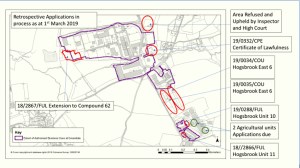
How many Retrospective Applications can one company do at once? Answer 9! Where? Greendale Business Park!

In 2017 FWS Carter and Sons, the owners of Greendale Business Park, appealed against an “Enforcement Notice” against the removal of various industrial compounds and buildings at their Business Park, which they had built prior to obtaining planning permission.

They lost their appeal with the Planning Inspector, who stated in his report that FWS Carter and Sons had misinterpreted the East Devon Local Plan and that their interpretation was “patently wrong”.

But undaunted the company challenged the Inspectors decision in the High Court. Early last year the company lost the appeal in the High Court. The Judge’s decision also restricted the owners any further opportunity to appeal and them to pay all costs arising from the case.

The Company was required to return the area back to agricultural use, but it transpires that they imported soil and laid this over the concrete yards and simply reseeded it.

It remains to be seen if the covering the concrete is enough to satisfy the Planning Inspectors requirement that the land must return to agricultural use.

Lessons learnt?

So once bitten, twice shy you would have thought with substantial losses, large court fees and professional fees involved!!

Unfortunately, it would seem not, for this family run business. Now there are 9 applications which are known to have been or are in the process of building work before the Planning Applications were submitted.

18/2866/FUL. A retrospective planning application for a rear roller shutter door and concrete pad on the rear of an industrial building onto agricultural land at Unit 11 Hogsbrook Farm. This application is before East Devon’s Planning Committee on Tuesday 4 March.

19/0034/COU. A Retrospective Application at Hogsbrook East 6. A retrospective change of use from agricultural use to industrial. An interesting history to this one! Originally built for a gas pipeline contractors’ compound that had to be returned to agricultural use when the pipeline was completed. However, FWS Carter and Sons applied for planning permission to retain the secure compound for fruit farming. Instead of fruit-growing, Woodbury Carbreakers as tenants stored scrapped vehicles there instead! After 3 years and a court case they were eventually evicted by the Environment Agency, but the owners then used it for commercial storage. Their application for industrial use failed 3 years ago, but just before an Enforcement Notice was served in late 2018 they submitted a further application. But they withdraw it and submitted this latest application.

19/0035/COU. A Retrospective Application next to Hogsbrook East 6. Very similar to the previous application which was used for the gas pipeline company. FWS Carter and Sons submitted, what is called a “Certificate of Lawfulness” which in planning terms means that after 10 years of illegal use they would not require planning permission, to allow to continue operations. However, their own documents clearly stated that gas pipeline contractors had been tenants until July 2009. As this was classified at permitted lawful use the submission was refused. Just as the previous application prior to an “Enforcement Notice” was served as the previous site in late 2018 they submitted a further planning application. They again withdraw it, a submitted this further application.

19/0332/CPE. This was a submission of a “Certificate of Lawfulness” at Greendale unit 33A. Following the publication of the East Devon Villages Plan it was realised that this unit was outside the permitted “Employment Zone” for Greendale Business Park. This was because in its 15 years of operations, planning permission had never been applied for! Therefore, the Local Authority asked the company to summit the paperwork to legalise the operation.

19/043/FUL. A Retrospective Application for 3 Freezer storage pods at Compound 31. The compound is used by DHL Logistics for parcel distribution, but early last year after winning a distribution contract with Kentucky Fried Chicken they started frozen food distribution as well. Several residents living close by the noisy freezer units and hearing the loading and unloading during the night reported the problem to Environmental Health at East Devon. They suggested to the Planning Department that a retrospective application should be submitted.

19/0288/FUL. A Retrospective Application for an extension to Unit 10 at Hogsbrook Farm to extend an Industrial Building which sits on the Employment Boundary of Greendale Business Park. This would mean that the extended building would straddle the boundary between Industrial/Agricultural use.

18/2867/FUL. A Retrospective Application to extend Compound 62 beyond the Employment Boundary into agricultural and landscaping area. The area has been built up over recent years with inert waste material under an Environment Agency permit but it would seem the Company has gone beyond the permitted landfill area.

There are 2 further Retrospective Planning Applications due for extensions to Agricultural units that have been reported to the Enforcement Officer at East Devon District Council.

That’s nine Retrospective Applications in a row. Is that a record!!

And the Government still insist that Planning Authorities treat Retrospective Applications the same as any other Application!

“New homes in Devon are built so badly ‘children can remove cement with their fingernails’ “

Owl is confused. Isn’t EDDC’s Building Control department supposed to be passing or failing these new properties?

“The East Devon District Council meeting heard from Cllr Douglas Hull, who proposed the motion and said: “There are so many badly new built houses in East Devon and it is getting even worse”

The Government has been urged to prioritise a new property ombudsman to streamline complaints against shoddy builders as there are ‘so many badly new built houses in East Devon’.

Councillors on Wednesday unanimously voted to call on the government to fulfil its February 2018 pledge to provide the much needed remedy for homeowners as a matter of the highest priority.

The East Devon District Council meeting heard from Cllr Douglas Hull, who proposed the motion and said: “There are so many badly new built houses in East Devon and it is getting even worse.”

Cllr Hull added: “We have to have houses we can be proud of the region, and we have to say that enough is enough. We need to think about the people who end up buying second rate houses.”

He added that in some of the new houses, they are built so badly that small children with can rip out the cement with their fingernails, adding: “If you don’t believe me, try it yourself.”

Cllr Eleanor Rylance added: “We have a quality control issue with a lot of the houses, and then we have a problem with people are renting from a housing association who don’t feel that they can be complain as they will lose their house.

“Cranbrook is developer led but some developers are prone to get people to buy the property before everything is done.”

No developers were named during the meeting, but it has recently been confirmed that Persimmon Homes are carrying out fire safety barrier inspections in Cranbrook after it was found that some new build homes were missing them.

Cllr Ian Hall added: “Some of the building companies in this area just don’t care, and they have no shame.”

Cllr Geoff Pook, who has been involved in the building trade in East Devon, pledged his support for the motion.

The council unanimously agreed to urge the government to fulfil its pledge to introduce a new property ombudsman to streamline complaints against shoddy builders as soon as possible.”

https://www.devonlive.com/news/new-homes-devon-built-badly-2605646

“Excessive” housing in a Local Plan allowed to go to appeal

“CAMPAIGNERS battling the impact of Waverley’s “excessive” housing targets are celebrating a landmark legal decision giving them the green light to appeal.

In a fresh twist threatening to undermine the borough council’s adopted Local Plan, which calculates 11,200 houses must be built by 2032, the Court of Appeal agreed last Thursday it would hear the joint challenge by Surrey Campaign to Protect Rural England (CPRE) and Protect Our Waverley (POW).
The challenge centres on whether Waverley had to increase its housing target by 1,600 homes in order to accept Woking’s “unmet need”.

If the joint appeal succeeds – due to be heard later this year – it will anger residents forced to accept unpopular housing schemes driven by Waverley’s determination to meet its housing target, such as a controversial scheme for up to 200 houses agreed last week in Milford (see page three).
Last week’s Court of Appeal decision reverses a High Court decision in October 2018 rejecting POW and CPRE’s case that Waverley should not be obliged to take half of Woking’s unmet need.

Celebrating CPRE’s successful appeal against October’s verdict, Andy Smith, CPRE Surrey branch director, said: “We are pleased that the Court of Appeal wish to see the matter of Woking’s so-called unmet need properly addressed, as there are big question marks over it.

“In the housing requirement numbers for both the Waverley and Guildford Local Plans, this issue of Woking’s unmet need, lurks in the background. It will be good to bring this issue out in the appeal court, as it has profound consequences – not just for Waverley and not even just for West Surrey, but also county wide and nation wide.

“Our countryside is at risk from excessive, arbitrary and unsustainabule housebuilding targets, and that is why we needed to challenge the housing calculations.”

POW chairman Bob Lees highlighted that the appeal coincides with Woking Borough Council declaring it now has no unmet need, and new demographic figures released by the Office for National Statistics implying a much reduced need for new housing.

Welcoming last week’s decision, Mr Lees said: “This is great news. It provides Waverley Borough Council with a golden opportunity to significantly reduce the mandatory number of new houses to be built in the borough over the next 14 years.

“POW fought against the housing requirement at the examination of the Local Plan. POW fought again in the High Court. POW will fight in the Court of Appeal. POW is fighting to protect our Waverley against unneeded development of our towns, of our villages and in our beautiful countryside.”

Waverley has set aside a “fighting fund” of £300,000 to defend its Local Plan. Responding, borough council leader and Farnham councillor Julia Potts, said: “This news is obviously extremely disappointing for us, but we will, of course, be vigorously defending our adopted Local Plan; the plan we believe represents the best possible vision for the borough’s future.
“It means we can work in partnership with the borough’s towns and parishes to develop Neighbourhood Plans, so communities can mould new development where they live. It means we can safeguard our borough against inappropriate development.

“It should be remembered that Waverley did not bring this legal action, but we have to defend both the borough and town and parish councils, whose Neighbourhood Plans are now threatened by this action. We all want appropriate plan-led development and we did everything possible at the inspection to defend a lower housing number.

“It is extremely disappointing that a few determined individuals continue to raise these legal challenges, despite the High Court upholding the Local Plan following the hearing in October 2018 and despite it having been approved by a government inspector.

“We are committed to preserving and protecting the adopted Local Plan. It will remain our principal planning document and continue to guide our planning decisions.”

http://www.farnhamherald.com/article.cfm

“Help-to-buy scheme pushes housebuilder dividends to £2.3bn”

“Britain’s biggest housebuilders paid out £2.3bn in dividends in their most recent financial year, as the help-to-buy subsidy pumped up their profits and house prices.

The nine biggest housebuilders listed on the London Stock Exchange declared the dividend payouts in their last full financial years, according to an analysis by AJ Bell, an investment platform.

Help to buy, introduced in 2013 and recently extended until 2023 for first-time buyers, was one of the flagship policies of the coalition government. Former Conservative chancellor George Osborne hoped to boost home ownership among young people, as house price growth far outpaced wage growth.

However, many economists believe the scheme boosted house prices without making a significant impact on the supply of new houses, enabling a profits bonanza for Britain’s biggest housebuilders and their shareholders.

In 2012, the final full year before the help-to-buy scheme was introduced, the top nine firms – many of which had been battered by the financial crash – paid dividends of only £57.7m, according to AJ Bell. Dividends declared in the companies’ most recent financial year were about 39 times greater.

Since 2013 the nine housebuilders have paid out nearly £8bn in dividends, while City analysts forecast another £5.2bn in payouts in 2019 and 2020. Furthermore, shareholders have also enjoyed appreciation in housebuilders’ share prices, which have been sustained by the promise of further profits.

Persimmon, half of whose sales were part of help to buy, was responsible for 2018’s largest giveaway. Its shareholders collectively earned £732m in dividends in the year ending in December, after the company earned more than £1bn in profits.

Taylor Wimpey declared dividends of slightly less than £500m during the same period. Barratt Developments declared £435m in the year ending in June 2018. Bellway, Berkeley Group and Bovis all declared dividends of more than £120m in their last full financial year.

The large profits of housebuilders have attracted heavy criticism, amid a continued housing crisis and rising homelessness. Persimmon’s former chief executive, Jeff Fairburn, resigned in November following public fury over his £75m bonus, which had been scaled back from £110m after investor outrage. …”

https://www.theguardian.com/business/2019/mar/01/help-to-buy-pushes-uk-housebuilder-dividends-to-23bn

Owl was right: Rockfish for Sidmouth Drill Hall

As predicted: Up-market fish and chip shop for Drill Hall!

https://www.sidmouthherald.co.uk/news/rockfish-offer-for-sidmouth-drill-hall-1-5908857

Taylor Wimpey making nearly as much profit as Persimmon (£811 m)

“… The strong results came a day after rival Persimmon reported a £1.09bn profit for last year, the biggest ever made by a UK housebuilder. For every home sold, Persimmon made a profit of £66,265, compared with £53,073 at Taylor Wimpey.

Housebuilders have profited hugely over the past five years from the taxpayer funded help-to buy-scheme, which allows buyers to put down a deposit of as little as 5% on a new build home, while the government lends the buyer up to 20% of the value of the property (40% in London), interest free for the first five years.

More than a third of the homes sold by Taylor Wimpey last year were through the scheme, at 36%, although this was less than the 43% in 2017. The average price of a private home sold by the company was £302,000 – up 2% – while the overall average selling price, including social housing, was flat at £264,000.

Taylor Wimpey’s profits have trebled since the beginning of help-to-buy in 2013. It defended use of the scheme, noting that 77% of sales made through it were to first-time-buyers.

Greg Beales, campaign director at Shelter, said: “Taylor Wimpey joins Persimmon as the next developer making massive profits funded by taxpayer cash whilst doing very little to address the housing crisis in this country….”

https://www.theguardian.com/business/2019/feb/27/taylor-wimpey-reports-811m-in-profits-boosted-by-help-to-buy

“Regional” chain restaurant chosen as preferred bidder for Sidmouth Drill Hall

https://www.sidmouthherald.co.uk/news/restaurant-bids-proposed-for-drill-hall-site-1-5906323

Mitch Tonks Rockfish?
Hugh Fearnley-Whittingstall River Cottage?

Not allowed to know.

Persimmon: Cranbrook is confirmed among developments being inspected for missing fire safety barrier inspections

“Persimmon Homes is continuing to carry out fire safety barrier inspections not just in Devon but across the South West and nationally after it was found homes were missing them, it has been confirmed.

The developer has not disclosed which housing developments it is inspecting, but it is now known Cranbrook, the new town in East Devon will have 6,551 homes by 2027, as well as Hill Barton Vale in Exeter, Coverdale in Paignton and even developments in Cornwall, are among them.

The issue was exposed following a ‘ferocious’ blaze which broke out in in one of its developments, Greenacres, and the Newcourt area near Topsham. Last April a fire in Trafalgar Road off Admiral Way and Topsham Road, last April, spread into the roof spaces of two of the adjoining properties. Both homes failed subsequent fire safety barrier inspections.

In an email shared with Devon Live by a Newcourt resident, Persimmon Homes stated last month it is continuing to inspect homes. Persimmon Homes South West suggested the pass rate in Newcourt is 59 per cent, and the majority of other sites are achieving a pass rate of over 90 per cent of plots inspected. …

…However, the developer has been criticised for taking too long to carry out inspections after being made aware of the issue, as well as for sending out inspection request letters to residents in Cranbrook on unheaded paper, and confusing residents by sending out duplicated inspection letters when their homes have already been investigated.

In the email, Richard Oldroyd, regional chairman of Persimmon Homes, said: “You have asked what we are doing nationally and I can confirm that further inspections are being completed, but I am unable to provide details at this stage.

“I can confirm that as we previously advised when we met we have increased the resource on this project to ensure we are able to complete the inspections in shorter timescales.

“As you are aware we had relied upon the National House Building Council (NHBC) as part of their building control service to ensure that the cavity barriers were correctly installed. As a result of this failure in process we have instigated our own additional checking regime to provide an additional compliance inspection.”

https://www.devonlive.com/news/devon-news/cranbrook-confirmed-among-developments-being-2582214

Another construction greed and sleaze scandal

“Bosses at Britain’s largest private construction business enjoyed a sharp rise in payouts last year despite ongoing losses and a bumpy refinancing that forced it to file its accounts months after the legal deadline.

Five directors at Laing O’Rourke, which has worked on major projects such as Crossrail and Heathrow Terminal 5, were paid £3.4m in salaries and short-term incentives in the year to March 2018, compared with just £1.6m in the previous 12 months.

The accounts were due to be filed in September but auditors refused to sign off on the company as a going concern until it refinanced £177m of debt in its UK business. …”

https://www.telegraph.co.uk/business/2019/02/24/bumper-pay-day-bosses-loss-making-laing-orourke/

“Housing is creaking — and not just because of Brexit”

David Smith, economics editor The Sunday Times:

“… There are two other elephants in the room.

The first is affordability. Official figures show that the average house price in England and Wales is 7.8 times annual full-time average earnings. The ratio has continued to climb in recent years, even since the crisis.

Over the past 20 years, it has more than doubled in England — up 123% — and nearly done so in Wales — up 92%. Viewers in Scotland have their own figures, but it has also gone up substantially.

It is true, of course, that ultra-low interest rates affect the affordability calculation when it comes to monthly mortgage payments, making bigger mortgages more affordable, but high prices are still a mountain to climb when it comes to deposits.

Also, even though wage growth has picked up, at a little over 3%, it is not making much of a dent in the high house price/earnings ratio. Older readers will remember a time when you took out a mortgage you could barely afford, confident in the knowledge that salary rises would come to the rescue. Things are different now.

The other elephant is the Help to Buy scheme, beloved of my friends in the housebuilding industry, where it has been like manna from heaven. First-time buyers have been steered towards new housing by Help to Buy equity loans on up to 20% of a property’s value in most of the country and a hefty 40% in London.

This has had two effects. By tilting first-time buyers towards new-build homes, it has distorted patterns in the market for existing homes. Young people who used to buy older homes, including “doer-uppers”, now have a powerful incentive to buy new. Normal housing market chains are not having a chance to form.

The second effect has been to push up prices for new properties relative to existing homes. Again, this comes out clearly from the affordability data.

In the early 2010s, the house price/earnings ratios for new and existing homes were similar. Since then they have diverged significantly. The latest figures are that the ratio for new homes is 9.7 — the average new home costs nearly 10 times average earnings — compared with 7.6 for existing homes. First-time buyers are being pulled into higher-priced homes and, ultimately, more debt. …”

Source: Sunday Times (pay wall)

“Final contract yet to be signed for Exmouth watersports centre project”

“East Devon District Council (EDDC) and Grenadier Estates agreed a development deal in August 2017 and planning permission for the facility was granted in June last year, but the supplementary agreement relating to beach access has yet to be signed.

Peter Quincey, director of Grenadier, has said the company is excited to commence with this project and is keen to get on site as soon as possible, but the details of a supplementary agreement is still to be finalised.

The council’s deputy chief executive told councillors at a cabinet meeting that Grenadier is still being chased.

At the meeting on Tuesday, February 12, Exmouth councillor Steve Gazzard asked for answers on the Queen’s Drive project.

He said: “I am trying to be helpful, but I want some answers.

“Can we have an update on whether Grenadier signed finally signed the contract, whether Michael Caines is definitely opening a restaurant or is just interested in opening a restaurant, and whether, subject to planning permission being granted, there is money allocated in a budget for repairs to the play park on the seafront?”

Richard Cohen said: “I cannot say specifically what the details between Grenadier and Michael Caines are, but the fact they have announced he will be opening a restaurant suggests they have a high degree of confidence in it.

“We will have to budget for any maintenance at the play park that needs to be carried out and we have already done some work on wear and tear repairs.”

After the meeting, Mr Quincey said: “We are delighted to have Edge Watersports and Michael Caines supporting the new watersports centre on Exmouth seafront. Work is expected to begin on site in Summer 2019 and conclude Summer 2020.”

In November, the cabinet approved the £1.2m work on realigning the road and the car park as part of ‘phase one’ of the Exmouth seafront regeneration scheme, The second phase will be the development of the watersports centre and ‘phase three’ is a mix of leisure facilities on the former Exmouth Fun Park site and the current Harbour View plot.”

https://www.exmouthjournal.co.uk/news/watersports-centre-contract-not-signed-1-5896955

Persimmon faces loss of Help to Buy homes contract over shoddy work : Anger as Persimmon set to post £1bn profit”

Britain’s most profitable housebuilder faces being stripped of its right to sell Help to Buy homes after allegations of poor standards and punitive hidden charges.

James Brokenshire, the housing secretary, is reviewing Persimmon’s participation in the government scheme, which accounted for half of the homes it built last year, The Times has learnt.

Since Help to Buy was introduced, Persimmon’s profit per house has almost tripled, rising from £22,114 in 2012 to £60,219 in 2018. Half of the 16,000 homes the company built last year were sold under the scheme, which is designed to boost home ownership.

Persimmon is now set to become the first housebuilder in the country to report profits of more than £1 billion.

Introduced in 2013, Help to Buy offers buyers with a deposit of only 5 per cent an interest-free loan of up to 40 per cent of the purchase price in London, or 20 per cent outside the capital.

Critics say the scheme has subsidised huge profits and multimillion-pound bonuses across the housebuilding industry while inflating property prices.

An investigation by The Times last year found that homes available under Help to Buy cost an average of almost 15 per cent more per square metre than comparable properties that were not eligible.

At the end of 2017 Jeff Fairburn, then Persimmon’s chief executive, was in line for a bonus of £110 million despite the company being embroiled in a scandal over unfair leases and criticised for the quality of some of its homes.

The company has been accused of selling houses on leasehold terms, under which buyers are forced to pay ground rent charges that provide an extra source of income. There have also been complaints about the quality of some of the new homes.

Mr Brokenshire is understood to be worried about the company’s behaviour after a string of complaints. A source close to the housing secretary said that Persimmon’s “approach” would be “a point of discussion” when the government decided which house builders would be allowed to offer Help to Buy homes from 2021.

“James has become increasingly concerned by the behaviour of Persimmon in the last 12 months,” the source said. “Leasehold, build quality, their leadership seemingly not getting [that] they’re accountable to their customers are all points that have been raised by the secretary of state privately.

“Given that contracts for the 2021 extension to Help to Buy are being reviewed shortly it would be surprising if Persimmon’s approach wasn’t a point of discussion.”

They added: “James is clear any new government funding scheme will not support the unjustified use of leasehold for new homes, including Help to Buy.”

Yesterday critics demanded a complete overhaul of the scheme.

Clive Betts, the Labour MP and chairman of the housing, communities and local government select committee, said: “Help to Buy has clearly been the prime driver of Persimmon’s profits. Companies are there to make money but they should behave responsibly as well. Some of Persimmon’s practices have been questionable to say the least.

“I think most ordinary people will be outraged by this.”

Nationwide Building Society says that house prices for new-build properties have grown 15 per cent faster than for older properties since Help to Buy was introduced.

An official report published last year found that almost two thirds of people using Help to Buy did not need it to get on the property ladder and that the average income of applicants was £53,000.

Mr Betts added: “My personal view would be that if government wants to help solve the housing crisis, it will have to put more money into helping build homes that people can afford to rent.”

Henry Pryor, a buying agent, said that the increasing number of homes being built across the country had led to a decline in quality. “If you aspire to build 300,000 homes a year there will be people taking short cuts, it is human nature, and we don’t have a sufficiently robust system in place to ensure the properties are fit for purpose,” he said.

“I don’t think there is a conspiracy to knock out shoddy homes but we are seeing what I call Friday afternoon houses. Homes that seem like they have been built by someone who’s had a good lunch on a Friday or is rushing off for the weekend.”

The government confirmed last year that Help to Buy would be extended by a further two years from 2021, although from this date there will be a cap on the value of eligible homes to within 20 per cent of average prices in each region.

The Home Builders Federation argues that the scheme has been a huge success because it has helped to boost the supply of new homes.

A spokesman for Persimmon said: “Our performance over recent years reflects the group’s success in growing its construction volumes to meet UK housing need, particularly by offering attractively priced new homes to first- time buyers. Since 2012 we have increased our output by 75 per cent and invested £3.8 billion in new land. In late 2018 we announced a range of new customer service initiatives and we are confident that these will improve our performance once they have had time to take effect. We are also making a significant investment in training to address the shortage of skills in the industry.”

Analysis
Help to Buy has some heartfelt enthusiasts (Anne Ashworth writes). These are the millennials who cannot rely on a payout from the Bank of Mum and Dad but still want a place of their own. If they have a deposit of 5 per cent they can use Help to Buy to climb on to the ladder. Without it some would be forced to remain in rental accommodation for decades, excluded from home ownership.

However, even supporters of Help to Buy will share the widespread dismay about the way in which housebuilders have exploited the policy. Some bosses have enriched themselves at the taxpayers’ expense, apparently with the co-operation of the Treasury, which did not impose rules to ensure that the policy did not become a bounty for the boardroom. The most notorious example is Jeff Fairburn, former chief executive of Persimmon, who pocketed £75 million, but others have also prospered.

One of the original aims of Help to Buy was to ensure that builders “got shovels into the ground”. Little thought seems to have been given to ensuring that these homes would be solidly constructed. Many are shoddy, unlovely and not energy-efficient.

Thanks, in part, to Help to Buy, mortgage lending to first-time buyers is at its highest since 2006. The chancellor is likely to hail this as a success story in his spring statement next month. He should instead order that Help to Buy, which runs until 2023, provide quality housing for first-time buyers, rather than financing yet more mansions for housebuilder directors.
Anne Ashworth is property editor of The Times

Case study
Nicola Bentley thought she was buying a “dream home” for her family last May when she exchanged contracts on a £280,000 house from Persimmon in Kippax, Leeds (Louisa Clarence-Smith writes). However, when the finance director, 46, moved in she said she found 700 snags, ranging from a damaged cooker to leaking pipes and shoddy plasterboard on internal walls.

Ms Bentley, a mother of two, said she is still waiting for issues to be resolved. “We have been living in hell for the last nine months,” she said. “Persimmon told us it would take three to four weeks to rectify all our snags. We are now into week 26 and living in a building site.”

A spokesman for Persimmon said: “We recognise that Ms Bentley has experienced an unacceptable level of issues and have been working hard to address these. The majority have been dealt with and we are working with Ms Bentley to resolve the remaining matters.”

Source: The Times (pay wall)

Clinton Devon Estates and Taylor Wimpey forced to halt construction at Plumb Park Exmouth due to foundation problem

“Construction work has been halted in one area of a new homes development site after foundation issues were discovered.

Work began on the Clinton Devon Estates and Taylor Wimpey’s Plumb Park development in Exmouth back in November 2017 with planning permission granted for 264 new homes. Work is expected to finish by the end of 2022.

However, it has emerged one plot – which is currently unoccupied – has foundation issues, but it has not been confirmed what they are.

Taylor Wimpey have stated the plot will not be sold until investigations are complete, or until any subsequent remedial work is carried out to the foundation.

The developer is currently is working closely with consultant engineers to carry out ongoing ground investigation works in the vicinity of affected plot.

It means construction work has been postponed in the area while those investigations take place.

Taylor Wimpey confirmed there are no issues in any occupied homes.

A Taylor Wimpey spokesperson said: “We are investigating a foundation issue that relates to one unoccupied plot at our Plumb Park development.

“This issue was identified as part of our ‘pre-construction testing of ground conditions’ on subsequent plots, and as part of our stringent quality checks. We can confirm that no occupied houses nor any public areas are affected.”

https://www.devonlive.com/news/devon-news/work-stopped-taylor-wimpey-homes-2573195