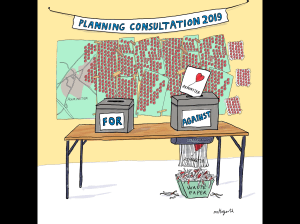
CON-sultation – Axminster-style!

East Devon District Council is controversially set to borrow £200 million to purchase property. The Council Cabinet agreed its Commercial Investment Framework, which would allow it to do so, on 6 February.
However many EDDC councillors have great concerns about this strategy. As a result, a Notice of Motion (NoM) was tabled by Councillor Roger Giles (Independent – Ottery Town) to be debated at the EDDC full council meeting on 27 February. The NoM was submitted in time, and was supported by more than the required number of other councillors.
However the EDDC Chief Executive Mark Williams struck the NoM off the agenda, on the grounds that the matter had already been discussed at the Cabinet meeting on 6 February.
“The EDDC Cabinet consists of just 10 councillors, and is Conservative controlled” said Roger Giles.
“The investment strategy would massively increase the council`s indebtedness, and is inherently risky. I therefore considered it essential that the whole council should be able to have a full-scale debate, and vote on the strategy.”
“However the Chief Executive has intervened to ban my NoM from being included on the agenda paper. By doing so I believe he has damaged our democratic processes – an action which is deeply regrettable.”
Councillors said they were horrified they were being asked to ‘give away poor people’s right to a house’.
Last month, Teignbridge District Council’s planning committee approved a scheme that will see 10 new two and three-bed apartments built on the site of the Neilston Retirement Hotel in Woodway Road, but only if an affordable housing contribution of £86,431 was provided.
But an independent viability appraisal confirmed that a contribution that large would mean that the development would not be viable and that they would not be able to proceed.
The application went back before planners on Tuesday morning and they voted to accept the recommendation of the planning officer that an affordable housing contribution of £37,500 was requested.
Had the application been totally policy compliant in terms of a 25 per cent affordable homes or off-site contributions for Teignmouth, then developers would have been asked for a total liability of £172,863.
Cllr Alistair Dewhirst said: “I am horrified that we could just give away poor people’s right to a house and I couldn’t possibly support it. I don’t think what is there now is special but what they are proposing looks like Colditz to me.”
Cllr Jackie Hook added: “Last time we were content with the application and were happy to see these new apartments built and we compromised in favour of a contribution of one affordable unit.
“The applicant’s appraisal identifies a developer’s profit of £228,280, so we should ask for £50,000, not the £37,500, and they will hardly notice the difference.”
Cllr Dave Rollason added: “A £228,000 profit is a lot of money. The need for affordable housing is massive and it is unfair that we are taking money from the pockets who need it most and giving it to developers.”
She added: “You either have to accept the independent advice over viability, or refuse the application.”
Cllr Phil Bullivant said it would be very difficult to go against the professional advice given and he could not see the evidence to go against it.
Cllr Dennis Smith, chairman of the committee, added: “We asked for this report and now seem to want to just be ignoring what it says. The viability statement says that £37,500 is fair, so I don’t see how we can argue about it.”
The proposal of Cllr Hook to increase the contribution required to £50,000 was lost, and then councillors voted by 14 votes to three to approve the application with an affordable housing contribution of £37,500.
The scheme would see the demolition of the existing building and the construction of a three storey apartment building containing 10 new two and three-bed apartments, plus 18 car parking spaces and two double garages.
Councillors had previously been on a site visit and raised no objections to the principle of the application, with Cllr Charlie Dennis said that the building has deteriorated, is past its best and at present it is a ‘sad thing to see’.
https://www.devonlive.com/news/devon-news/theres-busy-homeless-camp-exeter-2565711
“One of Britain’s largest housing associations has been forced to scrap an advertising campaign that implied its shared ownership scheme was equivalent to home ownership.
The Advertising Standards Authority (ASA) ruled Notting Hill Genesis – which owns 55,000 properties in London and the south-east – misled consumers by comparing its scheme in contrast with renting.
A slogan on its ad said: “I own a two-bedroom apartment and pay less per month than my friends pay to rent a room in a flatshare.”
But the ads were promoting the group’s shared ownership scheme, where homeowners only technically own a slice of the property and pay rent to Notting Hill in respect of the rest. …”
“Most new “affordable” housing in Devon is anything but, a major new DevonLive investigation has revealed.
Affordable housing is an umbrella term used by the government to describe lower-rent properties that are available to eligible households unable to afford the full market rate.
This includes both traditional social rent housing – which is similar to what most people know of as council housing – and “affordable rent” housing, which was first introduced in 2011/12.
Social rent is based on a formula that combines local wages and local property values, and typically sees rents set at around 50 per cent of private rents in the same area.
“Affordable rent”, however, is capped at 80 per cent of the full market rate – meaning that in many areas it will still be out of the reach of people on low incomes. …
… Some local areas see “affordable rent” housing dominate more than others. In Mid Devon, South Hams, Teignbridge and West Devon, 100 per cent of new affordable housing was “affordable rent” rather than social rent last year.
Meanwhile, in East Devon the figure stood at 97 per cent, in Torridge at 67 per cent, and in both North Devon and Exeter at just 13 per cent.
In Plymouth the figure also stood at 100 per cent, while in Torbay they made up 58 per cent of the total.
In comparison, the national average saw 81 per cent of new affordable housing built or acquired across England in 2017/18 classed as “affordable rent” rather than social rent.
The most common type of affordable housing found in Devon is general needs properties managed by private registered providers, such as housing associations.
These cost an estimated £86 a week on average for a social rent property, compared to £121 a week for an “affordable rent” property – meaning “affordable rent” in Devon is typically 42 per cent higher, or £1,854 more a year. Private renters in Devon pay an estimated £150 a week, on average.
Kate Henderson chief executive of the National Housing Federation said: “In 2010, the government stopped funding social housing altogether, and announced it would only fund homes for “affordable rent” instead.
“This left housing associations in a really difficult position where they had to choose between building homes for “affordable rent” or building nothing.
“In the face of a dire housing shortage, many housing associations chose to build affordable rented homes, but continued to argue that social housing shouldn’t be neglected.
“While affordable rents do work for some people, there are many more who desperately need social housing.
“In 2017, the government announced some new money for social housing for the first time in seven years, but this is nowhere near enough.”
https://www.devonlive.com/news/property/new-affordable-housing-devon-anything-2543061
“A disgruntled new home owner has spoken of his frustration at still waiting for his warped front door to be replaced after more than a year and having to contend with many other issues in his property.
Jamie Leaman moved into a two-bed house in Bishops Court – a housing development next to Sandy Park, Exeter – in July 2017 with his partner and their 12-year-old daughter.
Problems which have had to be corrected include a ‘leaky oven’ which had to be replaced and caused damage to a fitted kitchen cupboard; missing plasterboard tape which means joins are now visible; the back door handle had to be replaced because it was loose and had issues with the locking mechanism; and an incorrectly fitted bath panel has required replacing.
In January 2018, Jamie, 42, reported to Redrow he had a problem with his front door, and is still waiting for the issue to be resolved. Redrow have responded saying they are working with him to come to a resolution. …”
Jamie, who lives in a shared ownership property, claims there are also many other residents who live in Bishops Court who have also encountered problems with their homes.
He said: “There is a Bishops Court Facebook forum page where quite a few people have complained about Redrow. Someone said they wished they have never moved here. It doesn’t seem to matter if you live in a shared or full ownership home; the problems are the same. …”
“East Devon District Council has received three ‘interesting and diverse’ bids for the site following the consultation period, which ended on Friday, February 4.
A core group made up of Sidmouth and East Devon town and district councillors are now considering the bids, working with property agent JLL which has managed the marketing.
A council spokesman said at the moment the details of the bids must remain confidential and recommendations will be made for East Devon District Council’s cabinet for approval at a later date. …”
This means that, should the NHS ever regain the funding and doctors it needs, and should the local surgery then be in a position to open a secondary surgery in Newton Poppleford, it can never happen.
Anyone buying a new Clinton Devon Estates house at Newton Poppleford (particularly if they have children, or a chronic health condition or are elderly) might want to think twice if this is a suitable location for them.
And EVERYONE should beware “promises” from developers.
“A Devon development site once earmarked for a “much needed” GP surgery is being turned into housing instead – much to the disappointment of residents.
People living in Newton Poppleford have to travel miles for medical care.
It comes as a report from the government watchdog, the National Audit Office, has criticised how community infrastructure projects for healthcare, education, and transport are often abandoned once planning permission’s been granted.
In a statement, the developers Clinton Devon Estates said the withdrawal of the surgery plans was understandably very disappointing, but the decision was made by a local medical practice due to circumstances beyond their control with unexpected changes to NHS policy.
Developers take heed!
Last weekend, a car slid off the road into the dip alongside the bend in central Sidbury, smashing its windscreen and narrowly missing a row of lowlying cottages.
Radio Devon travel news announced (2nd February) that the Sidford-Sidbury Road (A375) was turning into a skating rink.
Radio Devon travel news announced A375 was closed due to burst water main.
Imagine of that car had been a lorry …..
Owl hears that, somewhat surprisingly, EDDC’s Development Management Committee voted to defer the bat habitat decision.
It also appears that yesterday’s activity in and around the barn, reported by Owl here:
has been reported to the Police who have allocated a crime number to it.
Here is how it has bedn reported in the local newspaper:
“Campaigners fighting the proposed demolition of a known bat habitat in East Budleigh have been given ‘breathing space’.

Image: Archant, Daniel Wilkins
More than 20 members of a conservation group gathered outside Exmouth Town Hall this morning (Tuesday, February 12) ahead of a crucial meeting to decide the fate of an East Budleigh barn known to be home to rare and protected bats.
East Devon District Council’s development management committee decided to defer their decision pending additional information from Natural England about wildlife mitigation on the site.
Landowner Clinton Devon Estates (CDE) is looking to knock down the barn and build a new dwelling on the site and has offered to build a separate ‘bat barn’ on the plot as mitigation.
Speaking after the meeting, Karen Alexander-Clarke, secretary of the East Budleigh Parish Conservation Group told The Journal this decision gives them ‘breathing space’ in their fight to protect the bats’ home.
The Pound, in East Budleigh, which is subject to a planning application to demolish a barn which is thought to be home to species of rare bats.
She also said they would be writing to Natural England to lobby them and ‘emphasise that there are councillors that feel as strongly as we do’.
Speaking at the meeting, councillor Brian Bailey also raised concerns over whether the bats would take to their new home.
He said: “The bats, I feel, have been served poorly because there is no guarantee what so ever that the bats will survive the demolition or would accept their new home.”
Cllr Geoff Jung said: “This is one house and one family that is going to benefit and how many bats and other wildlife are going to benefit?”
An independent ecology report commissioned by the council recommended that the mitigation being offered by CDE be accepted.
Cllr Mark Williamson said he did not feel confident that, if they refused the application and CDE appealed, the Planning Inspectorate would back their original decision.
He said: “As we do frequently, we would look to our statutory consultees to guide us.
“Natural England is giving quite detailed guidance and they recommend the planning authority follow advice from the ecologist.”
Councillors voted in favour of deferring the application pending information from Natural England on the suitability of the proposed ‘bat barn’.”
https://www.exmouthjournal.co.uk/news/east-budleigh-bat-barn-demolition-plan-deferred-1-5889261
“Following the message that we received asking us to remove our banner from the fence backing onto A3052, I thought that I should write to you to let you know we are still here and continuing the fight for sustainable development in Clyst St Mary. There has been numerous items in the press regarding development in and around Exeter known as the ‘Greater Exeter Strategic Plan (G.E.S.P)’ and I have attached a copy of our latest press release which might help to explain matters a little more.
Over five years ago when we formed the Save Clyst St Mary Campaign we never expected to have received so much overwhelming support, for so many years. It really goes to show how uniting the different areas of the village can lead to a continued great outcome for everyone.
If you know someone who wants to get involved either just as a member or actively helping please let me know.”
PRESS RELEASE
“Village Life -v- Future Development
Many people favour living in a picturesque, rural village nestled in surrounding countryside with only the amenities of a village shop, post office, school, pub, hall and church. Clyst St Mary is a village where some historic areas have barely changed since late-medieval times but the settlement has expanded and progressed to incorporate the demands of the 21st century.
It is often described as a rural idyll, offering a different lifestyle than that experienced in the nearby urban City of Exeter. The old village is portrayed as charming and rustic but new contemporary designs show a progressive quality that coexists with the more traditional standards of the settlement. It remains unpretentious but with a modern, caring and vibrant neighbourhood.
This community has recently embraced considerable, sustainable housing development with the building of almost 100 new residences (a substantial quantity for a modest-sized village) to support East Devon Local Plan growth policies to 2031. However, the Local Plan also includes a further 150 dwellings allocated on brownfield land at Winslade Park awaiting planning approval, which totals approximately 250 new homes. Although it is appreciated that people need somewhere to live, such high numbers in one village go beyond growth recommendations in the Local, Villages and Neighbourhood Plans.
Crucially, there are also fears that proposals in the Draft Greater Exeter Strategic Plan (GESP) for substantial future development along the A3052 around Westpoint at Clyst St Mary will sound the death knell for this historic Devon village, with the creation of, perhaps, another new town similar to Cranbrook or building a large suburb of Exeter or a sizeable extension to the existing settlement, all of which could result in the destruction of the village identity.
The entire GESP area incorporates Exeter City, Teignbridge, Mid Devon and East Devon with a vision for the provision of new homes, jobs and infrastructure for existing and future generations while protecting and enhancing the environment. Ideally, each area would share growth, avoiding one locality being burdened by substantial, unsustainable over-development.
However, concerns are not alleviated by recent comments made by East Devon planners declaring that some communities will be detrimentally impacted by proposed GESP large scale growth recommendations, e.g. ‘…in most cases growth would have to be quite substantial to make it viable to deliver the required services and facilities to make the settlement suitably sustainable for growth and in the process could harm the character of the village and the existing community.’
http://eastdevon.gov.uk/media/2581497/040918strategicplanningcombinedagenda.pdf – (Strategic Planning Committee report – 4th September 2018, page 24, Item 9.1).
Furthermore, at the full Council meeting in October 2018 in answer to a question as to why East Devon is taking a disproportionate share of development (58% more than Exeter, 53% more than Teignbridge and nearly three times that of Mid Devon according to independent analysis conducted by CPRE), a local politician replied: “Because we have the land and we are good at it.”
Exeter City Council has just unveiled their 20-year vision for the city, which includes 12,000 new homes, cultural centres, ‘a garden bridge’ across the Exe and the creation of a comprehensive cycle and pedestrian network to tackle traffic congestion.
However, with a target of 53,200 homes proposed for the Greater Exeter areas and the propulsion for substantial business growth, surely the communities within East Devon should equally have sight of the development proposals for their localities? For example, the present Exeter Sowton Park and Ride site appears to show future development – so where will the new replacement Park and Ride facilities be located to serve Exeter?
To date, representatives from East Devon local authority, business communities and growth partnerships have maintained exclusivity regarding the proposals for the GESP large allocation sites offered by landowners for future major development. Will there be a general release to the public of this restricted information before the Local Elections in May 2019? The electorate may be reluctant to vote for expansive commercial and housing proposals that would destroy or detrimentally alter their community.
Consequently, it might be thought unwise to acquaint the populace at this time with extensive GESP growth recommendations for fear that they would be judged undesirable. Although, there will, of course, be statutory public consultation on such vast development proposals under GESP but not until after the Local Elections!
In reality, Clyst St Mary’s portrayal as an idealised village is not entirely accurate and the images below bear testimony to the daily traffic congestion which reaches unacceptable levels, where the A376 and A3052 converge at the bottleneck that is the Clyst St Mary roundabout.
At present, large volumes of HGVs serving the extensive business expansions at Hill Barton and Greendale Industrial Estates, together with huge tractors and trailers importing and exporting to an ever-increasing sized anaerobic digester, thunder through the village! Coupled with significant large levels of commuter and tourist traffic they create safety issues for residents (especially young children) accessing the village primary school, shop, village hall and play park via the toucan crossing on the A3052. Regrettably, the pedestrian footbridge is unsuitable for many users and is generally in a state of disrepair!
Only last year a resident sustained serious injuries crossing the A3052 in the village after being knocked down by a speeding car during daylight hours! Fortunately, there appears to be current medium-sized road improvements planned around the Clyst St Mary roundabout and Junction 30 of the M5 in the near future.
However, it is considered that the crucial, major road network advancement necessary in this area at present and for any future development expansion may not be forthcoming in the current uncertain and fragile financial climate. It is unacceptable for developers to build sizeable residential and business developments that access a substandard, mediocre road network. There is gridlock with the present peak time traffic let alone any future requirements. Planning cycle tracks and park and ride facilities are positive approaches but may be inadequate ‘band-aid solutions’ that will not sufficiently tackle the root causes.”
[Pictures with press release not shown here]
Well, cover me in tar and call me the M5! Owl has been saying this for YEARS. The only question that needs to be asked is: Is this deliberate or unintentional? Either way, it’s a damning indictment of its mendacity and incestuous relationship with developers or a damning indictment of its totally inept ability to govern. Or, of course (and more likely) BOTH!
“The government’s housing planning system is unable to demonstrate it is meeting housing demand effectively, public spending watchdog the National Audit Office (NAO) has said.
The government wants 300,000 new homes a year from the mid-2020s onwards.
The Ministry of Housing, Communities and Local Government has a standard method, developed in 2017, for local authorities to assess the number of new homes needed.
The NAO says this has weaknesses.
It says these weaknesses will result in a cut in the number of planned new homes in five of nine regions, while in London, the method will mean that new builds need to double in order to meet what the department thinks is needed.
The Local Government Association (LGA) said the current formula did not take into account the needs of local communities.
‘Free-for-all’
Local authorities – by law – need to have an up-to-date plan for building new homes.
If they are unable to prove that they have a five-year supply of land for housing, developers have greater freedoms to build where they want.
The NAO points out that this risks ill-suited developments, while the LGA says it risks a “free-for-all”.
The NAO says that between 2005-06 and 2017-18, 177,000 new homes per year were built on average, with the number never rising above 224,000.
To meet its ambition for 300,000 homes a year, the department will need to oversee a 69% increase in the average number of new homes built.
The NAO recommends the housing department should regularly monitor the gap between its ambition for 300,000 new homes and what is being planned.
It also says it needs to work with local authorities and other government departments to ensure that infrastructure is delivered more effectively.
Amyas Morse, the head of the NAO, said: “For many years, the supply of new homes has failed to meet demand.
“From the flawed method for assessing the number of homes required, to the failure to ensure developers contribute fairly for infrastructure, it is clear the planning system is not working well.
“The government needs to take this much more seriously and ensure its new planning policies bring about the change that is needed.”
Councillor Martin Tett, the Local Government Association’s Housing spokesman, said: “We remain clear that the government’s housing needs formula does not take into account the complexity and unique needs of local housing markets, which vary significantly from place to place.”
“The number of social rent homes in England has plummeted by 165,697 in just six years, analysis by a trade body has found.
As many as 199,000 of social rent homes will have been lost between 2012 and 2020, according to analysis of government data by the Chartered Institute of Housing released yesterday.
The housing trade body estimated 140,828 council homes and 57,869 housing association properties will be lost by 2020.
Terrie Alafat, chief executive of CIH, said: “For many people on lower incomes, the only truly affordable option is social rent.
“It is simply unacceptable that we are losing so many of our most affordable homes at a time when more and more people are in need.”
The loss was mainly due to homes sold through right to buy but also demolitions and properties being converted to ‘affordable rent’, the CIH said.
Alafat added: “Government investment is still heavily skewed towards the private market.”
The CIH analysis found 79% of the central housing budget up to 2020-21 is directed towards private housing, with just 21% going to affordable housing.
“Rebalancing this budget could make a big difference – it is vital that the government supports councils and housing associations to build more homes for social rent,” Alafat said.
She added that CIH supports the principle of helping tenants move into home ownership but said “it cannot be at the expense of other people in need”.
Since 2010 funding for social rent, which tends to be around 30-40% cheaper than market rent, has been cut and funding has instead gone towards homes for ‘affordable rent’, which can be up to 80% of market rents.
CIH said the projection of 199,000 homes is lower than previous estimates because the government has made several “positive announcements” including funding for housing associations, lifting the HRA borrowing cap and abandoning plans to force councils to sell their most valuable empty homes to pay for an extension of right to buy.
Minister for housing Kit Malthouse said: “Providing quality and fair social housing is a priority for this government – evidenced by the fact we have delivered over 400,000 affordable homes since 2010.
“And by abolishing the borrowing cap, we’re also giving councils extra freedom to build the social homes their communities need and expect.”
https://www.publicfinance.co.uk/news/2019/02/more-165k-social-homes-lost-six-years-says-cih
Owl says: unlikely!
“Plans for 12,000 new houses in Exeter will be unveiled today as the city expands over the next two decades.
The biggest house-building project will be in Marsh Barton, where more than 5,000 new homes are planned.
Thousands of others will be built in Sandy Gate, East Gate and Red Cow village.
Other schemes are also in the pipeline, including a new bridge over the Exe, cultural spaces and new schools.”
From the East Budleigh Parish Conservation and Wildlife Protection Group.
What they do not mention is that the barn is owned by Clinton Devon Estates – the company that puffs itself up as “gold standard” when it comes to conservation …..
“Planning application, 18/1464/ful. The Pound, East Budleigh.
Since April 2018, the East Budleigh Parish conservation and wildlife protection group, have sought to do its utmost to protect the rare, and the not so rare species of Bat, as well as the other wildlife that inhabit the barn and adjacent green space known as ‘the Pound’ in East Budleigh.
All through this application we have researched extensively, bat law, wildlife protection, mitigation studies, European and domestic legislation and directives from the Bat conservation trust, the Back from the brink project, and Natural England to name but three.
Each body has standing advice on how to protect and conserve EPS (European Protected Species). We have shared that information with all the concerned councillors from parish to district level.
The advice from Natural England and Conservation bodies state that for rare species, the avoidance method should be taken, yet here we are fighting for those methods and laws designed to protect to be implemented.
Through our many conversations with various conservation trusts, the overwhelming response has been, “the laws are there to protect these species, if the LPA follow the directives and adhere to legislation, permission will be denied.”
Having studied the plans for mitigation, We have found shortcomings in all of the mitigation offered by the agent on this application, and areas of complete misunderstanding, or disregard for the laws that are supposed to protect all wildlife. So much so, that this contentious application has reached the next stage of the planning….. the development management committee.
Getting the application to this point is a small victory for the wildlife, as we feel sure, that had we sat by and done nothing, by now, the site would have been levelled, the new house been built and the wildlife displaced, gone, or even worse, dead.(as suggested possible in Richard Greens ecology report) So we have done incredibly well to get this far.
Now…according to EDDC planning agenda, the application is recommended for approval with conditions. It is due to be discussed at the next DMC, on
Tuesday February 12th at
11AM, in the
Council chamber at Exmouth town hall.
But, of course, as is usual in a ‘democracy’, free speech and independent opinion is subject to what the ‘powers that be’, decide on as to what can be discussed and what should be taken in to consideration, so that an informed decision and vote can be made!
During this long process, it has been, and still is, the groups aim to get the best possible outcome for our precious, rare wildlife and our local green space.
We are putting forward the argument that:
1) the Pound is a significant site, regardless of numbers, with no less than four rare species of Bat,( with up to fourteen species recorded by ourselves), evidence of Hazel Dormice and an active Badger sett.
2) the mitigation measures are not adequate, with little to no evidence that these measures are successful for the rarer, disturbance intolerant, more light adverse species such as the Grey long-eared, Greater and lesser horseshoe Bats. An opinion upheld by DWT’s conservation manager in his ‘neutral’ letter to EDDC.
3) the lighting plan is not in line with current research provided by the bat conservation trust, nor the ILP,(institute of lighting professionals) suggesting the maximum light spill should not exceed 0.45 lux lumen on a moonless night. whereas the current proposed lighting plan stands at 0.95. so still more than double.
4) These species ARE protected by law, but human interest is, once again, being favoured above the interest and protection of rare species and local wildlife.
We are, teetering on approval being granted, everything hinging on a committee of councillors who may not be able to see the bigger picture. Which is, if we all stand by and do nothing to protect our local patch and its inhabitants, we will lose more and more green space, more and more species and biodiversity.
Now we may not be able to make a difference globally, but if we all made a stand for our own little corner, couldn’t we, wouldn’t we, make East Devon a better place to be, not only for our wildlife, but ourselves too?
PLEASE STAND WITH US ON THE 12th.
We are meeting at around
10.15am outside the town hall in Exmouth,
to hold a peaceful protest prior to the DMC. So if you have time, We would greatly appreciate your support to stand beside us and be a voice for East Budleighs wonderful wildlife.
EBPCWP Group
ebpcwpgroup@yahoo.com
When the new owner asked who would decide which 27 stores he would close, he said:
Landlords
In Exeter the House of Fraser store was saved by doing a deal with landlord Exeter City Council.
Princesshay is owned by The Crown Estate/TH Real Estate which had already pulled out of extending the shopping centre last year.
“Newly built homes are more energy efficient than ever, the government said this week. But thousands of buyers are finding that their expensive new homes are cold and draughty with heating bills far higher than expected. The culprit? The finger of blame is pointing towards builders rushing to meet targets, lax standards and poor inspection, with badly installed dry lining at the heart of the issue.
Dry lining became popular in the UK in the 1980s, replacing traditional “wet” plastering with ready made plasterboard attached to walls and ceilings. It means plastering can be done in a couple of days rather than weeks.
There is nothing intrinsically wrong with dry lining, which is used commonly in Scandinavia and North America, where winter temperatures drop far below those of Britain. It gives a smooth finish and can be decorated straight away.
But what thermal imaging surveyors and other building experts are discovering is that widespread poor installation of plasterboard has resulted in the airtightness suffering badly.
Housebuilders rush to meet targets (their own and the government’s), often cutting corners, and airtightness suffers as a result. The plasterboard is attached to masonry with adhesive. But Paul Buckingham, a thermal imaging surveyor, says housebuilders often cut costs using “dot and dab” adhesive, rather than solid dabbing.
Thermal imaging often finds air pockets behind plasterboard walls, causing cold spots and reduced thermal efficiency.
“We don’t see any of this airflow in old houses,” he says. “In those built in the 60s and 70s, with concrete floors, the airtightness is pretty good.” (However, they may leak air elsewhere – through open trickle ventilators or fireplaces.)
Going even further back, case studies undertaken in 2011 by energy consultant Diane Hubbard found that most of the houses built before 1900 were more airtight than expected, and in some cases better than required by the 2006 building regulations, and “modern extensions may not be as airtight as the original building”. ….”
Owl wonders how EDDC is getting on with Grenadier in Exmouth …..
“Uncertainty over the impact of Brexit on the UK property market has hit two major council investment projects.
Essex County Council this week formally removed £6m from the budget for its £50m property investment fund after pausing further purchases due to worries over Brexit.
Meanwhile, Brighton & Hove City Council has been forced to delay the signing of a development agreement on a regeneration scheme in which it is planning to invest £8m.
The problems emerged in a week that communities secretary James Brokenshire announced allocations for councils under a new £56m fund to help them prepare for Brexit.
In a report to councillors, Margaret Lee, executive director for corporate and customer services, recommended the £6m reduction in Essex’s property investment fund, saying: “Due to the uncertainties caused by Brexit and the potential impact on the property market, the scheme has been paused with no further purchases planned.”
The pause in investment was originally agreed by Essex councillors in November, after advice from its adviser Hymans Robertson not to expand its commercial property programme “due to the current market conditions including the unknown impact of Brexit”.
However, the council has now decided to remove £6m from the investment programme budget as part of a package of measures that will help the authority reach a forecast underspend of £29.6m in its 2018/19 capital spending programme.
Before the programme was halted, £44m of the fund had been spent on property, which the council says is already yielding £1m for council services.
Essex is set to review whether to restart commercial property investment through the fund during the summer.
Meanwhile, in Brighton, councillors have been forced to delay a deadline they set for housebuilder Crest Nicholson to sign the development agreement on the King Alfred leisure centre and housing regeneration scheme.
Originally, councillors had proposed to walk away from discussions with the developer unless it signed the deal by 31 January.
However, it extended the deadline until 30 March – the day after the UK’s date for leaving the European Union (EU), following a last minute plea from Crest.
In a letter to the council, it cited “challenging economic uncertainties surrounding Brexit and the impact this could yet have on the construction industry workforce and wider confidence and stability of the property market”.
It added that “as soon as we have greater certainty over the nature and form of the Brexit arrangement which we all hope and expect will be achieved shortly, and assuming this does give reasonable certainty over the future trading relations with Europe, then we will enter into the development agreement and commit the team and resources required to promote the scheme, develop the design and seek planning in accordance with the conditions and programme”.
In 2016, the council committed £8m to the project, which comprises a sports centre, swimming pool, underground parking and 565 homes in blocks of up to 18 storeys high.”
A reporter … reports:
“At Tuesday’s Strategic Planning Meeting at Knowle (29 /01/2019), chaired by Paul Diviani, the masterplan for increasing Housing in Axminster by a whopping 30% , was voted through almost unanimously (there was one abstention), despite serious cross-Party criticism of the plan.
As the debate ended, the considerable number of Axminster residents in the public gallery were astonished to hear the Chair’s quip, to Cllr Jill Elson, “ I felt confident that you would come out with something that would stir things up”.
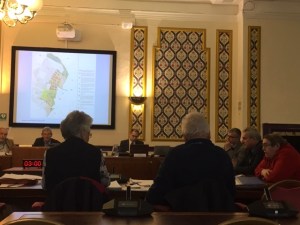
Cllr Elson (shown on right of the photo, beside Cllr Philip Skinner), had argued firmly that “the problem with plans is that they change” , citing her Ward as an example.
“Exmouth ended up with two huge estates with no play space or amenities whatsoever”, she said. Cllr Mike Howe (Con) shared her concerns, saying, (the masterplan) “doesn’t give us much credence or security that we will get the right houses”. But the Deputy Leader of the Council, Philip Skinner (Con ), expressed his view that “Give and take is needed in negotiations with a developer”.
Shortly afterwards, when Cllr Geoff Jung (East Devon Alliance, EDA) observed that the plan might not suit young families, it became apparent that Cllr Skinner was not aware that the proposal to include a primary school had been dropped.
Cllr Eleanor Rylance (Lib Dem) had noticed significant typing and other errors in the masterplan document. Cllr Rob Longhurst (Independent) observed there was no mention of the words ‘Neighbourhood Plan’ in the document.. although Cllr Moulding had told the meeting that he had designed one for Axminster… and suggested this Strategic Plan Committee would like to see “if the community wants and needs” the masterplan.
Cllr Susie Bond (Independent) asked for clarity about the legal implications for the Council if the costs for the relief road “went through the roof” (So far, EDDC has agreed to borrow £7m to ensure the road, estimated cost £16.7m, can be delivered.)
Ian Hall (Con) admitted “this masterplan doesn’t sit easily with the residents of Axminster”, which Alistair Ferguson’s speech in Public Question Time, confirms. The text is reproduced below, with Mr Ferguson’s permission):


In support of the objections, other District Councillors, Cathy Gardner and Marianne Rixson (both EDA), also attended the meeting, though not on the Strategic Planning Committee themselves.
Cllr Gardner pointed out that agreeing to a massive increase in the town’s housing numbers “would not be for the right reasons”, if it was done primarily to fund a relief road. The masterplan “was being done to the people of Axminster, not for them”, she said.
And Cllr Marianne Rixson added that “delivery of affordables does not have a good record” in East Devon.
Having listened to the comments aired, Cllr Geoff Pook (Ind) cautioned the committee not to be “persuaded by the opposition”. “There are just as many people in favour”, he opined.
Finally, the fear that the time-limited government funding for the relief road would be missed, therefore putting in jeopardy the 650 homes allocated in the Local Plan, swayed the committee members to approve the masterplan, albeit with caveats based on their misgivings.
Is this how the wrong sort of housing so often gets built in the wrong place?
In Axminster’s case, how much will the masterplan impact on the historic former deer park? As Cllr Mike Howe, Chair of the Development Management Committee (DMC) told yesterday’s meeting, there’s an urgent need to know….’
This is necessarily a somewhat technical summary of why Owl thinks EDDC has got its recent past and future jobs and housing numbers terribly wrong, and attempts to pinpoint why this is. If the assumptions below are correct East Devon cannot hope to match new jobs to housing number increases and hence to aspirational growth figures.
It has huge implications for the district – not least Cranbrook and Axminster, where huge housing growth does not appear to correlate with very modest job growth.
CURRENT STATISTICAL TREND 258 JOBS/YEAR
EDDC’s 2015 aspiration 950 jobs/year
EDDC’s “Jobs-led policy on scenario” 549 jobs/year
Ash Futures (Experian) “Upper end” 309 jobs/year
Ash Futures “more likely” scenario 200-234 jobs/year
Evidence from the first set of job growth statistics published by EDDC since the adoption of the local Plan are running at less than half the number used to justify the housing development target. This is only one quarter of EDDC’s aspiration to create one job per new household or 950/year.
A “Jobs-led Policy On” aggressive growth strategy lies at the heart of EDDC’s Local Plan for 2013 to 2031.
Consultants were employed to create a number of scenarios forecasting growth in jobs. They ranged from 162-191 jobs/year for forecasts based on past trends to a top estimate for above average “jobs led” growth of 309 jobs/year. This top estimate would justify a housing target of 13,050 for the period.
One of these consultants, Ash Futures, gave cogent arguments as to why this figure, in their opinion, lay at the upper end of likely growth and proposed a more modest, more realistic, set of growth assumptions generating 200-234 jobs/year. This more likely scenario was never converted from a jobs forecast to a housing assessment but it would have been just a bit higher than the 10,512 figure based on past trends. All these forecasts took account of demographic changes, migration into the region and economic growth.
Ignoring this, EDDC decided to add a further 240 jobs/year to the upper end 309 figure in a new “policy on” scenario to provide a total forecast of 549 jobs/year. (Something to do with Cranbrook but the details of this and whether there is any double counting remains a mystery). This 549 job/year figure was ultimately used to justify the final 17,100 minimum housing target for the 18 year period of the Plan adopted in 2016.
The plan requires a minimum average build of 950 houses/year. EDDC’s aspiration is to combine this with the creation of one job for every house built. But this demonstrates a complete failure to understand demographics and household formation. The need for houses and the need for jobs is not a simple equation of one with the other.
Papers attached to EDDC’s Strategic Planning Committee for 29 January 2019 (see footnote) contain data for East Devon employment covering 2009 to 2016. The explanatory text says: “It is recognised that it is an aspiration of Members [surely not every Councillor?] to deliver one job for each new home across the district but since the adopted Local Plan does not set out to deliver this it is not considered appropriate to formally monitor the relationship between the delivery of homes and the delivery of jobs.”
Here’s why – the real evidence, from the data, is of jobs growing at an annual rate of only 258 jobs/year.
This figure confirms the more modest forecasts presented by Ash Futures and, inconveniently for EDDC, is less than half of that used to justify the “Jobs-led Policy On” housing targets. It is only a quarter of the one job per house aspiration of “Members”.
Where does the 258 job/year trend come from? It is the gradient of the best fit linear regression trend line to the data given the Strategic Planning Committee and shown in the graph below. The full data source is referenced in the footnote.
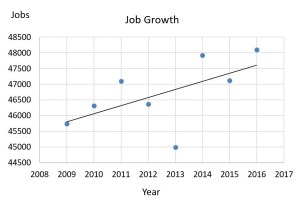
This is a relatively small sample; and the extent of the fluctuations in the recorded number of jobs from year to year can be seen in the graph. For the technically minded the correlation coefficient of the trend line is 0.6, which is quite a strong one.
All the job number quoted above are for “full time equivalent” jobs (FTE).
Owl has been fortunate to find from the same official source as used by EDDC a set of estimates of the total number of jobs in East Devon which extends the time series to 2017. The significance of this is that the total number of jobs in East Devon fell between 2016 and 2017 and so we can expect the same to happen with FTEs. As a result Owl feels even more confident that the trend line shown above, despite the sample size, reflects what is actually happening.
The Local Plan has been in preparation since 2002 and EDDC has been following a growth policy for many years. So, although 2013 marks the formal start of the Local Plan, there is no statistical evidence to consider 2013 a “turning point” for job growth, though it does look to be an outlier.
With EDDC’s plan to build houses running ahead of creating the jobs needed for a sustainable community, just who are we building all these houses for?
Isn’t it time to cool the building programme, not ramp it up as Owl fears is being planned in the Greater Exeter Strategic Plan?
One of the key architects to all this is Councillor Paul Diviani. When asked at a recent council meeting why East Devon is taking all this development replied: “Because we have got the land, and we are good at it”.
Footnote: The combined minutes, agenda and reports of the Strategic Planning Committee with the job data for 2009 to 2016 on page 116 can be found here:
Click to access 290119strategicplanningcombinedagenda_opt.pdf
 East Devon Watch