Greater Exeter – will city living take some of the pressure off East Devon?

It seems that, after years of decline, living in cities has become more and more popular for all age groups, but particularly you g professionals. Given the decline in rural services such as loss of transport, infrastructure, sixth forms, community hospitals and shops, this is not too surprising.

However, when it comes to living in Exeter it seems less popular with its city council (headed as CEO by former EDDC Head of Regeneration Karim Hassan) which appears to favour student housing and leisure centres and cinemas over homes.

And our developer-led Local Enterprise Partnership sees housing growth in areas which its developers favour for very high house prices – pretty towns and commutable rural villages, the coast – including AONBs.

There is no data for Exeter in the article but Plymouth’s city centre population has increased by 34%.

Here is what a BBC article has to say:

“The growth in city centre living is down to young people – older generations have not returned from the suburbs in significant numbers.
Some are students, whose numbers grew with the expansion of university education.

For example, the student population in Sheffield city centre grew by more than 300% between 2001 and 2011, according to census data. By 2011 there were 18,500 students, accounting for about half the population.
Similarly, Liverpool’s city centre student population grew by 208% (6,300 more people), and Leeds 151% (7,700 more people).

But the popularity of big city centres among young, single professionals is the main factor.

The number of 20 to 29-year-olds in the centre of large cities (those with 550,000 people or more) tripled in the first decade of the 21st Century, to a point where they made up half of the population. There is no reason to think that this trend has eased since the census.

Only one in five city centre residents were married or in a civil partnership, while three-quarters were renting flats and apartments.
More than a third had a degree, compared with 27% in the suburbs and outskirts of cities. …”

https://www.bbc.co.uk/news/uk-44482291

Will the Greater Exeter Strategic Plan (now held over until after local elections in May 2019] recognise this new trend? It would certainly take a lot of pressure off East(ern) East Devon.

Exeter or Cranbrook … Exeter or Honiton … hhhmmmm.

https://www.bbc.co.uk/news/uk-44482291

Swire thinks planning officers are poorly trained and don’t stand up to developers

Hugo Swire:

“My right hon. Friend the Secretary of State will be aware of my view—as he and I have discussed it—that most objections to large planning developments are based on the fact that the developments themselves add nothing to the local vernacular, do not acknowledge it and are often poorly built. That is partly owing to a lack of local planning officers and the fact that planning officers are poorly trained. Could the Government consider affiliating some of them to the Royal Institute of British Architects or the Commission for Architecture and the Built Environment, and empowering them so that they can stand against the volume house builders?”

Owl says: What about councillors who roll over to have their tummies tickled by developers – or who are developers themselves!!!

Or even those in your own (Tory) back yard in East Devon, who run their own planning consultancies and boast they can get planning for anything but don’t expect to be paid peanuts for it:

https://www.telegraph.co.uk/news/politics/9920971/If-I-cant-get-planning-nobody-will-says-Devon-councillor-and-planning-consultant.html

“Grenfell Tower borough ‘behaved like a property developer’ “

Fancy that … a council more interested in property development than public service … rather like a council that sells off its land to a luxury retirement housing developer so it can build itself a new, expensive HQ elsewhere …

“The chief executive of the Royal Borough of Kensington and Chelsea told survivors of the Grenfell Tower disaster that the council had been behaving like “a property developer masquerading as a local authority”, MPs have been told.

Barry Quirk, who took over at the borough one week after the fire in June 2017, made the comment in a private meeting with Grenfell United, the survivors’ group, one of its leading members, Edward Daffarn, told the House of Commons housing select committee.

“Think about that,” Daffarn told the MPs. “They were property developers masquerading as a local authority. They failed to keep us safe because they had higher priorities – getting their hands on the land, this massive goldmine they had.”

The council said it accepted Daffarn’s remarks and agreed. It indicated its strategy has changed since the fire, which sparked the resignations of the leader and deputy leader, Nick Paget-Brown and Rock Feilding-Mellen, the latter of whom works as a property developer.

Kim Taylor-Smith, current deputy leader, said: “We know we have to change, to listen to our residents and to act on their wishes. We respect Ed Daffarn’s views … The new council has pledged to build new social homes in the borough and have also taken on private developers like Capco, who are building high-end flats in Earl’s Court, and have made them include more social homes in their developments.”

Daffarn also criticised the council’s evidence to the public inquiry into the disaster, which claimed 72 lives. He said it was not being honest about “the little cabal of senior councillors and senior council officers from housing, from corporate property and from planning who have decided to asset strip the whole of our community, sweat our public buildings, disregard the people that live there and force them from the land they were living on because it was a gold mine.”

The committee heard from residents’ leaders that a year after the fire the relationship between the Conservative-led council and residents was riven with mistrust, particularly over the process of rehousing. It also took evidence from Elizabeth Campbell, the leader of the council, and Quirk.

Quirk told the committee that several of the senior executives at the council have been changed, notably in the housing department.

Sixty-eight households from Grenfell Tower and the walkways below have yet to move into a temporary or permanent home, according to the latest figures.

Nineteen households have yet to accept any offer, although Campbell, said 18 of these cases were in hand. Quirk said errors had slowed down rehousing by up to three months.

Sophie Earnshaw, of the North Kensington Law Centre, told the MPs: “The level of mistrust between the council and survivors and residents is significant. In initial months there was a lot of pressure on survivors to make very important decisions about their housing and survivors felt under pressure to accept unsuitable offers. The council has improved to a certain extent but residents do still feel that pressure.”

She said the council bought 100 properties soon after the fire that disregarded the needs of survivors, with some in high-rise buildings.

Jacqui Haynes, from the Lancaster West Residents’ Association, which represents residents in the wider area, said the problem with rehousing them was similar to those of Grenfell itself. Of the 127 Lancaster West residents only 39 have moved into a permanent home.

“They are being given one offer that they have to take,” Haynes said of some residents. “Some of the policies that surround their tenancy effectively mean they feel they are being forced to move out when they are unsure or uncertain. This is years of disempowerment and years of being looked upon as if we don’t matter and it is something that has cascaded.

“We have been suffering this sort of treatment for years and decades and it has been OK. It was just the fact that this disaster happened that everything blew up into the air and we can see this cannot continue. We don’t trust them and possibly that won’t happen for years.”

Campbell said: “Each household will come to a different decision. We hope that some of them will return home”. If they don’t they will be given high priority in bidding for other homes, she said.

Quirk told the committee that the council had addressed the rehousing challenge early on “without genuinely appreciating the depth of grief and despair”. He said the council had made housing its priority, but it should have been the humanitarian response. The council has bought 320 properties for rehousing in all.

Daffarn told the committee that some of the properties had not had fire risk assessments carried out.

“Residents weren’t informed of that when they were viewing and choosing,” he said. “Examples like that show the way that we feel we are not being treated with the respect we deserve. Even if they didn’t have the fire safety certificates, they should have informed us these properties would have to undergo further tests.”

Campbell denied the council had shown indifference. “We absolutely do care,” she said. “People have been in hotels a long time, but it’s complicated. We have worked extremely hard to build that [trust].”

https://www.theguardian.com/uk-news/2018/jun/20/grenfell-tower-borough-behaved-like-property-developer-barry-quirk

“Planning rules could be ripped up in last-ditch bid to save Britain’s high streets”

We’ve had offices into houses, barns into houses, now developers are going to be able to get their hands on high street shops to turn into houses …

https://www.thesun.co.uk/news/6574438/planning-rules-could-be-ripped-up-in-last-ditch-bid-to-save-britains-high-streets/

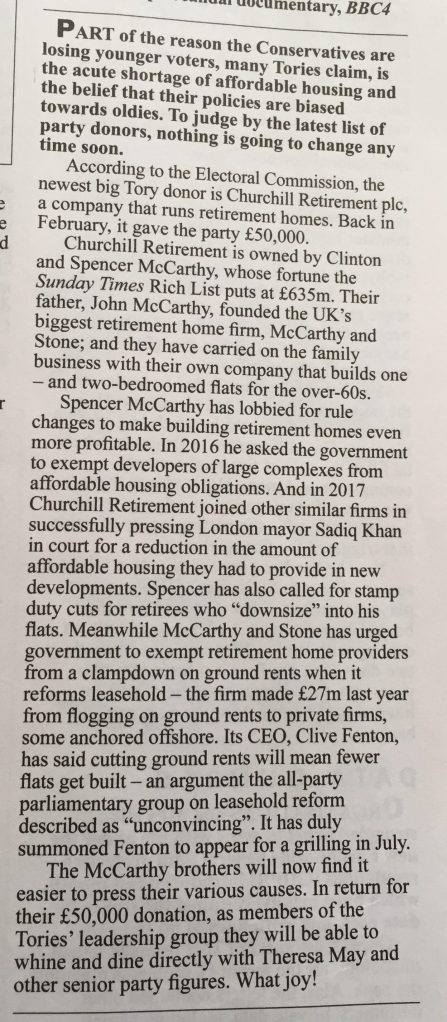
Retirement home builders feeling the pinch …

“” … Another profit warning at McCarthy & Stone (MCS.L) triggered a sharp share price fall for the UK’s biggest builder of homes for retirees a 18.8 percent decline. …”

Could this be part of the reason? There are no affordable properties being built at the PegasusLife Knowle site:

“The Mayor of London’s Office has today welcomed a judgment handed down by the High Court that has backed the Mayor’s ‘threshold’ approach to affordable housing.

Following a legal challenge by four retirement homes developers, the Hon Mr Justice Ouseley has ruled that the Mayor’s threshold approach, which allows developments to be fast tracked through the planning system where they provide at least 35 per cent affordable housing, is consistent with the adopted London Plan.

The judge rejected claims by McCarthy and Stone Retirement Lifestyles Ltd, Pegasus Life Ltd, Churchill Retirement Living and Renaissance Retirement Ltd that this policy, contained within the Mayor’s Supplementary Planning Guidance (SPG) on Affordable Housing and Viability, would fail to secure the maximum reasonable level of affordable housing.

Jules Pipe, Deputy Mayor for Planning, Skills and Regeneration, said; “Tackling the capital’s housing crisis is the Mayor’s top priority and this ruling is an important moment for thousands of Londoners who are desperate for genuinely affordable homes to rent and buy.

“Our guidance sets out a clear approach that makes the planning system in London clearer, quicker and more consistent. I am pleased that the Judge has backed this approach which will help us to turn around years of neglect when it comes to building the homes Londoners so desperately need.”

The Mayor’s Draft London Plan includes the same requirements on reviews as the SPG. The judgment confirms that this has weight as it is an emerging plan.

The judgment also rejected the claims of the retirement homes developers that the guidance should have been the subject of Strategic Environmental Assessment and found that the claims that the Mayor had failed to have due regard to his duties under the public sector equality duty of the Equality Act 2010 were unarguable.”

https://www.london.gov.uk/press-releases/mayoral/judge-rules-in-favour-of-mayors-housing-approach

Wake up apathetic Honiton! For the sake of half-a-dozen volunteers your town is at enormous risk!

Owl simply cannot believe that in a town the size of Honiton half-a-dozen people cannot be found to join the neighbourhood planning group. People have been falling over themselves in the rush to volunteer in smaller towns and villages, many of which gave already had their plans signed, sealed and delivered.

What is wrong with the people in the town? Have they no civic pride? Do Honiton people not realise what enormous danger they are in if they DON’T have a neighbourhood plan? Everywhere in Honiton NOT named in the Local Plan (and that’s a lot of land) up for grabs by developers. Who will provide no infrastructure to the town and likely no affordable housing.

It paints a dreadful picture of a totally apathetic town with an inept town deputy clerk (who suggested shelving the project until 2020) and lazy town councillors if this situation is allowed to happen.

“Residents have been urged to ‘step up’ or face ‘losing out’ after the creation of the Honiton’s Neighbourhood Plan was granted a six-month continuation.

The warning, made by the town’s mayor, comes a month after the future of the document was thrown into doubt following a recommendation to shelve the document until 2020.

Deputy town clerk Heloise Marlow made the suggestion to town councillors based on the ‘lack of past and current’ interest from residents in getting involved with the plan’s creation.

The Honiton Neighbourhood Plan’s current committee is ‘inquorate’ – meaning it is not made up of enough members.

A report submitted to last month’s council meeting said: “A steering group made up of about nine to ten members with one-third councillors and two-thirds community members is essential. In view of the lack of past and current interest from the community of Honiton, the recommendation is that a neighbourhood plan cannot currently be delivered.”

However, at a meeting of Honiton Town Council last week, members agreed to let the creation of the town’s Neighbourhood Plan continue for the next six months.

Cllr Henry Brown, town mayor and chair of the council, said: “The Neighbourhood Plan will continue for the next six months, with the hope that the Community Engagement Forum will act as a conduit to entice members of the public to join the Neighbourhood Plan.

“The public must outnumber the council in representation on this – our community needs to step up or we face losing out.”

At last month’s council meeting, Cllr Roy Coombs staged a late intervention to save the Neighbourhood Plan from being shelved until 2020 – recommending it be deferred until last week’s council meeting at The Beehive.

He said: “If we have not got a Neighbourhood Plan in place it could, I feel, become a developers’ free-for-all.”

The Community Engagement Forum, which is comprised of various groups in Honiton, was formed in 2016 with the aim of improving the town and bringing about change.

Anyone who wants to join the Neighbourhood Plan committee should get in touch with the town council on 01404 42957 and ask to speak to Heloise.”

http://www.midweekherald.co.uk/news/creation-of-honiton-s-threatened-neighbourhood-plan-granted-a-six-month-continuation-1-5567305

Council challenges planning inspector decision affecting strategic planning

Implications for the Greater Exeter Strategic Plan? You know, the one being delayed until after the next council elections …. for some reason …

“South Gloucestershire Council is to bring a legal challenge over a planning inspector’s decision to grant planning permission for a 350-home development in Thornbury.

The proposed Cleve Park scheme would also include a 70-unit elderly care facility, associated open space, community and commercial facilities, and infrastructure. The planning application was made by Welbeck Strategic Land LLP.

The local authority said it had “carefully considered” the Inspector’s decision and would be issuing legal proceedings challenging it.

South Gloucestershire added that it had written to the Secretary of State for Housing, Communities & Local Government James Brokenshire, “requesting that he exercises his powers to recover the planning appeals relating to developments in Charfield and another in Thornbury from the Planning Inspectors, and make the decisions himself”.

These requests relate to two applications, one for outline planning permission for the erection of 121 homes and a retail outlet on land off Wotton Road in Charfield (Barratt Homes, Bristol), and also the appeal relating to land south of Gloucester Road, Thornbury (Bovis Homes Ltd), which seeks outline consent for the demolition of existing agricultural shed buildings and residential development of up to 370 homes, a flexible use building, public open space, accesses onto Gloucester Road and associated infrastructure.

The council said that it considered that these appeals, if granted, would undermine the Joint Spatial Plan (JSP) process and its impact upon the residents and communities of South Gloucestershire.

Cllr Toby Savage, Leader of South Gloucestershire Council, said: “Enough is enough. I am determined to see the council take a robust approach to challenging unsustainable development across the district. Where we have taken difficult decisions to proactively and positively plan for future housing and jobs growth, we should not have decisions from the Planning Inspectorate which undermines this work as it only stores up economic, social and environmental problems for the future.”

Cllr Colin Hunt, Cabinet Member for Planning at the council, said: “In South Gloucestershire we are trying to be plan led with our decisions on planning applications. While we appreciate that we have a shortfall on our five year land supply, nonetheless we want decisions to reflect that we have a solid plan that was prepared in consultation with the public.”

http://localgovernmentlawyer.co.uk/index.php?option=com_content&view=article&id=35658%3Acouncil-to-challenge-grant-of-planning-permission-for-350-home-scheme&catid=63&Itemid=31

Cornish coastal village shows the way on second homes

“Mevagissey is following St Ives’ lead to stop too many properties becoming second homes.

Residents of the Cornish fishing port voted overwhelmingly in favour of adopting the “primary residence policy” in yesterday’s referendum, making it the fifth place in the county to decide that newly-built homes should only be available to people living there permanently.

A third of eligible voters turned out – 90% voted in favour.

When you get up to one in four of the properties being a second home, you can’t deny the right of people to sell to additional homeowners. All we’re trying to do is to discourage the development of more second homes by putting this restriction on new builds.”
Garth Shephard
Mevagissey Parish Councillor”

https://www.bbc.co.uk/news/live/uk-england-devon-44366793

Devon and Somerset – a new Klondike gold rush?

The LEP housing numbers, anticipating 50,000 new households in Devon, are almost certainly driven in part by the heroic assumptions about the local economy, as Owl has pointed out many times.

As we know, the LEP assumption is 4% growth per annum for the next 18 years. Such a sustained economic boom would invoke a ‘Klondike’ style immigration rush into Devon and Somerset, as the economies of all of the rest of the western world failed to compete with us at that level.

East Devon’s current Local Plan is based upon an anticipated annual UK economic growth rate of 3% from 2007, which has turned out to be just over 1%.

This, of course, is why many of our employment sites are dormant (and one of the many reasons why we do not need a new site in Sidford), and all our town centres are struggling – there simply isn’t demand.

Even if economic growth was to average 3% growth from now until the end of the Plan period, which looks incredibly optimistic, we would still have 33% more employment land than we need, according to East Devon’s own numbers.

The LEP’s projections have been laughed at by everyone – especially, Owl gathers, in Whitehall.

But they feed into a whole raft of housing and economic projections, that will ultimately emerge as policy around the region.

What assumption will be used for the Greater Exeter Strategic Plan (GESP) projections, Owl wonders? Now delayed until after the next local council elections in 2019?

Will the GESP team dare to condemn the LEP numbers, or will they adopt them, even when they must know they are nonsense?

What might happen if those without vested interests in the growth of expensive housing in the area were for once denied a say due to conflict of interest?

And where are the signs of the revisions of our Local Plan, based on current realities, that are required every 5 years?

“Fury as housing associations redevelop and sell affordable homes”

“Housing associations have made at least £82.3m from auctioning homes in five London boroughs since 2013, according to figures seen by the Guardian. Analysis by the Labour MP for Westminster North, Karen Buck, shows that Westminster, Brent, Camden, Hammersmith and Fulham, and Kensington and Chelsea sold 153 properties at auction through Savills estate agents – with more than half in Westminster where sales totalled £36.4m. The true figures are likely to be much higher as the data only covers sales made by one agency. The auctions are part of a wider trend of some housing associations selling off social housing in expensive central London to fund new developments, which tenants say are unaffordable or far removed from their families, schools and work.

Buck says: “I’m dealing with a family who are statutorily overcrowded and in the highest medical priority and I haven’t been able to get them moved in over eight years. That’s because housing associations [in general] say they don’t have the stock in the area and yet they’re still selling off homes.”

Nationally, sales of housing association social homes to the private sector have more than tripled since 2001, with 3,891 social homes sold in 2016. Overall, more than 150,000 homes for social rent have been lost since 2012. …”

https://www.theguardian.com/society/2018/jun/13/fury-affordable-homes-redeveloped-sold-housing-associations

By 2036 one-third of people in Devon will be over 65 – but don’t worry, they will have PLENTY of houses available!

Owl is puzzled. Our Local Enterprise Partnership says we need 50,000 new homes in the next 5 years (published in 2017 – so say until 2023):

Click to access SEP-Final-draft-31-03-14-website-1.pdf

(page 8)

Yet the Office for National Statistics says that the population of Devon will increase by just over 52,000 by 2026 (see below). Averaging a very low estimate of low 2 people per home that would mean we would need 26,000 new homes IN TOTAL in Devon in the next 8 years, not 50,000.

In fact, the same Office of National Statistics says average occupancy is 2.4 persons per household – so a more accurate figure would be 21,666 extra homes needed in Devon by 2026 – again NOT 50,000!

https://www.ons.gov.uk/peoplepopulationandcommunity/birthsdeathsandmarriages/families/bulletins/familiesandhouseholds/2017

Someone has their sums badly wrong. 50,000 by 2023 or 21,666 by 2026.

Is it the Office of National Statistics or our LEP with its preponderance of developers and landowners?

“The population of Devon will increase by 52,100 by 2026, according to the Office for National Statistics.

In 2016 the population was 778,800. By 2026 it is expected to reach 830,900, a rise of 6.7%.

Every two years the ONS estimates how the population of England will change over the next 25 years.

Statisticians study birth and death rates, and look at how the county’s population is ageing.

In Devon the percentage of the population made up by pensioners is expected to rise from 24.8% in 2016 to 27.6% 10 years later. And by 2036 the ONS thinks over 65s will make up almost a third of the area’s residents. …”

https://www.devonlive.com/news/devon-news/population-devon-grow-52100-1667958

“Crest Nicholson to close London office and build more ‘flat pack’ houses as costs bite”

So sad that their profit margin has dropped from 20.3% to 18%! In 2017 Crest Nicholson’s chief executive, Stephen Stone, was set to receive a share bonus worth almost £812,000, on top of a salary of £541,158, while chief operating officer Patrick Bergin was set to net £562,500, in addition to pay of £375,000.

Maybe that’s where their profits are going … just a thought …

And better not anticipate any affordable housing in their “flat pack” developments!

“Housebuilder Crest Nicholson is feeling the pinch of rising construction costs and a slower housing market, prompting it to close its Central London office and expand production of so-called “flatpack” housing structures.

In its half-year results, Crest Nicholson said that it expects its margins to be around 18pc for the full year compared with 20.3pc last year – and at the lower end of its 18pc to 20pc range – due to the “generally flat” pricing environment.

Shares in the FTSE 250 housebuilder fell more than 7pc in morning trade. …”

https://www.telegraph.co.uk/business/2018/06/12/crest-nicholsons-margins-squeezed-rising-costs/

“Just look at housing to see the true cost of privatisation”

“Council homes are being sold off far more quickly than new social homes are being built, a new report has warned. The research into the government’s right-to-buy scheme, by the Local Government Association, finds that this has been the case since 2012: at no point has the social housebuilding rate matched, or come close to matching, the rate at which homes are being sold.

Right to buy was given a boost by the Conservatives after the 2010 election in an attempt to sell even more homes, since traditionally homeowners tend to vote Tory. In 2013, the then chancellor, George Osborne, announced the maximum discount available for those renting a council home in London would rise to £100,000. In effect he’d approved the asset-stripping of some of our most-needed council stock.

But right to buy needs to be viewed for its long-term effects, and not just with regard to how it helped those families who bought their council homes in the 1980s and 90s. Today, 40% of the homes sold under the scheme are rented privately at far higher rents than local authorities would ever charge. Right to buy has become right to buy to let.

Across the country, home ownership is in crisis, with renting exorbitantly expensive and young people especially – even those in professional jobs – being priced out of the market. Their earnings disappear into the pockets of private landlords, while the finances of local government are given a kicking.

Council housing works because it pays for itself relatively quickly: the rent paid by tenants covers the building costs in the long term, and eventually makes a profit for the local authority, which continues to invest in the local area. The money continues to circulate within the community rather than simply boosting the profits of landlords.

But with councils forced to sell to tenants through right to buy, then being obliged to give a chunk of the receipts straight to Whitehall, building becomes ever more difficult. And the property shortfall is expensive, as authorities struggle to house their homeless residents. Last year £8.4m was spent by 23 councils to rent 725 flats as temporary accommodation, the magazine Inside Housing found. A vast transfer of wealth has taken place from the public to the private sector, under the guise of helping the aspirational working class. Instead, we’ve just made it harder to provide housing for those most in need.

The folly of right to buy echoes the mess that is Britain’s rail system. In the mid-90s, John Major – echoing Margaret Thatcher’s disdain for the state a decade earlier – believed that breaking up British Rail would create competition, and that competition would ensure greater services and be far more efficient than control by the bloated state. Instead, the cost of train travel has become exorbitant, the service appalling almost everywhere you attempt to travel, and the state is constantly required to intervene – either because a franchise has collapsed, in the case of the east coast mainline, or because the rail service has become chaotic, witness recent weeks in the north and the south-east.

The long-term effects of privatising both rail and housing, aside from ensuring we live in a country of crumbling infrastructure (in contrast to mainland Europe), is one of diminished social and personal opportunities. Many people are unable to see friends and family as often as they’d like due to the cost of rail travel. Others are delaying having children, or wondering if they can afford them at all, since they cannot afford to buy a home and landlords can be hostile to children. Those with children are in no better position: well oOverMore than 100,000 children are living in temporary accommodation, usually due to eviction.

Right to buy was popular, but with 1.8m council homes having been sold off, there are now about 750,000 households paying far more than a local authority rent. Housing, not buying, should be a right – and available and affordable for all. Right to buy is devastating our housing system, just as rail privatisation has devastated our transport infrastructure.

Privatisation rarely works: we need new ideas, and far more public ownership of housing, infrastructure and utilities, if we wish to provide for our citizens.”

https://www.theguardian.com/commentisfree/2018/jun/12/housing-true-cost-privatisation-right-to-buy-landlords

Bovis Homes buyers complaints aren’t reducing …

… if statistics on the closed Facebook Group are anything to go by:

3,063 current members
added 119 members in the last 30 days
8 new posts today
263 posts in the last 30 days

https://www.facebook.com/groups/BovisVictimsGroup/

“Persimmon pay panel chief unable to tell MPs firm’s average pay”

“Persimmon’s executive pay row was reignited on Wednesday after the head of the housebuilder’s remuneration committee said she did not know how much the average worker was paid by the firm.

MPs on the business, energy and industrial strategy (BEIS) committee were stunned by the admission from Marion Sears, who was giving evidence after Persimmon angered shareholders earlier in the year by handing its chief executive Jeff Fairburn a £75m bonus.

“The average … I don’t have that figure to my finger tips,” Sears told MPs, when asked by the committee chair, Rachel Reeves, what average pay was.

“You’re chair of the remuneration committee at Persimmon aren’t you? And you don’t know what average pay is, as chair of the remuneration committee?” asked an incredulous Reeves.

After the meeting had concluded, the Labour MP tweeted that Sears’ lack of knowledge was a disgrace.

She added in a statement: “Executive pay at Persimmon is a tale of corporate greed and incompetent pay management, financed on the back of a tax-payer funded housing scheme [help to buy].

“Persimmon paid out huge bonuses to the men at the top of the firm and yet this morning we have heard that Persimmon are unable to tell us how much average workers at the company are paid.”

A spokesman for the firm later confirmed the average salary at the firm is £35,600.

During the bruising session, Sears also appeared confused about the sum Fairburn received last year, at first answering “£675,000”. Prompted by Reeves to give the total pay figure, she said it was “about £45m”. The total figure shown in the 2017 annual report and accounts was £47.1m.

When asked by Reeves whether or not Persimmon was a living wage employer, Sears said yes, but then went on to clarify that the FTSE 100 firm was not accredited by the living wage foundation. …”

https://www.theguardian.com/business/2018/jun/06/persimmon-pay-panel-chief-unable-to-tell-mps-firms-average-pay

Why the Grenfell Tower fire happened – by a survivor

““Every single link in this chain is going to be found to be rotten and cancerous,” Daffern [the survivor who had lived there for 16 years and predicted the tragedy in his blog] said.

“The government didn’t implement the inquest recommendations after the Lakanal House fire where six people died in 2009. Had they done that Grenfell wouldn’t have happened. RBKC failed to carry out scrutiny of the TMO.

“The way the TMO [Tenant Management Organisation] operated, the handling of the contracts, the construction, through to the building regs, the materials that were used, the consultation process.”

When asked what links these failures, he said: “Greed, lack of respect, lack of humanity. It is the opposite of everything it should be. This is housing as a commodity to be exploited. It is not only in RBKC [Royal Borough of Kensington and Chelsea], it is what housing has become.”

https://www.theguardian.com/uk-news/2018/jun/03/grenfell-survivor-blames-landlords-cancerous-decisions-for-disaster

Only in the Sunday Times …

… would you find an article with the headline:

“Small businesses at risk from house price fall”

about small business owners using their homes as collateral.

Might a headline in the Daily Mirror read:

“Small business owners forced to use houses as collateral as big banks fleece them with high interest rates and government fleeces them with high business rates”!

“Home Builders Federation criticises planning proposals”to

Oh, those poor, poor developers … less profit … that’s all this is about:

Proposed changes to the National Planning Policy Framework could cause the cost of land to increase and exacerbate the housing crisis, the Home Builders Federation (HBF) has warned in a letter to the Government.

The industry body claimed that proposed changes, which would enable councils to base contributions towards affordable housing based on the existing value of land – rather than its projected sale value – would mean they would have to offer lower sums to landowners and therefore be able to build fewer homes.

A spokesman for the Ministry of Housing, Communities and Local Government said that proposed changes “will mean that developers know the contributions expected of them and local communities are clear about the infrastructure they will get alongside new homes. We are currently analysing responses to the consultation and will set out next steps in due course.”

Sources: Telegraph p1, Times p1 (pay walls)