Bodies left to rot for months at sheltered housing after warden cuts

“The bodies of two dead people were allegedly left to rot for months at a retirement home because of ‘callous’ care cuts, residents have claimed.

The latest corpse was found on August 8 at Mussidan Place in Woodbridge, Suffolk, after a neighbour noticed the man’s kitchen was infested with flies.

Residents at the home, which previously used to be sheltered housing before it turned into retirement accommodation, believe the body had been there since June, when they first complained about a bad smell. They said they were shocked by the death but it was not the first.

Another body was found in February and neighbours claim the dead man’s relative told them it had been there since November last year. They said the bodies would have been found sooner if budget cuts hadn’t stripped away wardens who used to check up on residents.

Valerie Kersey, 74, who has lived at Mussidan Place, owned by Flagship Housing, for four years, said: “There’s been a lot of reaction since the latest death.

“You feel guilty, thinking you should have noticed, and you feel angry. It shouldn’t happen. We’ve been through it twice now.”

Residents are urging Suffolk County Council to bring back funding for wardens. The cuts to sheltered housing support sparked complaints from tenants across the region when they came into force in 2018.

Flagship said there is a pull-alarm system in all communal areas connected to a call centre and people could buy individual alarms, but residents say these are unreliable.

Clive Field, 78, said it could take 20 minutes to get through to one the call centres, as there’s “never anyone on the phone.” Trevor Rose, 70, said Flagship failed to respond to complaints about the buildings and had not reassured people after the deaths.

Woodbridge mayor Eamonn O’Nolan, who attended as a first responder when the latest body was discovered, has since held a meeting with residents. He said: “I’m quite frankly horrified that their essential support services have been reduced to zero, in a cold and callous way”. “Two elderly residents have died and their bodies lay undiscovered for weeks and months while their neighbours and the authorities were in complete ignorance of their deaths.

“There is no doubt that had Mussidan Place still had a warden, then at least the bodies would have been discovered immediately.” He said the deaths were tragic and ‘should come as a serious wake-up call for us all’. He added: “It is clear to me that the county council’s social services department is not doing its job.”

Sylvia Keeble, who was a warden for 35 years, said there were 17 sheltered schemes locally when she started, all with live-in staff and then gradually over the years, they got ‘rid’ of them. “We had cutback after cutback until there were just four staff managing 15 shelter schemes”, she said.

Flagship, which made record profits of £33.1m last year, stopped providing sheltered support in 2016. Orwell Housing stepped in with a reduced service, which saw wardens phone round residents each morning and visit if needed. The services stopped completely in April 2018.

Coun Helen Armitage, Labour’s adult care spokesman at the county council, was ‘saddened and appalled by the failings in social care’. She said: “Residents move into sheltered accommodation because they need additional support and security – support and security that regular warden visits used to provide. “Since the Conservatives at SCC have cut their funding, housing associations been unable to plug the gap and have been forced to reduce their services.”

The council said sheltered housing providers had been informed of the proposals to remove funding two years before they came into force.

A spokesman said Flagship and Orwell Housing were both told about the budget changes in 2016.

“This was to provide an opportunity for the providers to develop options on how they may choose to provide support when the grant expired at the end of the 2017/18 financial year.

“Suffolk County Council publishes its proposed budget and any changes to funding are in the public domain. The council is committed to working alongside providers of care and support to deliver quality services to residents across Suffolk.”

The council allocated £234m for adult and community services in 2019/20,
almost half its total £500m budget for the year. It has cut £260m from its overall budget since 2011.

https://www.mirror.co.uk/news/uk-news/bodies-two-people-left-rot-18977024
“Building more new homes WON’T solve Britain’s housing crisis”

“Britain’s soaring house prices and ‘broken housing market’ have long been put down to a chronic shortage of homes, but new evidence has emerged that building more homes is unlikely to bring prices down.

A paper written by Tony Blair Institute chief economist Ian Mulheirn argues that building 300,000 homes a year wouldn’t make homes in the UK more affordable. Nor, he says, would more homes mean that more people manage to get onto the housing ladder.

The paper, published today by the UK Collaborative Centre for Housing Evidence, suggests that 160 per cent of the growth in house prices since the late 1990s has had nothing to do with a shortage in housing supply. Instead, Mulheirn claims that rock bottom interest rates for more than a decade have made borrowing so cheap that those able to buy have ratcheted up their borrowing, causing prices to soar.

‘Building 300,000 houses per year will do very little to bring down house prices in Britain, and next to nothing to raise home ownership,’ he wrote.
‘The real culprit for sky-high house prices is low global interest rates that have made it easy for homeowners and investors to take on large amounts of mortgage debt and pay ever more for houses.’

The figure of 300,000 new homes needed a year has been largely undisputed for the past decade.

In 2004, Kate Barker wrote a landmark review on housing supply for the then Labour government, concluding that 245,000 new private-sector homes a year were needed, plus another 17,000 social housing units, to keep house price inflation down to 1.1 per cent annually. She later revised that number up to 300,000 homes a year.

But Mulheirn disagrees. He points to official data showing that since the 1996 nadir of house prices, the English housing stock has grown by 168,000 units per year on average, while growth in the number of households has averaged 147,000 per year. Even in London and the South East, the number of houses has grown faster than the household count.

As a result, while there were 660,000 more dwellings than households in England in 1996, this ‘surplus’ has since grown to over 1.1 million by 2018. Similar trends are also apparent in Scotland and Wales, suggested Mulheirn.
Nevertheless, UK house prices have spiralled from around 4.5 times median household income in 1996 to a multiple of around 8 today.

The most recent figures from the Office for National Statistics showed across Britain, prices rose 0.7 per cent in June to an average of £230,292 – up 0.9 per cent compared to June 2018.

Mulheirn argued cheap mortgage finance is to blame.

‘Since the late 1990s, mortgage rates have tumbled, with inflation-adjusted interest rates on five-year fixed-rate mortgages, for example, falling from 8 per cent to around 2 per cent today,’ he said. ‘Since mortgage interest rates tend to be the dominant element of the cost of capital for home owners, this change can be expected to precipitate a substantial increase in house prices of a similar magnitude to the 160 per cent increase seen since 1996.’

Meanwhile, he said, a shrinking social rented sector, cuts to housing benefit and slow wage growth among young people are making rented housing less affordable for many even as though private sector rents are stable.
He added: ‘Neither our ownership or rental affordability problems will be solved by hitting the 300,000 target.’

According to the paper a 1 per cent increase in the stock of houses tends to lead to a decline in rents and prices of between 1.5 per cent and 2 per cent, all else equal. This implies that even building 300,000 houses per year in England would only cut house prices by something in the order of 10 per cent over the course of 20 years. ‘This is an order of magnitude smaller than the price rises of recent decades,’ said Mulheirn.

‘If we are to create more affordable houses to buy and rent, the solutions lie elsewhere.’ …”

https://www.thisismoney.co.uk/money/mortgageshome/article-7378649/Building-new-homes-WONT-solve-Britains-housing-crisis.html?ito=rss-flipboard

Cranbrook population to grow to 18,000 (with a town centre?)

“The new town of Cranbrook near Exeter will grow to have a population of around 18,000 people under a plan submitted to central government.

East Devon District Council has submitted the local plan for Cranbrook to the Secretary of State for examination.

Local plans are drawn up to shape the future development of towns and villages.

East Devon District Council said the plan envisaged the town growing to 7,750 homes.

When building first started in 2011 Cranbrook there were 2,900 homes planned as well as schools, shops, a library and energy plant.”

https://www.bbc.co.uk/news/england/devon

EDDC Development Management Committee makes another controversial planning decision

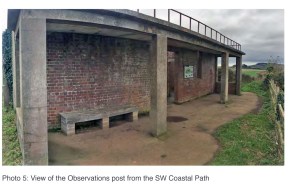
The planning application for the conversion of the South West Coast Path WW2 observation post into a holiday dwelling, covered by Owl here:

https://eastdevonwatch.org/2019/07/07/a-poignant-planning-application-on-the-75th-anniversary-of-d-day-and-enthusiastically-supported-by-clinton-devon-estates/

has been agreed. The roof will be “reconstructed and roof lights, doors, windows and solar panels will be added, thus destroying its original function as a historical building.

The owners of the land are, of course, Clinton Devon Estates.

Another developer attempts to rip-off EDDC (and the NHS)

.”A housing developer has been accused of ‘blackmail’ over a refusal to pay any contribution to the NHS.

Councillors had previously agreed to a land swap between the Exeter Science Park and Eagle One that would make the next phase of the Science Park expansion more deliverable and allow the 150 new homes to form an extension of the Redhayes/Mosshayne development.

The plans were agreed by councillors in April, subject to a viability assessment of a £216,000 contribution towards the NHS due to the impact of the development.

At last Tuesday’s East Devon District Council development management committee meeting, Chris Rose, the council’s development manager, said that the NHS contribution would not have a sufficiently detrimental impact on scheme viability to cause the proposed land transfer to fail.

But he said that Eagle One have said that as the overall transaction would not be in their interest, they will not agree to provide any NHS contribution.

Officers had recommended that councillors approve the application, even without any NHS contribution.

Mr Rose said: “In pure viability grounds, our viability consultant considers that with the contribution to the Trust, the development is still just viable but could certainly support a reduced sum of £81,422 as officers have tried to negotiate.

“However, the applicant is not prepared to enter into a S106 agreement which includes any contribution to the Trust as they consider it doesn’t meet the tests for acceptability and that the land deal is on the basis of what was previously agreed without the contribution to the Trust.

“The options open to the council are therefore to either refuse planning permission on the basis that the development does not adequately mitigate its impact on health services, or accept that no contribution to the Trust will be forthcoming and proceed.

“The main risk with a refusal is that the proposed land deal would be lost which would negatively impact on the delivery of the Science Park.

“To issue an approval of planning permission without the contribution to the Trust would secure the land deal and have huge benefits to the progress of the Science Park. Members would need to be clear that to do this would accept no mitigation for the impact of the development on health services.

While at the current time, significant weight should be attached to the request for a contribution to the NHS Trust, it is considered that greater weight should be attached to the proposed land transfer which will facilitate significant long terms gains for the delivery of a major science park integrated with the other development happening in the area.

“While there are grounds to secure a contribution to the Trust, nevertheless the applicant will not agree to a contribution and have advised that they will not enter into the land transfer on this basis. “The only way for the Council to proceed with confidence that the land swap transaction will go ahead would be without the NHS contribution.”

He added though that late documentation had been provided by the applicant from neighbouring councils to support Eagle One’s assertion that the NHS’s request was not justified, but that officers had not had the chance to fully assess the documentation.

Cllr Kevin Blakey, portfolio holder for economy, said that the application should be approved due to the benefits it would bring to the Science Park, and that if it was refused, the land swap deal was almost certain to fail.

He added: “Although the request is legal, this deal won’t proceed if there is a requirement for Eagle One to make a contribution. It may be unpalatable but if we want to see this happen and introduce opportunities for highly paid and highly skilled jobs, this deal should proceed.”

But Cllr Mike Allen, lead member for business and employment, said that while the land swap should proceed, there should be a contribution for the NHS as it was viable. He added: “This has been rejected by Eagle One and I think they have stepped over the line from negotiation to bullying.”

Cllr Steve Gazzard said that he had real concerns about the application and that Eagle One’s behaviour was ‘tantamount to blackmail’. He said: “They will build 150 homes so that could be up to 500 people, and it will increase pressure on the NHS. It is not an undemanding request that they should provide something.”

He proposed that the application be deferred to seek further advice on the legitimacy of the health contribution following additional information being submitted by the applicant.

Cllr Paul Hayward supported him, although said: “I wouldn’t use the word blackmail. I think undue pressure may be better. I am sure there is a reason why the NHS has asked, so we have to take it into account. We have asked for something, and they are saying they won’t pay and won’t move their position at all. We need to see the evidence.”

The council’s solicitor, Henry Gordon Lennox, said that officers had considered the benefits from the land swap were sufficiently great that the application should be approved, even if there is no contribution towards the NHS.

He said: “We were content that the contribution was justified, and we have now been given information that it isn’t, and we haven’t had a chance to look at it properly. But as they aren’t paying a contribution anyway, so it is irrelevant.

“Our officers are suggesting you approve it without any contribution to the NHS. If you are not willing to do that, then deferral is the right option, as we need to understand the legitimacy of the health contribution.”

The committee agreed to defer a decision for a further month to seek further advice on the legitimacy of the health contribution.”

https://www.devonlive.com/news/devon-news/blackmail-claims-over-housing-developers-3205288

Not the first time Eagle One has hit the headlines:

https://eastdevonwatch.org/2018/06/25/eddc-current-planning-policy-encapsulated-in-one-planning-application/

https://eastdevonwatch.org/2014/11/19/more-development-between-exeter-and-cranbrook-when-will-it-stop/

“Persimmon probe steps up a gear as 100,000 people are asked for their views on the housebuilder and its homes”

Owl says: So, a developer gets another developer to lead an “independent review ” into its practices that chooses its particicipants … you COULD NOT make this up.

“More than 100,000 people are being asked for their views on housebuilder Persimmon as an independent review into the company enters its next stage.

Customers, employees, suppliers, trade bodies, local authorities and civil servants will all be contacted on Tuesday in a bid to gather information about customer care and the quality of the group’s work.

The process, which was launched in April, is set to rigorously assess every aspect of the firm’s construction and inspection regime as it sets out to rebuild its image in the wake of controversy over payouts to executives. …

… Clive Fenton, the former chief executive of fellow housebuilder McCarthy and Stone, is providing assistance to the review as an industry expert.

The consultation period closes on September 16, with findings of the review due by the end of the year. …”

https://www.thisismoney.co.uk/money/markets/article-7351969/Persimmon-probe-steps-gear-100-000-people-asked-views.html?ito=rss-flipboard

Luxury retirement schemes to get luxury lending libraries

Meanwhile, in real life, libraries are closing all over the country.

“London book chain Foyles is to supply libraries to high-end retirement homes in a deal with a residential developer.

The partnership with Elysian Residences will launch at its development in Stanmore, north-west London, when it opens later this year, with a mix of biographies, travel writing, novels and specialist books selected by Foyles. Residents at the development, which aims to combine “UK development expertise with a US hospitality-led approach to care”, will be able to borrow from a collection maintained and refreshed every quarter by the book chain. Foyles is being paid a lump sum for the work.

“Libraries are an important cornerstone of a vibrant community, offering visitors a place of relaxation, learning and discovery,” said Elysian chief executive Gavin Stein. “We wanted to provide our residents with a relaxing reading environment curated with the latest high-quality books.”

The deal will also allow residents to order books, music and DVDs from Foyles via the Elysian concierge, as well as giving them access to Foyles’ foreign language books, classical and jazz music recordings. The Foyles libraries will then be rolled out across Elysian homes in London and the south east as they open.

This is the first time that the bookseller, founded by the Foyle family in 1903 and sold to Waterstones last year, has curated private libraries. It now hopes to find further such deals.

“This is a new and exciting venture for us, and we look forward to offering a service of the same high standard to which we hold each of our bookshops,” said general manager Stephen Clarke.”

https://www.theguardian.com/books/2019/aug/13/foyles-sets-up-libraries-for-high-end-retirement-homes-bookseller?CMP=Share_iOSApp_Other

“Have your say on the Jurassic Coast’s future” [suggestion: new National Park]

Now Mr Diviani is no longer leader of EDDC perhaps the idea of a Jurassic National Park can be resuscitated – he and his council were against this as they didn’t want to lose their control over planning (over-developing) the site:

https://eastdevonwatch.org/2018/10/09/new-national-park-for-east-devon-not-while-people-like-diviani-are-councillors/

And surely we are not in the situation of caring what our CEO then and now thinks?

“The public is being asked to help draw up a new blueprint for the future management of the Jurassic Coast.

https://jurassiccoast.org/what-is-the-jurassic-coast/world-heritage/looking-after-the-jurassic-coast/partnership-plan-consultation/

The survey is here:

https://www.surveymonkey.co.uk/r/QLGGNSD

The trust which manages the site, stretching from Exmouth, in East Devon, to Studland, in Dorset, is creating a new partnership plan document in collaboration with a wide variety of stakeholders.

It will be published towards the end of this year and will guide management of the World Heritage Site over the next five years.

The plan will take in conservation and preservation of the site, how the site impacts on the local economy and how it can play an active role in the lives of local communities.

As part of the creation of the new partnership plan, a consultation process is being untaken from now until the end of September.

A spokesman for the Jurassic Coast Trust said: “The new partnership plan is an important document, representing a tangible expression of the partnership that looks after the Jurassic Coast.

“It explains the reasons for the Jurassic Coast’s World Heritage designation, and how it is protected and managed.

“It also outlines the aims, policies, actions and aspirations for managing the site over the coming years.”

The partnership plan is a formal requirement and will replace the current site management plan, which, along with a copy of the new draft plan, can be seen by clicking on the Trust’s website here Alternatively a copy can be requested by telephoning the Trust’s office on 01308 807000.

People going online can contribute their views directly or they can download a printed version of the survey to fill in later.

The completed surveys should be sent directly to the

Jurassic Coast Trust,
email at:
info@jurassiccoast.org

or by post to:

Partnership Plan Consultation,
Jurassic Coast Trust,
Mountfield,
Bridport,
Dorset DT6 3JP

The Jurassic Coast Trust will also be running drop-in consultation sessions across the World Heritage Site area in September. Dates and venues will be announced towards the end of this month.

The deadline for responses to the survey is Friday, October 4. All comments received as part of the consultation will be collated. A report will be produced by the Jurassic Coast Partnership detailing the responses and indicating how the plan will be subsequently amended.

The report will be made available online and to anyone who has asked to be sent updates on the progress of the plan.

Once an amended version of the plan is agreed by the Jurassic Coast Partnership and approved by Historic England, it will be adopted by Dorset Council and Devon County Council before being formally submitted to DCMS and UNESCO.”

https://www.midweekherald.co.uk/news/consultation-on-management-of-the-jurassic-coast-1-6203990

Clinton Devon Estates: “‘Deceit and lies’ – Councillors speak out Newton Poppleford GP campaign looks to be over”

Wonder if EDDC’s CEO had any private advice for CDE?

This has gone into the most spectacular orbit of deceit and betrayal in the planning system.”

Those are the words of one councillor as the district authority agreed at a meeting on Tuesday (August 6) not to fight a developer’s appeal over a Newton Poppleford site.

Clinton Devon Estates (CDE) lodged an appeal after East Devon District Council (EDDC) delayed a decision on an application to build two homes on land originally earmarked for a GP surgery.

A wider plan for a 40-home development at King Alfred Way, including a doctors’ surgery, was approved in 2013. CDE was unable to find a tenant, so instead applied to build two more homes.

At that stage the parish council expressed an interest in running the surgery.

EDDC twice delayed a decision – the second to allow the parish council to meet with the developer to find a solution.

The developer lodged an appeal with the planning inspector, who will now also decide whether the council should pay costs.

Planning officers recommended the authority should not fight the appeal arguing the surgery was not ‘legally justifiable’. Councillors voted by seven votes to five not to fight it.

Councillor Mike Howe, chairman of the development management committee, told the meeting CDE had acted ‘atrociously’ and could not be considered an ‘ethical or nice developer’.

Cllr Olly Davey said, unless ‘legally enforceable’, ‘any promise that a developer makes is not worth the paper it is written on’.

Councillor Paul Arnott put forward a motion to reject the application, on the grounds the developer had failed in its ‘commitment’ to deliver the surgery – but it was thrown out by seven votes to four.

Councillor Paul Arnott said the application was the most ‘spectacular orbit of deceit and betrayal’ and the council should mount a challenge despite the costs. He said: “It’s so mired in lies and deceit going back years, betrayal, treachery, accusations of wording.

“We cannot afford, as a rule, to be spending council taxpayers’ money on appeals we may not win, but on this occasion we have to. It is a notorious case and we have to draw a line.”

Cllr Eileen Wragg said the committee needed a ‘damn good reason’ not to agree with the officers’ report.

Council officer Henry Gordon-Lennox, strategic lead, said nothing in planning law could stop the developer applying for a different use of them land, despite the original plan for a surgery.

He said: “I do absolutely understand the frustration and the annoyance and the disappointment, but from our point of view as officers there is nothing to defend precluding them from doing this, unpalatable as that may be.”

CDE was represented at the meeting Amy Roberts, who said there has never been a planning justification for the surgery, within the original plan. She said CDE did not want to appeal, but that the developer’s ‘hands were somewhat forced’ by the non-determination, despite planners’ recommendations.”

https://www.sidmouthherald.co.uk/news/clinton-devon-estates-slammed-for-newton-poppleford-homes-plan-1-6203178

Lib Dems at Mid-Devon challenge developers on zero-carbon development, Tories whinge

“A motion was passed at Mid Devon District Council’s full council meeting on Wednesday, July 24, following on from the declaration of a climate emergency in June.

Developers will face a zero-carbon requirement on all future development taking place in Mid Devon.

A motion was passed at Mid Devon District Council’s full council meeting on Wednesday, July 24, following on from the declaration of a climate emergency in June.

Councillor John Downes (Boniface, Liberal Democrats) who put forward the following motion: “That this council instructs the Head of Planning, Economy and Regeneration to take the earliest available opportunity in planning policy terms to embed a zero-carbon requirement on all future development taking place in Mid Devon to respond to the climate emergency.”

Cllr Downes said he had wanted to word the motion so that planning which wasn’t zero-carbon would be refused as policy, and that it would be down to the planning inspector to agree to development or refuse. He added that the Chief Executive, Stephen Walford, had offered advice to defer to the head of planning to allow policy to change.

He said: “This is to make the point that we declared a zero-carbon target and any development we allow that is not zero-carbon is effectively carbon debt which is making the problem more difficult for us in the future.

“One developer, with the profit they made this year, could have made all their houses zero-carbon with the profit that they returned. The point is, if we do make the point and champion zero-carbon, technologies will need to change because that’s the way people are going to start making money and doing developments.

“It’s just about keeping it alive and making it current. I understand that policy will take time, but I think having declared a crisis, we need to show that we’re trying to do something, and planning and licensing are areas in which we can.”

However, Councillor Andrew Moore (Clare & Shuttern, Conservative) questioned whether the motion could be acted upon.

“Do we have any idea as to whether this can be done?” he said.

“An eco-home can operate carbon neutrally, and I’m advised that the likely uplifting cost to build is about 30 per cent, which of course is going to have a significant impact. That will come down in time naturally, but this is not necessarily a cheap thing to be imposing in policy.

“The thing that worries me though is what of the build cost in carbon terms? A study identified that on average, the carbon cost of simply constructing a home – forget the operational cost – is about 65 tonnes of CO2 on average. An average family car uses five tonnes per year, so that’s 13 year’s worth of car travel to build a house.

“Normally, one would amortise that over the life of the house, which is typically taken as 100 years, and how do you do that? Well a UK native tree would consume about one tonne in its whole life of 100 years, so build a house, plant 65 trees, and you know what, it equals out over time. But to be carbon neutral by 2030, that debt payoff model doesn’t work anymore because we’re saying it’s got to be neutralised at the point of the build.

“I have no idea, through my research, as to how on earth that is going to be accomplished. How at point of build, you’re going to get rid of 65 tonnes of CO2. I think it’s a great challenge and I am going to look forward to what actions and policies this motion will ultimately deliver.”

Councillor Richard Chesterton (Lower Culm, Conservative) applauded Cllr Downes for bringing the motion forward but warned that planning policy was a slow process.

He said the Council would also have to manage public expectations.

“I was at a parish council meeting recently in Uffculme where there was an assumption by members of the public that because we had made the decision we had made, that automatically a contentious planning application on the edge of the village wouldn’t happen because it wasn’t in keeping with that decision,” he said.

“I had to explain how the planning process works with policies set out at both national level and local level and that even the adopted local plan, while having some very good policies in them which will encourage the use of green technology and things like that, wouldn’t necessarily get to where you’re looking to get to, and wouldn’t necessarily be able to rely on that in their reason for why it should be turned down.

“The public expects that it will be different from the speed that we will meet, so we mustn’t get our hopes up too fast. It will also be complicated because any local plan and any planning policy that we bring forward has to be in line with national planning policies which don’t, at this moment in time, set out the same deadline and timescale that this Council has set out.

“That’s going be a stumbling block along the way. We need to be aware of that, and we need to know how the executive will push forward a planning policy that might be at odds with Government policy. It might not be of course by the time we get there.”

Cllr Chesterton quizzed the cabinet member for planning and economic generation, Councillor Graeme Barnell, (Newbrooke, Liberal Democrats) about a timescale, and whether or not the Council would have to introduce a revised Local Plan at the earliest opportunity.

He added: “Would it be through a revised local plan at the earliest available opportunity, or would it be just through maybe a revised development management policies? And what timescale do you see it being able to come forward?”

Cllr Barnell replied: “We haven’t been idle as a cabinet in responding to the green agenda. We have been very active in thinking through our policies, but as you quite rightly point out, there are a number of constraints including Government policies that are pre-existing and the plans we’ve inherited from the previous administration.

“We’re looking at a greener Devon policy which the biggest single thing we can do in making practical steps towards zero-carbon. We are looking to get people out of their cars, get people working locally, sustain the rural economy, plant trees and hedgerows. These are long term, not short term fixes. They are long term answers to a chronic problem.

“We have to take every practical step within our planning policies to be able to implement this, not just indulge in wishful thinking. We’re going ahead with careful thought about this and how it will impact on the Cullompton Garden Village, the Tiverton Eastern Urban Extension and making sure we have a mixed development with local jobs that aren’t reliant on commuting, that is reliant on high-quality local jobs that people don’t have to get in their cars to go to.

“Reducing car journeys, so people don’t have to take their children to school are really important issues, and they may sound small, but they’re an important contribution to implementing the climate change agenda, and they will be filtering through as soon as possible into local planning policy.

“The last thing we want to do is tinker with the Local Plan. The Local Plan has been subjected to repeated delays; we want to see it across the line. We will be bringing forward changes to local planning policies in line with our greener Devon agenda and moving towards sustainable local Devon communities and more details soon, you will be being asked to consider those.”

https://www.devonlive.com/news/devon-news/zero-carbon-requirement-imposed-future-3167887

EDDC “Independent” Leader firmly nails his colours (blue?) to his CEOs mast


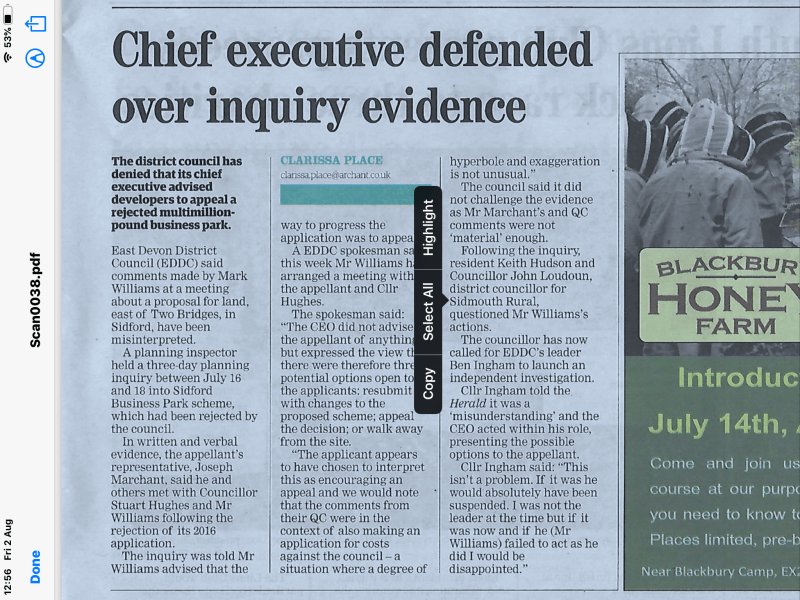
Owl sees no “misunderstanding”.

Another “TiggerTory” policy?

And what does Mr Marchant, the person accused of being “misunderstood” – and Ford’s QC who perpetuated the “misunderstanding” several times at the public inquiry – think about this?

And where’s Councillor Hughes’s explanation for not sharing information about the meeting with other councillors, particularly those on the Development Management Committee – or did he share it with only a select few of his colleagues?

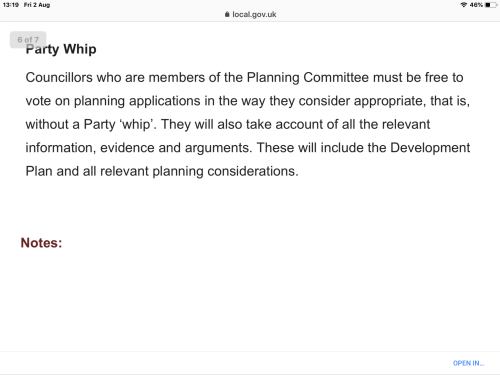
Remember, the Development Management Committee is a STATUTORY committee with rules and regulations … and it must NOT be subjected to party whipping or interference, nor must they “avoid undue contact with interested parties”.

Click to access planning-committee-manage-1cd.pdf

Greater Exeter Strategic Plan – latest housing needs figures shows East Devon bearing greatest load

As at June 2019, ast Devon to bear the brunt of new housing:

Page 10:

Click to access Local-Housing-Need-Assessment-for-the-Greater-Exeter-Area-1st-Edition-June-2019-web.pdf

Countryfile presenter works out what we’ve all known for years about modern rural life!

“Countryfile host John Craven has hit out over the loss of rural services, saying the problem has left residents “socially isolated”.

He laments the disappearance of many rural shops, schools, post offices, pubs and bus routes.

He said: “In particular this has hit the rising number of pensioners who live long distances from surgeries and hospitals and maybe don’t have anyone to keep an eye on them.”

The TV veteran feels the main visual change to the countryside in the past 30 years is the swathe of “new homes on the outskirts of villages.”

But he voiced his concern that there have not been “enough affordable ones to stop young country folk migrating to towns”.

The long-running series’ presenter also told BBC Countryfile Magazine: “No matter what happens over Brexit, I worry for the future of UK food production.”

With just 60% of Britain’s food currently home-grown, he warned: “It’s vital that we step up our level of self-sufficiency and improve our exports.

“Most farmers are middle-aged to elderly and over the years so many sons and daughters have told me they have no interest in taking over from their parents.

“So we’ll need more young recruits from non-farming backgrounds if future food demands are to be met.

“Politicians must face up to this or the UK will be forced to rely increasingly on imports.”

The ex-Newsround host, 78, also said “one joy of being at BBC Countryfile Live every August is to be regarded as a friend by folk I’ve never met before”.

https://www.mirror.co.uk/3am/celebrity-news/tvs-countryfile-host-john-craven-18808486

Big developer CEOs offloading large blocks of their shares …

“Barratt Developments’ boss follows Berkeley founder’s lead and sells more than a third of his shares for £3.3m.

Barratt Developments’ boss has sold more than a third of his shares for £3.3 million.

David Thomas sold 500,000 shares for 660p each. He still has 823,000 Barratt shares worth £5.3 million.

The move came just weeks after Berkeley founder Tony Pidgley cut his stake in his company by a fifth – cashing in £37.2 million of shares.

The sales raise concerns that housing bosses believe the market has peaked.

And Taylor Wimpey warned rising costs and ‘flat’ house prices were putting pressure on its profits.

It reported first half sales of £1.7 billion, almost unchanged from the previous year, and said profits fell from £301 million to £299.8 million. The firm has proposed a 2019 dividend of 18.34p per share.”

https://www.dailymail.co.uk/money/markets/article-7306879/Barratt-Developments-boss-sells-shares-3-3m.html

EDDC CEO tries to slither out of responsibility (NOT successfully!) for his planning advice to developer in private meeting

Owl has SO many questions!

First, Mr Williams’ ‘explanation’ defies belief, he basically accuses the developer of lying about the meeting. Then, he issues his denial of the circumstances of the event to the press, rather than to the councillor who asked him for an explanation. THEN, there appears to have been a totally undocumented meeting between him, Stuart Hughes and the developer – something that is extremely worrying – how many other such meetings with developers and hand-picked councillors have occurred? How do they happen?

But judge for yourself from the full text of the DevonLive article.

Owl thinks the very least EDDC majority councillors should do is suspend him until this is satisfactorily sorted.

“Calls have been made for an independent investigation after East Devon District Council’s chief executive allegedly told developers to appeal his own council’s refusal of planning permission for the Sidford Business Park.

East Devon District Council in 2018, on the grounds of harm to highway safety, relating to increased heavy goods vehicle usage of the area’s narrow roads, refused the plans for land, currently used for agriculture, the east of Two Bridges Road in Sidford.

A larger scheme submitted by the applicants was rejected previously by the council in 2016.

Applicants Tim and Mike Ford challenged the 2018 refusal of the council and three days of arguments for and against the development took place in July.

At the planning inquiry though, Richard Kimblin QC, on behalf of the applicants OG Holdings Retirement Benefit Scheme, and Joseph Marchant, their planning agent, said that following the refusal of the 2016 scheme, Mark Williams, the council’s chief executive, advised them they should appeal.

The claims, made both in writing and verbally, were unchallenged by East Devon District Council during the inquiry.

Paragraphs 13 and 14 of the Mr Kimblin QC’s final closing arguments at the Inquiry said: “After the 2016 application was refused, there was a meeting with Councillor Stuart Hughes and the CEO of the Council. The CEO advised that the way to progress was to appeal. That is an extraordinary state of affairs.”

Following a request for comment from the Local Democracy Reporting Service on the remarks allegedly made by Mr Williams, an East Devon District Council spokesman said that the he did not advise the appellant of anything, the applicant chose to interpret the comments he did make as encouraging an appeal, and the comments were made in a ‘situation where a degree of hyperbole and exaggeration is not unusual’.

Cllr John Loudoun, who represents the Sidmouth Rural ward, though has called for an independent inquiry into the meeting and the comments, saying that the while the council says there was a ‘misinterpretation of events’, “misinterpretation is a nice way of calling someone a liar.”

The claim that was made by Mr Marchant was set out in his written evidence to the inquiry, which said: “Subsequent to the refusal of the 2016 application, an approach was made to Members, including Councillor Stuart Hughes and the CEO (Chief Executive) of EDDC, Mark Williams.”

The following paragraph added: “We were advised by Mark Williams….that in his opinion, the applicant (Fords) may make more advance in progress towards delivery through appealing the Council’s decision to refuse the 2016 planning application rather than resubmission.

Paragraphs 13 and 14 of Mr Kimblin’s final closing arguments at the Inquiry added: “After the 2016 application was refused, there was a meeting with Councillor Hughes and the CEO of the Council. The CEO advised that the way to progress was to appeal. That is an extraordinary state of affairs.”

Asked to comment on the claims made at the inquiry, an East Devon District Council spokesman said: “The council officers and legal representative, acting on behalf of the local planning authority, did not consider the comments made by Mr Marchant or the appellant’s QC as material in specifically defending the reason for refusal, which is of course their role in the inquiry.

“The simple point is that the circumstances described have no bearing or relevance to the local planning authority’s decision and nor therefore to the focussing of all of their efforts in seeking to persuade the Inspector that the proposed development was unacceptable.

“As for the meeting itself, as was made clear at the inquiry the CEO was asked by the applicant/appellant to facilitate a meeting between them and Cllr Hughes to ascertain what options there might be available to them in the light of the refusal of planning permission.

“At the meeting, as reflected in Mr Marchant’s proof of evidence, Cllr Hughes expressed his opinion that he could not foresee any circumstances under which planning permission would be acceptable, notwithstanding the Local Plan allocation.

“The CEO did not advise the appellant of anything, but expressed the view that there were therefore three potential options open to the applicants: resubmit with changes to the proposed scheme; appeal the decision; or walk away from the site.

“The applicant appears to have chosen to interpret this as encouraging an appeal and we would note that the comments from their QC were in the context of also making an application for costs against the council – a situation where a degree of hyperbole and exaggeration is not unusual.”

However Cllr Loudoun said that having read the council’s response, he was even more convinced of the need for what he originally asked for, a genuinely independent inquiry in these issues, and he was appalled that the response to his concerns was sent to the press and not him.

He added: “Evidence provided at the Inquiry was fully tested by both the Council and the applicants’ representatives because this is the way in which facts are established or challenged. The statements made verbally and in writing by Mr Marchant for the appellants are, according to the District Council statement, misinterpretations of the events and comments at the meeting involving the Chief Executive.

“This is an extraordinary state of affairs as we now have a challenge to Mr Marchant’s evidence at a point where he cannot defend himself and after the point when the Council allowed the statements to be accepted as fact. It would appear that the Council is now saying that Mr Marchant spoke untruths and that these were untruths were in turn repeated by the applicants’ QC.

“They are essentially accusing them of lying. When it was raised in the inquiry, no-one complained about it and or questioned it. To me, saying it was a misinterpretation is a nice way of calling them a liar.”

He added: “The Council’s statement is disingenuous in that it tries to down play the quotes of what the Chief Executive said as put forward by the applicants’ QC as “hyperbole and exaggeration” whilst pursuing a costs order. This ignores the fact that Mr Marchant made the claims whilst giving evidence and that the appellants’ QC repeated them not only in his arguments for costs but also, and more importantly, in his broader closing submissions in support of the applicants’ case.

“It was not a throwaway comment as it was in the both written and verbal statements and made by two people.

“I am even more concerned having read the Council’s public response to these matters and I am now even more convinced of the need for what I originally asked for, a genuinely independent inquiry in these issues.

“If he did say that they should appeal then he has it then he was undermined the officers, the council and his role on a very serious issues, and if not, then why wasn’t it challenged at the inquiry?

“I am bemused at the response from the council to this matter which seems to be now turning into as much a focal point as the planning application and subsequent Inquiry.”

A decision on whether to allow the appeal to allow the plans for 8,445sqm of employment space built on the outskirts of the village is set to be made by the Autumn. If the appeal was allowed, then a further planning application would need to be submitted for the details of the scheme.”

https://www.devonlive.com/news/devon-news/independent-inquiry-calls-after-claims-3158474

“Young Britons believe dream of owning home is over, survey says”

“One of Britain’s biggest mortgage lenders has found that 70% of young people now believe that the homeownership dream is over for their generation.

Having carried out the largest-ever survey of potential first-time buyers, Santander said its own figures suggest less than 25% of 18- to 34-year-olds will be in a position to buy a home by the year 2026.

The Spanish-owned bank said that while 91% of the young people interviewed still aspire to own a home, over two-thirds said it was unlikely to happen unless they received the deposit from their parents. Back in 2006, around half of those under 34 were able to get on the property ladder, the bank said.

The study found that the sharpest fall in first-time buyer homeownership has been among those on middle-incomes – those earning between £20,000 and £30,000 this year. Of the new buyers who had been able to buy, two-thirds reported having household incomes of more than £40,000….”

https://www.theguardian.com/money/2019/jul/31/young-britons-believe-dream-of-owning-home-is-over-survey-says?CMP=Share_iOSApp_Other

Greater Exeter Strategic Plan delayed

“A document that was set to reveal the possible locations for more than 57,000 new homes across four districts has been delayed.

The paper, which details sites put forward for developments of 500 homes or more in East Devon, Mid Devon, Teignbridge and Exeter (Greater Exeter) was due to be published in June.

More than 700 parcels of land were proposed by agents, developers and landowners during the ‘call for sites’ for the Greater Exeter Strategic Plan (GESP). Details of these options were due to be published in June.

However following the elections, a review of the timetable is ‘likely’ be needed, according to the GESP website.

Four councils are involved in the development of the plan – Exeter City Council, East Devon District Council, Mid Devon District Council and Teignbridge District Council.

But, in May’s elections the Conservative leadership at three of the district councils lost control.

The Local Housing Need Assessment for the Greater Exeter Area, published in November 2018, quotes an annual housing need figure in East Devon of 844. It states that the GESP authorities must plan to deliver at least 2,593 homes per annum between them up to 2040.

The assessment of larger strategic sites is being undertaken and the results will be published in a housing and economic land availability assessment (HELAA) alongside the draft Greater Exeter Strategic Plan.

The assessment of smaller sites will be undertaken by the four individual councils (as relevant). And, the results in HELAA will support the respective local plans.

The timetable is:

The Greater Exeter Strategic Plan timetable:

– Issues Consultation – February 2017 (completed).

– Draft policies and site options – June 2019 (Now under review).

– Draft Plan Consultation – November 2019 (Now under review).

– Publication (Proposed Submission) – February 2021.

– Submission – July 2021.

– Hearings – September 2021.

– Adoption – April 2022.

If approved, then the GESP would supersede and sit above the existing local plans, but they would not be scrapped.”

https://www.midweekherald.co.uk/news/greater-exeter-strategic-plan-document-is-delayed-1-6190128

Possible new East Devon “villages” (mostly extensions to current ones) are detailed here:

https://www.midweekherald.co.uk/news/possible-locations-for-new-devon-villages-set-to-be-released-1-6061225

Housing numbers: government targets are NOT set in stone

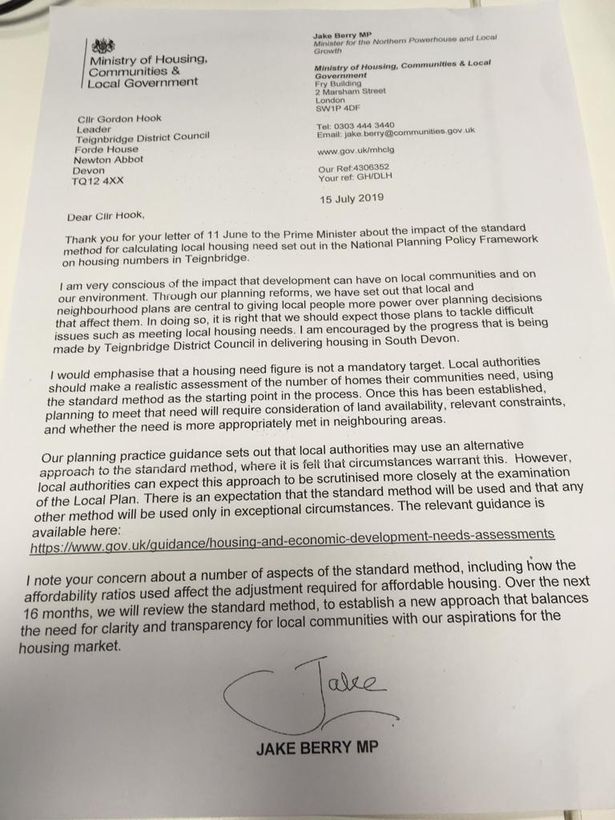
Letter from Department of Communities and Local Government to Teignbridge Council, which queried its raised target:

For background, see:
https://www.devonlive.com/news/devon-news/glimmer-hope-housing-need-rise-3153098

Bovis can’t build footpath on Axminster estate “because there are tree roots in the way”

Owl says: so who designed this then, knowing the problem? Amd which planner didn’t spot it?

“Residents on a new Axminster housing estate say the lack of a pavement outside their homes is putting lives at risk.

They say mums with pushchairs and wheelchair users are being forced to cross a busy road used not only by residents but also heavy construction traffic.

Brian and Barbara White claim plans for the Cloakham Lawns estate, off Chard Road, showed a pavement outside their home at Cloakham Drive.

But council officials say what they deemed to be a footpath was, in fact, only a ‘service margin’.

And they say building a permanent pavement there would harm the roots of a tree on the adjoining open green space.

Mrs White said the situation was ‘an absolute nightmare’, with pram and wheelchair users having to cross the road to the pavement on the other side and then cross back again further down the estate to return to the right side.

“Our road is busy with normal traffic plus heavy lorries, diggers, bulldozers and forklifts. Bovis Homes will be building here for years. There is plenty of room to continue the pavement all the way on this side of the road.”

Mr White added: “There is going to be an accident before long. People are putting their lives at risk.”

Bovis Homes has recently put down a temporary footpath outside the houses but says it cannot build a permanent pavement because of the nearby tree.

A spokesman told the Herald: “The tree is a hybrid lime, which is a category-A tree and is protected by a tree protection order (TPO) and also by a root protection area (RPA).

“RPAs are designed to protect the trees’ root systems and provide sufficient rooting environment to allow the trees to continue to thrive.

“The RPAs prohibit groundwork, construction, development or storage activity within the designated area. The highway proposals obviously had to take that into account.

“The temporary footpath is in place while there is construction work going on, and this hasn’t required the more robust foundation work that a permanent footpath would, which would adversely impact the RPA.”

https://www.midweekherald.co.uk/news/axminster-residents-say-mums-with-pushchairs-are-forced-to-cross-a-busy-road-1-6188464

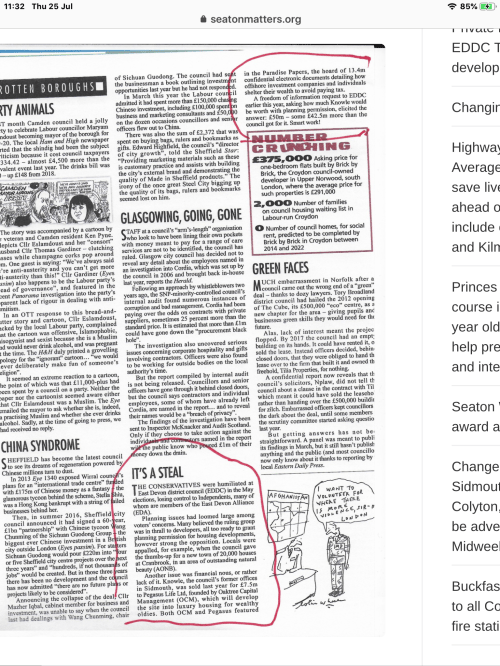
EDDC Tories appear in Private Eye’s “Rotten Boroughs” column

From the blog of DCC EDA Independent Councillor Martin Shaw:

Private Eye goes to town on EDDC Tories’ handout to developers of the Knowle

Oh dear – and now “The Independent Group” led by EDDC Leader Ben Ingham has chosen to cosy up to Tories, rather than East Devon Alliance independents, whom he has frozen out.

With current Councillor Ingham having the been a member of all 3 groups and Leader of 2 of them (former Tory, former Leader of East Devon Alliance and current leader of ‘The Independent Group’) he really has to decide which side of the fence and his cohort are on!

Or maybe he has already decided – given that he appointed a Tory as Chairman of the Development Management Committee, who then used his casting vote to push through a controversial planning applucation in Axminster, opposed by Axminster EDA councillors on safety and pollution grounds:

https://eastdevonwatch.org/2019/07/19/eddc-tory-dmc-chairman-uses-his-casting-vote-in-controversial-planning-application/

Reality check needed for some of his colleagues, perhaps?