… if you take all the unanswered and refused Freedom of Information requests on the whatdotheyknow website:
https://www.whatdotheyknow.com/body/east_devon_district_council

… if you take all the unanswered and refused Freedom of Information requests on the whatdotheyknow website:
https://www.whatdotheyknow.com/body/east_devon_district_council
Potential car parkers in the Mill Street car park in Sidmouth had charges hiked by more than 300% to £5,400 per year so it’s not surprising that they did not take up spaces which worked out at more than £14.79 per day.
We now hear that DCC are offering landlords, contractors and business owners ( which, of course will include developers) will be able to park on double yellow lines for £5 per day = £1,825 for 365 days of parking.
Mill Street – £14.79 per day
Double yellow lines – £5 per day
Today, the Express and Echo says there will be few checks on the £5 per day charge – indeed without appropriate legislation to define each category it will be impossible to do it at all. A source is quoted as saying “It’s all about the money”.
Yet another example of EDDC plc and Devon County Council plc – grabbing what they can when they can build their luxury HQ (EDDC) or to plug their own party’s funding cut black holes (DCC).
Sheer madness or sheer greed – take your pick.
Interesting exchange of emails regarding the contract for Knowle between EDDC and Pegasus:
You can see why the Conservatives want to water down the Freedom of Information Act.
40 percent funding reduction would devastate local services and communities, councils warn
LGA media release 19 October 2015
“A further 40 per cent real terms reduction in local government grant funding in the Spending Review would deliver the £10.5 billion knock-out blow to cherished local services, the Local Government Association warns today.
Non-protected government departments have been ordered to draw up savings plans worth, in real terms, 25 and 40 per cent of their budgets ahead of the Spending Review on November 25, which will set out government spending plans for the next four years.
Analysis by the LGA, which represents more than 370 councils in England and Wales, reveals a 40 per cent real terms reduction to core central government funding would be worth £8.4 billion. The same cut to separate local government grants would see a further £2.1 billion lost from council budgets.
This would mean local government losing 64 per cent of its grant funding between 2010 and 2020.
In its Spending Review submission to the Treasury, the LGA has already predicted councils will face almost £10 billion in separate cost pressures, through government policies, inflation and demand, by 2020 even before another penny is taken out of council budgets.
Together with another 40 per cent reduction to funding from central government, this would leave councils facing £20 billion in funding cuts and increased cost pressures by the end of the decade. Local government leaders say this would devastate local services and communities.
To put those figures into context, annual council spending on individual services in 2013/14 include:
Bin collection and recycling – £3.3 billion;
Arts and leisure (libraries, leisure centres, museums) – £2 billion
Road maintenance – £1.3 billion;
Subsidised bus services and free travel for elderly and disabled – £1.7 billion
Street cleaning – £717 million;
Parks maintenance – £690 million;
Street lighting – £530 million
Trading standards, noise, environmental health – £480 million.
The LGA said even if councils stopped providing all of these vital services for their residents, it would still not be nearly enough to plug the potential £20 billion hole in their finances by the end of the decade.
Lord Porter, LGA Chairman, said:
“Councils are under no illusions about the challenge that lies ahead. We know we face almost £10 billion in cost pressures by 2020 even before the prospect of further challenging funding reductions over the next four years.
“What is clear is that another 40 per cent real terms reduction to local government grant funding on top of these cannot be an option on November 25.
“It is a false economy to reduce funding to local government while attempting to prop up other departments.
“Providing councils with fairer funding is the only way to avoid the unintended consequence of other parts of the public sector, such as the NHS, being left to pick up the financial pieces. When making its spending decisions government must consider the huge pressure funding reductions to councils would have not just on vital local services but on the public sector more widely.
“Councils have worked tirelessly to shield residents from the impact of the 40 per cent government funding reductions they have been handed since 2010. However, the resilience of local government services cannot be stretched much further.
“It would be our residents who would suffer as councils are no longer able to deliver some of their statutory duties, like street cleaning and providing the free bus travel that is a lifeline to our elderly and disabled.
“Closing every children’s centre in England would save £700 million but this would only be enough to plug the funding gap facing adult social care for one year. Councils could stop fixing the two million potholes they fill each year to save £600 million by 2020, but this would still not be enough to keep providing free bus travel to elderly and disabled residents.
“These are the difficult decisions councils will be forced to face. Many of the things people take for granted, like clean and well-lit streets, maintained parks and access to leisure centres, will become a thing of the past as a result.”
Additional information
Breakdown of local government core spending (figures in £000s and exclude expenditure on schools and housing benefit).
2013/14
Education
£4,249,676
Highways
£1,591,039
Public Transport
£1,850,344
Children’s Social Care
£6,914,607
Adult Social Care
£14,565,464
Housing
£2,003,473
Cultural Services
£2,708,616
Waste Management
£3,324,260
Other Environmental Services
£798,707
Regulatory Services
£888,334
Planning and Development
£1,262,183
Central services
£2,618,551
All other services, capital financing and other costs
£4,693,501
Public Health
£2,507,832
Total net expenditure
£49,976,587″
A couple of solicitors writing on the “Local Government Lawyer” website give advice to developers on how to get the best out of their dealings with local authorities. Here are a couple of paragraphs of their article:
“… Huge cuts in public sector funding means that councils are looking to engage ever more in property development to generate place-shaping, capital receipts or longer term income streams. If developers know how to engage properly with councils, understand what makes them tick and talk the right language then great (and profitable) things can be achieved. Conversely, far too many developers shoot themselves in the foot both reputationally and financially and miss out on deals with the public sector because they just don’t know how to put it together. …
… Councils are a lot more innovative and willing to explore collaborative arrangements with developers than developers often realise. Not every council is going to have the right approach and, indeed, councils need to improve and continue to develop their own commerciality and freedom of thought. For the most part, however, in our experience they are open to listening to and engaging with developers who have something different say and an attitude which chimes with that of the council. Whether it is at the soft market testing stage or during the procurement it is worth exploring the options. …”
Mysterious words from EDDC Leader Paul Diviani at the latest Full Council apparently. They tumbled out in response to a barrage of questions from IEDA Councillors, following issues raised by representatives of the Save Exmouth Seafront (SES) campaign.
East Devon Watch has received this summary:
“Cllr Megan Armstrong quoted from Exmouth Regeneration Board minutes (7th Oct 2015) which state that the area was being regenerated “for the wider benefit of Exmouth” . Was this statement, and other justifications for the seafront development, “based on facts, assumptions, or wishful thinking by the Council”, she asked?
Cllr Ben Ingham picked up her point, saying that the Council should “tell the truth”, that their Exmouth seafront plans were to make money to fill an anticipated gap in their finances. It was “total rubbish” to pretend it was “for the wider benefit of Exmouth”.
Cllr Ingham also referred to concerns raised at public question time about EDDC’s choice of partnership company for the seafront development. SES had sent Councillors their research on the matter. But Cllr Cathy Gardner’s proposal that the Scrutiny Committee should check that due diligence had been properly done, was summarily dismissed by Leader Paul Diviani. “You are wandering into territory that is very dangerous”, he told her.
A (combined?) written reply to the Independent Cllrs was promised.”
More on the Save Exmouth Seafront campaign on BBC RADIO DEVON’s breakfast programme today and on RADIO EXE.
Some background here:
It is now widely accepted that councils are no longer viewed as “public services”. A council used to be elected to represent the interests of its area and its councillors were supposed to represent the views of their electors (though this was not always the case). Council tax was seen as the price we paid for our public services.
Now councils are seen as businesses. They exist to make a profit. They are no longer guardians of public assets but are looking to sell off as many of their “unprofitable” assets as possible whilst retaining cash cows. They do not see a responsibility to council tax payers or to future generations and now developers are what they call their real “customers” that they are there to serve. Indeed, a few years ago, one of EDDC’s senior officers said that, yes, developers are their real customers as they pay large sums into council coffers, more than council tax and therefore they should be considered the council’s most important customers – far more important than council tax payers.
Now we have the situation where the “council businesses” no longer has the interests of electors at their heart and they are increasingly attempting to be simply profitable businesses. But the problem then arises when what is best for the business is not best for electors.
Take the situation in Exmouth. The district council does not want Marks and Spencers Food to be sited near the railway and bus stations (on land owned by Devon County Council) but on its own land which is currently designated as a rugby field. Marks and Spencers knows what it wants and would have been aware of the choice of sites and they chose the one that suited their needs.
This now pitches council business against council business – EDDC against DCC. Some might say this is a good thing as it stimulates competition. However, there is a BIG stumbling block. One of these businesses (EDDC) holds the right to allow or refuse the planning application on the other businesses’s land. Today it is EDDC which holds the trump cards, tomorrow it may be DCC (for example, Straitgate Quarry, where DCC wants it to continue and EDDC does not).
In the past, the deal-breaker would have been: what is best for the district? Now the deal-breaker is: what effect does this have on our income stream and our ability to sell off assets to the highest bidder?
Increasingly, councillors are playing no part in these decisions, except to follow government guidelines that services must be slashed and developers must be encouraged and they must toe the party line on this.
We, the electors, are not just marginalised but practically eradicated from the decision-making process, since our interests are not those of the businesses which our councillors now serve.
Is this what we should accept? If not, how do we ensure that we get what is best for our district and not what is best for EDDC plc or DCC plc?
Planning Application 15/2188/MOUT
Objections need to be in to EDDC Planning by 27th October 2015. This is the date which you should look to if you want your email or letter displayed on the EDDC website and to be considered by the Development Management Committee.
The planning application will probably be discussed by the Development Management Committee on 8 December 2015 at The Knowle, Seaton.
Unfortunately the EDDC New Local Plan will not be approved by the inspector until early 2016 – one possible reason why this planning application has been made at this time.
Below is a link to points that you may wish to consider when making your objection:
Following requests, here are the minutes and audio recordings of the last Cabinet meeting (16 October 2015) – including the controversial debate about beach huts:
Agenda Item 3 SW Region Planning Officers meeting, Cranbrook:
“Exmouth and Seaton Regeneration:
Presentation by Alison Hayward, Principal Regeneration Project Manager at East Devon District Council – Appendix 2
Exmouth noted signs of economic decline in earl y 2000’s.
Council – enabling role and significant landowner.
Masterplan adopted 2011 and delivery strategy. Public realm improvements £1m. Elizabeth Hall community venue to redevelop as Premier Inn. Indoor bowling alley, soft play, venue (all from private investment). Station area – aim to improve connectivity, discussions with stagecoach (depot). Rugby club to be relocated to enable supermarket development. Watersports facilities at Queens Drive – looking to relocate road for better linkage with sea – inc hotel / holiday accommodation. Outline planning application prior to selling some of the site to developer partner / operator. Mamhead slipway (deepwater) collapsed – engineering solutions to replace/enhance, up to £1.3m council costs. Town centre area also being examined – land ownership issues complex.
Seaton – special policy (regeneration) in 2006 local plan. Capital receipt of EDDC land sale (Tesco + 400 homes) reinvested. Coastal communities and HLF funding bids for fossil centre. Wetlands reserve (Devon Wildlife Trust). Other projects: Seaton Quay, workshops, tramway improvements.
Q&A – Tesco does not appear to have impacted on town centre. Ex estuary mitigation strategy for Premier Inn south.”
Planning Officers SW meeting October 2013
But did they take this into account:
or this:
https://public-api.wordpress.com/wp-admin/rest-proxy/#http://widgets.wp.com
“Sightseers spend £499million a year in the South West, more than anywhere else in the UK, new figures show.
Even more (£547million) is spent on visitor attractions in the region – second only to London, a survey of domestic tourism has revealed.”
And still East Devon District Council ignores tourism. The more incursions of housing and industrial units into our beautiful coastal and countryside areas, the fewer tourists we get.
Two successes for EDA Independent councillors’ campaign for openness and democracy at last night’s EDDC Scrutiny Committee Meeting –and a thumping failure.
At the suggestion of EDA Independent councillor Ben Ingham, the committee unanimously recommended that the shadowy activities of the secretive Asset Management Forum should be dragged into the light. They agreed that Forum meetings from now should be minuted and open to press and public.
They also unanimously approved “best practice” recommendations from a recent Government training session for scrutiny committees.
In fact, EDA Independent councillor Marion Rixson was praised for having already pre-empted the recommendation that individual councillors should do detailed research into topics of concern. Her comparative study of different councils’ management of beach huts was crucial in influencing the EDDC’s recent decision to scrap its plan to auction the rental of its beach huts to the highest bidder.
Sadly the Committee was unable to shine a light on the scandalous Chardstock affair.
Two speakers expressed their frustration and disappointment that the Committee could not scrutinise the dubious way in which their small, isolated community had been declared suitable for large scale development in the Local Plan.
If any village in East Devon in “unsustainable” it’s Chardstock with its few facilities and poor access. The Parish Council thought so, EDDC’s planning officers thought so. But at an Extraordinary Council Meeting on March 25, called to finalise the Local Plan, Chardstock was designated “sustainable”!
Grave doubts have been expressed about the process that led to this astonishing decision. A member of the public, who many assumed was a Chardstock councillor, spoke strongly in favour of designation as sustainable. He was later identified as a developer, not resident in the village.
Deputy Leader Andrew Moulding spoke eloquently in his support – and a majority of the Council agreed to re-designate the unfortunate village.
To many observers, including Independent councillors, this appeared to be a shameful manipulation, and an earlier meeting of the Scrutiny Committee had agreed to investigate the process.
Last night it emerged that the Council’s Legal Officer had advised that the Scrutiny Committee should not discuss the matter until the Inspector had ruled on the Local Plan. By which time it would be impossible to change Chardstock’s designation!
The Legal Officer did not attend, and it was left to a deputy to try justify the decision.
In frustration, one of the Chardstock councillors accused the Committee of kicking the Chardstock scandal “into the long grass”. Chair Roger Giles denied it, and said it would be investigated whenever the Inspector had made his decision.
EDA Independent councillor Cathy Gardner said she was embarrassed to be a member of the Scrutiny Committee which had let down the public.
There’s obviously work to do before all the dark corners of EDDC are open to daylight!
East Devon councillor Cathy Gardner reports on the EDA website:
“I had some new experiences this week – attending a ‘think tank’ and a Sidmouth Beach Management Plan (BMP) Steering Group meeting. Think Tanks are informal discussions arranged by Portfolio Holders (Cabinet members given specific areas of responsibility like Economy or Tourism). I have no idea yet if there will be any actions as a result of the discussions on Monday (12/10/15) but Officers were present and some good ideas were put forward. The topic of this meeting was how to use grant money that the Council had received for supporting the local economy. The workings of EDDC are becoming clearer, if still frustrating.
The BMP meeting was very informative, although progress seems to have been slow. The Steering Group consists of a range of people, mostly not on EDDC although it is Chaired by Cllr Moulding (Axminster) who is Deputy Leader. An area of concern is Alma Bridge: continued erosion means that another solution will be needed soon. Even so it seems highly likely that the coastal path will be diverted over the footbridge at the ford at some point. There does not seem to be any urgency from DCC to start work on a long-term answer (probably with the bridge further inland than it is now). They seem to want to wait until the BMP process advances some more. Another challenge for the BMP is the quality of the data being used to estimate erosion rate. This is a historical problem as good data has only been recorded recently, however the inclusion of data that everyone agreed was wrong seems counter-intuitive. We will have to wait many more months before a plan is drafted and then more months before funding is found to start work.
I hope this insight into the workings of EDDC is informative.”
Some reading between the lines needed here:
Auctioning leases has NOT been ruled out when 5 year leases are offered ( it is unclear if leases apply to all sites or just Budleigh Salterton and Seaton sites).
Taking out the word “significant” from the original phrase ” significant increase” means nothing.
“Market rents” will be charged.
A typical EDDC non-transparent fudge that only benefits one side: EDDC.
Tenants beware!
Will this nightmare never end?
From EDDC:
“The East Devon Local Plan Inspector has asked that we consult on additional changes to the local plan. The consultation will run from Friday 16 October 2015 to 12.00 Noon on Monday 30 November 2015.
These changes and further information about the consultation can be viewed on the Council web site at:
http://eastdevon.gov.uk/planning/planning-policy/emerging-plans-and-policies/the-new-local-plan/examination-and-hearing-sessions-and-further-consultation/work-programme-autumn-2015/#article-content
We will send copies of the paperwork to public libraries in East Devon and to Lyme Regis Library and Exeter Central Library and paper copies can be inspected at the council offices here in Sidmouth.
To save paper we have provided the web link, however, if you are unable to view or download documents via our web site please contact us directly and we can supply a paper copy of the proposed changes and a form for making comments.
Please ensure that we receive any response by 12.00 noon on Monday 30 November 2015 at the latest.”
“The most reasonable jobs-led (policy-on) scenario is therefore CR2 & EA2, using the DCLG 2012 headship rates. This leads to a dwellings requirement of 723 per year (13,014 over the plan period).
There is a further element which has not been sensitivity-tested, which is the 549 jobs number calculated in the Ash Futures paper in Feb 2015 (psd2015e). This relies on an over-optimistic calculation of job creation at the Exeter & East Devon Growth Point, particularly the major sites at the Science Park, Skypark and Intermodal facility. I raised queries about this at the hearing in July.
The Skypark Development Partnership (Representor 7169) stated in their representations that job development has been slow: “the reality therefore is that it has taken 5 years to secure the first B1/2 occupier on the site suggesting the site will take at least 20 years to complete”.
We also heard at the July hearing that development of the Intermodal facility has stalled and is unlikely to come forward in the near future, and alternative uses may need to be found.
Therefore the job creation at the Growth Point is very likely to be lower than that predicted in the Ash Futures paper, and the total number of jobs is likely to be less than 549/year which has been used in all the Edge Analytics scenarios.
The number of 723 dwellings / year should therefore be regarded as an upper limit, and a realistic figure would be lower than that.
I therefore disagree with the Council’s continued use of the housing requirement figure of 950/year, which is not supported by the evidence.”
http://eastdevon.gov.uk/media/1330903/hh2015a-cpre-comments-sep-2015_redacted.pdf
“13 October 2015
Council asks residents for their views on delivery of services
Moving and Improving consultation will give households across East Devon the chance to have their say on how and where council services will be delivered
Having made the decision to relocate its offices from Sidmouth to Honiton and Exmouth, East Devon District Council has launched its Moving and Improving public consultation, as part of its ongoing commitment to providing excellent services to the local community.
The council is carrying out the consultation to help inform decision making about how and where services should be provided so it is keen to hear back from as many East Devon residents as possible. This consultation will help inform decision making regarding where and how council services are delivered following the move to Honiton and Exmouth.
As part of the consultation process, 3,000 households throughout East Devon were recently selected to receive a copy of the Moving and Improving consultation questionnaire in the post.
However, the consultation is also open to all other East Devon residents, who can have their say by going online and completing the questionnaire at:
http://www.eastdevon.gov.uk/consultation-and-surveys/moving-and-improving
Residents participating in the consultation can enter a prize draw for vouchers worth £100 and can also sign up to receive the results.
A separate consultation questionnaire is also being sent to town and parish councillors, representatives of voluntary and community groups, and representatives of local businesses, as their opinion is also valued and will help inform the way council services are delivered.
The closing date for the Moving and Improving consultation is Thursday 12 November 2015.
Commenting on the consultation, Councillor Paul Diviani, Leader of East Devon District Council, said: “As a public authority, it is our duty to make sure that everyone can access the services they need and that our services represent great value.
“The council offices are old, expensive to run and need ongoing repairs. The public spaces are not very welcoming and the offices are not fit for purpose for a modern 21st century organisation such as ours. Quite simply, moving is a cheaper option for East Devon than staying put.
“Our vision for service delivery is that you will be able to do business with the council when, where and how you want to. This means that not only will we operate from offices in Honiton and Exmouth, but we will continue to have a presence in main towns through surgeries and we will continue to develop better online self service options for you.
“It’s really important that you have your say about how and where you want our services to be delivered in the future, as this will help us decide how to provide our services when we move.”
Contact details below are for media only and not for publication
For more information, contact:
Richenda Oldham, Communications Officer 01395 517559, ROldham@eastdevon.gov.uk”
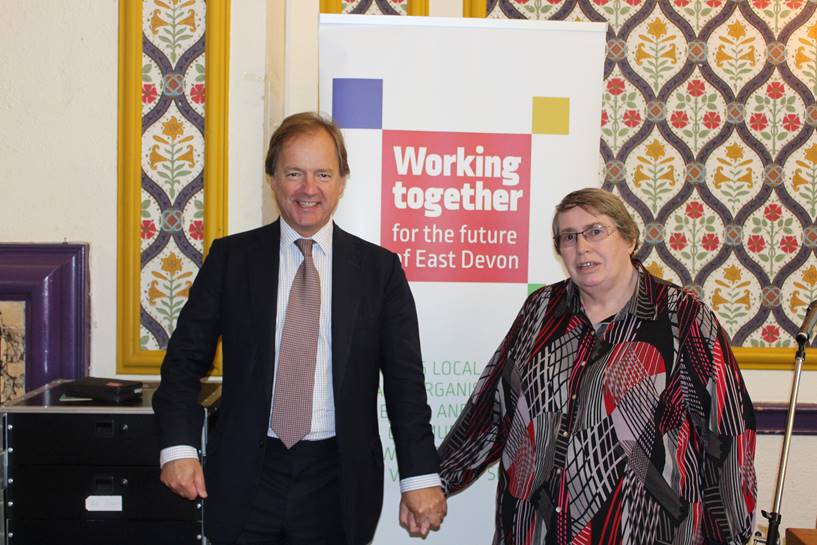
EDDC recently held an event to publicise the many ways it “works together” with local organisations:
David Cameron chose Newton Abbot over the weekend to launch his policy on more housebuilding and the threat to impose numbers on Local Authorities which do not have a Local Plan.
This seems a strange venue. Teignbridge adopted its Local Plan in 2014. In it, it choose not to adopt the “supporting high economic growth” target that EDDC prefers.
Based on the lower demographic, Teignbridge had a target of 620 houses a year. If EDDC had gone down this route, its equivalent would be 584 houses a year (10,512 over 18 years).
Teignbridge with its lower target gets the PM’s praise, EDDC gets nothing.
Strange that …
 East Devon Watch