Hold your breath in Sidford, the HGVs are coming

Imagine the increase in particulate discharge, particularly its effect on the health of the children of the village.and the integrity of the structure of those beautiful old houses on the route, most built with shallow foundations. And in a flood-prone area of an AONB. Wouldn’t happen in the Blackdown Hills!

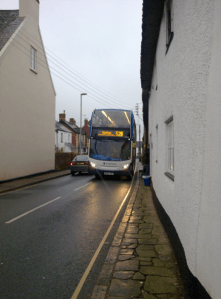
“Campaigners have branded Sidford and Sidbury’s ‘bottleneck’ roads ‘too narrow’ to handle the increased transit of lorries.

Councillor Marianne Rixson said traffic is predicted to increase by a third along ‘pinch point’ roads if plans for a business park in Sidford go ahead.

She said the roads are already congested – particularly School Street, near Sidbury Mill and through Sidbury – and branded claims that the site ‘is well served by highway access’ as misleading.

Cllr Rixson, who represents the Sidmouth-Sidford ward on East Devon District Council, said: “The roads are too narrow yet they are predicting a 32 per cent increase in traffic through School Street if the development is approved – Sidbury, too, has various ‘pinch points’ where two vehicles cannot pass.” She added that there needed to be a ‘duty of care’ to pedestrians on roads where there are no pavements.

And with HGVs nearly three metres wide, Cllr Rixson fears two lorries could not pass each other in School Street – which is just 4.8 metres wide.

She said: “The A375 is an upgraded B road and is essentially still a B road. Already lorries drive on the pavement in School Street and, in Sidbury, there are stretches where there are no pavements at all.”

Devon County Council’s highways team is being consulted on the application and said it is considering its response.”

http://www.eastdevonalliance.org.uk/in-the-press/20160702/sidmouth-herald-hgv-increase-issue-on-narrow-roads/

Sidmouth: local architecture competition short list designs on display

Short listed designs can be seen here:
http://futuresforumvgs.blogspot.co.uk/2016/06/plans-for-port-royal-and-eastern-town_29.html

‘Blue-sky thinking’ in Sidmouth architecture competition

“An open-air theatre, a pier venue and a marina are among the five final designs in a competition to re-imagine Sidmouth’s eastern town.

Ideas came in from around the world – from Japan to Peru and Brazil – with entrants letting their imaginations run riot to redefine the Regency resort.

A jury has whittled some 18 designs down to a shortlist of five – and now Sidmouth citizens can vote for their favourite.

The competition was dreamed up by Sidmouth-born architect Henry Beech Mole, who said: “The shortlisted entries represent a good variety of possible futures for Sidmouth – a pier, a marina, landscapes, ecological strategies, and new public spaces – any of which would be great additions to the town. We would now hope that, with local support, we can move towards trying to implement the winning scheme. This is an unusual chance for the town to think about what it wants to be in the 21st century.

“I hope that through the competition we can move away from the binary arguments of tradition and progression and take an holistic view of how the town can retain its charm and beauty while also evolving to become a more vibrant and successful place for the future.”

For now, these are just ideas – their implementation will be down to the landowners. The detailed designs will be exhibited until Tuesday, July 12, at Kennaway House, where residents can vote for their favourite.

They can also be seen online at sidmouthherald.co.uk

The winning entry will be revealed on July 13.”

http://www.sidmouthherald.co.uk/news/blue_sky_thinking_in_sidmouth_architecture_competition_1_4598727

“There’s more to life than the economy”

Speaking of an ” explosion” in best-selling books about the natural world, judge of a nature prize Fiona Reynolds (ex-National Trust) says:

“Even in these three years there has been an absolute flood of books in which writers are talking about nature and its meaning, and not just in a superficial sense. These are profound books, about a deep relationship and about the deeply spiritual questions which confront us in society.” “[They show us that] there’s more to life than the economy, or foreign policy – these writers are articulating beautifully the ways in which the human spirit needs to connect with the world around us, and to respect the world around us.”

http://gu.com/p/4n4nb

Shame our district council hasn’t got the message.

“Toothless Environment Agency is allowing the living world to be wrecked with impunity”

No chance for Sidford Fields then.

” … The Environment Agency no longer prosecutes even some of the most extreme pollution events. In 2013, a farmer in Somerset released what the agency called a “tsunami of slurry” into the Wellow Brook. One inspector said it was the worst pollution she had seen in 17 years. But the agency dithered for a year before striking a private agreement with the farmer, allowing him to avoid possible prosecution, criminal record, massive fine and court costs, by giving £5,000 to a local charity.

New rules imposed by the government means that such under-the-counter deals, which now have a name of their own – enforcement undertakings – are likely to become more common. They are a parody of justice: arbitrary, opaque and wide open to influence-peddling, special pleading and corruption.

I see the agency’s farcical investigation of the pollution incident I reported as strategic incompetence, designed to avoid conflict with powerful landowners. Were it to follow any other strategy, it would run into trouble with the government.

These problems are likely to become even more severe, when the new cuts the environment department has just agreed with the Treasury take effect. An analysis by the RSPB and the Wildlife Trusts reveals that, once the new reductions bite, the government’s spending on wildlife conservation, air quality and water pollution will have declined by nearly 80% in real terms since 2009-10.

It’s all up for grabs now: if you want to wreck the living world, the government is not going to stop you. Those who have power, agency, money or land can – metaphorically and literally – dump their crap on the rest of us.

Never mind that the government is now breaking European law left right and centre, spectacularly failing, for example, to ensure that all aquatic ecosystems are in good health by the end of this year, as it is supposed to do under the water framework directive. It no longer seems to care. It would rather use your tax money to pay fines to the European commission than enforce the law against polluters.

I’ve heard the same description of Liz Truss, the secretary of state for environment, who oversees the work of the Environment Agency, from several people over the past few months: “Worse than Owen Paterson”. At first, I refused to take it seriously. It’s the kind of statement that is usually employed as hyperbole, such as “somewhere to the right of Genghis Khan”, or “more deluded than Tony Blair”. But in this case, they aren’t joking. Preposterous as the notion of any environment secretary being worse than Paterson might seem, they mean it. …”

http://gu.com/p/4e5jg

Sidford: Environment Agency “not using new flooding figures to save developer money”

The Sid Vale Association is to take legal advice on the Environment Agency’s “incomprehensible” decision to support a planning application for a business park on a Sidford floodplain.

Here’s an extract from the Sidmouth Herald’s report :

” … The Environment Agency (EA) has defended its ‘incomprehensible’ support of plans for a 9.3-acre business park in Sidford – because using its new flood risk figures could cost the developer money.

A climate change report by the government body states that the region’s peak river flow is expected to increase by 85 per cent – four times more than anticipated – while surface water is likely to increase 40 per cent by around 2070, which is double the previous forecast.

In light of the increased risk to the flood-prone valley, representatives are calling for the agency to rethink its support of an outline planning application for the business park between Sidford and Sidbury, submitted by Fords of Sidmouth.

But the EA states it has not taken the new figures published earlier this year into account because the site is already allocated in the adopted East Devon Local Plan – a development blueprint to cover the next 15 years.

The EA’s policy states: “The advice will come into immediate effect. However, where local plans or development proposals and associated flood risk assessments are well advanced, the application of the updated allowances could significantly slow down completion or add to costs.”

An EA spokesman said: “We considered the plan and application to be well advanced and therefore reasonable to base advice on the existing allowances.”

The Sid Vale Association (SVA) has threatened legal action if the agency does not review its ‘short-sighted and potentially dangerous’ position on the matter.

SVA conservation and planning committee chair Richard Thurlow said: “Our letter [to the EA] reflects the comments of many Sidmouth and Sidford residents. We find it absolutely incomprehensible that the Environment Agency is not using its own regulations which came into operation in February. … “

Increased flood risk: SVA calls for Environment Agency rethink on the Sidford planning application.

Claire Wright: even more important that MPs represent their constituency

“Brexit: It is now more important than ever that this country has MPs who will represent the people

Tuesday, 28 June 2016 1 Comment by Claire

Since Friday events have moved so fast I haven’t even written a blog as each time I think of an angle it gets superseded by another major news story!

The only clear thing among all the chaos and confusion, is that this country has probably never been more divided – politically and socially – and in my view, more in peril than at any other time in living memory.

The party system seems to have totally fractured. Not only has the Conservative parliamentary party become bitterly broken, the Labour party is also at war.

Last Friday morning I felt shellshocked and upset that we had left an institution I believed worked for the greater good, despite its many faults. Since then I have watched fascinated as the subsequent dramatic events unfolded.

The economic fallout came swiftly and is very worrying. The value of the pound has plummeted to a 31 year low, we are told that the UK’s credit rating has been downgraded from a triple A to a double A rating, we have dropped from being the fifth largest economy in the world to the fourth and the Bank of England is on standby to pump £250bn of public money into the markets to reduce the jitters currently reverberating across the globe from our EU exit.

More than £200bn has been wiped from the value of the UK stock market – equivalent to 24 years worth of EU contributions.

A general election is now looking possible in October, to tie in with the selection of a new prime minister.

Lies and exaggeration were undoubtedly the order of the day for both the Leave and Remain campaigns, but what is really galling to me is that the Leave movement won people over on false pretences. On the NHS and immigration in particular – two major planks of their operation, their claims have been found to be resoundingly untrue.

The Remain campaign focused too much on scaremongering and too little on how the EU helps us, which only riled people and forced them into entrenched positions , setting family member and friend against one another.

The conservative IN bandwagon, seemed to be blinkered on issues mainly linked to the economy and immigration, discounting all the positive things that the EU does for us, for example on employment, the environment and human rights for example. I believe that this was because these are the issues that are not valued by the right wing political elite that we currently have governing this country.

David Cameron’s supposedly one nation conservative cabinet, which campaigned WITH big business against a ban on bee killing pesticides, has already scrapped or weakened as many environmental protections as it can get away with. Planning regulations are now as relaxed and in favour of developers as they have been since the introduction of the Town and Country Planning Act in 1947.

With a future hardline right wing government on the cards, possibly led by the current favourite Boris Johnson, the likelihood of the current protections remaining for our seas, clean air, recycling, waste and for rare species, landscapes and plants – the Habitats Regulations – is remote.

Over the past few years the Conservative government has lobbied to scrap the EU Habitats Regulations – tough laws which protect some of our most precious landscapes here in East Devon, such as Woodbury Common, Aylesbeare Common, the Exe Estuary, as well as large swathes of Dartmoor.

However, despite the Habitats Regulations protecting our most rare and precious species such as the dartford warbler and the nightjar, our government announced the laws were “gold plated,” and lobbied the EU hard to get them scrapped.

The EU has so far held firm to these regulations, which also mean strong planning rules in these areas , as well as the surrounding countryside.

But I now can see on the horizon an inevitable and horrible ‘bonfire of red tape’ as a new right wing conservative leadership sets about dismantling anything that it views as in the way of “growth.”

So what is the future of East Devon now most of the country has voted to leave?

In my own council ward of Ottery, there must now be question marks for a controversial quarry proposed at Straitgate Farm, which was quietly looking less likely, due in part to the strict Habitats Regulations Protecting Woodbury Common, where Blackhill Quarry is based and where stone and gravel processing currently takes place. It was due to cease as of the end of this year because of these laws.

What will Brexit mean for East Devon’s two biggest industries? Agriculture and tourism? And what will it mean for education? What does it mean for our cash strapped NHS and our local very much at risk
community hospitals?

What will it mean for the most vulnerable people in the constituency and those on low incomes?

Certainly, both agriculture and education are forced to rely on EU subsidies and grants.

Prolonged economic hardship will surely mean even deeper public spending cuts, yet deeper cuts to public services, which as always, will have the biggest effect on those people who have the least.

If a general election does take place in October, the future of our district – and the rest of the country – rests with those politicians examining thousands of pages of EU law and policy with a view to changing, scrapping or tightening it.

The future of our vulnerable residents also rests with MPs who have a duty to stand up for people who need help and support.

East Devon’s MP needs speak and vote in favour or against new laws and policies based on how they affect local people. That’s voting FOR the people of East Devon, not his party.

Each MP has a duty, in my view, to be a diligent scrutineer of this process.

What laws or policies do we want in East Devon that will benefit us, our communities, our wildlife and our businesses? Now is the time to consider this very carefully.

If democracy is working effectively people in East Devon should have the opportunity to influence such discussions through our MP.

And our MP has a responsibility to stand up for the people of East Devon and what they see as their priorities, especially at this very turbulent time.

The question has to be as ever. Is Mr Swire up to the job?”

http://www.claire-wright.org/index.php/post/brexit_it_is_now_more_important_than_ever_that_this_country_has_mps_who_wil

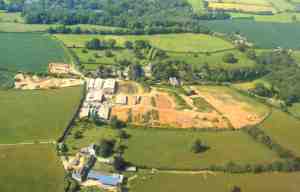
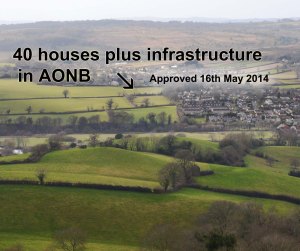
Sidford Business Park: evidence and information for objectors

Sidford-Sidbury Rd, next to Sidford Fields site for proposed business park.

Sidford-Sidbury Rd, next to Sidford Fields site for proposed business park.

imageimage

More details here:
Save Our Sidford—- Where to write

“Cronyism in the south west”

Something we all know about in East Devon!

“Cronyism in the South West”
The sheer amount of unsuitable and damaging development that has been pushed through against all objections in my home town of Totnes, but also throughout the south west, is making me question the role of cronyism in the deals made.

It starts at the very top of course in government, but appears to have sucked up many of our more august bodies that we are more used to seeing as our defenders and protection, into its net. The National Trust for example, now has a right wing business leader as its head. I wouldn’t suggest for a moment that this is as a result of any wrong doing, but I question why he is there, when he comes with no history of interest or involvement in conservation or the heritage sector. It is a coincidence of course that the National Trust appear to be engaged recently in the development business themselves, aiming to sell land, given to them in trust in Bovery Tracey and also in Somerset, for housing. To say local people aren’t happy is a bit of an understatement.

Natural England also, is now headed up by a right wing business man, an ex-developer actually, with little to no interest up to now in the environment, or preserving the countryside, he was too busy working to concrete it over as head of Linden Homes. George Monbiot describes his appointment as, ‘The government wants a chairman who can flog nature and have chosen a Tory party donor with a background in investment banking and housing developments.’

So our conservation and heritage organisations appear to be headed by cronies, our secretive Local Enterprise Partnership appears to be also. This is the self-appointed group tasked with pouring vast amounts of public money into encouraging enterprise and business down here and with running our devolution bid. The fact that the majority of those on the board come from the construction and housing sector and a few who are involved in weapons manufacturing won’t come as a surprise when you see that our devolution bid, which they mostly engineered, is very heavy on giant construction projects, which the board’s companies appear to profit from and very weak on tourism, farming and sustainability. This bid is about growth. ‘I want to only build structures that you can see from space,’ the chair is quoted as saying. The fact that this undemocratically elected group hold their meetings in private, have no head office, very little accountability and have managed to keep the lid on their activities very successfully is worrying and the ultimate in cronyism.

This culture goes down the line; housing developments pushed through when they are so obviously damaging and ridiculous. In Totnes, Great Court Farm was sold to developers in very suspect circumstances in my opinion. It is the last dairy farm in Totnes, the home to a fourth generation of farmers, a totally unsuitable spot for yet more mass building in this beleaguered town. The access is terrible, the logistics ridiculous and yet it was pushed through by a combination of cronyism and mis-management. The people who suffer are the people who always suffer when cronyism is allowed to flourish and that’s us – everyone else and in this instance the farmer and his family and the people of Totnes, who see their landscape the plaything of those in power.

Across the county, across the country in fact, the same story is played out endlessly. Local people left shocked and devastated as those in power find the wherewithal to circumnavigate due process and make an absolute fortunes flogging nature and our land to line their own pockets.”

https://allengeorgina.wordpress.com/2016/06/19/comment-piece-for-western-morning-news-cronyism/

Natural England newly- designated sites – only one in Devon

… and that is the South West Coast path works only.

https://www.gov.uk/government/publications/natural-england-designations-programme-for-areas-sites-and-trails/natural-englands-designations-programme-to-march-2017

“MPs criticise government over flood protection plans”

Of interest to those in Sidford, who are being let down by flood protection by inappropriate development.

… “Labour MP Ms Creagh said: “We know that flooding is projected to get worse and occur more frequently because of climate change, so it just isn’t good enough for government to react to flooding events as they occur.

“Communities at risk deserve certainty from government.”
The committee found that funding for flooding fluctuates year-on-year. Funding was initially cut during the last parliament and only increased after the winter floods of 2013-14.

The government has committed to spending £2.3bn on building new defences and to protect spending on maintaining existing defences – but the EAC warned they were “sceptical” the government would reach its target of protecting 300,000 properties, saying it was based on an optimistic forecast that assumed the greatest efficiency in spending decisions.
The committee also said it was surprised to learn the extra £700m funding for flood defences announced in this year’s Budget was based on a “political calculation” and may not be allocated with the same strict economic criteria as the £2.3bn.

The report said that could lead to inefficiencies in flood investments, poor decision-making and outcomes that were potentially unfair to some regions. …

… The condition of critical flood defences is in decline, according to the committee.

Ms Creagh said: “The government needs to put money into the upkeep of existing flood defences as well as investing in new defences. Failure to do so can have terrible consequences for residents and businesses when defences fail.

“Any decline in the condition of critical flood defences represents an unacceptable risk to local communities in flood prone areas. We urge the government to go beyond its current target and aim to have virtually all its critical assets meeting the Environment Agency’s required condition by 2019.”

The committee said it was concerned the government does not know how prepared local authorities are for flooding, with Ms Creagh adding that local authorities “are not receiving the support they need to prepare for, and mitigate, the impacts of flooding”.

http://www.bbc.co.uk/news/uk-36480213

South Hams community raising crowd funding to protect wildlife

A community in Devon taking South Hams District Council to a Judicial Review, for granting planning permission to a developer bent on destroying wildlife. The scheme also forces social tenants, against their wishes, from bungalows with gardens into flats.

The group says Council won’t protect them, so they are doing it for ourselves. They are asking for help to set a vitally- needed national precedent and stand up for the rights of wildlife, for local people and kids futures.

The campaign is for Brimhay; a close of small bungalows set around a green adjoining a wild stream valley, in the heart of Dartington village, near Totnes, Devon. The valley is home to dormice and five species of bats- all endangered and which should be protected by European legislation.

Their crowdfunding page is here:
http://www.crowdfunder.co.uk/www-dontburydartington-co-uk

Hinkley C: what happens to nuclear waste? We are not allowed to know

“A furious row has broken out after the Department of Energy and Climate Change (DECC) refused to disclose the arrangement with EDF for dealing with radioactive waste at the planned Hinkley Point C nuclear plant.

The information commissioner’s office has turned down a freedom of information (FoI) request for state aid arrangements between the UK and the European commission to be made public.

The FoI complainant, David Lowry, has launched an appeal, claiming it is in the public interest for British citizens to be able to judge whether their government had made the right decision about the new reactors in Somerset.

Lowry, a British-based senior research fellow with the Institute for Resource and Security Studies in the US, said: “I do not believe the balance of judgment should be in favour of a foreign company, EDF Energy, who will potentially make huge multibillion-pound financial gain from the continued non-disclosure, and hence non scrutiny, over myself as a British tax and electricity bill payer.”

The government said that anyone building new reactors in Britain must manage and pay for the cost of handling waste products, unlike the existing situation where all radioactive materials are effectively dealt with through the public purse via the Nuclear Decommissioning Authority.

However, although the operator must agree to take responsibility for the spent fuel and other radioactive waste, the cost is expected to be passed on to the domestic electricity user through higher bills. …

… “If Hinkley is such a good deal, it should be no problem for the government to release the information to prove it. Their failure to do so leaves us to believe that their assumptions are correct – it’s a terrible deal for bill payers and they simply don’t know what to do with the nuclear waste.” …

http://gu.com/p/4jev8

You want a green environment? Get insured …

“The UK could develop a more flexible approach to environmental protection free of “spirit-crushing” Brussels directives if it votes to leave the EU, the farming minister, George Eustice, has said.

Speaking to the Guardian, the pro-Brexit minister said a leave vote in the 23 June referendum would free up a £2bn green dividend that could be spent on insurance schemes and incentives for farmers.

Environmental laws that have helped protect endangered species and clean up dirty beaches are seen one of the key achievements of the EU, but Eustice sought to reassure green-minded voters that the UK could develop better protections by going it alone. …

… One of the original authors of EU environmental legislation was Stanley Johnson, Boris’s father, who now co-chairs Environmentalists for Europe. He said of Eustice’s proposal: “I am absolutely shocked and horrified at what looks like a no-holds-barred attack by the Brexiteers on an agreed consensus that the environment benefits from a common approach.

“Don’t tell me that a new Brexit-led British government is going to put environmental regulations at top of its pile on June 24. It is not going to happen.”

The European commission is reviewing the birds and habitats directives – which define Europe’s conservation strategy – and is under unprecedented public pressure not to water them down.

The origin of the “fitness check” lies in a domestic review instigated by George Osborne in 2011, when he told parliament that the “gold-plating” of EU habitat rules was imposing “ridiculous costs” on business.

Martin Harper, the conservation director of the RSPB, said: “These nature directives have been the cornerstone of nature conservation in Europe since coming into force. Not only have they improved the fortunes of threatened species but they are essential if we want to meet our international biodiversity commitments.”

On pesticides, Eustice said the EU’s precautionary principle needed to be reformed in favour of a US-style risk-based approach, allowing faster authorisation.

“A precautionary approach is the right thing to do but it should be based on realistic assessments of risk and not just theoretical hazards,” he said. “That is the wrong way to go about it.”

The principle has underpinned bans on GM foods, neonicotonoid inseciticides linked to bee colony declines and endocrine disrupting chemicals.

The marine strategy directive would also be scrapped, Eustice said. He cited a dispute with Brussels over the UK’s failure to designate protected marine areas for harbour porpoises as an example of over-regulation, when dolphin-repelling electronic devices could have been used on nets instead.

However, the Whale and Dolphin Conservation Society said electronic pingers could already be used under current EU nature laws, which also protect porpoises from trawling, dredging, pile driving and noise from military sonars.

Clive Lewis, the shadow energy and climate change spokesperson, said: “It is absurd to suggest that Brexit could be good for the environment when the major challenges we face, not least the risk of catastrophic climate change, are international by their nature.”

http://gu.com/p/4jmg2

Devon Minerals Plan: inspector recommends more than 200 changes

It appears from the press release (link below) that the recommendation is that Straitgate Quarry should be reduced in size but the Inspector raised many issues about access and alternative sites to which he did not receive adequate answers.

Much centred on lack of consultation, and the amended report must now go out to public consultation again from August 1 to September 23,

http://www.exeterexpressandecho.co.uk/Devon-Minerals-Plan-hearing-recommends-nearly-200/story-29331545-detail/story.html

Report from the Straitgate Quarry Action Group here:

http://straitgateactiongroup.blogspot.co.uk/

Cranbrook: Unicorn poop?

Further to our earlier posts about Sustainable Utopian Cranbrook:

Children of St Martin’s Primary School have been creating a new poster design to encourage Cranbrook residents to clean up after their dogs.

Children at the school recently heard from Cranbrook Councillor Karen Jennings at an assembly about the dog fouling around the town. Children were asked if they could help teach adults to be responsible pet owners, to help make Cranbrook a great place to live.”

http://www.exeterandeastdevon.gov.uk/pick-up-the-poop-say-cranbrook-schoolchildren/News-Article/

Flytipping in Utopia (aka Cranbrook)

Cranbrook Town Council Facebook page – not quite Councillor Diviani’s perfect sustainable town (see earlier post)

“LET’S WORK TOGETHER TO STAMP OUT FLY TIPPING

Fly tipping is beginning to be a problem in the Cranbrook area. In a number of recent cases, however, East Devon District Council has been successful in catching the offenders and serving fixed penalties (to cover the clear up costs) which were an average of £150 in each case. Obviously it is in everybody’s interests that we avoid unsightly and potentially hazardous views like this one, so please click for information about what to do if you see incidents of fly tipping or need advice on how to dispose of your rubbish responsibly.”

Cranbrook Development Plan, neighbourhood plans and fairy dust …

Owl rarely sleeps and decided accordingly to look at the DMC agenda for 31 May:

Click to access 310516-combined-eo-dmc-agenda.pdf

Owl was particularly interested to see what EDDC has planned for Cranbrook, and for its growth from its present 1250 houses to 8000 by 2031.

A few points came up on reading the “Cranbrook Development Plan: Issues and Options Report, May 2016”.

· Page 21 mentions the need to deliver confidence for stakeholders, which basically means developers. (DMC papers are open about Cranbrook needing to succeed if the Local Plan is not to fail; and at present EDDC is sitting on planning approaches from developers for 4260 houses. And yes, none of us can afford for either the town or the LP to fail – going back to the EDDC drawing board is not an option).

· Page 24 notes that “A number of Neighbourhood Plans are being prepared by the communities around Cranbrook. The District Council is working with these communities to ensure that they develop plans for their future that build on the opportunity presented by Cranbrook.”

No pressure, then – Owl would be very worried if Neighbourhood Plans had to be revised just to suit Cranbrook.

· Page 34: “People are excited by Cranbrook because they want to know what it means to be in a ‘Sustainable New Town’. Looking and feeling like any other new development is not enough”.

Really? The papers for DMC admit that 57% of Cranbrook residents don’t think they know enough about what is being planned! And, unfortunately, Cranbrook already looks and feels like every other similar development in the country. And as for sustainable – well, they had to drop the eco from eco-town, which says it all.

· Page 35: the section entitled ‘Vision’ confirms Owl’s long-held suspicion that Councillor Diviani, who has given his name to the Foreword, may have been overindulging in happy-making recreational substances – perhaps at the Deer Park hotel:

– “What is it like to live in a healthy, happy town? It is where you are able to socialise and know your neighbours, have ready access to a rewarding career on your doorstep, enjoy good health and feel safe … When you travel down your street to work you meet and chat with your neighbours along the way. Spaces along streets are welcoming, inviting you to pause on your journey …”

– … “It is where you live in complete peace and harmony with your fellow-man, in a Utopian dream and where where fairy-dust is sprinkled over the rooftops by flying unicorns and which also teach the world to sing in perfect harmony …”.

Actually Owl made that last bit up, but it could just as easily have been in this vacuous passage.

Incidentally, on page 23 it says that anyone can comment on the Plan. Many may wish to do so.

“Literary Landscape Loss Lament”

“This week, leading contemporary writers and artists joined the Campaign to Protect Rural England (CPRE) in warning that our matchless and finite countryside is threatened by the Government’s relaxation of planning laws. The group came together to sign a letter to the Sunday Times (published on 29 September) warning that iconic English landscapes are under threat.

The writers support CPRE in saying that Government plans for new homes should prioritise brownfield sites in towns and cities, not the more profitable greenfield sites where housing developers would prefer to build.

In the letter poet Simon Armitage, novelist John le Carre, writer Jeanette Winterson and the sculptor Cornelia Parker and others argue that the Government’s policy of giving preference to greenfield sites over brownfield sites is threatening the “matchless beauty of England” and failing to provide affordable homes.

In support of the letter, Jeanette Winterson said:

‘Concreting the countryside isn’t the answer to Britain’s housing problems. This government is out of touch with real life and tries to cover up its privilege by making what it thinks are popular decisions. We need imaginative people, not policy wonks or developers with vested interests, to re-draw the UK housing strategy. I don’t know why politicians can’t think in colour. Especially the colour green. We can build enough homes. We don’t need to lose our fields for that.’

The letter said:

Dear Sir,

In the two months since the launch of the Campaign to Protect Rural England’s charter to save our countryside we have seen new research showing that over half a million houses are planned for open countryside, with a further 150,000 in the Green Belt.

The scale of this projected development is unprecedented. This needless sacrifice of our green spaces should not be tolerated when England currently has suitable brownfield land for 1.5m new homes which could help regenerate our towns and cities.

As artists and writers who have been inspired by the matchless beauty of England, we urge the Government to support the three basic principles set out in CPRE’s charter to save our countryside.

First, build on suitable brownfield land first, rather than unnecessarily sacrificing the countryside. Second, real localism: give people a proper say in shaping the places they love.

Finally, we must build more houses – not executive houses on green fields, as is too often the case now, but well-designed affordable homes in the right places.

We urge your readers to support CPRE’s charter atwww.saveourcountryside.org.uk
.

http://www.cpre.org.uk/media-centre/latest-news-releases/item/3437-literary-landscape-loss-lament?highlight=WyJsZSIsImNhcnJlIiwibGUgY2FycmUiXQ==

Alternative East Devon calendar April – June concentrates on our Areas of Outstanding Natural Beauty

image

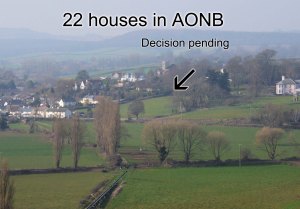
April – AONB counts for nothing so don’t believe everything in your EDDC AONB calendar – it may not be there this time next year!

image

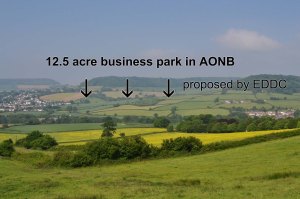
May –  AONB countryside – who cares …well, not EDDC who slipped this one into the Local Plan at the last minutes without consultation.

image

June – what attracts tourists to East Devon?  The countryside.  RIP tourists and countryside.