How does an “Independent Group” become an independent group?

Owl is confused.

The Local Government Independent Group website says:

“The Independent Group represents councillors in England and Wales who are Independent or of a political affiliation outside of Conservative, Labour and Liberal Democrat. It provides a voice at the national level and works within the cross-party Local Government Association (LGA) to ensure that the values and interests of its members are promoted.”

Who created the EDDC Independent Group? Who was invited to join? How did they elect their leader? What were people who joined told? Are they still independent if they include Tories in their Cabinet and as a committee chair? If EDA is “independent” according to the LGA what is different about EDCC?

Would really appreciate a tutorial!

TiggerTory EDDC Chairman responds to EDA Councillor Martin Shaw

Owl says: Not really sure this makes things any better! Proof positive of TiggerTory chats …

Still not sure this is what voters anticipated … and since when was the post of Chairman of EDDC “non political”? Anyone ever remember Tories electing a non-Tory Chairman in the last 45 years?

I take exception to Martin Shaws assertions that the Independents who formed a minority administration allowed the Conservatives to take the key position of Chair/Chairman of the Council……Wrong Cllr Shaw…. I actually was approached by the leader of East Devon Ben Ingham and he asked if I would consider taking the (non-political) position of Chairman having done a good job from 2015 to 2017….. I accepted the position and he contacted Andrew Moulding to give him the news and Andrew called to congratulate me and asked if I’d get a seconder lined up for the AGM.

I also believe that Mike Howe was approached to see if he would take on the Chairmanship of DMC and so once again Cllr Shaw is barking up the wrong tree.

The East Devon Alliance Party had the opportunity to put names forward for the Chairmanship of the Council … however they chose not to and I do believe some of their members voted for me.

Many outside bodies went to the EDA including Recycling and Waste with Conservatives voting for Denise Bickley…..the Conservatives also voted for other positions to be taken by EDA.

I am delighted to have EDA member Cllr Val Ranger as my Vice Chairman who was voting and she was not only voting for EDA nominations but for also Conservatives, Lib Dem’s and true Independents.

It is comments like yours that are unhelpful and perhaps before writing again you should take time and get your facts right.

Stuart Hughes CC

East Devon Alliance county councillor Martin Shaw adds his thoughts about TiggerTories

From his blog “Seaton and Colyton Matters”:

“I was unfortunately unable for personal reasons to attend last night’s annual meeting of EDDC, but many Independent supporters who were there have expressed considerable disappointment. I have however close knowledge of the situation and offer the following comments.

Mandate for change

On May 2nd, after 45 years of increasingly dysfunctional rule by the Conservatives at East Devon District Council, the local electorate reduced their number to just 19 of the 60 councillors. Instead voters elected a majority of 31 Independents, including 11 members of the East Devon Alliance (EDA), 8 Liberal Democrats, and 2 Greens.

A clear mandate was given by local people. Big gains by Independents – both EDA and others – Liberal Democrats and Greens all represented their desire for change. The best administration would have been a coalition of some of these groups, which could have formed a progressive majority of up to 40 seats out of 60.

A new ‘Independent Group’ excludes the East Devon Alliance

Before the elections, all Independent councillors including EDA members were part of the Independent Group, led by Ben Ingham. EDA expected this to continue and looked forward to working with other Independents to form a progressive new administration, possibly in cooperation with the Liberal Democrats and Greens.

However on the day after the elections, Ben formed a new Independent Group, which EDA councillors were not invited to join. He was elected leader and Susie Bond deputy leader. As a result of this exclusion, EDA councillors formed their own group but continued to work for an alliance of EDA with the Ingham-led Independent Group.

The Independent Group relies on the discredited Tories

Since the new Independent Group with 20 members is the largest group on EDDC, they had the right to take the initiative in forming an administration. In this light the EDA leader, Paul Arnott, was happy to second Ingham’s nomination as Leader of the Council.

However there was no justification for the Independent Group, with only one-third of all councillors, to form an exclusively Independent Group cabinet. Even the outgoing Conservative administration, which had an overall majority, was more inclusive, including some non-Conservatives in the Cabinet.

In both the Axe Valley and the Sid Valley, the East Devon Alliance had routed the Conservatives, but in Ben’s selection of his new Cabinet and chairs of key committees, he could find no place for EDA Independents from these areas. The east of East Devon is once again drastically under-represented in the EDDC leadership.

Rewarding the discredited Tory party

Clearly there were personal issues here – Ben had left EDA after being voted out as leader in 2017 – but we had still collaborated in the old Independent Group. Nothing can justify Ben’s apparent decision now to rely more on the defeated Tories than on his fellow Independents.

The Conservatives are the official opposition, entitling them to the Chair of the Scrutiny Committee. But the Independent Group have also allowed them to take the key positions of Chair of the Council and Chair of the Development Management Committee. In contrast they offered EDA only the position of Vice-Chair of the Council. In addition they appear to have voted members of the discredited Tories on to other bodies, at the expense of EDA and Lib Dem candidates.

At the very moment when the electorate voted for change, and the Conservative Party has lost all credibility nationally as well as locally, the EDDC Independent Group seems to have breathed life back into this exhausted party and allowed it to keep several important positions, while turning its back on the other advocates of change.

A way forward

The East Devon Alliance believes that many members of the Independent Group share our desire for change at EDDC. They must surely realise that yesterday was a highly embarrassing false start.

Despite the way that group has chosen to form its administration, I know the EDA group will support them, as the Lib Dems have also said they will, when they propose positive policies for the benefit of East Devon, as well as seeking their support for our own proposals.

In particular, I welcome the fact that when questioned by Paul Arnott, Ben Ingham yesterday repeated his long-held position that EDDC should consider the option of a more collaborative Committee system, rather than the all powerful Leader-with-CEO and small Cabinet model which he has inherited, which leaves most councillors with little real input into major decisions (as I know from the County Council).

In any case, EDA councillors will have healthy proportionate representation on key committees such as Planning, Strategic Planning, Scrutiny, Audit & Governance and Overview, and I am certain that this will give them many opportunities to change the district council in a collaborative and positive way.

We must now hope that despite yesterday, both groups of Independents together with the Lib Dems and Greens can do some real work for local communities in the new Council. “

A false start at EDDC sees new ‘Independent Group’ relying on the discredited Tories rather than the East Devon Alliance, Lib Dems and Greens who local communities voted for in order to achieve change. And the Axe Valley is left out in the cold again.

Tiggers looked to Tories for coalition not EDA Independents? Just one question: Why?

From Facebook page of Paul Haywood, EDDC East Devon Alliance councillor for Yarty:

Correction! WEDNESDAY crunch day for Indies at EDDC … and us

Elections for various posts will take place at the Annual Council meeting on WEDNESDAY (Blackdown House, Honiton, 6pm) where Leader, Chairman etc will be revealed.

Then the interesting bit.

How representative will the new cabinet be of different types of independents?

Jobs for the boys/girls or best man/woman for the job?

Will Greens or Lib Dems get a seat at the table?

Will it be loaded geographically to one side of East Devon or spread out equally?

Who will lead the influential Development Management Committee?

Who will represent EDDC at Greater Exeter Strategic Plan meetings?

Who will the MINORITY Conservative leader be?

Who will chair the Scrutiny Committee?

So many questions!

What’s the future for the Greater Exeter Strategic Plan? Highly debatable … unless …

Exeter – minor changes on 2 May (new Green Councillor, first Independendent councillor) but Labour still in control

Mid Devon – now no overall control (Lib Dems, Indies and Greens outnumber Tories)

Teignbridge – Lib Dems won control

East Devon – now no overall control (Indies, Lib Dems and Greens outnumber Tories)

Oh dear, looks like GESP may have to go back to the drawing board …

UNLESS the previous (unelected) councillors controlling it (Diviani for East Devon) and their bossy officers stitched it up before the falls from grace …

Torbay independents and Lib Dems join forces …

Owl still a bit mystified why East Devon Lib Dems want to go it alone … they would surely be a force for good countering the effect of pseudo-independents…

The Liberal Democrats and Independents have joined forces to take control of Torbay Council.

It follows the elections two weeks ago where no party won enough seats for outright control.

The Conservatives are the largest party, but now the Lib Dems with 13 seats and Independents with eight are linking up.

They say they have shared values and will work together on their priorities of housing, helping deprived areas and regeneration.”

https://www.bbc.co.uk/news/live/uk-england-devon-48185493

Devon Lib Dems – what do they want?

What do Lib Dems want in Devon?

They don’t seem to know!

Independents and Lib Dems are working together in North Devon:
https://www.northdevongazette.co.uk/news/north-devon-council-annual-meeting-2019-1-6055299

They are considering it in Torbay:
https://www.devonlive.com/news/devon-news/independents-consider-alliance-liberal-democrats-2865164

In East Devon Lib Dems say no:
https://www.exmouthjournal.co.uk/news/east-devon-liberal-democrats-coalition-decision-1-6046826

Independents at EDDC … an interesting spread …

Independents by their nature are a funny bunch! With no party politics to bind them (a VERY GOOD thing!) what else can bind them?

The East Devon results are particularly interesting: a very cohesive group for the eastern area based on Exmouth, but with a smattering of Lib Dems and Greens, a very cohesive group for the whole of the Axe Valley and Yarty and a bunch of mostly newbies literally in the middle (Ottery St Mary, Cranbrook, Feniton).

Might we see a new way of doing things this time around – geographically rather than party politically? But might that have its own dangers as each area vies for scarce resources? Or, can the three different areas blend and share resources equitably and be seen to be doung so? The values of independents suggests they could if the will is there.

Now that would be interesting …..! It would certainly keep the now somewhat raggle-taggle mostly Honiton-based minority Tories on their toes and fighting their now very,very much smaller corner!

Interesting times … interesting times!

“District council coalition talks ‘ongoing’ says East Devon Alliance leader”

Discussions over the formation of the district council are ongoing according to the leader of the Independent East Devon Alliance (IEDA).

Paul Arnott, councillor for Coly Valley, has welcomed the decision by the Liberal Democrats to ‘support the formation of an independent-led administration’.

There are now 11 IEDA councillors at East Devon District Council and a partnership with the independent group, which has 20 councillors, would give the coalition overall control of the council.

The Liberal Democrats said they are not interested in forming a coalition with any other parties or groups.

Mr Arnott said: “We were very pleased to be told by the Liberal Democrats that they would be prepared to support the formation of an Independent-led administration.

“As Independent East Devon Alliance councillors we have principles based on accountability, democracy and transparency.

“We believe we were all elected to run the council to the highest standards while also reforming its governance from the outset.

“We are currently in discussions with other independents about how best to deliver this.”

https://www.midweekherald.co.uk/news/district-councillor-formation-talks-are-ongoing-1-6047103?

Role model independent talks about independents

“What kind of independents are these?

Given that these numbers record only district level and above, they won’t include many of the grassroots independents that have succeeded in record numbers at the community level: town councils and parishes. Notable exceptions will include Herefordshire County and East Devon District Council – the first fully independent council. The majority are more likely to be disillusioned and ashamed Tory and Labour councillors, unwilling to go down with their national party.

However, they are a broadening gateway to something else quite remarkable, and now moving into the space of people’s politics. A new wave of local people who are taking it upon themselves to be responsible for what happens in their local community, how the money is spent and how decisions are made.

Given that over the past three years turnout for local elections has fallen to 33%, leaving 67% technically open to persuasion, the margin for an upset is always large. In 2013 this was the entry point for UKIP. With only one MP and later 2 MPs in the UK Parliament to represent them, they used the power of narrative and social media to characterise this localism as a people’s vote in favour of leaving the EU.

Yet there was no new mechanisms on offer to give people any more agency in the political sphere – even locally – it was all coming from above. After the Brexit referendum they were more or less deserted by their leaders and are now heavily regarded as a spent force.

In hindsight, nevertheless, it is possible to see UKIP and the Leave vote as important moments in the revolution of UK democracy. Not only has there been a weakening of the long-standing duopoly in British politics but it has stirred ambition for a better expressed people’s politics – a genuine alternative to the current political system and culture. Amongst other things, even as a phenomenon to grapple with, it gave birth to The Alternative UK.

The degree to which such a democratic emergency dovetails with the environmental emergency cannot be underplayed. They depend upon each other to achieve the transformation of our society we need to survive. Our own deep dive into this arena for over two years has revealed a substantial movement – appearing in multiple guises – of a new socio-political sensibility that links people to power to planet (I, We, World).

Frome Frome! The Flatpack model picks up speed

Within this, the “values-based” independents inspired by Flatpack Democracy in Frome are causing a storm right now.

The readers of the Daily Alternative, know this political model of citizen-led and participatory politics. The Independents from Frome were also one of the first towns to declare a Climate Emergency. But unlike the UK government, this came with a report of how to get Frome to zero carbon by 2030 and a commitment to deliver locally.

With the added phenomenon of Extinction Rebellion, leading a national and international campaign, becoming independent suddenly takes on another dimension – that of citizens stepping up to save our future, in the face of national-level failure to do so.

How many of the wave of newly elected independents below the district level were Flatpack Democracy aligned candidates, we won’t know for another day or so. In Frome where Flatpack was birthed, former Mayor Peter Macfadyen stood back after two terms to see a resounding 17/17 seats retained for IfF.

In Devon where we have been closely watching and working to create the conditions for the rise of Flatpack politics, remarkable gains were made at District, Town and Parish levels, many of them taking control of their councils.

I spoke to Pam Barrett, former Mayor of Buckfastleigh who reported winning 10 out of 12 councillors; 11/16 in Dartmouth, 9/13 in Chudleigh, 7/14 in Bovey (taking control with 2 non-aligned independents), Portishead 15/16. East Devon has become the first ever independent District Council in the country.

Meantime, members of the Torridge Common Ground, co-founded by XR initiator Jamie Kelsey-Fry, won two further District Council seats alongside their 6 at town level.

Says Jamie: “I’m somewhat rocked in my soul today.. we have a foot in the door and can start to change the way local power operates. We have people’s assemblies, listening, radical inclusivity and the consciousness of acting with the next seven generations in mind, all at the heart of how we do things. It’s impossible not to have hope right now”.

Standing where we have been for the past two and a half years, steadily charting and helping to generate the rise of a new politics, this month feels like a Mexican wave. With first Greta, then the school strike, then Extinction Rebellion, then the Parliaments, then the local independents, all rising to take the headlines in turn. Together they’re generating the sense of something genuinely alternative in the making.

Link rising movements to better practice

But knowing how these waves are designed to start up and gradually fall away, how do we embed them more deeply in the rhythm of our daily lives? How can we maintain the excitement in ways that not only keep the connection between these movements going, but open the door to many more? …”

https://www.thealternative.org.uk/dailyalternative/2019/5/5/alternative-editorial-a-mexican-wave-of-change-as-local-elections-show-breakthrough-for-independents?

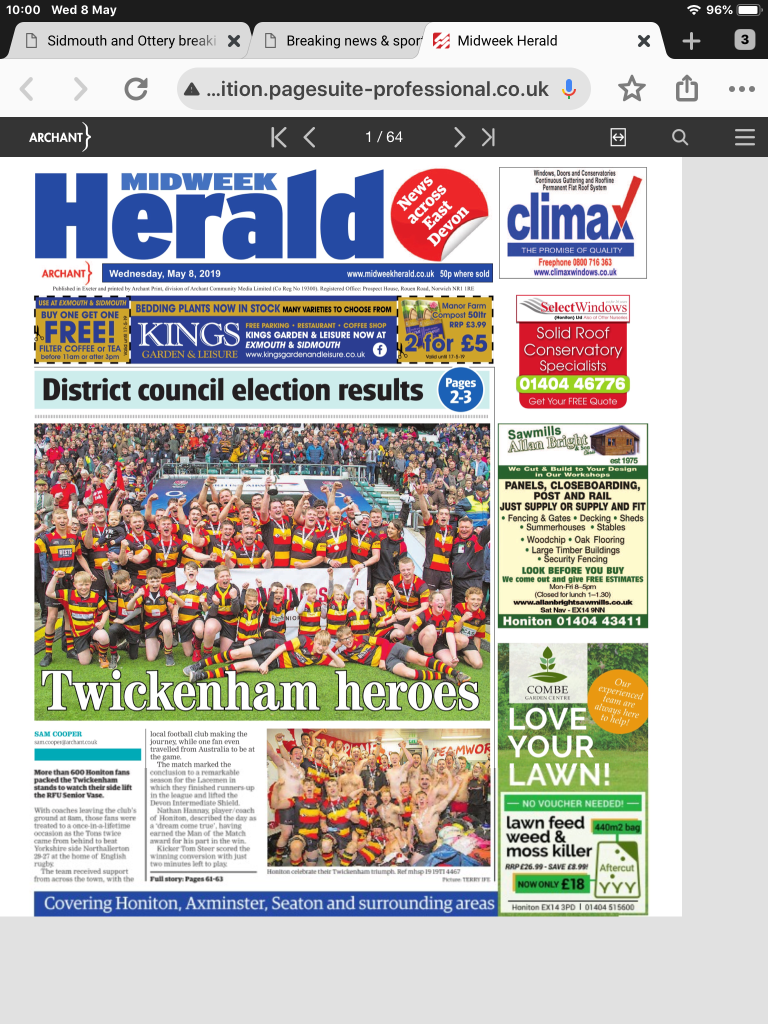
Biggest political upset in East Devon for 45 years – this is Midweek Herald front page

Election results on pages 2 and 3 … back to normal for Archant!

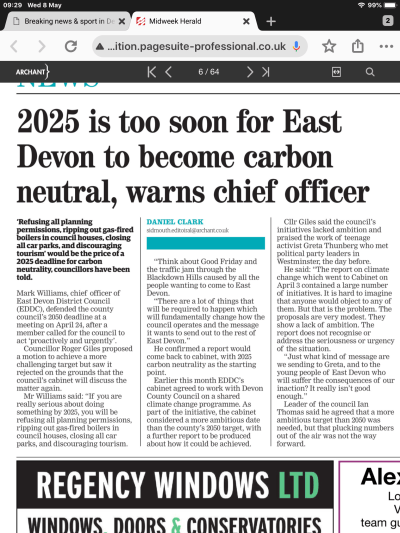
EDDC CEO puts new majority in their place about climate crisis – wants very slow change

Wasn’t aware Williams was in charge ….. print quality of the article is poor but you get the gist – I won’t be rushed …

   the

“For England’s new councillors, the reality of life in our boroughs will hit hard”

“Optimism will be short-lived among the 1,560-plus new councillors – Liberal Democrats, independents, Greens – elected last week in the cities and shires of England, where countless councils changed hands.

These newcomers may have worthy ambitions to transform their councils. But reality kicked in on Tuesday. Entering town halls for briefings, one issue became clear: there’s barely any money left to fund even adult and children’s care, which swallows the majority of cash – let alone keep the rapidly shrinking library service running, the leisure and swimming pool afloat, parks and highways maintained.

Countless warnings from respected organisations, notably the government’s own spending watchdog, have gone unheeded by the government. Last year, the National Audit Office cautioned that council financing is unsustainable and that 10% of the larger councils could have exhausted their reserves – which prop up social care – within three years.

It gets worse. The Commons public accounts committee said recently that the government is in denial about a crisis in which councils are overspending alarmingly on social care, while some are courting “greater risks” through property speculation. …

How did we land in this mess? Look no further than George Osborne, the former chancellor, whose parting gift was a wheeze to make English councils almost self-sufficient by slashing central government grants while handing back control of most business rates. Until Osborne’s intervention, rates had been collected centrally, then redistributed relatively equitably, since 1993.

In 2016, the government initiated a “fair funding review” to work out how Osborne’s reforms might be implemented – and it’s turning out to be anything but fair. Why? Because ministers are taking little account of need and deprivation in poorer areas, with a £7.8bn funding gap emerging overall in council finances. Up to now, these areas have been compensated to take account of low tax bases because they have few expensive houses which deliver higher council tax receipts. Furthermore, business rates from run-down high streets generate a pittance in poorer areas compared with thriving city centres in London and elsewhere. No matter: for this lot, inequity is compounding denial.

Something has to give in a system where almost 60% of council spending now goes on adult and children’s social care – although, overall, social care spending is still falling. Everyone in Whitehall and town halls knows that the social care system is in freefall. A review of how it should be funded – locally, or nationally – is promised. So why introduce a new funding system for local government while its largest single service is awaiting a review?

True, some councils – sometimes smaller districts, with no social care responsibility – are plugging gaps in their finances by morphing into de facto property developers, borrowing heavily to buy shopping and office centres to deliver an annual income. In 2017-18 alone, councils spent £4bn on commercial property, in spite of NAO warnings that finances could be “strained” in the event of a downturn.

But radical action is needed. Rob Whiteman, head of the public sector accountants body Cipfa, argues that authorities should have the power to set council tax rates locally, based on up-to-date property values. His call should not go unheeded.”

https://www.theguardian.com/society/2019/may/07/england-councillors-cuts-funding-system-poorest-areas?

If party politics undid EDDC Tories what could undo Independents.

Self-interest and ego – title before right person for the job
Power games – valuing being top-dog over best person for job
Infighting – not sorting out best person for job, letting personalities rule
Really being a closet Tory – and ensuring they are your first oriority
Dishonesty to voters, unaccountability
Lack of transparency – scrutiny, scrutiny, scrutiny and then more scrutiny
Being developer or officer-led – letting Sir Humphrey sabotage policies

But it isn’t going to happen is it Independents?

“The Local Elections Showed Banging On About Brexit And Nothing Else Is A Fast Track To Extinction”

“If voters wanted to reward parties committed to making Brexit happen, why would Ukip get wiped out at the polls? If a People’s Vote is such an anti-democratic proposal why did we not see losses to the Liberal Democrats and the Greens? …

… Voters who supported Brexit then or now share something in common with many pro-Remain voters: they want Westminster to pay greater attention to concerns on the doorstep and reconnect with the issues that matter most to them. Brexit was a way of giving the establishment a wake up call. If this was really about making Brexit happen, Liberal Democrats and Greens would be wiped out and swept away. But that did not happen either north or south.

The local election results indicate that bringing the country back together is achievable. It will require offering policies bringing tangible benefits, not playing it overly safe and support for a confirmatory People’s Vote. Those parties learning these lessons stand to weather the European elections best and will have the winning results when a general election is called. Banging on about a Brexit plan no one wants to the exclusion of everything else is a fast track to political extinction, as some parties may find out, unless a swift change in direction is made.”

Thom Brooks is Dean of Durham Law School and author of Becoming British

https://www.huffingtonpost.co.uk/entry/local-elections_uk_5ccc3103e4b0076cfb2a8a23?guccounter=1

“Don’t look to national politics for hope: you’ll find it thriving in local councils”

Something to cheer on our new councillors … “municipalism”

” … At the heart of the crisis in local politics is a deep contradiction. For 15 years at least, Westminster politicians have habitually talked up somehow reviving local government. But power has continued to be snatched from people on the ground. (Consider, for example, the story of how elected local politicians have been shoved out of any control or oversight of state education.) Meanwhile austerity has ensured that helpless local politicians are answerable for nonsensical policies authored by Westminster, just as our exit from the EU and the noise made by moronic opportunists has poisoned debate at every level.

Yet here is the fascinating thing. Despite cuts, crises and the sense that far too many councils are locked into decline, there is some cause for hope. The realisation that central government is too remote to solve a whole host of problems, and most things are best dealt with at the most local level, feels like it has become unanswerable: something highlighted not just by failures at the top (picture the transport secretary, Chris Grayling, and the point will instantly become clear), but by a host of trailblazing examples of how to do things differently.

The biggest recent news about childhood obesity came not from the Department of Health, but a programme created in Leeds. The new Labour party is setting great store by the so-called Preston model, whereby that city’s council is boosting the local economy by using its financial clout to help local business. If you want to know about the cutting edge of regeneration, it is best to talk to people who have either created local success stories or are trying to, in Manchester, Plymouth or Doncaster.

This continuing revolution, moreover, is not restricted to big places. Where I live, in the 25,000-population town of Frome, the coalition of independents in charge of the town council – who last week won all 17 of its seats, a feat they pulled off for the second time – have spent eight years encouraging sustainable transport, assisting local charities and helping to ease the realities of poverty and inequality. Among their achievements is the town’s “community fridge”, which encourages people to donate food that would otherwise be thrown away – and is now saving 90,000 items annually as well as enabling emissions savings equivalent to taking 43 cars off the road. This was not an idea authored in a central ministry: it is a classic example of an initiative that has proved successful and which now deserves to be adopted elsewhere: an opportunity for local politics to influence what happens nationally, rather than the other way round.

Across Europe and beyond, this kind of thinking is known as the new municipalism, and its lessons are obvious. If you want representatives who reflect the places they serve, we will have to pay them more. If councils are to attract and retain new people, they need not warm words but meaningful power. Many town, city and county halls are due a huge change in culture. Above all, if we are eventually going to push beyond the anger, silliness and polarisation of Brexit politics, it is obvious where we will have to start: not among grandstanding celebs and the white noise of social media, but in close proximity to the problems we need to solve, in the places where millions of us actually live.”

https://www.theguardian.com/commentisfree/2019/may/05/national-politics-hope-councils-councillors-local-elections?

Now the awkward bit … sorting out Independent wheat from chaff

Owl is not convinced several “Independent” councillors have their hearts in true independence …

The proof of the pudding will be seeing how they vote over the coming months … Owl is betting a small number will find themselves voting again and again with old Tory pals.

But not enough of them to break the new Independent majority …

Interesting times.

Local Tories did NOT lose control of EDDC because of Brexit!

How does Owl know this?

Because the 31 Independents elected on Thursday did not mention Brexit at all when appealing to voters to vote for them!

VERY easy to blame national politics for local losses … no – you lost because you put your party (and your party’s donors) before your district.

Never mind, you have 4 years to work out what to do next time!

West Hill falls to Independent

West Hill and Aylesbeare (one seat)
Jess Bailey (Independent) – 956 ELECTED
John Sheaves (Conservative) – 285